Haiti: Top Officials Fired After Anti-Corruption Protests
Haitian President Jovenel Moise removed Monday two top government officials in a purge of people linked to a corruption scandal that sparked violent mass protests last week, Channel News Asia reported.
The cabinet chief and the secretary general of the presidency were fired from their posts along with 15 government advisers, according to an official announcement.
These firings follow a report compiled in August by the Haitian Senate that called for charges to be brought against two former prime ministers and several other government officials for alleged embezzlement of US$3.8 billion, abuse of power and forgery in connection with a Venezuelan oil loan program.
PetroCaribe, a Venezuelan-led oil alliance between the South American nation and Caribbean countries, was funneling money into Haitian government coffers. But the Haitian Senate’s report follows up parliamentary investigation into whether the PetroCaribe funds were then misspent by previous administrations.
“To have a healthy process, the president has decided to rid the environment of people linked to Petrocaribe without admitting they are guilty of anything,” Prime Minister Jean-Henry Ceant said at a news conference this week.
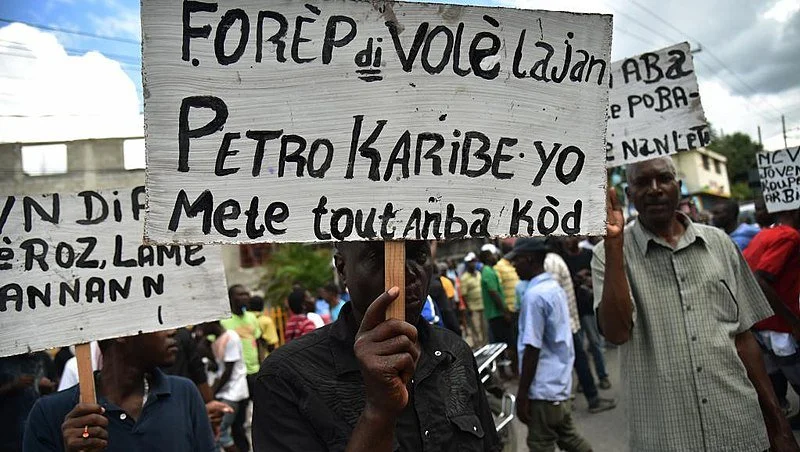
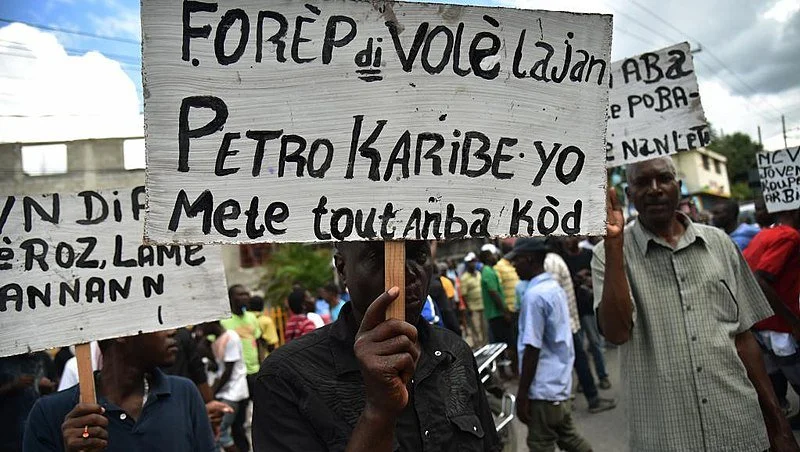
Haiti’s citizens remain outraged by the lack of arrests and the slow pace of the investigations. Last week at least two people were killed and dozens were injured as anti-corruption protesters numbering in the thousands surged through the streets of the Haitian capital of Port-au-Prince.
A police spokesman said 11 civilians were injured by bullets and 11 officers by flying rocks, but other officials reported higher civilian injuries.
The protests were kicked off by a photo tweeted by Haitian filmmaker and writer Gilbert Mirambeau Jr. showing him blindfolded and holding a cardboard sign reading “Where is the PetroCaribe money?” in Creole.
The social media campaign, called the #petrocaribechallenge, has spread like wildfire throughout Haiti, one of the poorest nations in the world.
“We are fed up with what’s going on,” said Mirambeau, 35. “It’s like we have a knife under our throats, and are looking at the government and not doing anything.”
Some marchers were heard calling for the resignation of President Jovenel Moise, who took office in February 2017 and whom many accuse of thwarting the PetroCaribe investigation.
In response to the protests, both Moise and Prime Minister Ceant reasserted their commitment to investigating the alleged embezzlement.
“No one will escape justice. It is a moral duty and a righteousness,” Moise tweeted on Thursday.
“We are going to create an independent commission to investigate the truth of Petrocaribe,” Ceant told journalists.
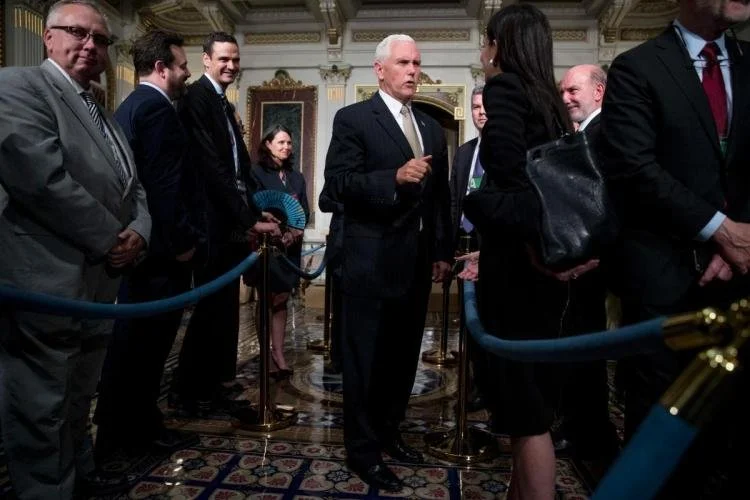
Haiti excluded from White House reception of 'like-minded' friends on Venezuela
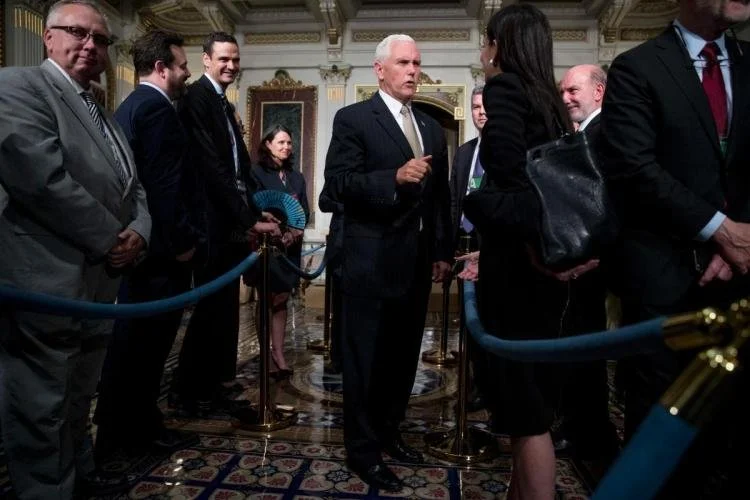
Vice President Mike Pence greets members of the audience at a reception for the Organization of American States in the Indian Treaty Room at the Eisenhower Executive Office Building on the White House complex in Washington, Monday, June 4, 2018, as the Trump administration renewed its call Monday for the Organization of American States to suspend Venezuela and for other members to step up pressure on the country's government to restore constitutional order. Andrew Harnik AP Photo
WASHINGTONThe government of Haiti was not invited to a special White House reception Monday night for “like-minded” governments who are standing with the United States in a call to suspend Venezuela from the Organization of American States.Vice President Mike Pence and his wife Karen invited a group of more than 22 countries' leaders to the White House for a cocktail reception. Mike Pence described the gathering as a “small token of appreciation” for support on such a challenging issue in the hemisphere.“I’ll make a promise to you,” Pence said. “Stand with us and know we’ll stand with you. Work with us and we will work with you.”Haiti was noticeably absent from the reception that also included top ranking members of the National Security Council and State Department as well as the Secretary General of the OAS Luis Almagro.It was a clear indication that despite considerable pressure in recent days by the administration and an April meeting between Haitian President Jovenel Moïse and Florida Republican and Venezuela hardliner Sen. Marco Rubio that the country had not caved and would not be supporting the U.S. toughening position on the Maduro regime.Held in conjunction with the 48th annual OAS General Assembly, Pence used the reception to call on allies to kick Venezuela out of the United Nations-like organization for the hemisphere.Carlos Trujillo, the U.S. ambassador to the OAS, said Haiti and others who backed Venezuelan leader Nicolás Maduro were intentionally left off the invitation list.“We did not invite any countries that recognize the Maduro regime as legitimate,” Trujillo said.Haiti has been under considerable pressure by the United States to change its stance from abstention to expulsion. But based on the speech Monday from its foreign minister, Antonio Rodrigue, it doesn’t appear that the Trump administration succeeded.While Caribbean ministers for the most part made no mention of the Venezuelan crisis in their interventions, Rodrigue pushed for dialogue with Venezuela and respect for all nations’ sovereignty and independence.“It is obvious to us that the Venezuelans themselves must resolve their problem. It’s the only way to a sustainable and lasting solution,” Rodrigue said.Among those who did receive invites were Argentina, Bahamas, Barbados, Brazil, Colombia, Ecuador and Guyana. But notably several Caribbean nations who have also been sympathetic to Venezuela were also invited, including Jamaica, Saint Lucia and Saint Kitts and Nevis.Tuesday’s vote will be a significant test for the Latin American and Caribbean diplomats who have been reluctant to take punitive measures against one of their own.“Whether the OAS takes this step will speak volumes about its relevance in the 21st Century — and it will make clear which nations in our hemisphere truly stand for freedom,” Pence said.Venezuela's subsidized oil export program, Petrocaribe, has been a powerful tool that the Maduro government has used to wield political influence in the Caribbean.Caribbean and Latin American nations such as Haiti, Saint Vincent and Grenadines, Dominica, Saint Kitts and Nevis and Nicaragua receive billions in cheap loans for oil. And in return, they have helped Maduro retain crucial diplomatic support and block hemispheric efforts to punish the regime.Moïse also currently serves as chair of the 15-member Caribbean Community regional bloc known as Caricom. While Caricom usually votes as a bloc on international issues, members have increasingly been divided over the Venezuelan issue.One observer noted those divisions are likely to continue should the issue go for a vote with some Caribbean countries voting for, others against and others abstaining.During a meeting of Caribbean ministers on Sunday, Rodrigue gave no indication of Haiti’s position, leading many to wonder if the country, an ally of the U.S. with a $2 billion debt to Venezuela, would switch its stance.Trujillo was not unsympathetic, but said the United States hoped Haiti would recognize the worsening conditions in Venezuela.“They’re in a difficult position,” Trujillo said of Haiti. “They have two friends, the United States and Venezuela. They have $2 billion in external debt that is due to the government of Venezuela but we’re hopeful that the government of Haiti will make the right decision. It’s a country that has suffered a lot.”By: Franco Ordoñez And Jacqueline Charles for mcclatchydc.com | June 4, 2018