
Haiti Helped Create Largest Revolt of Enslaved Africans in U.S. History. The “Independence Debt” with France and the Louisiana Purchase
The Triumphant Haiti Revolution help double the size of the U.S. Yet, the U.S.-EU nations continue to demean, malign and pillage Haiti.
So, sorting fiction from reality, which one is the “land of the free and the brave, the pioneers of human rights, freedom and liberty in the Western Hemisphere? Which nation didn’t make white folks 3/5ths human even after 300-years of brutal, rape and enslavement? But gave the few whites who fought alongside the African warriors, Haitian citizenship, full and equal rights?” Haiti, of course.
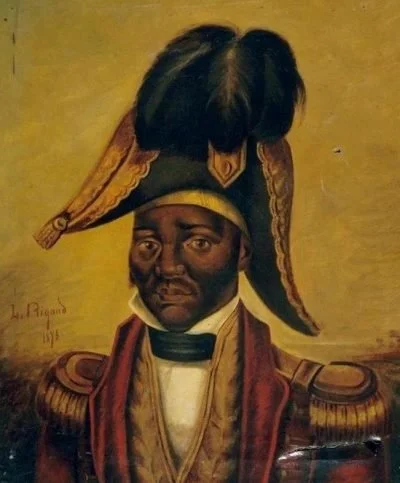
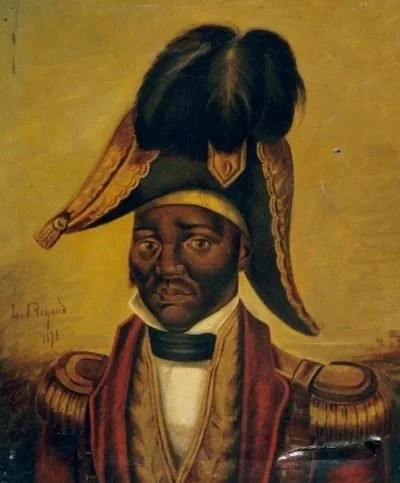
The triumphant Haiti revolution triggered the selling to Thomas Jefferson of the Louisiana Purchase which doubled the size of the United States. Also, the second contingent of 20,000 soldiers sent by Napoleon to the Louisiana Territory for French control of all in the U.S. had to be redirected to go fight in Haiti after the Afrikan warriors, led by Desalin and the indigenous Haiti army, which Desalin called the “armies of the Incas,” decimated the first 50,000 French soldiers sent in 1802 and led by Bonaparte’s brother in law, General Lerclerc. Later, Desalin, Haiti’s founding father, declared, in the name of the slaughtered since 1492, “I have avenged America!”This historical triumph of the enslaved Afrikans in Haiti – Black men, women and children – against the greatest and most well-armed European armies of the era – first the French, then Spanish, then English armies – a U.S. embargo and then Napoleon’s French armada, is what stopped the U.S. from possibly being conquered by the French, whose 20,000 troops were, at that point in U.S. history, larger and much more battle-experienced than the U.S. armed forces. Haiti’s win, helped make the U.S. the superpower that it is but it has been terrorized by the white tribes since its independence. President Thomas Jefferson conspired with General Napoleon Bonaparte and the rest of the slavers and rapists nations to force besieged and embattled Haiti to pay an Independence Debt that was 10 times more than what Jefferson paid for the Louisiana purchase. Yet, Haiti’s land mass is as small as Rhode Island. Jefferson paid Napoleon $15million francs for the Louisiana Purchase which ended up creating, in part and whole, 15 new American states. Haiti, a country smaller than Rhode Island was forced, at the point of 300 gunboat cannons, to pay ten times that amount – $150million to France as reparations for France losing Haitians as their slaves. (After this debt help cost Haiti to lose the Eastern side of the Island now called Dominican Republic, the amount was reduced to $90million Francs)It took Haiti 122 years to finish paying this 1825 slave-trade debt. This moral perfidy, after the Afrikans gave 300 years of FREE labor (1503-1804) to the European terrorists, slavers, rapists, plunderers and colonists. Haiti is not the poorest country because it still has vast riches, protected by the Afrikans, for over 200 years from the grasp of the hoarders. But, it is the most exploited nation. Its resistance continues to this day….as under Barrack Hoe-bama, his U.S. colonial “exceptionalism,” its pretensions and the disaster capitalism of the devastating 2010 earthquake, Haiti has presumably lost, without world scrutiny, nearly 30% of its landmass. This, through Bill Clinton’s HRC – U.S. sanction of puppet president Martelly decrees that gerrymander and gives away, to the corporatocracy, Haiti offshore islands and prime lands. Through the Clintons’ World Bank amendment to Haiti constitution, if not stopped, Haiti will loses control of its gold belt, shorelines, iridium, oil and gas reserves, all the Caracol zone and Haiti’s Northern and Southern deep water ports.It simply cannot be over-emphasized, how there’s no one in power to protect the bullied, disenfranchised and brutally suppressed Haiti masses from the international crime syndicate, now in Haiti behind a humanitarian front, which is steadily extracting rare earth metal resources and mining gold on another earthquake fault line in Haiti – the Septentrional fault line in the North. (See also, The dangers of building garment factories next to one of Haiti’s most important marine national parks/a US $3.2 trillion mangrove and coral reef ecosystem and Tourism is not development)The Independence Debt that Haiti was forced to pay France for losing the grangrans as property, caused such internal dissatisfaction and protest within Haiti, that the destabilization (along with a devastating 1843 earthquake in Northern Haiti) allowed space for the Eastern side of Haiti to separate into what is today known as the Dominican Republic. The Spanish immediately pounced to retake this landmass. On its part, the French terrorists returned to Haiti with the Independence Debt, which meant controlling Haiti economically and then ecclesiastical colonialism, which meant controlling Haiti education…. Haiti has yet to recover. And then they all returned, a world war to stop the Black masses’ celebration of the Haiti bicentennial, in 2004, with a popularly elected Haiti president.President Aristide was and is the first and only Haitian president to ask France to return the Independence Debt.For that temerity, Bush the lesser, unleashed his shock and awe military on an island nation with no military, that was no threat but merely wished peaceful co-existence. To live free and sovereign on lands paid for in 300 years of free labor, over 214 years in containment in poverty; a 60-year U.S. embargo; a 19-year U.S. occupation where the Marines carted out Haiti gold reserves in 1914 never to be returned; and 122-years of paying off an Independent Debt to France to be recognized as a free nation after slavery and winning our Independence in combat and losing half the Black population (250,000) in that revolutionary war. (See, Haiti: Until She Spoke and, Three Simple Èzili principles for a Just New World)By Ezili Dantò Global Research, August 24, 2017
Biography of Haitian Revolution Leader Toussaint Louverture
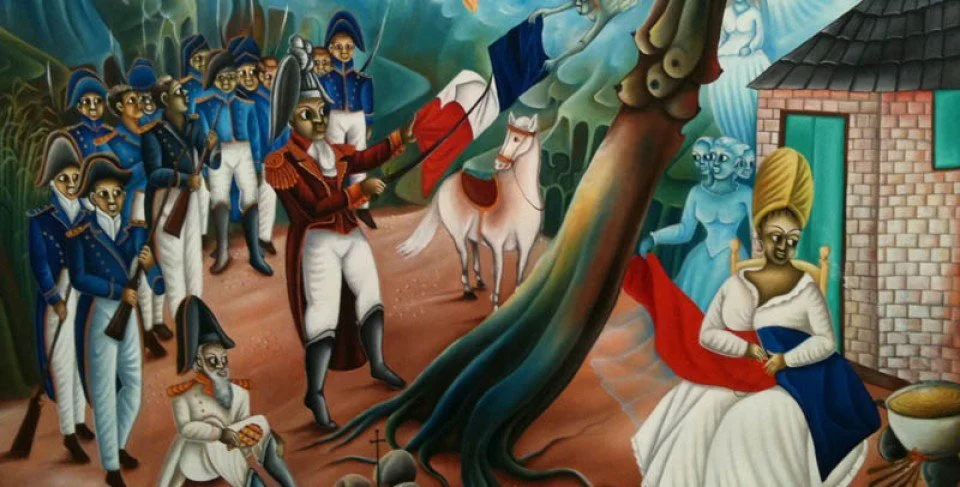
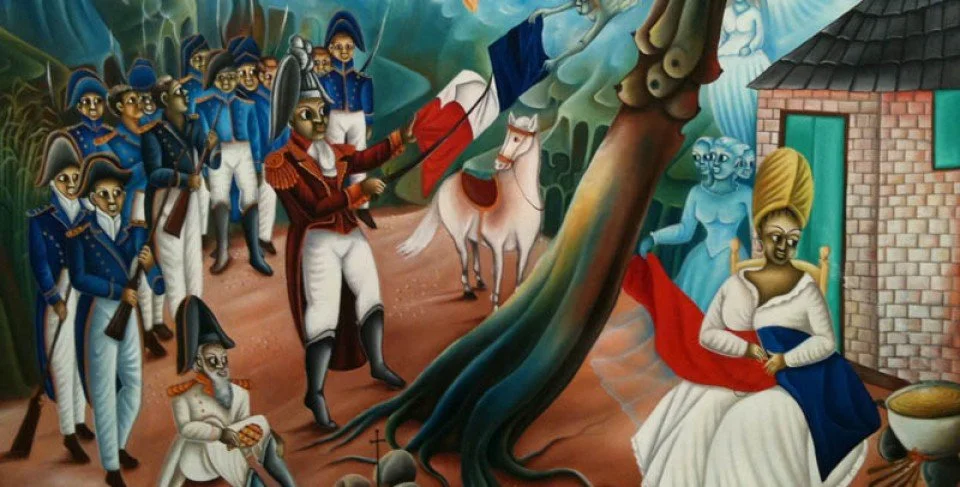
Toussaint Louverture led what is known as the only triumphant mass slave revolt in history. Thanks largely to his efforts, Haiti won its independence in 1804. But the island-nation didn't live happily ever after. Institutional racism, political corruption, poverty and even natural disasters have left Haiti a nation in crisis. Still, Louverture remains a hero to the Haitian people and those throughout the African diaspora. With this biography, learn about his rise, fall and the political prowess that resulted in him leaving an indelible mark on the island-nation once known as Saint Domingue.EARLY YEARSLittle is known about François-Dominique Toussaint Louverture before his role in the Haitian Revolution. According to Philippe Girard, author of 2016's "Toussaint Louverture: A Revolutionary Life," his family came from the Allada kingdom of West Africa. His father, Hippolyte, or Gaou Guinou, had been an aristocrat. Around 1740, however, members of the Dahomey Empire captured his family and sold them as slaves to the Europeans. Hippolyte specifically was sold for 300 pounds of cowrie shells.His once aristocratic family now the property of European colonists, Louverture was not born in West Africa but likely on May 20, 1743, in the city of Cap on the Bréda plantation in Saint Domingue, a French territory. Louverture displayed a giftedness with horses and mules that impressed his overseer, Bayon de Libertat.He also received training in veterinary medicine. His godfather, Pierre Baptiste Simon, likely played a large role in educating him. He may have also received training from Jesuit missionaries and from West African medicinal traditions.Eventually Libertat freed Louverture, although he had no authority to do so, as the absentee slaveholders the Brédas owned Louverture. It is unclear exactly which circumstances led Libertat to free him. The overseer reportedly had him drive his coach and then released him. Louverture was about 33 years old at the time.Biographer Girard points out that it was highly unusual that Louverture was freed. The slave mothers of mixed-race children were most often freed, with men making up fewer than 11 percent of liberated slaves.In 1777, Louverture married Suzanne Simone Baptiste, born in Agen, France. She is believed to have been his godfather's daughter, but she may have been Louverture's cousin. He and Suzanne had two sons, Issac and Saint-Jean. Each also had children from other relationships.Biographers describe Louverture as a man filled with contradictions. He led a slave insurrection but never took part in smaller revolts that occurred in Haiti prior to the revolution. In addition, he wasn't partial to any religious faith. He was a Freemason, who practiced Catholicism devoutly but also engaged in voodoo (in secret). His embrace of Catholicism may have factored into his decision not to participate in voodoo-inspired insurrections that took place in Saint Domingue before the revolution.After Louverture won his freedom, he went on to own slaves himself.Some historians have criticized him for this, but he may have owned slaves to free his family members from bondage. As the New Republic explains:To free slaves required money, and money on Saint Domingue required slaves. As a free man, Toussaint leased a coffee estate from his son-in-law, including the slaves. True success navigating the slave system meant joining the other side. The revelation that the 'Black Spartacus' drove slaves spurred some modern historians to over-correct, speculating that Toussaint was a well-heeled bourgeois by the time of the revolution. But his position was more precarious. The coffee estate failed, and a slave register unearthed in 2013 records his tragic next move: Toussaint resumed his place on the Bréda plantation.In short, Touissant remained a victim of the same exploitative system he'd joined to free his family.But as he returned to the Bréda plantation, abolitionists begin to gain ground, even convincing King Louis the XVI to give slaves the right to appeal if their overlords subjected them to brutality.HAITI BEFORE AND AFTER THE REVOLUTIONBefore the slaves rose up in revolt, Haiti was one of the most profitable slave colonies in the world. About 500,000 slaves worked on its sugar and coffee plantations which produced a significant percentage of the world's crops. The colonists had a reputation for being cruel and engaging in debauchery. The planter Jean-Baptiste de Caradeux, for example, is said to have entertained guests by letting them shoot oranges off the tops of slaves' heads. Prostitution was reportedly rampant on the island as well.After widespread discontent, slaves mobilized for liberty in November 1791, seeing an opportunity to rebel against colonial rule during the throes of the French Revolution. Toussaint’s comrade Georges Biassou became the self-appointed Viceroy and named him general of the royal army-in-exile. Louverture taught himself about military strategies and used his newfound knowledge to organize the Haitians into troops. He also enlisted deserters of the French military to help train his men. His army included radical whites and mixed-race Haitians as well as blacks.As Adam Hochschild described in the New York Times, Louverture "used his legendary horsemanship to rush from one corner of the colony to another, cajoling, threatening, making and breaking alliances with a bewildering array of factions and warlords, and commanding his troops in one brilliant assault, feint or ambush after another."The slaves successfully fought the British, who wanted control over the crop-rich colony, and the French colonizers who'd subjected them to bondage. Both French and British soldiers left detailed journals expressing their surprise that the rebel slaves were so skilled. The rebels had dealings with agents of the Spanish Empire as well. Haitians also had to confront internal conflicts that sprang up from mixed-race islanders, who were known as gens de couleur, and black insurgents.Louverture has been accused of engaging in the very practices for which he criticized the Europeans. He needed weapons to defend Saint Domingue and implemented a forced labor system on the island that was virtually the same as slavery to ensure that the nation had sufficient crops to exchange for military supplies. Historians say he held onto his abolitionist principles while doing what was necessary to keep Haiti secure. Moreover, he intended to free the laborers and wanted them to profit from Haiti's achievements.“In France, everyone is free but everyone works,” he said.Louverture has not only been criticized for reintroducing slavery to Saint Domingue but also for writing a constitution that gave him the power to be a lifelong leader (much like the European monarchs he despised), who could choose his own successor. During the revolution, he took on the name "Louverture," which means "the opening" to emphasize his role in the uprising.But Louverture's life was cut short. In 1802, he was lured into talks with one of Napoleon’s generals, which resulted in his capture and removal from Haiti to France. His immediate family members, including his wife, were captured as well. Abroad, tragedy would befall him. Louverture was isolated and starved in a fortress in the Jura mountains, where he died in April 1803. His wife survived him, living until 1816.Despite his demise, Louverture biographers describe him as a leader who was far savvier than either Napoleon, who completely ignored his attempts at diplomacy, or Thomas Jefferson, a slave owner who sought to see Louverture fail by alienating him economically.“If I were white I would receive only praise,” Louverture said of how he'd been slighted in world politics, “But I actually deserve even more as a black man.”After his death, Haitian revolutionaries, including Louverture's lieutenant, Jean-Jacques Dessalines, continued to fight for independence. They won freedom in January 1804, when Haiti became a sovereign nation. Two-thirds of the French army died in their bid to squash the revolution, most from yellow fever rather than armed conflict.LOUVERTURE'S LEGACYLouverture has been the subject of numerous biographies, including 2007's “Toussaint Louverture” by Madison Smartt Bell as well as biographies by Ralph Korngold, published in 1944; and Pierre Pluchon, published in 1989. He was also the subject of 1938's "The Black Jacobins” by C.L.R. James, which the New York Times has called a masterpiece.The revolution Louverture led is said to have been a source of inspiration to abolitionists such as John Brown as well as the many African nations that won independence in the mid-20th century.by Nadra Kareem Nittle
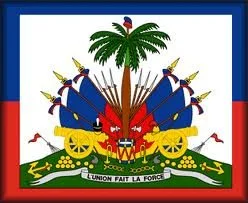
MAY 18 | HAITIAN FLAG DAY
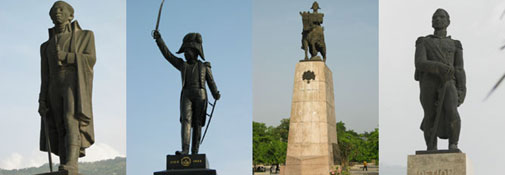
Toussaint Louverture, Jean-Jacques Dessalines, Henri Christophe, Alexandre Petion
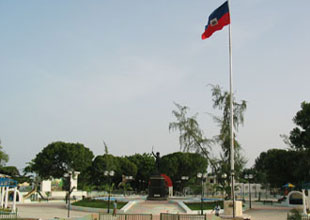
This meeting, known as the Congress of Arcahaie, was set for May 14 to 18, 1803; the agenda had two essential points: the establishment of a united command of the revolutionary army under the supreme authority of Jean-Jacques Dessalines, and the adoption of a flag by the indigenous army. The two principal leaders at this time, Dessalines and Pétion, jointly drew up this agenda. On May 14, 1803, military delegations flocked to Arcahaie; only a few of them were from the south.
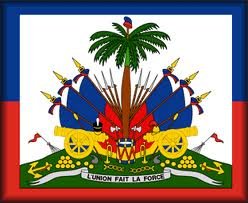
The principal heads of the insurgency did answer the call. The Congress was opened by Dessalines and Pétion May 15, 1803, on the Mérotte plantation in Arcahaie. The two men focused on the military situation, insisting on the need for all forces rebelling against the enemy to unite so that victory would be more rapid and decisive. Curiously, there was not a word about the new Haitian flag; priority was put on new strategies and tactics to thwart the colonial army and also to select a Commander of the insurrection army.Dessalines was appointed general-in-chief of the insurrection army.The question of the new Haitian Flag came up on the last day, May 18. The new Commander General suggested the old slogan "Live Free or Die" be replaced by "Liberty or Death." The debate over the proclamation of the creation of a new Haitian flag lasted a whole day. It was only in the evening that the Congress of Arcahaie definitively adopted the new Flag of Haiti. The white stripe was eliminated, while the remaining red and blue bands were attached together. The removal of the white stripe symbolizes the abolition of the White Man's control and the union of blacks and mulattoes in Haiti. The arms are composed of a palm tree surmounted by the Phrygian cap of liberty and ornamented with trophies with a banner across the bottom saying "L'Union Fait La Force" (through Unity there is Strength). 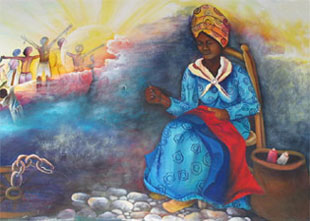 By this gesture, they publicly designated that this country no longer wanted to be recognized as a French territory and that the people who lived on this land preferred to be dead rather than be slaves. "Liberté ou la Mort!" meaning "Liberty or Death" had become the new motto as it had already been embraced at the Ceremony of Bwa Kayiman " held on August 14, 1791.Haiti's first flag was sewn by a lady named Catherine Flon at the Congress


 In 1805 , shortly after Jean-Jacques Dessalines proclaimed himself emperor, the Haitian flag color was changed to black and red bands placed vertically respectively. After the emperor's death, in 1806, the country will be divided into two republics for 14 years. Henri Christophe , in the northern part kept the flag that Dessalines used.In the South and the western part of the country, Alexandre Petion nourished the idea of giving the indigenous army its own flag. He went back to 1804's flag that was blue and red only this time he added the white squared portion that included the country arms and the famous motto " L'UNION FAIT LA FORCE ", meaning that through unity we find strength.This flag was in use till 1964 when Papa Doc Duvalier modified it with the black-red vertical bicolor of Dessalines on which he added a modified version of the arms of the Republic.On February 25 1986, after the fall of Baby Doc and the Duvalier regime, the Haitian flag was again changed with the request of the Haitian people to two equal-sized horizontal bands, a blue one on top and a red one underneath. The coat of arms of the Republic remained in the center. That is the flag used until today.As we celebrate the Haitian flag Day, we need to remember that our ancestors created this bicolor blue and red as a symbol of unity among all of us of Haitian descent to fight colonialism and live free forever.
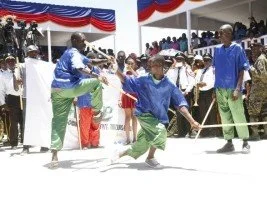
"Jeu de Bâton" A Fighting Art of the National Army
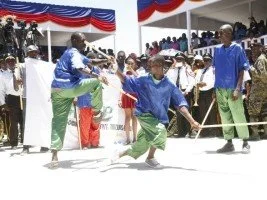
Monday in Lagrange (Artibonite Department), as part of the Day of Agriculture and Labor, the National Bureau of Ethnology (BNE) in collaboration with the Ministry of Tourism and Ministry of Culture organized a show of «Jeu de bâton» (stick game). This tradition that has existed since the colonial period in St Domingue, was also a means of combat used by the native army during the war of independence. It is also a martial art inspired by the forms of African combat. A variety of stick styles such as : "Baw Blan", "Migel" and "Pati kola" were used during this activity. An intangible cultural heritage strongly practiced and preserved in the Artibonite. Jessy C. Menos, the Minister who traveled to encourage stick Practitioners and BNE dancers, said the show "is part of a promotion of the 'Jeu du bâton' and a duty to remember."According to Erol Josué, the Director General of the BNE "This ritual was the means of combat of the native army" recalling that "Gran Toya", great aunt of the Emperor Jean Jacques Dessalines, was a great warrior and would have initiated the Emperor at this game from a young age. Other peoples like the Amazons of the former Dahomey also practice stick fighting.From this collaboration around the development of Ethno-Tourism in Haiti, an inventory of cultural practices and sites will be launched, which will begin in the Department of Artibonite in order to highlight the riches Haitian heritage. HaitiLibre | May 3, 2017
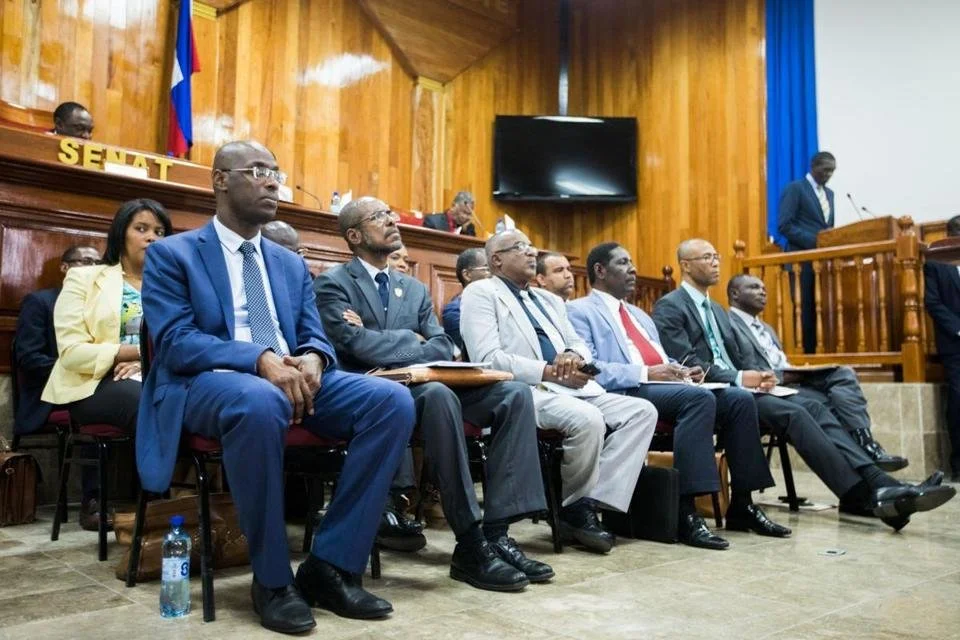
Haiti should relinquish its sovereignty
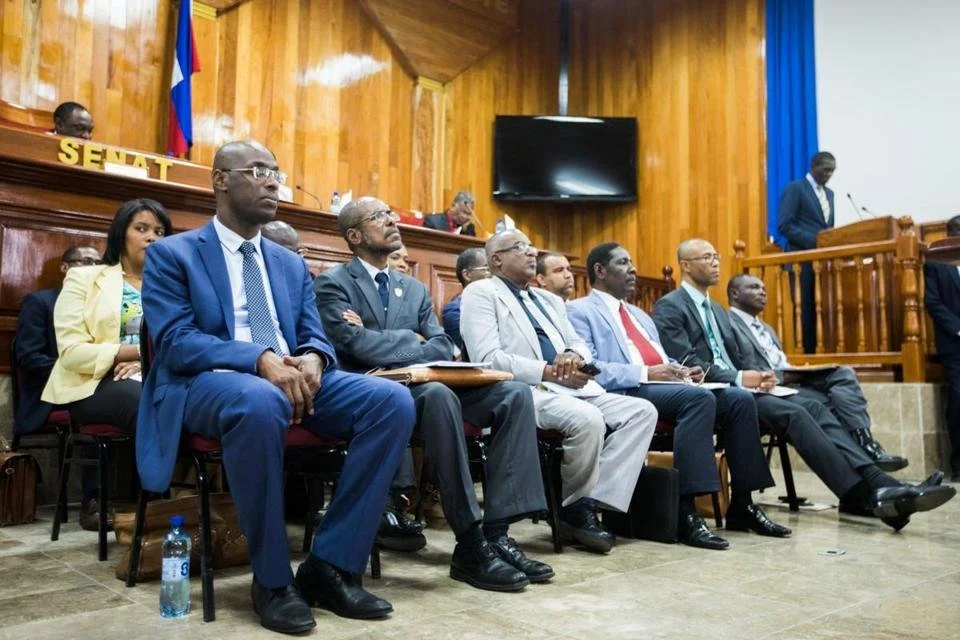
I moved back to my native Quebec from Port-au-Prince not long before Haiti adopted its constitution 30 years ago. Since then, Haitians have failed to build the democracy they envisioned for their new era of constitutionalism. Military rule, a legacy of colonial devastation, natural disasters and two coups — one engineered by the United States — certainly have not helped.The truth is that the constitution has not made much of a difference because the country needs a far more dramatic intervention. Nearly every part of everyday life is worse now than it was then. Conditions are so unspeakably awful that some find themselves recalling with misplaced affection the days of the Duvalier dictatorship.
The problem rests not with the Haitian people but with their leaders. This year on the occasion of the constitution’s 30th anniversary, the Chamber of Deputies launched nationwide public consultations on how to amend the Haitian Constitution to rebuild faith in the country’s corrupt public institutions.Yet there is little reason to believe that constitutional amendments will do anything to give Haiti and its long-suffering citizens what they need most: political leaders inspired by an ethic of public service, not driven by narrow self-interest. History has proven that the political class has neither incentive nor interest to put the country first.This moment nonetheless offers an opportunity to transform Haiti for the better. Instead of settling for mere tinkering with their constitution, Haitians should demand an altogether new one that can help to finally bring the peace and prosperity they have lacked for over 200 years of independence since driving away their French slavers in 1804.The new Haitian Constitution should do something virtually unprecedented: renounce the power of self-governance and assign it for a term of years, say 50, to a country that can be trusted to act in Haiti’s long-term interests.Why would a country accept this multigenerational commitment? The optics alone of a majority-white country running Haiti — even if in Haiti’s best interests — revive ghosts of the distant but never-forgotten past of slavery.
The choice of sponsor is delicate, and the list is short. Despite the hundreds of thousands of Haitians who live in New York City, Miami, and Boston, the United States has ruined nearly everything it has touched in the land once called the “pearl of the Antilles.” France and the United Kingdom are likewise nonstarters. Brazil and South Africa are possibilities, though both are now preoccupied with their own political crises. And the United Nations in Haiti? It has been a disaster.The answer may be Canada, for years one of Haiti’s most loyal friends and foreign aid donors — and today one of the most popular destinations for the diaspora. Canadians today yearn for real influence in the world, and there may be no better way than building Haiti anew drawing from Canada’s values of equality, diversity, and compassion, and its unique expertise in humanitarian assistance. Prime Minister Justin Trudeau is still looking for a major foreign policy achievement since his election in 2015, and this commitment could leave a legacy that would match his father’s own achievements as prime minister.Critics would be right to wonder whether Haiti would remain a country in the conventional sense of the term. We live in a post-Westphalian world, but the organizing logic of countries today remains rooted in traditional understandings of the nation-state. We hold sometimes too strongly to the idea that a country is sovereign — all-powerful within its jurisdiction and an independent actor beyond its borders — to fully appreciate that external pressures are not only a reality of our global order but often also a force for good.Haiti would not be alone in surrendering an important marker of national sovereignty in the pursuit of larger objectives, in this case the most basic ones of all: improving the quality of life of its people and building a modern infrastructure for the country. Other countries have on occasion willingly forfeited some measure of their sovereignty to a foreign power. For example, many countries of the Commonwealth Caribbean choose to retain the Judicial Committee of the Privy Council in London as their court of final appeal instead of acceding to the jurisdiction of the homegrown Caribbean Court of Justice. Similarly, roughly 25 countries choose to outsource their monetary policy to the United States. And until 35 years ago, Canada had voluntarily ceded to the United Kingdom the power to amend its own constitution.Difficult times often yield impossible choices, and this would be an extraordinarily difficult decision for Haiti’s political leaders. Yet the greatest gift Haiti’s political class can give their fellow citizens is to give up the power to govern. This ultimate sacrifice would be a triumph of national over individual interests, and it would forever memorialize Haiti’s current leaders as the country’s modern founders.By Richard Albert May 02, 2017