
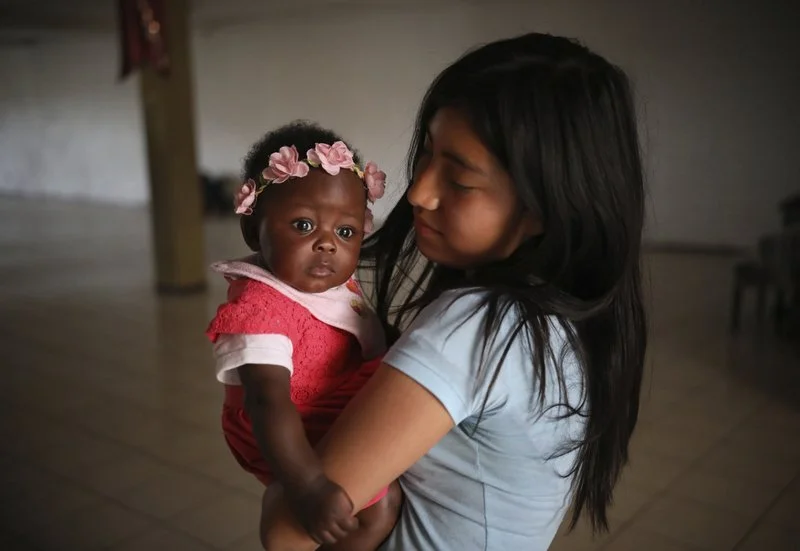
Tijuana's 'Little Haiti' Stalled But Migrants Planting Roots
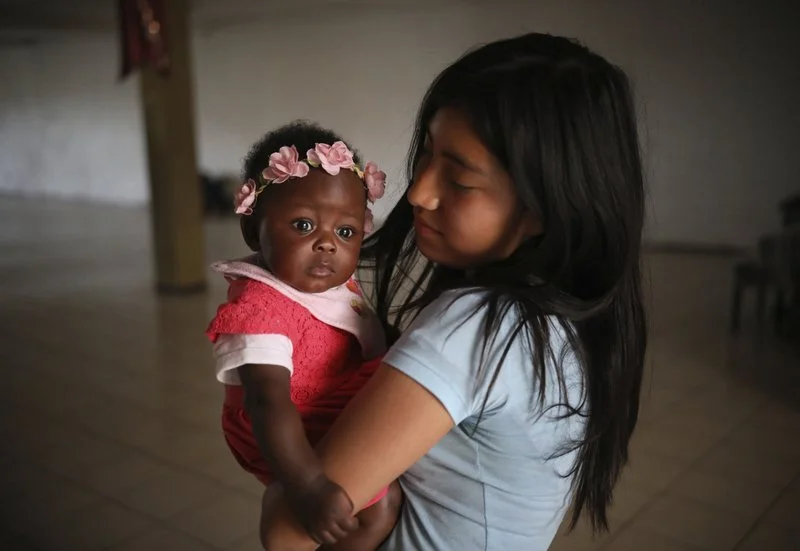
 Brightly colored clothes air from lines strung between rudimentary plywood-sided homes. Cinderblocks stacked chest-high form the skeletons of unfinished houses, anda pile of unused rebar lies in the dirt patio.A billboard puts a name to what has become something of a neighborhood interrupted: "Little Haiti. City of God."
 The arid hillside barrio, on property belonging to the Ambassadors of Jesus evangelical church, made headlines last year when nearly 3,000 Haitians ended up in this city bordering San Diego on a failed bid to get to the United States. About 200 were taken in by the church.But the church's plans to build a community for Haitians hit a roadblock when civil defense officials said there was a flood risk and barred further construction. A year later, just eight of the 100 homes envisioned are in place, with another 50 people or so living in similar conditions in nearby Scorpion Canyon."The neighborhood was not built, and the Haitians who were here went to rent elsewhere and became part of the work life," Tijuana Mayor Juan Manuel Gastelum Buenrostro said.Indeed, the denizens of Little Haiti represent a small portion of the local migrants from the impoverished Caribbean nation, many of whom are putting down roots just across the border from what was once their destination.Most of the Haitians had gone to Brazil after a 2010 earthquake devastated their own country and found jobs during the Olympics and World Cup. When Brazil's economy slumped and work dried up, they headed north. Some decided to stay in Tijuana because they had found decent work and were eager to settle down. Others said they feared the U.S. would be unwelcoming.
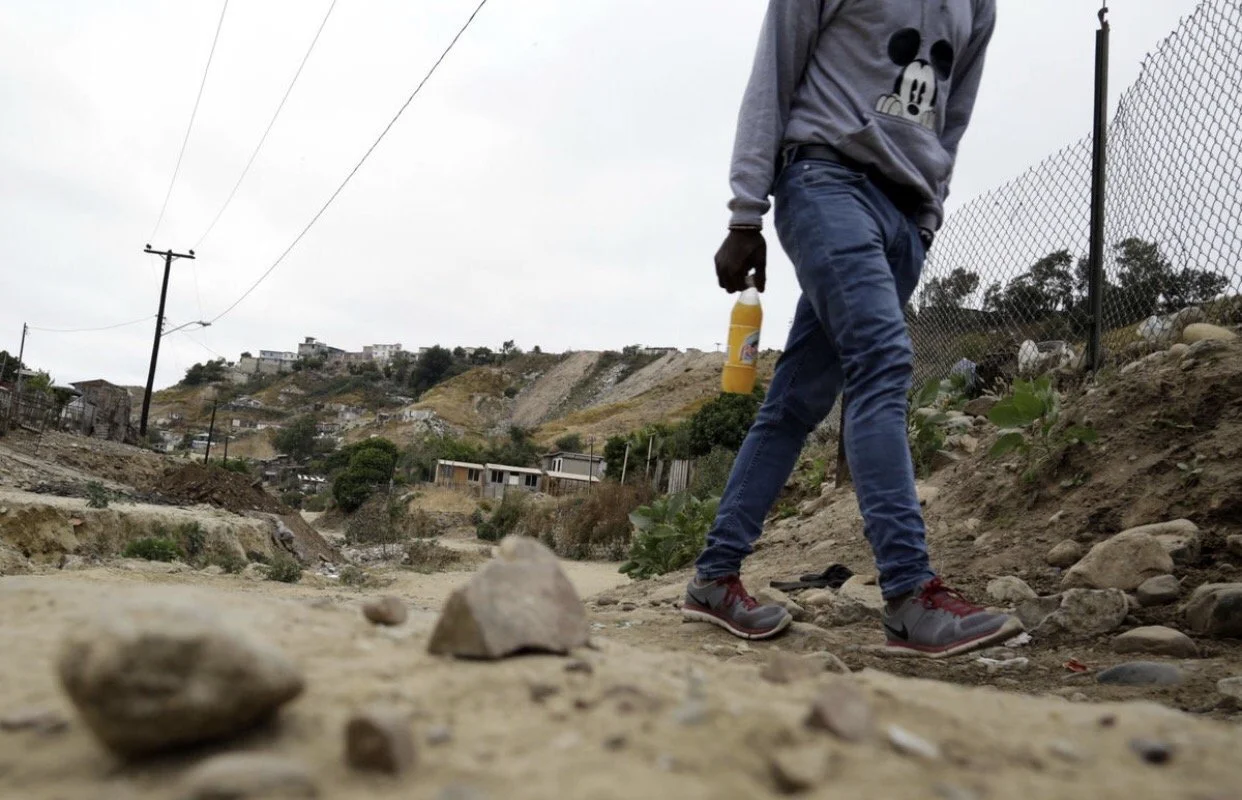
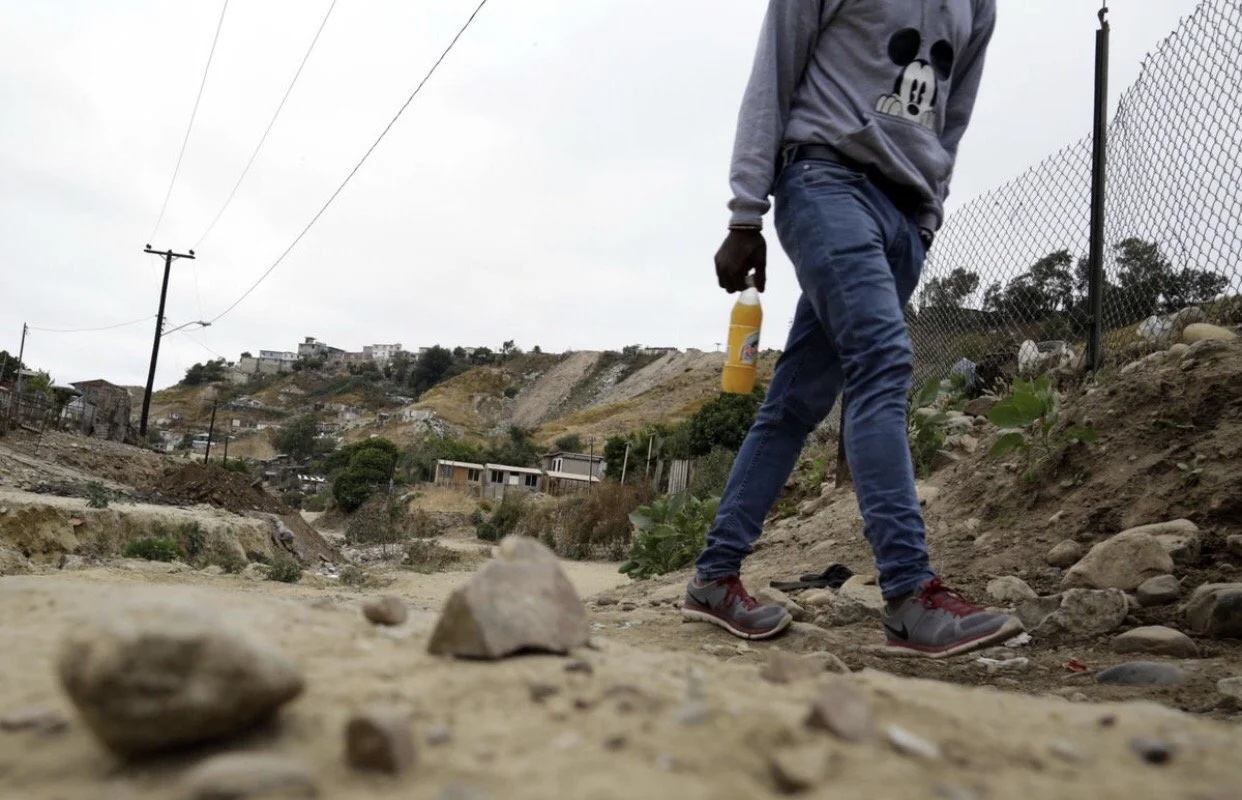
 Across the city, Haitians have found employment as welders and factory workers, and have become part of the urban landscape, seen boarding buses, pumping gas or wading into traffic selling flavored waters to motorists."With this job plus what my wife earns selling tamales ... it gives us enough to pay the rent and the monthly expenses," said Thony Mersion, a 34-year-old working as a security guard at the Tijuana airport.On Sundays, many attend a special service at Ambassadors of Jesus. Recently the Haitian ambassador flew up from Mexico City to officiate at a mass wedding of his compatriots. Some have now had Mexican-born children, which makes it easier to qualify for residency.
 One of the most successful, commercially, is Marie Toussaint, 30, who this year opened a beauty salon with money loaned from an uncle in Los Angeles."With how well it's going, I can hire Mexican employees to attend to my clients who come from San Diego," Toussaint said.The Haitians also got a high-profile shout-out last week when, during a presidential debate, candidate Ricardo Anaya praised Tijuana for taking them in."I get goose bumps. ... That is the Mexico I want, a generous Mexico, a Mexico with arms open," Anaya said.However, an estimated 500 to 800 arrived after authorities stopped issuing humanitarian visas for Haitians in April 2017, and they are living on society's fringes, unable to work legally.
 Pierre Franzzy, 26, said he goes almost every week to the migration office, trying to legalize his status. But when a high-profile caravan of Central American migrants that had attracted the ire of U.S. President Donald Trump arrived in the city recently, he was told his case was no longer a priority."For that reason I have made the decision to return to Haiti voluntarily before they file a complaint or deport me," Franzzy said.Back in Little Haiti, pastor Gustavo Banda said about $20,000 has been spent on the existing homes and he's hopeful — optimistic, even — that he'll be able to put up more, despite the opposition from civil defense officials."Here the property tax is paid and the government does not do anything for the improvement of the homes ... or even basic services such as trash collection, paving and drainage," Banda said. "We have been dealing with this problem for 12 years, and this will not stop us.""The Haitians wish to stay here, and with the government authorizing them in two years to bring close relatives who currently live in Haiti, I am sure that Little Haiti is going to become a community with Creole as its main language," he added.Not all envision a permanent stay in the neighborhood, which is next to a pungent wastewater channel at the bottom of Scorpion Canyon.
 Saintanier Jeune, 40, has a stable factory job and said he is comfortable in Little Haiti. But he hasn't lost sight of the U.S., visible from a nearby high point in the form of San Diego's bay and gleaming office towers."I have the possibility to become a permanent Mexican resident since my daughter was born in this country," Jeune said. "Still, I want to leave ... because I do think I could have a better quality of life on the other side."
Haitians blocked at US border find 'Mexican dream'
TIJUANA, Mexico (AP) — Jose Luis Millan found a new crop of star employees at an upscale Tijuana car wash where customers cross the border from the U.S. to pay up to $950 to have their prized possessions steamed and scrubbed for hours. They're never late, always hustle and come in on days off to learn new skills, traits that he says make them a model for their Mexican counterparts.They are among several thousand Haitians who came to Mexico's northwest corner hoping to cross the border before the U.S. abruptly closed its doors last year. The Mexican government has welcomed them, with a visa program that helps them fill the need for labor in Tijuana's growing economy.In a country whose population is 1 percent black, Tijuana's Haitians stand out. They share tight living quarters, sending much of their meager wages to support family in Haiti. Haitians earn far less than they would in the United States but enough to forsake the risk of getting deported by heading north.Two new Haitian restaurants downtown serve dishes with mangoes and mashed plantains. Dozens of Haitian children attend public schools. Factories that export to the U.S. recruit Haitians, who can also be found waiting tables and worshipping at congregations that added services in Creole."It's the Mexican dream for many of them, a sense that they belong," Millan said. "Mexico has given them opportunity. Mexico has opened up and let them achieve their dreams."Millan, who lived in the Los Angeles area for two decades until he was forced to leave last year for employing dozens of people illegally at his party planning company, sees parallels to Mexicans in the U.S. Their teamwork sets an example. Some customers ask for them.Haitians, he says, "fight hard, fight strong, and they don't stop." The Haitians took an accidental route from their impoverished Caribbean homeland to Tijuana, a city of about 2 million that borders San Diego and also has large pockets of Chinese and Korean immigrants.Brazil and its neighbors took in the Haitians after that country's 2010 earthquake. As construction jobs for the 2016 Summer Olympics ended and Brazil descended into political turmoil, they crossed 10 countries by plane, boat, bus and on foot to San Diego, where U.S. authorities let them in on humanitarian grounds.Then President Barack Obama shifted course in September and started deporting Haitian arrivals. Many decided to call Mexico home.After struggling as a schoolteacher in Haiti, Abelson Etienne moved to Brazil in 2014 to work at a factory that made cable for lighting products. He arrived in Tijuana in December after a harrowing journey with his wife who, despite the U.S. policy shift, was allowed in on humanitarian grounds, presumably because she was seven months' pregnant.Etienne, a 27-year-old who studied chemistry in college in Haiti, settled into a routine of six-day weeks and three double shifts, earning him 1,900 pesos (a little over $100), mostly for his wife in New York City and the infant son he hasn't seen. On Sundays, he sleeps until the afternoon and goes to church.
 "There's so much work in Tijuana," he said while a pot of fish stew with mangoes and tomatoes simmered on an electric burner in the two-room apartment that he rents with three other Haitians. "I've been treated very well in Mexico."The Mexican government is giving Haitians one-year, renewable visas that allow them to work but not bring family. Rodulfo Figueroa, the region's top immigration official, says Mexico is practicing what it asks of the U.S. and other countries."We believe that there's a humanitarian case to be made for these people to find better lives in Mexico," said Figueroa, the National Migration Institute's delegate in Baja California state, which includes Tijuana. "Our policy is to have the Haitian population do what they need to do to have status in Mexico."The new arrivals, currently numbering around 3,000, are manageable in a country of 122 million. Central Americans, who come illegally in much larger numbers, are typically deported, although Mexico is granting asylum more often.Rodin St. Surin, 36, is among hundreds of Haitians who found work at Tijuana's export-oriented factories. CCL Industries Inc., a Toronto-based company that makes Avery office products for retailers including Staples, Wal-Mart, Target and others, needed help after moving manufacturing from Meridian, Mississippi, last year.The plant hired St. Surin and 15 other Haitians in May for its workforce of 1,700 during peak back-to-school season. They inspected and packaged binders at the back of a giant, spotless floor where machines also churn out labels, folders and markers around-the-clock."I'm very comfortable with these people," said Mario Aguirre, the plant's operations director and a 43-year industry veteran. "They have given us very good results. They don't miss work, they always arrive on time. We'd like to see the same attitude in everyone."The factory offered 1,500 pesos (about $85) for a six-day week, with health coverage, paid vacation and a free shuttle to work. St. Surin, who left Brazil with hopes of joining a cousin in Miami, sends earnings to a caretaker for his three children in Haiti, whom he hopes to bring to Tijuana."Mexico could become my home," he said outside a crowded, graffiti-covered building where a nun allows about 50 Haitians to live rent-free on a street shared by cars and stray dogs. They tap a neighbor's hose for water to bathe, and cook meals on a campfire under a large canopy.The Ambassadors of Jesus Church, which sits on a rugged dirt road lined by agave and used tires, housed up to 500 Haitians last year on floors strewn with mattresses, making it perhaps the largest religious or civic aid group. Its pastor, Jeccene Thimote, wants to build a "Little Haiti" of 100 houses nearby at the bottom of a canyon where the sound of peacocks and roosters and smell of pigs permeate the air. He built three houses before the city halted construction for lack of flood controls.Thimote, 32, survives on two hours' sleep, rising to pray at 5 a.m., serving as foreman for a crew of 10 Haitians building a house in one of Tijuana's wealthiest neighborhoods, and working the night shift at RSI Home Products Inc., a California-based company that makes cabinetry for The Home Depot and Lowe's.Thimote, who was among 160 Haitians still living rent-free at the church this summer, sends his earnings to Haiti to settle family debts and support a 3-year-old daughter. He hoped to join a cousin in New York when he left Ecuador last year, but considers Mexico better than Haiti, saying, "There's more poverty there than here."The church has adapted. Every Wednesday night, Haitians gather for a rousing sermon in Creole. Mexicans attend a Sunday service in Spanish. A Haitian and Mexican recently announced plans to marry at the church.By Elliot Spagat, Associated Press | Sep 19, 2017
Copyright 2017 The Associated Press. All rights reserved. This material may not be published, broadcast, rewritten or redistributed.
Haiti in crisis: What next after the stolen election?
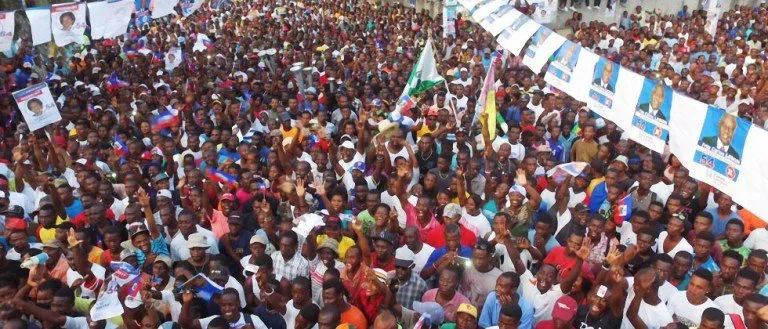
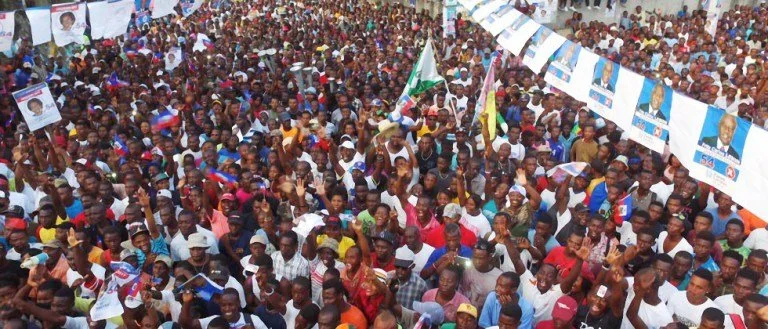
Addressing an overflow audience in Oakland in late April, Dr. Maryse Narcisse, presidential candidate of Fanmi Lavalas, the party of former president Jean-Bertrand Aristide, spoke about the necessity of reforming the justice system, investing in education and health, and the decisive role of women in the fight for democracy. Reflecting on the devastation wrought by both the 2010 earthquake and Hurricane Matthew, she focused on the growing threats posed by climate change to the island nation and the need for a vigorous environmental campaign to meet that threat. She emphasized that the Lavalas movement “places human beings at the center.”Dr. Narcisse spoke in the wake of the selection of Haiti’s new president, Jovenel Moise, a right-wing businessman and protégé of former president Michel Martelly, who took office via an electoral process so replete with fraud and voter suppression that opposition forces called it an “electoral coup.” She denounced the stolen elections and the corrupt electoral commission that validated the outcome.But she reiterated that the deteriorating economic and social conditions in Haiti would be the catalyst for renewed protest in the days and months ahead. “There is no choice,” she stated, “but for the people to resist. And Lavalas will be there to support them.”We can see the truth of this throughout Haiti. Market women – the very heart of Haiti’s economy and the foundation of so many Haitian families’ ability to survive – have been targeted by police trying to move them off the streets of Port-au-Prince, where they have been selling their goods for generations. When the women organized themselves and refused to move, police burned down their stalls.
She reiterated that the deteriorating economic and social conditions in Haiti would be the catalyst for renewed protest in the days and months ahead. “There is no choice,” she stated, “but for the people to resist. And Lavalas will be there to support them.”
On July 10-12, 2017, during three days of peaceful protest for an increase in the minimum wage, Haitian police attacked the workers from the industrial park in Port-au-Prince with tear gas, batons and cannons shooting a liquid skin irritant. They beat a woman who had recently returned to work from giving birth. A few days later, a young book vendor was shot to death in Petionville, on the outskirts of Port-au-Prince, by a police officer in front of horrified witnesses, who tried to prevent the police from quickly removing the body and covering up the crime. They were attacked with batons and tear gas.There has been a 35 cent increase in the price of gasoline – which was already higher than what we pay here in the United States. The government has also announced plans to reduce government subsidies for oil and gas, which will send the price even higher. The rise in the cost of transportation combined with a hike in the price of food has made already untenable living conditions even worse for the vast majority of Haitians.Former president Michel Martelly came to power in 2011 touting his plan to build new schools and make education free for all. Instead, investment in public education has remained stagnant while tuition for private schooling has skyrocketed. Teachers have been on strike for months, demanding that they be paid after not receiving their salaries for up to two years. This despite the fact the Haitian government adds a surcharge to every international phone call and money transfer, supposedly to fund education.Students have also protested, both in support of their teachers and to denounce the failure of the government to invest in their education. They too have been met with violent repression, exemplified by a recent incident when the rector of the National University of Haiti used his SUV to run over a student protester, landing the student in the hospital in critical condition. A video captured the gruesome sequence. No charges have been filed in the case.The Haitian government has a solution for the crisis in education – more prisons. There are now more than 10,000 Haitians locked up in prison, the majority of whom have never been charged or sentenced. Prisoners are frequently beaten, receive no health care, and live in overcrowded cells, where epidemics spread rapidly.

Cascading catastrophes since the 2004 coup forced Lavalas out of power have not entirely destroyed Haitians’ hope and confidence they can once again exercise the full power of the people. Their constant marching in the face of mortal danger – Haitian police are notorious for firing live ammunition into a marching crowd – demonstrates that power … and their trademark joie de vivre.
When United Nations soldiers from Nepal introduced cholera to Haiti in 2010, the disease swept through Haiti’s prisons, killing hundreds. At the recent opening of a new prison in Haiti’s central plateau, the head of Haiti’s national police, Michel-Ange Gedeon, boasted about the increase in prison construction, saying: “In every society, whenever schools fail in their mission, prisons are built in a cascade to try to right the ship. If offenders are to be neutralized, then prisons are needed to contain them.” This is Haiti’s version of mass incarceration, so well known to Black and Brown communities here in the U.S.Now there are new political prisoners – many of them associated with the Lavalas movement – who were arrested during the sustained wave of protests over the stolen elections. As living conditions worsen and protests sharpen, the prisons will fill even more.All of this, added to the impact of Hurricane Matthew – the biggest storm to hit Haiti in 50 years – has led more Haitians to flee the country. In early July, the Coast Guard intercepted and sent back to Haiti 107 Haitians in a small, dangerously overcrowded boat south of the Bahamas.There are over 4,000 Haitians right now in Tijuana, living in refugee camps. Recruited by occupying forces of Brazil to work in the Rio Olympics, they were pushed out after the games ended. Hoping for Temporary Protected Status (TPS) in the United States, which has been granted to Haitians since the 2010 earthquake, they instead have been deported or placed in detention camps if they cross the border.When Haitian president Moise traveled to the United States and met with Vice President Mike Pence in June, he refused to meet with Haitians worried about the changes in their TPS status, telling them to “calm down.” In their joint communiqué, Pence and Moise did not mention the migration crisis but did pledge to jointly pursue “an economic reform agenda to attract investment and generate growth.” Moise’s handshake with Pence symbolized just how much of a compliant partner his regime is with the U.S. government as it seeks even more control over Haiti’s economy and future.
When Haitian president Moise traveled to the United States and met with Vice President Mike Pence in June, he refused to meet with Haitians worried about the changes in their TPS status, telling them to “calm down.”
The United Nations Military Occupation Forces (MINUSTAH), which has functioned as a colonial overseer since the 2004 coup, is set to scale down its operation but will remain in Haiti under its new acronym MINUJUSTH (United Nations Mission For Justice Support). MINUJUSTH will consist of 1,185 police officers, and will continue to train and support the Haitian National Police – the same police who beat, tear-gassed and shot pro-democracy protesters during the last electoral cycle.Lt. Gen. Cesar Lopes Loureiro, the head of the Brazilian forces that have been in command of MINUSTAH since the beginning of the occupation, recently issued a glowing report on the accomplishments of MINUSTAH. But he was silent about U.N. responsibility for the cholera outbreak, and failed to mention the numerous cases of rape and other sexual assaults by U.N. soldiers.The U.N. has still not compensated the victims of the cholera epidemic, and it has given impunity to the many soldiers charged with raping Haitians during the long occupation. And there was not one word about the killings by U.N. soldiers of people in pro-Lavalas neighborhoods like Cite Soleil and Bel-Air or in the Port-au-Prince prison.Whether the U.N. calls its operations MINUSTAH or MINJUSTH, the continued presence of its forces, even in the guise of a reframed mission, is a clear assault on Haiti’s sovereignty.

The documentary film “Black in Latin America: Haiti & the Dominican Republic” will be shown on Sept. 14, 7 p.m., at La Pena Cultural Center, 3105 Shattuck Ave., Berkeley. The screening is co-hosted by La Pena and Haiti Action Committee. Pierre Labossiere, co-founder of Haiti Action Committee, will lead a community discussion after the film. For more information, visit https://lapena.org/event/black-latin-america-haiti-dominican-republic/.
What now looms on the horizon is the resurrection of the Haitian military. This has been a key goal of right-wing Haitian forces since President Aristide got rid of the army in 1995. Jovenel Moise has stated that he wants the army in place within two years. The beginnings of that new army have been in the works for years, training at military bases in Ecuador.In a statement to the Miami Herald, the president of the Haitian Senate, Yuri Latortue, who was a central organizer of the 2004 coup, said, “In Haiti we are used to having an army.” Referring to the U.S. occupation of Haiti from 1915-1934, which created the modern Haitian army, Latortue went on to say, and “the Americans understood that if we have the police but not an army, we will not get anywhere.”
What now looms on the horizon is the resurrection of the Haitian military. This has been a key goal of right-wing Haitian forces since President Aristide got rid of the army in 1995.
When Haitian activists speak of the Haitian Army, there is a chill in the air. Before Aristide disbanded it, 40 percent of Haiti’s budget went to the military. In a country with fewer than two doctors per 10,000 people, there was one soldier per 1,000 people.The Army has long been Haiti’s central institution of repression; the main organizer of coups against elected officials, helping to enforce the Duvalier dictatorships and those that followed before the rise of Lavalas. It was the Haitian Army that overthrew Aristide in 1991 and initiated a reign of terror that took over 5,000 lives before Aristide returned in 1994.The goal of the 2004 coup, like the 1991 coup that preceded it, was not only to topple the Aristide government, but also to rid the country of the powerful grassroots movement that has activated, energized and given voice to Haiti’s poor. That goal has not been accomplished. A stolen election cannot hide this reality.Throughout her campaign, Dr. Narcisse, often accompanied by former President Aristide, was greeted by tens of thousands of supporters in the poorest communities of Haiti. A vibrant Lavalas presence was evident across the country.In the face of decades of COINTELPRO-style counterinsurgency, including imprisonment, the killing and exile of thousands, attempts to buy off activists and encourage internal strife, Lavalas once again showed its significant base among Haiti’s majority population. In or out of government, this strength will serve as a bulwark against the harsh austerity program already being put into place by Moise and his U.S. sponsors.At the end of her speech in Oakland, Dr. Narcisse highlighted the grassroots work of the Aristide Foundation for Democracy. In the midst of the cholera epidemic, mobile health clinics from the Foundation treated patients who had nowhere else to go.After the devastation caused by Hurricane Matthew, President Aristide and Lavalas activists went to Les Cayes, Jeremie and other hard-hit areas to provide medical support, food and clothing. On Haitian Mother’s Day, hundreds of women filled the Foundation to get medical care for themselves and their children.Other clinics took place in mid-July, including on President Aristide’s birthday, July 15. And the University of the Aristide Foundation (UNIFA) continues to grow, providing higher education for over 1,200 students, most of whom could never afford other universities in Haiti.This is a movement that is not going away. As Lavalas digs in for the long haul, those in solidarity with Haiti have to do so as well.by Robert Roth/San Francisco Bay View - September 10, 2017