

A Hunger Strike Makes Headlines Before Milan Fashion Week Begins
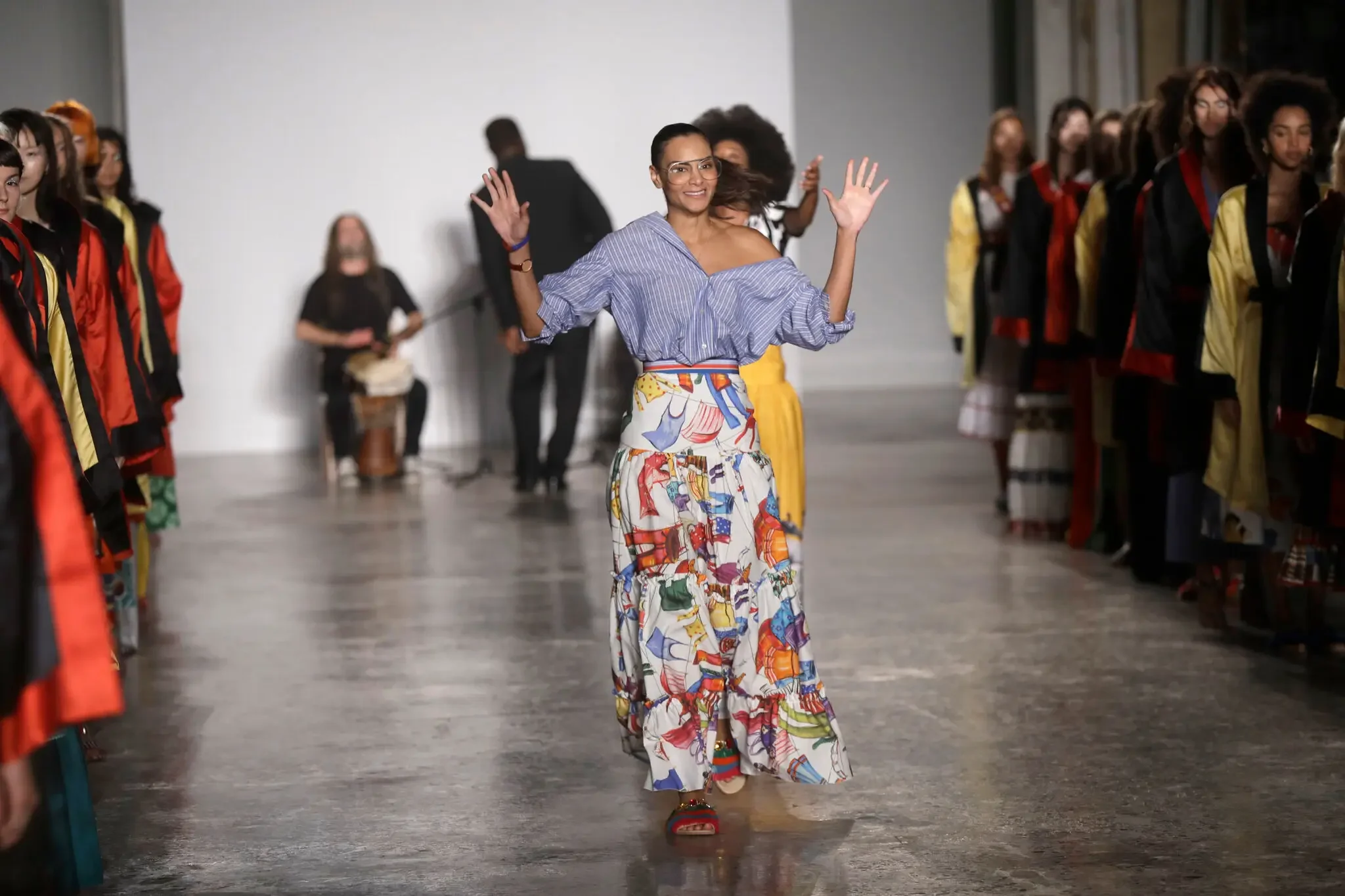
Stella Jean, one of the few Black designers in Italian fashion, protests her industry’s lack of diversity and inclusion.
The designer Stella Jean has often cut a solitary figure.
Since her debut at Milan Fashion Week in 2013, and with support from Giorgio Armani, the Haitian-Italian designer remains the only Black member of the National Chamber of Italian Fashion. She has often used her platform to address the need for better representation and financial support for design talent of color in the Italian fashion industry — a sector long criticized over instances of racism and cultural appropriation. In recent years, she has undertaken increasingly radical steps to encourage racial equity, co-founding a collective called WAMI, or We Are Made in Italy, after the Black Lives Matter movement in 2020.
Ms. Jean announced she would go on a hunger strike after a dramatic showdown at a news conference on Feb. 8 with Carlo Capasa, the chairman of the powerful national chamber, known officially as the Camera Nazionale della Moda Italiana, which organizes the Milan fashion shows that take place each spring and fall. She accused the chamber of “abandoning” WAMI and its promotion of young designers of color working in Italy, saying that she believed they had cut their support after a speech she made last September highlighting the challenges of being Black and Italian in the industry.
Now, she is taking this extreme step — saying she fears ongoing professional “recriminations” against her and the designers in her collective — to safeguard the less visible members of WAMI, which she co-founded with the African American designer Edward Buchanan, who is based in Milan, and Michelle Ngonmo, who leads the Afro Fashion Association. The Camera had provided financial and institutional support for WAMI members to produce and present three collections as part of Milan Fashion Week. But in an October letter sent to Ms. Ngonmo, Mr. Capasa said that WAMI was “no longer in line with the current strategy,” adding that the Camera would continue to assess support for collections or projects by the collective on an ad hoc basis. Facing a considerable reduction in funding for the project, Ms. Jean said WAMI’s operations would be suspended, citing the “health and well being” of its members.

“After we confirmed the Camera’s abandonment of WAMI without further specifications and assurances,” Ms. Jean said over a video call, “some collective members confided in me that they feared the worst for themselves and their livelihoods as they suddenly found themselves in an extremely critical and time-sensitive situation.”
She added, “I found myself holding the responsibility of the lives of these people who had relied on and believed in WAMI and who at that moment had their lives hanging in the balance. That’s why I offered to swap what little I could. I understood that if I stopped demanding equal opportunity, Mr. Capasa would, in turn, have a guarantee that nothing would ever happen to any of these designers or people working in fashion.”
In an email sent to The New York Times, Mr. Capasa said the Camera Della Moda had not withdrawn its support for WAMI. He said that he had offered the collective a free venue for Milan Fashion Week, which begins on Feb. 21, and that slots on the calendar remained available and at no charge to WAMI designers and Ms. Jean, who announced that she would no longer participate in the show.
“No step backward was taken on our part on the support we offered. Economic support for the production of collections and events for brands is not part of the core of Cameras’s activities. Any additional economic support may be one-off for new brands, especially at the beginning of their journey,” Mr. Capasa wrote. Although there was never a signed partnership, he added, “we are very proud to have always supported WAMI and the Afro Fashion Association projects, adopting different ways depending on the possibilities available at different times.”
Mr. Capasa said that two previous WAMI designers were presenting collections as part of the official calendar in Milan this season, and that there would be a new event, the Black Carpet Awards, to be held on Feb. 24, that would showcase work by Italian-based designers of color.
Ms. Jean previously stepped away from the fashion calendar in 2020, saying that she would not return until there were more Black designers on the schedule. Last season, two non-Italian designers of color — Maximilian Davis and Rhuigi Villaseñor — made debuts at Salvatore Ferragamo and Bally, partly spurring Ms. Jean’s comeback show last September. On Friday, Mr. Capasa added that he regretted that neither Ms. Jean nor several WAMI members would present during the fashion week and he hoped that would change.
While Ms. Jean praised the appointment of Mr. Davis, who is British-Trinidiadian, and Mr. Villaseñor, who is Filipino American, in European fashion houses, calling it “important and symbolic,” she also said that designers of color who might fall under the category of “made in Italy” were “completely ignored.” Talent cannot only be exported, she argued. It must also be homegrown — including by investing in and supporting young talent accessing college placements, internships, jobs or even showing collections on the mainstream calendar.
“Black made in Italy can speak to and tell so many things about the national condition and what happens in this country,” Ms. Jean said.

“I’m mindful of the fact that I arrived with a blue U.S. passport here and a Parsons degree,” said Mr. Buchanan, a co-founder of WAMI who has lived in Milan for two decades. “But if I had a passport from Nigeria or Somalia, it would have likely been a different story.”
He called Ms. Jean’s decision to go on a hunger strike “a personal one,” though he agreed with her statements about the challenges of being Black and working in fashion in Italy. “I can’t say enough about these struggles and difficulties,” he said. “I have had many of them, too, and ultimately I have been within the interiors of the fashion establishment in Italy for 25 years.”
The global fashion industry has been under sustained pressure in recent years to improve representation and racial equity both in front of and behind the camera. But several racist gaffes by Italian fashion houses, including Gucci’s 2019 “blackface” sweater with a mouth cut out and trimmed in red, and Prada’s 2018 keychain of a monkey with inflated lips, has placed Italian fashion under particular scrutiny.
Italy is whiter than most European countries — and does not collect racial data in its population census, nor does it have birthright citizenship, which means that children of immigrants who are born in the country do not automatically become Italian citizens.
In a New York Times investigation published in 2021 that attempted to track representation progress, many Italian brands said regulation prohibited companies from processing data on race, ethnicity, political opinions, religious beliefs, trade union membership or sexual orientation without explicit consent. This meant they were unable to participate in charting whether there were more people of color in their design studios, sales rooms, on their runways and in their campaigns.
For Ms. Jean, the future of minority talent in the Italian fashion establishment remains far from certain. She said her hunger strike felt like a last stand after feeling as though she and her younger peers had been professionally blacklisted for their activism.
“I’m a small independent designer, and I’m the only Black-owned brand in the history of fashion of the Chamber — this does not make me stronger than others,” she said. “I’m always aware of being a flea near these giants and of my perceived inability to put convincing arguments on the table. When I learned that my companions were in such a disparate situation, I had nothing else left to barter with.”

Miss Haiti 2017: Meet the 15 Top Finalists!

 Name: Christelle YoubinAge: 26International Relations

Name: Gredeline Rousseau
Age:24
Legal Sciences
 Name: Madjolah PierreAge: 23Social Communications
Name: Marie Gerline Moreau
Age 22
Accounting

Name: Junnie MichelAge: 23Administrative Assistant

Name: Weendy Legerme
Age: 25
Psychology
 Name: Alise Murielle JosephAge: 23International Relations
Name: Alexandra Eloisier
Age: 24
Political Science
 Name: Chrystel DufourAge: 24Psychology/Communications

Name: Joanne Shirley Delbeau
Age:24
Sociologist
 Name: Cassandra CheryAge: 21Model

Name: Daphnee Brutus
Age: 25
Hostess
 Name: Caroline Minerve BegeinAge: 22Administrative Assistant
Name: Sophonie Basquin
Age: 20
Management Systems
 Name: Wheytnie AlexandreAge: 26Medical Student
These are the top the top 15 finalists for the Miss Haiti title. 
Photos and information from Miss Haiti Organisation.

Eklà Beauté - More than a salon....it's an Experience!!!

 Eklà Beauté is a beauty salon like no other.
 Owner, Christina Fils-Aimé, had a vision. She wanted to offer professional service, excellent hair care and a truly one on one experience; All of that while inviting you into the peaceful, serene and calm environment of her studio.Christina, left Haiti at the age of 18 and moved to New York. There, she became a hair colorist and makeup artist and worked in many hair salons. At 30 years old, she moved back to Haiti and left the hair and makeup business. However, her love for fashion and hair care pulled her back to the hair business. Its her passion; And it shows in the results.She works by appointment only to give each client the time and care they expect, need and deserve. Her goal is simple: "I want it to be 100% about my clients. I want them to walk out feeling good about themselves and with a smile on their faces. That’s what I enjoy most of my job, to be able to put a smile on my clients’ faces”, she says. Eklà also offers manicures, pedicures and makeup services for a one stop shop to pamper yourself.The décor has a zen feel and the relaxing ambiance with soothing music is sure to please.
 If you're looking to escape the chaos of everyday, check them out for your beauty needs. Eklà is located at 46 Rue Rebecca, Petion-Ville, Haiti. You wont be disappointed!
Source: FashionAyiti, pagespro

Haitian Black Castor Oil Now Available at Whole Foods Market

Haitian Black Castor Oil Now Available at Whole Foods Market
 Kreyol Essence is excited to be the first company to launch Haitian beauty products at Whole Foods Market and the first Haitian company to bring Haiti’s beauty treasure to the mainstream U.S. & Canadian market! Haitian Black Castor Oil aka Lwil Maskriti is the Liquid Gold of the Caribbean. We have known for centuries how this indigenous oil promotes hair growth, moisturizes hair and skin, and is a staple for medicinal purposes.Having our products at Whole Foods is a testament to our quality and commitment to social impact in Haiti. We are launching in over 95 stores in Pennsylvania, New Jersey, Virginia, Maryland, Washington DC, Ohio, Kentucky, Florida, Canada, and are working on additional locations every day. If you want the best black castor oil and to help create work for women and farmers, purchase your bottle of oil at any of the Whole Foods Stores listed below and tell a friend to do the same. Check our website frequently for additional store addresses.
 KENTUCKYLexington – Lexington, KYMARYLANDBethesda – Bethesda, MDColumbia Maryland – Columbia, MDHarbor East – Baltimore, MDMount Washington – Baltimore, MDSilver Spring – Silver Spring, MDOHIOChagrin- Beachwood, OHPENNSYLVANIA Philly Center City – Philadelphia, PAPittsburgh – Pittsburgh, PAWexford – Wexford, PANEW JERSEY Cherry Hill – Cherry Hill, NJVIRGINIAArlington VA -- Arlington, VACharlottesville – Charlottesville, VAVirginia Beach, Virginia Beach VANewport News — Newport News, VAOld Town -- Alexandria, VAShort Pump – Glen Allen, VATysons, Fall Church, VAWASHINGTON DC Foggy Bottom – Foggy Bottom, DCGeorge Town – Washington, DCTenleytown – Washington, DCP Street – Washington, DCH Street— Washington, DC
- March 03, 2017
- Kreyol Essence
Kreyol Essence | March 3, 2017