
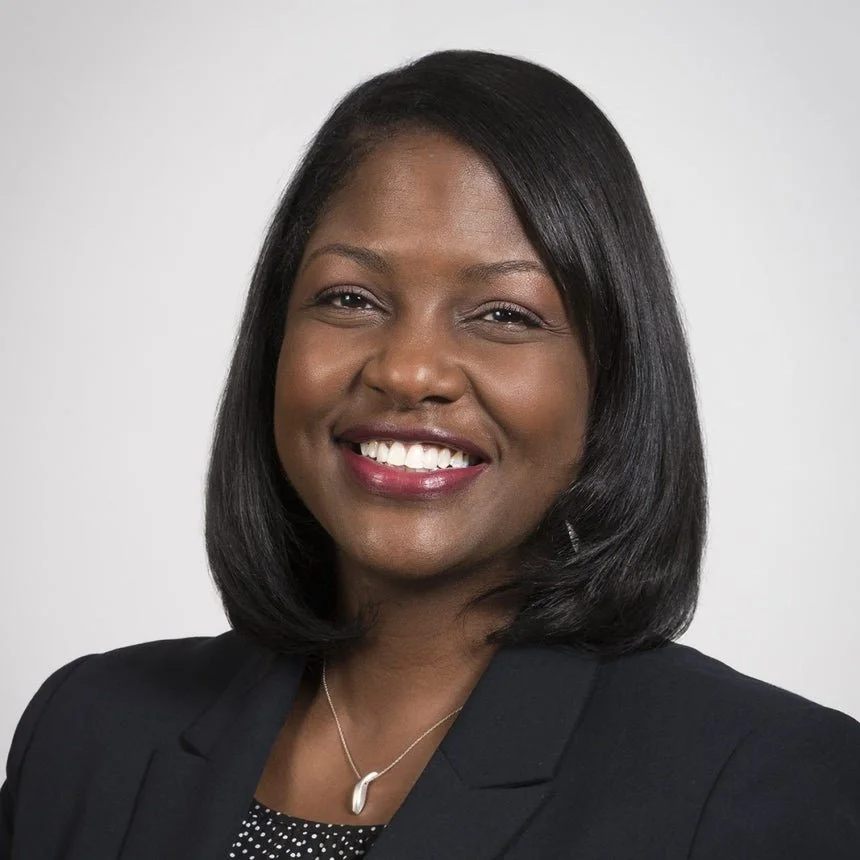
NJ Gov. Phil Murphy Nominates Fabiana Pierre-Louis To The State’s Highest Court
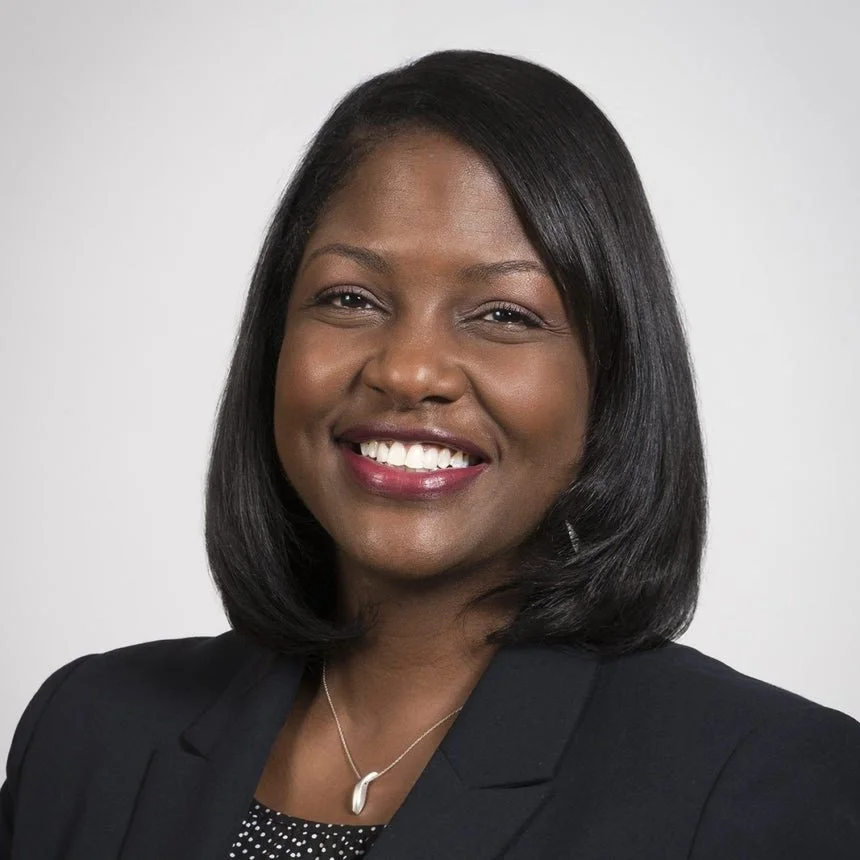
On Friday, NJ Gov. Phil Murphy will announce his first pick for the state’s Supreme Court since taking office, and it will be a historic one.
Murphy will nominate Fabiana Pierre-Louis, a partner at Montgomery McCracken Walker & Rhoads, to be the next associate justice of the state’s highest court. If the state Senate confirms the nomination, Pierre-Louis will be the first Black woman to ever sit on the court.
Pierre-Louis, 39, has not only worked in private practice, but has also worked as a federal prosecutor with the Department of Justice for years.
“It’s hard to put into words the honor that it is to be nominated to the highest court in the state of New Jersey,” Pierre-Louis told ESSENCE. “My goal, particularly as a prosecutor, was always to pursue justice and fairness in the law…It’s just a remarkable opportunity to continue in the very proud tradition of this state’s Supreme Court.”
The daughter of immigrants from Haiti, and a first-generation American, Pierre-Louis believes she will bring a unique perspective to the court if confirmed.
“I am a Black woman. I am the child of immigrants from Haiti. I am someone who is a first generation American citizen here in this country, [the] first person in my family to attend law school, to become a lawyer, someone who’s also lived in a variety of inner cities throughout my life, beginning with my early childhood in Brooklyn, then followed by the remainder of my childhood in Irvington, New Jersey,” she said. “All those experiences bring a unique perspective to the Court that currently is not there.”
To the governor, the nomination was a no-brainer, given his own belief that a judiciary should reflect the diversity in the state.
“A core tenet of my Administration is a commitment to an independent, fair-minded judiciary that reflects the immense diversity of our great state,” Murphy told ESSENCE. “As a first-generation American, Fabiana brings both a sharp legal acumen and the perspective of her own past that will greatly benefit the proceedings of our state’s highest court.”
“New Jersey is a very diverse state,” Pierre-Louis echoing the governor’s statements. “It is extremely important for the judiciary and other government bodies to be a reflection of the community that they serve. So, having people of diverse backgrounds and diverse perspectives sitting on the highest court in these states certainly inspires confidence that the court will rule and have these diverse perspectives in ruling on extremely important cases.”
Pierre-Louis’ own work speaks volumes for her. She graduated from Rutgers Law School with High Honors before going on to clerk for Justice John Wallace Jr. during the 2006-2007 Supreme Court term. From there she went to Montgomery McCracken for about three years, before moving to the U.S. Attorney’s Office for the District of New Jersey in 2010. In 2012, she moved to the Trenton office, and four years later she would be the first woman of color to be Attorney-in-Charge. In that role, she supervised all aspects of criminal matters handled by the office, while also investigating and prosecuting her own caseload, inclusive of matters from child exploitation offenses, to national security matters, to public corruption matters and more.
While in Trenton, Pierre-Louis helped to create the Trenton Reentry Court, which provides assistance to returning citizens to help reacclimating to society.
In 2018, she became the first woman of color to serve as Attorney-in-Charge of U.S. Attorney’s Office in Camden, later returning to private practice in 2019.
“My experience speaks volumes with regard to my ability to take on this position and to successfully execute the duties of an associate justice of the Supreme Court of New Jersey. I’ve practiced in private practice at a law firm doing civil work. I’ve also been a federal prosecutor,” Pierre-Louis said. “I’ve supervised a wide variety of cases and gained the respect of not only the judiciary but of my colleagues and even defense attorneys that I have worked on cases with. And I think my integrity, my open-mindedness, and my ability to communicate well with others is something that has helped me succeed throughout my career.”
If confirmed, Pierre-Louis will be the first Black judge to sit on the court since 2010, when then-Gov. Chris Christie stirred controversy and outrage in the state after failing to renominate then-Justice John Wallace Jr. to a tenured term.
In the New Jersey State Supreme Court, a justice is initially confirmed for seven years. After those seven years, once a justice has served with good behavior and made sound decisions (regardless of who may or may not agree with said decisions), they are typically renominated and reconfirmed for a tenured term, which automatically expires once the justice turns 70, regardless of if that justice was initially chosen by a governor of a different party.
Wallace has been the only justice that has been denied tenure since the state Constitution was adopted in 1947. At the time, he was the court’s only Black justice (and only the second Black person to ever sit on the court), and his tenured term would have automatically expired when he had reached 70 in less than two years.
The fallout was swift, and Christie’s Judiciary Advisory Panel all resigned en masse to protest the then-governor’s decision to replace Wallace. Democrats balked, with the Democrat-led senauntil Justice Walter Timpone was confirmed and sworn in 2016.
It is Timpone’s seat that Pierre-Louis will fill if confirmed, as the justice will reach the mandatory age of retirement in November.
Pierre-Louis’ nomination comes at a time when the nation is in turmoil and many have flooded to the streets demanding justice for Black Lives and accountability from the police, but Murphy stressed that his selection did not come as a result of the current national discourse.
“In addition to her esteemed legal career, Fabiana’s humility, empathy, and character are all traits that make her well-suited to become the first Black woman and the next Associate Justice to serve on New Jersey’s Supreme Court,” Murphy said in a statement.
“I have not chosen to nominate Fabiana because of the current national discussion around race. However, given the challenges which are being brought to the forefront of our society, and the questions which will undoubtedly rise to reach our Supreme Court – core issues of socioeconomic equality and equity – there is no better meeting of an individual and the times,” he added.
Pierre-Louis told ESSENCE that she seeks to be a “fair, open-minded” justice, if nominated.
“I certainly believe that I would…have the ability to listen to all arguments from all sides and make a determination after having done so and looked at the facts and the law before me to make determinations about whether I believe there was an error on the lower court below or not,” she said.
“I think the New Jersey Supreme Court is a perfect model of a very strong court in this country that has historically been very independent,” she added. “I think the role of a Supreme Court justice is to review the cases and ensure that fairness and justice results no matter what the political atmosphere is at the time.”
By: BY BREANNA EDWARDS for Essence.com | June 5, 2020

Biden Campaign Adds Karine Jean-Pierre As Senior Adviser

Joe Biden has hired Karine Jean-Pierre, a veteran African American political strategist, as a senior adviser to his presidential campaign as the presumptive Democratic nominee pivots to the general election campaign.
Jean-Pierre will advise on strategy, communications and engaging with key communities, including African Americans, women and progressives.
“This really is the most important general election in generations,” Jean-Pierre told The 19th, a nonprofit newsroom, in an exclusive interview Monday night. “I’ve known Joe Biden for 10 years now. I believe he’s a man of integrity, he’s a man who knows how to lead, he’s a man who knows how to use the levers of government to help people and he’s the man who could beat Donald Trump in November. For me, as a black woman, I just could not sit this out.”
Jean-Pierre, 43, will begin her role with the Biden campaign next week. She gained prominence in 2008 as the southeast regional political director for then-candidate Barack Obama’s history-making presidential campaign.
She served in the Obama White House as regional political director before working as deputy battleground states director on his 2012 reelection. In the latter role, Jean-Pierre handled political engagement in key states including Ohio, North Carolina, Pennsylvania and Florida.
Born in Martinique to Haitian parents and raised in New York, Jean-Pierre worked on former Maryland governor Martin O’Malley’s 2016 Democratic presidential bid before joining liberal group MoveOn as chief public affairs officer. She is also an MSNBC political analyst.ADnull
Separately, the Biden campaign announced Tuesday that it hired Obama campaign alum Julie Chavez Rodriguez — who previously worked as co-national political director for Sen. Kamala D. Harris’s presidential campaign — as a senior adviser, making her the highest-profile Latina to join the team as Biden struggles to shore up his support with Hispanic voters headed into November.
Biden’s swift rise this spring was fueled largely by black voters — particularly black women, who are regarded as the backbone of the party and seen as key to a winning general election coalition in the fall. Energizing these voters will be crucial to the record turnout needed to topple Trump. Black turnout was down in 2016 from historic highs in 2012 and 2008, when the country elected its first African American president.
Jean-Pierre said her hiring signals that Biden “understands how he became the presumptive nominee.”
“Black voters, black women, have helped him get to this point,” she said. “When everybody was counting him out, black voters spoke out. I am so proud and excited as a black woman watching how black women have exerted their power … we had to say loud and clear this (the actions of the Trump administration) is not okay.”
Valerie Jarrett, former senior adviser to Obama, called Jean-Pierre “a superstar” who shares Biden’s values of equality, fairness and justice.
“She will be able to communicate his agenda in an authentic way that I think will resonate importantly with African American women, but also with the entire country,” Jarrett said in a telephone interview. “It’s a coup for vice president Biden and his campaign.”
By Errin Haines | The 19th and The Washington Post May 20, 2020
This story is part of a collaboration between The Washington Post and The 19th, a nonprofit newsroom covering gender, politics and policy.
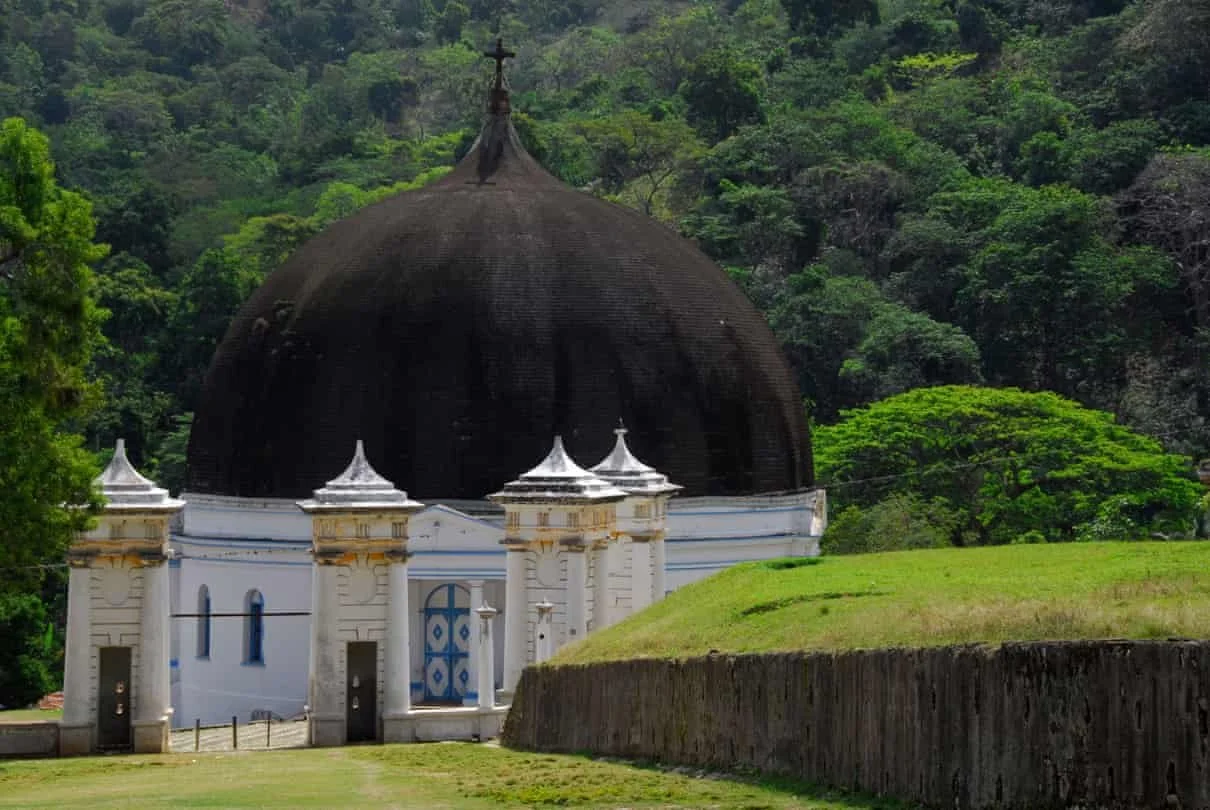
'Our heritage is abandoned': burning of Haitian church fuels anger at politicians
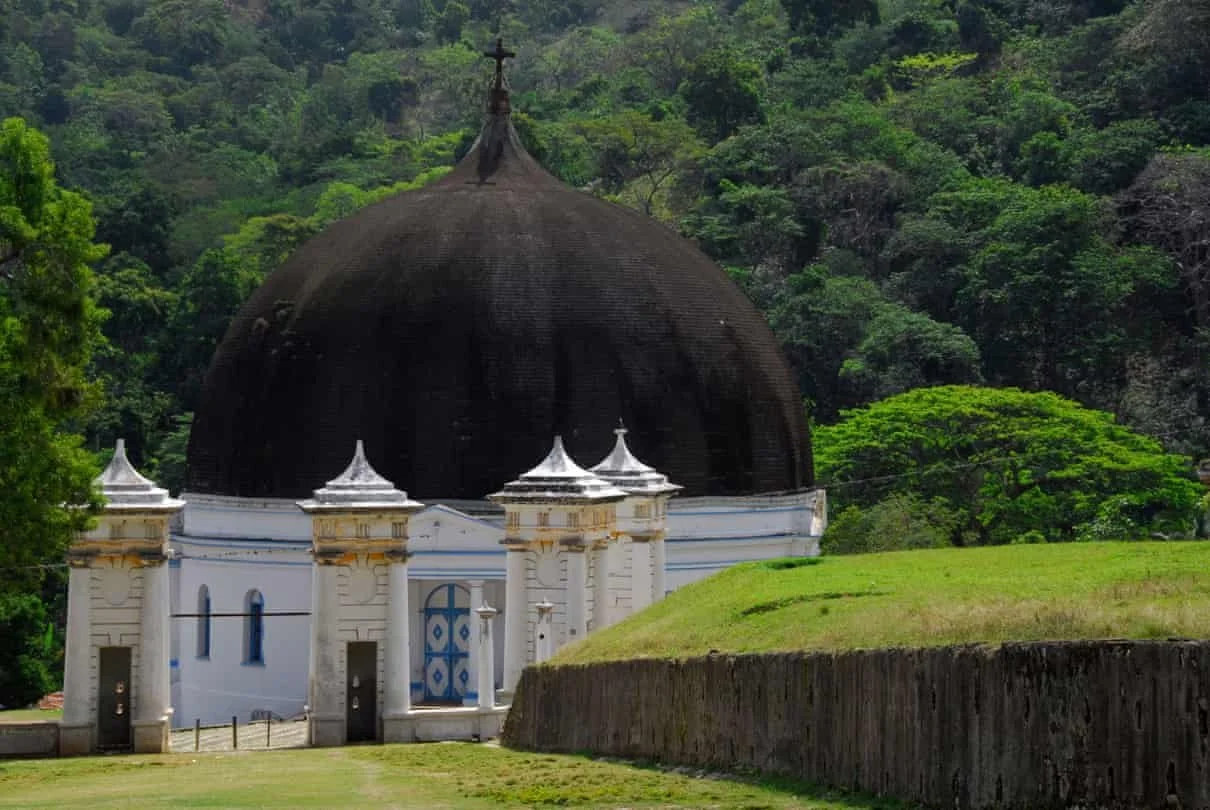
Damage to part of Unesco world heritage site is emblematic of uncaring government, critics say.
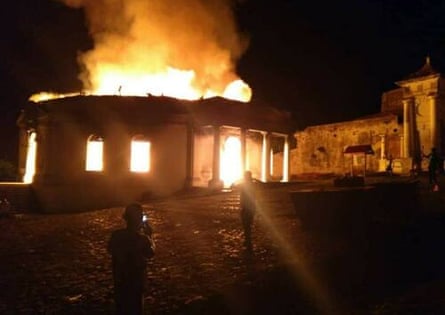
Cultural leaders in Haiti have described the gutting by fire of a celebrated 200-year-old church as an avoidable tragedy that highlights the fragility of the Caribbean nation’s patrimony – and the need to preserve its historical treasures.
The Our Lady of the Immaculate Conception church in the town of Milot is part of a Unesco world heritage site that includes the ruins of the Sans Souci palace and the Citadelle Laferrière, an imposing fort that looms over Haiti’s northern plains.
Fire tore through the church on Monday, causing its distinctive black wooden dome to collapse. The cause of the blaze has not been determined, but some saw it as indicative of the malaise of misrule that has long bedeviled the island – some of it locally rooted, and some imported by more powerful neighbors.
“[For years] we have been asking the state to ensure the protection of these colonial dwellings, which are important as monuments of slavery, yet nothing has been done,” said Laënnec Hurbon, a sociologist with the State University of Haiti.
“But the state spends its time buying luxurious cars for ministers, functionaries and parliamentarians. It is therefore not surprising that everything concerning the national heritage is abandoned.”
The church was constructed between 1810 and 1813 by Henri Christophe, one of a cadre of revolutionary leaders including Toussaint Louverture and Jean-Jacques Dessalines who helped Haiti oust the French and end the system of slavery.
Christophe went on to declare himself King Henry I and ruled in autocratic splendour over northern Haiti until his death by suicide in 1820 amid a protracted civil war.
On Christophe’s death, the church was ransacked, and its dome had collapsed following an 1842 earthquake. In the 1970s, the renowned Haitian architect Albert Mangonès led an effort to restore the complex. It was named a world heritage site in 1982.
Some worry the legacy that the buildings at Milot attest to is being lost amid Haiti’s current political upheaval.
“The structural inequalities in our society mean there has never been an education accessible to all that would teach the idea of the common good,” says the Haitian author Yanick Lahens.
Haiti has been shaken by often violent unrest for months, prompted in part by a long multibillion-dollar corruption scandal which has engulfed the administration of President Jovenel Moïse.
Despite the political battles, however, the church seems to pierce to the heart of Haiti’s national identity, across party lines.
In a letter to the government after the fire, educational and civil society figures called on the nation’s political leaders to “stop this denial of our history as a people [as] only these monuments remain, testimonies of our history of struggles, suffering and hope.”
One former president, Prosper Avril, who ruled the country from 1988 to 1990, has called for a taskforce to protect the country’s cultural heritage.
In a land that often seems beset by internecine political vendettas, some hope that even in this dire moment, the church’s reconstruction might serve as a point of unity.
“The royal chapel of Milot is a testimony to the history of our people,” said Erol Josué, director of Haiti’s national bureau of ethnology (BNE). “The Haitian state should engage all layers of the population in its reconstruction, because this is our heritage.”

Savings and Credit for Haiti
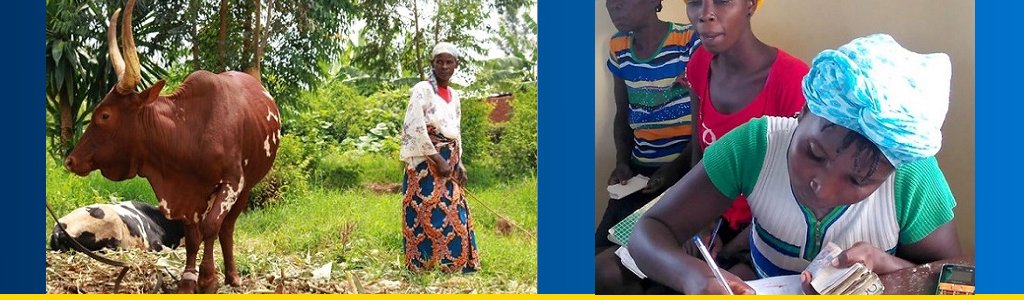
Haitians pool resources, launching small savings and credit groups that lend and invest in community projects – with an emphasis on saving.
A magnitude 7 earthquake devastated Haiti a decade ago – and NGOs launched many programs including a network of small credit and savings groups. The community-run programs set their own low interest rates and terms with the emphasis on long-term savings rather than aid or loans. Individuals “pool their resources, and then lend to each other or invest in their communities,” explains Kate Schecter, who leads the nonprofit World Neighbors. “By taking control over their own finances, individuals can decide whether they want to invest in a small business or farm, invest in a child’s education or address other needs.” Community groups that save substantial sums establish cooperatives, identifying leaders and developing the management skills. Savings grow in rural areas that lack banks, and over the course of years, financial security contributes to political leadership and community stability. Schecter notes, “Like savings itself, these programs build upon themselves.” – YaleGlobal
OKLAHOMA CITY: In the decade since an earthquake devastated Haiti, the United States and other governments poured more than $13 billion into recovery and rebuilding efforts. Well-intentioned international organizations drew up elaborate plans for industrial parks and other large-scale investments, with talk of stable democratic governance and an escape from the cycle of poverty that has long troubled the country of 11 million people.
While the money relieved suffering and did help build some infrastructure, it did not catalyze sustainable development. There are many reasons, including Haiti’s longstanding political problems. But there can be little doubt that traditional strategies did not achieve intended goals. Yet some development projects have worked in Haiti over the past 10 years, and one of these is savings and credit programs.
Development is premised on the concept of investment in human capital. However, donors rarely focus on the fundamentals of saving for those communities in international development projects. Donors want to distribute grants, measuring and evaluating results of that spending over a relatively short time. While this makes sense in terms of accountability, over the long term, individuals do not save to build capital.
One response has been microfinancing in the Grameen tradition – small loans from banks with low interest rates. This model, successful in the short term, has shown some drawbacks over time. Banks expect repayment in a timely fashion; borrower defaults can lead to debt traps and further poverty. In many rural areas, no banks or small loans are available, with the poor often forced to borrow from unscrupulous lenders who charge high interest rates and defaulters, again, forced into deeper poverty.
Another take on microfinance are savings and credit groups. In this model, participants pool their resources, and then lend to each other or invest in their communities. It is estimated more than 10 million people participate in such programs around the world. By taking control over their finances, individuals can decide whether they want to invest in a small business or farm, invest in a child’s education or address other needs. Many community savings groups use pooled funds to build water wells, schools or clinics. They set their own priorities and establish control over the public goods they build.
Often, community groups grow capital so quickly they need to form cooperatives to manage it. They then move to a higher level of credit and growth, developing accounting, marketing, public advocacy and other business skills necessary to expand markets and output.
This is what is happening in some communities in Haiti.
Before the January 2010 earthquake, Meladine Dalphinis was a tailor. With her workplace and livelihood destroyed, she went into farming. This provided her and her children a sustenance income. In 2015, Dalphinis learned about World Neighbors and a local community-based partner organization. The savings and credit groups determine interest rates and she became involved. This Haitian group offered a rate of 2.5 percent, a rate recommended by World Neighbors. Dalphinis took out a $35 loan, which she used to expand her leek fields and build a small fishpond. Her family eats the fish, a crucial source of protein, and she sells the surplus in the local market. This generated enough profit to invest in livestock. Our local partner taught Dalphinis to use animal waste to fertilize her crops – a critical method to reduce costs, increase profit and avoid the health risks of handling chemical fertilizers. Surplus livestock fertilizer is another source of revenue and profit.
Today Dalphinis runs a substantial family farm, and many of her neighbors in Odige do the same. It all comes back to the ability to save and invest, relying on technical support to make that investment profitable and sustainable. Right now, World Neighbors works with 20 savings and credit groups in the Artibonite region of Haiti. Another 28 groups thrive on their own after graduating from assistance. Each group averages about 30 people, with 1,500 people working together to save for their families and communities. These 48 groups grow their businesses, in the process learning financial skills and lifting entire communities out of poverty.

There are five ways international development groups can assist communities with savings and credit initiatives:
1) Self-management: A savings and credit group needs to manage itself, free of direct control by non-government organizations. Otherwise, the group cannot sustain itself after the development group leaves. By training community-based groups and offering a participatory process to identify community leaders, an international development organization can relinquish day-to-day management of the funds. In Haiti and the 13 countries where World Neighbors works, including Kenya, Nepal and Timor-Leste, community leaders have gone on to teach other communities how to establish and run their own savings and credit programs. Like savings itself, these programs build upon themselves.
2) Long-term commitment: The often-lengthy time involved in amassing significant capital argues for long-term involvement by international development groups. In Haiti, this means up to 10 years. This requires that donors not be rigid about measuring success through short-term “metrics.” Investors in tech companies are patient. Consider, it took Amazon nearly 10 years before it reported its first profit. Development groups and donors should be likewise patient as poor communities work to amass enough capital to catalyze self-sustaining income and wealth creation. World Neighbors does not provide seed money so it can take time to accumulate savings. In very poor communities, the groups start out saving small amounts, but quickly amass capital and begin lending.
3) Gender equality: An inclusive approach helps communities begin to challenge the gender assumptions and discrimination that hinder women’s ability to work and earn an income outside of the home. As Dalphinis's experience demonstrates, women are eager to take advantage of opportunities and share their success. In many countries, this economic leadership translates into political leadership. For instance, in Bihar, India, Munni Devi joined a savings and credit program run by a local partner of World Neighbors. Successful in increasing her family’s agricultural output, she formed her own savings and credit group. Group members served as her base when she successfully ran for sarpanch, the head of her village council – the first woman to serve in that position.

4) Avoid banks: Community-based savings and credit programs avoid high interest rates and onerous conditions placed on borrowers when they struggle to repay loans. In small communities, groups set their own low rates and help when borrowers fail to make a payment.
Lack of bank involvement does not mean these groups cannot scale up to have the capital to invest in larger projects, like food processing plants. To do so, they come together to form savings and credit cooperatives. In Kenya, for example, the Akukuranut Development Trust has successfully evolved from a collection of small savings and credit groups to a sizeable cooperative registered with the government. Nevertheless, the cooperative maintains roots in the communities and continues to lend at low rates.
In rural isolated areas where bank branches are rare, these groups provide the opportunity for credit without the dangers of high-interest lenders who often prey on the poor.
5) Help communities create endowments: Many groups invest the capital they initially saved back into the community through institutions that live on long after original funders leave. World Neighbors is not alone. Other development organizations, large and small, use the methodology with great success, including CARE, Oxfam, CRS, PLAN, and the Bill and Melinda Gates Foundation – all helping communities to create endowments with an eye toward sustaining the wealth they accumulate.
Savings and credit groups are no magic wand. They only work as part of a holistic approach that involves health, water, sanitation, improved agricultural techniques, education and other services. But income generation and wealth creation are not sustainable without some kind of long-term savings mechanism.
In light of the current COVID-19 pandemic, these mechanisms will be essential as the global economy tries to get back on its feet. This crucial component that improves lives in Haitian communities will help there and numerous countries as all begin to recover from the pandemic.
Haiti reports its first coronavirus death
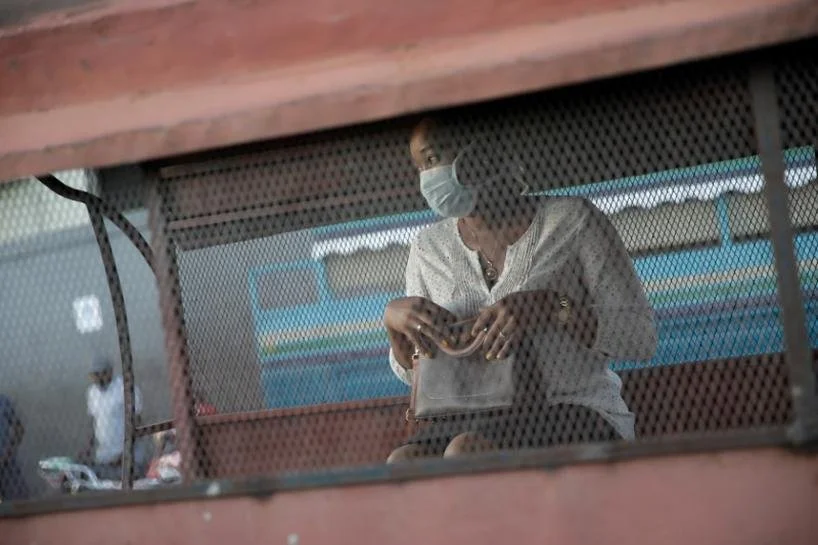
Port-au-Prince (AFP)
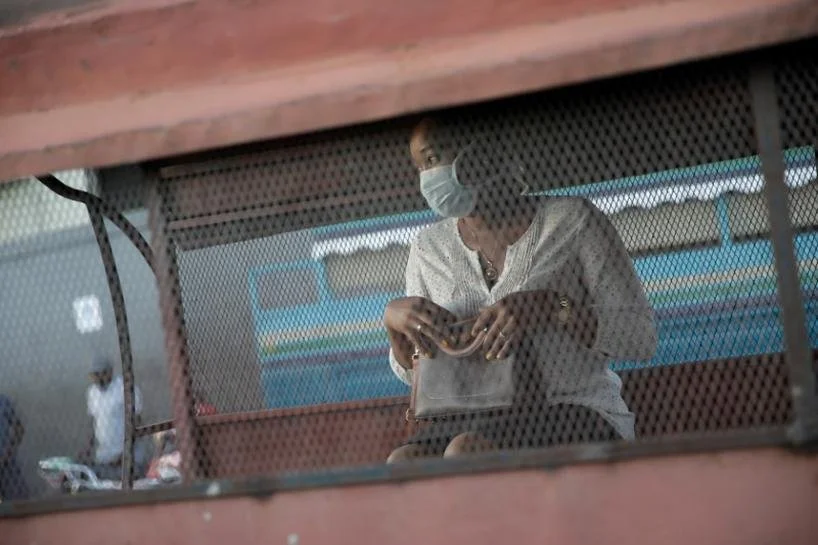
Haiti on Sunday reported its first novel coronavirus death, a 55-year-old man who had underlying health conditions.
The health ministry said the man suffered from diabetes and hypertension.
He was one of only 21 confirmed cases of the COVID-19 virus in Haiti, a demographically young country where over half those diagnosed with the disease have been under age 45.
Only 218 tests for the new coronavirus have been carried out in Haïti since the first two cases were confirmed March 19, however, leading to criticism from the national medical community of the government's handling of the pandemic.
Since the virus first appeared, the government has announced stringent measures to contain it, but they have not been rigorously followed or enforced.
A ban on gatherings of 10 or more people is routinely violated, notably in the country's crowded public transportation system.
Stay-at-home measures, like those in place in Italy and France, are difficult to apply in Haiti because the vast majority of its inhabitants depend on the informal economy to survive.
The density of the population of Port-au-Prince, the most populous capital in the Caribbean, with three million people, also makes strategies like social distancing impractical.
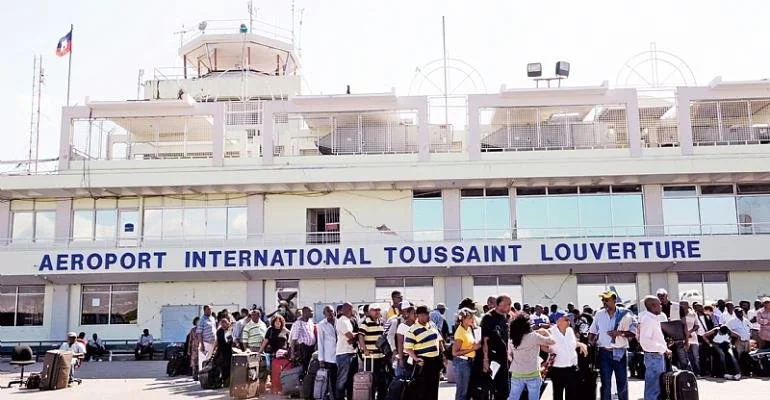
Coronavirus: Haitian Leaders Urging Authorities To Secure Airports And Bus Stations As Virus Hit The Dominican Republic
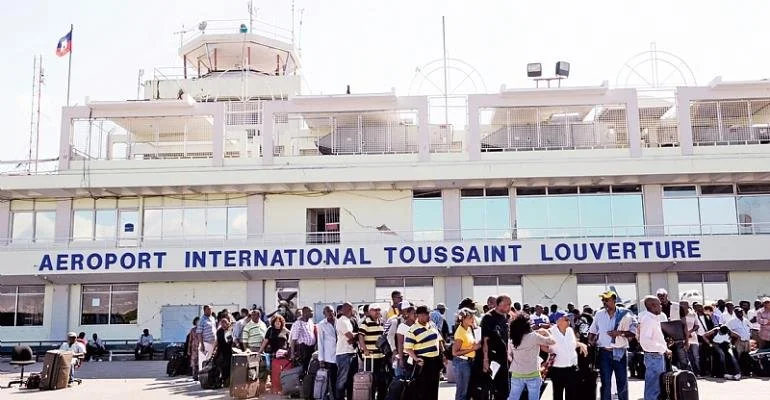
According to reports from local media like Bon Déjeuner! Radio (BDR! Live), VOA, and Radio Television Caraibes, the opposition leaders, health leaders, and other political leaders across Haiti are asking the Haitian Government officials and other agencies officials across Haiti to keep their eyes on the tourists from the U.S. and other countries who are entering the country due to Coronavirus fear as death are growing overseas.
The opposition leaders and other political leaders across Haiti are afraid that the Coronavirus hit Haiti when the country doesn't have good hospitals and types of equipment to solve the problem. That virus is from China and it is reportedly in the Dominican Republic now, so this is why the leaders in Haiti are making sure that the virus stays overseas because Haitian authorities are not ready for cases in a poor country like Haiti. Unfortunately, President Jovenel Moise and the new Prime Minister Jouthe Joseph are quiet about how to secure the security and the safety of Haiti Citizens.
As the Coronavirus death toll going up in Asia countries, Italy, the United States, and others, the leaders in Haiti are making sure there are no cases in Haiti because the health leaders said Haiti doesn't have the proper equipment for such a thing.
"It's sad that the Coronavirus is already in the Dominican Republic, and I hope the Dominican Republic leaders do their best to protect their Citizens like we are doing our best to protect our Citizens in Haiti.", said Mr. Werley Nortreus and other political leaders across Haiti.
As the virus is growing overseas, even the employees at the government-run, General Hospital in Haiti’s capital, Port-au-Prince, fear the day when the first coronavirus patient checks in.
Dr. Jacques Mackenzie told VOA that no measures have been taken to protect the staff at the nation’s largest health facility if Coronavirus hit the country.
“It’s sad to say this but the hospital receives a lot of patients daily and we are not — I repeat — we are not ready, as far as I know, to diagnose a person who has the coronavirus,” he said, adding that they don’t even have the test to determine if someone is infected.
According to reports, the Dominican Republic health officials are now reporting five cases, including a 56-year-old Dominican woman who lives in Italy, and a 12-year-old who recently returned from a European vacation with his family. Both are in quarantine at home. There are now a total of 15 confirmed COVID-19 cases in the Caribbean, and that's why Haiti leaders are making sure that Haiti stays clean without Coronavirus in the country.
"I am calling the Government officials and other agencies officials to keep their eyes on the tourists from the U.S. and other countries entering the country to make sure that they are not infected because Haiti is not ready for this mess.", said Mr. Werley Nortreus, a political leader and founder of Vanyan Sòlda Ayiti and A New Haiti Before 2045 (ANHB 2045).
The number of people in the Caribbean who have contracted the novel coronavirus continues to grow with the Pan American Health Organization confirming Friday an additional positive case in the Dominican Republic and eight new ones in the French overseas territories, bringing the total to 12.
“The diagnosis is biological so the laboratory has to confirm the diagnosis. We don’t have the test. We, the medical personnel, have not received any instructions at all with regards to detecting coronavirus cases, nor how to protect ourselves. We are seeing (in the news) all the equipment other countries have to deal with the coronavirus, their doctors, their technicians are well equipped. We, on the other hand, have never received anything that would allow us to face the possible arrival of coronavirus in the country.”, said health officials and Doctors in Haiti.
French Guiana is reporting five cases of COVID-19 while Martinique confirmed two cases. The cases are in addition to three previous cases — two in St. Martin and one in Saint Barthelemy — that had been previously reported along with a previously confirmed case in the Dominican Republic. No information was released on whether any of the 12 patients have died.
As the Coronavirus death toll going up in Asia countries, Italy, the United States, and others, some leaders in Haiti, including Mr. Werley Nortreus are making sure there are no Coronavirus cases in Haiti and the Caribbean.
Violence forces Haiti to cancel Carnival
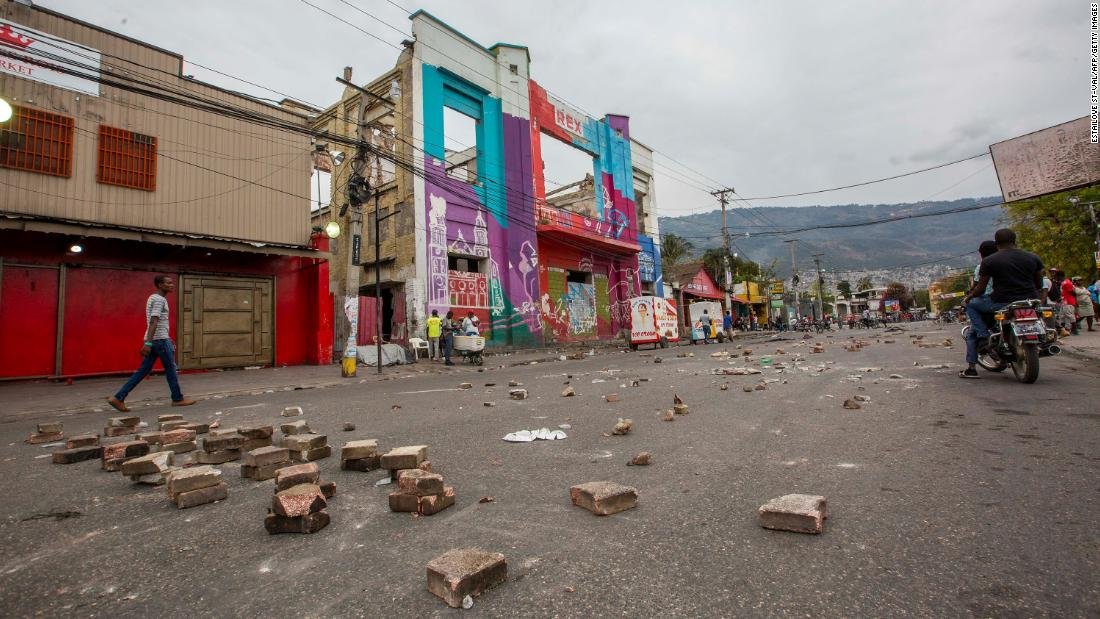
Haiti's biggest celebration of the year, Carnival, has been canceled after deadly protests and gunfire interrupted the first day of festivities in Port-au-Prince, leaving at least one person dead.Haiti's vibrant Carnival draws thousands every year for mass celebrations. But the three-day festival was cut short after gunshots were heard and people ran for cover in the nation's capital over the weekend."In order to avoid a planned bloodshed, the Government takes the opportunity to inform the population that the carnival has been canceled in Port-au-Prince and invites the Haitian people to remain calm while waiting for the next announcements," a statement from Haiti's communication ministry read on Sunday.
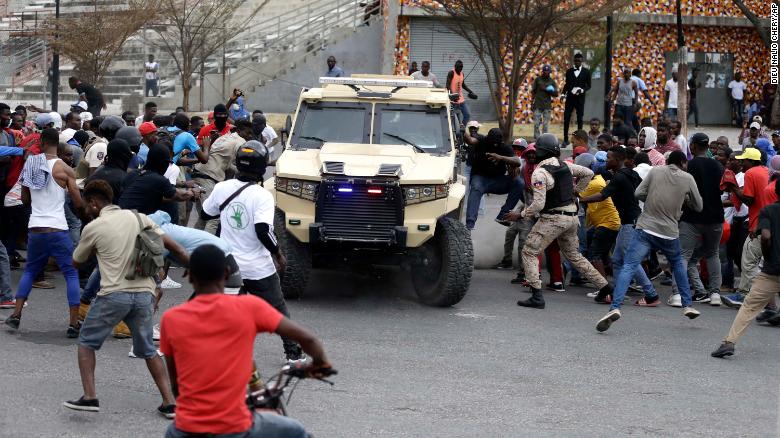
Armed off-duty police officers commandeer an armored vehicle during a protest over police pay and working conditions, in Port-au-Prince, Haiti, Sunday, Feb. 23, 2020.Haiti's Armed Forces said protesters from the country's National Police had attacked its headquarters, leaving one soldier dead and two others injured. Haitian police have been protesting for months, demanding better pay and conditions, but have not yet responded to claims their officers were involved in this incident.
"Despite the repeated assaults of the attackers, the military authorities maintain a defensive posture to avoid a bloodbath. The High Command of the Armed Forces once again calls on the National Police of Haiti to restore calm," Sunday's statement from the Armed Forces read.Video from Reuters shows chaos in the city, with fire burning near the festivities and people ducking for cover as gunshots are heard. Other images show several people with guns running throughout the event.
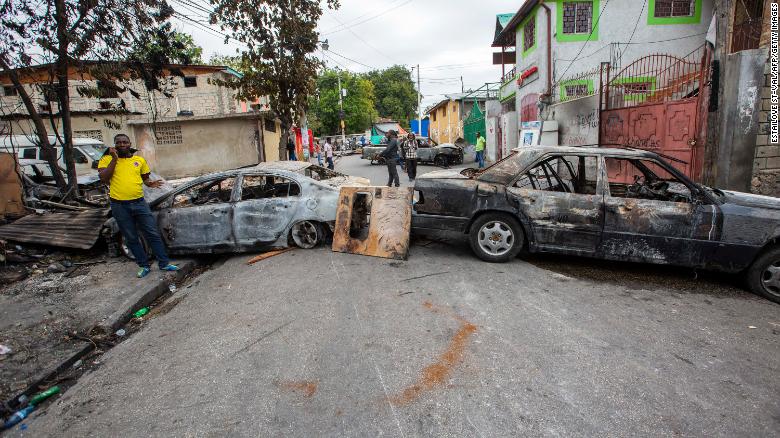
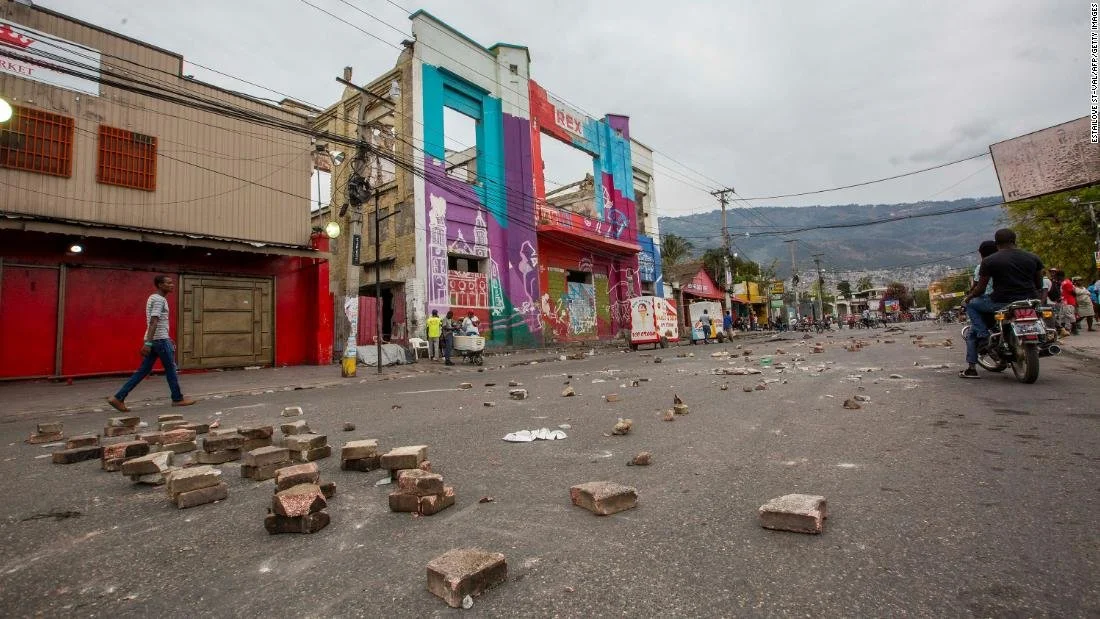
Main roads through the city of Port au Prince are blocked after Sunday's clash between Haitian police and the army in Port au Prince, Haiti February 24, 2020.The United Nations office in Haiti expressed its "grave concern" for "the serious incidents Sunday" that "lead to the cancellation of the Carnival celebrations," on Monday.
"The United Nations calls on all sectors, in particular those elements of the national police demanding better working conditions, to avoid any situation which could cause tensions to escalate and jeopardize the security of the population," the statement read.
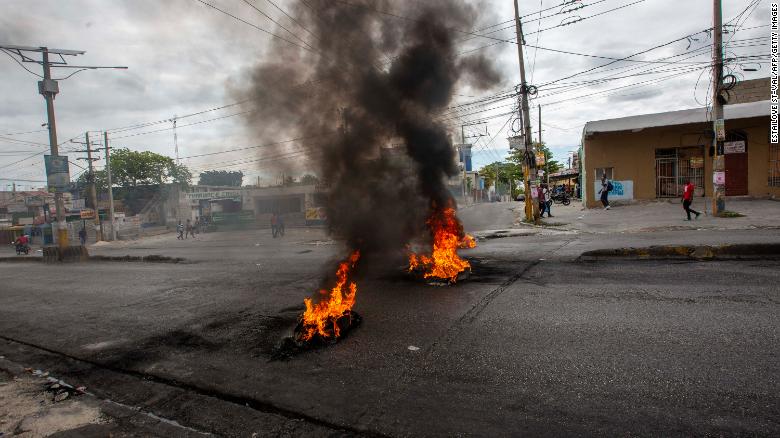
Main roads through the city of Port au Prince are blocked after Sunday's clash between Haitian police and the army in Port au Prince, Haiti February 24, 2020.The police protests are not directly related to recent anti-government protests, but they add to the widespread unrest that has gripped the nation since February last year as demonstrators demand the resignation of Haitian President Jovenel Moise.
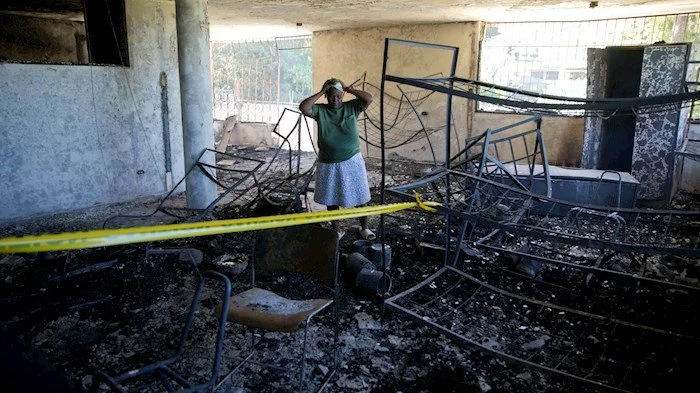
15 Killed in Fire at Haiti Orphanage Run by US Church
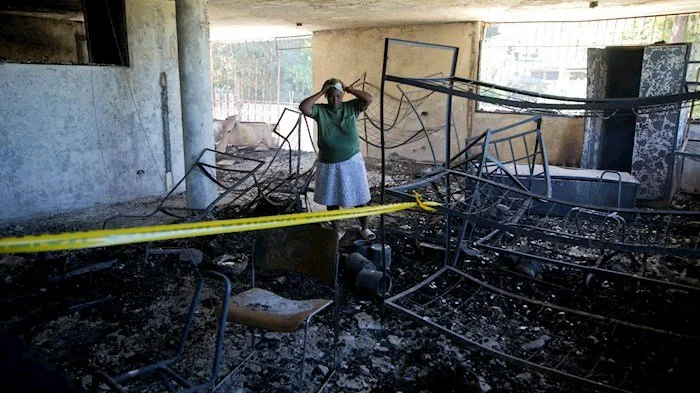
The controversial Church of Bible Understanding lost accreditation several years ago for unsanitary conditions at the facility.
A fire swept through a Haitian children’s home run by a Pennsylvania-based Christian nonprofit group, killing 15 children, officials said Friday.
Rose-Marie Louis, a child-care worker at the home, told The Associated Press that the fire began around 9 p.m. Thursday and firefighters took about 90 minutes to arrive. The orphanage had been using candles for light due to problems with its generator and inverter, she said.
About half of those who died were babies or toddlers and the others were roughly 10 or 11 years old, Louis said.
Late Friday afternoon, police raided another home also run by the Church of Bible Understanding and took away several dozen children in a bus over protests from employees.
The fire happened at the group’s orphanage in the Kenscoff area outside Port-au-Prince, the Haitian capital.
“It could have been me,” said Renadin Mondeline, a 22-year-old who lived in the home with her son, now 6, for about two years until she started making enough money as a street vendor to start renting her own place to live last year. “These little girls inside were just like my baby.”
Rescue workers arrived at the scene on motorcycles and didn’t have bottled oxygen or the ambulances needed to transport the children to the hospital, said Jean-Francois Robenty, a civil protection official.
“They could have been saved,” he said. ‘‘We didn’t have the equipment to save their lives.’’
The Associated Press has reported on a long-standing series of problems at the two children’s homes run by the Church of Bible Understanding.
“‘We are aware of the fire in the children’s home in Haiti,” said Temi J. Sacks, a spokesman for the group, which is based in Scranton, Pennsylvania. “It would be irresponsible for us to comment until after all the facts are in.”
The Church of Bible Understanding lost accreditation for its homes after a series of inspections beginning in November 2012. Haitian inspectors faulted the group for overcrowding, unsanitary conditions, and not having enough adequately trained staff.
Members of the religious group were selling expensive vintage building fixtures like banisters and chandeliers at high-end stores in New York and Los Angeles and using a portion of the profits to fund the homes.
The Associated Press made an unannounced visit to the group’s two homes, holding a total of 120 kids, in 2013 and found bunk beds with faded and worn mattresses crowded into dirty rooms. Sour air wafted through the bathrooms and stairwells. Rooms were dark and spartan, lacking comforts or decoration.
The Church of Bible Understanding operates two homes for nearly 200 children in Haiti as part of a “Christian training program,” according to its most recent nonprofit organization filing. It has operated in the country since 1977. It identifies the homes as orphanages but it is common in Haiti for impoverished parents to place children in residential care centers, where they receive lodging and widely varying education for several years but are not technically orphans.
“We take in children who are in desperate situations,” the organization says in its tax filing for 2017, the most recent year available. “Many of them were very close to death when we took them in.” The nonprofit reported revenue of $6.6 million and expenses of $2.2 million for the year.
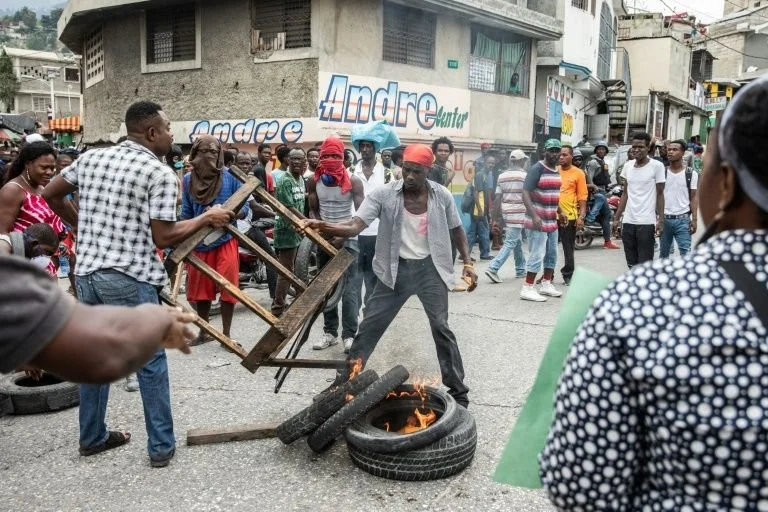
With Government Paralyzed, Rising Crime Terrifies Haitians
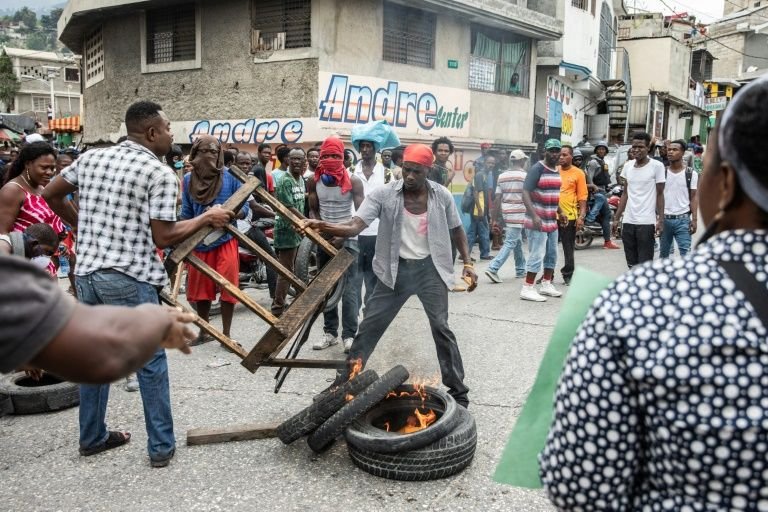
PORT-AU-PRINCE, Haiti — Thousands of young Haitians spent 2019 on the streets, demanding President Jovenel Moise resign over his government’s failure to prosecute years of unbridled corruption that siphoned billions in international aid into bank accounts overseas.
For now, Moise's opponents have failed.
Haiti’s parliament shut down indefinitely in January because of the chaos, eliminating the check on presidential power that paralyzed Moise for years. Thursday marks the president's first month of ruling the country by decree.
But the reed-thin former banana farmer looks nothing like the strongmen of Haiti’s past. With weak political support at home and an international community wary of democratic backsliding, Moise has issued no significant decrees and billions in development aid is blocked.
Three years into his five-year term, the president appears barely able to enforce his will beyond the gates of the National Palace downtown and his relatively modest rented home in the hills above Port-au-Prince. In the city below, gangs rule entire neighborhoods and a wave of kidnappings is terrifying ordinary Haitians.
“A few hundred feet from the National Palace, armed gangs control the streets,” said Paul Denis, who served as justice minister under President René Preval. “But the president who leads us, what is he doing? What is he doing to impose order, to render these bandits harmless? Absolutely nothing.”
The United States, United Nations and Organization of American States are trying to midwife a deal between Moise and his opposition that would lead to declaration of a unity government and avert a return to chaos on an island that’s seen two coups, U.S. intervention, a U.N. peacekeeping mission and a devastating earthquake in the 34 years since the end of a decades-long dictatorship.
“The president of the republic has no power and the people demand everything from the president of the republic,” Moise, 51, lamented last week in an interview with The Associated Press “The president is responsible for everything,”
In the vacuum, insecurity is growing.
Two years after the departure of U.N. peacekeepers, young bandits with automatic weapons randomly halt cars on the main routes in and out of the capital. The economy appears to be shrinking. Electricity comes only a few hours a day in most of the capital. Some police are protesting working conditions and demanding a union, which the government says would be illegal.
“The people have been thrown to their fate,” said Edel Berger, a slender 29-year-old apprentice lawyer who was walking to work in a suit Tuesday morning despite the 90-degree heat. “We’re all in danger. Every Haitian needs to buy a gun to protect themselves. It’s the law of the jungle.”
Along with the Canadian and French ambassadors,, diplomats from the U.S., U.N. and Organization of American States are trying to persuade as many political players as possible to agree on an agenda for talks and sit down to negotiate.
"The U.S. would really want to see forward movement here," Ambassador Michele Sison told the AP. "Getting a political accord in place that would lead to a functioning government, to be able to move this country forward and restart, we would hope, economic growth, bring in a functioning government that could serve the people."
Backed by the international community, Moise is demanding to stay in office until he can oversee the passage of a new constitution that strengthens the presidency and eliminate the ability of just a few opposition legislators to block virtually all laws and appointments.
Members of the moderate opposition say they are open to such a deal. The hard-line politicians who brought the country to a halt last fall demanding Moise’s immediate resignation are also talking about joining negotiations.
“The opposition has never rejected dialogue as a means of resolving the crisis,” said André Michel, a lawyer and hard-line opposition spokesman. “All of this should be on the table: When should the president leave power? Should the president leave power in three weeks, this week, in two months?”
Michel said the opposition’s non-negotiable demand was the release of about 150 opposition members jailed over the last year and the cancellation of arrest warrants for another 50 people. Sison, the U.S. ambassador, said the Trump administration's central demand was holding legislative elections as soon as technically possible.
Representatives of the president and the moderate opposition held three days of fruitless talks late last month at the mission of the papal envoy to Port-au-Prince.
Sidelined in the negotiations is the anti-corruption movement known as the Petro Challengers, which began on social media in 2018 and spread onto the streets. The movement was sparked by reports from government investigations into the misdirection of hundreds of millions of dollars in revenues from PetroCaribe, a now-defunct Venezuelan program providing subsidized oil to Caribbean countries.
Several of the young, well-educated leaders of the movement said Moise had proven himself incapable of governing and should immediately hand power to a technocratic transition government that could oversee prosecutions for corruption and the reconstruction of public institutions.
“We've said that we don't want to continue with Jovenel Moise, that we want a transition that would move the Haitian people toward honest elections, and the international community has said, ‘No, we're going to continue with Jovenel Moise,'' and the meanwhile the situation is degenerating every day,' said James Beltis, a 37-year-old sociologist and spokesman for one of the movement's main groupings.
Jean-Lylus Louis-Jean, 57, earns a little more than $100 a month as a sanitation supervisor for the city of Port-au-Prince. On Tuesday morning he stood in the shade of a cinderblock wall in the Delmas 33 neighborhood waiting for a truck to come pick up a long pile of trash that had been dumped along the sidewalk.
He said he felt in danger every day in Port-au-Prince from the gangs of muggers and kidnappers that roam the city, and things were no better in his hometown of Las Cayes, a town on the southern coast where he once felt completely secure.
"I"m risking my life every day being in streets," he said. “Young men are killing each other for pocket change. The only thing I have keeping me safe is God watching over me.”
Prime Minister Jean-Michel Lapin announced Wednesday that police would begin searching vehicles at random in an attempt to crack down on kidnapping. And he said Moise would pass a budget by degree that would raise the salaries of police and other public employees.
“We are working secure the population,” he said.
But after months without protests, Port-au-Prince saw hundreds of university students and other demonstrators return to the streets Wednesday in a demonstration against the wave of kidnappings. Protesters chanted "Down with kidnapping!” and destroyed stands set up for carnival celebrations this month. Police fired tear gas to disperse them.
“We not going to stop,” said Mario Brice, an unemployed 34-year-old. “Jovenel have to leave office, the country is not moving anywhere ... Look around, it's nothing but guns and people being kidnapped.”
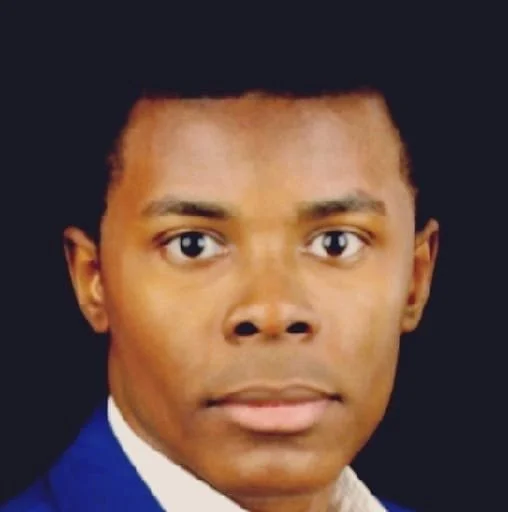
Musician Werley Nortreus Announced Presidential Bid Nomination In Haiti
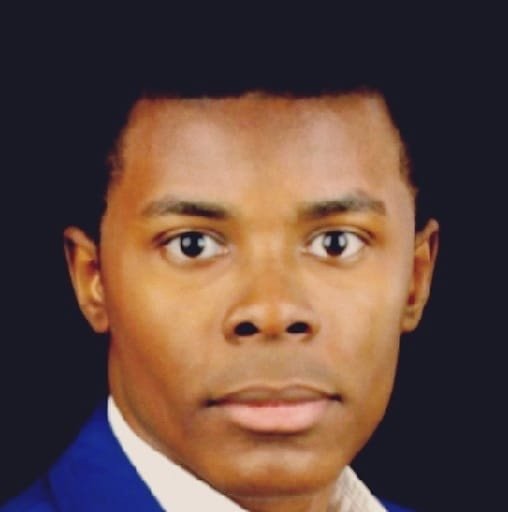
26 years old, Werley Nortreus is known as a Musical Artist, Author, Entrepreneur, Politician, and the CEO of Ceraphin Corporation, a mass media company that he founded. He was born in Limbé but he was raised in Port-au-Prince, the Capital of Haiti. He believes in Humanism and he wants to be a contributor for a better Haiti before the year 2045.
He studied business administration and political science because he wanted to become an Entrepreneur and a Politician to serve his home country, which is Haiti.
The 26 years old musician believes that the youth in Haiti and the upcoming generations should see him as a role model so they can have the same mindset and behave exactly like him. He uses his music and books to speak positive messages so the world can become a better place. Hopefully, the future Leader of Haiti believes that Haiti will get on its feet before the year 2045 once he takes offices.
For years, Werley Nortreus has contributed towards political movements and activism, include 'Haitians Lives Matter' and 'Black Lives Matter' movements. Those movements have contributed strong messages about discrimination and racism, especially towards black people in America and around the world. Werley Nortreus hopes to inspire many people along his journey to make the world a happier and healthier place to live.
One of his greatest goals is to help his homeland earn the respect and position in the global community as viewed through his own eyes. His love and admiration for his home country are evident when you speak with him. Nortreus is proud to have been born and raised in the Caribbean, and the culture and its ethnicity mean everything to him.
According to a few interviews, Werley Nortreus has a deep passion to involve in politic and for the right reasons. He wishes one day to become the President of Haiti in order to help Haiti get its respect and dignity back from those who stole it years ago. Through his organizations as well as in his personal capacity, Werley has helped when natural calamities destroyed many human lives in Haiti. He believes in unity and he believes Haiti will change one day.
"As a human being, I believe that I was created in order to value and love other humans like me. Humanism is the reason that I want to become the President of Haiti one day, in order to serve my country and serve other countries around the world.", said Werley Nortreus.
"The first wish should be named "A New Haiti" because I've always wanted to see Haiti become a significant country in the world. The second wish should be named "Werley Nortreus to become President of Haiti" because I love Haiti so much and I will take all the risks and everything it takes to change the country. The last wish should be named "Haiti is the most powerful and respected country in the world", because the country has suffered so much, and I believe it's time for the country to get its power and respect back.", said Werley Nortreus during an interview with Kreol Magazine in the UK.
"As we all know that there are a lot of Chaos and Riots in Haiti from 2016 until today and the current Leader 'Jovenel Moise' and 'PHTK' Leaders refused to step down, which is not good for the country because the protesters won't give up the streets until they step down. Honestly, I, Werley Nortreus want to involve in politic in Haiti so I can put the country in the right path so the country can get its respect and dignity back from the elites who stole it.", said Werley Nortreus.
He believes that the youth in Haiti and the upcoming generations should see him as a role model so they can have the same mindset and behave exactly like him. He uses his music and books to speak positive messages so the world can become a better place. Hopefully, the future Leader of Haiti believes that Haiti will get on its feet before the year 2045 once he takes offices.
"I would like to debate with Jovenel Moise". Said the musician.
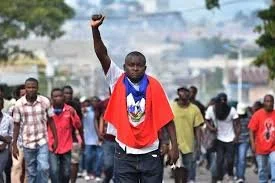
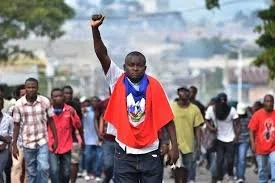
Haiti Is in the Eye of the Storm
Port-au-Prince—My friends in Haiti told me not to come—too much chaos, too much violence. if i insisted on coming, they advised, I had to find a bodyguard, a driver, and an armored car. They said: Bring expired credit cards to give to armed robbers; don’t bring cash. Dress down (as if I ever dress any other way) and don’t wear jewelry. And of course, don’t visit any ATMs or banks. Don’t go near the shantytowns, where I previously spent hours talking to people, hanging out. Don’t drive late at night. Don’t go downtown.
It all seemed a little extreme. But then, a week and a half before I arrived, a French couple who had never been to Haiti before were killed shortly after they flew in to adopt a kid—gunned down in front of their hotel, in an area you pass all the time, no matter where you’re going.
For more than a year, the country has been rocked by protests against its corrupt president, Jovenel Moïse, a former banana dealer known in Haiti as Neg Banann, and against the corrupt political system more broadly. Peaceful sit-ins came together outside government buildings in the capital, and large, stirring marches took place throughout the country. The system responded: Well-armed police in battle gear fired on many of the protests, and at least 187 people were killed, some execution style. Journalists were assassinated.
By the time I was planning my trip, Haiti seemed on the edge of a crisis or breakdown. I’d seen such moments there before. Sometimes they would swing in favor of the people, more often in favor of the ruling elites and the status quo.
Haiti was cornered—exhausted, hungry, exasperated with the old, afraid of the new. To make matters worse, in mid-January, the 10th anniversary of the earthquake that killed more than 100,000 people would arrive, and so would the international media, to show Haitians and the rest of the world how little the country has changed for the better during the past decade, how deeply it has sunk back into the old, bad ways. Yet new threads of hope were gleaming and glittering through this dark material, new ideas coming from young people who feel that without change, they have no future in this country. Older opposition figures—some valuable, some not—are also trying to figure things out, a fractious but united group whose breadth hasn’t been seen here recently.
By the time I was planning my trip, Haiti seemed on the edge of a crisis or breakdown. I’d seen such moments there before. Sometimes they would swing in favor of the people, more often in favor of the ruling elites and the status quo.
Haiti was cornered—exhausted, hungry, exasperated with the old, afraid of the new. To make matters worse, in mid-January, the 10th anniversary of the earthquake that killed more than 100,000 people would arrive, and so would the international media, to show Haitians and the rest of the world how little the country has changed for the better during the past decade, how deeply it has sunk back into the old, bad ways. Yet new threads of hope were gleaming and glittering through this dark material, new ideas coming from young people who feel that without change, they have no future in this country. Older opposition figures—some valuable, some not—are also trying to figure things out, a fractious but united group whose breadth hasn’t been seen here recently.
Meanwhile, Haitians continue to face what Pierre Esperance, executive director of the Haitian National Human Rights Defense Network (RNDDH), has called “the ongoing gangsterization of the state.” Armed gangs—estimated to number in the dozens—regularly receive funding, automatic weapons, and ammunition, although as Esperance points out, Haiti doesn’t make weapons or ammo, and the country has been under an on-and-off arms embargo for many years. These gangs have carried out five massacres during the Moïse administration, the worst of them in a shantytown known as La Saline, a hotbed of anti-government protest that borders one of Port-au-Prince’s best-known open-air markets; at least 71 people were brutally murdered there.
All the protests have posed a question central to national sovereignty: Who owns the nation—the people or the government and business class? “Kot kob PetwoKaribe?” (Where’s the PetroCaribe money?) has been the protesters’ cry, a reference to the late Venezuelan president Hugo Chávez’s aid program for Haiti, whose funds have been ruthlessly plundered by government officials and their friends. The plunderers include Moïse, according to a damning 656-page report by the Haitian government’s own auditors. The PetroCaribe funds were meant to develop housing, sanitation, roads, health care—things that Haitians need desperately. But most of the money is gone, vanished into political pockets and, through various kinds of nepotistic zombie contracts, into the wallets of good friends of the current administration and its predecessor.
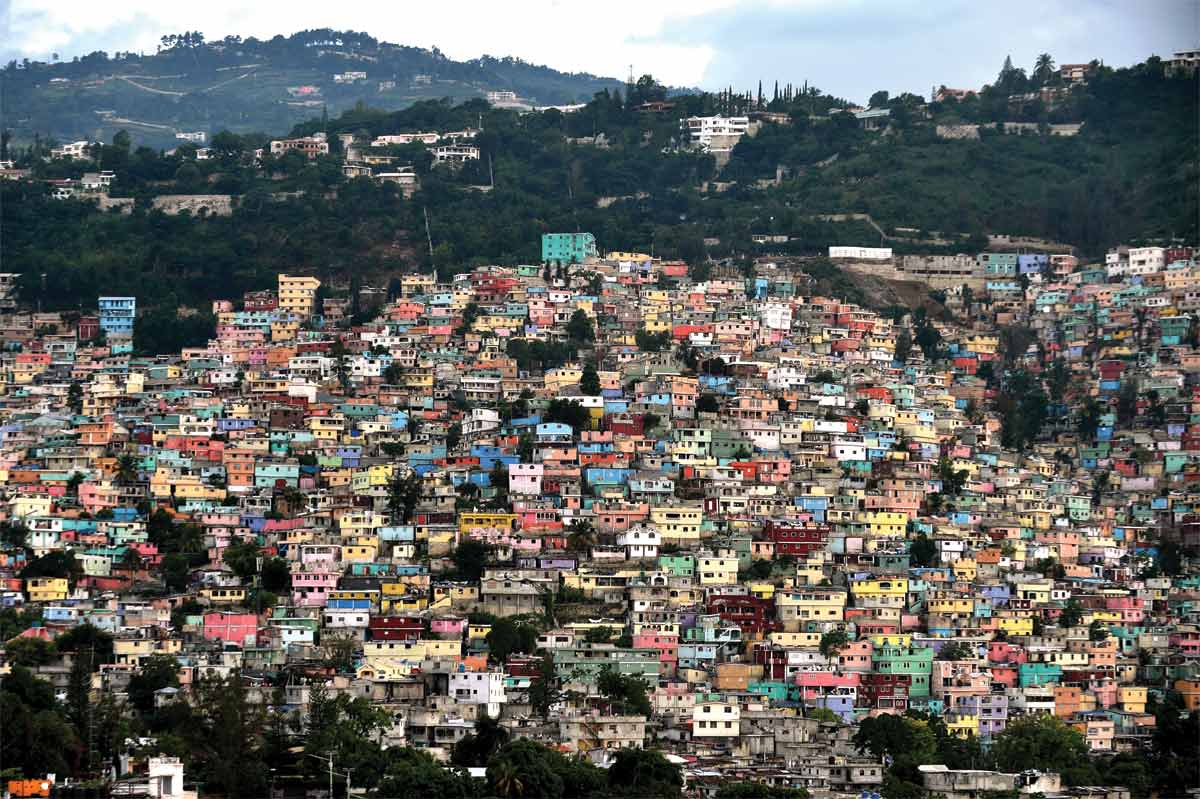
(Hector Retamal / AFP via Getty Images)
More damningly, in February 2019 supporters of Moïse (and possibly the president himself) sent a band of US mercenaries to protect an official who went to the central bank downtown to transfer $80 million from the PetroCaribe fund to an account controlled exclusively by the president.
For three months this fall, the opposition put the country on repeated lockdowns. No one violated peyilok, as it is called. People starved but didn’t (or couldn’t) go out to buy food; people were sick but couldn’t get to the doctor. You couldn’t work. By the time I arrived in December, kids hadn’t been able to go to school since the term began in September. The dead couldn’t be taken to the morgue. During these days and weeks of peyilok, the opposition called on various sectors of society to march in protest—labor, clergy, artists and musicians, medical workers, students, and others. But meanwhile, armed gangs of no clear provenance roved the streets, shooting at will.
Still, Moïse says he is committed to serving his full term, which ends in 2022. Late last month he moved from virtual silence into neo-Duvalierist mode, saying there were a number of people whose heads he intends to “cut off.” He threatened that there will be “accidents” if people get in his way. Silent regarding the massive opposition against him, Moïse focused his rage on an energy provider that sells electricity to the state-run Electricité d’Haiti, another trough of possible corruption that he has long desired to control.
“What happens when the unstoppable force meets the immovable object?” asked Kim Ives, a veteran Haiti observer, referring to the protests and the president. “In Haiti, the answer seems to be: You form a commission.”
There are now several commissions militating for Moïse’s orderly departure, the resignation of the useless Parliament, and the installation of a replacement government in some form. They range ideologically from fairly far left to pretty far right. What is unprecedented is that they’ve been trying to work together. Still, for the young, who make up the majority of the country’s population and have been crucial to the protests, the results have been less than spectacular.
“We are against corruption and impunity, and we are for social justice,” said Pascale Solages, a young leader of the group Nou Pap Dòmi (We Will Not Sleep). NPD is part of the enormous Petrochallenger opposition, which mostly consists of young people who have come out repeatedly to protest the government’s impunity over its plunder of the PetroCaribe funds. Solages and I sat at a long table at a restaurant NPD often uses as a headquarters. Surveying the various groups clamoring for Moïse’s ouster, Solages added, “I don’t have a single view of the opposition. But for the most part, it is run by a political class that the population does not trust. For the last 30 years they’ve been destroying Haitian institutions, which are now on their knees. We need a new political class and a profound change.”
After months of peyilok—and amid concerns about further instability in this “shithole” country—the Trump administration, previously indifferent to Haitian affairs, sent down three US officials in turn for brief visits and photo ops with Moïse. The meetings changed the tenor of the national conversation. Each American bureaucrat advised the Haitian president to meet with the opposition, but none suggested that he depart. Then they left. It was clear the US government was not going to whisk Moïse away; he was its obedient friend. At the United States’ behest a year earlier, Haiti’s ambassador to the Organization of American States (OAS) voted against recognizing the legitimacy of Nicolas Maduro’s election in Venezuela. Maduro is the successor of Chávez, who had provided all the PetroCaribe money for Haiti.
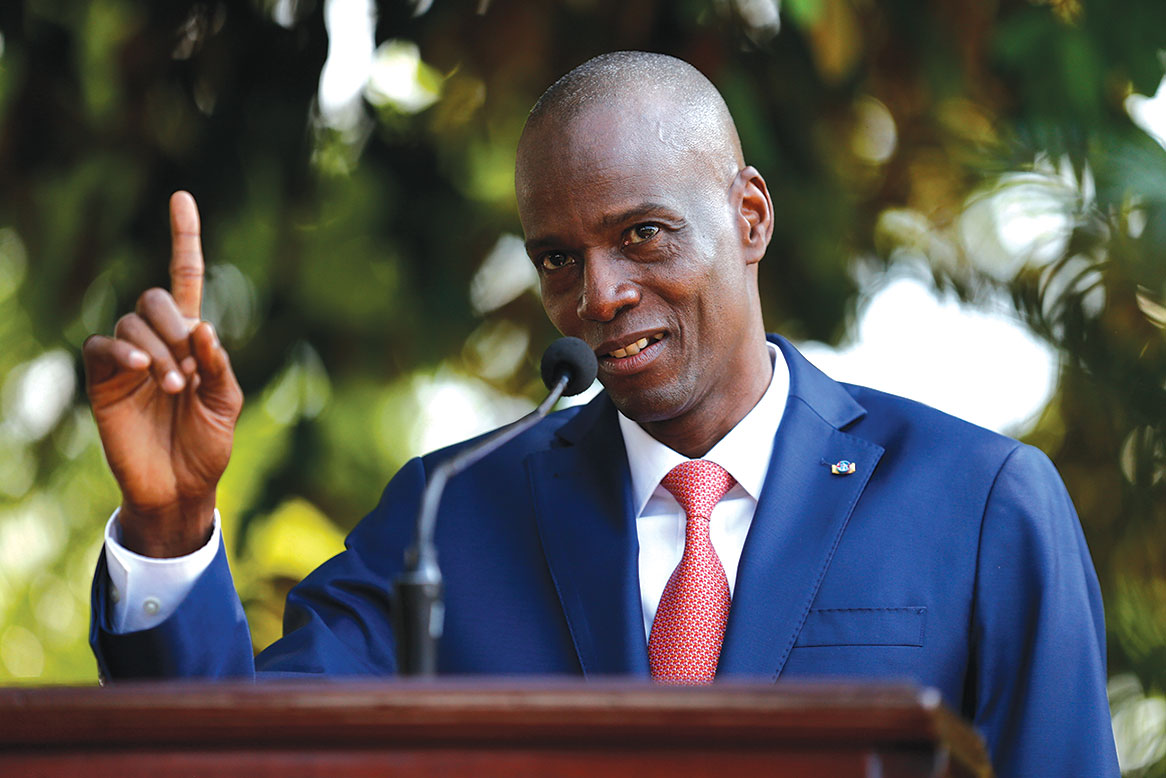
Not going: Haitian President Jovenel Moïse has defied repeated calls to resign—warning that there will be “accidents” if people get in his way. (Rebecca Blackwell / AP)
After the visits, Moïse reached out to the opposition, as recommended by his American friends, always with the understanding that he was not going to leave. The opposition initially refused his invitation. That’s when I arrived, expecting peyilok, armed gangs, paralysis. I took an armored car to my hotel with two big bodyguards in the front seat. In spite of all the dire warnings, everything was calm. Feeling ridiculous—even foolish—and extremely white, I quickly abandoned the security detail. From then on, my stay was in many ways like every other time I’ve spent in Haiti. Although we drove high up into the hills above town and then far downtown into the poorest and most crowded areas and then over to the shantytown where I’d been told I absolutely could not go, we had no problem.
What accounted for this relative peace? It was the opposition unlocking the country. Haitians were growing restive and resentful under the strictures of peyilok. “People are tired of it,” Solages said. Also, the opposition did not want to seem unaware of the US position; they needed a space from which to negotiate that didn’t appear intransigent.
Interestingly, Haiti has now gone from peyilok, which exerted real pressure for a change of government, to a political paralysis from which it’s hard to see an escape route. Moïse’s position remains precarious. On one side, he faces an angry, organized, and militant population trying to push him out. On the other, his friends need him to remain in power so the plunder can continue. Moïse is no doubt worried about both the people and his friends. In French they call his position coincé, or cornered.
In the midst of all this, no one but the current president believes in the value of future elections. Elections brought Haitians the corrupt Moïse—even though it took 14 months from the initial ballot to the final result, with all sorts of shenanigans in the process. An earlier, questionable election, the results fudged with the connivance of OAS personnel, brought them the corrupt Michel Martelly, whose sole qualification for the presidency was his fame as a singer and entertainer.
Most Haitians simply don’t believe in elections as they are currently run. To quote the former president Jean-Bertrand Aristide, who was elected in a 1990 landslide that no one has yet questioned (or duplicated), elections in Haiti have since turned into “selections.” Aristide, by the way, was ousted in a coup green-lit by George H.W. Bush’s administration just nine months after that landslide. So much for the legitimately elected.
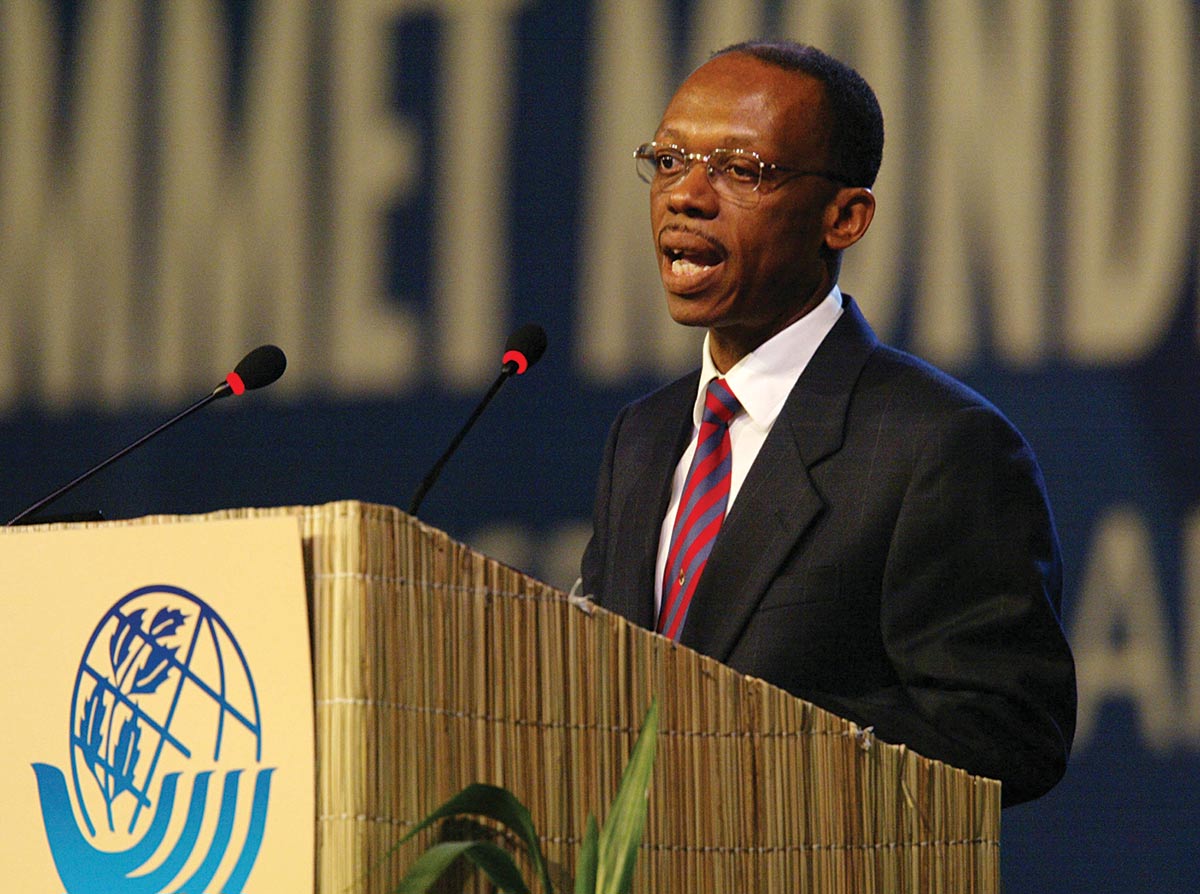
Yesterday’s man? Jean-Bertrand Aristide was elected president in a 1990 landslide that none of his successors have matched—which didn’t protect him from a US-sponsored coup. (Anna Zieminski / AFP via Getty Images)
Today Aristide lives in a large white house in Tabarre, a suburb of the capital that was farmland when he built his home there some 30 years ago but is now part of the growing Port-au-Prince metropolitan area. There are peacocks and peahens roaming his front lawn.
Aristide seems to have retired from political life after the presidential candidate he backed lost the contested election that Moïse eventually won. But in Haiti, tou sa w we, se pa sa, as the expression goes: All that you see is not what it seems. And many think Aristide is still working behind the scenes.
He greets me in his very presidential office: huge desk in the center, white walls, white tile floors, bookshelves, the Haitian flag. He is wearing a formal white guayabera and pressed pants and doesn’t seem substantially changed from the person I first met back in 1986, when Jean-Claude Duvalier (aka Baby Doc, the son of François “Papa Doc” Duvalier, the country’s notorious longtime strongman) had just fallen. Back then, Aristide was a firebrand priest from the poorest parish in town. His break with the church, his two presidencies (or three, depending on how you count them), the two coups d’état against him, his two forced exiles, marriage, fatherhood, projects of all kinds—nothing seems to have changed him. He remains the kind of person who would love a peyilok movement. No doubt he’d like to lead it.
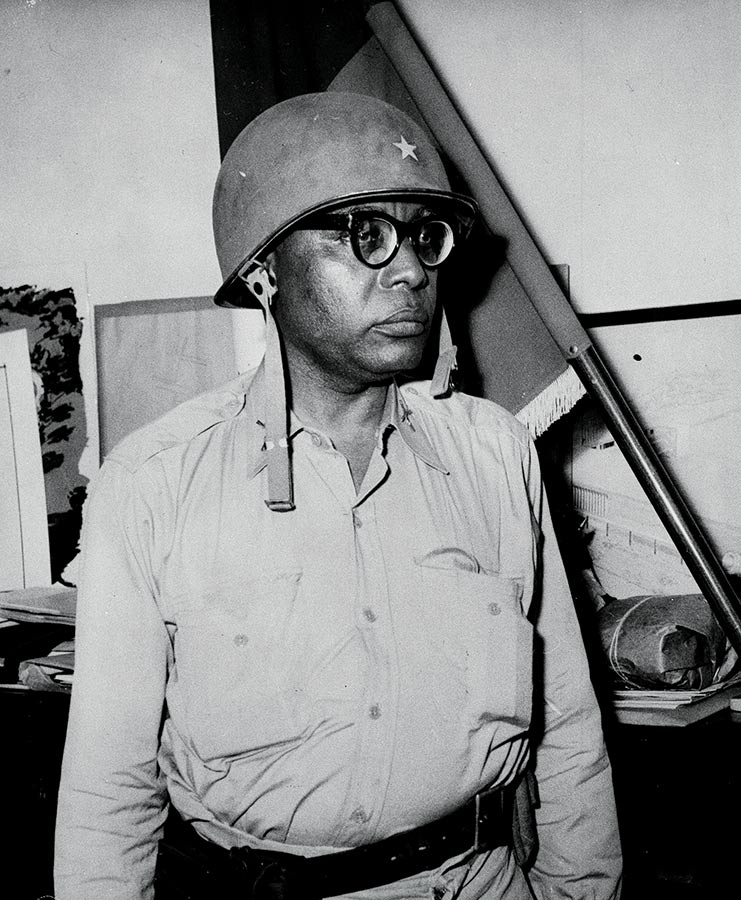
Papa Doc at war: President for Life François Duvalier fighting off a military coup in 1958. He led his despotic regime for 13 more years, until his death. (AP)
Aristide’s radicalism in the mid-1980s, which grew out of liberation theology, seemed unacceptable to the moderates then running the world. It might be more acceptable now, especially since it has been embraced by the new generation, both in Haiti and elsewhere. In 2003, long before Ta-Nehisi Coates’s famous piece in The Atlantic, Aristide presented France with a $21 billion bill for the 90 million gold francs in reparations that Haiti (the victor, remember) was forced to cough up to France (the loser) after the Haitian Revolution in 1804. (France cavalierly rejected Aristide’s payback demand and promptly collaborated with the United States to remove him from the presidency—for the second time.) Still, in spite of Aristide’s historic feats, it seems unlikely that a person with his vexed history, in Haiti and the hemisphere, can carry the banner for a new way forward.
But Aristide is not the only name from the past that gets mentioned in discussions of Haiti’s future. As a toddler, Nicolas Duvalier fled the country with his family when his father, Baby Doc, was overthrown by a popular uprising in 1986. Though Nicolas Duvalier grew up mostly in France, he’s been toying recently with a future in Haitian politics. “We are not there yet,” he said when asked if he’ll run for president. But there’s a saying in Haitian Creole (there’s one for every occasion): Ptit tig, se tig. The son of a tiger is a tiger.
Haitians are thinking about the earthquake as its anniversary approaches. They’re always thinking about the earthquake, actually, because everyone lost someone in it and because the rebuilding effort has been such a massive disappointment. Most of the money promised to Haiti for reconstruction has been squandered or stolen or lost—or was never delivered in the first place. Bill Clinton’s Build Back Better campaign for post-earthquake Haiti has been a total failure, despite the campaign’s declaration amid the rubble that the country was “ready for business.”
Clinton was appointed the United Nations special envoy for Haiti eight months before the quake struck. (He and Hillary Clinton spent part of their honeymoon there in 1975.) Much of the funding that came in after the earthquake went to US contractors for projects, fees, housing, food, and security. Less than a penny on every dollar ended up with Haitian groups.
A few banks downtown have been rebuilt, but there is still earthquake rubble in the area behind them, topped with burning garbage, through which the poorest of the poor are scavenging. Even on Grande Rue downtown, once the city’s business center, you can see 19th century buildings ready to collapse. People live and work precariously amid the rubble or are constructing concrete buildings that don’t abide by any seismic code. A few shantytowns were created during reconstruction, but they are now overrun with gangs and drugs.
There are some new hotels, most functioning at a reduced level because of peyilok and because the post-quake international relief caravan has moved on to more fruitful fields. Interestingly, the most lucrative clients the hotels have attracted recently have been the opposition factions that met to produce what are known as the Marriott Accord, which seeks the replacement of the entire Moïse government, and the Kinam Agreement (at the Hotel Kinam), which calls for the replacement of the entire government—except for Moïse.
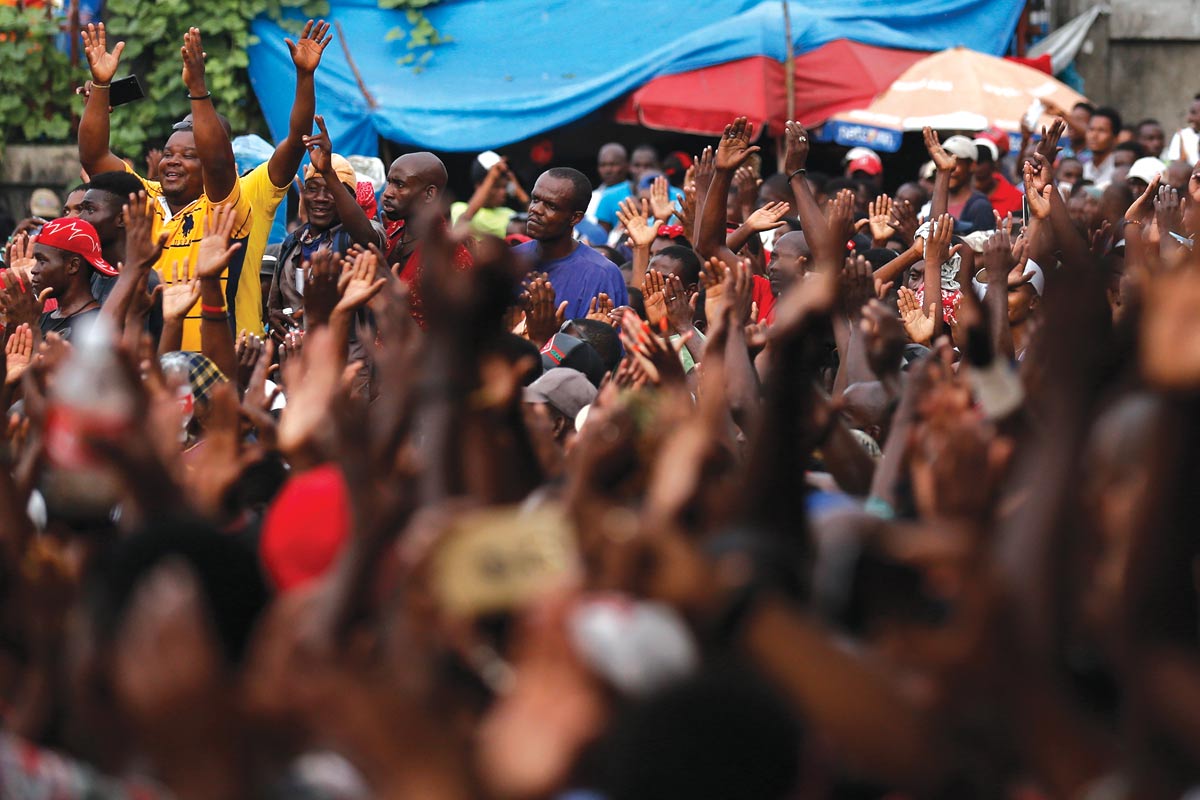
A country in lockdown: During the months of peyilok, different sectors of society each marched. Here, artists from Port-au-Prince take to the streets. (Rebecca Blackwell / AP)
“Haiti is a little machine that produces gigantic amounts of corruption,” said Frantz Duval, the editor of Le Nouvelliste, the French-language daily in Port-au-Prince. “The earthquake was like PetroCaribe. All that money suddenly turning up was an opportunity for thievery. And there’s kind of an entente cordiale among the thieves splitting up the booty. There was a period of enjoyment after the earthquake when everyone was in the game—just like PetroCaribe.”
This is why Petrochallengers like Solages don’t just want to displace Moïse; they want to get rid of the whole damn system. Most people here don’t go into government for the love of statecraft or out of a desire to serve the public. They do it to enrich themselves as much and as quickly as possible before they’re ousted by the next batch of thieves. Periodic elections do little to intrude on this musical-chairs mechanism; they simply offer an illusory authenticity to each successive wake of vultures.
By the middle of December 2019, the opposition began to send out feelers to Moïse. The message that the United States wanted him to stay had been received. This doesn’t always play out, though. At the end of January 1986, President for Life Jean-Claude Duvalier stood before the Haitian people and told them, “I am here, stronger than a monkey’s tail.” A week later, he was on a US C-141 transport plane bound for Paris.
It turned out the Reagan administration had other ideas about who could run Haiti. The State Department put together a claque of Haitian political figures and army officers known officially as the National Council of Government but called by Haitians what it was: the junta. The Trump administration, au contraire, apparently can’t imagine an alternative to its pliant Haitian banana dealer.
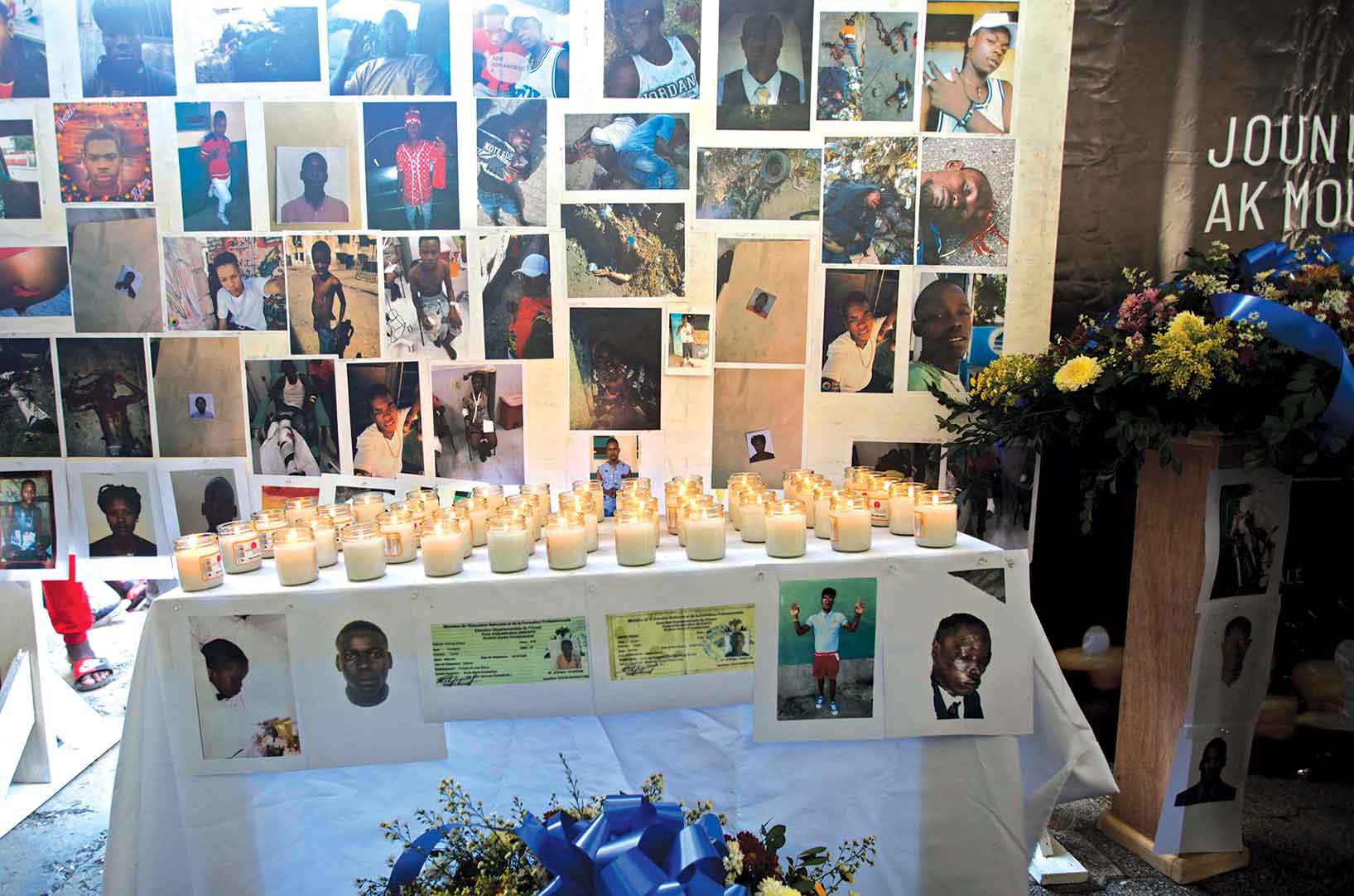
Not forgotten: An altar commemorating the victims of La Saline massacre. (Dieu Nalio Chery / AP)
Idrive to an end-of-the-year picnic in the mountains above Port-au-Prince in a convoy with a group of businesspeople, diplomats, and their families. On the way up, the city falls away, and then you’re in the Haitian countryside. The hills are steep, and terraced emerald farms climb the sides of the canyon. Strong, thin farmers—kiltivatè, as they’re called—walk by the side of the road carrying their machetes. Women walk there too, carrying produce to market in baskets or black garbage bags, a more modern accessory, on their heads. Roadside shacks and little stalls sell fruit and water in the smallest to-go plastic bags.
At the picnic, a beautiful little blond girl is swinging from a hammock and talking about her grandparents’ house in Palm Beach—“not on the beach, though.” But where do you live? “In Haiti, of course, but we’re moving.” Where to? “I don’t know. Bahamas, Croatia….”
“We are all moving out of the country,” says one glamorous matron from an old and wealthy family. “We’re all selling our houses. Except, of course, no one is buying. Because the people who could buy are all selling, obviously. The situation in the country is unacceptable. We can’t sit through another one of these episodes. We have to go. And the thing is, what these people don’t understand is, we are the state.”
The implication is clear: When they go, Haiti fails. Though from what I’ve been told, the elite moved most of their money out of the country a long time ago.
Richard Widmaier runs Radio Metropole, which in one form or another has been in his family for four generations. He’s not a big enthusiast of Moïse (“He has a passion for two things: agriculture and himself”) but still thinks he should remain in office. “OK, he really should have just been minister of agriculture, which maybe he could have handled,” Widmaier says. “But a president who’s elected for five years should serve for five years.” It’s a point of view held mostly by people with connections to the present government—or who understandably fear the chaos that might ensue if Moïse steps down.
Later that day, I’m with a businessman up in Pétion-Ville, which used to be a safe haven from the craziness of downtown until the earthquake came and downtown moved uptown. We’ re having a lovely dinner on a covered terrace, palm fronds shaking in the breeze, pretty little sconces and chandeliers over the tables. My friend is eating the biggest crab I have ever seen. We’re chatting in a preliminary way when he gets a call.
“Another kidnapping,” he says as he takes the phone out of the restaurant. “I can fix this,” I hear him say to the person on the other end. Four minutes later, he comes back to the table, and we finish our meal almost as if nothing out of the ordinary had happened. Two days later, the victim is released. A ransom was paid. Kidnapping is a business in Haiti now.
Ihave an old friend in Haiti who has worked in difficult political situations there for pretty much her whole life. She has moved up and down through nongovernmental organizations, and she’s Haitian, so she understands the lay of the land—and doesn’t want me to use her name. After Duvalier fell, she says, Haitian civil society burst into activity. There were all sorts of meetings—tet ansanm (heads together) is the term in Creole—of intellectuals, artists, professionals thinking about ways to jump-start the country. “And the thing is, they were all doing it on their own,” she says, “without start-up funds or not-for-profit status or money from foreign groups.” Farmers were still managing to grow and survive on their small plots of land. Back then, Haiti still had food self-sufficiency.
Now, she points out, Haiti is the second-largest importer of US rice, after Mexico. I hear this fact mentioned everywhere I go, because it is astonishing to Haitians. The country’s fertile Artibonite Valley once provided more than enough rice to feed Haiti. The story of how rice production failed is long, but it includes subsidized US rice being dumped on the Haitian market during the Clinton administration, with much of the grain coming from Arkansas farms. As cheap US rice undersold locally produced rice, farms in Haiti collapsed, and people from the countryside moved to the capital, where they eventually lived in shacks and shanties and ended up eating US rice. When Duvalier left, my friend continues, the Haitian poor were still fit and healthy. Now they eat “really scary” imported stuff, and illnesses that used to be rare—like heart disease, diabetes, and cancer—are increasingly common.
She paints a picture of the pastoral Haiti that I remember. There were ideas and activism and a lot of energy. Living was cheap. Professionals could reside in leafy neighborhoods, and even though they earned only $600 or $800 a month, rent was just $50. But in 1991, when the first UN observers arrived (after the initial coup against Aristide), some were earning $6,000 a month, and rents rose.
“Every natural disaster here brought with it new outsiders,” my friend says. “The value of things is no longer measured by the national but by the international market. Haitians are priced out of everything, including food. To put together a group, you have to rely on outsiders to fund you, and your innate Haitianness gets lost or muddled.”
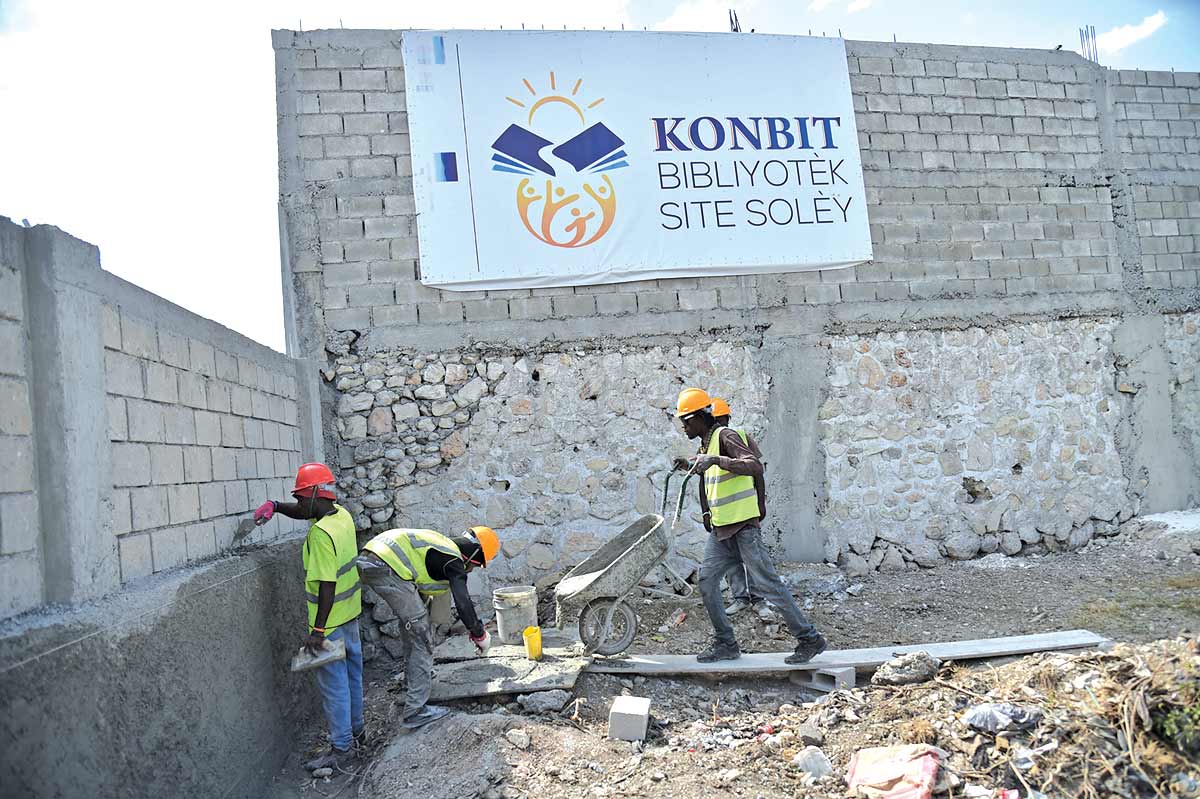
Book by book: In Cité Soleil, where armed gangs roam the streets, a library is being built by the community. (Hector Retamal / AFP via Getty Images)
“Haitians aren’t the same as they were in 1986,” says Marcus Garcia, a longtime editor and radio host. “There’s not much hope. And the politicians are not the same. There are no éminences grises. All the communists are dead. The intellectuals are dead. The objective press is finished. The diaspora is desperate and disappointed. There’s just a big void everywhere.”
What is new and good in the country, he adds, are the young. For a while, after the earthquake, they fled; there were two planes a day to Chile and Brazil. “With the changes in those countries’ governments, that’s no longer an option,” Garcia says, “and so the kids have nowhere to go. They have to fight for their lives here, and that’s what we’re seeing.”
My old Haitian friend from the NGO world agrees that there is healthy protest right now, and she’s cheered by this. But she also has ideas for Haiti’s long-term future. Like many, she believes that it would be healthier for Haiti to avoid the global economy than to participate in it. There is a nostalgia for decent poverty these days, for what Aristide called sitting at the table, not under it.
This same idea was proposed by the Haitian geographer Georges Anglade in his 1983 book Elegy for Poverty. Anglade—who died in the earthquake—argued for the brilliance and know-how of the Haitian peasantry against a global economy that, at best, provides assembly jobs for the poor and the loss of all tradition. Nearly 40 years after the book’s publication, his Haiti has been almost eradicated.
In Haiti there was once something called the konbit, a cooperative handed down from the early days of the colony, when the enslaved population was responsible for any improvement in their lives. Roof raising was a particular activity of the konbit, and the tradition continued long after the revolution. During a konbit, the community would assemble. Food was cooked, songs were sung, stories were told, and children frolicked; meanwhile, a roof was raised for a neighbor. Or a path to a field was built. Or a community garden was planted. The konbit would be repaid with later good deeds for other members of the group.
What my friend is mourning and what Anglade worried about decades earlier is the loss of such communal effort and competence as cash—in the form of international aid—enters the economy. After the earthquake, for example, people didn’t form groups to protect women in the camps from rape. Instead, victims went from one foreign relief organization to another, seeking funds and rape kits. This didn’t protect them from more attacks, but it did bring in cash, and the aid organizations could add another rape to their fundraising lists. The konbit builds solidarity on the ground that can be sustained, unlike a cash influx.
In the old days, a big konbit could have gotten rid of the earthquake rubble near the port downtown within a month and without pay, because it had to be done. Today, with no one paying and the big yellow trucks from the international relief organizations gone, the rubble remains. When your country is no longer your own, you wait for others to fix it for you or pay you to fix it. Pride of ownership has faded in Haiti, which used to be one of the country’s signal characteristics, since it was precisely ownership of themselves—their bodies and their land—for which Haitians fought a revolution.
There is a realism in Haiti-pessimism, but Haitians’ struggle for the soul of their country is not yet entirely lost. In Cité Soleil, one of the most battered shantytowns, where armed gangs roam and people live near a much-photographed river of sewage, there is a library being constructed opposite the police station where shantytown residents can go to borrow books; study for tests; learn to use computers; record in the recording studio; work in the language lab on their Creole, French, Spanish, English, or Arabic; rent a room as an office or workspace; or just hang out at the cafeteria or play in the playground, and it’s being built mostly with small contributions from the community and from visitors. (Everything described above is still en train but visibly underway.) It’s a form of konbit.
Downtown there is the Ghetto Biennale on Grand Rue, where foreign artists come and meet Haitian artists and work for a week. (Despite the current unrest, more than 30 foreign artists turned up for this great tradition, which begins in mid-December.) There’s the annual jazz festival, during which musicians play all over town. There’s Grande Plaine, the tiny peasant community outside the town of Gros Morne that has reforested its area with the help of family members living abroad. There’s the park in Martissant that neighbors—including gang members—cultivate and use for recreation and craft markets. Little shoots of possibility everywhere.
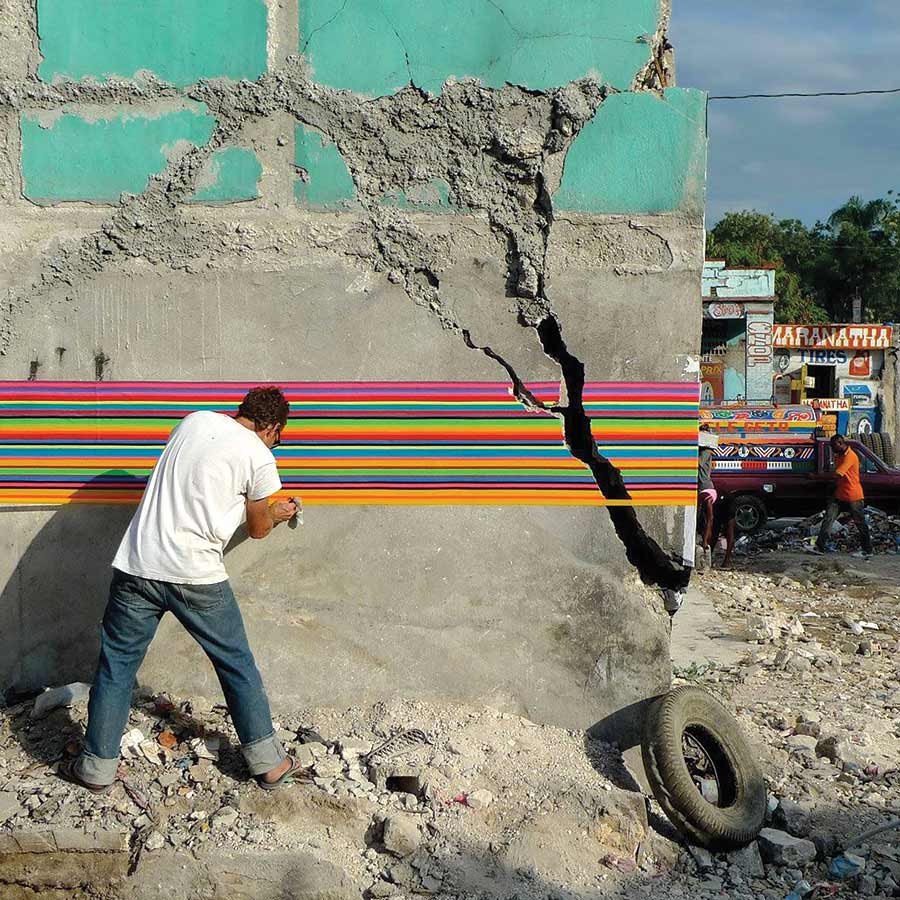
The Ghetto Biennale: This December, more than 30 foreign artists arrived for a week of work and conversation with their Haitian counterparts. (Fungus Collective)
Later, I’m driving up a hill to get away from downtown and look at art, but really I’m already in a Haitian tableau. Sky blue. Puff of bright white cloud. Strange wisps of smoke along the roadside: garbage burning, corn grilling. Small businesses dot the landscape, everything terraced, shacks topped with corrugated tin and stairways leading to nowhere (a Haitian architectural specialty). Rebar sprouts in bunches from concrete like some strange heliotropic plant, awaiting further building instructions that may or may not come. Small cardboard churches with colored cellophane windows hang from trees. These are the annual fanales, for sale as Christmas decorations, because everyone is hoping things will stay quiet and Haiti will have its beloved Christmas this hard year. Beyond the road hides the countryside as we limp up the hill.
Finally we arrive.
And now I’m having lunch with a member of the country’s 1 percent, in a rambling stone house that once belonged to a Haitian president. We (a Swiss artist-intern, a young Haitian assistant, and me) sit down at the table. We’re waiting for the master of the house; the rest of his family has left Haiti because of peyilok. He walks in with a certain measured gait and looks at life with an infinite, patient condescension. A dark-skinned Haitian girl brings in lunch. Now we’re in France: two poussins surrounded by perfectly cooked boiled potatoes with parsley. A bottle of French malbec is the table’s centerpiece. More bottles sit on the sideboard.
The master of the house is definitely a Haiti-pessimist. Of course, he loves Haiti as well, but he would never say so. At the end of the meal, he gathers all our bones on one plate and calls in his eight big dogs—six recently purchased for security. Each dog gets some bones; favorites get a little more. They don’t fight because they know that if they do, they’ll get kicked out. One cocks her head, waiting.
When I get back to Los Angeles, I tear the brown wrapper off the painting I bought that day. Here it is on my desk, a tiny thing with all of Haiti in it: blue sky and sea, mountains behind mountains, canyons and ridges in the foreground, palms blowing, dirt roads going down the hillsides, a strip of pale diamond beach, and everything flecked with a shimmering green, gold, and purple. All that’s missing are the people. Even though, of course, they are the ones who hold the future of this country in their hands. They have two terrible disadvantages: a low caloric intake and no money. Yet their protests have brought Jovenel Moïse to the brink and forced a nervous US to send envoys to protect him. It’s cruel to wish the hardships of peyilok on anyone, and it’s not a strategy that can work indefinitely. But expect the protests, in some new form, to start up again after Christmas—or after Carnival in late February.
Haitians are not going to give up on this konbit. Or their country.
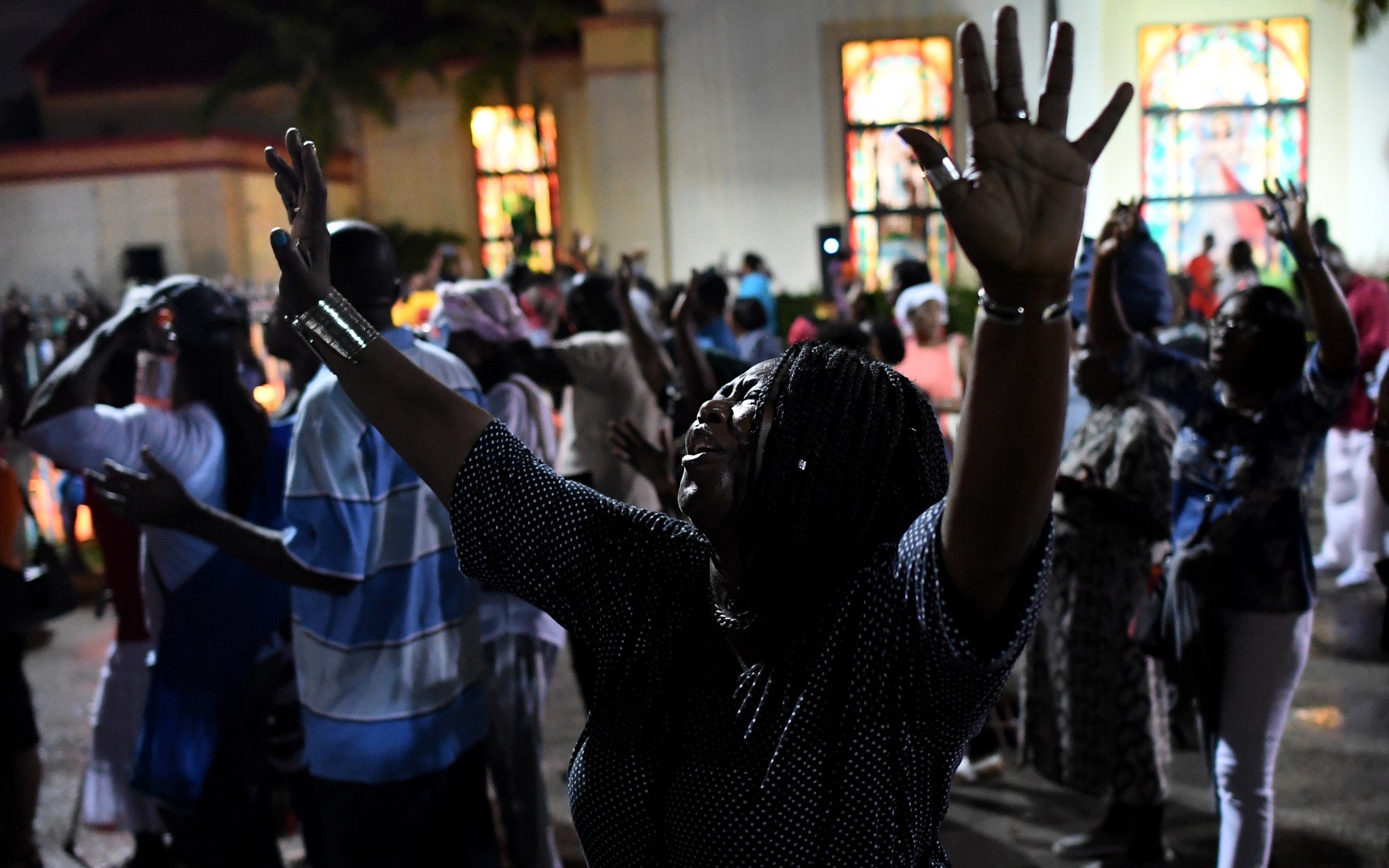
Haitians gained protections to stay in the U.S. after a devastating quake. A decade later, Trump wants that to end
MIAMI —
Almost every day, it seems, a parishioner comes to Father Reginald Jean-Mary with the same plea: Pray for us, we’re scared. We can’t go back, not now.
They live in fear of a forced return to Haiti, a country where they were born and that they love, but one that’s been paralyzed by poverty, violent protests and a debilitating cholera epidemic.
They fear even more for their American-born children, who, unlike them, would be eligible to remain in the only country they’ve ever known. For many Haitian immigrants, the idea of uprooting preteens to live for the first time in a deeply impoverished country seems out of the question.
“Haiti will always be my home by birth, but this is my new home,” said Luce Janvier, a parishioner at the church. “It’s not safe in Haiti — not now, maybe never.”
Here in the Miami neighborhood of Little Haiti — along the asphalt streets where chickens run wild and Creole is the predominant language— Jean-Mary’s cream-colored Catholicchurch serves as a refuge for Haitians from across the city.
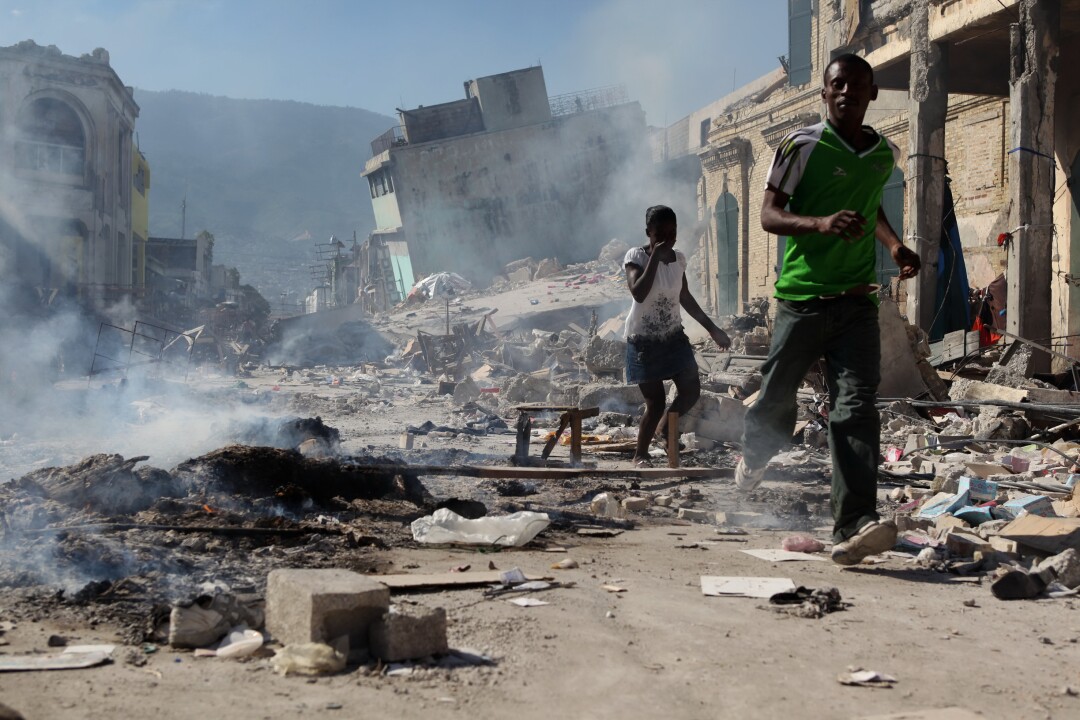
After a magnitude 7.0 earthquake devastated Haiti in January 2010, leaving hundreds of thousands of people dead and crippling infrastructure in Port-au-Prince, the capital, tens of thousands of survivors fled to south Florida.
In a humanitarian gesture, President Obama swiftly designated Haiti as a country whose nationals could receive Temporary Protected Status, meaning they could live legally, but temporarily, in the U.S. Some found work as housekeepers and cooks, others enrolled in community colleges, and many joined churches. For nearly a decade, they have scraped together what’s left of their paychecks and sent it home to family still in the Caribbean.
Today, an estimated 46,000 Haitians have Temporary Protected Status, which was granted to those who migrated to the U.S. within a year of the quake, or who were already in America, no matter their legal status, at the time of disaster.
Nationwide, roughly 317,000 people from 10 countries, including Haiti, have the protected status, which is granted in six- to 18-month intervals by the federal government for people from countries devastated by natural disasters or war.
Shortlyafter taking office, President Trump, who had run on a platform hostile to immigrants, abruptly announced he would end TPS for Haitians as well as immigrants from El Salvador, Honduras, Nepal, Nicaragua and Sudan. Immigrants from South Sudan, Somalia, Syria and Yemen, who also have TPS, were not targeted by the administration. Even so, the status is set to expire for immigrants from the latter four countries in 2020 and 2021 if the administration does not grant an extension.
Immigrant advocates responded with lawsuits, and in 2018 a federal judge issued a preliminary injunction, allowing Haitians and immigrants from El Salvador, Nicaragua and Sudan to remain in the country through this month.The Department of Homeland Security recently announced that the agency would hold off evicting those from Haiti and the five other countries initially targeted until January 2021 as part of the ongoing litigation.
As the 10-year anniversary of the Haitian quake approaches, the legal limbo has left many law-abiding families in serious peril, said Ahilan Arulanantham, senior legal counsel for ACLU, which helped file the lawsuit that resulted in the injunction.
“They are a part of our society,” said Arulanantham, estimating that 80% are in America’s workforce, “and deserve to be treated with dignity and respect, not wanton cruelty.”
For immigration attorney Vanessa Joseph, recently elected city clerk of North Miami, Fla., the extension provides “a welcome sigh of relief, but it’s not a permanent solution,” she said.
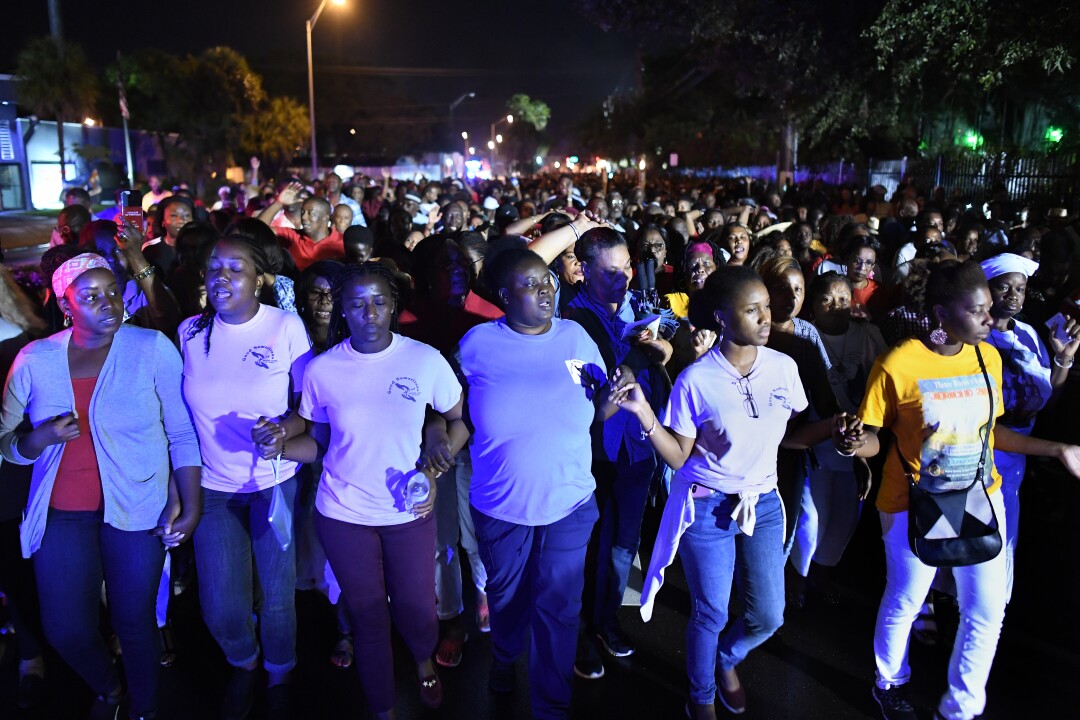
Haitian immigrants had always known that, in theory, the protections weretemporary. But over the years, as they worked, worshiped and had children — more than half in south Florida — Haiti began to feel very far away.
Fear started to grow in the months before Trump’s announcement following then-Homeland Security Secretary John F. Kelly’s trip to Haiti to assess the situation. Kelly declared that conditions had improved, leaving many in the Haitian community concerned that the administration would soon end TPS.
Anxiety now runs deep, said Marleine Bastien, executive director of the Family Action Network Movement, a group that hosts information meetings for immigrants in Little Haiti.
Bastien still shakes her head at the decision, noting that even the National Palace, where Haiti’s president lives, remains under construction.
“The country is still in ruins,” she said. “There are the protests and violence in the country. It’s not stable.”
Trump administration officials, including in the Department of Homeland Security, have not responded to a request for comment about its decision to end TPS for Haitians.
Bastien’s group estimates that since the earthquake, Haitians with protected status have given birth to about 30,000 children — all of whom are American citizens.
“Parents wake up and do not know if they will be taken from kids,” said Bastien, who travels to Haiti and Washington, D.C., several times a year to offer on-the-ground updates to lawmakers. “Families right here in south Florida are scared.”
A report from the University of Miami School of Law found that people deported after being convicted of crimes — including nonviolent drug offenses — are much more likely to become homeless once they return to Haiti, where they are often viewed as extensions of the United States government, with which Haitians are deeply angry.
“Finding gainful employment is out of reach for many deportees,” the researchers concluded. “Many deportees do not speak fluent Creole or speak Creole with an accent that is recognizably ‘American.’”
To Bastien and many Haitians, Trump’s comments about the country have been racist. Several news outlets, including The Times, reported in January 2018 that Trump referred to Haiti and several African nations as “shithole countries” in a meeting with a bipartisan group of senators.
“There is animus toward black people — toward Haitian people — by this president,” Bastien said.
Jacsonny Nelson, 31, agrees.
Leaving behind his mother and six siblings in Haiti to come to south Florida,he received TPS in 2011 and now shares a one-bedroom apartment with his wife, their infant son and his mother-in-law.
Nelson works long hours doing kitchen prep at a diner, but when he can, he stops by Bastien’s office, wondering how much longer he can live in Fort Lauderdale, where he feels welcome.
These days, Nelson said during an interview in his family’s living room, he often worries about being separated from his wife and son.
“We all cannot stop thinking about it,” his mother-in-law, a U.S. citizen, interjected, caressing her grandson’s chest with her index finger.
Nelson sees more opportunity here in Florida for his son — better education, quality of life — and says he would not uproot him for the instability of Haiti.
For Nelson, a decade in the U.S. has served as a balm from tragedy. He lost cousins and close friends in Port-au-Prince in the quake, and images of the destruction are seared in his mind.
“It was chaos,” he recalls, “people running in the streets.”
Since he arrived in south Florida, he says, he has worked six days a week at the same diner. And each month, he says, he sends about $400 home to his mother, who uses the money to support his siblings.
“I’m all she has for income some months,” he says.
For parishioner Janvier, life in south Florida is also about providing for family back in Haiti. Most days she wakes up before 5 a.m. and takes a bus to her minimum-wage housekeeping job at a hotel in Miami Beach. Janvier moved to Miami in 2004, and since she was already in the U.S. when the earthquake hit, she qualified for temporary status.
Janvier, who has two sons remaining in Haiti, regularly sends them part of her check.
“It’s great money, compared to what I would make in Haiti,” she said.
Janvier has traveled to Washington with Bastien’s group to meet with Florida’s members of Congress to express concerns over the looming termination of TPS.
In July, Sen. Marco Rubio, citing the ongoing “volatile” situation in Haiti,introduced legislation for an extension specifically for Haitians.
“During my recent visit to Haiti,” Rubio wrote to the Trump administration, “it was clear to me that the country is unable to absorb a large number of returnees at this time.”
For Jean-Mary, the pastor, the legal limbo means hours of prayer.
“We ask for guidance and for strength,” he prays with families. “We look for a path forward.”
On a recent evening, local elected officials flanked Jean-Mary on the tiled altar of his church. Hundreds of parishioners packed into wooden pews at his church, Notre Dame d’ Haiti, celebrating Jericho, an annual days-long spiritual revival. Outside, people ate fried fish and sweet plantains from styrofoam containers.
Jean-Mary thanked the politicians for their work in the community, at the church and in the halls of the state Capitol. Then, he singled out Joseph, the immigration attorney, who had attended the church as a child.
“She is always here bringing legal guidance,” he said in Creole, “especially for those who are on TPS.”
Joseph smiled.
A woman toward the back of the church clasped her hands and looked up at the vaulted ceiling. A toddler in her mother’s arms cried, and then a hush fell over the church. Jean-Mary asked everyone to bow their heads — there was a lot to pray for.
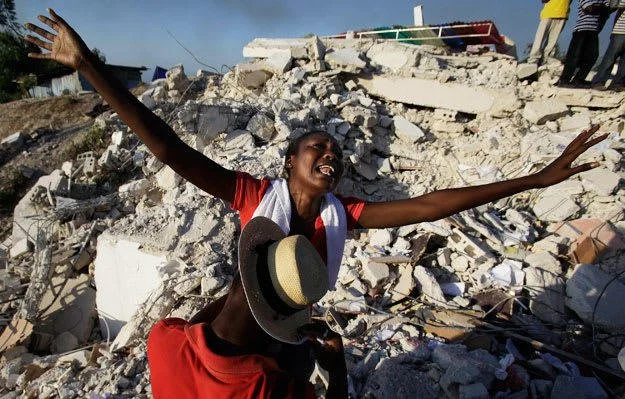
Haiti 10 Years After The Earthquake: Why So Little Recovery Progress In A Decade?
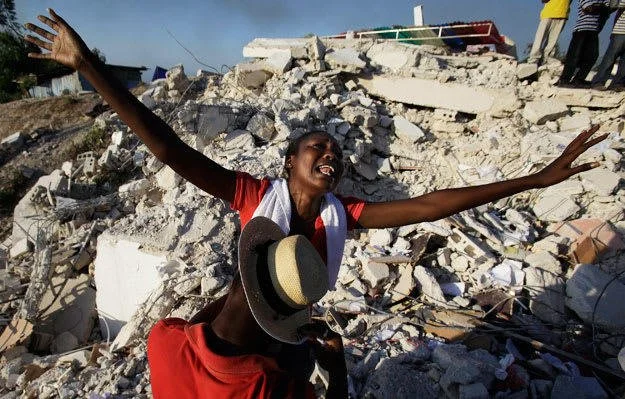
Port-au-Prince was a canyon of crushed concrete and horrified screams as Jean Samson Edouard ran panicked and barefoot through the capital’s Carrefour-Feuilles district.
It was shortly before 5 p.m. on Tuesday, Jan. 12, 2010 — a decade ago this Sunday. A magnitude 7 earthquake had just destroyed much of Haiti — and killed anywhere between 100,000 and 200,000 people, according to most estimates (although the Haitian government had put the toll as high as 300,000).
“The longest night in my life,” Edouard says.
He was 23, a communications student and engaged to Joselene Saint Phard, a nursing student at the Université Saint Gérard.
The school had collapsed; Saint Phard was inside the rubble.
After racing through the streets, stumbling over people killed by falling walls, “I reached the university building and I asked someone, ‘Where is Saint Gerard?’” Edouard remembers. “And he said, ‘There.’ No building anymore. Now I lose all hope to see my fiancée again.”
Edouard says he felt especially hopeless as he scanned corpses crushed in Saint Gerard’s wreckage.
“Horrible,” he recalls. “Body on body, literally broken. Arms, feet – God, it’s undescribable.
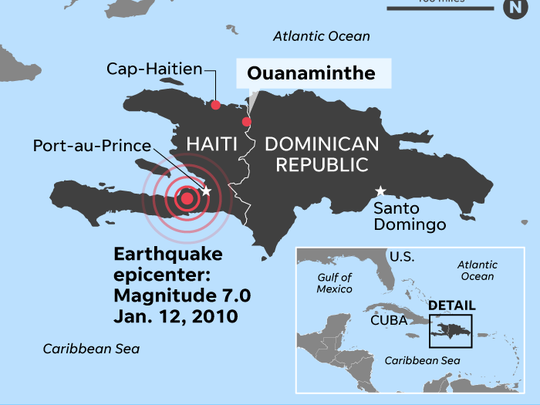
CREDIT AP
“So I — I go under the concrete. ‘Joselene, Joselene, where are you?!’ And … when I’m calling her,” he says, choking back tears, “it be for one hour … I hear some voice.”
It was Joselene. Her legs badly injured. But alive.
Today, Jean Samson and Joselene are married and have two daughters. They also have a deeper sense of purpose — in no small part, he says, because he also called out to someone else while searching the rubble that night.
“I said, ‘God, if you give me my fiancée back, I will serve you for the rest of my life.'”
To him, that meant: serve Haiti. I spoke with Edouard in a restaurant in West Palm Beach, where he was visiting relatives. Like so many Haitians after the earthquake, he could have come to live in South Florida.
“But I can’t,” he insists, “because I have Haiti. I need, when I pass away, my children can say, ‘Hey, my father struggled to change something in Haiti.’”
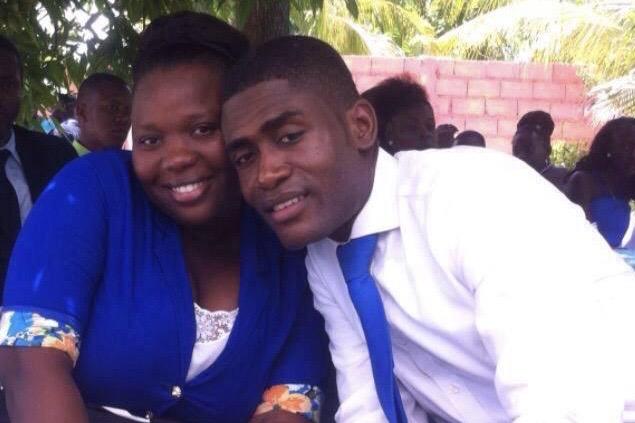
Jean Samson Edouard, right, and his wife Joselene today in Arcahaie, Haiti.CREDIT COURTESY JEAN SAMSON EDOUARD
So Edouard returned to his hometown of Arcahaie, Haiti, just northwest of Port-au-Prince, and became a schoolteacher. Today, he’s a principal; Joselene is a nurse. Edouard also began studying economic development — and he helps run a nonprofit called ECODA whose “sustainable village” project promotes local economic opportunities.
But Edouard realizes that kind of effort remains rare in Haiti, even after all these years — and he concedes the larger effort to rebuild the impoverished Caribbean nation has mostly failed.
“The earthquake gave Haiti an opportunity to take off, to learn development,” he says. “Unfortunately, nothing [has] happened. No planning. No leadership. No project.”
It’s hard to argue with him. It took a year after the quake just to get real debris removal started. It took seven years to reopen Haiti’s major hospital. Today, Haiti is facing one of the worst food shortages in the Americas. That’s not to mention the country’s endless political upheaval — and protesters now demanding the ouster of President Jovenel Moïse, who is accused of involvement in a $2 billion corruption scandal involving infrastructure project funds (which he denies).
So why, after a decade, has Haiti made so little recovery progress?
Many Haitians say one big reason is that the country’s spirit itself has yet to recover.
“When you need to be psychologically healed first, then it’s hard for you to think about development,” says Marie Guerda Nicolas, a Haitian American and a psychology professor at the University of Miami.
Nicolas was in Haiti during the earthquake, and she says it’s hard to exaggerate how brutally traumatic it truly was.
DEEPENED DESPAIR
For one thing, modern Haiti had never dealt with earthquakes: This was the first there since the 1700s. That’s a big reason so much caved in: Haiti’s building codes were some of the world’s most lax.
But the quake dealt another gut punch to Haiti's psyche: At that time, before the earthquake, Haiti was finally looking up after decades of dictatorship and dysfunction.
“We had more stability in terms of the political situation,” Nicolas says. “Economically, there was more exporting; infrastructure being built. We were moving in the right direction.”
To then have that optimism so suddenly and violently shattered only deepened Haitians’ despair. So Nicolas threw herself into creating clinical networks like Rebâti Santé Mentale (Rebuilding Mental Health) to help Haitians pull through.
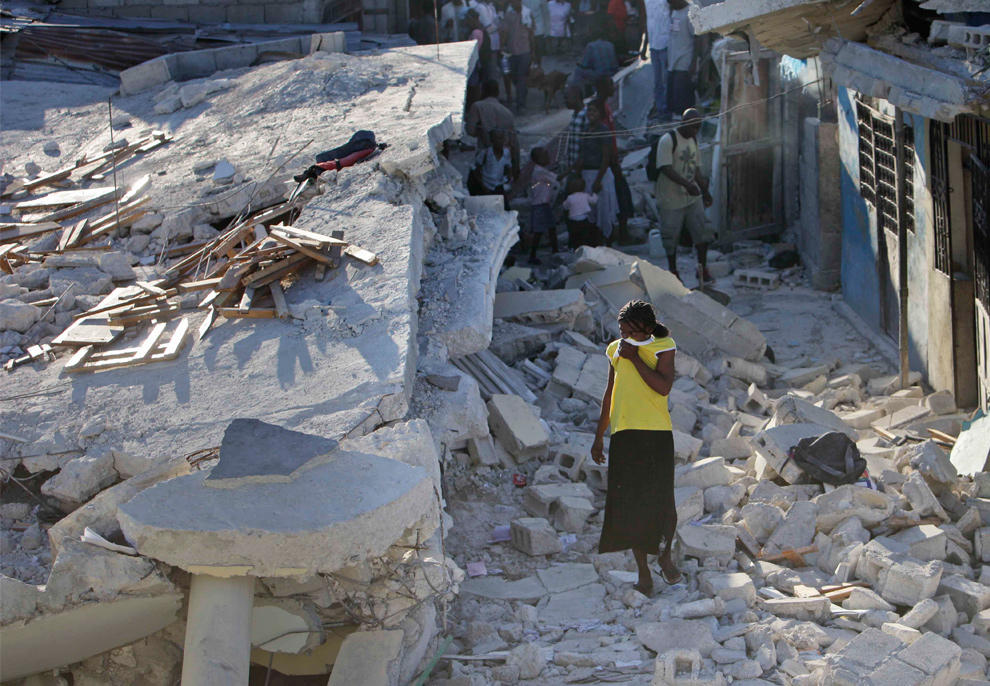
A Haitian woman wanders the rubble of her neighborhood in Port-au-Prince after the 2010 earthquake.CREDIT GREGORY BULL / AP
Among her tougher cases was a woman in Léogâne, near the earthquake’s epicenter. She’d lost her 8-year-old daughter in the disaster. But she found one of the girl’s legs — by identifying her sock and shoe.
“She went home, she washed the leg and she put it in the daughter’s bed and she kept it there,” Nicolas recalls.
Neighbors, fearing the woman had gone mad, plotted to take the leg away. But Nicolas told them: “It’s a normal response for her to have. The incredibly abnormal is the earthquake.”
She ultimately persuaded the woman to have a burial ceremony for the leg. Like that mother, tens of thousands of Haitians weren’t able to bury loved ones after the earthquake.
Nicolas points to one other circumstance that made recovery more difficult: The earthquake, which destroyed the National Palace in Port-au-Prince, effectively crushed Haiti’s government, too. In fact, then President René Préval (who died in 2017) seemed to disappear.
"I think he was traumatized himself," says Nicolas.
The international community had to fill the vacuum — and its performance was controversial at best. More than $10 billion pledged by governments never fully materialized. Worse, U.N. troops were responsible for a cholera outbreak that killed thousands more people, prompting months of angry Haitian street protests against the U.N. and, in some cases, global NGOs in general.
Critics argue that many of those NGOs that flooded into Haiti, many well intentioned but others with what Nicolas calls arrogant “savior complexes,” had scant oversight — and effectively shut Haitians in Haiti out of their own recovery effort.
“The people with the skills and the abilities to do good in their own country weren’t being utilized,” Nicolas says. “That fuels the sense of helplessness.”
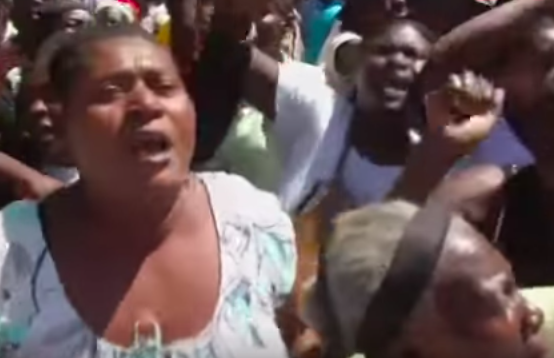
Haitians protesting the U.N. and international NGOs in Port-au-Prince in 2010.CREDIT AP/YOUTUBE
But on this side of the Caribbean, especially in South Florida, the earthquake fueled a heightened sense of purpose in the Haitian expat community.
“The diaspora that always wanted to step up and be engaged self-organized and mobilized in record proportions,” says Karen Andre, a Haitian-American attorney and political consultant in Miami.
Andre says her grandmother spent the night of the earthquake outside in Port-au-Prince’s Delmas district, singing psalms to neighbors trapped in rubble to help locate them. During those same moments, in Miami, Andre heard about the disaster driving home after work on Biscayne Boulevard.
“I immediately just made a U-turn,” she recalls, “and went straight to Little Haiti, went to 54th Street.” There she helped coordinate an expat relief effort that eventually grew into an NGO: Konbit for Haiti, or Cooperative for Haiti, which steered funds to Haitian development projects run by Haitians.
Political and business elites in Haiti had always kept the Haitian diaspora at arm’s length. But Andre says the aid work emboldened expats to demand a larger role in Haiti’s affairs. And to a certain extent they got it, including the granting of dual citizenship to Haitian expats.
“The earthquake knocked a lot of dominoes down,” Andre says, “so that in Haiti we can go in and move the needle.”
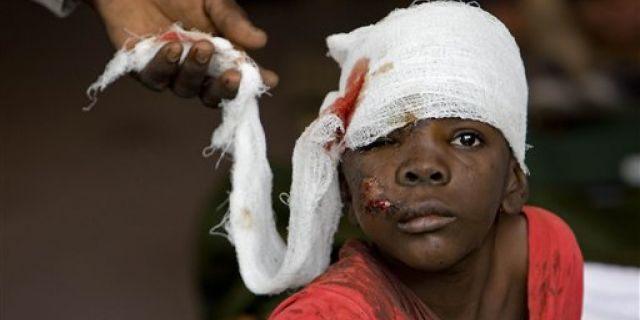
A Haitian boy injured in the 2010 earthquake.CREDIT LOGAN ABASSI / AP
Since then, critics say that diaspora commitment has waned. But one Haitian expat — and earthquake survivor — who wants to help move the needle is South Florida college student Arielle François.
“Haiti’s a part of me,” says François, who studies criminal law at Florida Atlantic University in Boca Raton. “I feel like it’s my responsibility to [go] back.”
François was a schoolgirl when the earthquake hit, traveling in her parents’ car in Port-au-Prince’s Pétion-Ville suburb.
“I remember seeing a pink house literally crumble down on this man, and you just see … a line of blood,” she says. “And I saw this woman who fell on her knees and started praying. I was just 11, seeing people die in front of me is, like, even to this day I’m traumatized by it.”
Arielle Francois as an elementary school student in Petionville, Haiti, a decade ago, before the 2010 earthquake.CREDIT COURTESY ARIELLE FRANCOIS
François’ best friend Paula also died in the earthquake. Soon after, François and her family moved to South Florida — and she, admits, a better life. Now a U.S. citizen, she feels conflicted about the good fortune she’s had since the earthquake.

Arielle Francois today, a junior at Florida Atlantic University.CREDIT TIM PADGETT / WLRN.ORG
“I could have died like my best friend,” she says. “And the fact that we were blessed enough to come here, alive, and pursue education, I feel like I have no choice but to help my country where I was born. I can only give back now.”
François says the earthquake anniversary reminds her how urgent that is. Haitians like her hope that 10 years later, Haiti’s leaders start feeling more of that urgency too.
US Marine, who enlisted after surviving Haiti earthquake, charged with smuggling guns
Authorities in Haiti seized weapons three weeks ago from a U.S. Marine who is now facing gun-smuggling charges in North Carolina, according to reports.
Jacques Yves Duroseau, 33, had flown to Haiti on Nov. 11 with eight weapons, according to federal prosecutors. They said he told investigators that he went there to train Haitian soldiers in marksmanship and to help defeat “thugs” threatening the country’s stability, the Associated Press reported.
The prosecutors also said a person who was with Duroseau when he went to Haiti told federal agents Duroseau “was in contact with the U.S. Embassy in Haiti to tell them that he wanted to be president of Haiti.”
The North Carolina charges against Duroseau were contained in a criminal complaint filed in Raleigh Federal Court last week.
According to the complaint, Duroseau had filled out a firearm declaration form with American Airlines stating he was carrying unloaded guns, but he didn’t have permission from the U.S. Marines to leave the country or permission from U.S. authorities to export firearms.
The firearms included five handguns and three rifles, and they were able to trace at least five of them to purchases made by Duroseau, the complaint said.
It said Duroseau also had an officer’s uniform and body armor with him when he went to Haiti.
Duroseau was a Marine sergeant in 2016 and grew up in Haiti, according to a profile at the time that was written by a Marine public affairs officer.
The profile said Duroseau survived the earthquake that devastated the country in 2016 and he had been rescued after being pinned between two walls in his home for four days. He joined the Marines soon after.
The article said Duroseau was an instructor in marksmanship at Marine Corps Base Quantico in Virginia.
“Whenever I come home I try to share a lot of things with my friends and I tell them if you want it you can make it, even when you thought you lost everything,” Duroseau was quoted as saying. “Whenever you put your mind to it and you want it there’s nothing stopping you.”
CARIBBEAT: Death of LGBTQ leader Charlot Jeudy in Haiti puts spotlight on discrimination and violence
Early in Thanksgiving week, the news came that the Haiti LGBTQ leader Charlot Jeudy was found dead in his home in the capital city of Port-au-Prince. He was 35.
Concerns about foul play in his death and calls for thorough investigations have been raised since his body was discovered on Nov. 25.
The Associated Press reported it wasn’t immediately clear how Jeudy died, and police did not return calls for comment.
Jeudy was the head of a Haiti-based organization that worked to defend human rights for homosexuals and transgender people in Haiti and combat discrimination and violence. The organization is called Kouraj in Haitian Creole — which means courage in English.
According to the AP, Jeudy — an outspoken advocate against homophobia — was forced to cancel a Afro-Caribbean LGBTQ community festival in 2016 due to threats of violence.
The U.S.-based Haiti Advocacy Working Group coalition is one of the organizations praising Jeudy for his commitment and calling for an investigation into his death.
“Charlot carried his message promoting gender equal-rights for all people, not just across Haiti but onto the international stage as an example for others to follow. We urge local authorities to continue a full investigation into the cause of his premature death,” the group tweeted last week.
The AP reported that Haiti’s LGBTQ community remains mostly underground because of a strong social stigma, but unlike English-speaking Caribbean islands, there are no Haitian laws criminalizing homosexual relations.
However, a 2015 human rights report on Haiti by the U.S. State Department said “local attitudes remained hostile to outward” LGBTQ identification and expression, especially in the capital, said the AP.
The U.S. Embassy in Haiti issued a statement on Jeudy’s “untimely passing,” his tireless advocacy for human rights and equality in Haiti and offered condolences to the late leader’s friends, family, and colleagues.
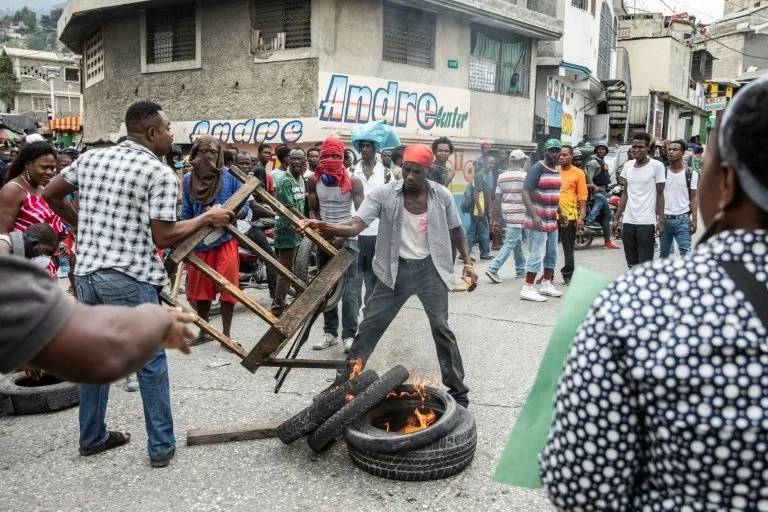
French couple shot dead in Haiti while seeking adoption, officials say
Port-au-Prince (AFP) - Two French citizens were shot dead in Port-au-Prince at the weekend shortly after flying into the Haitian capital to adopt a child, diplomatic and other sources told AFP Monday.
An official at the French embassy confirmed that a French couple had been killed, without giving further details of the exact circumstances of their deaths.
According to two other sources, however, the couple were from the Ardeche region of southeastern France and had arrived in the Caribbean country to adopt a child.
One of the sources said they were killed in an armed robbery that turned deadly.
A spokeswoman for the Ardeche department confirmed to AFP that the couple, from the town of Saint-Martin-d'Ardeche, had been given a green light last year to adopt their first child.
Haiti, the poorest country in the Americas, has been roiled for two months by protests, which were triggered by fuel shortages but have turned violent and morphed into a broader campaign against President Jovenel Moise.
According to UN figures, at least 42 people have been killed and dozens injured during anti-government protests since mid-September.
The French foreign ministry recommends visitors "postpone their trip to Haiti until further notice."
"Demonstrations, accompanied by blockades on the main roads and violent acts (rock throwing, shots...) are very frequent. Violent groups are active and fueling a climate of insecurity," the foreign ministry warned last month.
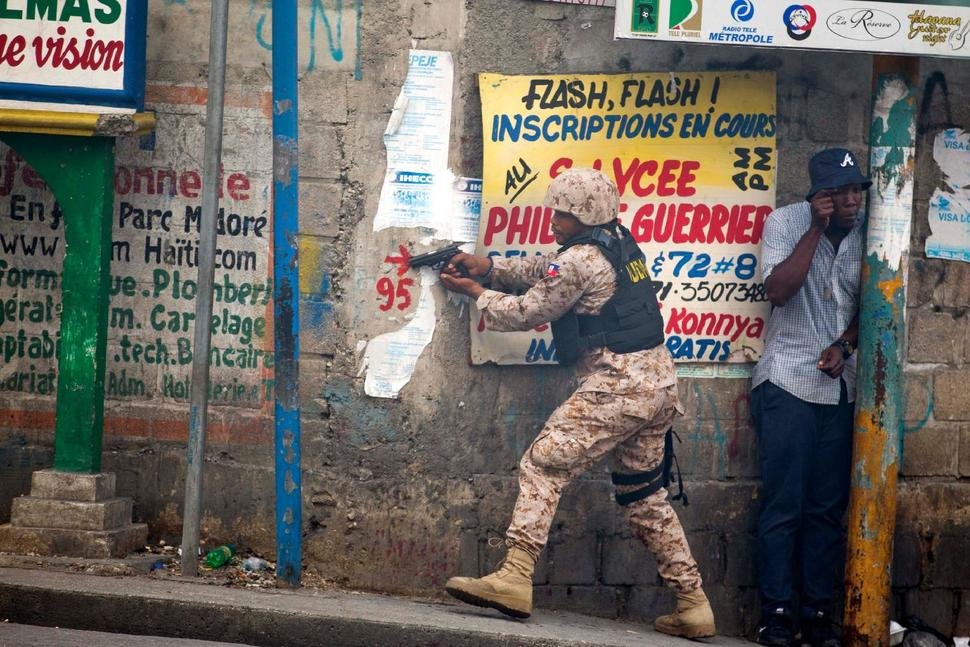
Haiti Mourns 5 People Killed During Ongoing Protests
PORT-AU-PRINCE, Haiti (AP) — Wails filled a church in Haiti’s capital on Tuesday during funeral services for five people killed in anti-government protests that began more than two months ago.
Among those killed was 15-year-old Jasmine Pierre, whose father told The Associated Press that she was hit inside their home by a stray bullet when police began firing at protesters.
“This really hurts,” said her father, Macene Pierre. “I lost my little girl. I don’t know what I’m going to do.”
Hundreds of people attended the funerals for Pierre and four men, three of whom were allegedly shot by police while participating in the protests.
The fourth victim, 25-year-old Bernard Vaudreuil, was working as a moto taxi driver when he was shot, said cousin Marie-Ange Laroche.
“He was not involved in the turmoil,” she said. “He was just trying to survive.”
More than 40 people have been killed and dozens injured in more than two months of demonstrations organized by opposition leaders demanding the resignation of President Jovenel Moïse amid anger over corruption, ballooning inflation and a scarcity of basic goods.
The protests have shuttered many businesses and schools across the country as Moïse continues to urge dialogue after stating he won’t resign.
The mourners joined a small group of protesters after church services as some of them jogged down the street with one casket while tires burned around them. Among the mourners was Guerline Jeremie, a mother of two whose husband, Desir Jean Belleville, 34, was killed last week.
“We want justice for them,” she said of those who died. “I don’t know exactly what I’m going to do to feed these kids.”
The United Nations has said that 3.7 million people in the country of nearly 11 million lack access to enough food amid the political turmoil, and that the number is expected to reach 4 million early next year.

Delta to end a decade of service to Haiti

Delta Air Lines will end a decade of service to Haiti citing weak demand.
The SkyTeam Alliance carrier will operate its last flight between Atlanta (ATL) and Port-au-Prince (PAP) on Jan. 9, Delta confirmed and Cirium schedules show. The last flights will be operated with a Boeing 737-700.
Delta spokeswoman Susannah Thurston said the move is in response to a “soft demand environment.”
The airline has served Port-au-Prince since 2009 when it began flights between the Haitian capital and New York John F. Kennedy (JFK), according to Cirium. Flights between Atlanta and Port-au-Prince began in 2012.
Delta last offered seasonal service between JFK and Port-au-Prince last winter, with those flights ending in April.
Four airlines — Air France, American Airlines, JetBlue Airways and Spirit Airlines — will serve Haiti from the U.S. after Delta’s exit. American serves Port-au-Prince from Miami (MIA); JetBlue from Boston (BOS), Fort Lauderdale (FLL), JFK and Orlando (MCO); and Spirit from Fort Lauderdale.
Air France offers a unique “fifth-freedom” flight — a route between two countries where an airline is not based — between Miami and Port-au-Prince.
Delta plans to grow system capacity by 3-4% year-over-year in 2020, executives said in October. Highlights of the growth will be the beginnings of its new strategic partnership with LATAM Airlines, as well as new markets like Mumbai (BOM) that launch in December.
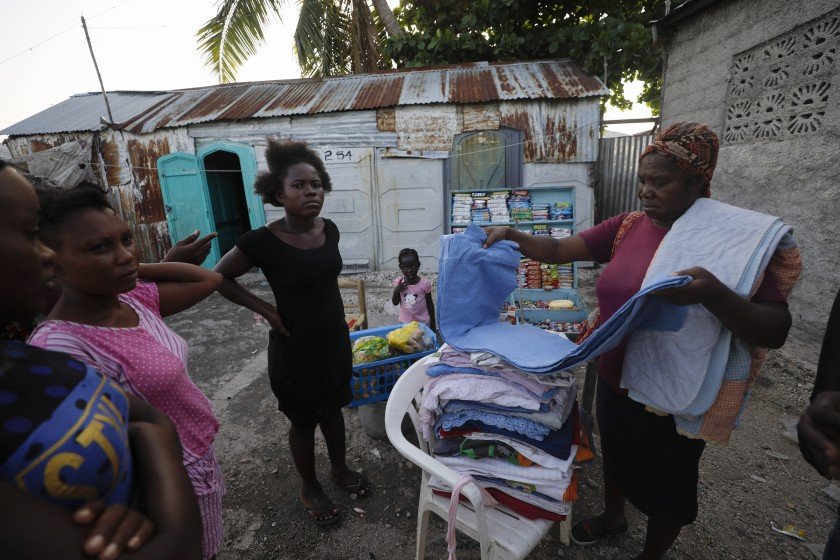
Journalist killed as anti-government protests rattle Haiti
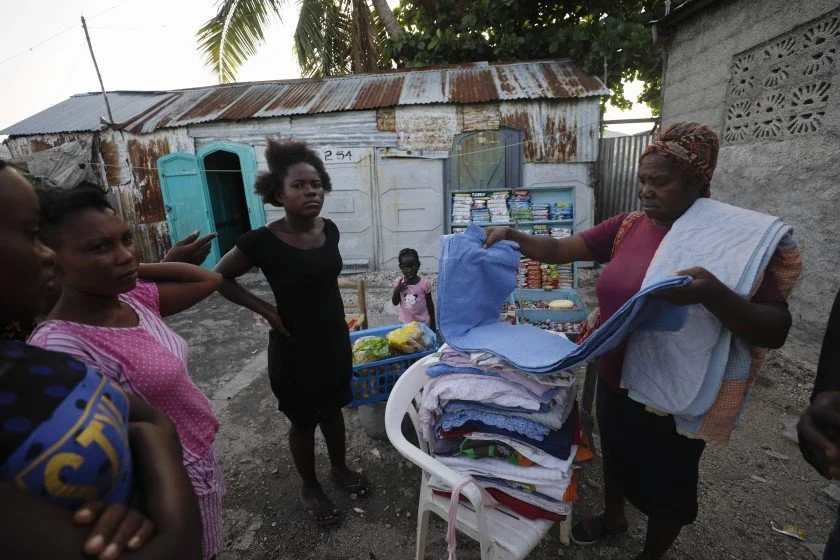
PORT-AU-PRINCE, Haiti —
Protesters burned tires and spilled oil on streets in parts of Haiti’s capital on Friday as they renewed their call for the resignation of President Jovenel Moïse just hours after a journalist was shot to death.
No one has been arrested in the death of reporter Néhémie Joseph of Radio Méga, who had been covering the protests and was found dead in his car late Thursday in the town of Mirebalais, northeast of Port-au-Prince, according to Radio Vision 2000.
In a Facebook post in late September, Joseph said that a couple of politicians had threatened him after one of his shows and accused him of inciting protests. It was unclear, however, if this was the motive for his killing.
“The press should not have to claim victims and bodies as their own,” the Association of Professional Journalists of Artibonite said, calling on justice officials to investigate the killing.
Joseph is the third Haitian journalist killed in less than two years. Radio Sans Fin reporter Pétion Rospide was fatally shot in June as he drove home, while freelance journalist Vladjimir Legagneur disappeared in March 2018 while working on a story.
The most recent killing comes amid a spike in violence in Haiti’s capital and surrounding communities as protests that have caused nearly 20 deaths and almost 200 injuries paralyze the country for nearly a month. Businesses remain shuttered and an estimated 2 million children have not been able to go to school, according to the United Nations.
“It’s a very, very serious situation,” said Michèle Pierre-Louis, a former prime minister with the non-governmental organization FOKAL. “No one is really talking about the suffering of the people. The consequences are terrible.”
On Friday, the normally clogged streets of Port-au-Prince were nearly empty as people stayed indoors out of fear.
A small crowd gathered in Pétionville yelled and pushed on the occasional car that tried to drive through.
Reynald Brutus, a 28-year-old unemployed protester, said opposition supporters won’t accept anything other than Moïse’s resignation. If that doesn’t happen, Brutus said demonstrations will grow even more violent.
“We’re going to break and destroy everything,” he said.
One man took a large rock and beat it against a metal post as the sound echoed across the area.
“I’m ringing the alarm!” he said as protesters arrived.
As the crowd grew, among those watching it was 33-year-old Naomi Pierre, who works at the police academy.
“I like what’s going on,” she said. “It’s for the best of the country.”
Pierre has two children who haven’t been able to go to school for a month, and she lamented the lack of food, medical care, electricity and security.
“Everyone’s walking up and down with their heart beating scared,” she said.
Earlier this week, Moïse announced the creation of a commission charged with finding a solution to end the worsening crisis, but opposition leaders have rejected his call for dialogue and unity. The opposition says it wants Moïse to step down as anger over corruption, rising inflation and lack of basic goods including fuel continue to roil Haiti.
Many also are calling for a more in-depth investigation following a report by Haiti’s Senate that accuses former top government officials from the administration of former president Michel Martelly of misusing at least $2 billion in funds tied to a Venezuelan subsidized oil program that were meant for social programs.
The report also names a company that Moïse once owned. Moïse, who was Martelly’s hand-picked successor, has denied the allegations.
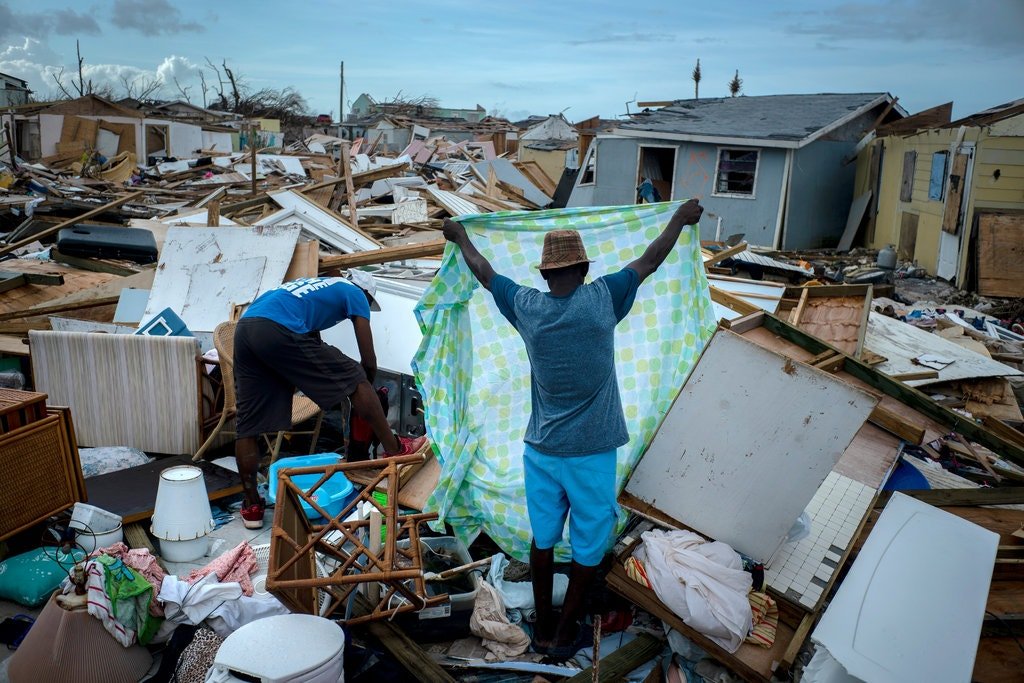
Haitian Migrants, Devastated by Dorian, Face Deportation From Bahamas
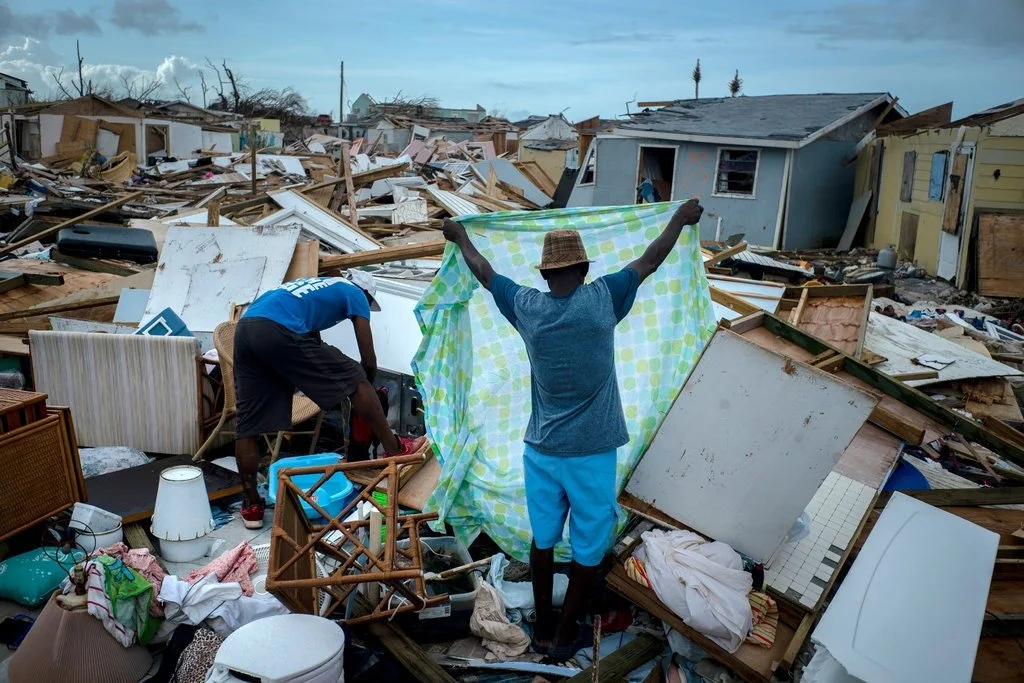
NASSAU, Bahamas — More than 100 Haitian migrants were deported on Thursday, six weeks after Hurricane Dorian leveled Abaco and Grand Bahama in the northern Bahamas with a devastating wallop that struck the Haitian community especially hard.
It was unclear how manystorm survivors were among 112 Haitians deported. While the deportation of Haitians is not uncommon, the matter has been contentious in the aftermath of the monster hurricane.
The issue of illegal immigration from Haiti to the Bahamas has spanned decades, with Haitian nationals long stigmatized in the country.
Outside the island of New Providence, Abacowas believed to have had the largest population of Haitians, many residing in informal shantytowns. The largest two, The Mudd and Pigeon Pea, in Abaco’s capital, Marsh Harbour, suffered severe wind and flood damage.
Dorian’s official death toll is 61, but officials believe that many bodies remain among the rubble in Abaco’s shantytowns.
Marsh Harbour residents who survived the storm were urged to evacuate to shelters on the island of New Providence. The shelters, which housed more than 2,000 people at one point, were largely filled with Haitians and people of Haitian descent.
In the immediate aftermath of Dorian, the immigration minister, Elsworth Johnson, said the government would suspend deportations in parts of the country that were affected by the storm. The shelters, he said, qualified as affected areas.
But the moratorium appeared to have expired last week, when Mr. Johnson said undocumented migrants still in shelters would be deported.
Several organizations have raised concerns over the treatment of migrants. The International Organization for Migration said this month that fear of the authorities was “widespread, even among documented migrants and Bahamian nationals of Haitian descent, some of whom have lost their documents in the hurricane.”
Other rights groups have condemned the government’s plans to deport survivors, citing the trauma of the storm and the social turmoil in Haiti.
But in an interview with The Nassau Guardian, Mr. Johnson said that “at the end of the day, we must do what is in the best interest of the Bahamas while still protecting the dignity of the human person.”
Prime Minister Hubert Minnis has warned that undocumented migrants affected by Hurricane Dorian would not receive asylum or special treatment. He also warned Bahamian businesses not to hire migrants without work permits. Even those Haitians who were working legally but lost their jobs as a result of the storm were told that applications for new work permits must be filed from outside the Bahamas.
Many who face deportation were born in the Bahamas and have never known another home. Alicia Reckley, 37, a mother of five, was born in Haiti but is married to a Bahamian, and thus is exempt from deportation.
But Mrs. Reckley is worried about her 11-year-old niece, who was born in the Bahamas to Haitian parents and has neither Haitian nor Bahamian documents. The child’s mother was deported last year.
“She’s crying nonstop,” Mrs. Reckley said of her niece. “At night, all she does is cry.”
The shantytowns where many migrants lived have long been a lightning rod. Now, more than a year after the government embarked on a plan to eradicate shantytowns on Abaco, Dorian appears to have helped finish the job.
The Minnis administration announced its plan last year, but a local human rights group obtained an injunction from the Supreme Court blocking demolition. Thousands of people were still residing in the communities when Dorian made landfall.
The government’s eradication efforts have come to the forefront again as Mr. Minnis has highlighted the safety risks associated with the remaining structures. Last month, the government banned new construction in Abaco’s shantytowns.
Contracts were awarded to several companies for the cleanup and days later, images emerged of one shantytown being bulldozed.