
Why many thousands of Haitians converged on the US-Mexico border
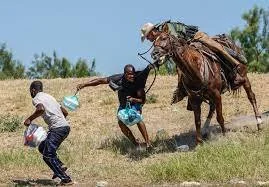
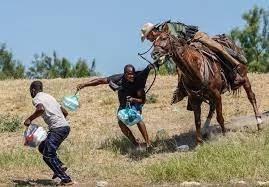
(CNN)Thousands of Haitian migrants have appeared at the US-Mexico border seeking to cross the Rio Grande and find refuge in the US.Human rights activists are condemning images of US border agents, mounted on horseback, trying to head off migrants almost as if they're herding cattle. The US special envoy to Haiti, Daniel Foote, has now resigned to protest the Biden administration's "inhumane" effort to send them back to Haiti.At the same time, conservative lawmakers are accusing the Biden administration of failing to head off another crisis at the border and the distressing images of the massive migrant camp in Del Rio, Texas, back up that idea.How Haitian migrants, would-be refugees fleeing an island nation that is rocked by political instability and economic depression, converged at once at the US-Mexico border in a specific spot in Texas is complicated. So is the question of will happen to them next. Read the latest report from CNN's Priscilla Alvarez and Rosa Flores.
What's happening now:
- More than 10,000 Haitians converged in recent days near Del Rio, Texas, and have sought to stream into the US, creating a massive migrant camp under an overhead bridge between Coahuila, Mexico, and Del Rio, while they wait for access.
- Department of Homeland Security Secretary Alejandro Mayorkas has promised the US will clear out the camp in the coming days.
- Traffic between the US and Mexico has been disrupted, interrupting life in those towns.
- Mounted border agents in were filmed using aggressive tactics, drawing condemnation. Mayorkas said on CNN that he was were "horrified" by the images.
- The Texas governor ordered a miles-long drive-up border wall of parked vehicles.
- The Biden administration is using a Trump-era Covid policy to fly thousands of Haitians back to Port-au-Prince after days of detaining them in the US, and left them there, causing chaos at the airport there.
- DHS officials have desperately warned Haitians not to come to the border and said they would be turned away.
- CNN has witnessed some Haitians being driven across the border and allowed to enter the country.
- DHS has also been moving thousands of migrants from Del Rio to other processing sites.
How big is this surge?
The numbers are incredible; the number of migrants swelled from about 400 to a max of 14,000 in days.More could be on the way according to CNN's Alvarez, who writes: There are up to 30,000 Haitians in Colombia who may be seeking to travel north, CNN has learned. The department is tracking between 40,000 to 60,000 Haitians in the hemisphere, though they are not necessarily seeking to come to the US, according to the congressional aide. Recently, Mexico also stopped some buses of Haitians coming north, DHS said, according to the aide.
Why are Haitians, specifically, coming to the US border?
Back in May, Mayorkas announced an 18-month temporary protective status for Haitians already residing in the US, which now applies to Haitians in the country as of July 29. Mayorkas had cited "security concerns, social unrest, an increase in human rights abuses, crippling poverty, and lack of basic resources, which are exacerbated by the Covid-19 pandemic." And that spring announcement was before Haiti's president was assassinated and an earthquake struck over the summer.Many of those arriving at the US border now had left Haiti long ago and were either living or staying in other Central and South American countries, from Guatemala to Chile.CNN talked to 26-year-old Jameson Tilus. He fled Haiti years ago after he was assaulted in his home and his aunt was shot at.In Chile since 2015, he wants to join his brother, uncle and cousins, who are in the US. Friends told his family the border was open in Del Rio, so Tilus, his wife, their 5 year-old daughter and their 3 year-old son started the two-month journey there."I'm 26 years old, and I don't have a profession," Tilus said, his voice breaking. "I was doing very badly, I wanted a better life."Read more.
What's the US plan?
Here's what Mayorkas told lawmakers after visiting the border Monday:"The plan that we have is a multi-part plan.
- One is to address the root causes of irregular migration.
- Two is to ensure that there are safe, orderly, and humane pathways so people do not have to take the dangerous perilous journey to make a claim of asylum that our laws that Congress passed are recognized.
- And third is to rebuild our asylum system here in the United States."
What are the critics saying?
Patrice Lawrence leads the group UndocuBlack, which advocates for undocumented Black people in the US. She writes for CNN that the Biden administration should be distinguishing itself from the Trump administration and allowing for a more orderly asylum process rather than flying Haitians back to Haiti."The Biden administration could have made a strong statement in favor of due process and dignity by allowing for an orderly asylum process. Instead, it has opted for mass expulsions of vulnerable people."On the other side of the spectrum is Texas Republican Gov. Greg Abbott and his wall of police cars."When you have an administration that is not enforcing the law in this country, when you have an administration that has abandoned any pretense of securing the border and securing our sovereignty, you see the onrush of people like what we saw walking across this dam that is right behind me," Abbott said at a news conference in Val Verde County.
Haiti prosecutor seeks charges against Prime Minister in connection with President's assassination
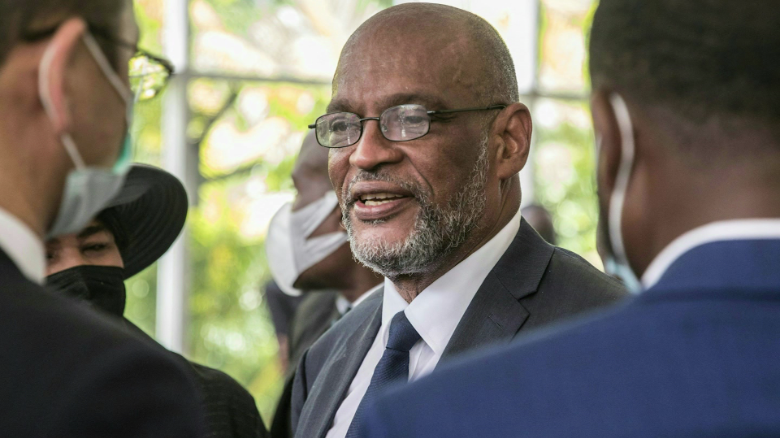
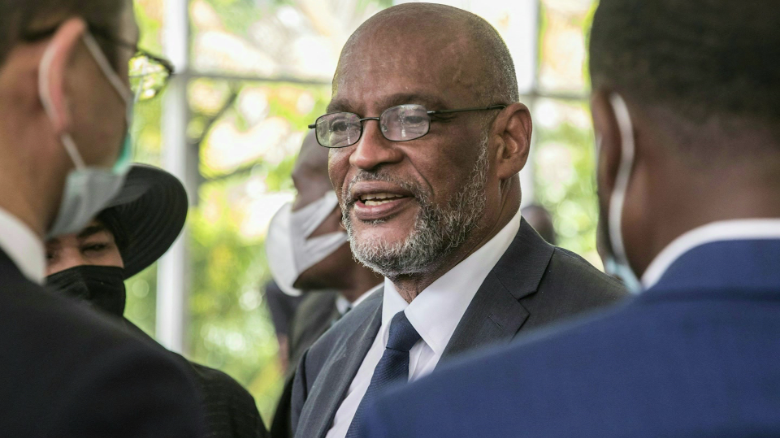
(CNN)Haiti's top prosecutor is seeking charges against Prime Minister Ariel Henry in connection with the assassination of the late President Jovenel Moise. He has also barred the Prime Minister from leaving the country.Port-au-Prince's chief prosecutor, Bed-Ford Claude, previously invited Henry to testify about the case, citing evidence that a key suspect in the assassination called him in the hours after the murder. Henry was due to testify on Tuesday morning.That suspect, former Haitian Justice Ministry official Joseph Felix Badio, is believed to be on the run. CNN has not been able to reach him for comment.Claude told CNN that he is discussing possible charges against Henry with the judge.
The late President Moise was brutally killed during an attack on his private residence on July 7. The investigation into his killing is ongoing and has turned up dozens of suspects, including US and Colombian citizens.
Moise's death prompted a weeks-long standoff over succession in the country's leadership between the recently nominated Henry -- a neurologist by training -- and then-acting Prime Minister Claude Joseph, before Henry ultimately took power.
In a series of tweets Saturday, Henry appeared to reference the case, writing, "I want to tell those who still have not understood, that the diversionary tactics to seed confusion and impede justice from doing its work serenely will not stand.""The true culprits, the intellectual authors and those who ordered the odious assassination of President Jovenel Moise will be identified, brought to justice and punished for their crime," he also wrote.The early months of Henry's tenure have been troubled by continuing intrigue over the assassination, deadly gang violence in capital city Port-au-Prince, and a catastrophic August earthquake in the country's south that left more than 2,100 dead and injured more than 12,200.
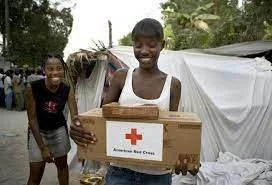
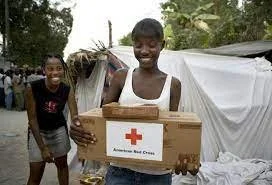
The American Red Cross' 2010 performance in Haiti has become the focus of critics who are urging people not to donate to the organization

- In 2010, a 7.0-magnitude earthquake killed more than 200,000 people in Haiti.
- The American Red Cross raised nearly a half-billion dollars for Haiti after the 2010 earthquake.
- An NPR and ProPublica investigation found that little of the money reached Haitians in need.
A 7.2-magnitude earthquake struck the southwestern peninsula of Haiti on August 14, killing and injuring thousands. As its citizens search for survivors among the rubble, many Haitian Americans, Black activists, and individuals tied to the Haitian diaspora are warning those interested in donating money to recovery efforts to avoid giving to the American Red Cross.
In 2010, hundreds of thousands of Haitians were killed when a 7.0-magnitude earthquake rocked the country, which resulted in an outpouring of nearly a half-billion dollars in donations to the American Red Cross, NPR reported.
Dozens of Twitter users, including many Haitian Americans and individuals with ties to the Caribbean, used their platforms to remind their followers of a 2015 joint investigation by NPR and ProPublica that documented what the two news organizations said was a gap between funds donated to the American Red Cross and what actually went toward directly assisting victims in Haiti after the 2010 earthquake.
Their investigation found "poorly managed projects, questionable spending and dubious claims of success."
Despite the nonprofit's claim that it housed more than 130,000 people in the aftermath of the 2010 earthquake, the investigation revealed it had only built six permanent homes.
The investigation also found that many of the American Red Cross' reported failings in Haiti were of its own making and that less of the money had reached those in need than the charity had stated, according to ProPublica.
Issues that hindered the organization's work in Haiti included "an overreliance on foreigners who could not speak French or Creole," difficulties navigating the country's land title system, and the lack of progress souring relationships with residents.
Haiti's prime minister at the time of the 2010 earthquake, Jean-Max Bellerive, expressed doubt about figures relating to Haitian relief efforts that the American Red Cross used in its promotional materials.
"No, no," Bellerive told ProPublica. "It's not possible."
When asked about the calls on social media to avoid donating to their charity, the American Red Cross provided Insider a financial breakdown of how it spent donations following the 2010 earthquake in Haiti and said it strongly disputes the reporting done by NPR and ProPublica.
"Contrary to accusations, the American Red Cross has made a significant impact in Haiti, including investment in more than 50 hospitals and clinics, safer housing for more than 22,000 families, funding for the country's first wastewater treatment plant, support for Haiti's first-ever cholera vaccination campaign and so much more," a statement from the nonprofit organization read.
"Americans donated generously in the aftermath of the 2010 Haiti earthquake to save lives - which is exactly what their donations did. In fact, we spent nearly one-third of donations on helping to keep people alive in the first six months alone."
When one nonprofit betrays community trust, the whole sector pays for it.
Regina Birdsell, CEO of the Center for Nonprofit Management, said the real focus should be on transparency and whether a nonprofit uses the money to achieve the goals it outlined when soliciting donations. "The really important thing to remember is that [nonprofits] exist to serve the public. So as tax-exempt organizations, the trade-off is that we need to be transparent," she told Insider.
Birdsell said that the nonprofit sector has been debating what percentage of donations is appropriate to spend internally and is concerned that nonprofits don't talk enough about their need to pay staff living wages.
"At the end, we want to make sure that we never have the community feeling like they were misled. That dries up confidence in our sector, and that's not a good thing," Birdsell told Insider.
Nonprofits should proactively implement internal checks and balances before crises happen to ensure they have mechanisms in place to account for and properly disburse all donations, according to Birdsell. Even when billions of dollars are donated in response to a crisis, nonprofits need to be able to function in a dynamic environment and maintain transparency, Birdsell told Insider.
A 2016 Senate Judiciary and Finance Committee report said the American Red Cross spent a quarter of the nearly $500 million it raised for Haiti relief efforts on internal expenses, such as salaries, travel costs, and "oversight."
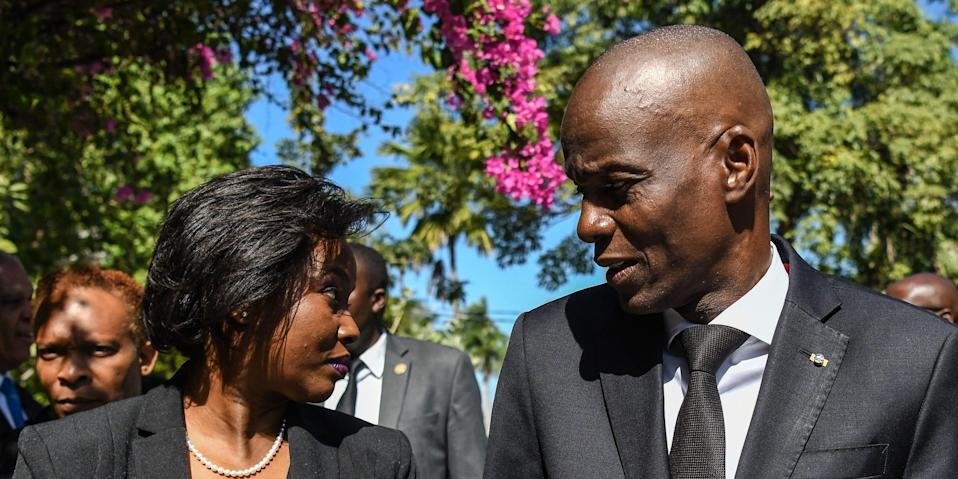
Haiti former first lady calls for help in unraveling husband's murder
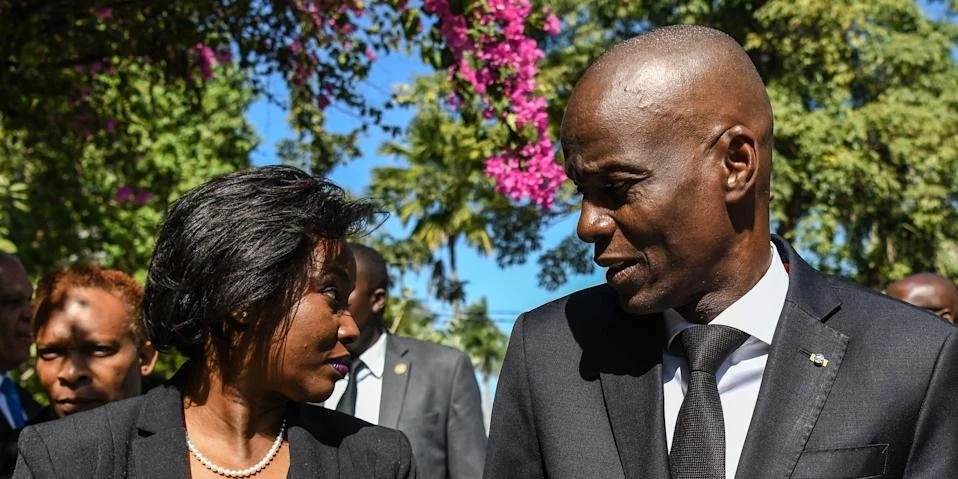
(Reuters) - The widow of Haiti's slain President Jovenel Moise called on the international community to help track down those responsible for gunning down her husband in a late night raid by suspected mercenaries at the couple's home in July.
Moise's assassination https://www.reuters.com/world/americas/haitian-president-shot-dead-home-overnight-pm-2021-07-07 plunged the Caribbean nation, already plagued by hunger and gang violence, further into chaos, and triggered a hunt for the masterminds across the Americas.
Wearing a black dress and sling following the injuries she suffered during the attack, Martine Moise told Reuters in a room flanked by bodyguards on Monday that while Haitian authorities had made some advances, she feared progress had slowed.
"I feel that the process is... stalling a little," she said. "The people that did this are still out there, and I don't know if their name will ever be out. Every country that can help, please help."
Nearly two months after the July 7 assassination of her husband, key aspects of the murder remain shrouded in mystery. Haitian police have arrested more than three dozen suspects, including 18 Colombian mercenaries, an obscure Haitian-American doctor they say aspired to be president, and the head of Moise's security team.
But they have made public little in the way of evidence.
"Those people (they have arrested) did it, but someone gave the orders, someone gave the money," Moise told Reuters.
She said she had spoken twice with the U.S. Federal Bureau of Investigation (FBI) and felt they could "find the people that financed that odious crime."
As security worries have dogged the investigation in Haiti, one judge investigating the case stepped down, citing concerns for his safety.
First lady Moise said Haiti's Prime Minister Ariel Henry, who is also now dealing with the aftermath of an August earthquake that killed more than 2,000 people, must call for elections as soon as possible to ensure stability.
"I think the advice that my husband would give him (is) try to have an election. With the election you can have peace, you can think long term," she said.
Elections initially slated for September have been postponed until November, and some have speculated they could be delayed further following the quake.
"If they want elections to happen, (they) will," said Moise.
Moise confirmed previous comments she had made in interviews on her interest in running for president herself but said that she would take care of her family first.
"I want to run for president. I won't let the vision of the president die with him. With the earthquake too, there's a lot to be done in Haiti," she said.
HAITI RUMOR MILL
Amid the ongoing investigation and arrests, conspiracy theories about the murder in Haiti have swirled for weeks.
Friends of the murdered president have told https://www.reuters.com/world/americas/he-never-stood-chance-fateful-downfall-haitis-president-2021-08-22 Reuters he feared for his life immediately before he was killed.
His wife on Monday said he had not talked to her of a specific plot against him.
"If he knew he would talk about it... but he never did," she said. "Because having Colombians, having soldiers here in Haiti, they are here for something."
She denied social media rumors that Moise had squirreled away millions in cash in his official residence in the upscale suburb of Petion-Ville.
"It is a president. There is some money. But the amount of $48 million that I heard in social media, that can't be true. Where in the room (can you stick) $48 million?"

New judge tapped in Haiti to oversee Moïse slaying case

LES CAYES, Haiti (AP) — A Haitian justice official has appointed a new judge to oversee the investigation into the killing of President Jovenel Moïse, acting more than a week after his predecessor withdrew from the case and as the country struggles with recovering from the devastating magnitude 7.2. earthquake that killed hundreds and injured thousands.
Magistrate Bernard Saint-Vil, dean of the Court of First Instance in Port-au-Prince, confirmed Monday to The Associated Press that he chose judge Garry Orélien to be in charge of the case.
Orélien replaces judge Mathieu Chanlatte, whose resignation from the case was announced Aug. 13. Chanlatte cited personal reasons without giving more information, but he left the post a day after one of his assistants died under unclear circumstances.
Orélien will supervise a case that it doesn't seem close to be solved. Police have arrested more than 40 suspects, but there is no clarity about who was behind the plot to kill Moïse on July 7. Among the detainees are 18 former Colombian soldiers and 20 Haitian police officers.
Also on Monday, Public Security Minister Rockefeller Vincent requested in a letter to the National Police that the Colombians be held in cells away from other detainees to minimize risks, although he didn't elaborate.
The earthquake that struck Haiti's southwestern peninsula July 14 killed more than 2,000 people, according to authorities, and it had distracted national and international attention away from Moïse's assassination. While Haitians work to recover from the disaster and look for the Moïse investigation to advance, the country also is expected to hold a presidential election Nov. 7.
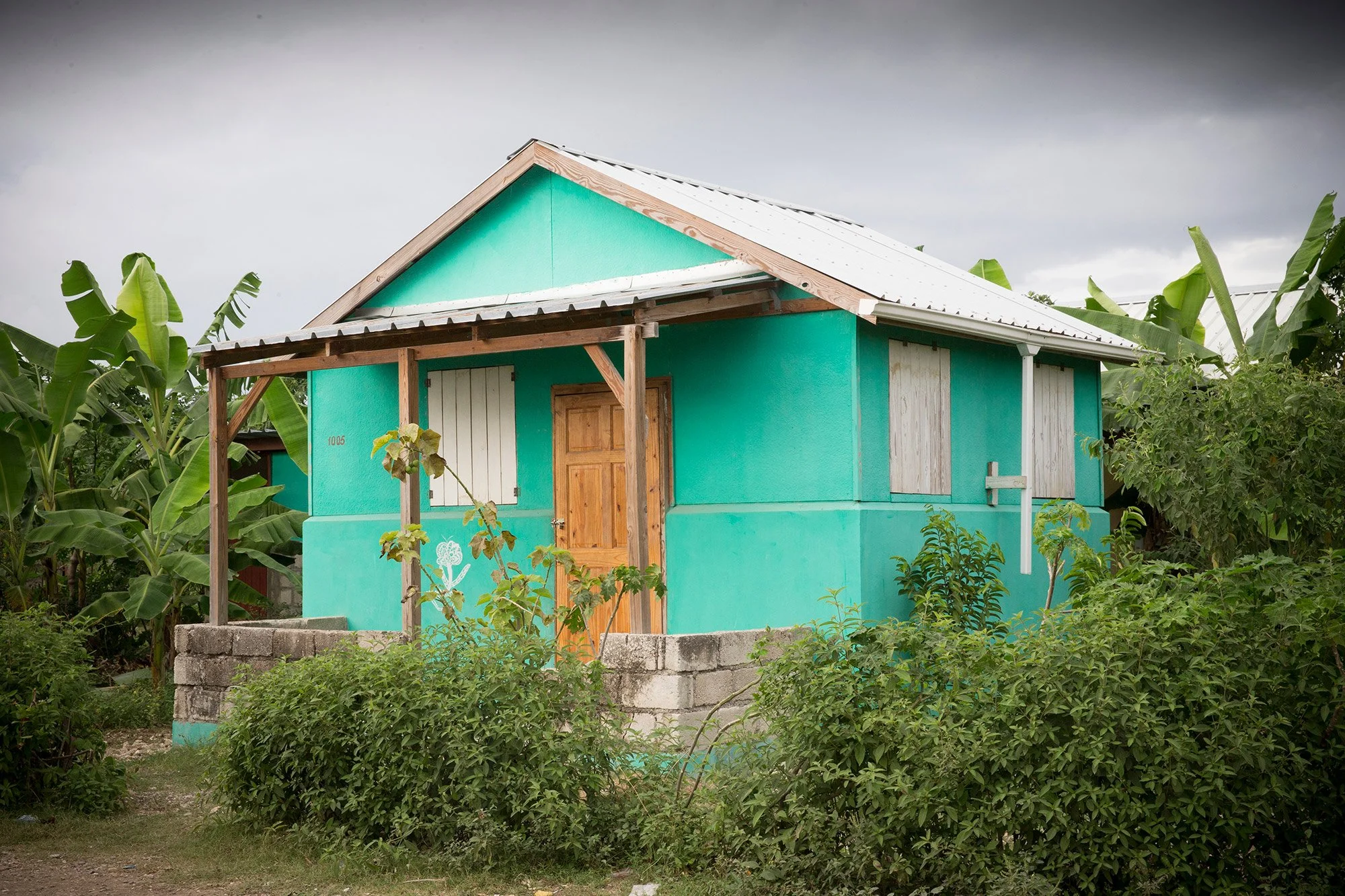
Haitians Need Affordable Homes Now More Than Ever—And Here’s How You Can Really Help
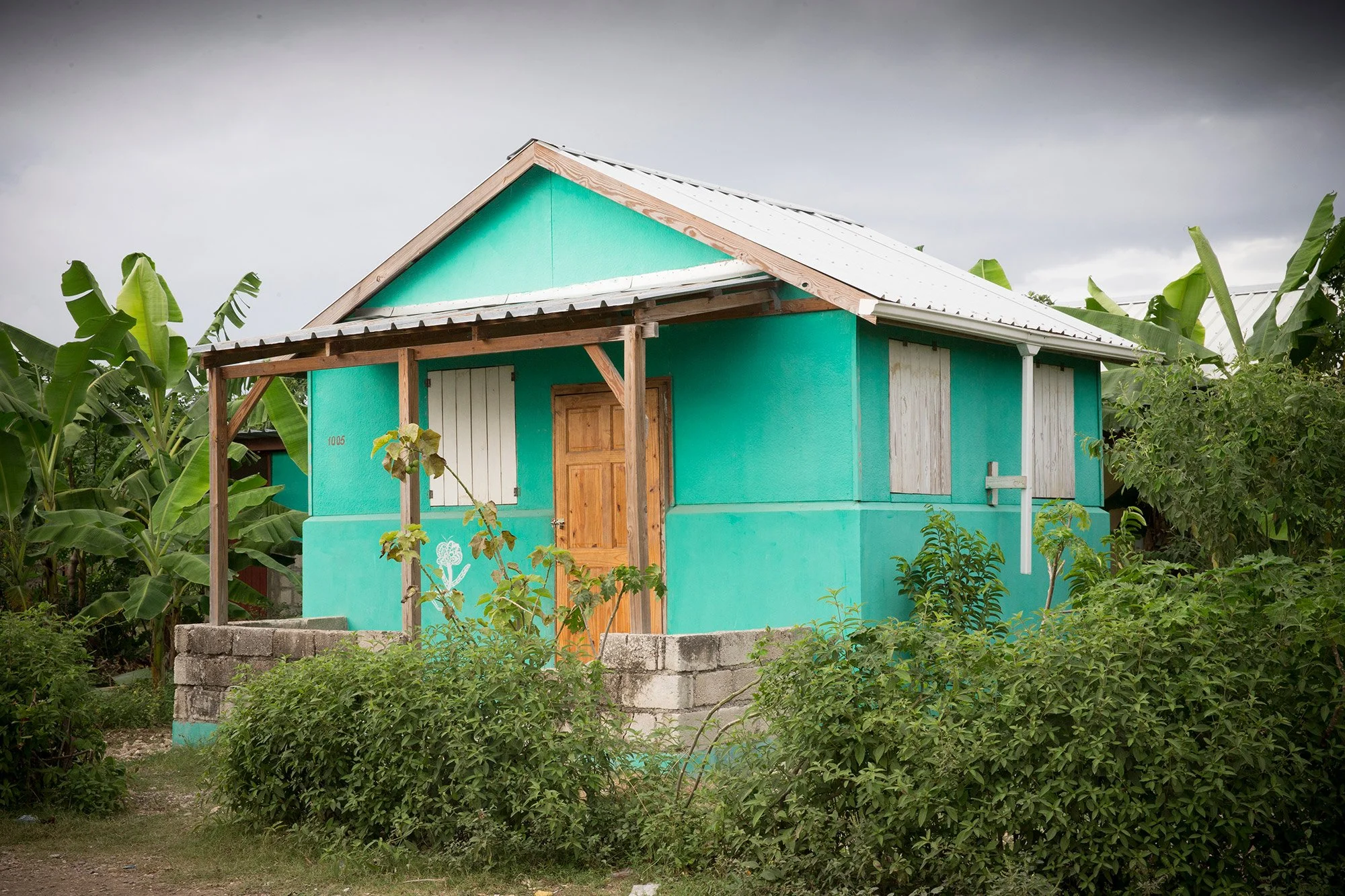
In the span of a month, the news from Haiti has been as shocking as has been sobering. First, in the early-morning hours of July 7th, there was the assassination of Haitian President Jovenel Moïse. In a matter of weeks, the country was then ravaged by a 7.2 magnitude earthquake that, according to Haiti’s civil protection agency, wrought some 2,189 deaths and 12,000 injuries. As if the scene couldn’t get any more grim, heavy rainfall from the recent tropical storm Grace has added to the misery, where earthquake victims have already been sleeping outdoors. These unfathomable events (compounded by the coronavirus, in which just 0.17% of Haitians have received at least one dose of a vaccine) would challenge any nation, let alone the poorest country in the Western Hemisphere. Yet, as hospitals care for survivors and as rescuers comb through the ruins, local and international organizations (such as Florida-based Hope For Haiti) have been accepting donations—including New Story, a nonprofit dedicated to building affordable homes for disaster victims around the world. “Imagine spending night after night in a tent with no safety and no stability,” Brett Hagler, cofounder of New Story, told AD in 2017. Some four years later, the country is in need of affordable housing now more than ever.

Since launching in 2015, New Story has completed more 2,000 homes across Haiti (1,050), El Salvador (400), Bolivia (66), and Mexico (650). The homes feature two bedrooms, a communal area, a shower and latrine, and, in some areas, land on which to grow food. Solar panels generate electricity, and—for the newest houses—a water system collects and purifies rain. Amazingly, the cost per home on average comes to just about $6,500. In Haiti, each roughly 500-square-foot residence is designed according to Miami-Dade County earthquake and hurricane codes. It’s because of this fact that, thankfully, the homes built by New Story survived the most recent salvo of natural disasters.

Funded through donations, New Story uses all the money it raises to acquire land and fund construction. “Many people we hire are members of the local communities,” cofounder Alexandria Lafci says. Maintaining those communities, she explains, is ultimately the goal. Rather than putting up one-off houses that might upset social networks, New Story plans clusters of homes and gives families full ownership to ensure roots that will last for generations. New Story has been collaborating with AD since 2017 to fund and build its newest Haitian development, preventing further disruptions to family routines. “If you’re a single mother who relies on a friend to watch your child, you don’t want to lose that when you move,” Lafci says. “We’re not asking families to completely restart their lives.” What they do offer, however, are new beginnings. “It’s amazing to see kids move in,” Hagler says. “They’re so happy and proud to have a house because many of them have never had one.”

According to UNICEF, the latest earthquake has affected some 1.2 million Haitians (almost 11% of the country’s population). The child-welfare organization estimates that 84,000 homes were damaged or destroyed—a dilemma that they say will require at least $15 million to respond to urgent needs. This is all happening in a country ravaged by turf wars, murders, rapes, and kidnappings at the hands of active gangs. With no other alternatives, displaced Haitians are seeking refuge anywhere they can find it; some sleep in public parks and squares while others crowd into churches and gymnasiums. “As Americans, the pandemic has forced us to confront the importance of home more than ever,” says Sarah Lee, Chief Operating Officer at New Story. “Families in Haiti haven’t had the option to stay safe at home because they don’t have a safe home to begin with. Together we can help families rebuild and unlock their safety, security, and opportunities to thrive.”
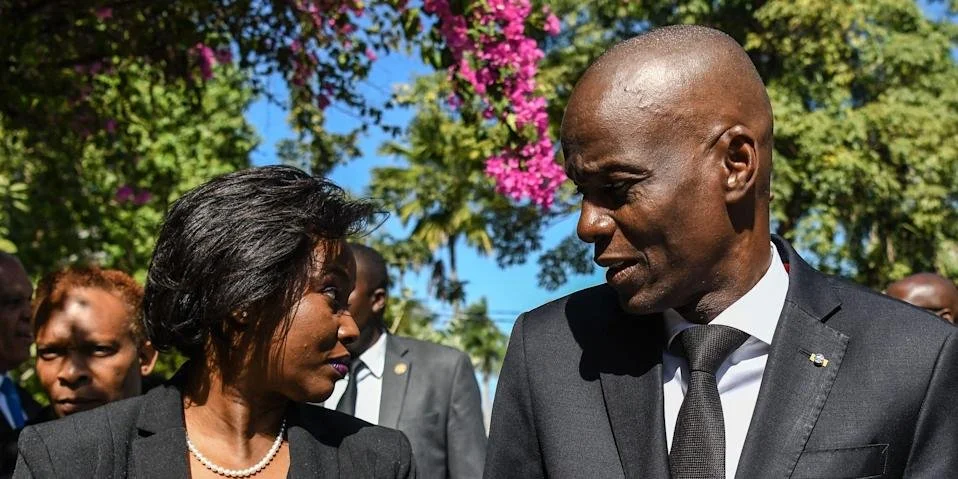
The wife of Haiti's assassinated president said she used her dead husband's tie as a tourniquet after the attack
- Haiti's president was assassinated next to his wife. She said she was later found by a maid.
- Martine Moïse, who was shot, said she asked the maid for one of her husband's ties to use as a tourniquet.
- She questioned where security staff were, and if someone had ordered them to leave.
- See more stories on Insider's business page.
The wife of Haiti's assassinated president said she was found with a gunshot wound by a maid after the attack, and needed to use her dead husband's tie as a tourniquet.
Jovenel Moïse was assassinated in his home on July 7. Martine Moïse was shot in the arm and was left in critical condition.
She told CNN that it was the maid, rather than security staff, that found her in their bedroom after the attack.
She said she asked her maid to bring her one of her husband's ties so she could use it as a tourniquet.
She previously told The New York Times that she had told her children to hide in a bathroom. They survived the attack.
In the CNN interview, Martine Moïse questioned how the attackers were able to reach the couple: "The guards wouldn't leave without an order. Maybe they received an order to leave - this is what I think," she said.
"I've been thinking a lot about how this could have happened."
Haiti has detained several Colombians, Haitians, and Haitian Americans over the attack. But Moïse said authorities need to find who ordered and paid for the attack.
"Someone gave the order, and someone paid the money. Those are the people that we are searching for. I want the United Nations Security Council's help to find those people," she told CNN.
She previously told The Times that she survived the attack because the attackers thought she was dead.
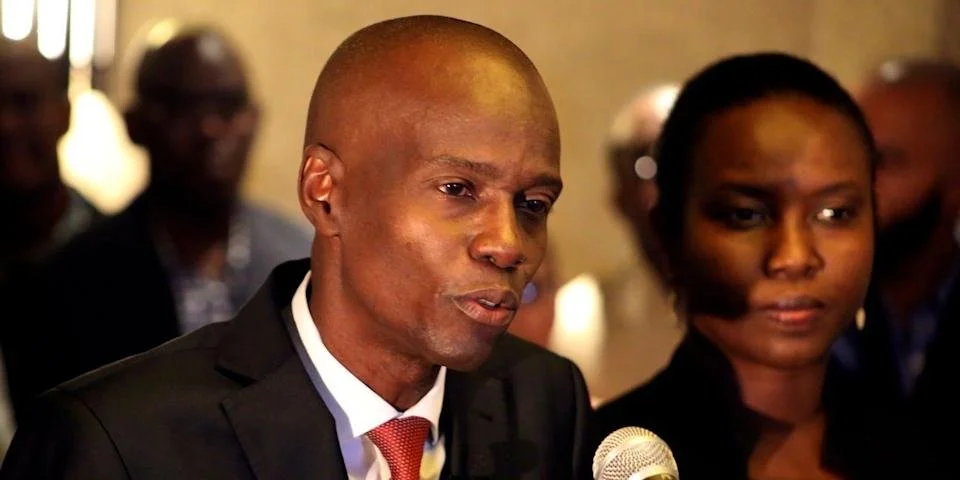
The Haitian president's assassins appeared to identify him by confirming he was 'tall, skinny, and Black' on a phone call before killing him, wife says
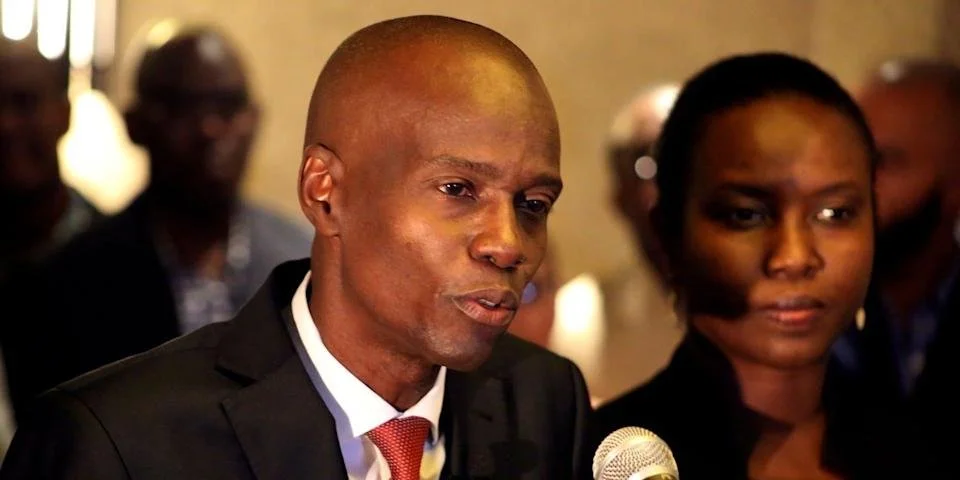
- Haiti's president was assassinated in his bedroom on July 7.
- His wife said the killers made a phone call and said he was "tall, skinny and Black" before shooting him.
- She says she survived because the attackers thought she was dead.
- See more stories on Insider's business page.
The wife of Haiti's assassinated president said his killers appeared to identify her husband by confirming that he was "tall, skinny and Black" on a phone call before they shot him.
Jovenel Moïse was assassinated in his home on July 7.
His wife, Martine Moïse, told CNN that the attackers came into their bedroom and appeared to find something they were looking for. She said they then turned to her and her husband on the floor and made a phone call.
"He was alive at the time. They said he was tall, skinny and Black, and maybe the person on the phone confirmed to the shooter that was him. Then they shot him on the floor."
Haiti has detained several Colombians, Haitians, and Haitian Americans over the attack.
Martine Moïse said she believes someone must have ordered and funded the attack, and that person needs to be found.
She told CNN: "Someone gave the order, and someone paid the money. Those are the people that we are searching for. I want the United Nations Security Council's help to find those people."
She was shot in the arm during the attack, and was left in critical condition.
She told The New York Times that she survived the attack because the attackers thought she was dead.
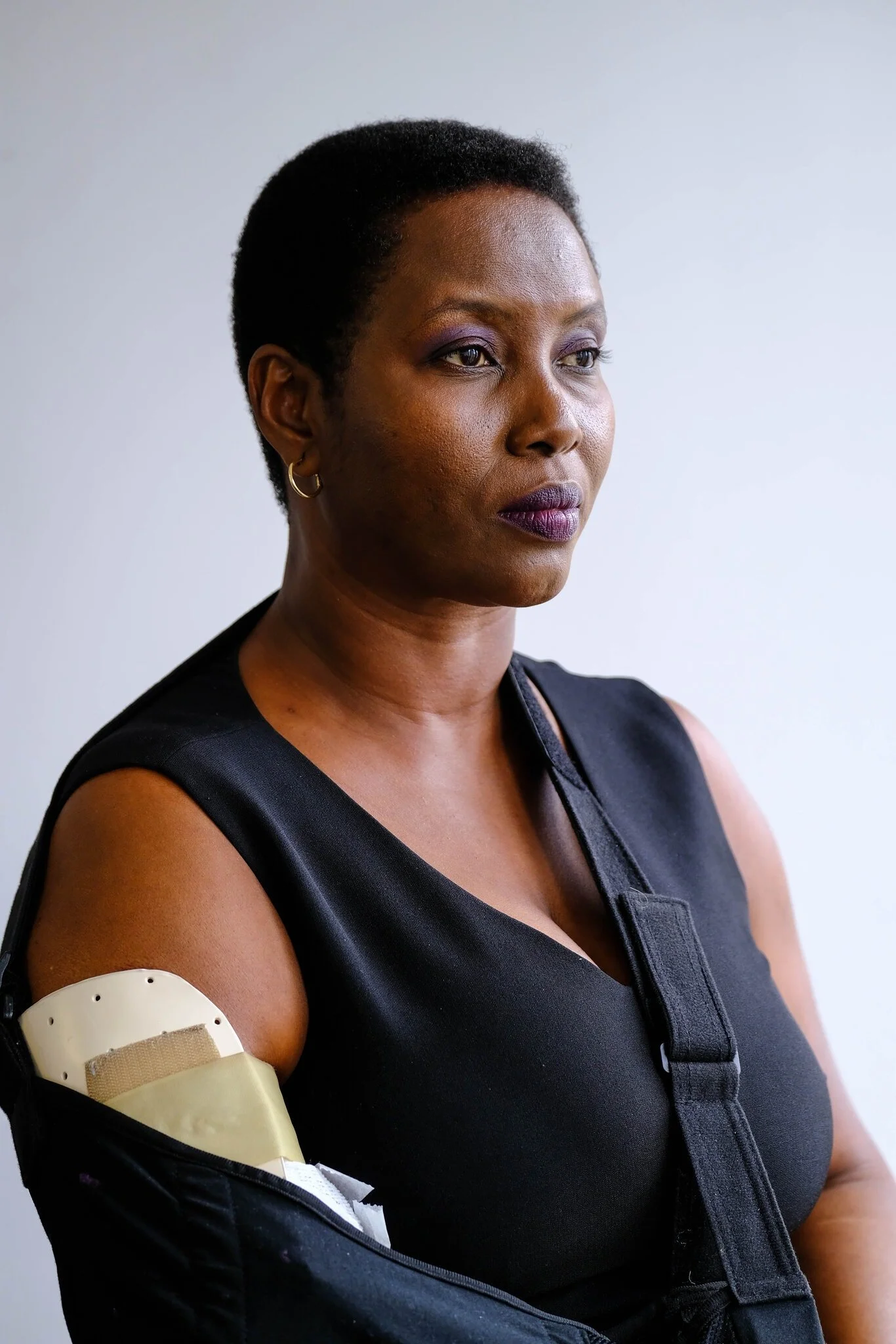
‘They Thought I Was Dead’: Haitian President’s Widow Recounts Assassination
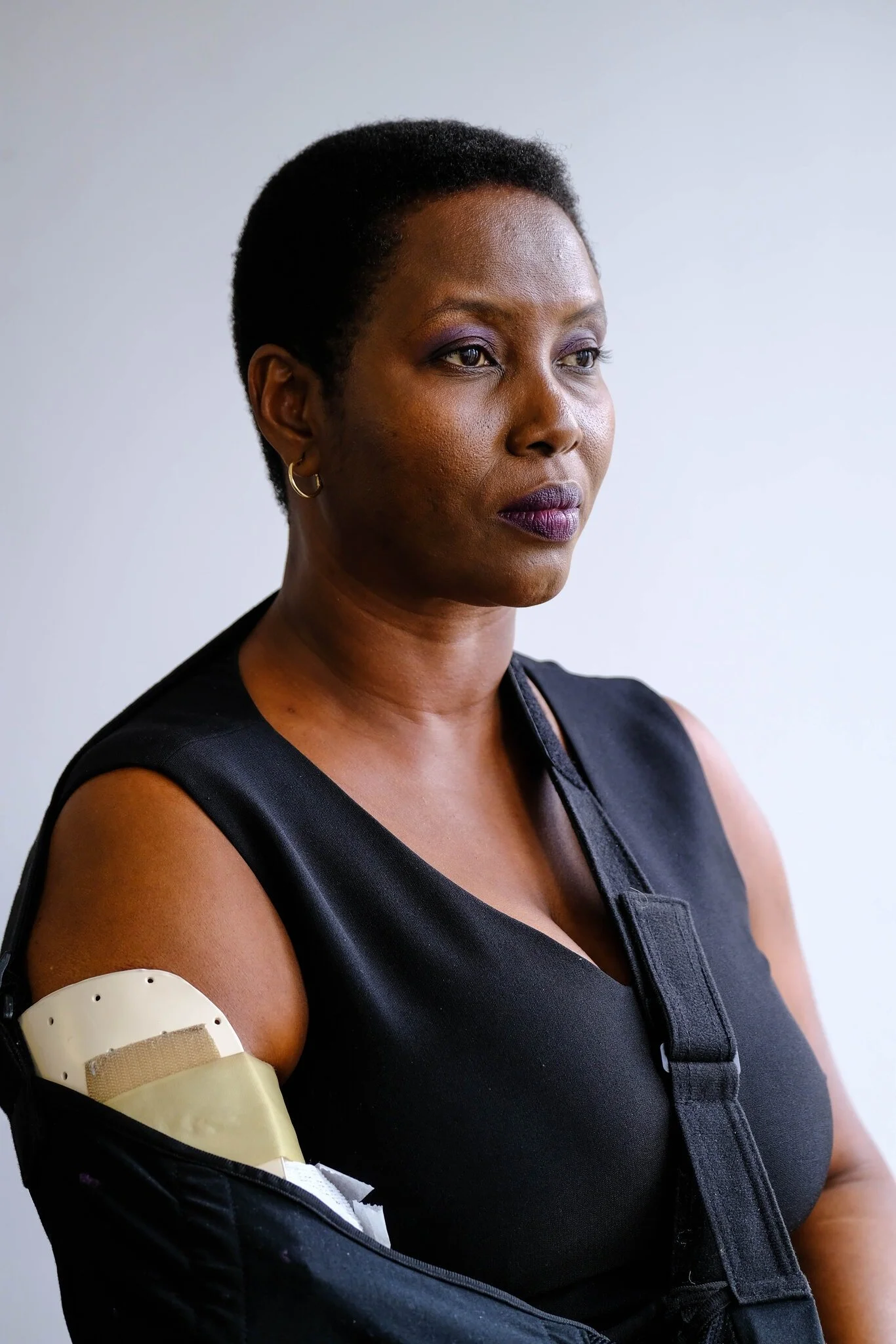
Struck by gunfire, Martine Moïse lay bleeding as the assassins who killed her husband ransacked her room. Now, she says, the F.B.I. must find the mastermind behind the attack.
MIAMI — With her elbow shattered by gunfire and her mouth full of blood, the first lady of Haiti lay on the floor beside her bed, unable to breathe, as the assassins stormed the room.
“The only thing that I saw before they killed him were their boots,” Martine Moïse said of the moment her husband, President Jovenel Moïse of Haiti, was shot dead beside her. “Then I closed my eyes, and I didn’t see anything else.”
She listened as they ransacked the room, searching methodically for something in her husband’s files, she said. “‘That’s not it. That’s not it,’” she recalled them saying in Spanish, over and over. Then finally: “‘That’s it.’”
The killers filed out. One stepped on her feet. Another waved a flashlight in her eyes, apparently to check to see if she was still alive.
“When they left, they thought I was dead,” she said.
In her first interview since the president’s assassination on July 7, Mrs. Moïse, 47, described the searing pain of witnessing her husband, a man with whom she had shared 25 years, being killed in front of her. She did not want to relive the deafening gunfire, the walls and windows trembling, the terrifying certainty that her children would be killed, the horror of seeing her husband’s body, or how she fought to stand up after the killers left. “All that blood,” she said softly.

But she needed to speak, she said, because she did not believe that the investigation into his death had answered the central question tormenting her and countless Haitians: Who ordered and paid for the assassination of her husband?
The Haitian police have detained a wide array of people in connection with the killing, including 18 Colombians and several Haitians and Haitian Americans, and they are still seeking others. The suspects include retired Colombian commandos, a former judge, a security equipment salesman, a mortgage and insurance broker in Florida, and two commanders of the president’s security team. According to the Haitian police, the elaborate plot revolves around a 63-year-old doctor and pastor, Christian Emmanuel Sanon, who officials say conspired to hire the Colombian mercenaries to kill the president and seize political power.
But critics of the government’s explanation say that none of the people named in the investigation had the means to finance the plot on their own. And Mrs. Moïse, like many Haitians, believes there must have been a mastermind behind them, giving the orders and supplying the money.
She wants to know what happened to the 30 to 50 men who were usually posted at her house whenever her husband was at home. None of his guards were killed or even wounded, she said. “I don’t understand how nobody was shot,” she said.

At the time of his death, Mr. Moïse, 53, had been in the throes of a political crisis. Protesters accused him of overstaying his term, of controlling local gangs and of ruling by decree as the nation’s institutions were being hollowed out.
Mr. Moïse was also locked in battle with some of the nation’s wealthy oligarchs, including the family that controlled the nation’s electrical grid. While many people described the president as an autocratic leader, Mrs. Moïse said her fellow citizens should remember him as a man who stood up to the rich and powerful.
And now she wants to know if one of them had him killed.
“Only the oligarchs and the system could kill him,” she said.
Dressed in black, with her arm — now limp and perhaps useless forever, she said — wrapped in a sling and bandages, Mrs. Moïse offered an interview in South Florida on the agreement that The New York Times not reveal her whereabouts. Flanked by her children, security guards, Haitian diplomats and other advisers, she barely spoke above a whisper.
She and her husband had been asleep when the sounds of gunfire jolted them to their feet, she recalled. Mrs. Moïse said she ran to wake her two children, both in their early 20s, and urged them to hide in a bathroom, the only room without windows. They huddled there with their dog.
Her husband grabbed his telephone and called for help. “I asked, ‘Honey, who did you phone?’” she said.

“He said, ‘I found Dimitri Hérard; I found Jean Laguel Civil,’” she said, reciting the names of two top officials in charge of presidential security. “And they told me that they are coming.”
But the assassins entered the house swiftly, seemingly unencumbered, she said. Mr. Moïse told his wife to lie down on the floor so she would not get hurt.
“‘That’s where I think you will be safe,’” she recalled him saying.
It was the last thing he told her.
A burst of gunfire came through the room, she said, hitting her first. Struck in the hand and the elbow, she lay still on the floor, convinced that she, and everyone else in her family, had been killed.
None of the assassins spoke Creole or French, she said. The men spoke only Spanish, and communicated with someone on the phone as they searched the room. They seemed to find what they wanted on a shelf where her husband kept his files.
“They were looking for something in the room, and they found it,” Mrs. Moïse said.
She said she did not know what it was.
“At this moment, I felt that I was suffocating because there was blood in my mouth and I couldn’t breathe,” she said. “In my mind, everybody was dead, because if the president could die, everybody else could have died too.”

The men her husband had called for help, she said — the officials entrusted with his security — are now in Haitian custody.
The Assassination of Haiti’s President
- An assassination strikes a troubled nation: The killing of President Jovenel Moïse on July 7 has rocked Haiti, stoking fear and confusion about the future. While there is much we do know about this event, there’s still much we don’t know.
- A figure at the center of the plot: Questions are swirling over the arrest of Dr. Christian Emmanuel Sanon, 63, a doctor with ties to Florida described as playing a central role in the death of the president.
- More suspects: Two Americans are among at least 20 people who have been detained thus far. Several of the people under investigation met in the months before the killing to discuss rebuilding the country once the president was out of power, Haitian police said.
- Years of instability: The assassination of Mr. Moïse comes after years of instability in the country, which has long suffered lawlessness, violence and natural disasters.
And while she expressed satisfaction that a number of the accused conspirators have been detained, she is by no means satisfied. Mrs. Moïse wants international law enforcement agencies like the F.B.I., which searched homes in Florida this week as part of the investigation, to track the money that financed the killing. The Colombian mercenaries who were arrested, she said, did not come to Haiti to “play hide and seek,” and she wants to know who paid for it all.
In a statement on Friday, the F.B.I. said it “remains committed to working alongside our international partners to administer justice.”
Mrs. Moïse expected the money to trace back to wealthy oligarchs in Haiti, whose livelihoods were disrupted by her husband’s attacks on their lucrative contracts, she said.
Mrs. Moïse cited a powerful Haitian businessman who has wanted to run for president, Reginald Boulos, as someone who had something to gain from her husband’s death, though she stopped short of accusing him of ordering the assassination.
Mr. Boulos and his businesses have been at the center of a barrage of legal cases brought by the Haitian government, which is investigating allegations of a preferential loan obtained from the state pension fund. Mr. Boulos’ bank accounts were frozen before Mr. Moïse’s death, and they were released to him immediately after he died, Mrs. Moïse said.

In an interview, Mr. Boulos said that only his personal accounts, with less than $30,000, had been blocked, and he stressed that a judge had ordered the release of the money this week, after he took the Haitian government to court. He insisted that, far from being involved in the killing, his political career was actually better off with Mr. Moïse alive — because denouncing the president was such a pivotal part of Mr. Boulos’s platform.
“I had absolutely, absolutely, absolutely nothing to do with his murder, even in dreams,” Mr. Boulos said. “I support a strong, independent international investigation to find who came up with the idea, who financed it and who executed it.”
Mrs. Moïse said she wants the killers to know she is not scared of them.
“I would like people who did this to be caught, otherwise they will kill every single president who takes power,” she said. “They did it once. They will do it again.”
She said she is seriously considering a run for the presidency, once she undergoes more surgeries on her wounded arm. She has already had two surgeries, and doctors now plan to implant nerves from her feet in her arm, she said. She may never regain use of her right arm, she said, and can move only two fingers.
“President Jovenel had a vision,” she said, “and we Haitians are not going to let that die.”

Haiti gang leader rallies hundreds to honor slain president
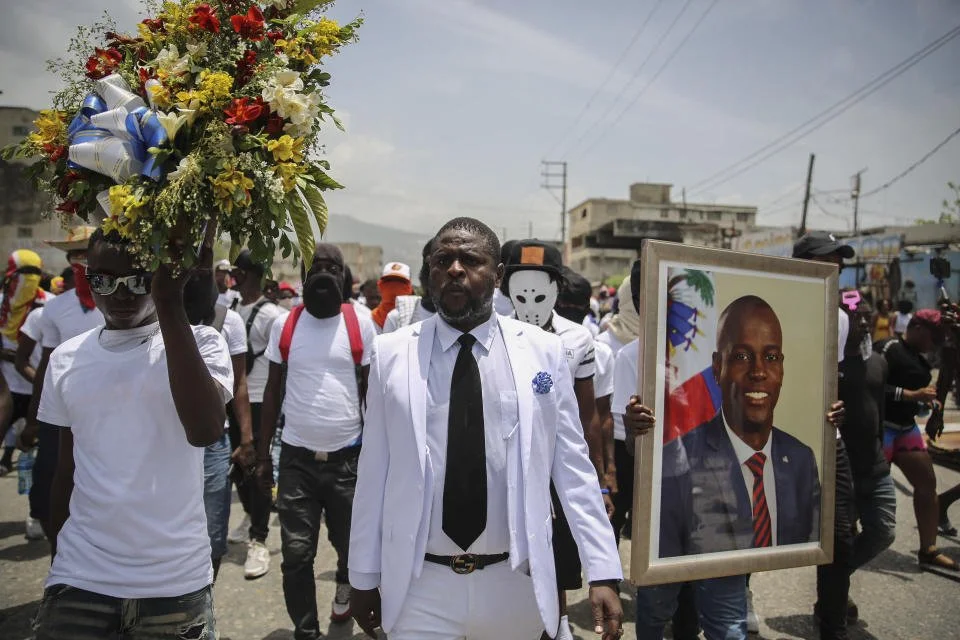
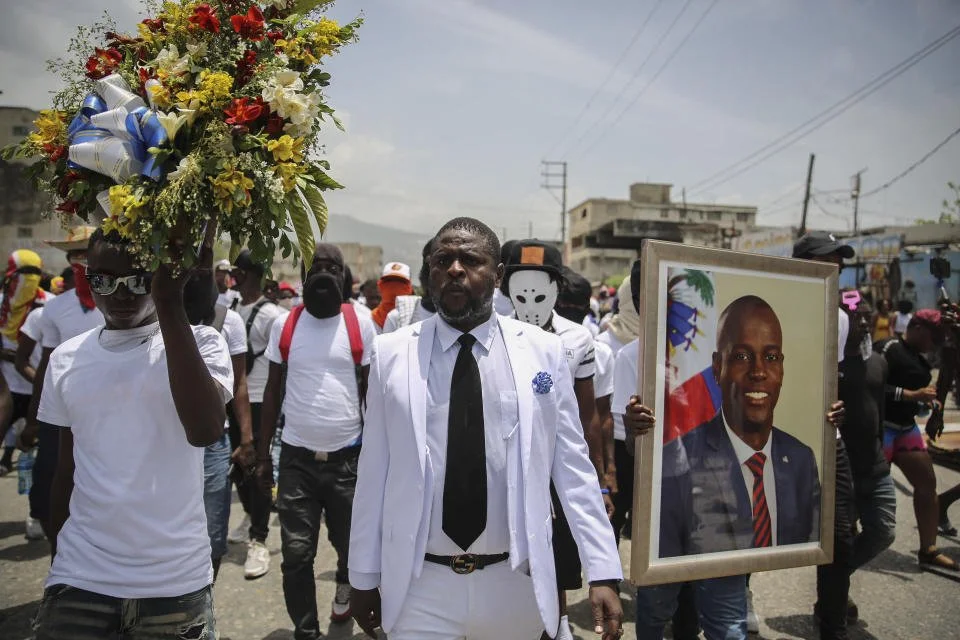
PORT-AU-PRINCE, Haiti (AP) — More than 1,000 demonstrators gathered around one of Haiti's most notorious gang leaders on Monday to commemorate slain President Jovenel Moïse.
The crowd was mostly dressed in white as they cheered on Jimmy Cherizier, a former police officer who now leads “G9”, a federation of nine gangs whom officials have blamed for a spike in violence and kidnappings in recent months.
“Everyone needs to wait on my order before we respond to the killing of Jovenel Moïse,” said Cherizier, who goes by the name of “Barbecue" and whom police say is behind several recent massacres that targeted civilians living in communities run by other gangs.
He was wearing a white suit and black tie as he spoke to the crowd at the seaside slum of La Saline in the capital of Port-au-Prince. A nearby truck played music as Cherizier knelt down before a large portrait of Moïse and began to light candles.
“No justice, no peace!” he said.
Earlier, the crowd sang as they made a circle around a bonfire and threw salt into it as part of a ceremony to honor Moïse. Many had their faces covered so as not to be identified.
Moïse was shot several times during a July 7 attack at his private home in which his wife was seriously injured. At least 26 people have been arrested, including 18 former Colombian soldiers. Police are still looking for various suspects, including a former rebel leader and an ex-Haitian senator. On Monday, they identified another suspect: Haiti Superior Court Judge Windelle Coq Thelot.
4 Haitian novels that beautifully blend history, memory and reality
Following the July 7, 2021 assassination of Haiti’s President Jovenel Moïse and after one Haitian official requested that the U.N. and U.S. send troops to help stabilize the nation, many Haitian activists and artists recoiled at the prospect of yet another outside intervention.
The Haitian-American novelist Edwidge Danticat is one artist who has repeatedly railed against past U.S. occupations of Haiti. In her foreword to Jan J. Dominique’s “Memoir of an Amnesiac,” she highlights a tension that exists in Haiti’s collective memory – pride over the revolution for freedom and independence from France in 1804, and frustration over continuous foreign meddling, brought to a new height with a 20-year occupation by the U.S. military starting in 1915.
“Never again will foreigners trample Haitian soil, the founders…declared in 1804,” Danticat writes. “Yet in 1915, the ‘boots’ invaded,” which meant that Haitians like the father of the narrator in Dominique’s tale would “never truly know a fully free and sovereign life, having had not just his country but his imagination invaded and occupied by the Americans.”
A specialist in Haitian literary and historical studies from the University of Virginia, Marlene L. Daut has selected four Haitian-authored novels that sit with this contradiction, along with many others.
By guiding readers through Haiti over the past century, she shows how these contemporary writers magnificently paint the entanglements of memory, history and imagination that make Haitian art, from all times, so enduring and brilliant.
1. Évelyne Trouillot, “Memory at Bay” (2010)
In “Memory at Bay,” Trouillot explores the ruthless juxtaposition that exists between Haitian President-turned-dictator François “Papa Doc” Duvalier, called “the Deceased” in her novel, and Haiti’s subjugated position in the Western world.
Many years after the death of Duvalier and the fall of his successor and son, “Baby Doc,” the Deceased’s bedridden wife tries to cast her husband as both a protector of the Haitian people and a target of the West’s quest for revenge.
“After all, how could the Western countries ever forgive or forget Napoleon’s debacle, the sorry defeat of the French army … and the rout of the French colonizers at the hands of an army of former slaves?” the Deceased’s wife thinks. The widow attempts to paint her husband as having been the only one to stand up to the “former colonialists, the one-time occupying power, and all those who wanted to use the country as a springboard for their ambitions.”

The attendant caring for her in a nursing home in France has a different memory of the Deceased and his legacy. Coming from a family devastated by the Tonton Makouts – Duvalier’s murderous henchmen responsible for the deaths of tens of thousands of Haitians – the nurse finds herself disgusted at having to care for an integral culprit in her country’s devastation.
“So many overlooked stories of men and women just guilty of having been alive at the wrong moment, in the wrong place,” she thinks, as she briefly contemplates whether to kill the widow. “My father, my uncle, the resister whose grandchildren will never know him, Madame So-and-So’s husband, the grocer’s cousin, his friend’s godfather, the mother of the little girl who will not be born, the boy who should have been born.”
2. Dany Laferrière, “Down Among the Dead Men” (1996)
Set in 1996, after the fall of the Duvalier regime and during the United Nations’ occupation of Haiti, this partly autobiographical tale tells the story of a never-named protagonist – a stand-in for Laferrière – who decides to come home to Haiti for the first time in 20 years.
Haiti has changed a lot during his exile in Montreal, where he was making his living as a writer. He no longer recognizes the capital, Port-au-Prince, which has seen massive migration from the countryside into the city. The result is overcrowding, famine and generalized misery.
In a chance encounter with a shoeshine man, the narrator is told that these changes mean “All the people you see in the street, walking and talking, most of them died a long time ago and they don’t even know it. This country has turned into the world’s largest cemetery.”
Such commentary encourages the narrator to write a book about “the other world.” He wonders “[i]s it here or elsewhere?” After unwittingly accepting from a powerful Vodou priest “the most terrifying offer anyone could make a writer: to take him to the kingdom of dead,” the narrator meets in succession the Vodou god Papa Legba, master of the crossroads, and Ogou Feraille, the god of war.
Ultimately, the narrator ends up as disappointed with the spirit world as he is with the mortal one. “This was hardly Dante’s inferno,” he remarks. “I’d been expecting…a universe so powerful and rich in symbols, so complex that it would have helped me… Instead, I ended up with a giggling adolescent goddess and the complaints of her father, the supposedly fearsome Ogou Feraille.”
All of this happens parallel to searing political commentary about the punitive and insulting measures forced upon Haiti by the world powers after the 1991 military coup that unseated President Jean-Bertrand Aristide. For example, along with U.N. “peacekeepers,” a comical cast of foreign investigators arrive to study why the people of the northwestern town of Bombardopolis do not need to eat for months at a time. The foreigners conclude that it is because they are all plants, and not human beings.
The irony of course is that foreign meddlers are the ones who have caused the starvation. “Hunger remains the most effective weapon,” one character wryly remarks.
Sometimes the sardonic humor stings a little too much: “When everyone starts joking in a country, you know that all hope is gone,” the narrator’s friend Manu complains. “Humor is the weapon of desperate people.”
3. Edwidge Danticat, “The Farming of Bones” (1999)
In this work of historical fiction, Danticat transports readers to the Dominican Republic, to the border town of Alegría. There, Haitian workers are living “a cane life” – engaged in the brutal work of planting and cutting sugar cane, “travay tè pou zo, the farming of bones.”
Hewing closely to the historical record, Danticat captures the horrors of Dominican dictator General Rafael Trujillo’s massacre in 1937 of tens of thousands of Haitians living and working along the border. The more fictional sections follow the escape of Amabelle Désir, who had many years before witnessed the death by drowning of her parents, both migrant herbal healers, as they tried to cross the Dajabón River separating Haiti and the Dominican Republic.
Amabelle will eventually lose her lover, Sebastien Onius, to the troops of the “Generalissimo,” after Trujillo gives orders “to have all Haitians killed.”

As Haitian characters are tortured or executed because they cannot trill their Rs to pronounce “perejil,” the Spanish word for parsley, Haiti’s glorious revolutionary past seems to fade into the background of the torturous present.
“When Dessalines, Toussaint, Henry, when those men walked the earth, we were a strong nation,” one man who escaped the massacre states. “Those men would go to war to defend our blood. In all this, our so-called president says nothing…nothing at all to this affront to the children of Dessalines, the children of Toussaint, the children of Henry; he shouts nothing across this river of our blood.”
4. René Depestre, “Hadriana in All My Dreams” (1988)
Near the end of “The Farming of Bones,” a guide taking visitors to King Henry’s famous Citadelle says, “Famous men never truly die…It is only those nameless and faceless who vanish like smoke into the early morning air.”
Beginning in 1938, just one year after Trujillo’s massacre, Depestre’s “Hadriana” trails the life, death and reemergence of a white French woman born in Haiti named Hadriana Siloé, who appears to mysteriously die while saying her wedding vows. She is then suspected of having been transformed into a zombie when her body goes missing from its grave.
During her funeral-turned-carnival, historical figures from different eras join the masked wake, as “historical memory” has gotten “mixed up to the point of ridiculousness.”
And so readers are treated to scenes of the Haitian emperor Jacques the First, who ruled Haiti from 1804 to 1806, playing table tennis with his partner, Joseph Stalin, while Venezuelan freedom fighter Simón Bolívar dances alongside King Henry Christophe, who became king of northern Haiti in 1811.
“This masked occasion had convoked three centuries of human history to [Hadriana’s] wake,” her childhood friend Patrick says. They “had come together to dance, sing, drink rum, and refuse death, kicking up the dust on my village square, which, in the midst of this general masquerade, took itself for the cosmic stage of the universe.”
In the end, it is not just history but all of life that appears to be one large carnival as the contours of death come alive on the streets of the living.
This tale has a happy ending, though. Decades later, Hadriana is revealed to be alive after all and describes how she miraculously escaped from the botched attempt to turn her into a zombie. She even gets married, not to her original fiancé but to Patrick, who has chronicled all that took place in her absence.
The true romance here may be that unlike so many of those who have disappeared in yesterday’s and today’s Haiti, Hadriana and Patrick live to tell their story.
Haitian president's funeral takes place amid violent protests
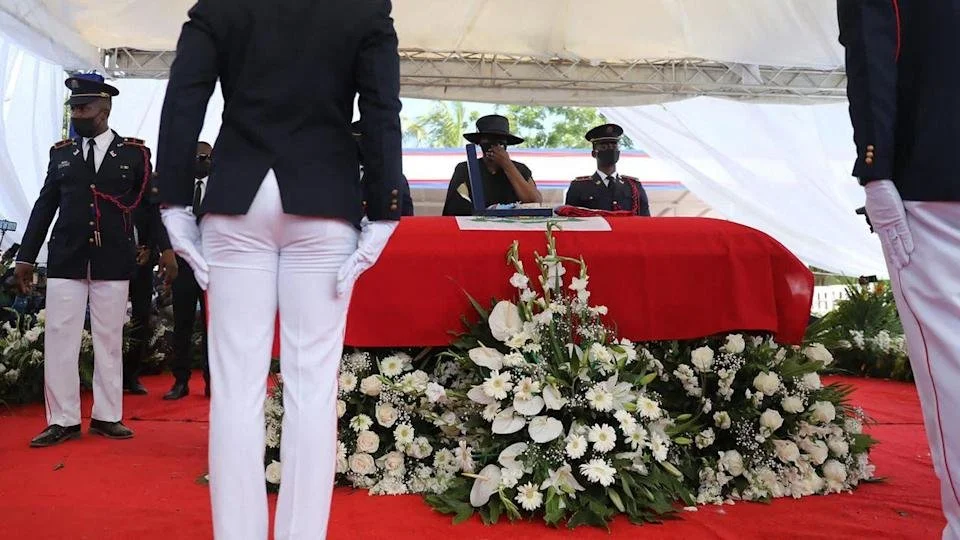
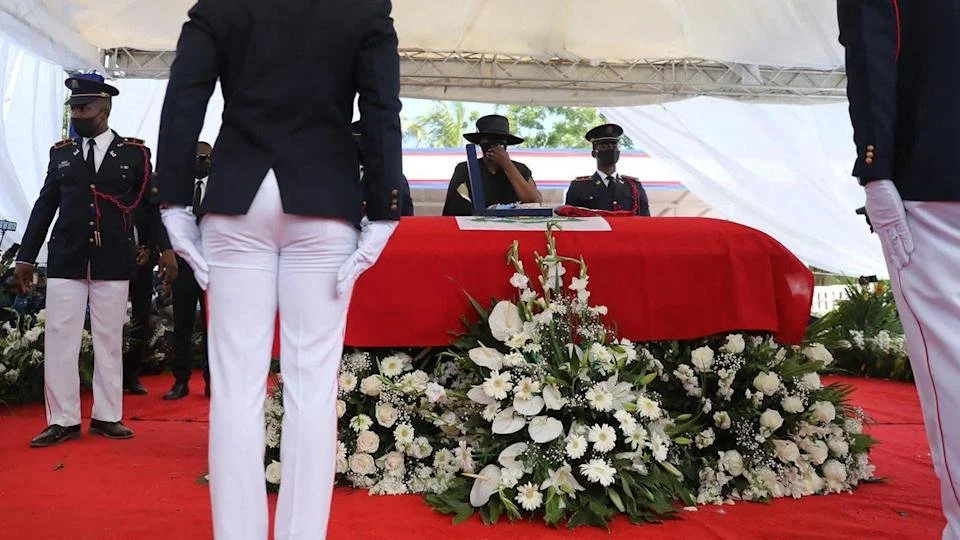
The private funeral for assassinated Haitian President Jovenel Moïse took place on Friday as protests continue to erupt in the country, AP reports.
State of play: At the start of the ceremony, several Moïse supporters stood outside, the residence, shouting, "Justice for Jovenel!" and "Justice! Justice!" as politicians arrived. When León Charles, Haiti's national police chief, arrived, people surrounded him, calling him an "assassin," per AP.
- Protesters clashed with police outside the event, and shots were fired into the air, U.S. officials told AP. There were no immediate reports of injuries and funeral guests were not put in danger, Reuters notes.
- U.S. Ambassador to the United Nations, Linda Thomas-Greenfield, was in attendance, but departed less than a half hour into the funeral, per the New York Times.
- "[T]he presidential delegation is safe and accounted for in light of the reported shootings outside of the funeral," White House press secretary Jen Psaki said at a press briefing on Friday.
- "They’re on their way back to the United States, we are deeply concerned about unrest in Haiti, and this critical moment, Haiti’s leaders must come together to turn a united path that reflects the will of the Haitian people."
- "We remain committed to supporting the people of Haiti in this challenging time."
The big picture: The funeral comes two weeks after Moïse's assassination and the investigation into what happened remains ongoing. Some protesters "were angry that the president would be buried before the investigation into his assassination was completed," the Times writes.
- Several suspects have been arrested in connection to the killing.
- Haiti's Ambassador to the U.S. Bocchit Edmond told CNN earlier this month that "there is no doubt" the assassins had inside help.
What they're saying: "They’re watching us, waiting for us to be afraid," said Martine Moïse, wife of the late president.
- "We don’t want vengeance or violence. We’re not going to be scared."
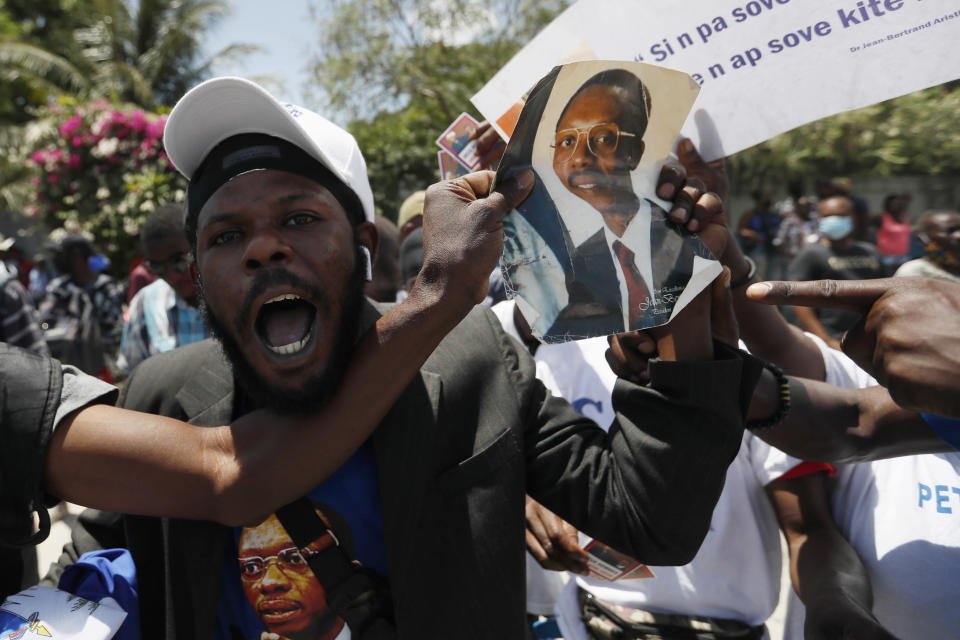
Hundreds greet Aristide on return to troubled Haiti
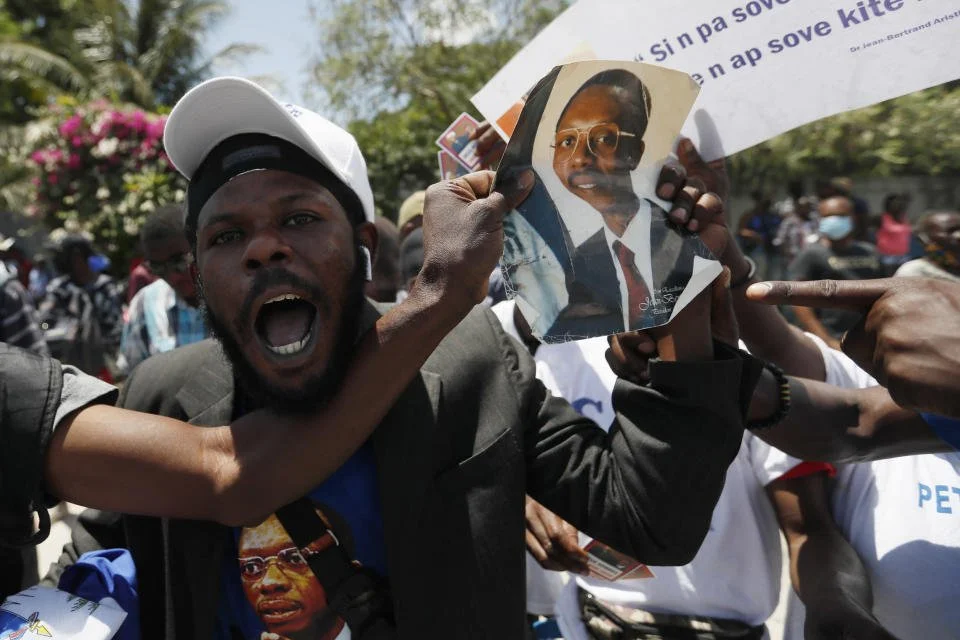
PORT-AU-PRINCE, Haiti (AP) — Former President Jean-Bertrand Aristide returned to Haiti on Friday after a nearly a month in Cuba, thrilling hundreds of supporters who gathered at the airport at a time of tensions over the recent assassination of the country's leader.
Aristide, a charismatic yet divisive figure in Haiti who was receiving unspecified medical treatment in Cuba, arrives back in a country simmering with tension over the July 7 assassination of President Jovenel Moïse as new details about the investigation emerged.
Colombian Police Chief Gen. Jorge Luis Vargas on Friday accused a former Haitian government official of ordering ex-Colombian soldiers to kill Moïse. He said Joseph Felix Badio told Colombians Duberney Capador and Germán Rivera that “what they have to do is kill the president of Haiti.”
Vargas said Badio gave that order roughly three days before the assassination during a meeting in Haiti with the two Colombians, who had been in the country since May 10.
Capador was killed in a shootout with Haitian police hours after Moïse was slain. Rivera remains detained in Haiti while police are still searching for Badio, who previously worked for Haiti’s Justice Ministry and then the government’s anti-corruption unit until he was fired in May.
More than 20 suspects accused of direct involvement in the slaying have been arrested, the majority of them former Colombian soldiers. At least three other suspects were killed, and police have said they are still looking for at least seven others.
Colombia’s government has said only a small group of Colombian soldiers knew the true nature of the operation and that the others were duped.
Also on Friday, Police Chief Léon Charles said 24 police officers were standing guard when the president's house was attacked. He said they have been interrogated and that a fifth high-ranking police official has been placed in isolated detention with four others, although none have been named as suspects.
Interim Prime Minister Claude Joseph said the government will continue to bring those responsible to justice.
“We will continue to pose questions,” he said.
Tickets for most of the former soldiers, at least, were purchased through a Florida-based company, Worldwide Capital Lending Group, Vargas said Friday.
Officials earlier said they had been bought by another Florida company, CTU Security, which allegedly recruited the men.
Worldwide issued a statement Thursday saying it helped provide a loan to CTU, but said it was meant to help finance infrastructure projects sought by Christian Emmanuel Sanon, a Haitian physician and pastor who has been arrested in the plot.
“At no time during any meeting or conversation with Dr. Sanon or with any of his representatives was there any mention, discussion or suggestion of an assassination plot against President Moïse or the intention to use force to bring about a change of leadership in Haiti,” the company said.
Meanwhile, throngs of Aristide supporters cheered when they saw the former president arrive. They had arrived a couple of hours before the plane landed, holding pictures of the former priest, some saying, “The king is back!”
Aristide was taken home in an ambulance that made its way through the crowd. Some touched the vehicle’s windows before being pushed away by police. Some supporters lingered outside after the ambulance entered Aristide’s home, but the former leader did not come out and speak.
Joel Edouard “Pacha” Vorbe, an executive committee member of Aristide’s Fanmi Lavalas party, told The Associated Press that Aristide “is completely recovered,” although he didn't have details about his condition. Neither Aristide nor the government have described the health issue.
Aristide’s return adds a potentially volatile element to an already tense situation in a country facing a power vacuum. Aristide has long been one of Haiti’s most polarizing politicians and is still popular with many.
Aristide became a global figure of resistance when, as a slum priest known for fiery oratory, he led a movement that ousted the hated dictator Jean-Claude “Baby Doc” Duvalier in 1986.
He was elected president in 1990, forced out in a military coup a year later and restored to power by the U.S. military in 1994 to serve out the remainder of his term. As a champion of the poor and advocate of leftist “liberation theology,” he was deeply hated by members of the elite.
Reelected in 2000, he was ousted four years later in a rebellion led by opponents with ties to the elite and the old Duvalierist regime. Aristide spent seven years in exile in South Africa before returning in 2011. He has largely kept a low profile, except when campaigning for his party's unsuccessful presidential candidate in 2016.
Joseph is currently governing Haiti with the backing of police and military, although he faces growing challenges to his power.
While Haiti's government has asked for military help, U.S. President Joe Biden said Thursday that sending troops was “not on the agenda." However, he said U.S. Marines would be deployed to boost security at the U.S. Embassy.
Mathias Pierre, Haiti's elections minister, said he believes the door is still open for potential U.S. military assistance, noting that the country is in a “fragile situation” and requires a secure environment to hold elections in upcoming months.
A U.S. citizen is among those arrested for the assassination of Haitian President Jovenel Moïse
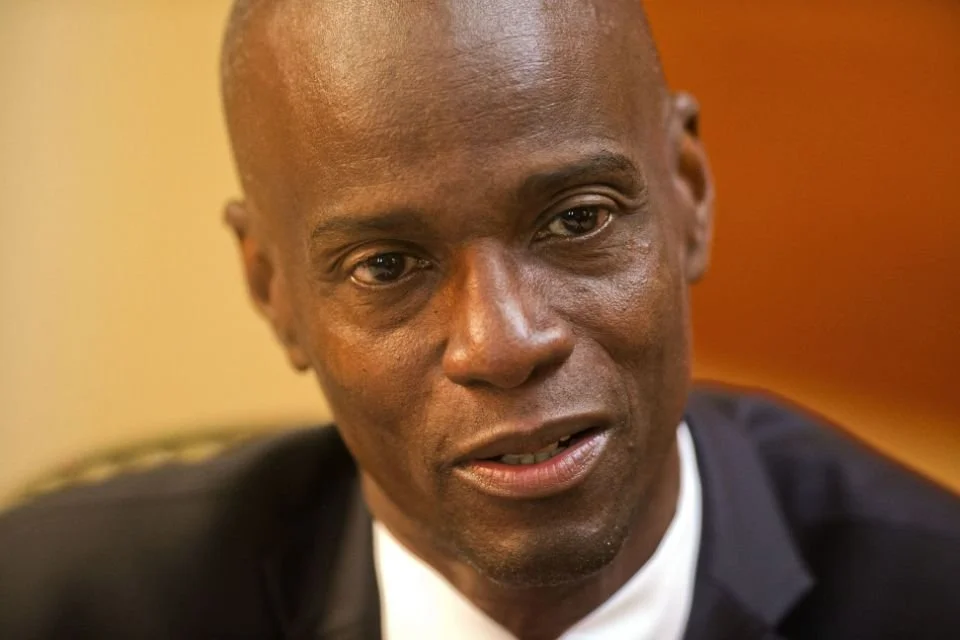
- A US citizen of Haitian descent was reportedly among those arrested in connection with the assassination of Haitian President Jovenel Moïse.
- The Haitian-American was identified as James Solages by the Associated Press and The Washington Post.
- Moïse was assassinated by a group of armed assailants who burst into his home at around 1 a.m. Wednesday.
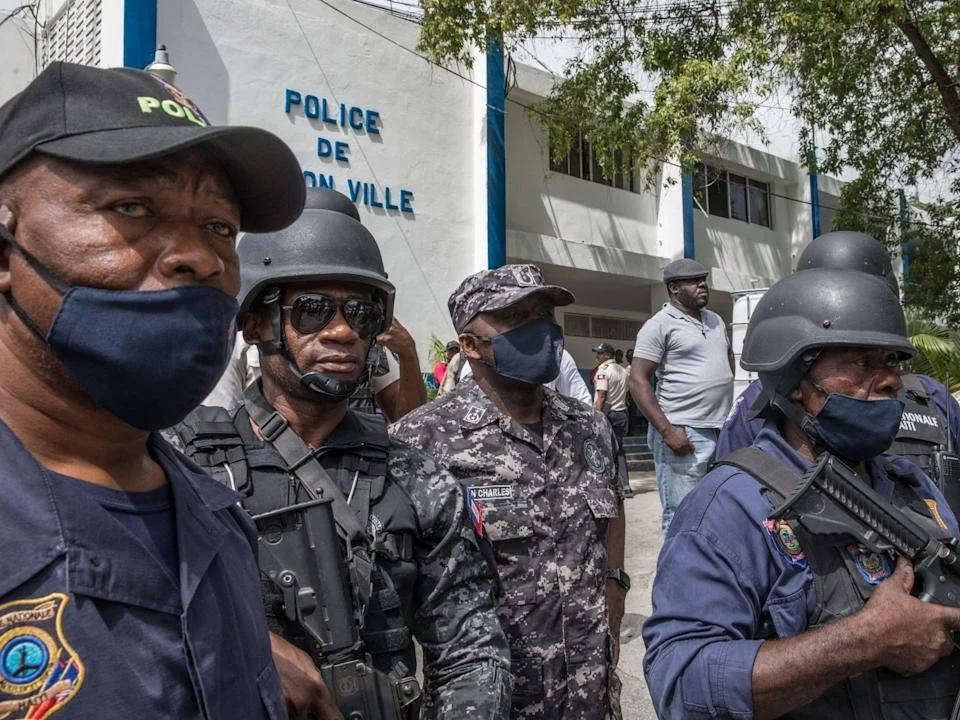
A US citizen of Haitian descent has reportedly been arrested in connection with the assassination of Haitian President Jovenel Moïse.
The Haitian-American, identified as James Solages, is among the six people who have been nabbed for the early Wednesday killing of Moïse at his home, The Washington Post and the Associated Press reported Thursday.
The AP and Washington Post cited Mathias Pierre, Haiti's minister of elections and inter-party relations.
Pierre told The Washington Post that at least one other person who was apprehended is also believed to be a Haitian-American.
Moïse, 53, was assassinated by a group of armed assailants who burst into his home at around 1 a.m. Wednesday.
Haitian first lady Martine Moïse was also critically injured in the attack. She was later flown to Miami, Florida for treatment for her gunshot wounds.

Léon Charles, the director of Haiti's National Police told reporters Thursday that a total of six suspects have been busted in connection to fatal ambush.
Authorities have said that four other suspects believed to be involved in the assassination were killed in a gun battle with police.
Haitian authorities were still looking for more assailants, Charles said Thursday, according to the Associated Press.
"The pursuit of the mercenaries continues," Charles said Wednesday night. "Their fate is fixed: They will fall in the fighting or will be arrested."
Pierre told The Washington Post that the nabbed suspects were being held at a police station in the capital and that an anrgy mob of people had surrounded it.
"The special units are trying to protect the police station, because the population is very mad and is trying to get to them, to burn them," Pierre told the news outlet. "We're trying to avoid that."
The identities of the other suspects were not immediately released.
Haitian Communications Minister Pradel Henriquez has called them "foreigners,"according to The Washington Post.
Official: Haiti President Jovenel Moïse assassinated at home
PORT-AU-PRINCE, Haiti (AP) — Gunmen assassinated Haitian President Jovenel Moïse and wounded his wife in their home early Wednesday, inflicting more chaos on the unstable Caribbean country that was already enduring an escalation of gang violence, anti-government protests and a recent surge in coronavirus infections.
Claude Joseph, the interim prime minister, confirmed the killing and said the police and military were in control of security in Haiti, where a history of dictatorship and political upheaval have long stymied the consolidation of democratic rule.
While the streets of the Haitian capital, Port-au-Prince, were quiet Wednesday morning, some people ransacked businesses in one area. The country appeared to be heading for fresh uncertainty ahead of planned general elections later this year. Moïse, 53, had been ruling by decree for more than a year after the country failed to hold elections and the opposition demanded he step down in recent months.
Former President Michel Martelly, whom Moïse succeeded, said he was praying for first lady Martine Moïse, calling the assassination “a hard blow for our country and for Haitian democracy, which is struggling to find its way.”
Joseph said Martine Moïse, 47, was shot and in a hospital. He condemned the president's killing as a “hateful, inhumane and barbaric act.”
“The country’s security situation is under the control of the National Police of Haiti and the Armed Forces of Haiti," Joseph said in a statement from his office. “Democracy and the republic will win.”
In the statement, Joseph said some of the attackers spoke in Spanish but offered no further explanation. He later said in a radio address that they spoke Spanish or English.
A resident who lives near the president’s home said she heard the attack.
“I thought there was an earthquake, there was so much shooting,” said the woman who spoke on condition of anonymity because she fears for her life. “The president had problems with many people, but this is not how we expected him to die. This is something I wouldn’t wish on any Haitian.”
The U.S. Embassy in Haiti said it was restricting U.S. staff to its compounds and that the embassy would be closed Wednesday because of ‘’an ongoing security situation.''
The White House described the attack as “horrific” and “tragic” and said it was still gathering information on what happened. U.S. President Joe Biden will be briefed later Wednesday by his national security team, spokesperson Jen Psaki said during an interview on MSNBC.
“The message to the people of Haiti is this is a tragic tragedy,” she during a previously scheduled interview on CNN. “And we stand ready and stand by them to provide any assistance that’s needed.”
Haiti's economic, political and social woes have deepened recently, with gang violence spiking heavily in Port-au-Prince, inflation spiraling and food and fuel becoming scarcer at times in a country where 60% of the population makes less than $2 a day. These troubles come as Haiti still tries to recover from the devastating 2010 earthquake and Hurricane Matthew that struck in 2016.
Opposition leaders accused Moïse of seeking to increase his power, including by approving a decree that limited the powers of a court that audits government contracts and another that created an intelligence agency that answers only to the president.
In recent months, opposition leaders demanded the he step down, arguing that his term legally ended in February 2021. Moïse and supporters maintained that his term began when he took office in early 2017, following a chaotic election that forced the appointment of a provisional president to serve during a year-long gap.
___
This story has been updated to correct that Moïse ruled by decree for more than a year, not more than two years.
Haiti squares up with Nicaragua in decisive World Cup qualifier
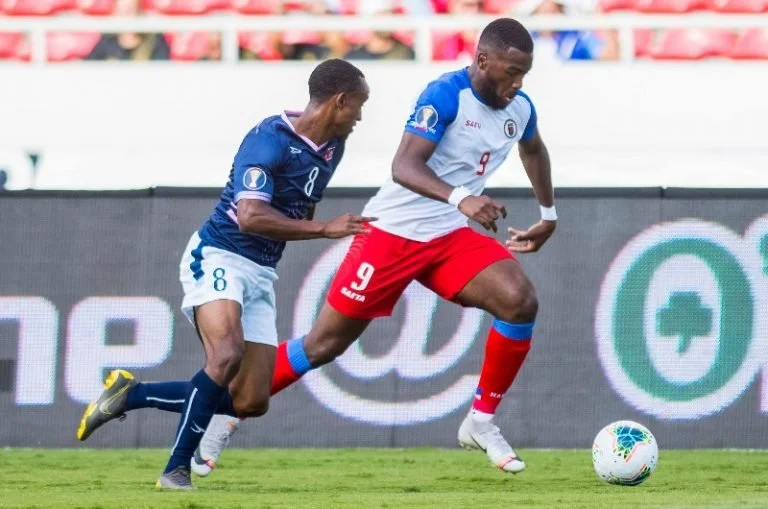
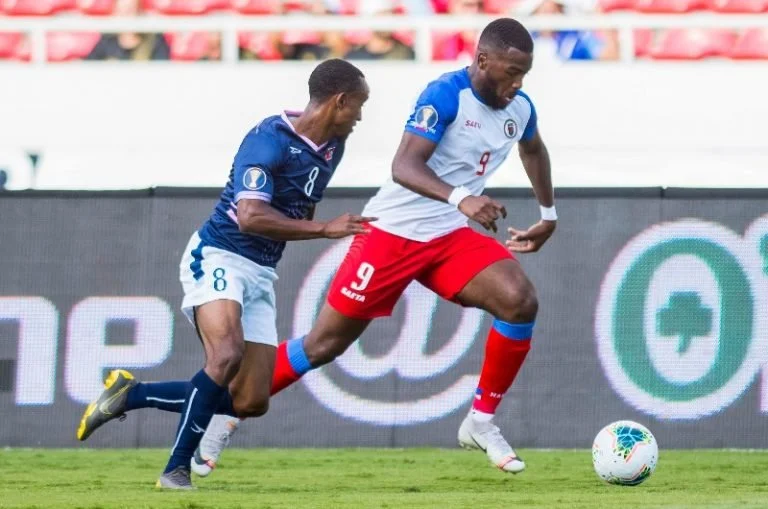
Haiti’s soccer team will welcome Nicaragua home at Sylvio Cator Stadium Tuesday at 5:00 p.m.
A win or a draw will send Haiti to the second phase of the qualifiers, while a loss will end its World Cup quest.
Haiti sits on top of its group with six points after overpowering Belize 2-0 in March and Turks and Caicos Islands 10-0 Saturday.
Meanwhile, Nicaragua is in second spot after beating Turks and Caicos Islands 7-0 and Belize 3-0.
Duckens Nazon leads Les Grenadiers in scoring with four goals. Nazon netted the second fastest quadruple in the history of the World Cup qualifiers versus Turks and Caicos Islands, scoring four goals in 10 minutes.
Hervé Bazile, who started the last game, and Carlens Arcus won’t be available due to injuries.
The game will be played without fans because of a surge in COVID-19 cases in Haiti.
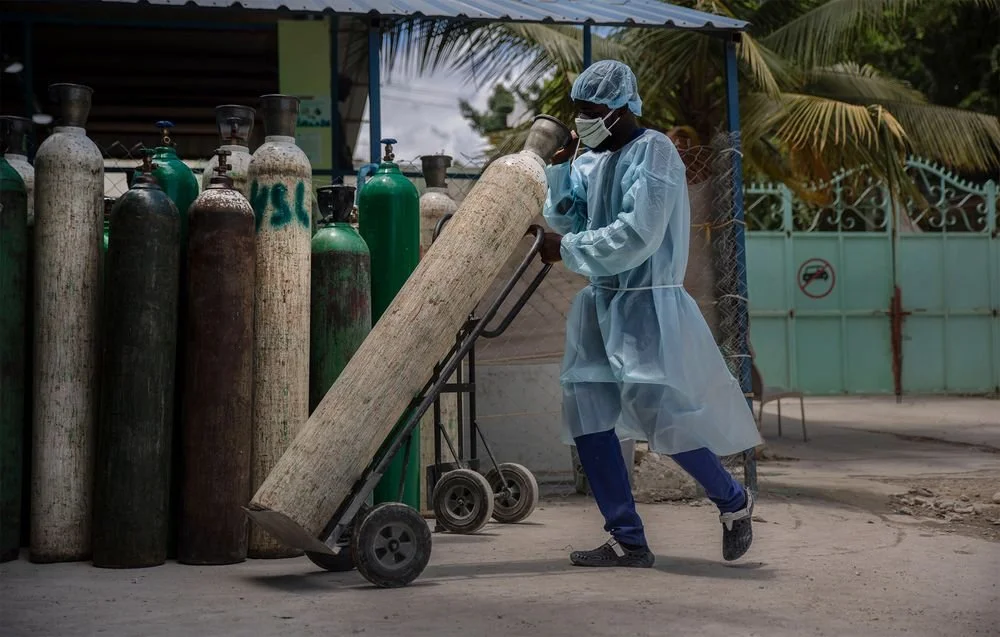
Haiti Is the Only Country in Western Hemisphere Without Vaccines
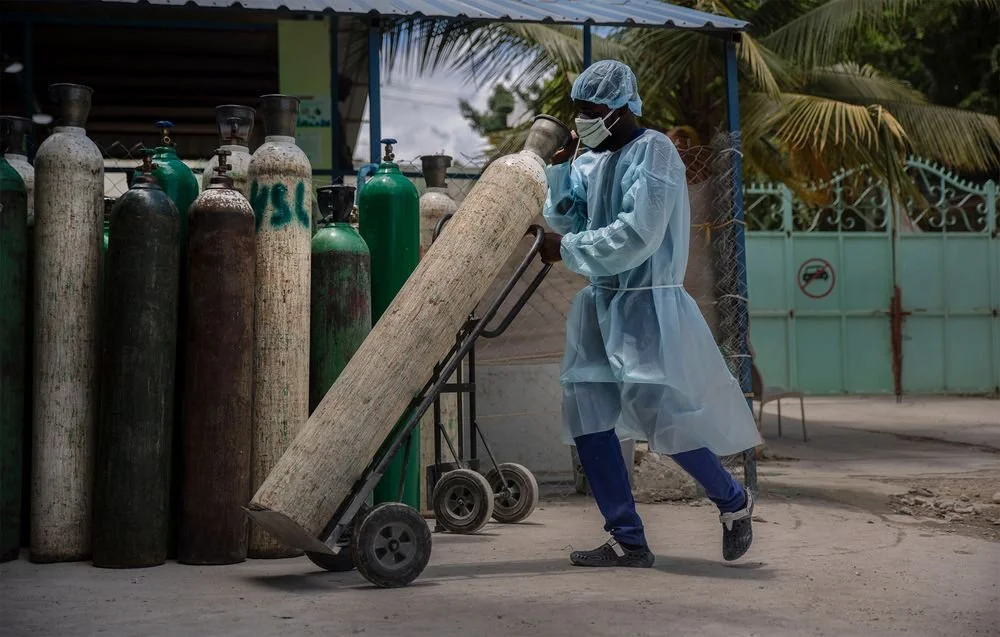
Haiti, the poorest nation in the Western hemisphere, has earned another grim distinction: it’s the only one that hasn’t vaccinated a single resident against Covid-19.
One of a handful of nations worldwide still awaiting vaccines, Haiti was among the 92 poor and middle-income countries offered doses under the Covax Facility. But the government initially declined AstraZeneca PLC shots, citing side effects and widespread fears in the population.
“Haiti did not reject the offer of vaccines from Covax,” Haiti Ministry of Health General Director Laure Adrien said in a telephone interview. “All we asked was that they change the vaccine they were providing us.”
By last month the equation had shifted. Fears about AstraZeneca were subsiding just as Haiti was seeing a surge in cases. When the country finally agreed to receive the doses, production issues in India and a spike in global demand made them unavailable.
The United Nations’ Vaccine Market Dashboard -- which processes information provided by Covax -- has no scheduled delivery date for Haiti. And Adrien said it is unclear when the vaccines will arrive.
Multiple Maladies
The pandemic is just the latest malady to befall the nation of 11.3 million. Haiti has seen months of protests against President Jovenel Moise and a rash of gang violence and kidnappings. Last month, a staff member of Doctors Without Borders, the non-profit that runs several clinics and hospitals in Haiti, was murdered on his way home from work.
Covid, along with the violence, has become one more “huge obstacle” to providing basic health care, said the organization’s mission head, Alessandra Giudiceandrea.
While Haiti has reported 15,435 coronavirus cases and 325 deaths due to Covid-19, the true scope of the problem is obscured by the lack of widespread testing, she said.
“We are seeing a high mortality rate and facilities are overloaded,” she said.
Dominican Republic Plans Border Fence to Keep Haitians at Bay
The dearth of vaccines is all the more striking because neighboring Dominican Republic, with which it shares the island of Hispaniola, has vaccinated almost 20% of its population.
Those vaccines are only available to Dominican citizens and documented residents, leaving most of the estimated 750,000 Haitians living there ineligible.
Father Tomas Garcia, with the Fundacion La Merced, a Dominican aid agency, said vaccinating the vulnerable, regardless of their nationality, should be a priority.
“This is not about saving yourself, this is about saving all of us,” he said. “We’re all in the same boat.”
Adrien, with the Health Ministry, said it’s unclear which vaccines Haiti might receive first, the Covax doses or ones offered to the region last week by U.S. President Joe Biden.
He also argued that there’s a silver lining to the late arrival of the doses. Many Haitians would have declined a shot before now due to widespread hesitancy and the country is better prepared for the cold storage and distribution requirements, he said.
“I don’t think this late onset of the vaccination program will have any impact on the recovery,” Adrien said. “If we started earlier and had a failure in our vaccine program, it would be the same as if we started now and had our program succeed.”
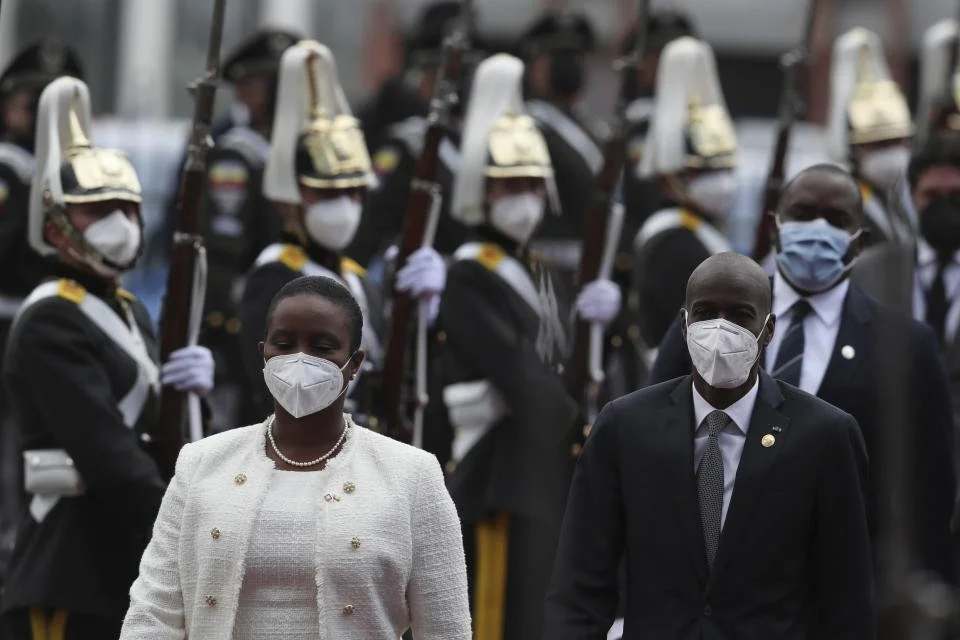
Haiti imposes curfew, orders mask use for pandemic emergency
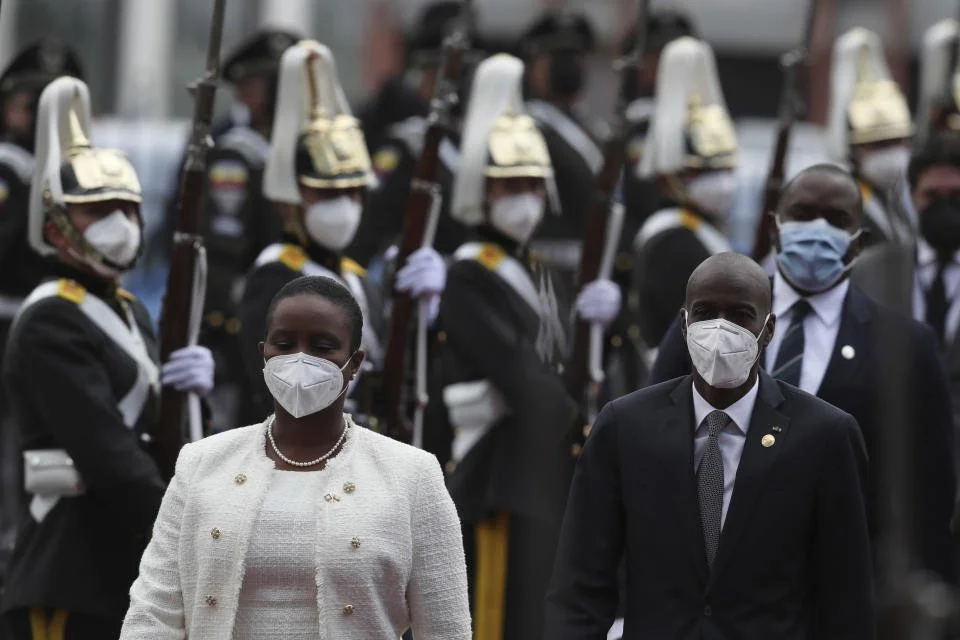
PORT-AU-PRINCE, Haiti (AP) — Haiti’s government imposed a nightly curfew and other restrictions Monday under an eight-day “health emergency" meant to curb the spread of the coronavirus.
All outdoor activity will be banned from 10 p.m. until 5 a.m. under the decree issued by President Jovenel Moise, who was in Ecuador on Monday for the inauguration of that country's new president.
The decree also makes the use of face masks mandatory for anyone out in public, while temperature checks and handwashing stations are required for all public or private buildings such as banks, schools, hospitals and markets. Social distancing in public places is set at 1.5 meters (nearly 5 feet).
The president also ordered public institutions to reduce staff on duty by 50%, while he encouraged that other employees work from home.
Mon, May 24, 2021, 5:39 PM
PORT-AU-PRINCE, Haiti (AP) — Haiti’s government imposed a nightly curfew and other restrictions Monday under an eight-day “health emergency" meant to curb the spread of the coronavirus.
All outdoor activity will be banned from 10 p.m. until 5 a.m. under the decree issued by President Jovenel Moise, who was in Ecuador on Monday for the inauguration of that country's new president.
The decree also makes the use of face masks mandatory for anyone out in public, while temperature checks and handwashing stations are required for all public or private buildings such as banks, schools, hospitals and markets. Social distancing in public places is set at 1.5 meters (nearly 5 feet).
The president also ordered public institutions to reduce staff on duty by 50%, while he encouraged that other employees work from home.- ADVERTISEMENT -https://s.yimg.com/rq/darla/4-6-0/html/r-sf-flx.html
Residents of Port-au- Prince seemed to take little regard of what was expected of them under these new rules as street markets continued to be crowded as was public transportation. Most people were not wearing masks and social distancing was not followed.
According to official government statistics, Haiti has had 13,906 coronavirus cases since the pandemic began in March 2020 and 288 deaths related to COVID-19. But a recent surge in daily cases of contagion has prompted authorities to declare the state of emergency.
Haiti has not yet begun to vaccinate its population against the coronavirus. The government recently announced its expects to begin giving the shots in June.

The boy who loved soccer in Haiti grew up to love football in Buffalo

At first Rev. Chuck Whited didn’t understand what was happening. He heard the loud pop of a wall cracking and felt the ground sway.
Then he knew.
The earthquake that struck Haiti in 2010 killed more than 100,000 people and displaced hundreds of thousands more.
Whited is pastor of First Trinity Lutheran Church in the Buffalo suburb of Tonawanda. Some years before the quake, his church had begun doing mission work at the Children of Israel Orphanage in Les Cayes, a seaport 120 miles from Port-au-Prince.
Erik BradyFri, May 7, 2021, 10:32 AM
At first Rev. Chuck Whited didn’t understand what was happening. He heard the loud pop of a wall cracking and felt the ground sway.
Then he knew.
The earthquake that struck Haiti in 2010 killed more than 100,000 people and displaced hundreds of thousands more.
Whited is pastor of First Trinity Lutheran Church in the Buffalo suburb of Tonawanda. Some years before the quake, his church had begun doing mission work at the Children of Israel Orphanage in Les Cayes, a seaport 120 miles from Port-au-Prince.- ADVERTISEMENT -https://s.yimg.com/rq/darla/4-6-0/html/r-sf-flx.html
He and his wife, Susan, adopted two children from the orphanage in 2007, but by 2010 they had yet to take them home; miles of bureaucratic red tape kept preventing it. Chuck and Susan dearly wanted these two to join their four biological children. And each year there would be tears all around when travel visas were denied yet again.

Then the earthquake hit. Chuck and his missionary team, in those frantic moments, led children to the safety of the soccer pitch — a refuge of open space away from buildings. That field had long been a different sort of refuge for his adopted son, Wisken, who had spent many happy hours there playing with the other children.
The human toll of the earthquake remains incalculable, but one glimmer of light is this: Haitian authorities said Lovelie, 11, and Wisken, 7, could at last leave for their new home in the United States. They arrived in Buffalo six days after the quake — and could not believe what they saw.
“This being Buffalo, there was a lot of snow on the ground,” Chuck says of that January day. “They would go to the back door, look at the snow, and just giggle. Then they would go back inside to warm up, and then open the door again and giggle some more.”
Lovelie is 22 now and works in child care. Wisken is 18 and a senior at Canisius High School, the defending Catholic state champion in football. He plays wide receiver on offense, and cornerback and safety on defense — and, on special teams, he kicks off, punts, and kicks field goals and extra points.
“He rarely ever leaves the field,” says Bryce Hopkins, assistant head coach and special-teams coach.
Saturday Canisius will play St. Francis High School in the championship game of the local Catholic league; that will end a truncated spring season, there being no state title game this time.
An American sport wins out
How Wisken got from that soccer field in Haiti to a football field in Buffalo is an American story. Soccer was his first love; all the kids at the orphanage played it. And when he got to the U.S., that love stayed with him, until football won him over.
“No matter what kind of ball we gave him at first — basketball, football — he kicked it like a soccer ball,” his father says. “Everything was a soccer ball.”
Then, as the years rolled on, Wisken could see how much Buffalo loved the Bills. He dearly wanted to try American football. So, as an eighth-grader at Christian Central Academy, he told his parents he wanted to go to Canisius and play football there. His parents liked the Canisius part, for an education grounded in faith, but his mother wasn’t so sure about the football part.
“So many kids get hurt playing football,” she says. “That’s what you hear.”

So Wisken played soccer as a freshman, but never stopped pestering his parents about football until they finally let him try out for junior varsity as a sophomore. He struggled at first, trying to learn the rules and the game’s finer points. But he excelled right away at kicking; he had long known how to do that.
As a junior, Wisken kicked for the varsity team — and emerged as the unsung hero of the state championship game in 2019, which is the last time there was one. Canisius beat Cardinal Hayes of the Bronx, 25-24, in storybook fashion. Quarterback Tyler Baker hit receiver Nik McMillan for a 13-yard TD as time ran out, and fullback C.J. Ozolins crashed in for the winning two-point conversion.
Cardinal Hayes had scored four touchdowns but made none of its conversions. Canisius scored three touchdowns — plus Wisken’s 28-yard field goal and both of his extra points.
“It’s simple math,” Hopkins says. “Three touchdowns doesn’t beat four touchdowns without Wisken.”
Think of Canisius as Kicker High, in the sense that Penn State is Linebacker U. All three placekickers who preceded Wisken went on to play for Division I programs: Michael Tarbutt at Connecticut and Minnesota, Blake Haubeil at Ohio State, and Tristian Vandenberg at Ohio University. And the other day Haubeil signed a free-agent contract with the Tennessee Titans.
“There was a ton of pressure on Wisken last year, following in the footsteps of those guys,” Hopkins says. “But it’s like he doesn’t feel pressure.”
A late start in football
Wisken played sparingly, other than kicking, as a junior. But this spring, as a senior, he emerged as a force. He scored 27 points in a 63-0 win against rival St. Joseph’s Collegiate Institute — nine for nine on extra points plus two touchdowns on receptions and one more on an interception. Canisius is ranked No. 1 in The Buffalo News large-schools poll, and Wisken is the team’s leading scorer.
“I don’t know if we have ever had a kid who started playing football so late who has been this successful,” Canisius coach Rich Robbins says. “It speaks to how hard he works.”
And not only in football. Among the instruments he plays, by his mother’s count, are the saxophone, tenor sax, piano, guitar, ukulele — and the drums for Sunday worship at First Trinity. “God has gifted him with many talents,” she says.
Wisken will go to college at Liberty University, in Lynchburg, Va., where he hopes to walk on to a football team that finished No. 18 in the Amway USA TODAY coaches poll last season. And he has his sights set even higher. Ask him about Greg Rousseau, the Bills’ top draft choice, whose mother and father hail from Haiti, and Wisken has a ready answer.
“That’s pretty cool,” he says. “Hopefully one day that will be me.”
That seems unlikely, as Wisken is 5-11, 180 pounds.
Then again, his whole life has been unlikely.
“I am extremely appreciative for what my parents have done for me,” he says. “I am grateful for them.”
And for his adopted hometown of Buffalo, where he learned to love that other kind of football.
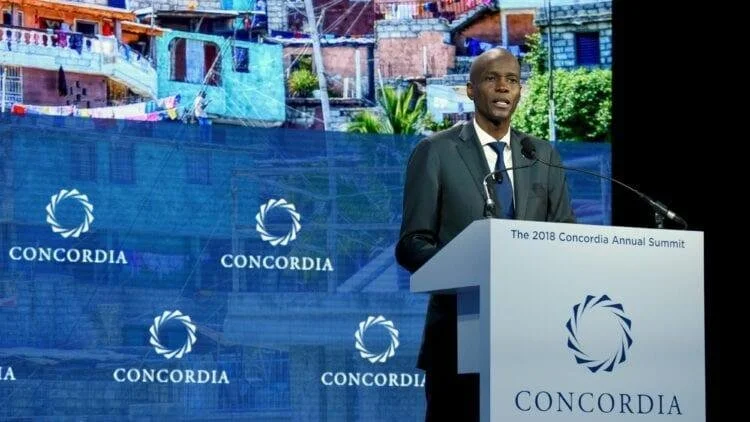
Haiti is on its 6th prime minister under the Moïse administration and many are wondering why?
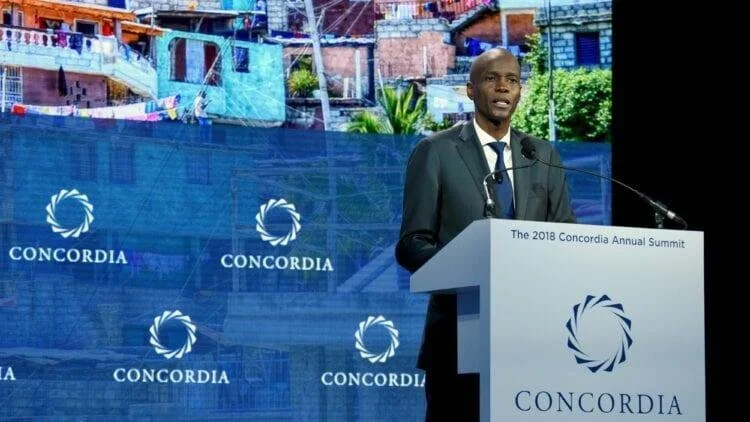
OPINION: To understand the constant turnover of prime minsters, it is paramount to first understand how Haiti’s system of government works
In the midst of the chaos and civil unrest that has plagued Haiti this year— the Haitian people have been dealt yet another blow. Prime Minister Joseph Jouthe resigned from his post under President Jovenel Moïse last month.
Shortly thereafter, Moïse appointed Foreign Minister Claude Joseph as his replacement—making Joseph the sixth prime minister appointed under the Moïse administration. Six prime ministers in the last four years (see below for a complete list of prime ministers under the Moïse administration).
To any outside country or international organization that would explain why Haiti’s government seems to be crumbling underneath the very feet of those in power. To understand why this is occurring, it is paramount to first understand how Haiti’s system of government works.
1. Jack Guy Lafontant. He was the longest serving prime minister under the Moïse administration, serving for a year and a half. He resigned following deadly protests as a result of the government raising gas prices.
2. Jean-Henry Céant. He was ousted while he was out of town on official government business by a vote of no confidence after an accusation of censuring the government largely related to the Petro-Caribe scandal.

3. Jean-Michel Lapin.* The former acting prime minister was appointed by President Moïse but failed to be confirmed by Parliament four times.
4. Fritz William Michel.* Michel was nominated to succeed Lapin but also failed to be confirmed by Parliament.
5. Joseph Jouthe. Jouthe resigned after a year as Haiti’s rates of insecurity, crime and political violence continued to surge. This resignation came on the heels of the recent attacks on an orphanage and the kidnapping of several clergymen and women.
6. Claude Joseph.* Joseph has been appointed as Haiti’s current prime minister. He previously served the Moïse administration as the Minister of Foreign and Religious Affairs.
When a Haitian president is elected, he/she also inherits the power to appoint a prime minister. The National Assembly must ratify this prime minister, and his cabinet. Haiti’s cabinet is led by the prime minister, who is largely considered the head of government. He/she is able to appoint ministers and secretaries of state and is responsible for national defense as well as enforcing the law.
To many, the prime minister may actually be regarded as the most powerful position within the government. Thus the issue lies therein, that the prime minister serves at the pleasure of the president. This, quite frankly, explains why the Moïse administration has gone through six PMs in the last four years.
The theory that President Moïse is insistent on running Haiti via presidential decree starts to seem less and less implausible when understanding the storied history of Haiti’s multiple prime ministers. Typically, when a president appoints a prime minister, the National Assembly must approve of them.

However, as quorum has been breached, the last two prime ministers (Joseph and Jouthe) did not have to go through that government confirmation process. Instead they were simply appointed and approved by Moïse himself—leaving no room for the traditional checks and balances system put in place by the constitution.
Moïse is no fan of the constitution as is—in fact he hopes to single handedly reconstruct it with his June 27 referendum. Although the referendum has not been presented as finished, some of the proposed changes directly address many of the present instabilities.
For example, Moïse’s proposal to eliminate the office of prime minister altogether, instead replacing it with a vice president who is elected alongside the president. Moreover, the president wants to implement the inability to impeach or prosecute a president during his first year in office and also seeks to restrict how often the president can be accused criminally.
Meanwhile much of the country remains skeptical that Haiti will have elections at all. This is because of an issue stemming from the imposition of new voter Identification cards and the notion that it will take anywhere between 10 and 18 months to complete the project of procuring Voter ID cards for all citizens.
These cards are due to be produced by ONI, Office National D’Identification—the office for state archives in Haiti. But as we’ve learned in the United States, with any change in voting requirements there comes the possibility of voter suppression.
Many Haitians have found themselves left with countless questions, with little answers. Will ex-President Michel Martelly run again? What is the timeline for elections in Haiti? Will legislative and presidential elections occur in September? Will municipal and local elections occur in November? Who will replace Ambassador Michele Sison? Yet sadly, most of these questions remain just as ambiguous as President Moïse’s future as president.