
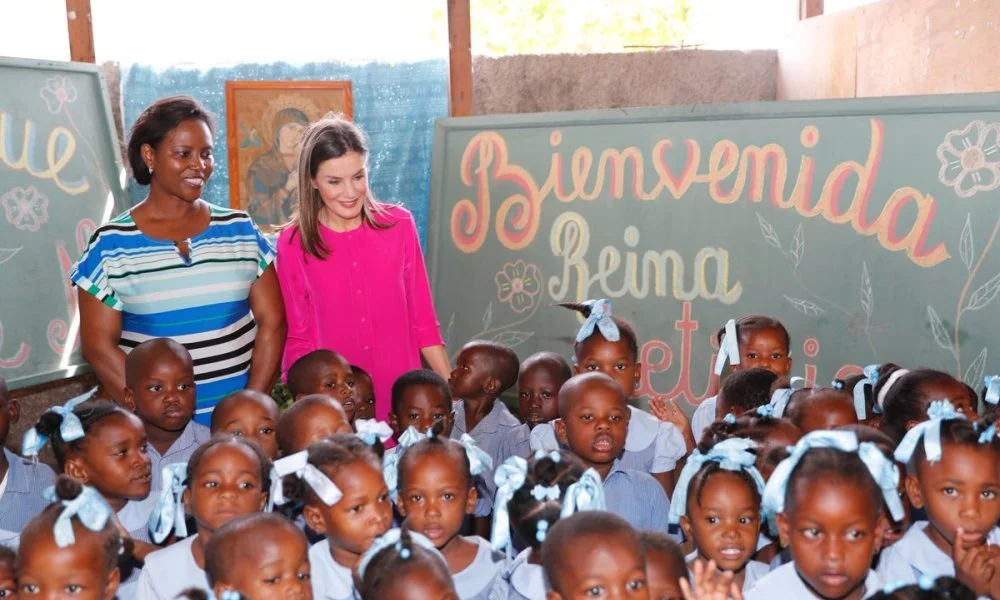
Queen Letizia Ends Co-Operation Trip To Haiti
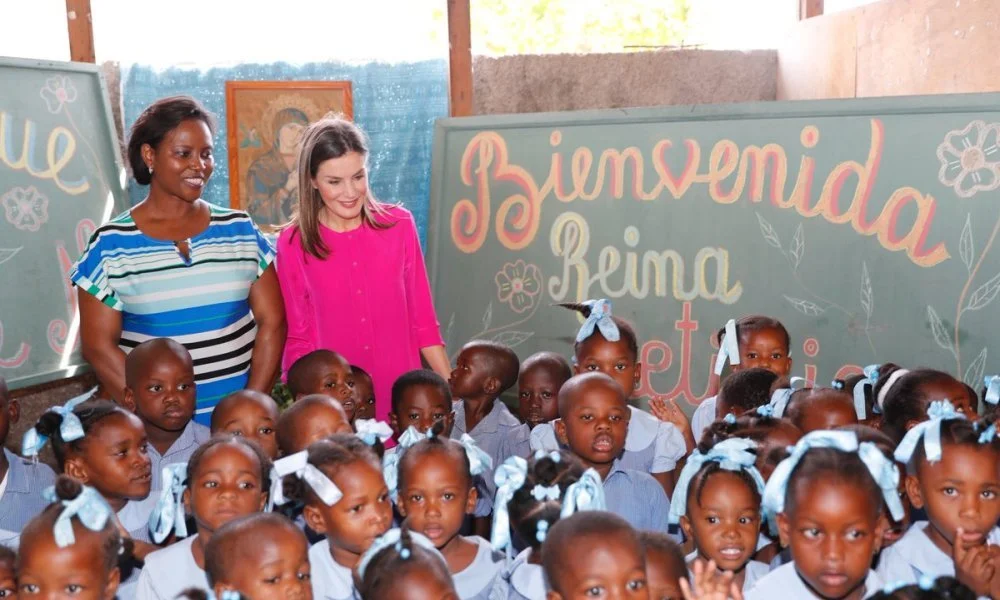
On 23 May, Queen Letizia spent her last day in Haiti, ending a three-day co-operation trip to the Dominican Republic and Haiti.

© Casa de SM el Rey
She first travelled to the Cité Soleil neighbourhood where she visited the Educational Centre of the Sisters of St. Vincent de Paul, in which Spanish Co-operation is financing several projects and, in particular, one on the sanitation of the complex.

© Casa de SM el Rey
Afterwards, Queen Letizia was received by the President and the First Lady of Haiti to have an official lunch at the Presidential Palace. The First Lady and the Queen then visited the National Museum of the Haitian Pantheon where the Queen of Spain held a meeting with a group of prominent Haitian women, to learn about the situation of women in that country.

© Casa de SM el Rey
At the Liceo Alexandre Petion, Queen Letizia attended a meeting with students and Spanish teachers, who will perform various performances before the Spanish delegation. This was the last event of the trip as the Queen then departed from Port-Au-Prince to travel back to Madrid.

© Casa de SM el Rey
Haiti is considered as Country of Association by the Spanish Co-operation. The Spanish Co-operation in Haiti focuses mostly on water, sanitation, and education. In addition to these, other essential intervention sectors have been established that have a large volume of funds: Economic Growth for the reduction of poverty, Rural Development and Fight against hunger, Environment, Democratic Governance and Culture, and Development. The Spanish Co-operation has concentrated its interventions in the capital, Port-au-Prince, and in the southeast of the country, especially in the city of Jacmel. During her co-operation trip, Queen Letizia had the opportunity to learn about all of the Spanish Co-operation’s work in both the Dominican Republic and Haiti.This was Queen Letizia’s third co-operation trip since becoming Queen in June 2014. Before that, Queen Sofía was the one taking part in those cooperation trip.By: Heaven Leemiller for Royalcentral.co.uk | May 24, 2018
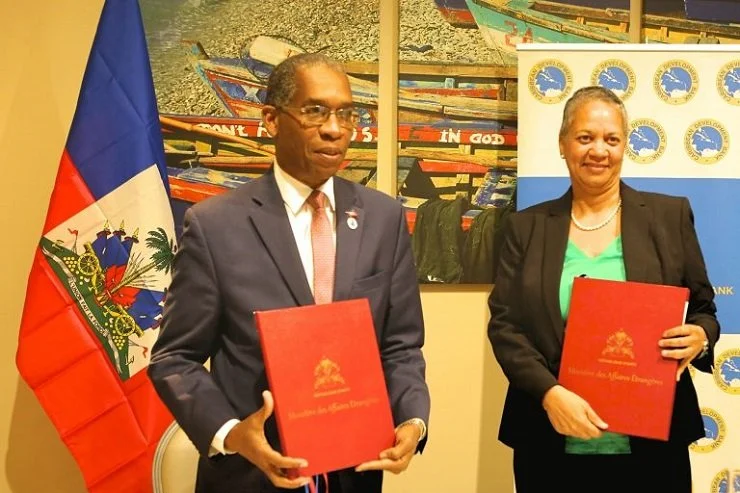
Caribbean Development Bank to Establish First Country Office in Haiti This Year
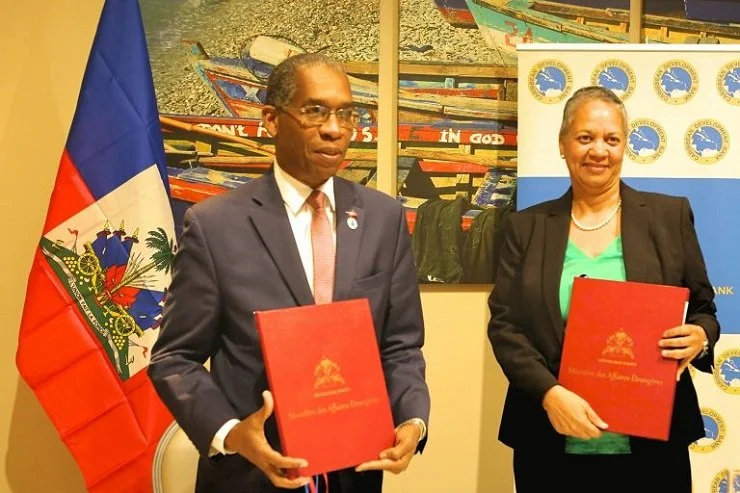
BRIDGETOWN, Barbados, Thursday March 15, 2018 – The Barbados-based Caribbean Development Bank (CDB) will establish its first country office in the Republic of Haiti later this year.Minister of Foreign Affairs Antonio Rodrigue and the Bank’s Vice-President (Operations), Monica La Bennett, recently signed the Country Agreement to pave the way for that to become reality.La Bennett said the signing of the agreement further cements the strong partnership between CDB and Haiti.“Last year, CDB, in collaboration with the Government of Haiti, developed a country strategy plan for the period 2017 to 2021, with an indicative resource envelope of US$100 million to help Haiti meet its development priorities. The strategy focuses on three main themes: agriculture and community development, sustainable energy development and education and training. It is this deepening engagement between CDB and the Government of Haiti that has led us to conclude that there is a need for a country office,” she said.“We expect that this will lead to the development of closer relationships with the Government and the people of this country, enabling CDB to be a more proactive, responsive development partner.”Haiti became a member of CDB in 2007. Since joining the Bank, the country has been allocated grant resources from CDB’s most concessional resource pool, the Special Development Fund (Unified). In 2017, an allocation of US$45 million was approved under the ninth cycle of the Fund.To date, a total of US$133 million has been committed to Haiti. Projects supported included the Education for All Phase II Project; the Technical and Vocational Education and Training Project II; interventions in agriculture and rural development; technical assistance for micro, small and medium enterprise development, and improving the quality of, and access to basic education.CDB’s ongoing work in Haiti includes projects in education, including technical and vocational education and training; climate resilience; and community-based agriculture and rural development. In addition, since May 2013, the Bank has paid the country’s insurance premiums to CCRIF SPC. The payments cover Haiti’s earthquake, tropical cyclone and excess rainfall policies. Under this arrangement, the country has received three major payouts, most recently following the passage of Hurricane Matthew in October 2016.By: Carribean360.com | March 15, 2018
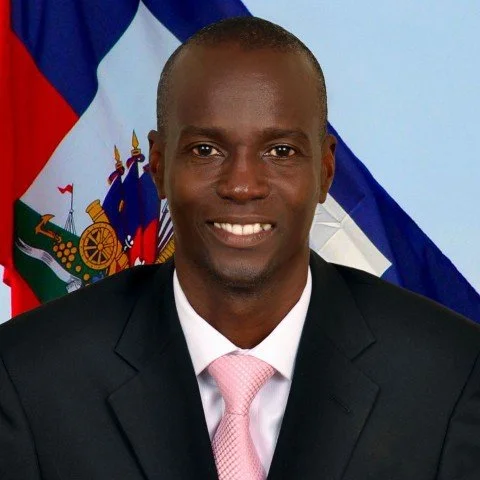
Haiti - Symposium on University and Territorial Development
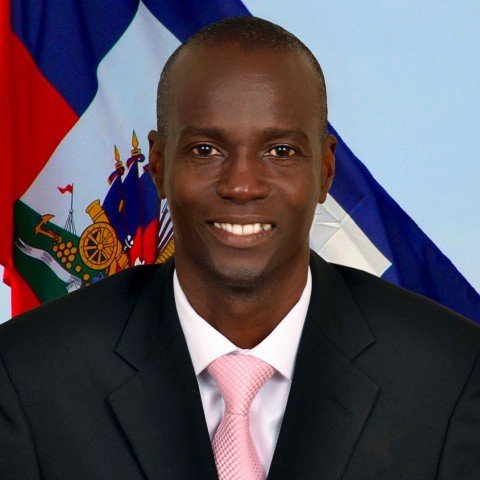
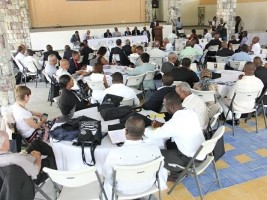 Aware of the fundamental social role attributed to the university in the production and animation of ideas and convinced of the need to strengthen the governance capacity of local authorities, territorial development managers; the UPR network, under the patronage of the Ministry of National Education (MENFP), has decided to organize (28 to 30 July) at the Hotel La Cretonne, in Les Cayes of assizes, which are supported by Unesco and several experts from universities in Haiti, Canada, France, the Caribbean and the United States.These scientific days are intended to provide a space for critical debate on the mission of the University in a framework of analysis of sustainable territorial development according to local resources, needs and expectations of the various actors (citizens, users of public services, companies, tourists and visitors) to offer them a quality of life.Pierre Josué Agénor Cadet, the Minister of National Education, officially launched the Symposium in the presence of the Rectors of the Public Universities in Regions (UPR), Senator Pierre Francois Sildor, former Prime Minister Jacques Edouard Alexis, technical and financial partners, deans, professors and researchers from France, Canada, the USA and the Caribbean.For the Minister Cadet "the University must play its role in the production and animation of ideas and help to strengthen the governance capacity of public authorities, managers of territorial development. In this sense, we must listen to the various actors, citizens, users of public services and businesses [...]"He hoped that the outcomes of the conference would provide an inexhaustible source for researchers and a redefinition of more rational and responsible public policies based on a reliable diagnosis of our reality.Speaking also at the opening ceremony, representatives of the French Embassy, the Agence Universitaire de la Francophonie (AUF) and Unesco welcomed this initiative by the UPR and the Ministry and expressed their willingness to cooperate in this action for the benefit of local and regional authorities.Research and territorial development, University and territorial development, higher professionalization and territorial development, ICT and decentralization of higher education, financing of territorial development are among the main themes to be debated during these three scientific days.HL/ HaitiLibre