
Air Force Reservists Deliver Humanitarian Aid to Haiti
PORT-AU-PRINCE, Haiti, Nov. 27, 2017 — What can 15 airmen and a C-17 Globemaster III aircraft do on a Denton Program mission? A lot, if they're from the Air Force Reserve Command's 514th Air Mobility Wing.
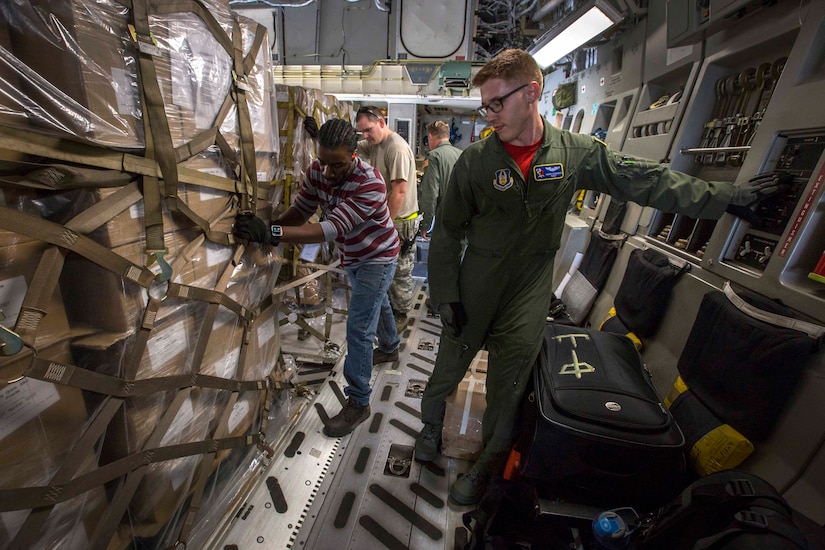
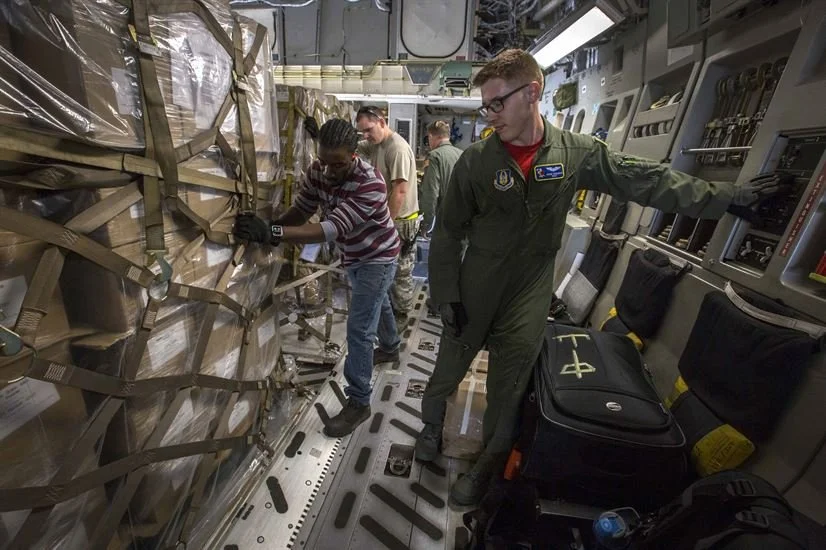
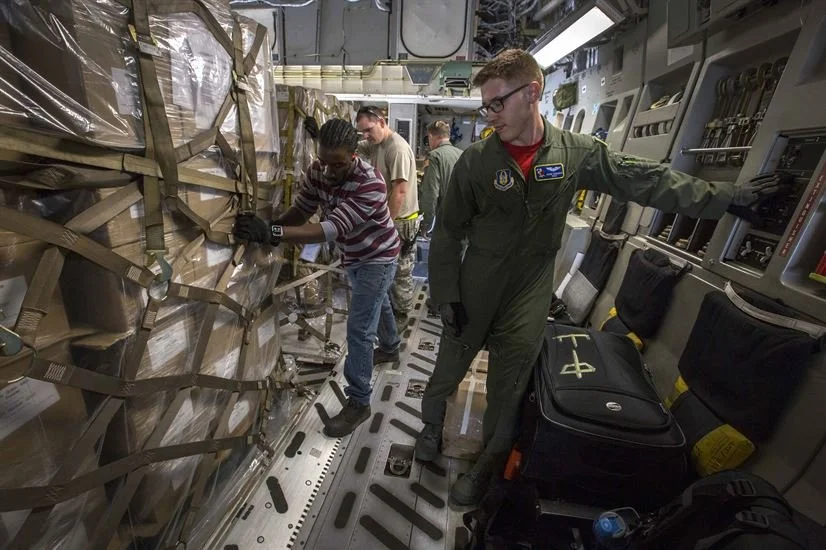
On Nov. 18, four pilots and a loadmaster with the 732nd Airlift Squadron, a loadmaster and two crew chiefs with the 514th, three Phoenix Raven Team members, and four 514th Security Forces airmen delivered 15 pallets of food, weighing 76,410 pounds, to Haiti."It's a high priority to get food down there," said Air Force Senior Master Sgt. Shawn R. Reynolds, a C-17 loadmaster with the 514th Air Mobility Wing. "Just the sheer volume of food we moved was impressive."The humanitarian mission, accomplished through the Denton Program, delivered fortified rice and soy protein and barley grass juice powder to Haiti. This was Reynolds' fifth Denton mission."That food will be used for a nutrition program for orphans and school children," said Jean Lubin St. Marc, executive director of Mission of Hope. "We appreciate the U.S. military that bring Denton cargo to us."Deliveries Began after 2010 EarthquakeSince a 2010 earthquake in Haiti killed more than 100,000 people, the 514th has delivered supplies and equipment through the Denton Program to Haiti. The program was an amendment to the Foreign Assistance Act of 1987, and it is named in honor of U.S. Sen. Jeremiah Denton, a former Navy pilot and Vietnam prisoner of war."Delivering relief supplies is one of the more rewarding missions we do," said Air force Lt. Col. Samuel F. Irvin, a C-17 pilot and the commander of the 732nd Airlift Squadron.Irvin has been on more than a dozen Denton missions during the past 10 years.The program is jointly administered by the U.S. Agency for International Development, the State Department and the Defense Security Cooperation Agency. It enables Americans and U.S. based nongovernmental organizations to use available space on military cargo aircraft to transport humanitarian goods -- agricultural equipment, clothing, educational supplies, food, medical supplies and vehicles -- to countries in need."This is the first time it has been strictly food," said Air Force Maj. Lee C. Schmeer, a 732nd Airlift Squadron C-17 pilot. "Usually it has been a mixed bag -- tractors, forklifts, trailers, and flatbed trucks, along with food."To give some perspective on how much cargo a Globemaster can handle, it can carry an M1A2 Abrams tank, which weighs 130,000 pounds, and still have room for 40,000 pounds more cargo.Cargo HubThe crew received the cargo at Joint Base Charleston in South Carolina, which is the cargo hub for the Denton Program. In 2016, Joint Base Charleston supported 85 missions to 10 countries delivering 609 pallets of cargo and 22 vehicles."We're in a position to help and we're happy to help," Schmeer said.While the Denton Program helps countries and people in need, it also serves military personnel. Aircrews that need to get qualified or have their qualifications updated volunteer for a Denton mission, and additional training will be scheduled during the mission."We schedule training at the bases we visit for our aircrews," Irvin said.During this mission, which began Nov. 16 and ended Nov. 19, the 514th Security Forces Squadron's combat arms training and maintenance team trained four C-17 pilots and two loadmasters at the pistol range at Naval Air Station Pensacola in Florida."By using our training time, it's a win-win for everyone," Reynolds said.Delivering the supplies was a team effort. In this case, the security forces airmen pitched in, helping to unload cargo."Moving Denton cargo is satisfying for me," Reynolds said. "We are moving something that matters."By: Air Force Master Sgt. Mark C. Olsen 514th Air Mobility Wing for the US Department of Defense | November 27, 2017
Haiti: Massive rallies call for Jovenel Moise to step down
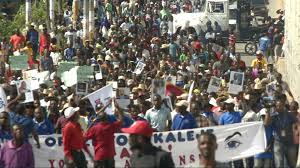
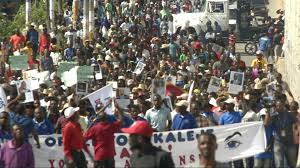
Thousands of people have taken to the streets in Haiti calling for President Jovenel Moise to step down.It's the latest of ongoing protests against Moise that began two months ago.It comes on the day Moise officially reintroduced the national army, some 22 years after it was disbanded, and a week after an investigation revealed millions of dollars in earthquake relief had been stolen.By Teresa Bo for Aljazeera.com |November 19, 2017
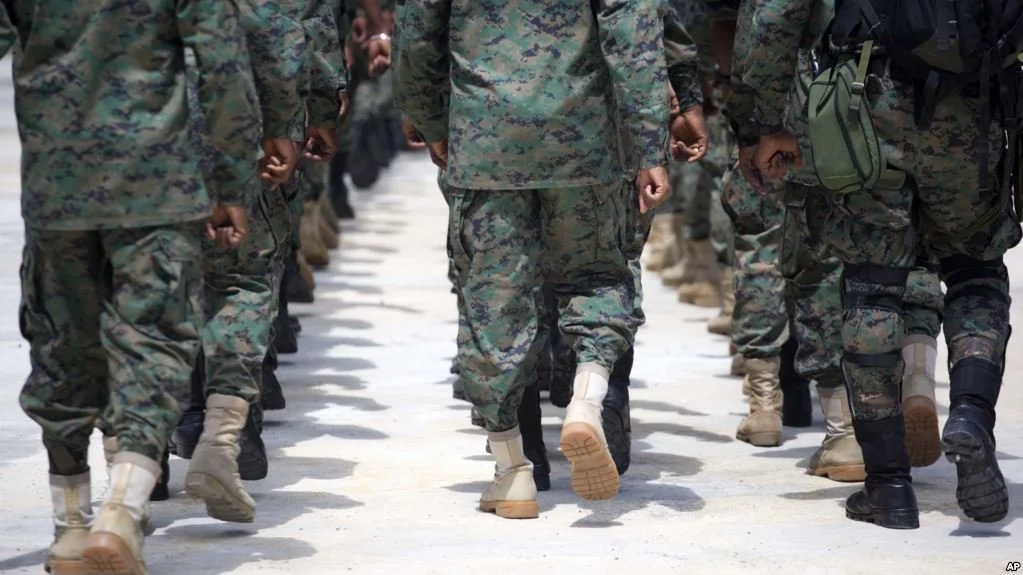
Haiti Prepares to Introduce Its Revived Military
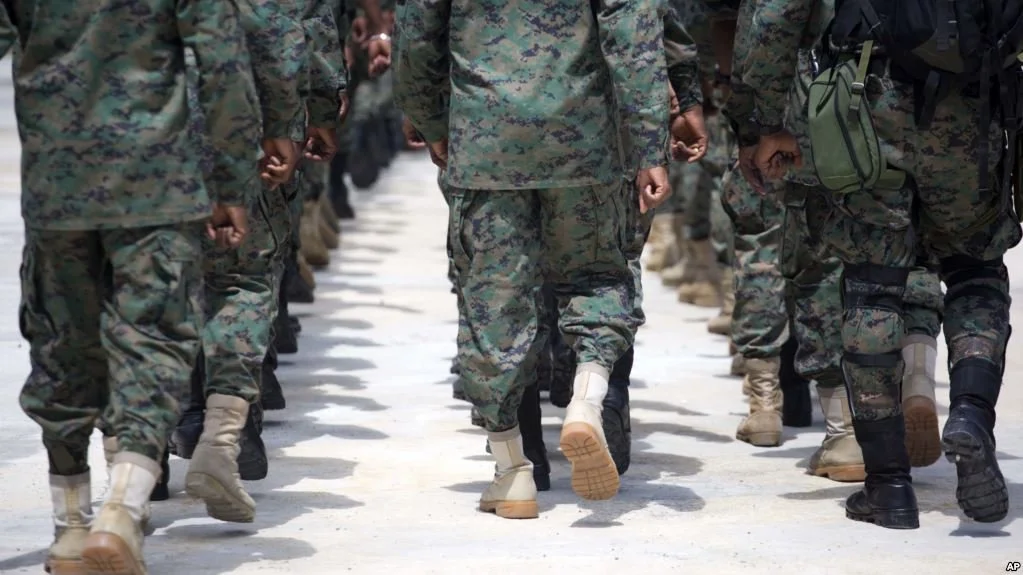
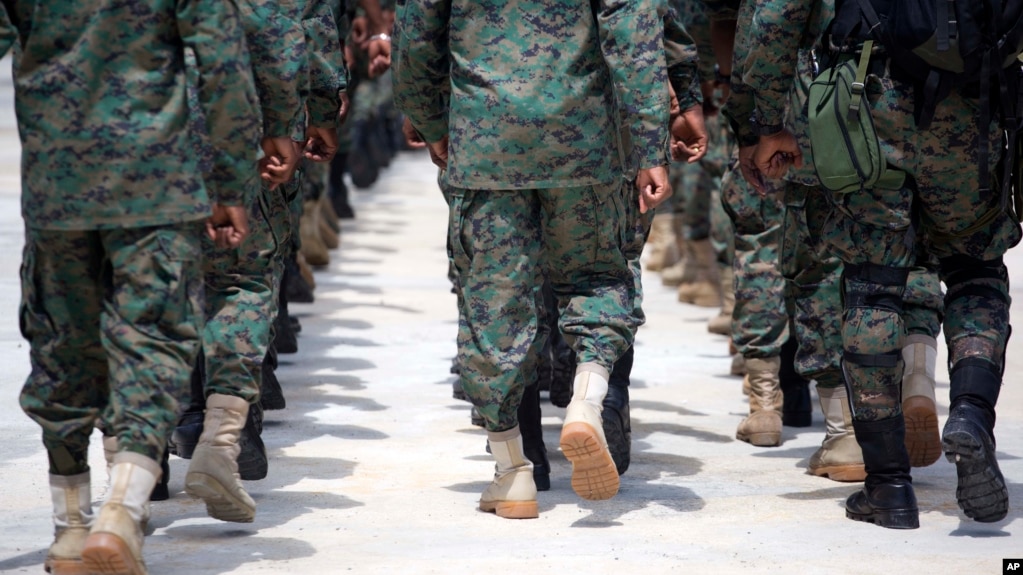 CAP-HAÏTIEN, HAITI — More than two decades after Haiti’s leader disbanded its army, with its history of violent coups, the Caribbean nation is about to unveil a reconstituted military.The Haitian National Army will be formally reintroduced with a parade in this northern port city on Saturday, the anniversary of a decisive 1803 battle [Battle of Vertières] nearby that secured Haiti’s independence from France.“The army I am reinstating for you is a professional one. It is a necessity for our country. It will not be an army of repression,” President Jovenel Moïse, who took office in February, said at a news conference last week. “It will be instead an army that will help out when a hurricane strikes our country. It will help repair roads. This is the army I have promised you.”
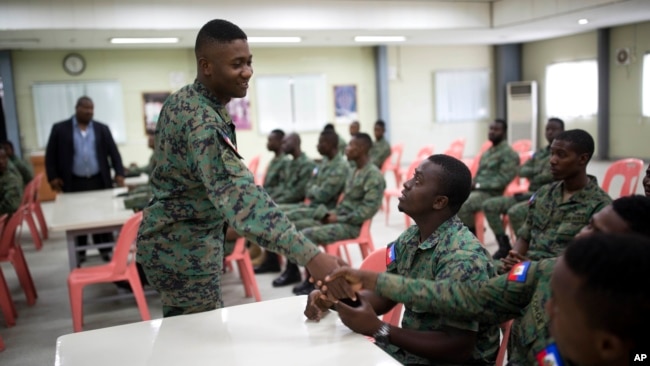
Civilian forceMoise aims to distinguish it from the military that overthrew Jean-Bertrand Aristide in 1991. When Aristide reclaimed the presidency in 1995, he dismantled the army and put security in the hands of the civilian Haitian National Police. That force now has roughly 15,000 officers.In contrast, the army has at least 150 recruits, young men and women mostly engaged in building up the impoverished country’s infrastructure, Defense Minister Hervé Denis said at news conference Monday. Since their selection in late summer, they have set up a medical clinic in central Haiti and begun fixing roads.Eventually, there could be 3,000 to 5,000 troops, Denis said.“But we know that we cannot have an army of that size the next day” because of budget constraints, he added.
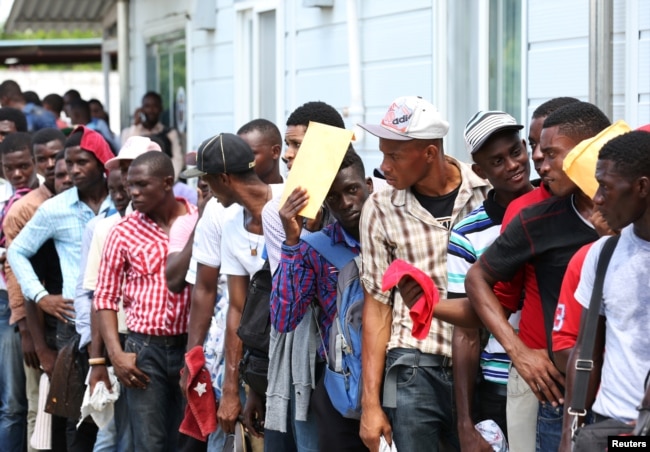
Haiti’s government has allocated $8.5 million for defense spending in the 2018 fiscal year. Denis acknowledged funding challenges but, according to the Miami Herald, said the armed forces’ patrols could stem annual losses of $200 million to $500 million in contraband coming from neighboring Dominican Republic.The army’s restoration draws mixed reactions at home and abroad.The army offers precious jobs in a poor country whose unemployment rate tops 40 percent.But Wednesday marked the third consecutive day of street demonstrations in Cap-Haïtien, the country’s second-largest city, with hundreds of public high school students protesting spending on a new military when their teachers have gone unpaid for months.Their rallying cry: “We don’t want an army, we want an education!”“The country has other priorities that are more important than the army,” Edouard Innocent, the city’s former mayor, told VOA in a phone interview. He said Moise should “prioritize economic development, education, health. … I think this army is [a means] for the president to secure his power.”Right to an armyCiné Aneus Daneus, a lawyer in Cap-Haïtien, pointed out that Haiti has the constitutional and sovereign right to an army. He called for “a professional army” to protect the country’s borders and provide aid in case of natural disasters. He added, “This force must not be involved in politics.”Nenel Cassy, a Haitian senator, told VOA he worried that the army would strain the national budget and could be used to suppress political dissent. He said its reinstatement created “a chaotic situation.”
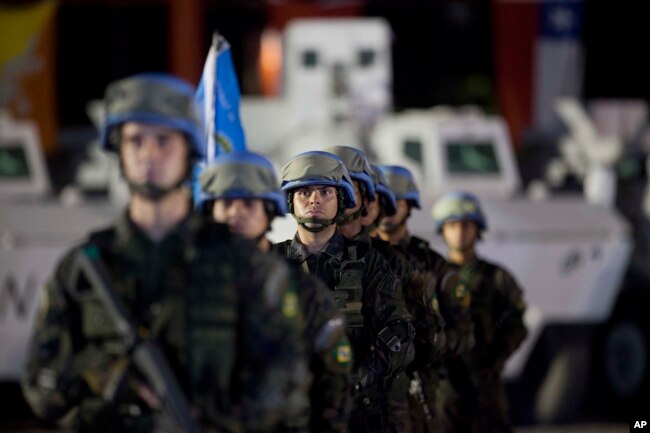
The army’s reinstatement comes a month after the end of the U.N. Stabilization Mission in Haiti (MINUSTAH), aimed at steadying the leadership after the 2004 military coup. That effort has given way to the U.N. Mission for Justice Support in Haiti (MINUJUSTH), meant to strengthen the justice system, policing and human rights protections.The United Nations and foreign governments, including the United States, discouraged Haiti from reviving its army. Instead, they supplied financial aid and training for the Haitian National Police.Kenneth Merten, the State Department’s special coordinator for Haiti, said the U.S. government disapproved of a reconstituted Haitian army because of that army’s history of coups d’etat. He told VOA’s Creole Service early this year that the U.S. has “spent a lot of money so Haiti could have a police force that is competent and transparent.”The United States, Haiti’s biggest benefactor, has disbursed at least $3.9 billion in post-2010 quake aid.‘Good reason to be nervous’Given the high degree of international involvement in Haiti, restoring the army brings “a sense of nationalistic pride with certain elements of the population,” Geoff Burt, executive director of the Canada-based Center for Security Governance, told VOA.But “there’s good reason to be nervous,” added Burt, who has explored the issue’s complexities in a report last year for the International Journal of Security & Development.One argument is that rebuilding the army could distract from the “more important priority of building a more effective, accountable police force.”“The big problem isn’t with the army per se, it’s the connection to the political process,” Burt said. “… Will the army become a player in Haitian politics? That’s what everyone would like to avoid.”By: Jacquelin Belizaire, Jean Philippe and Jean-Pierre Leroy for voanews.com | November 15, 2017.
The Implementation Of The Haitian Army: An Imminent Danger For Haiti
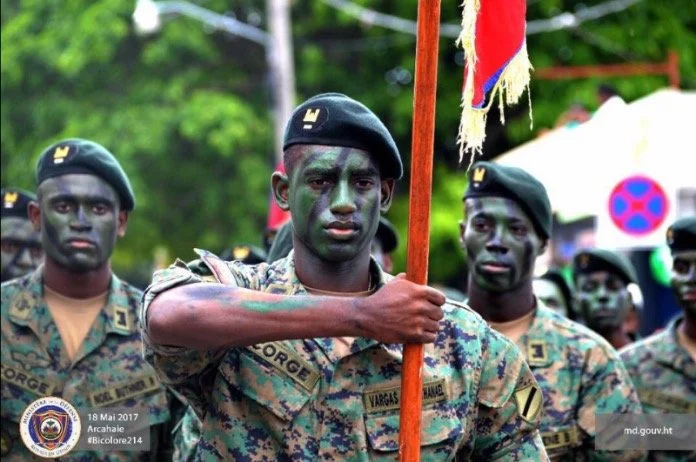
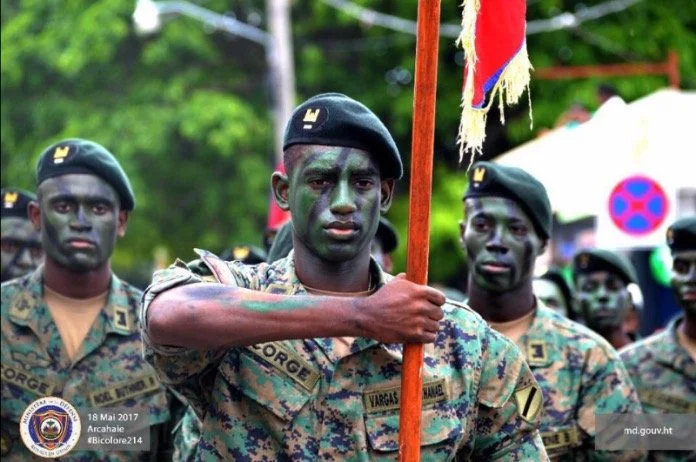
 The current president seems to be more than ever determined to restore the army, and in doing so, picking up where his predecessor, Michel Martelly, left off. The government maintains the demolition of the army was anti-constitutional since the constitution recognizes its existence.Dismantled 22 years ago, by President Jean Bertrand Aristide, the Haitian Gendamerie, later known as Armed Forces Of Haiti (FADH), is an institution that has historically caused more problems for the country than it fixed. For many, in Haiti and in the Diaspora alike, reinstating the army is an idea they would rather not have to think about; in many instances, the wounds inflicted by that defunct organization have not been healed yet.What is the rationale behind reviving an institution that has shamed and abused the very nation it swore to protect? Why would Haiti need an army in the first place? Further, a more relevant question is, “Are Haitians better off with or without the army?” That’s the question!If we were to place the Haitian Army’s performance on a balanced scorecard, the outcomes would be mournful. Ever since the first United States occupation in 1915, there have been at least 32 Coup- d’état. A series of unfortunate events, instigated by the army itself, that only brought about death, despair, destruction, insecurity, organized crimes, institutionalized corruption, violation of human rights on a massive scale, to say the least. From that vantage point, it would not be an exaggeration to suggest the army is directly responsible for the country’s current quagmire. Ironically, even some of those who themselves have caused bloodshed in the country, have not shied away from expressing their doubts about an eventual return of the army. Both Henry Namphi and Prosper Avril, former generals, have cautioned against the eventual reestablishment of the army- the very institution which has made them who they are today.For any country, having an effective border control has its place. But in the case of Haiti, border protection cannot possibly be at the top of the priority list; after all the country is not under any threats of outside invaders. If we were to look at this issue from a practical standpoint, since the Dominican Republic is the only country Haiti shares its borders with, why would the former want to invade the latter now? Why now? Aren’t they already in control of the Haitian markets, whereas Haiti imports more than twice as much as it exports? Isn’t most of the Dominican labor force made up of Haitian nationals living in the most humiliating conditions? Well, why then, would the Dominican Republic want to engage militarily in Haiti while it is more profitable for them not to do so?Today, there are more than 20 countries without an army. Why can’t Haiti remain part of that list? Let’s take Costa Rica and Panama, as two Central American countries. Both countries had their fair share of problems with their respective armies in the past. Costa Rica has not had an army since 1948. Panama’s army was demolished after general Noriega was removed from power in 1989. Today, they are both on the list of countries without conflict, according to the Institute for Economics and Peace (Source: Global Peace Index 2016). Costa Rica is said to have enjoyed greater peace and stability than most, if not all, of its neighbors.In light of the actual conjuncture the country is faced with, should the government be focusing on reforming the army while neglecting to revamp the country’s already broken infrastructure, improve its healthcare system, promote literacy, modernize its agricultural systems, revitalize its flagging economy?An army is there for national defense, not to run governments. And make no mistake about it, this is exactly what will happen should the FADH be allowed to be resurrected. If past behaviors are any indication, this will be the same army that had always been on the side of the rule of force rather than the rule of law. Let’s be pragmatic about it; in the final analysis, in the event should Haiti be invaded by a foreign force, would the country have a defense mechanism strong enough to be worthwhile anyway? If the answer is no, as we know it, why then bother? Such decision can only be counterproductive in that the government will undoubtedly be in need to find funds in order to keep it operated. And those resources could be better spent on other public services instead. This grotesque decision is political, one aiming at appeasing the former cohorts and sympathizers of the Duvalier regime.In closing, there should be an international coalition orchestrated by the United Nations to prevent such undertaking from being materialized. If not, this could be a mistake of biblical proportions, in that all the gains that have been made may be irretrievably lost. If I had any message for the president of Haiti, I would have advised him to do as the former Costa Rican president, Jose Figueres, did in 1948: Transform the military barracks into museums. Future generations will thank you for that.Haitian Times | September 2017
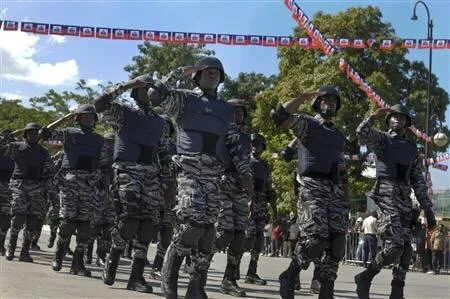
Haiti Plans Recruitment for Small Army
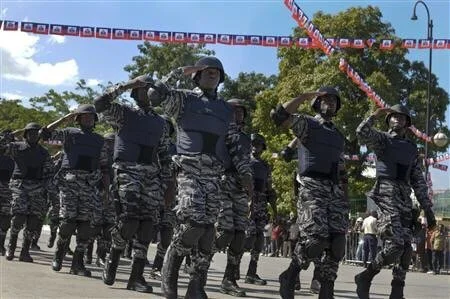
Haiti plans to start recruiting for a small, newly reformed army, the defense minister said on Tuesday, while critics questioned the need for such a force in a poor country with a history of military coups.The government expects to recruit fewer than 500 soldiers, whose duties will include rebuilding after natural disasters and monitoring borders for smuggled contraband, Defense Minister Herve Denis told Reuters in an interview."I was planning to recruit 500 in the first recruitment but now, because of budget problems, we have to reduce the numbers," he said. "We are waiting on the vote on the budget to determine how many we will eventually recruit."The vote is expected in the next few months.Former president Jean-Bertrand Aristide disbanded Haiti's army in 1995 following a military coup.Previous president Michel Martelly drafted a plan for a small military force in 2011. Calls from politicians for an expanded army have grown with the looming departure in October of a 13-year United Nations mission in Haiti intended to restore stability after a second coup against Aristide in 2004.However, Haiti's budget is tight and critics say the government should focus its resources on the two decade-old national police force, which has roughly 15,000 officers."Haiti does not need an army," said Mario Joseph, a human rights attorney and one of Aristide's lawyers. "We must use what little money Haiti has rationally. ... Haiti cannot even take care of the police with the national budget."By Joseph Guyler Delva | Reuters
"Jeu de Bâton" A Fighting Art of the National Army
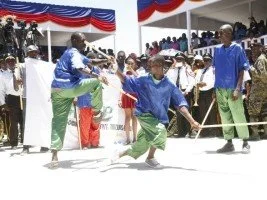
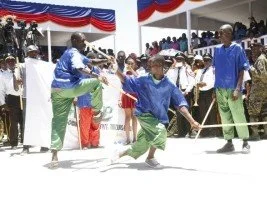
Monday in Lagrange (Artibonite Department), as part of the Day of Agriculture and Labor, the National Bureau of Ethnology (BNE) in collaboration with the Ministry of Tourism and Ministry of Culture organized a show of «Jeu de bâton» (stick game). This tradition that has existed since the colonial period in St Domingue, was also a means of combat used by the native army during the war of independence. It is also a martial art inspired by the forms of African combat. A variety of stick styles such as : "Baw Blan", "Migel" and "Pati kola" were used during this activity. An intangible cultural heritage strongly practiced and preserved in the Artibonite. Jessy C. Menos, the Minister who traveled to encourage stick Practitioners and BNE dancers, said the show "is part of a promotion of the 'Jeu du bâton' and a duty to remember."According to Erol Josué, the Director General of the BNE "This ritual was the means of combat of the native army" recalling that "Gran Toya", great aunt of the Emperor Jean Jacques Dessalines, was a great warrior and would have initiated the Emperor at this game from a young age. Other peoples like the Amazons of the former Dahomey also practice stick fighting.From this collaboration around the development of Ethno-Tourism in Haiti, an inventory of cultural practices and sites will be launched, which will begin in the Department of Artibonite in order to highlight the riches Haitian heritage. HaitiLibre | May 3, 2017