Politics Politics

The opposition announces 3 days of national demonstrations

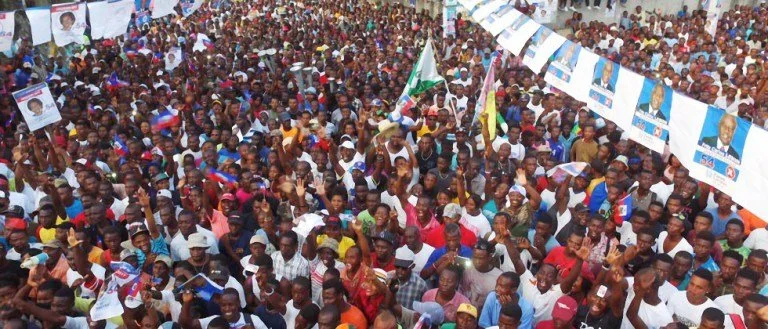
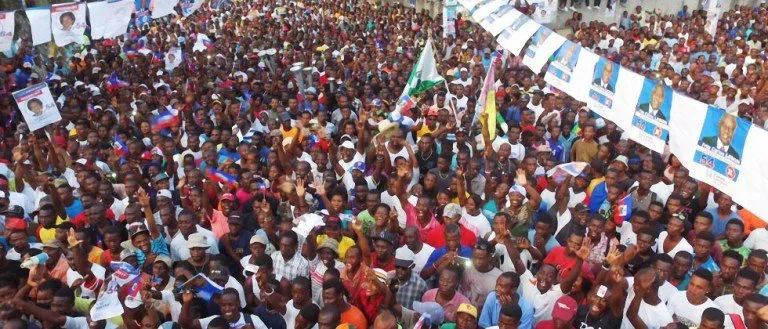
Monday, the coalition of opposition democratic organizations, including Pont, VERITE, "Pitit Dessain", "INITE démocratique", "PALMIS", "Kore N", Rally of Arcahaie, Lavalas and the opposition senators, announced 3 days of demonstration, on 28, 29 and 30 September, against the controversial budget 2017-2018 in order to force the Head of State to reverse his budgetary decisions.Me André Michel, one of the spokespersons for the Rally of Arcahaie, announces that the "battle is underway" and a vast mobilization movement in Port-au-Prince, in the Central Plateau, in Jacmel, Petit-Goâve, in Cap-Haitien, Saint marc and Léogâne, "the whole population will stand to denounce this budget which will further impoverish the Haitian population."For his part, the former President of the Senate and former Minister of the Environment, Dieuseul Simon Desras, urges the population not to be manipulated by speeches suggesting that the government will revise the budget, referring to Article 35 of the a universal declaration of human rights which states that "when a government violates the laws of its country, the only way out of the people is insurrection." He also denounced a plan aimed at assassinating opposition leaders, reminding members of the Government who would act "that they will be liable to the International Criminal Court."By: TB/ HaitiLibre - 26/09/2017

Read More
Politics Politics

Haiti: Thousands March Against New Budget

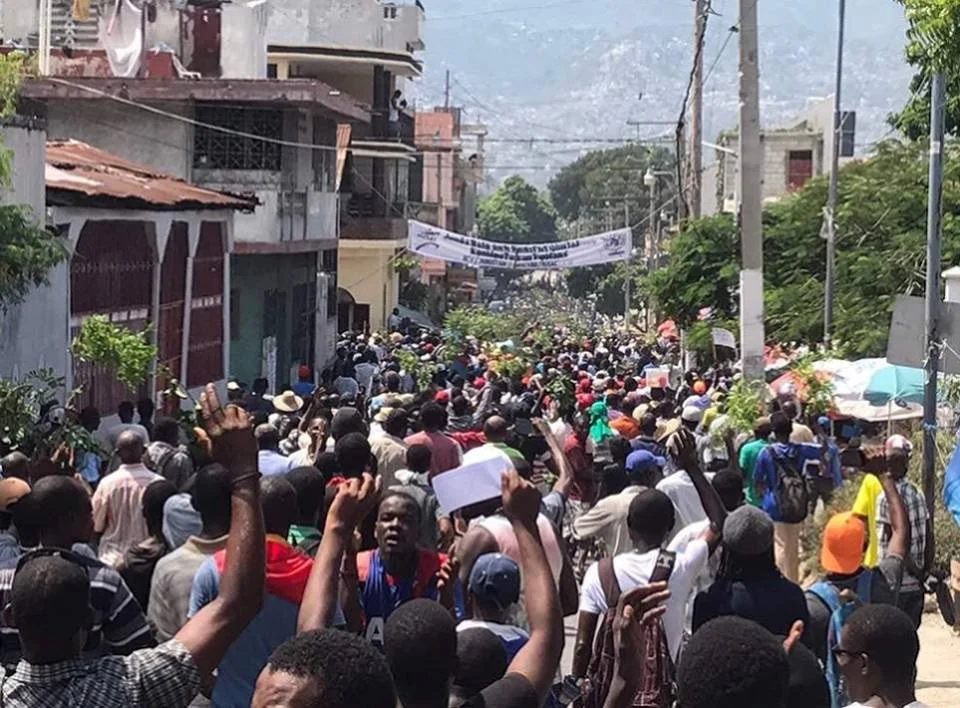
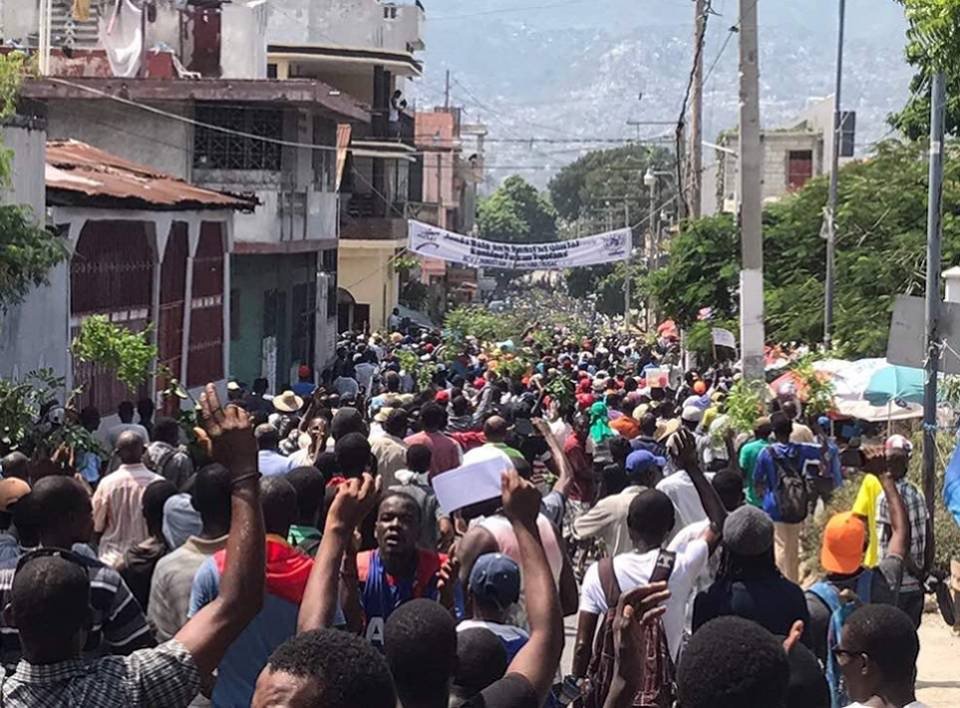
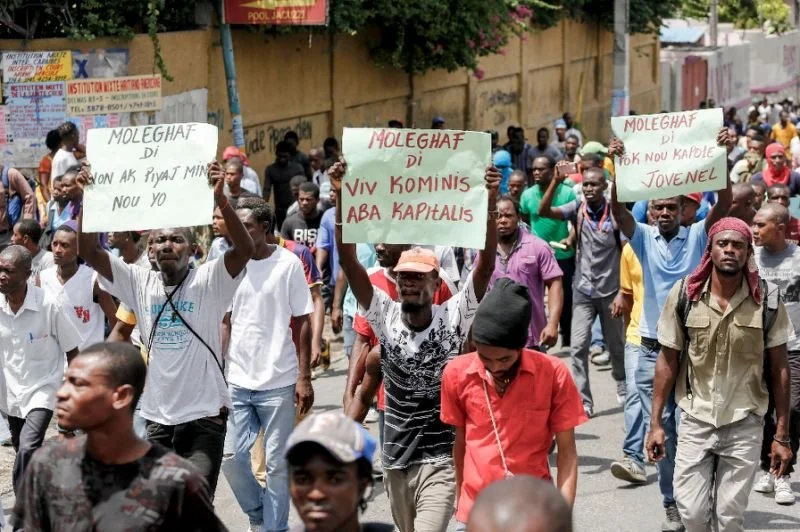
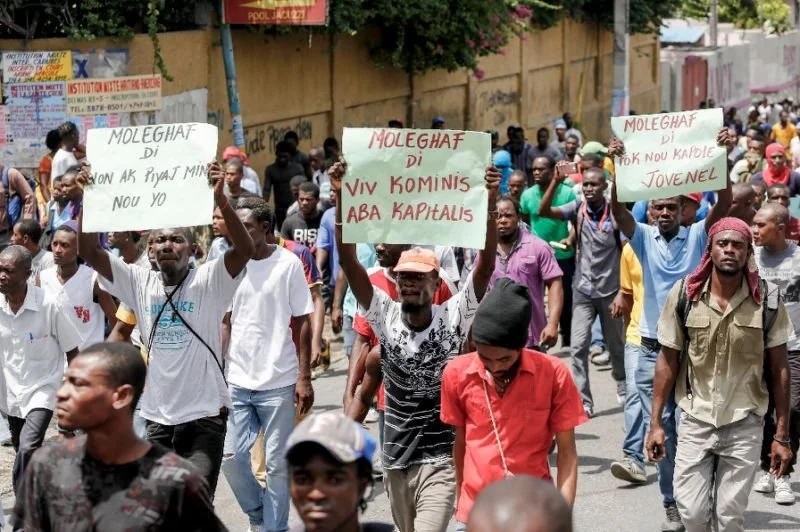
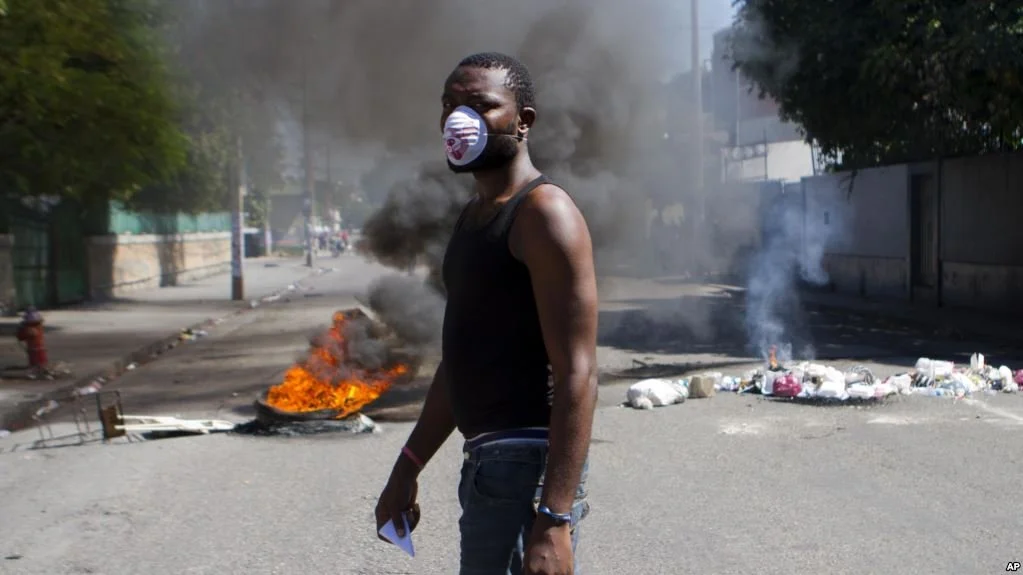
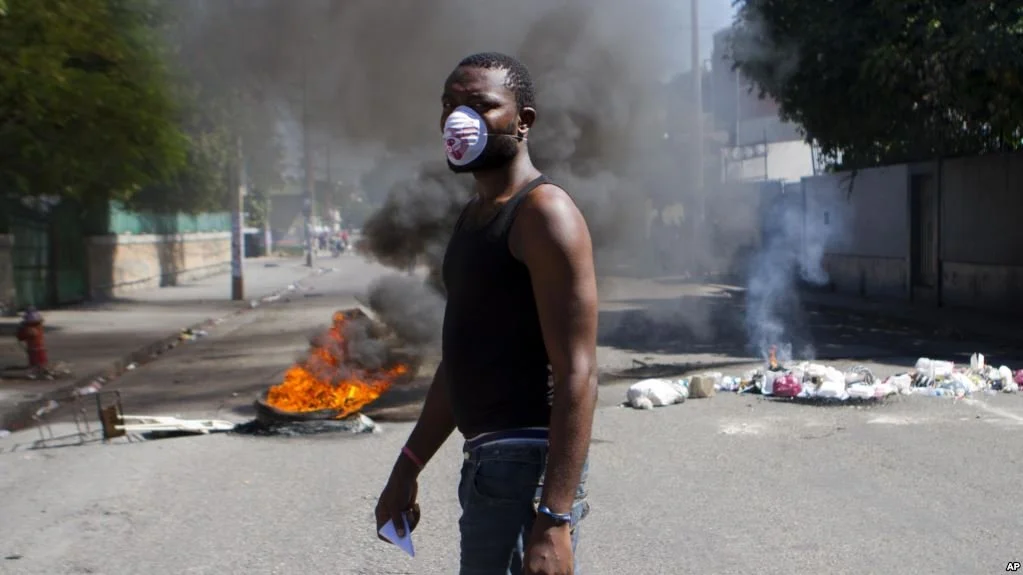
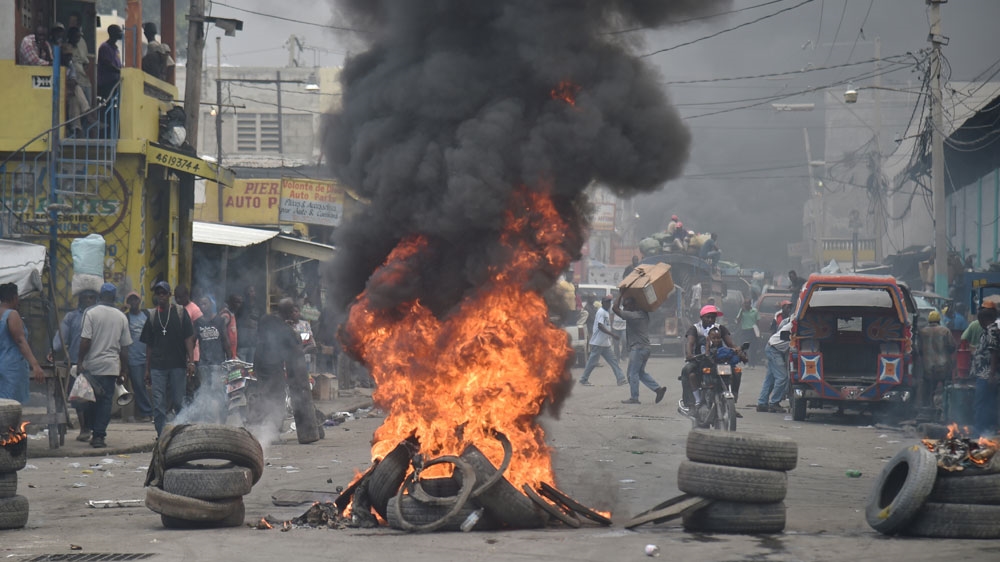
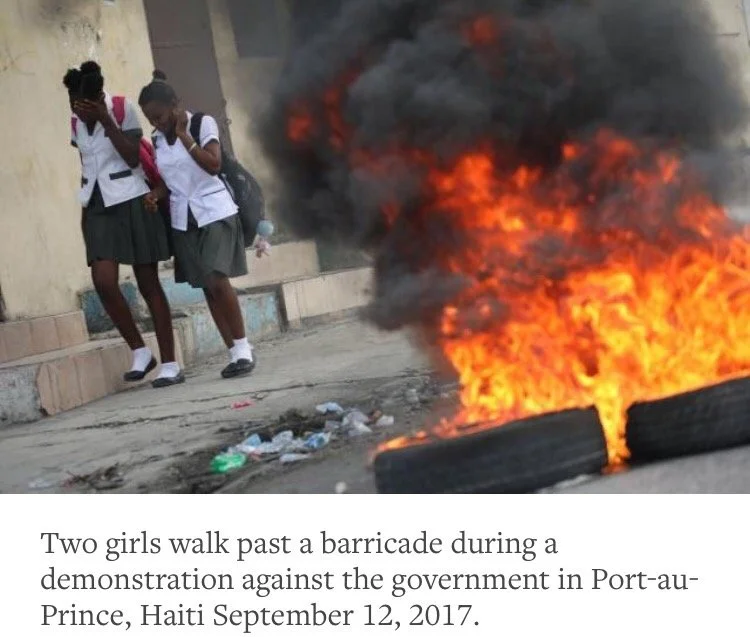
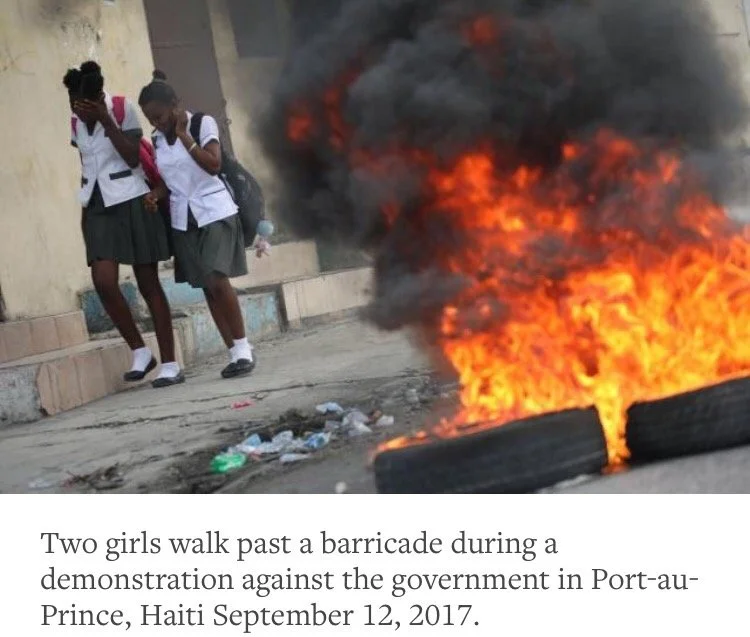
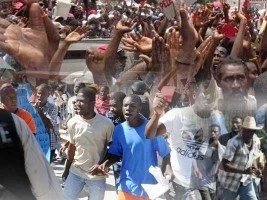
Thousands of Haitians marched through Port-au-Prince on Sept. 12 chanting “Down with Jovenel!” “Down with the bourgeoisie!” and “Liberty or death! The revolution is beginning!” (Haïti-Liberté, Sept. 13) Moïse Jovenel is the current president of Haiti.A leaflet passed out during the marches raised the issue of the “tuberculosis wages” resulting from the Parliament’s refusal to raise the minimum wage of $4.77 a day. There is growing anger over Parliament passing a budget that requires drivers to pay $158 for an income tax report, which is waived if their income is less than $958 a year. (AFP, Sept. 13)The day before, protesters had been in a single large group led by Fanmi Lavalas, the party started by Jean-Bertrand Aristide, who was elected President of Haiti in 1990 and 2000. The cops, using water cannon and tear gas, were able to keep them contained and away from downtown. The next day, they broke into smaller groups and the cops had much more trouble.The protesters set up barricades of burning tires and rocks, blocking key intersections. Behind the presidential palace, the people threw rocks at the cops, who had unleashed stinging, high-pressure water and tear gas at protesters.Two cars in front of the law offices of Planning Minister Aviol Fleurant were set on fire, and the windows of other cars in the parking lot were busted. Shop windows throughout the city were also damaged.Also in the new budget is a tax on all Haitians — even those living abroad — who want to use government services of 10,000 gourdes, or $159, annually (depending on the exchange rate).Another shocker in the budget, reported by Le Nouvelliste, is that it allocates 7.2 billion gourdes for 146 elected officials and only 6.14 billion gourdes for the health needs of 12 million Haitians.More demonstrations have been called for Sept. 20-23 by Dessalines Family, headed by Jean-Charles Moïse, a former presidential candidate. According to Van Bref Info, Haiti’s National Police attempted to arrest him on Sept. 12.The struggle in Haiti is nowhere over — no matter how firmly the U.S. supports the new government of Moïse Jovenel.By: G. Dunkel | September 24, 2017

Read More
News, Politics News, Politics

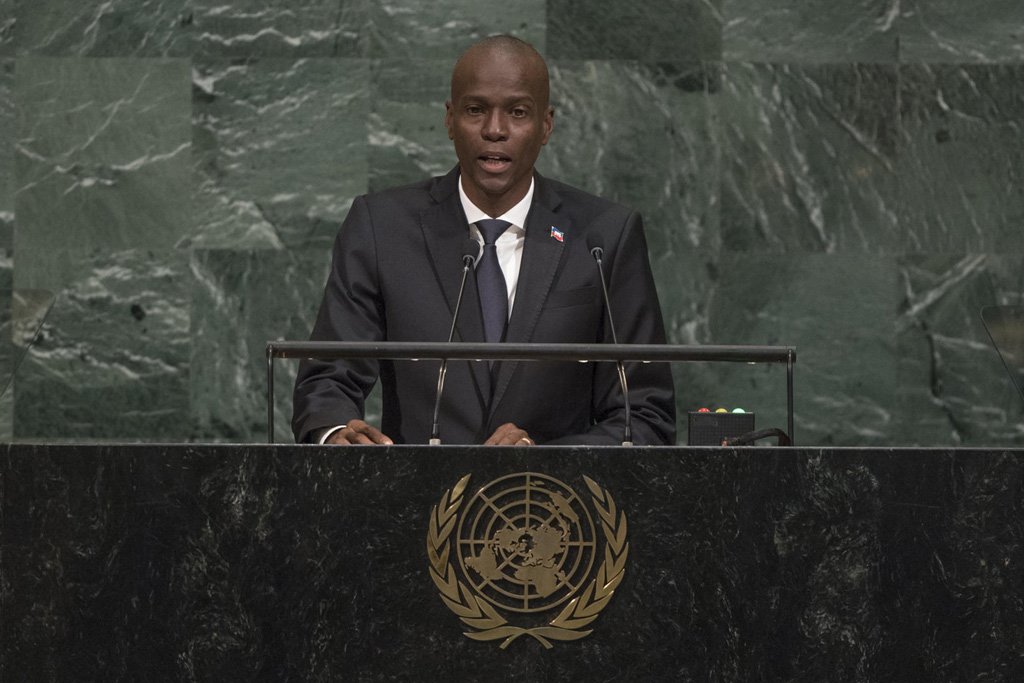
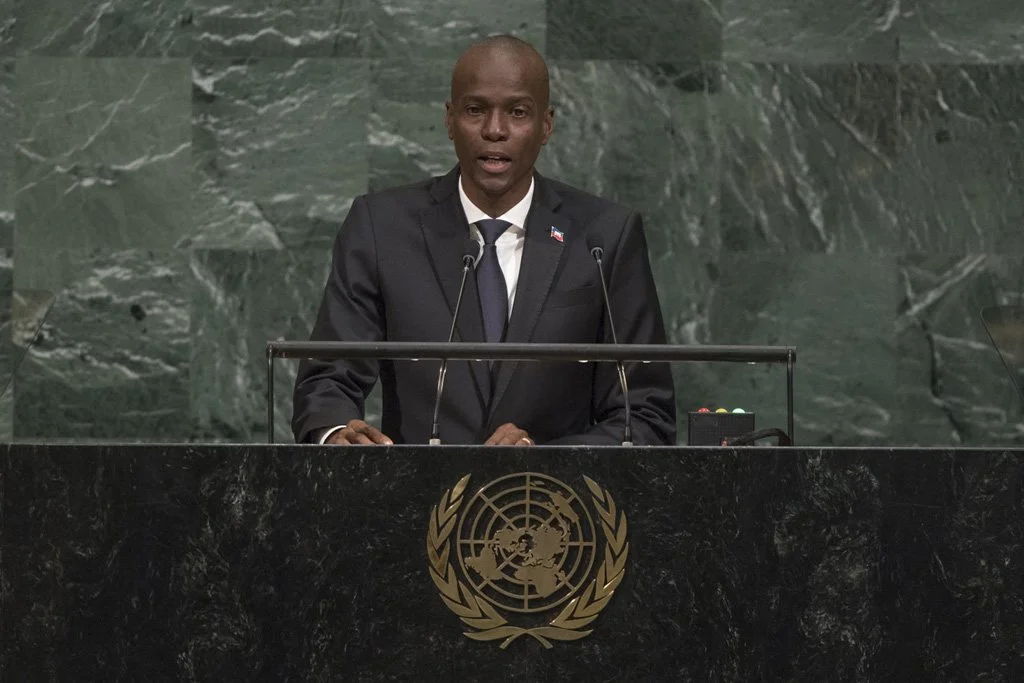
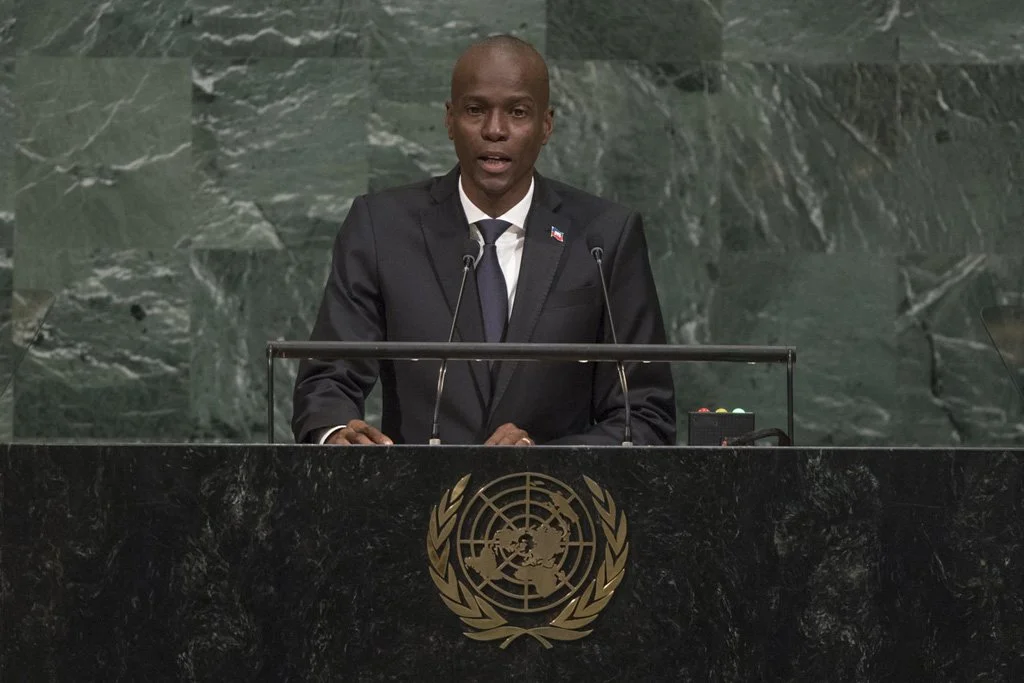
Video & Summary: President Jovenel Moise Addresses UN's General Debate, 72nd Session

Statement Summary:
JOVENEL MOISE, President of Haiti, said the mission of the United Nations had never been so important, and thus, it was necessary to adapt the Organization to modern realities on the ground.  Expressing support for any initiative that could contain crises and seek the peaceful resolution of conflicts, he encouraged the United Nations to move along the path of conflict prevention.  Haiti had always spoken out against the proliferation of nuclear weapons, and he condemned States’ blatant desire to acquire and increase nuclear arsenals.  He also expressed concern about the ongoing crises in Syria and Venezuela, as well as the conflict between Israelis and Palestinians.Haiti was deeply committed to the environmental facets of sustainable development, he said, and sought to build resilience against natural disasters that had consistently beleaguered its people and brother countries in the Caribbean.  His Government was committed to the Paris Agreement on climate change, and wished to see those countries most responsible for greenhouse gas production contribute the resources necessary for implementing that deal.  In the Caribbean, recent climatic events had drawn attention to the ways in which climate affected Haiti.  Such weather phenomena were due to the impact of humans on the environment, he stressed.  In January 2018, when Haiti assumed the presidency of the Caribbean Community (CARICOM), it would organize a regional conference aimed at establishing an inter-State commission that would devise a strategy for addressing climate issues, such as the availability of climate insurance.More broadly, he said Haiti had taken steps to consolidate democracy and the rule of law, having made significant efforts to promote development and political stability.  Noting that corruption had “infected” and shrunk Haiti’s economy, and compromised its political situation, he said it was time that official development aid (ODA) and domestic resources upheld the interests of the Haitian nation.  Corruption had prevented basic resources from being allocated to citizens, depriving them of adequate energy distribution, quality education, drinking water and socioeconomic opportunities.  Haiti’s new leaders were waging an unwavering struggle against such behaviour.  Efforts were also under way to guarantee the independence of and increase the effectiveness of the judicial apparatus.While the international community had spent more than a decade supporting security in Haiti, and had provided help when disaster struck, he said Haiti was using all levers available to grow the economy, despite its limited resources.  It was striving to create decent jobs for young people, and had made human resources management part of the State reform process.  His Government was determined to provide opportunities to the most vulnerable members of society, to ensure they were not tempted to leave the country, many times under life-threatening conditions.  Haiti could not allow institutions to be weakened or corruption to widen the distance between citizens and the State.  Haitians were acutely aware that they were responsible for their country’s development, he continued.Addressing two phenomena stemming from the United Nations presence in Haiti — the odious sexual abuse and exploitation by peacekeepers and United Nations staff, and the cholera epidemic — he said the Organization was morally obliged to provide the recourses to ensure that cholera left the country.  Improving Haiti’s health system, including by eradicating cholera, was a priority for his Government.  Despite some progress, the number of cholera victims stood at 10,000 people and continued to grow.  Further, there were tens of thousands of cholera orphans.  The United Nations must live by and give tangible form to its noble ideals, he stressed, by shouldering all its responsibilities to remedy the situation, which had caused grave harm to the Haitian people.

By: UN News Centre | September 21, 2017

Read More
News, Politics News, Politics

Haitian President Backs Paris Climate Accord, Calls On UN To Honor Commitments On Tackling Cholera

21 September 2017 – Addressing the United Nations General Assembly today, Jovenel Moise, President of Haiti, expressed deep commitment to the environmental targets in the global goals on sustainable development and said his island nation is seeking to build its resilience against the natural disasters and extreme weather events that consistently beleaguer its people and other countries in the Caribbean.“My Government is committed to the Paris Agreement on climate change,” Mr. Moise told delegations gathered for the Assembly’s annual general debate, adding that he wished to see those countries most responsible for greenhouse gas production contribute the resources necessary for implementing that accord.In the Caribbean, recent back-to-back extreme weather events had drawn attention to the ways in which climate affects Haiti. “Such weather phenomena are due to the impact of humans on the environment,” he stressed, and noted that in January 2018, when Haiti assumed the presidency of the Caribbean Community (CARICOM), it would organize a regional conference aimed at establishing an inter-State commission that would devise a strategy for addressing climate issues, such as the availability of climate insurance.More broadly, he said Haiti has taken steps to consolidate democracy and the rule of law, having made significant efforts to promote development and political stability. Noting that corruption has “infected” and eroded Haiti’s economy, and compromised its political situation, he said it is time that official development assistance (ODA) and domestic resources upheld the interests of the Haitian nation. In the meantime, Haiti’s new leaders are waging an unwavering struggle against corruption.Addressing two phenomena stemming from the UN presence in Haiti – heinous sexual abuse and exploitation by peacekeepers and other personnel, and the cholera epidemic – he said the Organization is morally obliged to provide the recourses to ensure that cholera left the country.Improving Haiti’s health system, including by eradicating cholera, is a Government priority for his Despite some progress, the number of cholera victims stood at 10,000 people and continued to grow. Further, there were tens of thousands of cholera orphans. The United Nations must live by and give tangible form to its noble ideals, including the announced ‘new approach’ to dealing with cholera, he stressed, by shouldering all its responsibilities to remedy the situation, which had caused grave harm to the Haitian people.Full statement (in French) available hereBy: UN News Centre | September 21, 2017 

Read More
News, Politics News, Politics

Positive Meeting Between Moïse And The IDB

On Tuesday, on the sidelines of the 72nd Ordinary Session of the United Nations General Assembly, President Jovenel Moïse received in audience Luis Alberto Moreno, President of the Inter-American Development Bank (IDB) to discuss the priorities of the Government of Haiti.President Moïse insisted on the Caravan of Change as a strategy to bring the State closer to the population by providing basic services and giving it the tools it needs to develop its environment. A medium-term strategy aiming to attract investment in the region; to build road, energy and social infrastructures.For his part, the President of the IDB welcomed initiatives to deconcentrate public services, fight corruption and reform public administration.Moreno indicated that he intended to take steps to support the implementation of the priorities of the Moïse Administration and announced that he will visit Haiti on October to inquire about the progress of the Caravan of Change and assess its needs.This meeting is part of President Moïse' determination to find more opportunities for the country and to attract potential investors to Haiti.By: HL/ HaitiLibre | September 21, 2017

Read More
News, Politics News, Politics

Marchers Demand Haiti's President Step Down

PORT-AU-PRINCE, Haiti (AFP) — Thousands took to the streets of Haiti's capital Wednesday to demand President Jovenel Moise step down following the publication of a national budget viewed as unfavorable to the country's poor."We do not agree with what Jovenel does: he is crushing the country," said Jean-David Senat, among a throng of demonstrators stretching down a main avenue."He said he would put money in our pockets, he did not. He said he would put food on our plates; we do not even have dirt to eat. So he and this team of thieves must leave," the protester said, referring to the president's campaign slogans.Since it was released in July, opposition lawmakers have decried the budget for fiscal year 2017-2018, saying it would balloon the debt of the poorest country in the western hemisphere.On Tuesday, protesters brought parts of Port-au-Prince to a standstill, setting vehicles alight and damaging local businesses.Protesters directed their anger toward senators who voted for the 2017-2018 budget last week and the deputies who approved it Saturday.Despite popular opposition, the government published the document in the official gazette late Tuesday.The lack of dialog has infuriated demonstrators.That the president "published the budget is a provocation to the Haitian people and to us the political leaders," said Moise Jean-Charles, an opposition leader who spearheaded the demonstration."The people will decide his fate," he said."An alternative is being prepared," Jean-Charles said. "This time we take our fate in our hands.""No one will be able to divert our movement to satisfy the bourgeoisie."The Haitian leader left the country Sunday to attend the UN General Assembly in New York and was due to deliver his speech Thursday and return to Haiti the following day.New anti-government demonstrations are already planned for Thursday and Friday in the capital.By: Jamaica Observer | September 20, 2017

Read More
Politics Politics

Champaign rolls out red carpet for Haitian delegation

CHAMPAIGN — In Mayor Nadal Estime's city of Kenskoff, Haiti, the needs are great.He speaks of a school system most kids can't afford to use, farm crops failing, and of building and infrastructure challenges.He's grateful to be here, talking about the struggles of his city, he said through a translator Tuesday. And he wants to say thanks for the invitation to him and a small delegation from Kenskoff to spend a week in Champaign."To be honest, there is no comparison with Haiti," he said of his first impression of Champaign. "We do not have what you have here."Estime, his wife, his chief of staff and a translator will be spending the week ahead touring and speaking to city officials and local experts.They'll be visiting the University of Illinois and Parkland College campuses, local sports facilities, city of Champaign police, fire and public works departments, and Curtis Orchard, as well as going to a city council meeting, a Champaign Central High School football game and a Sunday service at Trinity Lutheran Church in Urbana.Champaign Mayor Deb Feinen and company have packed activities into every day of this visit, which is being hosted (but not funded) by the city along with the local She Said Project.It isn't the first time some of the Haitian visitors and their hosts have met.When Feinen was on a She Said Project "Soul Journey" mission trip last summer in the Kenskoff region, she called on the mayor, and she and some others in the She Said group were given a tour of Kenskoff by the mayor and officials of that city, Feinen said. She got back in touch later and invited them all here.More than two decades before that, a link had already been established between East Central Illinois and Kenskoff through God's Littlest Angels orphanage, which was founded there by Monticello natives John and Dixie Bickel, Feinen said. Women on the She Said mission trips have been going to the orphanage to help with the children and work on projects.Feinen said it's hard to describe the poverty in Haiti to anyone who hasn't seen it. She has some hopes for this visit, herself."I guess I see it as a long-term vision," she said. "This is just the beginning of this relationship, but it's pretty exciting that they are able and willing to come, and hopefully they benefit from the experience of being here, and we learn more about them and have an opportunity to expose the community to a different culture."The 77-year-old Estime isn't on his first visit to the United States.Once part of a club considered a threat to the government of his country and thrown into jail, he came to Philadelphia with his wife, Lucienne, in 1968 to escape political struggles. He worked in Philadelphia as a carpet cleaner for nine months, and then the couple moved to New York, where he worked in construction for two years before they went home to Haiti. He's on his second stint as mayor of Kenskoff, first chosen in 2004 and elected in 2015, he said.He and his wife have also been commuting between Haiti and Miami, Fla., where Lucienne Estime is going to Bible school. She is learning to become a missionary to help the people of her country, she said.Nadal Estime said he hopes to bring change to his community and make a difference.He and others visiting Champaign want to observe city government in action, learn about development, talk to agricultural and building experts about their city's challenges and hopefully get some help, he said.A topic dear to him and his fellow visitors is getting children of Kenskoff educated. While there are public schools, tuition is charged, and uniforms and books must be purchased by the families, and that's all unaffordable to many, he said."We want to do something for the generation that is coming," he said.Almathe Jean, the translator in the group, said she was able to go to school and learn English with the help of missionaries who took her in when she was 9. Now she's paying for her nieces to go to school.Back in Kenskoff, there is land the city wishes to buy to expand its city building. Another desire is to build a sports center, Nadal Estime said.

Karyl Wackerlin, She Said Soul Journey leader, said she hopes a seed is being planted with this trip."Maybe God will open someone's heart, and when they hear the struggle the children are having, they will help," she said.The Kenskoff visitors are staying at the I Hotel for the first few days of the week. Then they'll be staying at private homes in the community, with the Feinens hosting the mayor and his wife.She Said Project founder Kerry Rossow and her family will be hosting Jean at their home. Rossow's husband, Jim, is vice president of news for News-Gazette Media.Rossow said with each She Said visit, the cities have become increasingly connected, and this visit in Champaign is all about relationship building.Feinen, who has a dual connection with the She Said group and the city, has done most of the work for this visit, Rossow said."I think we learned a lot when we were there, seeing their governmental systems, and hopefully they will, too," Feinen said.By: Debra Pressey | September 20, 2017

Read More
News, Politics News, Politics

Strike Over New Transport Taxes Brings Haiti to a Halt

Protesters, unhappy with a new budget approved earlier this month, take to the streets for a second week.

The strike forced many shops and schools to close as employees and students could not get to work or class. [Dieu Nalio/AP Photo]
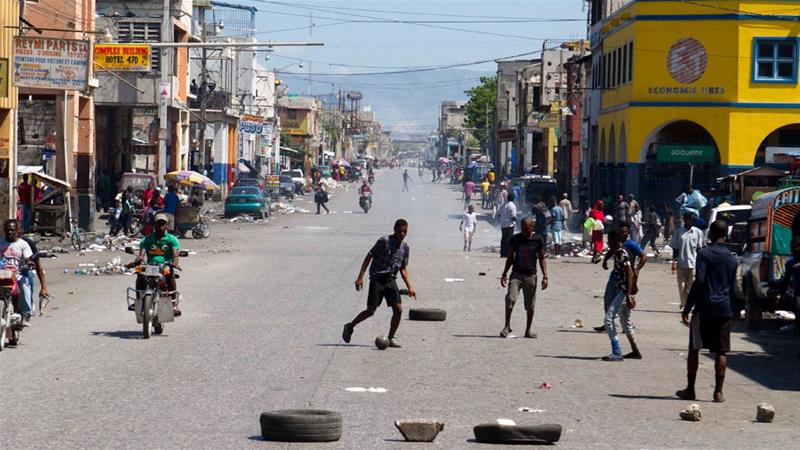
Much of Haiti has come to a halt because of a transportation strike over new taxes proposed by the government.Most Haitians do not have private cars, and they get around on motorcycle taxis or the often elaborately painted vans and trucks known as "tap taps". But none were available on Monday as drivers took part in a strike over driver's licenses, fuel and property, among other things."We don't want this budget [new taxes] to pass," one protester in the capital Port-au-Prince told The Associated Press. "We don't want it."Another protester, Eddy Edouard, said he supported the strike "100 percent because the situation is tough for us".

Most shops were closed, as were schools because students could not get to class. Government offices were technically open, but most employees could not get to work.President Jovenel Moise was out of the country to attend the UN General Assembly but has said the money will go back to the public in the form of services and new infrastructure.

'Revolution has just started'

Last week, protesters brought parts of Port-au-Prince to a standstill to protest the government's budget plans. The demonstrations, at times, turned violent."These little thieves in parliament voted for this budget to help the government exploit the people," protester Marco Paul Delva, who stood by a barricade of flaming tires near the legislature, told AFP news agency.Traffic in the centre of Port-au-Prince and on key routes around the city grounded to a halt after protesters threw stones and tires across roads.Although demonstrators gathered in relatively small groups, the protest took police by surprise - and they were unable to intervene in some blocked-off areas.Protesters directed their anger towards politicians who approved an unpopular budget earlier this month that raises taxes on products including cigarettes, alcohol and passports.

Anti-government protests in the centre of Port-au-Prince on September 12, 2017 [Hector Retamal/AFP]

"The revolution has just started. Jovenel Moise will have to retract his taxes, or he will have to leave immediately," Jacques Menard, a 31-year-old protester, told Reuters news agency."And this is a warning because the next phase can be very violent."At the same time, foreign aid to Haiti is slowing. The country is one of the poorest in the Americas and suffered a devastating earthquake in 2010 and the worst of Hurricane Matthew last year."If Jovenel Moise is intelligent, he should refrain from publishing the budget; otherwise he will have to face a series of street demonstrations that will further complicate the situation," former presidential candidate Jean-Charles Moise said on local radio last week.The government has defended the budget, saying that many of the things protesters are unhappy with are untrue."There are people manipulating public opinion," Economy and Fiance Minister Jude Alix Patrick Salomon said before last week's protests.By: Aljazeera| September 18, 2017

Read More
Featured, Politics Featured, Politics

Haitians blocked at US border find 'Mexican dream'

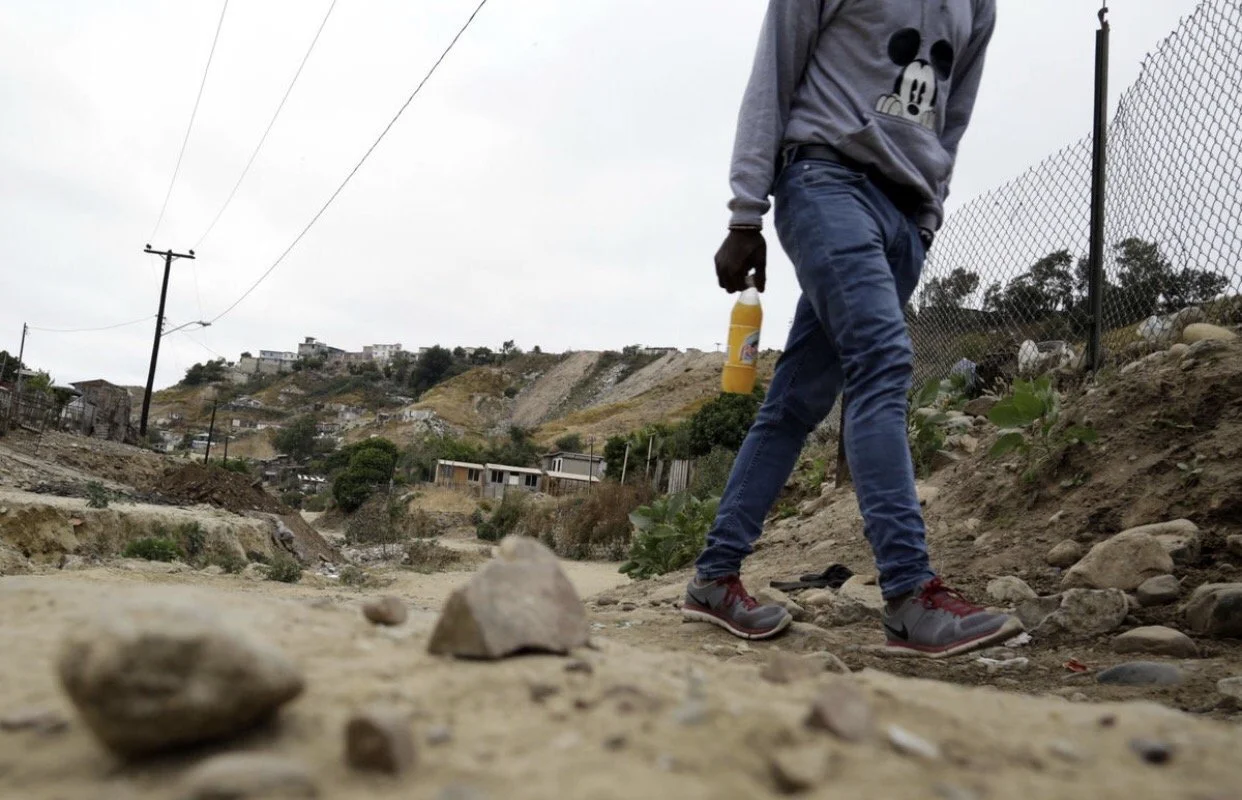
TIJUANA, Mexico (AP) — Jose Luis Millan found a new crop of star employees at an upscale Tijuana car wash where customers cross the border from the U.S. to pay up to $950 to have their prized possessions steamed and scrubbed for hours. They're never late, always hustle and come in on days off to learn new skills, traits that he says make them a model for their Mexican counterparts.They are among several thousand Haitians who came to Mexico's northwest corner hoping to cross the border before the U.S. abruptly closed its doors last year. The Mexican government has welcomed them, with a visa program that helps them fill the need for labor in Tijuana's growing economy.In a country whose population is 1 percent black, Tijuana's Haitians stand out. They share tight living quarters, sending much of their meager wages to support family in Haiti. Haitians earn far less than they would in the United States but enough to forsake the risk of getting deported by heading north.Two new Haitian restaurants downtown serve dishes with mangoes and mashed plantains. Dozens of Haitian children attend public schools. Factories that export to the U.S. recruit Haitians, who can also be found waiting tables and worshipping at congregations that added services in Creole."It's the Mexican dream for many of them, a sense that they belong," Millan said. "Mexico has given them opportunity. Mexico has opened up and let them achieve their dreams."Millan, who lived in the Los Angeles area for two decades until he was forced to leave last year for employing dozens of people illegally at his party planning company, sees parallels to Mexicans in the U.S. Their teamwork sets an example. Some customers ask for them.Haitians, he says, "fight hard, fight strong, and they don't stop."The Haitians took an accidental route from their impoverished Caribbean homeland to Tijuana, a city of about 2 million that borders San Diego and also has large pockets of Chinese and Korean immigrants.Brazil and its neighbors took in the Haitians after that country's 2010 earthquake. As construction jobs for the 2016 Summer Olympics ended and Brazil descended into political turmoil, they crossed 10 countries by plane, boat, bus and on foot to San Diego, where U.S. authorities let them in on humanitarian grounds.Then President Barack Obama shifted course in September and started deporting Haitian arrivals. Many decided to call Mexico home.After struggling as a schoolteacher in Haiti, Abelson Etienne moved to Brazil in 2014 to work at a factory that made cable for lighting products. He arrived in Tijuana in December after a harrowing journey with his wife who, despite the U.S. policy shift, was allowed in on humanitarian grounds, presumably because she was seven months' pregnant.Etienne, a 27-year-old who studied chemistry in college in Haiti, settled into a routine of six-day weeks and three double shifts, earning him 1,900 pesos (a little over $100), mostly for his wife in New York City and the infant son he hasn't seen. On Sundays, he sleeps until the afternoon and goes to church."There's so much work in Tijuana," he said while a pot of fish stew with mangoes and tomatoes simmered on an electric burner in the two-room apartment that he rents with three other Haitians. "I've been treated very well in Mexico."The Mexican government is giving Haitians one-year, renewable visas that allow them to work but not bring family. Rodulfo Figueroa, the region's top immigration official, says Mexico is practicing what it asks of the U.S. and other countries."We believe that there's a humanitarian case to be made for these people to find better lives in Mexico," said Figueroa, the National Migration Institute's delegate in Baja California state, which includes Tijuana. "Our policy is to have the Haitian population do what they need to do to have status in Mexico."The new arrivals, currently numbering around 3,000, are manageable in a country of 122 million. Central Americans, who come illegally in much larger numbers, are typically deported, although Mexico is granting asylum more often.Rodin St. Surin, 36, is among hundreds of Haitians who found work at Tijuana's export-oriented factories. CCL Industries Inc., a Toronto-based company that makes Avery office products for retailers including Staples, Wal-Mart, Target and others, needed help after moving manufacturing from Meridian, Mississippi, last year.The plant hired St. Surin and 15 other Haitians in May for its workforce of 1,700 during peak back-to-school season. They inspected and packaged binders at the back of a giant, spotless floor where machines also churn out labels, folders and markers around-the-clock."I'm very comfortable with these people," said Mario Aguirre, the plant's operations director and a 43-year industry veteran. "They have given us very good results. They don't miss work, they always arrive on time. We'd like to see the same attitude in everyone."The factory offered 1,500 pesos (about $85) for a six-day week, with health coverage, paid vacation and a free shuttle to work. St. Surin, who left Brazil with hopes of joining a cousin in Miami, sends earnings to a caretaker for his three children in Haiti, whom he hopes to bring to Tijuana."Mexico could become my home," he said outside a crowded, graffiti-covered building where a nun allows about 50 Haitians to live rent-free on a street shared by cars and stray dogs. They tap a neighbor's hose for water to bathe, and cook meals on a campfire under a large canopy.The Ambassadors of Jesus Church, which sits on a rugged dirt road lined by agave and used tires, housed up to 500 Haitians last year on floors strewn with mattresses, making it perhaps the largest religious or civic aid group. Its pastor, Jeccene Thimote, wants to build a "Little Haiti" of 100 houses nearby at the bottom of a canyon where the sound of peacocks and roosters and smell of pigs permeate the air. He built three houses before the city halted construction for lack of flood controls.Thimote, 32, survives on two hours' sleep, rising to pray at 5 a.m., serving as foreman for a crew of 10 Haitians building a house in one of Tijuana's wealthiest neighborhoods, and working the night shift at RSI Home Products Inc., a California-based company that makes cabinetry for The Home Depot and Lowe's.Thimote, who was among 160 Haitians still living rent-free at the church this summer, sends his earnings to Haiti to settle family debts and support a 3-year-old daughter. He hoped to join a cousin in New York when he left Ecuador last year, but considers Mexico better than Haiti, saying, "There's more poverty there than here."The church has adapted. Every Wednesday night, Haitians gather for a rousing sermon in Creole. Mexicans attend a Sunday service in Spanish. A Haitian and Mexican recently announced plans to marry at the church.By Elliot Spagat, Associated Press | Sep 19, 2017

Copyright 2017 The Associated Press. All rights reserved. This material may not be published, broadcast, rewritten or redistributed.
Read More
Featured, News, Politics Featured, News, Politics

The Financing of the new Haitian Parliament

Youri Latortue Senate President announced the reconstruction of the Parliament at the cost of about 3 billion Gourdes ($48 million). The new parliamentary complex will consist of 3 buildings, a 10-story building for the offices of parliamentarians including the working and meeting rooms of the Standing Commissions and the offices of the administration. The second one will comprise of three large hemicycles (Chamber of Deputies, Senate, and National Assembly), and finally the 3rd will include a four-story closed parking lot for parliamentarians and visitors...On Friday Sep. 15th, 2017, President Moïse wished to silence criticisms relating to the high budget of Parliament by stating that 50% of the 7.2 billion gourdes allocated to senators and deputies in the budget would be used for the reconstruction of Parliament in his message to the Nation regarding the publication of the budget.However, in reality, it is stated in the budget that the 7.2 billion Gourdes of the Parliament are divided 50/50 between the Senate and the Lower House, ie 3.6 billion for each Chamber. For the Senate 2 billion are devoted to the functioning and an "investments" heading has an envelope of 1.5 billion which will be allocated to the reconstruction of the Parliament. As for the budget of the lower chamber, it is essentially devoted to functioning and does not include any heading "investments". This means that only 50% of the estimated costs of reconstruction of Parliament will come from Parliament's budget and not all as Moïse said and the other 1.5 billion gourdes to complete the cost of the work, will have to come from other items in the State budget...If Senator Latortue evokes an amount of about 3 billion Gourdes for the new parliamentary complex, Clément Bélizaire, the Director of the Unit of Construction of Housing and Public Buildings (UCLBP) shows more reserved "We do not know yet how much will cost Parliament nor the firm that will carry out the work because adjustments have been requested," specifying that there will be no traditional call for tenders for the construction of the Haitian Parliament.SL/ HaitiLibre

Read More
Politics Politics

Trump’s priorities in Haiti, according to new US Chargé d’Affaires

PORT-AU-PRINCE, Haiti (sentinel.ht) – In Port-au-Prince, Robin Diallo, the new chargé d’affaires for the U.S. Embassy here held a press availability with several journalists on Friday. The diplomat gave an overview of several hot topics shaping the Trump administration’s relations with Haiti.According to an article published in Le Nouvelliste, Mrs. Diallo acknowledged major issues that are of utmost concern, that have arisen since her arrival. These would be the threat posed by the passing of Hurricane Irma and the demonstrations of protest against the budget of fiscal year 2017-2018.To these matter, the Embassy delivered the customary message of hope:

“The partnership between Haiti and the United States would not end with an administration. Haiti and the United States have long been true partners, and it will continue.”

However, the chargé d’affaires’ confidence in the continuation of the Haiti-US partnership did not allow her to say anything definitive or in the lease consequential regarding the hottest topic of the day, the expiring Temporary Protected Status.To the question of whether there is a chance that the status of temporary protection (TPS) will be renewed before January 23, 2018, she replied:

“I do not know. I can not guess… we discussed it a lot in Washington and Haiti even before I arrived. Now, the discussions are continuing…”

Mrs. Diallo deflected further questioning on the matter by saying that the Temporary Protected Status program is not a decision of the embassy but of the US government to decide whether to extend it or not.The end of the mandate of the United Nations Stabilization Mission in Haiti (MINUSTAH), which has received much of its funding from the United States, is a matter of focus on the U.S. side. It has always been the U.S. approach to closely coordinate with the Haitian National Police through its security agencies such as the Drug Enforcement Agency and the Federal Bureau of Investigations for examples.

“We already have a lot of special programs with the national police to strengthen security in Haiti. Now, we will work on the protection of the land border…”

The supervision of PNH agents by instructors and trainers from the USA goes back more than 20 years and more than once, according to Le Nouvelliste, Robin Diallo argued that the United States would continue to support the police institution.

“We have done a lot of work with the PNH. We are confident that the PNH can ensure the security of the country…”

The priority areas of intervention of the United States remain unchanged according to the diplomat. The priorities it has listed are particularly relevant to the health sector.

“We are already doing a lot of work in the health field to fight and treat HIV, tuberculosis, we are also promoting reproductive health and vaccines… [we plan to] strengthen civil society and support the judiciary. We also have education programs, exchanges and coaching…”

Another favorite playground of the US representative in Haiti is the issue of direct employment created in the country by US investments. “We are trying to promote trade with American companies,” she said.In an exclusive interview with Le Nouvelliste last week, she relied on the 12,000 people who work in Caracol and the additions to this project: water, electricity, education, as talking points of a success.Regarding the Permanent Electoral Council (CEP) that the three powers of the state are trying to set up, Diallo believes that “this is very important for the country.”

“Everyone in a democracy believes that independent and transparent elections are very important. [Such a process must] have a permanent CEP and ensure that the elections run smoothly. “ 

Robin Diallo, the new American diplomat in Haiti, a career diplomat, recently served as Minister of Public Affairs at the US Embassy in Baghdad, Iraq. She previously served in Afghanistan and the Philippines.Samuel Maxime Editor-in-Chief; The Haiti Sentinel - Monday, September 18, 2017

Read More
News, Politics News, Politics

President Moïse in New York

Sunday, President Jovenel Moïse left the country to New York to take part in the debate of the 72nd Ordinary Session of the General Assembly of the United Nations, which will be held from 18 to 26 September 2017.On the sidelines of the general debate, the Head of State will meet with Antonio Gutteres, the UN Secretary-General, Luis Alberto Moreno, President of the Inter-American Development Bank (IDB) and Christine Lagarde, Director General of the International Monetary Fund (IMF), among others, to discuss the economic and social development priorities of his administration.He will also take advantage of his stay in the United States to speak with compatriots of the Haitian community in the metropolitan area of New York.To this end, the Consulate General of the Republic of Haiti in New York invites the Haitian community to a meeting with President Jovenel Moïse on Thursday 21 September 2017 from 7:00 to 9:00 p.m. at Medgar Evers College located 1650 Bedford Ave, Brooklyn, NY 11225.The Head of State will return to Haiti on Friday, 22 September.By: HL/ HaitiLibre | September 18, 2017

Read More

Two killed as protests continue against budget proposals

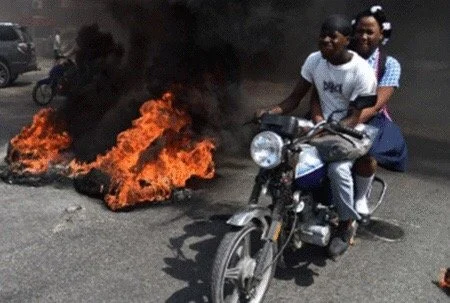
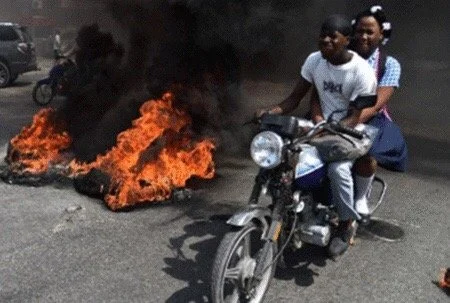
PORT AU PRINCE – At least two people were killed and 12 people arrested as protests action continued in this French-speaking Caribbean Community (CARICOM) country over the new budget presented by the Jovenel Moise administration.The National Police of Haiti (PNH) also confirmed that at least four vehicles had been burnt during the protest while dismissing reports that an arrest warrant had been issued for former Senator Moïse Jean-Charles, in connection with the anti-governmental demonstrations.Haitian motorcyclist rides past burning debris“The PNH has no arrest order against former Senator of the North,” said the PNH spokesman Frantz Lerebours, saying that the police were engaged in a routine check after a warning issued against the driver of a vehicle, which turned out to be that of the former legislator.Meanwhile, Jean Charles has announced four days of demonstrations here starting on Monday to protest the fiscal measures contained in the budget.He described the meeting between President Moise and leaders of some political parties here as “a huge joke” adding that “Moïse is deaf to the demands of the population”.The organisers said that transport workers have already signalled their intention to support the demonstrations.President of the Association of Haitian Owners and Drivers (APCH), Mehu Changeux, said that a national strike has also been planned for Monday to force President Moïse to recall the budget that was ratified by both Houses of Parliament last week.Several trade unions have already confirmed their support for the strike criticising the government for not taking any measures to improve the living conditions of the population, but on the contrary to increase the tax burden on the most disadvantaged strata of the population.Secretary General of the Council of Ministers Reynald Lubérice confirmed that the Executive would publish the budget 2017-2018 in the official newspaper “Le Moniteur” and that street demonstrations will not change anything.The authorities have also denied an increase in the cost of obtaining a Haitian passport, saying it still remains valid for 10 years.On Thursday, President Moise, accompanied by Prime Minister Jack Guy Lafontant met with political leaders at the National Palace, on various issues including the financing of political parties in Haiti.President of the Fusion of the Haitian Social Democrats (FUSION) Edmonde Supplice Beauzile, said he believes it is not the right time to talk about financing of political parties, while the government’s draft budget is the subject of street demonstrations.In the meeting Moise stressed the difficulties faced by political parties in Haiti.“In some countries, political life is organized and stabilized around two or three major poles. The choice of voters is facilitated because the political offer is reduced inviting the political parties to exert a leadership by their capacity to grasp the stakes for the Haitian society.”He said that he expects various obstacles to complete such an undertaking.“This system of institutionalized parties because funded properly will not happen without sacrifices. But such an initiative is worthwhile in terms of the expected results for the democratic health of our country,” he added.CMC | September 16, 2017

Read More

Violent Street Protests Break Out In Haiti Over Tax Hikes

Video Courtesy  of Miamiherald.com

PORT-AU-PRINCE (Reuters) - Protesters in Haiti damaged commercial buildings in the capital city and set cars on fire on Tuesday, angered by government tax hikes that

The Port-au-Prince protest, called by former presidential candidate Jean-Charles Moise, took many by surprise and represents the biggest outcry against the administration of President Jovenel Moise since he took office earlier this year.

“The revolution has just started. Jovenel Moise will have to retract his taxes or he will have to leave immediately,” said Jacques Menard, a 31-year-old protester. “And this is a warning because the next phase can be very violent.”

Protesters took to the streets in separate groups in several districts in the metropolitan area of Port-au-Prince, erecting flaming barricades, blocking traffic, and confronting riot police, who fired tear gas and warning shots in the air.

Several people were arrested, the police said, but there were no reports of any deaths or serious injuries.


Lawmakers last weekend approved an unpopular budget that raises taxes on products including cigarettes, alcohol and passports.


At the same time, foreign aid to Haiti is slowing. The country is one of the poorest in the Americas and suffered a devastating earthquake in 2010 and the worst of hurricane Matthew last year.

“If Jovenel Moise is intelligent, he should refrain from publishing the budget, otherwise he will have to face a series of street demonstrations that will further complicate the situation,” Jean-Charles Moise said on local radio.Government officials were not immediately available for comment, but Economy and Finance Minister Jude Alix Patrick Salomon defended the budget over the weekend.

 “There are people who are blaming many things on the budget that are not true,” Salomon told reporters shortly after the spending plan was approved. “There are people manipulating the public opinion.”

Read More
Politics Politics

Haiti in crisis: What next after the stolen election?

Addressing an overflow audience in Oakland in late April, Dr. Maryse Narcisse, presidential candidate of Fanmi Lavalas, the party of former president Jean-Bertrand Aristide, spoke about the necessity of reforming the justice system, investing in education and health, and the decisive role of women in the fight for democracy. Reflecting on the devastation wrought by both the 2010 earthquake and Hurricane Matthew, she focused on the growing threats posed by climate change to the island nation and the need for a vigorous environmental campaign to meet that threat. She emphasized that the Lavalas movement “places human beings at the center.”Dr. Narcisse spoke in the wake of the selection of Haiti’s new president, Jovenel Moise, a right-wing businessman and protégé of former president Michel Martelly, who took office via an electoral process so replete with fraud and voter suppression that opposition forces called it an “electoral coup.” She denounced the stolen elections and the corrupt electoral commission that validated the outcome.But she reiterated that the deteriorating economic and social conditions in Haiti would be the catalyst for renewed protest in the days and months ahead. “There is no choice,” she stated, “but for the people to resist. And Lavalas will be there to support them.”We can see the truth of this throughout Haiti. Market women – the very heart of Haiti’s economy and the foundation of so many Haitian families’ ability to survive – have been targeted by police trying to move them off the streets of Port-au-Prince, where they have been selling their goods for generations. When the women organized themselves and refused to move, police burned down their stalls.

She reiterated that the deteriorating economic and social conditions in Haiti would be the catalyst for renewed protest in the days and months ahead. “There is no choice,” she stated, “but for the people to resist. And Lavalas will be there to support them.”

On July 10-12, 2017, during three days of peaceful protest for an increase in the minimum wage, Haitian police attacked the workers from the industrial park in Port-au-Prince with tear gas, batons and cannons shooting a liquid skin irritant. They beat a woman who had recently returned to work from giving birth. A few days later, a young book vendor was shot to death in Petionville, on the outskirts of Port-au-Prince, by a police officer in front of horrified witnesses, who tried to prevent the police from quickly removing the body and covering up the crime. They were attacked with batons and tear gas.There has been a 35 cent increase in the price of gasoline – which was already higher than what we pay here in the United States. The government has also announced plans to reduce government subsidies for oil and gas, which will send the price even higher. The rise in the cost of transportation combined with a hike in the price of food has made already untenable living conditions even worse for the vast majority of Haitians.Former president Michel Martelly came to power in 2011 touting his plan to build new schools and make education free for all. Instead, investment in public education has remained stagnant while tuition for private schooling has skyrocketed. Teachers have been on strike for months, demanding that they be paid after not receiving their salaries for up to two years. This despite the fact the Haitian government adds a surcharge to every international phone call and money transfer, supposedly to fund education.Students have also protested, both in support of their teachers and to denounce the failure of the government to invest in their education. They too have been met with violent repression, exemplified by a recent incident when the rector of the National University of Haiti used his SUV to run over a student protester, landing the student in the hospital in critical condition. A video captured the gruesome sequence. No charges have been filed in the case.The Haitian government has a solution for the crisis in education – more prisons. There are now more than 10,000 Haitians locked up in prison, the majority of whom have never been charged or sentenced. Prisoners are frequently beaten, receive no health care, and live in overcrowded cells, where epidemics spread rapidly.

Cascading catastrophes since the 2004 coup forced Lavalas out of power have not entirely destroyed Haitians’ hope and confidence they can once again exercise the full power of the people. Their constant marching in the face of mortal danger – Haitian police are notorious for firing live ammunition into a marching crowd – demonstrates that power … and their trademark joie de vivre.

When United Nations soldiers from Nepal introduced cholera to Haiti in 2010, the disease swept through Haiti’s prisons, killing hundreds. At the recent opening of a new prison in Haiti’s central plateau, the head of Haiti’s national police, Michel-Ange Gedeon, boasted about the increase in prison construction, saying: “In every society, whenever schools fail in their mission, prisons are built in a cascade to try to right the ship. If offenders are to be neutralized, then prisons are needed to contain them.” This is Haiti’s version of mass incarceration, so well known to Black and Brown communities here in the U.S.Now there are new political prisoners – many of them associated with the Lavalas movement – who were arrested during the sustained wave of protests over the stolen elections. As living conditions worsen and protests sharpen, the prisons will fill even more.All of this, added to the impact of Hurricane Matthew – the biggest storm to hit Haiti in 50 years – has led more Haitians to flee the country. In early July, the Coast Guard intercepted and sent back to Haiti 107 Haitians in a small, dangerously overcrowded boat south of the Bahamas.There are over 4,000 Haitians right now in Tijuana, living in refugee camps. Recruited by occupying forces of Brazil to work in the Rio Olympics, they were pushed out after the games ended. Hoping for Temporary Protected Status (TPS) in the United States, which has been granted to Haitians since the 2010 earthquake, they instead have been deported or placed in detention camps if they cross the border.When Haitian president Moise traveled to the United States and met with Vice President Mike Pence in June, he refused to meet with Haitians worried about the changes in their TPS status, telling them to “calm down.” In their joint communiqué, Pence and Moise did not mention the migration crisis but did pledge to jointly pursue “an economic reform agenda to attract investment and generate growth.” Moise’s handshake with Pence symbolized just how much of a compliant partner his regime is with the U.S. government as it seeks even more control over Haiti’s economy and future.

When Haitian president Moise traveled to the United States and met with Vice President Mike Pence in June, he refused to meet with Haitians worried about the changes in their TPS status, telling them to “calm down.”

The United Nations Military Occupation Forces (MINUSTAH), which has functioned as a colonial overseer since the 2004 coup, is set to scale down its operation but will remain in Haiti under its new acronym MINUJUSTH (United Nations Mission For Justice Support). MINUJUSTH will consist of 1,185 police officers, and will continue to train and support the Haitian National Police – the same police who beat, tear-gassed and shot pro-democracy protesters during the last electoral cycle.Lt. Gen. Cesar Lopes Loureiro, the head of the Brazilian forces that have been in command of MINUSTAH since the beginning of the occupation, recently issued a glowing report on the accomplishments of MINUSTAH. But he was silent about U.N. responsibility for the cholera outbreak, and failed to mention the numerous cases of rape and other sexual assaults by U.N. soldiers.The U.N. has still not compensated the victims of the cholera epidemic, and it has given impunity to the many soldiers charged with raping Haitians during the long occupation. And there was not one word about the killings by U.N. soldiers of people in pro-Lavalas neighborhoods like Cite Soleil and Bel-Air or in the Port-au-Prince prison.Whether the U.N. calls its operations MINUSTAH or MINJUSTH, the continued presence of its forces, even in the guise of a reframed mission, is a clear assault on Haiti’s sovereignty.

The documentary film “Black in Latin America: Haiti & the Dominican Republic” will be shown on Sept. 14, 7 p.m., at La Pena Cultural Center, 3105 Shattuck Ave., Berkeley. The screening is co-hosted by La Pena and Haiti Action Committee. Pierre Labossiere, co-founder of Haiti Action Committee, will lead a community discussion after the film. For more information, visit https://lapena.org/event/black-latin-america-haiti-dominican-republic/.

What now looms on the horizon is the resurrection of the Haitian military. This has been a key goal of right-wing Haitian forces since President Aristide got rid of the army in 1995. Jovenel Moise has stated that he wants the army in place within two years. The beginnings of that new army have been in the works for years, training at military bases in Ecuador.In a statement to the Miami Herald, the president of the Haitian Senate, Yuri Latortue, who was a central organizer of the 2004 coup, said, “In Haiti we are used to having an army.” Referring to the U.S. occupation of Haiti from 1915-1934, which created the modern Haitian army, Latortue went on to say, and “the Americans understood that if we have the police but not an army, we will not get anywhere.”

What now looms on the horizon is the resurrection of the Haitian military. This has been a key goal of right-wing Haitian forces since President Aristide got rid of the army in 1995.

When Haitian activists speak of the Haitian Army, there is a chill in the air. Before Aristide disbanded it, 40 percent of Haiti’s budget went to the military. In a country with fewer than two doctors per 10,000 people, there was one soldier per 1,000 people.The Army has long been Haiti’s central institution of repression; the main organizer of coups against elected officials, helping to enforce the Duvalier dictatorships and those that followed before the rise of Lavalas. It was the Haitian Army that overthrew Aristide in 1991 and initiated a reign of terror that took over 5,000 lives before Aristide returned in 1994.The goal of the 2004 coup, like the 1991 coup that preceded it, was not only to topple the Aristide government, but also to rid the country of the powerful grassroots movement that has activated, energized and given voice to Haiti’s poor. That goal has not been accomplished. A stolen election cannot hide this reality.Throughout her campaign, Dr. Narcisse, often accompanied by former President Aristide, was greeted by tens of thousands of supporters in the poorest communities of Haiti. A vibrant Lavalas presence was evident across the country.In the face of decades of COINTELPRO-style counterinsurgency, including imprisonment, the killing and exile of thousands, attempts to buy off activists and encourage internal strife, Lavalas once again showed its significant base among Haiti’s majority population. In or out of government, this strength will serve as a bulwark against the harsh austerity program already being put into place by Moise and his U.S. sponsors.At the end of her speech in Oakland, Dr. Narcisse highlighted the grassroots work of the Aristide Foundation for Democracy. In the midst of the cholera epidemic, mobile health clinics from the Foundation treated patients who had nowhere else to go.After the devastation caused by Hurricane Matthew, President Aristide and Lavalas activists went to Les Cayes, Jeremie and other hard-hit areas to provide medical support, food and clothing. On Haitian Mother’s Day, hundreds of women filled the Foundation to get medical care for themselves and their children.Other clinics took place in mid-July, including on President Aristide’s birthday, July 15. And the University of the Aristide Foundation (UNIFA) continues to grow, providing higher education for over 1,200 students, most of whom could never afford other universities in Haiti.This is a movement that is not going away. As Lavalas digs in for the long haul, those in solidarity with Haiti have to do so as well.by Robert Roth/San Francisco Bay View - September 10, 2017

Read More

Accreditation of two new ambassadors

 President Jovenel Moïse, received the credentials of two new Ambassadors accredited in Haiti, at the National Palace. They are their Excellencies André Frenette of Canada and Oscar Chàvez Valiente of the Republic of El Salvador.The two new diplomats renewed their country's commitment to maintain close ties of friendship and strengthen cooperation between Haiti and their countries.The Head of State also reassured these ambassadors on his willingness to work by common agreement to the harmonious development of relations between his Haiti and these two friendly countries.Subsequently, after the delivery of their credentials to the President of the Republic of Haiti, they made a floral offerings to the Haitian National Pantheon.HL/ HaitiLibre

Read More

President Moïse announces the departure of 12,000 civil servants

President Jovenel Moïse announced last August 31 that "[...] have decided to withdraw 12,000 people from the State this year who are ready to retire from the 32,000 people who are at the age of retirement or at the end of their career [38.5% of the 83,000 persons working for the State] [...]"The Head of State said that this process of retirement will begin this year with the departure of 12,000 civil servants, in order through the Office of Management and Human Resources (OMRH). "To fill the vacancies of these 12,000 departures of public servants, another 12,000 will be recruited by competition from January 2018."HL/ HaitiLibre

Read More
News, Politics News, Politics

Senator urges Trump to extend protections for Haitians

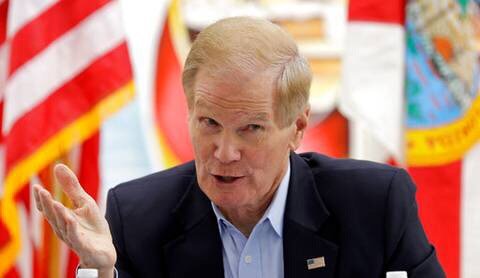
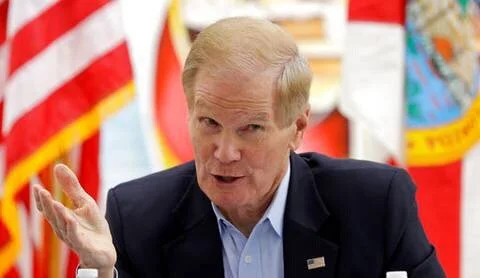
MIAMIA U.S. senator has called on President Donald Trump to extend humanitarian protections granted to Haiti after the country's devastating 2010 earthquake.Democratic Sen. Bill Nelson wants the Trump administration to renew Temporary Protected Status so that nearly 60,000 Haitians can continue to live and work in the U.S. without fear of deportation.The Florida senator, who met with a group of worried Haitians in Miami on Friday, hopes the Department of Homeland Security will extend the status beyond the Jan. 22 deadline, arguing that Hurricane Matthew in 2016 delayed Haiti's recovery efforts.Such extensions are typically renewed for 18-month intervals, but the latest announcement in May said it would expire in six months.Haiti has said more than 300,000 people died in the 2010 disaster. The exact toll is unknown.Sen. Bill Nelson, D-Fla., center, listens to Haitian-American Marlene Bastien, far right, Friday, Aug. 25, 2017, in the Little Haiti area in Miami, during a meeting with a group of Haitian community leaders. Sen. Nelson called on the administration to extend Temporary Protected Status for the nearly 60,000 Haitians living in the U.S. until at least July, 2019. Such extensions are typically renewed for 18-month intervals, but the latest announcement in May said it would expire in six months. Haitians granted the protection can live and work in the U.S. without fear of deportation.Associated Press | August 25, 2017

Read More
Politics Politics

Revocation of the Minister of Social Affairs and Labor

Roosevelt Bellevue, the Minister of Social Affairs and Labor, suspected of corruption, in a case of fraud in the acquisition of over-charged school kits, was revoked.In the official newspaper Le Moniteur N ° 139 dated Tuesday, August 29, 2017, a decree was issued appointing Prime Minister Jack Guy Lafontant, acting Minister of Social Affairs and Labor."Combating corruption and impunity is one of my commitments. I shall put all my strength into it. An act of corruption presupposes the presence of corrupters and corrupters. All are subject to the same penalties," declared President Jovenel Moïse.For his part, the former Minister denies his involvement in any corruption case. He considers these accusations to be "politicaillerie" and that this history of overcharging school kits is the work of a specific sector that wants to tarnish his image...For his part, Pierre Josué Agenor Cadet, the Minister of Education, denies any involvement of his Director of Cabinet, Jackson Pléteau, in cases of corruption related to a case of overcharging of school kits. Minister Cadet says he has not signed any contract to date.HaitiLibre - 30/08/2017

Read More

$4.7 Billion Chinese Development Project Advances in Haiti

It looks as if China is willing to make good on its agreement with Haiti for the renovation of Port-au-Prince. In a letter to Xie Yong Jian, an Advisor to China’s Southwest Municipal Engineering Design and Research Institute, Port-au-Prince Mayor Ralph Youri Chevy agreed to accept the Port-au-Prince Municipal Renovation Project. The project contains proposals for water and drainage works, road improvements, environmental protections, drainage and sanitation, a communications network and reconstruction of the old city of Port-au-Prince. The initial infrastructure investment is $4.711 billion. You can read the letter here.
“After thorough research and prudent consideration, the municipal government hereby supports the implementation of the Port-au-Prince Municipal Renovation Project by leveraging international investment and finance.”
It is unclear at this point where the money will come from, but China is definitely moving forward. The day before the signing, a hard-hitting video surfaced on YouTube, in French and English, outlining the project in extensive detail.[embed]http://youtu.be/f5vmt77tLmc[/embed] 
If this project comes to fruition, it is sorely needed in a country that has seen massive infusions of foreign aid since the 2010 earthquake and very little benefits. See this analysis. My last visit was in December 2015 and not much had changed.
The promised infrastructure seems almost too good to be true, but let’s hope that dreams can indeed come true for the Haitian people. China has made good on similar projects in its estimated Trillion dollar “Silk Road” initiative, not to mention 30 futuristic infrastructure projects in its own country. Perhaps the future has finally arrived for Haiti, and as a result the Caribbean corridor will be transformed.
100 km (62 miles) of 12 main roads will be completely re-engineered. This does not sound like much unless you have ever tried to drive in the Port-au-Prince municipality. Drainage engineering will take center stage with flood interception trenches and rainwater runoff collection systems that will be routed to the rivers and the sea.
After the United Nations Nepalese contingent contaminated all of the central waterways with cholera in October of 2010, a water purification plant capable of handling 225,000 cubic meters per day (59438711.8 US liquid gallons) will be a godsend. Distribution plans have not yet been made public.
A new sewage plant will treat 18,0000 cubic meters per day ”to required standards and be discharged along the rivers and sea,” according to project engineers quoted in the video.
Public toilets (450) and garbage collection will transform the cityscape and the “timely disposal of garbage during the day is expected.”
Waste landfills will accept 1,500 tons per day for domestic waste.
A new gas fired power station has a planned 2000 mega watt output. In India, 1 MW will power 1500 homes; in the United States a mere 145 homes. Of course power usage will determine how far 2000 MW can go. Solar is not mentioned as an option, but at this point a reliable source of power is welcome in Port-au-Prince. Imagine no more rolling blackouts everyday. You can find a primer on energy terms here, with some interesting comparisons.
A new communications proposal promises to provide reliable cell service and a nexus linking a central Internet Data Center with road monitoring and emergency dispatch systems.
Founded in 2008, Bati Ayiti S.A. is a Haitian corporation that is the engine behind this initiative. It was founded in 2008 by Amos Andre, Hans Tippenhauer and William Zreik. The Bati Ayiti Group has three Subsidiaries: Bati Ayiti Aggregates, Bati Ayiti Consulting, and Ville du Lac Development.
Amos André is a former politician and the founder of the political party, Font Uni. He was elected Senator of the Republic for the Department of the Northeast for two years in December 1990. André was re-elected at the end of the term with a majority of 79% of the votes cast for a term of six years in the 45th Legislature.
In late July and early August of this year The Haitian Press Agency (AHP) reported that China would invest $30 billion. Bati Ayiti and its Chinese partners signed an agreement for the renovation of Port-au-Prince with the Municipality of Port-au-Prince.
Bernard Sansaricq, who served with André in the Senate said in an email, “ I think the 4 Billion US is only to rebuild Port-au-Prince, and the 30 billion for project around the country. Again, knowing Haiti, the Chinese might be taking it slowly, not to get hurt.”
No stranger to the forces of corruption, Sansaricq cautions, “If we can control the greediness of those people in power, (then) the project will really benefit the Nation and the poor masses of the country.”André was unavailable for a comment.
Indeed it would be wise for China to takes things slowly. According to the Haiti Sentinel, there are dark forces trying to control development projects. “In Haiti, a trio of wealthy businessmen involved in the electricity sector and characterized as the ‘energy Mafioso,’ have successfully, according to reporting, forced, possibly through extortion, President Jovenel Moise to withdraw from a $2 billion [USD] plan with China to electrify all of Haiti.”China needs to tread carefully through the cesspool of corruption. Let’s also hope that the project will eventually extend beyond Port-au-Prince.
By: Georgianne Nienaber | August 27,2017
Read More