Biden Campaign Adds Karine Jean-Pierre As Senior Adviser

Joe Biden has hired Karine Jean-Pierre, a veteran African American political strategist, as a senior adviser to his presidential campaign as the presumptive Democratic nominee pivots to the general election campaign.

Jean-Pierre will advise on strategy, communications and engaging with key communities, including African Americans, women and progressives.

“This really is the most important general election in generations,” Jean-Pierre told The 19th, a nonprofit newsroom, in an exclusive interview Monday night. “I’ve known Joe Biden for 10 years now. I believe he’s a man of integrity, he’s a man who knows how to lead, he’s a man who knows how to use the levers of government to help people and he’s the man who could beat Donald Trump in November. For me, as a black woman, I just could not sit this out.”

Jean-Pierre, 43, will begin her role with the Biden campaign next week. She gained prominence in 2008 as the southeast regional political director for then-candidate Barack Obama’s history-making presidential campaign.

She served in the Obama White House as regional political director before working as deputy battleground states director on his 2012 reelection. In the latter role, Jean-Pierre handled political engagement in key states including Ohio, North Carolina, Pennsylvania and Florida.

Born in Martinique to Haitian parents and raised in New York, Jean-Pierre worked on former Maryland governor Martin O’Malley’s 2016 Democratic presidential bid before joining liberal group MoveOn as chief public affairs officer. She is also an MSNBC political analyst.ADnull

Separately, the Biden campaign announced Tuesday that it hired Obama campaign alum Julie Chavez Rodriguez — who previously worked as co-national political director for Sen. Kamala D. Harris’s presidential campaign — as a senior adviser, making her the highest-profile Latina to join the team as Biden struggles to shore up his support with Hispanic voters headed into November.

Biden’s swift rise this spring was fueled largely by black voters — particularly black women, who are regarded as the backbone of the party and seen as key to a winning general election coalition in the fall. Energizing these voters will be crucial to the record turnout needed to topple Trump. Black turnout was down in 2016 from historic highs in 2012 and 2008, when the country elected its first African American president.

Jean-Pierre said her hiring signals that Biden “understands how he became the presumptive nominee.”

“Black voters, black women, have helped him get to this point,” she said. “When everybody was counting him out, black voters spoke out. I am so proud and excited as a black woman watching how black women have exerted their power … we had to say loud and clear this (the actions of the Trump administration) is not okay.”

Valerie Jarrett, former senior adviser to Obama, called Jean-Pierre “a superstar” who shares Biden’s values of equality, fairness and justice.

“She will be able to communicate his agenda in an authentic way that I think will resonate importantly with African American women, but also with the entire country,” Jarrett said in a telephone interview. “It’s a coup for vice president Biden and his campaign.”

By Errin Haines | The 19th and The Washington Post May 20, 2020

This story is part of a collaboration between The Washington Post and The 19th, a nonprofit newsroom covering gender, politics and policy.

Read More
News, Politics News, Politics

Haitian army general staff appointed amid tensions with the Dominican Republic

Recent events show that workers and peasants face grave dangers as the ruling elite on both sides of Hispaniola resurrect figures from their violent pasts.Haitian President Jovenel Moïse announced on March 13 the appointment of six general staff members for the reconstituted Forces Armées d’Haïti. All six held senior posts in the FAd’H before it was disbanded by President Jean-Bertrand Aristide in 1995. Three have blood on their hands from the period of the Raoul Cédras military dictatorship in the early 1990s.Colonel Jean-Robert Gabriel, a new assistant chief of staff, was convicted in absentia for his role in the April 1994 Raboteau Massacre under Cédras. After his appointment to the new general staff was announced, the Bureau des Avocats Internationaux, which had secured his conviction in connection with Raboteau in 2000, issued a press release noting that not only was he complicit in the massacre, but he also was a torturer under Cédras.A Haitian court overturned Gabriel’s conviction in 2006, using a technicality it had dredged up from a 1928 law passed during the American occupation.Brigade General Sadrac Saintil, the new army chief of staff, was a Lieutenant Colonel during the Cédras regime and participated in the official whitewash of the Raboteau Massacre.Another assistant chief of staff in the resurrected army, Derby Guerrier, had his assets frozen by the US Treasury in 1993 because of his role in the Cédras dictatorship. The current acting commander in chief of the FAd’H, Jodel Lesage, served in the military of Jean-Claude “Baby Doc” Duvalier and was trained by the US military as a member of the Leopard Corps.In announcing the appointments, Moïse claimed that the army will be used to manage responses to natural disasters and as a coast guard. He undoubtedly views it as a replacement for the United Nations’ hated forces and the US military, which deployed far fewer marines after Hurricane Matthew than after the 2010 earthquake.The US, France, and the UN view the Haitian National Police, which they helped build up to 15,000 members, as a more effective means of suppressing domestic unrest than military troops. US Senator Marco Rubio had this tactic in mind when he pretended last month to oppose Moïse’s military appointments, telling the Miami Herald, “I continue to question why, with so many other needs, Haiti would pursue creating an army.”While the reconstituted army has fewer than 200 troops at present, Haitian Defense Minister Hervé Denis plans to recruit 5,000.Despite his protestations about human rights, Moïse also sees the army as a means of addressing tensions along the border with the Dominican Republic. There is currently no criminal extradition treaty between the two countries, but in March the Dominican military demanded the extradition of a Haitian suspected in the murder of a Dominican husband and wife in Pedernales.In response, Haitian judge Françoise Morailles told Le Nouvelliste that “more than ever it is time for the FAd’H…to get to work on the violent situation with which Haitians find themselves confronted at the border.”Ramfis Domínguez Trujillo, the grandson of murderous dictator Rafael Leónidas Trujillo, has announced his candidacy for the upcoming presidential election in the Dominican Republic. According to a Gallup poll last month, 42 percent of Dominicans support his candidacy while 51 percent are opposed. In order to give his campaign a populist air, Trujillo is promising to institute anti-corruption measures that would include 30-year jail terms for guilty officials.More ominously, he is proposing to build a border wall between Haiti and the Dominican Republic. The Dominican Republic is already monitoring parts of the border with drones and cameras.On Sunday, according to the Providence Journal, Trujillo told a group of Dominican emigrants in Rhode Island that “we need to hold a tough and firm stance before the peaceful Haitian invasion. We need to remove all Haitians who are in the country illegally.”In the Pedernales case, a Haitian named Edner Noël is accused of murdering a couple on whose Dominican ranch he had worked. He was captured and jailed in Haiti after crossing the border.After the murders, vigilantes drove through Pedernales in a pickup truck with a loud speaker on March 13 and demanded that all Haitians leave within 24 hours. At least 250 families fled across the border to Anse-à-Pitres. Dominican President Danilo Medina ordered the deployment of 60 soldiers to Pedernales, along with 30 anti-riot police.There are conflicting reports of whether Haitians had been killed in retaliation, with the mayor of Anse-à-Pitres on the Haitian side of the border telling Le Nouvelliste that he had heard reports of deaths. Tensions continued to be high two weeks after the murders, with the international market still closed by Dominican authorities.In a second incident, a Dominican was murdered on March 19 in Barahona province, with a Haitian co-worker named Jacques Estimphil accused of the crime. The Haitian refugee support group GARR told Alterpresse that approximately 100 people had fled across the border to Haiti to avoid reprisals. Dominican soldiers stopped people who were trying to flee and demanded bribes of 150 pesos.By John Marion for World Socialist Web Site | April 6, 2018

Read More
News, Politics News, Politics

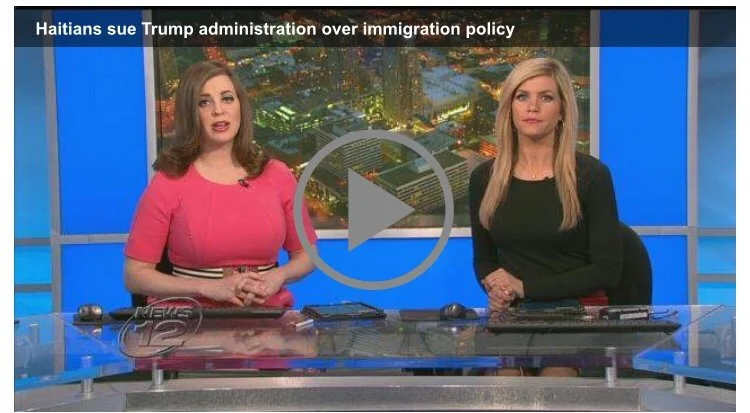
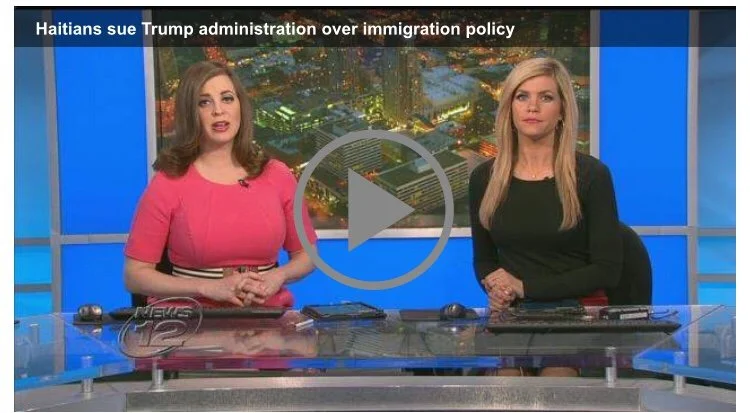
Haitians sue Trump administration over immigration policy

(AP) - Haitian immigrants are suing President Donald Trump and Homeland Security officials, alleging racism influenced a decision to end a program allowing them to live and work legally in the U.S. after disasters in their home country.The lawsuit filed Thursday in New York federal court is one of a handful nationwide challenging the Trump administration's decision to end temporary protected status for people from El Salvador, Haiti, Nicaragua and Sudan.The latest case details how the Haitian-American community could be harmed if roughly 60,000 Haitians become subject to deportation.The dozen plaintiffs include Haiti Liberte, a New York-based weekly Haitian newspaper, where a leading journalist with the protected status may be forced to return home, the lawsuit said.In Miami, the advocacy group Family Action Network Movement Inc. has had to divert resources from core services such as adult education and health care access to assist more Haitians fearing deportation. It also faces losing several activists who also are plaintiffs, the lawsuit said.Six plaintiffs face separation from their U.S.-born children, while another plaintiff with cerebral palsy would lose medical care if separated from his brother who is a U.S. citizen, the lawsuit said.The advocacy group's executive director, Marleine Bastien, said at a news conference in Miami that Haitians with the protected status make more contributions to the U.S. economy than they take."The plaintiffs who are based in Florida are not here because they are working. They have to pay taxes. They can't rely on charity," she said.The lawsuit claims U.S. Homeland Security officials failed to follow protocol when considering whether to renew protections granted to Haitian immigrants after a devastating earthquake struck their Caribbean country in 2010. Those protections were repeatedly extended until the Trump administration announced in November that Haitian recipients have until July 2019 to return home.Trump, Homeland Security Secretary Kirstjen Nielsen and Deputy Homeland Security Secretary Elaine Duke are named as defendants.Instead of reviewing conditions in Haiti, including a cholera outbreak and destruction from Hurricane Matthew in 2016, Homeland Security officials sought to maintain stereotypes about blacks and immigrants committing crimes and receiving public assistance, the lawsuit said.The lawsuit cites Trump's negative comments on immigration from his presidential campaign and separate reports that Trump said thousands of Haitians who came to the U.S. in 2017 "all have AIDS," and that he used vulgar language to question why the country needed more immigrants from Haiti or from African countries instead of from countries like Norway. Trump has denied the comments.The order to end temporary protected status for Haitians violates their due process rights "because the termination was based on the President's categorical and defamatory assertions about all Haitians, which the Haitian TPS recipients were given no opportunity to challenge," the lawsuit said.The NAACP and immigrant advocacy groups in California and Boston made similar allegations in previously filed lawsuits seeking reinstatement of temporary protected status for hundreds of thousands of immigrants.Homeland Security spokeswoman Katie Waldman said in an email Thursday that the agency does not comment on pending litigation.Copyright 2018 The Associated Press. All rights reserved. This material may not be published, broadcast, rewritten or redistributed.by News12 Westchester | March 15, 2018

Read More
History, Politics History, Politics

Haiti Has Been Mistreated By Politicians Like Donald Trump for Centuries

In this op-ed, writer Fabienne Josaphat explains the history of Haiti, and how it has been mistreated by politicians long before President Donald Trump's recent remarks.President Donald Trump’s ignorance of Haitian contributions and history continues to mislead the American people. On January 11, the President of the United States met with officials on immigration and allegedly said, regarding Haitians and Africans, “Why do we want all these people from shithole countries coming here?” The Washington Post first reported the news.These statements made on the eve of the anniversary of the January 12, 2010 earthquake that killed up to 300,000 Haitians. As a Haitian immigrant living in South Florida — where, in 2015, an estimated 127,189 people of Haitian ancestry lived in Miami-Dade County alone — I could feel the indignation broiling beneath my people’s skin. Locally, councilman Alix Desulme, who represents District 4 in the City of North Miami, called the alleged comments “divisive and racist,” and demanded an apology.“Sadly, we have a president who continues to show America how great we can become through his destructive selfishness,” the councilman said. The mayor of North Miami himself, Dr. Smith Joseph, chimed in with his own statement, saying, “Our nation should not tolerate this overt racism from a president who is sworn to protect us.” Haitian-American Congresswoman Mia Love, a Republican from the state of Utah, said, “The President must apologize to both the American people and the nations he so wantonly maligned.”Instead, what came hours after the news of the reported comments broke, was a tweet from the president in which he denied making the comments, calling Haiti “poor and troubled.” He claimed to have wonderful relationships with Haitians, but failed to acknowledge a single one by name. None of this, again, is surprising.Fox News host Tucker Carlson affirmed that the president was merely voicing what his base was already thinking, casually asking, “Why can’t you say that?” on air. Many Trump supporters disagree with the notion that Trump is a racist, despite his allegedly saying “We should have more people from Norway” after his “sh*thole” comment was made.Describing a person’s country as a “sh*thole” shows an absence of critical thinking, and is a display of ignorance. It echoes an existing sentiment of xenophobia in this country from Trump voters, most of them white, now referred to as “the forgotten men and women.” They are being misled by a man who knows nothing about the Haitian people and their history. Yes, the U.S. should respect the Haitian people simply because of their humanity. But Haiti also deserves respect because it spent its entire existence as a nation contributing to the enrichment and greatness of superpowers like America.Historically, Haiti has always offered its best to the world and is proud of its accomplishments. It was the first to lead a successful slave-led rebellion to topple French slave owners, claiming its freedom in 1804. Without Haiti, there would be no Louisiana Purchase, a treaty that earned the United States the entire Louisiana territory and more than doubled the country’s size. New Orleans’ vibrant culture would not be the same without the influence of integrated Haitians. In Illinois, what would later become the city of Chicago was founded by a Haitian-born pioneer named Jean-Baptiste Point du Sable. In addition to liberating slaves in other countries, Haitians helped America fight its Revolutionary War, and when World War II drove countries to form urgent alliances, Haitian pilots joined the Tuskeegee Airmen as part of the U.S. Army Air Force.Our decision in 1804 to live free or to die was heroic, but the U.S. did not officially recognize this independence until 1862. France put the nation in the humiliating position of having to pay reparations at an annual rate for the slaves they lost, so Haiti was forced to borrow money to repay their oppressors, and borrowed from banks in France and the U.S.. Several initiatives have been launched to cancel Haiti’s debt, but pressure to repay debtors initiated further borrowing, keeping Haiti in constant crushing debt.The U.S. profited off Haiti during the American occupation of Haiti from 1915 to 1934, suppressing riots and killing rebels. Initially led by then-President Woodrow Wilson, the U.S. military imposed racist soldiers onto the Haitian people, introducing a new strain of cruelty that led to the decapitation and dehumanization of insurgents.The dictatorship of François “Papa Doc” Duvalier, which lasted in Haiti from 1957 to 1971, was able to endure because of American complicity. Specifically, as Duvalier murdered and brutally oppressed Haitians, the U.S. looked the other way because Duvalier was effective at staving off communism, which the U.S. saw as a threat. When that regime was toppled when Duvalier’s son was overthrown in 1986, the nation was completely impoverished, its funds depleted to line the pockets of tyrants like the Duvaliers. In addition, because of its debts to the U.S., Haiti has been by default constantly subjected to American intervention.Despite our contributions to America, Trump’s language doesn’t necessarily come as a surprise to Haitians, as we too often face this type of disregard from so many in power. Yet, during his presidential campaign, Trump made sure to draw attention to Hillary Clinton’s actions regarding Haiti to discredit the Democratic candidate. In 2009, when she was Secretary of State, Clinton suppressed Haitian minimum wage, at the behest of manufacturers, then after the 2010 earthquake, Bill Clinton became head of the Interim Haiti Recovery Commission. He enlisted the Clinton Foundation to build shelters, a relief effort considered to be a disaster, called out even by the likes of Oxfam.With more than one million people displaced after the 2010 earthquake, the U.S. poured aid money into Haiti, but years later, investigations have found that very little money actually reached Haitian citizens. Haitians still lack shelter that was promised by the American Red Cross after the humanitarian organization raised almost half a billion dollars from helpful donors. The Clinton Foundation, again, is also implicated in failing in their recovery efforts to aid Haiti with reconstruction projects after the earthquake despite raising more than $30 million.Then, Haiti suffered a devastating cholera outbreak that started at a United Nations peacekeeping camp, and as of November 2017, the Trump administration has refused to assign unspent UN peacekeeping money to help combat the epidemic. Instead, his administration chose to end Temporary Protective Status for 60,000 Haitians sheltered in America as a result of the earthquake.This sent a clear message to Haiti and its diaspora, and now, his comments about them speak volumes. In Trump’s world, there is no room for black and brown people to thrive. Yet, he shows an acceptance of white nationalists, identifying as “very fine people” some of the those protesting to keep Confederate monuments after the deadly Charlottesville rallies.He does not know the history of Haiti, and he doesn’t comprehend the significance of Haiti’s contributions, because he doesn’t care to. His wealth and privilege have allowed him to erase others to the point of invisibility.But Haitians exist as a reminder that the damages of racism and oppression cannot sway self-determination. We are not going anywhere. In fact, Haitians continue to thrive despite adversity. Our ancestry and culture empower and enable us to bounce back and carry on. If the whip of slavery did not break us, the words of an inveterate racist will not kill us. Haitians sacrifice for others even when others don’t sacrifice for them. I see this as the definition of love: the continuous devotion to others with no expectation of reciprocity.As a Haitian immigrant, I am tired of always asking for apologies, so I’m not personally interested in one from Trump. I’m interested in active and constructive repairs to our dignity in the American media, demonstrating an intent to rebrand and respect Haiti, rather than baiting audiences into buying into images of poverty and misery, because one narrative does not define us. Apologies, to me, are futile unless they are backed up by action and determination for change. Until then, we are planting our feet in the ground and waiting for the next insult to fly.By: Fabienne Josaphat for TeenVogue.com | January 16, 2018

Read More
News, Politics News, Politics

Edwidge Danticat's Message To Us All On The Anniversary Of The Earthquake

Today We Mourn, Tomorrow We Fight

"Today, like many of my fellow Haitians and Haitian-Americans, I planned to mourn the dead. I planned to do my mourning quietly and in small doses. I planned to stay busy so I wouldn’t spend the whole day in pain. I planned to check on the children in my family who lost their father and baby brother in the catastrophic earthquake eight years ago. I planned to write notes to friends and family members who were rescued from the rubble by their neighbors. I planned to get through a panel at a literary festival without breaking down in tears. I planned to hold my two daughters a little bit tighter tonight, especially my youngest who was the baby I kept in my arms to keep myself from curling up in a fetal position each time I saw a child being pulled from under a school or house on my television screen.  Instead, because the President of the United States, who seems determined to insult Haitians every chance he gets, has said that Haiti--along with “Africa”--is a shithole, I must also lament yet another insult to our dignity.
A few weeks ago, it was “All Haitians have AIDS.” This week we are from a shithole country. Haiti is not unacquainted with racists or white supremacists. We defeated our share of them in 1804 when we became the world’s first black republic. Haiti is not a shithole country.  It is a country that, for example, if France hadn’t grown tired of fighting, it would have never sold 828,000 square miles of land to the US, from the western banks of the Mississippi River to the Rocky Mountains, nearly doubling the size of this country. Alexander Hamilton said that the Louisiana Purchase would have never happened were it not for the “courage and obstinate resistance of the black inhabitants” of Haiti. We are also the country that the United States has invaded several times, preventing us from consistently ruling ourselves. If we are a poor country, then our poverty comes in part from pillage and plunder. In the 1980s, the US government--claiming that Haitian pigs had swine fever--participated in the extermination of nearly every native black pig, which represented some families’ entire life savings. These same farmers were then “encouraged” to buy the pampered pink pigs of US farmers. This is only one of many examples I could list.
We are also a country where great art, music, and literature have risen from these and a slew of other woes. We are entrepreneurs, big and small, dreamers, workers. We are a country that created people like my father, who drove a taxicab in Brooklyn, sometimes sixteen hours a day, so that my three brothers (two teachers and an IT specialist) and I could have a better life. We are the country that eight years ago lost over 300,000 people whose lives and memory we should be commemorating today, rather than trying to hold our heads up wherever in the world we happen to be.  Apparently, the President’s remarks came out of a discussion about Temporary Protected Status, during which he is reported to have said “Why do we need more Haitians? Take them out.” Mr. President, so many have tried to take us out before. Eight years ago, the earth itself tried to take Haiti out. Yet the courage and obstinate resistance of Haitians remain. We survive, and when given the opportunity, we THRIVE.  To borrow a slogan that many Americans of different backgrounds have been using since the beginning of this presidency, today we mourn, tomorrow we fight." - Edwidge Danticat


Read More
Uncategorized Uncategorized

Venezuela and Haiti Sign New Bilateral Deals

The agreements will see Venezuela and Haiti deepen their collaboration in agricultural production as well as in joint infrastructure projects

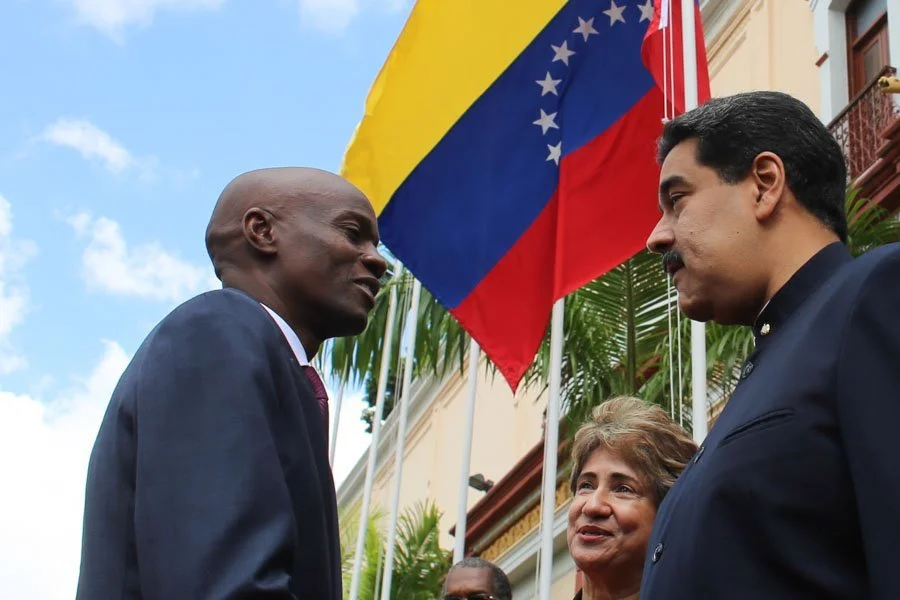
Caracas, November 28, 2017 (venezuelanalysis.com) – Venezuelan President Nicolas Maduro and his Haitian counterpart, Jovenal Moise, held bilateral talks in Caracas Monday where they signed fresh agreements in the areas of energy and agriculture.Known as the Energy and Agriculture Cooperation Agreement, the deal will see Venezuela and Haiti deepen their collaboration in agricultural production as well as in joint infrastructure projects. Further details have yet to be released.Both leaders also reaffirmed their governments’ commitment to the PetroCaribe program, an initiative created by former President Hugo Chavez Frias which sees Venezuela export oil to Haiti and other Caribbean and Central American nations at 40 percent of the market cost, with the remainder payable via 25-year low interest loans.The trip marks President Moise’s first visit to Venezuela since taking office in February on behalf of the right-wing "Bald Heads" (PHTK) party. The businessman was elected to office last November to replace fellow PHTK member, Michel Martelly, as president - though the elections were marred by accusations of fraud.Speaking during a meeting at Miraflores Presidential Palace, the Haitian leader paid tribute to the historic bonds uniting the two countries.“We have been in permanent partnership since the beginning of our history and we thank the people and the Venezuelan president,” he said, alluding to Haiti’s support for Venezuelan independence leader Simon Bolivar, who subsequently abolished slavery in the South American country.President Maduro, for his part, pledged his solidarity with the Caribbean island, which has been rocked by severe natural disasters in recent years.“We will always be together, Haiti and Venezuela. I ratify all of our support, love, and solidarity [for the Haitian people],” he declared.Under the leadership of Chavez and Maduro, the Venezuelan government has moved to strengthen ties with Haiti in recent years via PetroCaribe and other regional integration initiatives. Nonetheless, bilateral agreements between the two countries have been dogged by reports that the Haitian government has embezzled millions of dollars in Venezuelan aid.Between 2011 and 2014, Venezuela helped finance 234 projects in Haiti to the tune of US$1.2 billion.By: Lucas Koerner for Venezuelanalysis.com | November 28,2017
Read More
News, Politics News, Politics

UN to Haiti: 'Proof is in the pudding' on Corruption

PORT-AU-PRINCE, Haiti (AFP) — The United Nations, which last month launched a fresh mission to promote long-term development in Haiti, has had it with nice words: when it comes to corruption and human rights, "the proof is in the pudding.""They have said they want to fight corruption, so they have to take responsibility," insisted Susan Page, who is heading the UN Mission for Justice Support in Haiti (MINUJUSTH)."I'm going to take them at their word, but I'm also going to help them if that is really what they want," the American career diplomat said.Elected president after an electoral crisis that paralyzed the country for two years, Jovenel Moise insists he is going to use his time in office to clean up Haitian politics."Corruption, in all its forms, eats away and atrophies the economy, it profoundly weakens the political foundations and destabilizes society's social tissue: corruption is a crime against development," the president, who took office earlier this year, told the UN general assembly in New York in September.The concern is that his words are taking their time in being translated into action. In late August, a minister was sacked over corruption allegations, but no legal action has yet been taken.The new UN mission starts just as one of the symbols of financial waste in Haiti resurfaces: on Thursday, the Senate will debate a parliamentary report accusing a dozen former ministers, who held office between 2010 and 2016, of "fraud on a grand scale.""We'll see how they react, not just in regard to the report but in general," said Page, pointing to Haitian institutions in charge of fighting corruption and money laundering."Will they strengthen the capabilities of agents in these organizations? Really put investigations in place which they will then pursue to the very end? Will they bring people to justice? We will see."Gnawed away by corruption, the country's justice system is notoriously slow-moving. Its prison population, 400 percent above capacity, is one of the highest in the world.Maintaining the rule of law also demands a real commitment to improving conditions in detention centers, but there, too, MINUJUSTH will not take the lead."It's an age-old problem that the Haitians will have to sort out themselves," said Page. "We are here to support, not to do it for them. They need to have the political will to do it."Restoring the UN's image in Haiti during this new mission will prove almost as big a task as overhauling its justice system.The 13 years of the preceding UN mission, known as MINUSTAH, were blighted by sex crimes perpetrated against Haitian woman and children by UN police and peacekeeping troops, as well as a cholera epidemic sparked by Nepalese peacekeepers that has already claimed 10,000 lives.MINUJUSTH is the UN's sixth peacekeeping mission in Haiti over the past 25 years, a country where there is very little risk of civil war, regional conflict or terrorist attacks. The label "peacekeeping" exasperates many Haitian politicians, who may support the drive against corruption but also want a debate to redefine the UN mandate.Aware of that debate, Page prefers not to take sides: "The UN Security Council considers it necessary to keep a certain level of stability here and to tackle the great challenges which threaten long-term development... that is not a mandate for development – that is to enable a transition between a peacekeeping mission and a lasting development."

By: Jamaicaobserver.com | November 29, 2017

Read More
News, Politics News, Politics

Haiti Prepares to Introduce Its Revived Military

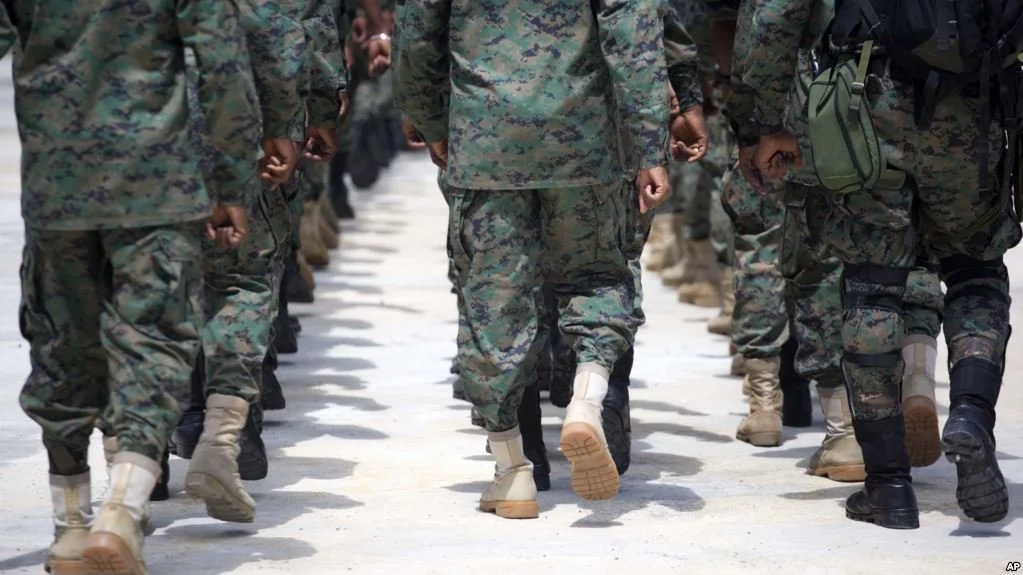
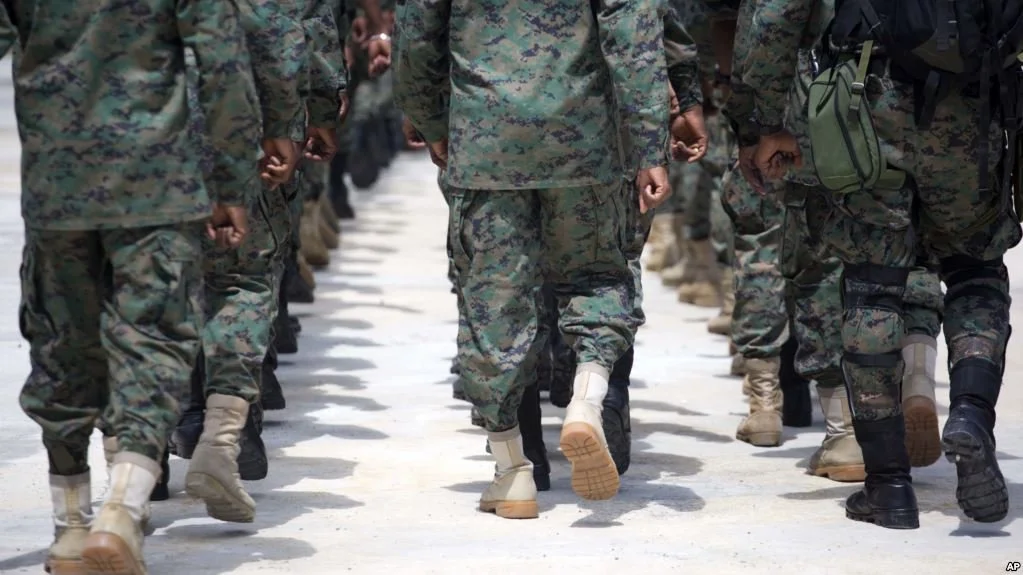
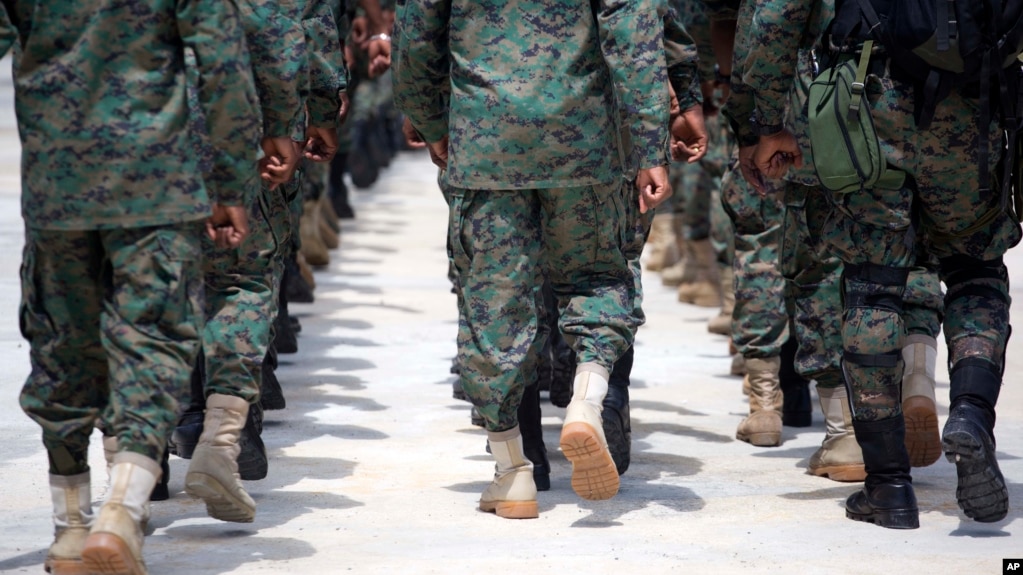
Members of Haiti's new national military force march during training at a former U.N. base in Gressier, Haiti, April 11, 2017. While it's easy to find citizens who strongly support reconstituting a Haitian army, the idea alarms those who vividly remember military coups and oppression. More than two decades after Haiti’s leader disbanded its army, with its history of violent coups, the Caribbean nation is about to unveil a reconstituted military.The Haitian National Army will be formally reintroduced with a parade in this northern port city on Saturday, the anniversary of a decisive 1803 battle [Battle of Vertières] nearby that secured Haiti’s independence from France.“The army I am reinstating for you is a professional one. It is a necessity for our country. It will not be an army of repression,” President Jovenel Moïse, who took office in February, said at a news conference last week. “It will be instead an army that will help out when a hurricane strikes our country. It will help repair roads. This is the army I have promised you.”

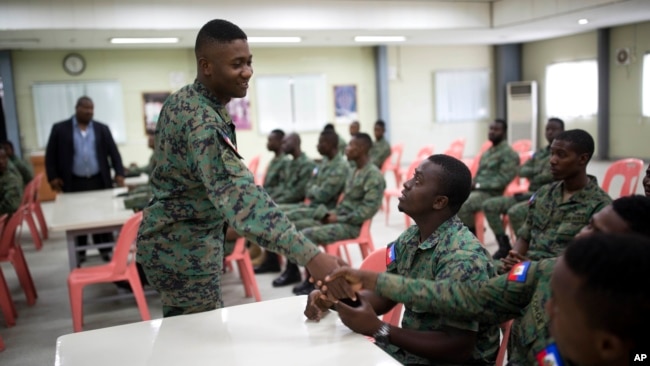
A member of Haiti's new national military force greets a fellow soldier in a meeting room at a former U.N. base in Gressier, Haiti, April 11, 2017.

Civilian forceMoise aims to distinguish it from the military that overthrew Jean-Bertrand Aristide in 1991. When Aristide reclaimed the presidency in 1995, he dismantled the army and put security in the hands of the civilian Haitian National Police. That force now has roughly 15,000 officers.In contrast, the army has at least 150 recruits, young men and women mostly engaged in building up the impoverished country’s infrastructure, Defense Minister Hervé Denis said at news conference Monday. Since their selection in late summer, they have set up a medical clinic in central Haiti and begun fixing roads.Eventually, there could be 3,000 to 5,000 troops, Denis said.“But we know that we cannot have an army of that size the next day” because of budget constraints, he added.

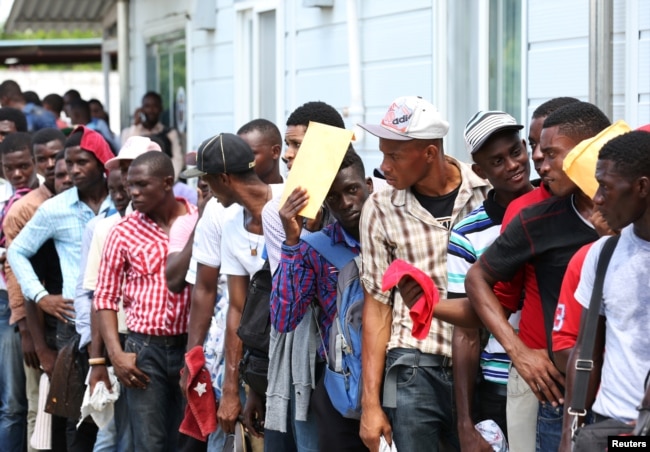
Haitians stand in line as they try to join the country's reformed military in Gressier, Haiti, July 18, 2017.

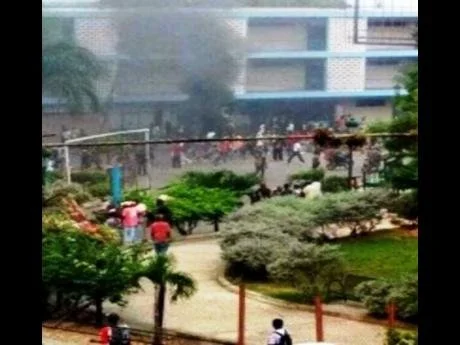
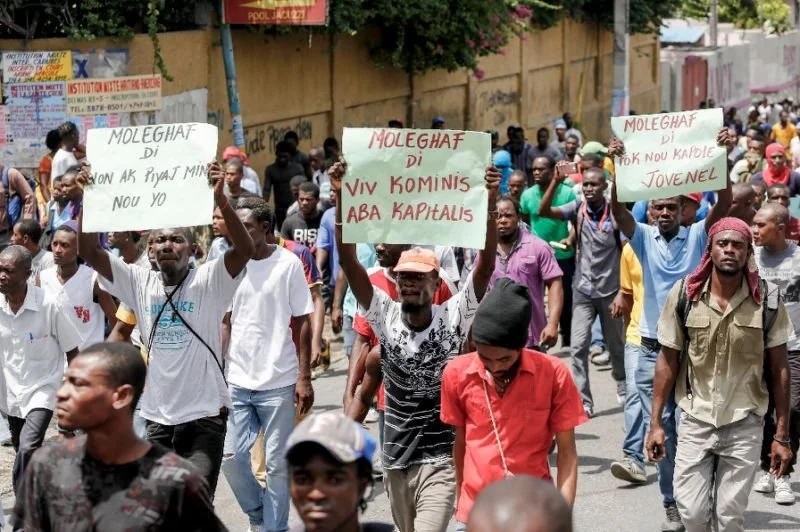
Haiti’s government has allocated $8.5 million for defense spending in the 2018 fiscal year. Denis acknowledged funding challenges but, according to the Miami Herald, said the armed forces’ patrols could stem annual losses of $200 million to $500 million in contraband coming from neighboring Dominican Republic.The army’s restoration draws mixed reactions at home and abroad.The army offers precious jobs in a poor country whose unemployment rate tops 40 percent.But Wednesday marked the third consecutive day of street demonstrations in Cap-Haïtien, the country’s second-largest city, with hundreds of public high school students protesting spending on a new military when their teachers have gone unpaid for months.Their rallying cry: “We don’t want an army, we want an education!”“The country has other priorities that are more important than the army,” Edouard Innocent, the city’s former mayor, told VOA in a phone interview. He said Moise should “prioritize economic development, education, health. … I think this army is [a means] for the president to secure his power.”Right to an armyCiné Aneus Daneus, a lawyer in Cap-Haïtien, pointed out that Haiti has the constitutional and sovereign right to an army. He called for “a professional army” to protect the country’s borders and provide aid in case of natural disasters. He added, “This force must not be involved in politics.”Nenel Cassy, a Haitian senator, told VOA he worried that the army would strain the national budget and could be used to suppress political dissent. He said its reinstatement created “a chaotic situation.”

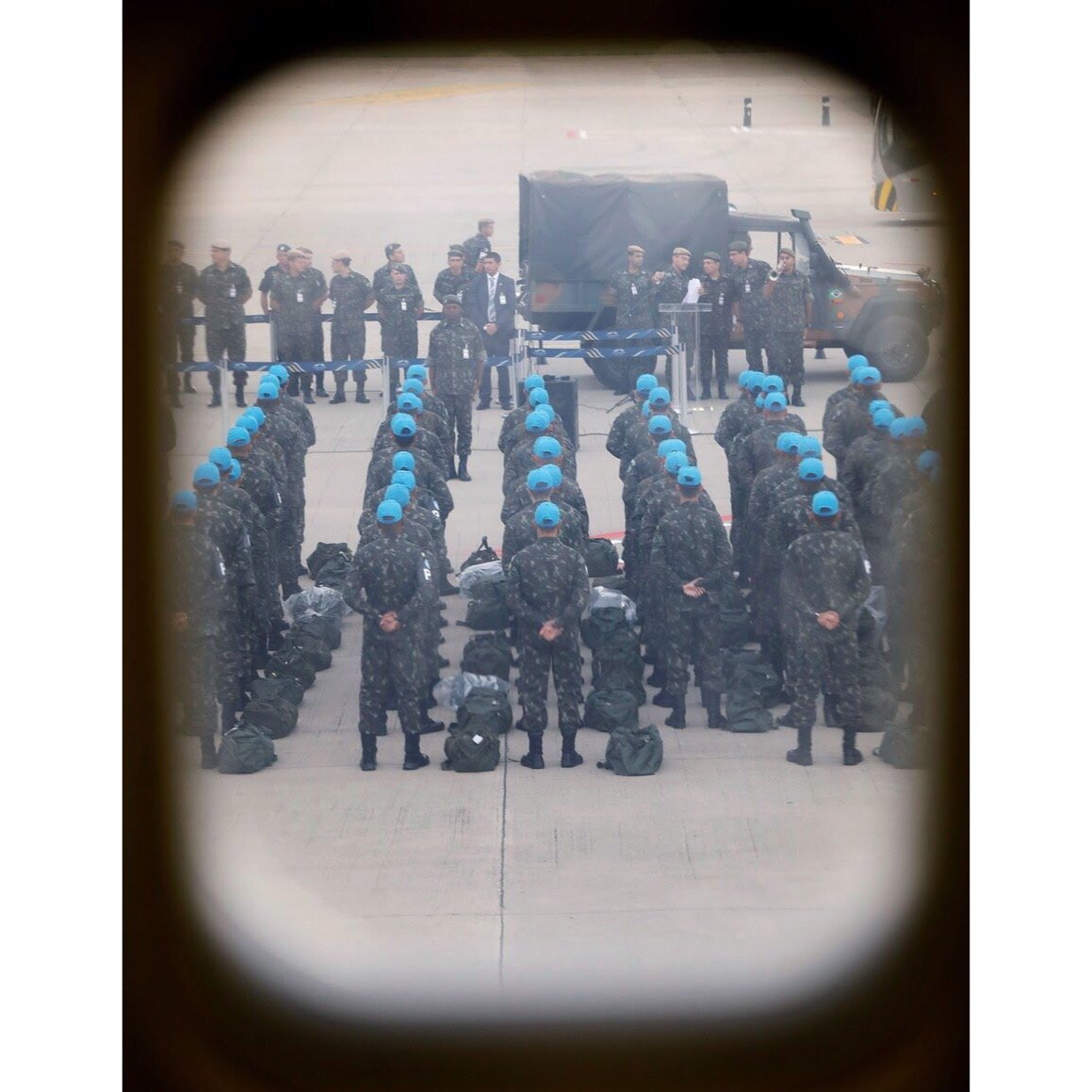
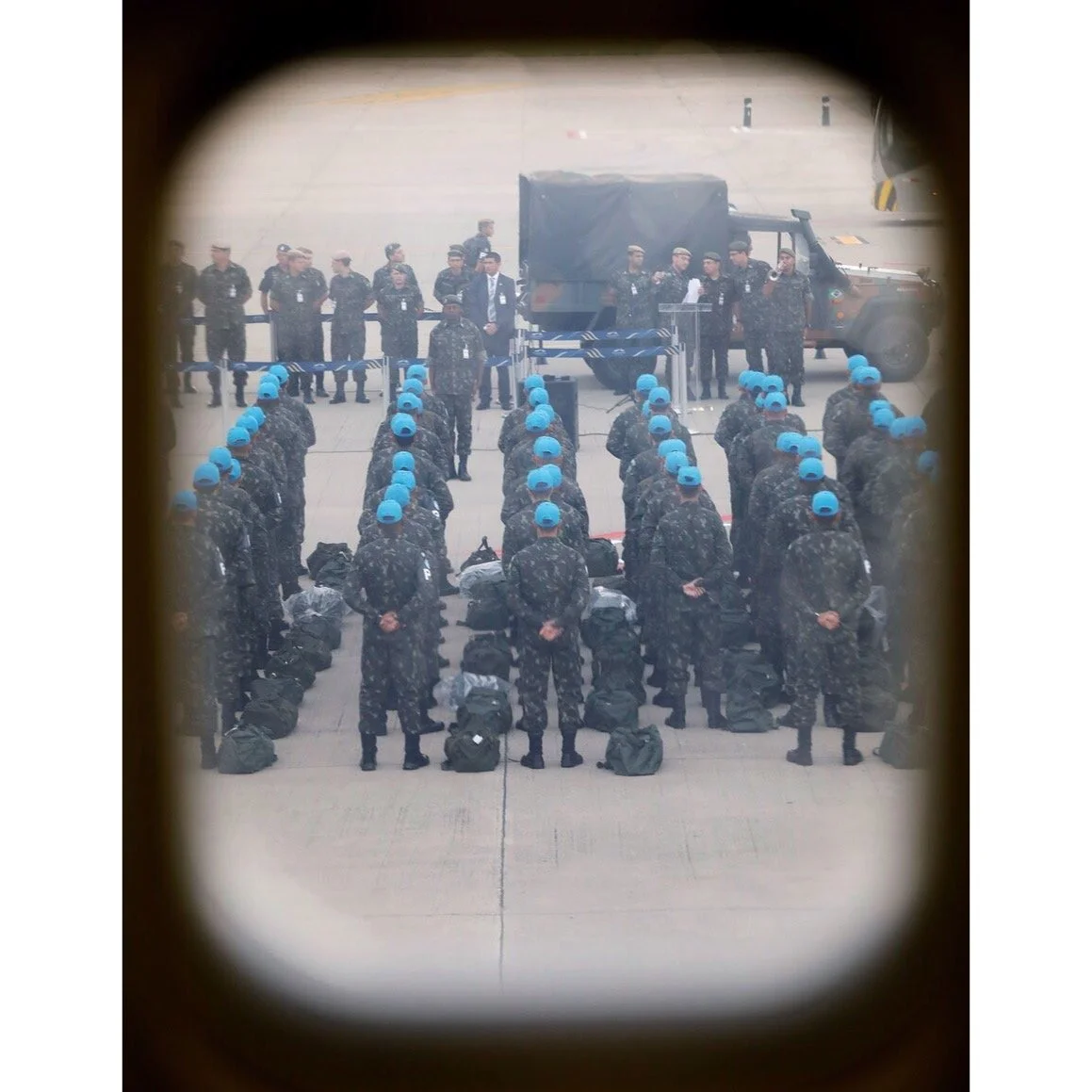
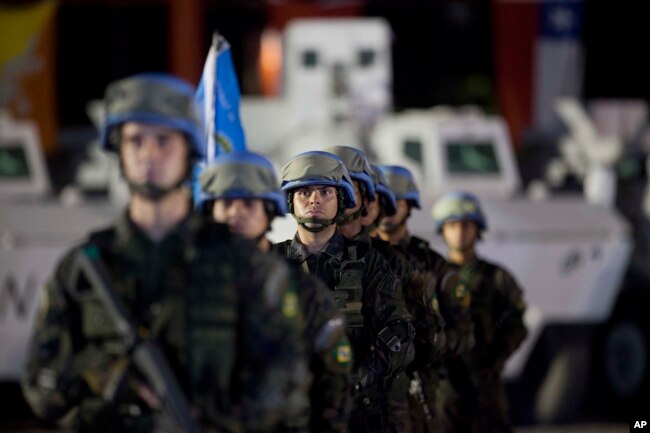
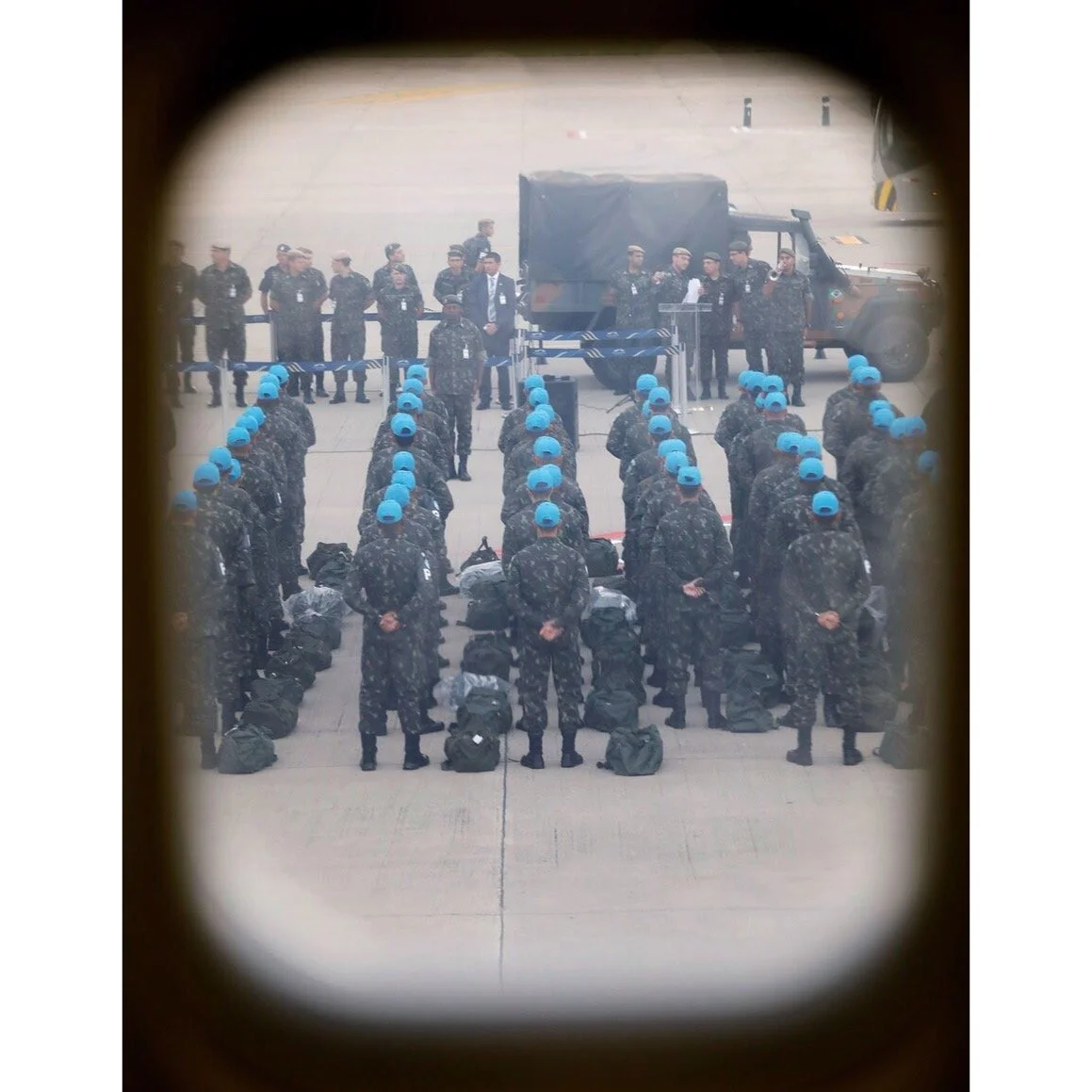
FILE - United Nations peacekeepers from Brazil stand at attention during the end of operations ceremony of the Brazilian battalion and engineering company, from the United Nations Stabilization Mission in Haiti, in Port-au-Prince, Aug. 31, 2017.

The army’s reinstatement comes a month after the end of the U.N. Stabilization Mission in Haiti (MINUSTAH), aimed at steadying the leadership after the 2004 military coup. That effort has given way to the U.N. Mission for Justice Support in Haiti (MINUJUSTH), meant to strengthen the justice system, policing and human rights protections.The United Nations and foreign governments, including the United States, discouraged Haiti from reviving its army. Instead, they supplied financial aid and training for the Haitian National Police.Kenneth Merten, the State Department’s special coordinator for Haiti, said the U.S. government disapproved of a reconstituted Haitian army because of that army’s history of coups d’etat. He told VOA’s Creole Service early this year that the U.S. has “spent a lot of money so Haiti could have a police force that is competent and transparent.”The United States, Haiti’s biggest benefactor, has disbursed at least $3.9 billion in post-2010 quake aid.‘Good reason to be nervous’Given the high degree of international involvement in Haiti, restoring the army brings “a sense of nationalistic pride with certain elements of the population,” Geoff Burt, executive director of the Canada-based Center for Security Governance, told VOA.But “there’s good reason to be nervous,” added Burt, who has explored the issue’s complexities in a report last year for the International Journal of Security & Development.One argument is that rebuilding the army could distract from the “more important priority of building a more effective, accountable police force.”“The big problem isn’t with the army per se, it’s the connection to the political process,” Burt said. “… Will the army become a player in Haitian politics? That’s what everyone would like to avoid.”By: Jacquelin Belizaire, Jean Philippe and Jean-Pierre Leroy  for voanews.com | November 15, 2017.   

Read More
News, Politics News, Politics

A New Chapter for the Disastrous United Nations Mission in Haiti?

The year the United Nations Stabilization Mission in Haiti (MINUSTAH) came to the country was a deadly one for my family. In February of 2004, Haiti’s first democratically elected President, Jean-Bertrand Aristide, was forced out of office for a second time, having been reinstated, and then reëlected, after a 1991 military coup. This time, Aristide was replaced by Gérard Latortue, a former United Nations official, who called those who took up arms against Aristide “freedom fighters.” (Their leader, Guy Philippe, is serving a nine-year sentence in a U.S. prison after pleading guilty to receiving multimillion-dollar bribes from cocaine traffickers.)

That April, claiming that the situation in Haiti constituted “a threat to international peace and security in the region,” the U.N. Security Council passed Resolution 1542, establishing the Brazil-led MINUSTAH. The mission, which officially began in June, 2004, lasted thirteen years and five months, and cost more than seven billion dollars, before officially ending this past Sunday.

Part of MINUSTAH’s mandate was to assist the transitional government in insuring “a secure and stable environment.” This is where my loved ones and others came into the mission’s crosshairs.

I spent the first twelve years of my life in an impoverished neighborhood in Port-au-Prince called Bel Air, where many Aristide supporters live. My eighty-one-year-old uncle, a minister, had called this neighborhood home since the nineteen-fifties, and was there on September 30, 2004, when protests began on the thirteenth anniversary of the first coup d’état. In response, the Haitian national police and MINUSTAH soldiers conducted joint raids in Bel Air that led to dozens of mostly unreported injuries and deaths. The following month, U.N. soldiers and Haitian riot police climbed up to the roof of my uncle’s church and killed some of his neighbors below. My uncle was forced to flee to Miami, where he died in the custody of U.S. immigration officials after being denied asylum.

Bel Air was not the only area subjected to these raids. During one of their bloodiest operations in Cité Soleil, another poor and densely populated neighborhood in the capital, MINUSTAH used more than twenty-two thousand bullets and seventy-eight grenades, among other artillery, to kill seven alleged gang members. No other deaths were acknowledged despite further raids until early 2007, when the mission head at the time, Edmond Mulet, brushed off such killings as collateral damage. This combat terminology was not incidental. MINUSTAH was a continuous military operation in a country in which there was no war.

There would be more collateral damage. In October, 2010, nine months after an 7.0-magnitude earthquake nearly flattened Port-au-Prince and the surrounding areas and killed more than three hundred thousand people, and while more than a million people were still displaced or living in makeshift tent camps, Nepalese peacekeepers stationed in the north of Haiti allowed raw sewage from their base to leak into one of Haiti’s largest and most intensively used rivers, causing a cholera epidemic. The U.N. at first refused to investigate the source of the outbreak and instead blamed Haiti’s lack of sewerage and water-treatment facilities. More than ten thousand people have died from cholera since 2010, and more than eight hundred thousand have been infected.

It took the U.N. six years to acknowledge its role in the cholera epidemic, and even though the former Secretary-General, Ban Ki-moon, declared last December that the U.N. needed to “do the right thing”, the U.N. continues to reject victims’ legal claims by citing immunity. The U.N. has also failed to deliver on Ban’s promise of a four-hundred-million-dollar fund to halt the spread of cholera and compensate the “most affected” victims. The fund has only raised $2.7 million, and the current U.N. Secretary General, António Guterres, seems unwilling to provide direct payments to the cholera victims and their families, many of whom have lost their sole breadwinner.

Neither the U.N.’s impunity nor the lack of accountability would surprise the women and boys and girls, many as young as twelve, who have told of being raped—one boy says that he was gang-raped—by MINUSTAH peacekeepers, who, according to the Associated Press, have used sex rings, offers of food, and other methods to trap their victims. Unacknowledged “MINUSTAH babies” and their destitute mothers are treated as though they do not exist. Though MINUSTAH rapes remain underreported, those who have come forward have had to confront the same type of repudiation faced by the initial cholera victims. Their rapists were rarely punished. They were simply sent home.

MINUSTAH has now been replaced by MINUJUSTH, a smaller mission which began on Monday. MINUJUSTH , the United Nations Mission for Justice Support in Haiti, has a mandate to “help the Government of Haiti strengthen rule-of-law institutions, further develop and support the Haitian National Police and engage in human rights monitoring, reporting and analysis.” MINUJUSTH, which will will consist of twelve hundred and seventy-five officers and support personnel, seems like a rebranding effort, an attempt by the U.N. to give itself a clean slate and erase MINUSTAH’s past. But if the U.N. were serious about justice and human rights in Haiti, it would wind down its presence in the country by having MINUJUSTH also investigate the damage done to both individuals and entire communities by MINUSTAH. Or, better yet, assign an independent body to do so, then offer the warranted compensation for the extrajudicial and civilian killings, the sexual assaults, and the introduction of cholera.

Haiti’s current President, Jovenel Moïse, whose two heavily contested election cycles are often touted as a MINUSTAH success, told the Miami Herald in an interview this month that “the conversion of MINUSTAH to MINUJUSTH is the recognition of the progress made by our country in recent years. Today, Haiti is no threat to regional and global peace and security.” To fill in the gap being left by MINUSTAH, Moïse plans to revive the defunct Haitian Army, whose history of human-rights abuses, the coup d’état against Aristide, in 1991, and its subsequent reign of terror led to an earlier United Nations mission, UNMIH, in 1993.

Moïse’s proposed budget for 2017, which calls for new tariffs and increased taxes on goods and services, has been a subject of mounting protests in Haiti. MINUJUSTH, like its predecessors, will likely find itself facing angry Haitians, or training those who do. Why should Haitians trust another group of U.N. “peacekeepers” who claim to promote the same human rights, justice, and rule of law that have been so blatantly violated by their colleagues? The U.N. may want to leave MINUSTAH’s dark chapter behind, but Haitians will have to suffer the consequences of the group’s actions for generations to come. And no new mission, under whatever acronym, will change that.

Edwidge Danticat is the author of many books, including, most recently, “The Art of Death: Writing the Final Story.”

By: Edwidge Danticat, The New Yorker | October 19, 2017

Read More
News, Politics News, Politics

Police Use Teargas as Demonstrations Continue Against Budget Proposals in Haiti

Haitians demonstrating against budget proposals presented to Parliament by President Jovenel Moise last month (Photo: CMC)
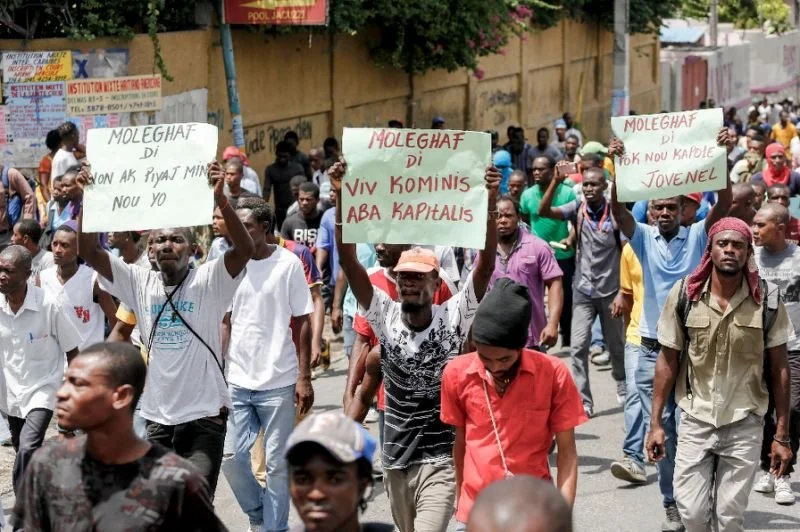
PORT AU PRINCE, Haiti (CMC) — Police used teargas to disperse hundreds of people demonstrating against the measures contained in the 2018 budget that has been presented to Parliament by President Jovenel Moise last month.The Parliament has approved the fiscal package, but Moise hinted at the possibility of reviewing some of the measures as demonstrators took to the streets again on Saturday in Pétion-ville demanding his removal from office.The demonstration planned by the political parties, Fanmi Lavalas, Pitit Desalin as well as other organisations and students attracted thousands of people, and despite the presence of members of the Body of Intervention and Maintenance of Order (CIMO), the protestors broke several storefronts and windshields of several vehicles.Stones and bottles were also thrown at some buildings even as the security agents fired gunshots into the air in a bid to disperse the crowd.The protesters also erected several barricades, blocking traffic and sporadic shooting was reported in the Juvénat neighbourhood, with media reports indicating that the damage “seemed considerable”.The police had to use teargas to disperse the crowd with several reports of being injured and there were several arrests.Commissioner Frantz Lerebours, spokesman for the Haitian National Police (PNH), was however, unable to give details.

Some of the demonstrators tried to reach the city centre but were met with a strong resistance from the CIMOs on the Champ de Mars.The opposition parties condemned the violence saying that the demonstrations had been infiltrated by people who wanted to provoke troubles and accuse the opposition of disorder…Last week, the Haitian Customs Association (ADH), gave the General Administration of Customs (AGD), of the Ministry of Economy an eight-day ultimatum to meet their demands or face work stoppage island-wide from Thursday.Customs officers, whose salaries are GOURDES17, 000 (One Gourdes=US$0.01 cents) after a nine-month training are demanding an 80 per cent wage increase.In addition, customs officers are demanding special status because of the importance of their mission and responsibilities: fiscal, economic and security.Meanwhile, the Council of Ministers last week adopted a preliminary draft law to amend article 149 of the Decree of 29 September 2005 on income tax.President Moise has since announced that he will convene an extraordinary session the Chamber of Deputies, once the draft bill has been ratified by the Senate.By: Jamaica Observer | October 01, 2017
Read More
News, Politics News, Politics

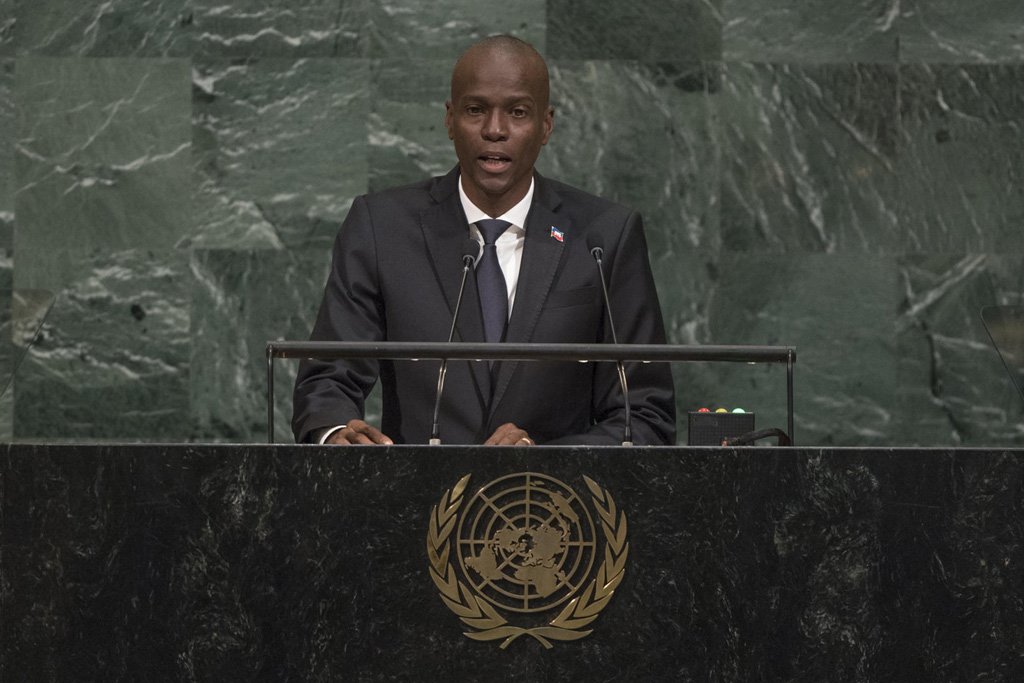
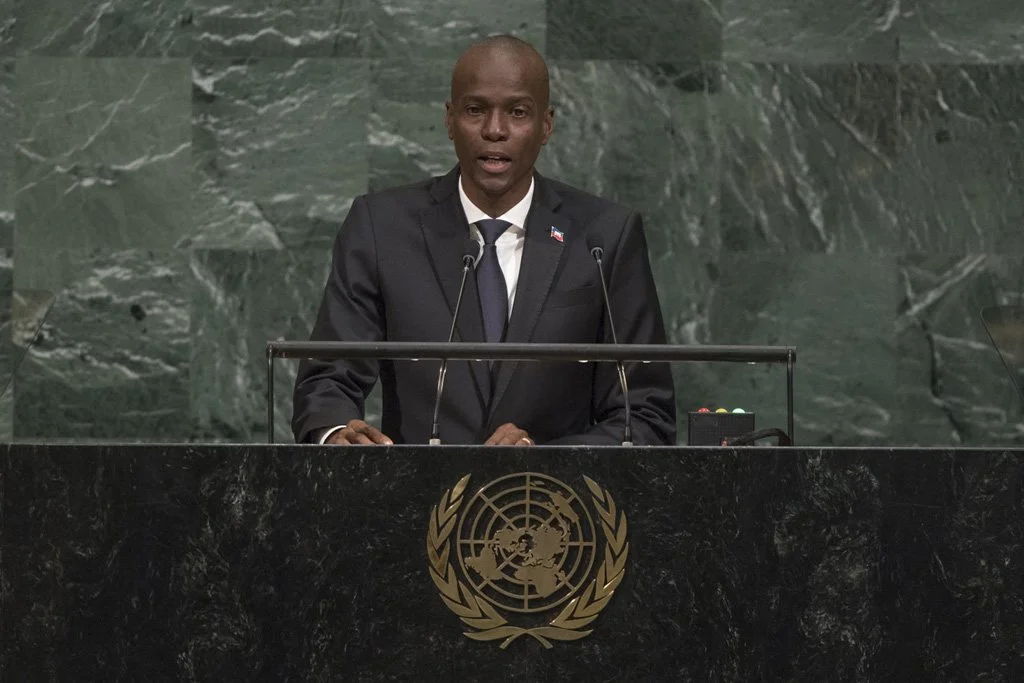
Video & Summary: President Jovenel Moise Addresses UN's General Debate, 72nd Session

Statement Summary:
JOVENEL MOISE, President of Haiti, said the mission of the United Nations had never been so important, and thus, it was necessary to adapt the Organization to modern realities on the ground.  Expressing support for any initiative that could contain crises and seek the peaceful resolution of conflicts, he encouraged the United Nations to move along the path of conflict prevention.  Haiti had always spoken out against the proliferation of nuclear weapons, and he condemned States’ blatant desire to acquire and increase nuclear arsenals.  He also expressed concern about the ongoing crises in Syria and Venezuela, as well as the conflict between Israelis and Palestinians.Haiti was deeply committed to the environmental facets of sustainable development, he said, and sought to build resilience against natural disasters that had consistently beleaguered its people and brother countries in the Caribbean.  His Government was committed to the Paris Agreement on climate change, and wished to see those countries most responsible for greenhouse gas production contribute the resources necessary for implementing that deal.  In the Caribbean, recent climatic events had drawn attention to the ways in which climate affected Haiti.  Such weather phenomena were due to the impact of humans on the environment, he stressed.  In January 2018, when Haiti assumed the presidency of the Caribbean Community (CARICOM), it would organize a regional conference aimed at establishing an inter-State commission that would devise a strategy for addressing climate issues, such as the availability of climate insurance.More broadly, he said Haiti had taken steps to consolidate democracy and the rule of law, having made significant efforts to promote development and political stability.  Noting that corruption had “infected” and shrunk Haiti’s economy, and compromised its political situation, he said it was time that official development aid (ODA) and domestic resources upheld the interests of the Haitian nation.  Corruption had prevented basic resources from being allocated to citizens, depriving them of adequate energy distribution, quality education, drinking water and socioeconomic opportunities.  Haiti’s new leaders were waging an unwavering struggle against such behaviour.  Efforts were also under way to guarantee the independence of and increase the effectiveness of the judicial apparatus.While the international community had spent more than a decade supporting security in Haiti, and had provided help when disaster struck, he said Haiti was using all levers available to grow the economy, despite its limited resources.  It was striving to create decent jobs for young people, and had made human resources management part of the State reform process.  His Government was determined to provide opportunities to the most vulnerable members of society, to ensure they were not tempted to leave the country, many times under life-threatening conditions.  Haiti could not allow institutions to be weakened or corruption to widen the distance between citizens and the State.  Haitians were acutely aware that they were responsible for their country’s development, he continued.Addressing two phenomena stemming from the United Nations presence in Haiti — the odious sexual abuse and exploitation by peacekeepers and United Nations staff, and the cholera epidemic — he said the Organization was morally obliged to provide the recourses to ensure that cholera left the country.  Improving Haiti’s health system, including by eradicating cholera, was a priority for his Government.  Despite some progress, the number of cholera victims stood at 10,000 people and continued to grow.  Further, there were tens of thousands of cholera orphans.  The United Nations must live by and give tangible form to its noble ideals, he stressed, by shouldering all its responsibilities to remedy the situation, which had caused grave harm to the Haitian people.

By: UN News Centre | September 21, 2017
Read More
News, Politics News, Politics

Haitian President Backs Paris Climate Accord, Calls On UN To Honor Commitments On Tackling Cholera

21 September 2017 – Addressing the United Nations General Assembly today, Jovenel Moise, President of Haiti, expressed deep commitment to the environmental targets in the global goals on sustainable development and said his island nation is seeking to build its resilience against the natural disasters and extreme weather events that consistently beleaguer its people and other countries in the Caribbean.“My Government is committed to the Paris Agreement on climate change,” Mr. Moise told delegations gathered for the Assembly’s annual general debate, adding that he wished to see those countries most responsible for greenhouse gas production contribute the resources necessary for implementing that accord.In the Caribbean, recent back-to-back extreme weather events had drawn attention to the ways in which climate affects Haiti. “Such weather phenomena are due to the impact of humans on the environment,” he stressed, and noted that in January 2018, when Haiti assumed the presidency of the Caribbean Community (CARICOM), it would organize a regional conference aimed at establishing an inter-State commission that would devise a strategy for addressing climate issues, such as the availability of climate insurance.More broadly, he said Haiti has taken steps to consolidate democracy and the rule of law, having made significant efforts to promote development and political stability. Noting that corruption has “infected” and eroded Haiti’s economy, and compromised its political situation, he said it is time that official development assistance (ODA) and domestic resources upheld the interests of the Haitian nation. In the meantime, Haiti’s new leaders are waging an unwavering struggle against corruption.Addressing two phenomena stemming from the UN presence in Haiti – heinous sexual abuse and exploitation by peacekeepers and other personnel, and the cholera epidemic – he said the Organization is morally obliged to provide the recourses to ensure that cholera left the country.Improving Haiti’s health system, including by eradicating cholera, is a Government priority for his Despite some progress, the number of cholera victims stood at 10,000 people and continued to grow. Further, there were tens of thousands of cholera orphans. The United Nations must live by and give tangible form to its noble ideals, including the announced ‘new approach’ to dealing with cholera, he stressed, by shouldering all its responsibilities to remedy the situation, which had caused grave harm to the Haitian people.Full statement (in French) available hereBy: UN News Centre | September 21, 2017 

Read More
News, Politics News, Politics

Positive Meeting Between Moïse And The IDB

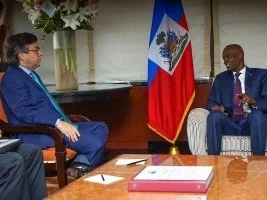
On Tuesday, on the sidelines of the 72nd Ordinary Session of the United Nations General Assembly, President Jovenel Moïse received in audience Luis Alberto Moreno, President of the Inter-American Development Bank (IDB) to discuss the priorities of the Government of Haiti.President Moïse insisted on the Caravan of Change as a strategy to bring the State closer to the population by providing basic services and giving it the tools it needs to develop its environment. A medium-term strategy aiming to attract investment in the region; to build road, energy and social infrastructures.For his part, the President of the IDB welcomed initiatives to deconcentrate public services, fight corruption and reform public administration.Moreno indicated that he intended to take steps to support the implementation of the priorities of the Moïse Administration and announced that he will visit Haiti on October to inquire about the progress of the Caravan of Change and assess its needs.This meeting is part of President Moïse' determination to find more opportunities for the country and to attract potential investors to Haiti.By: HL/ HaitiLibre | September 21, 2017

Read More
News, Politics News, Politics

Marchers Demand Haiti's President Step Down

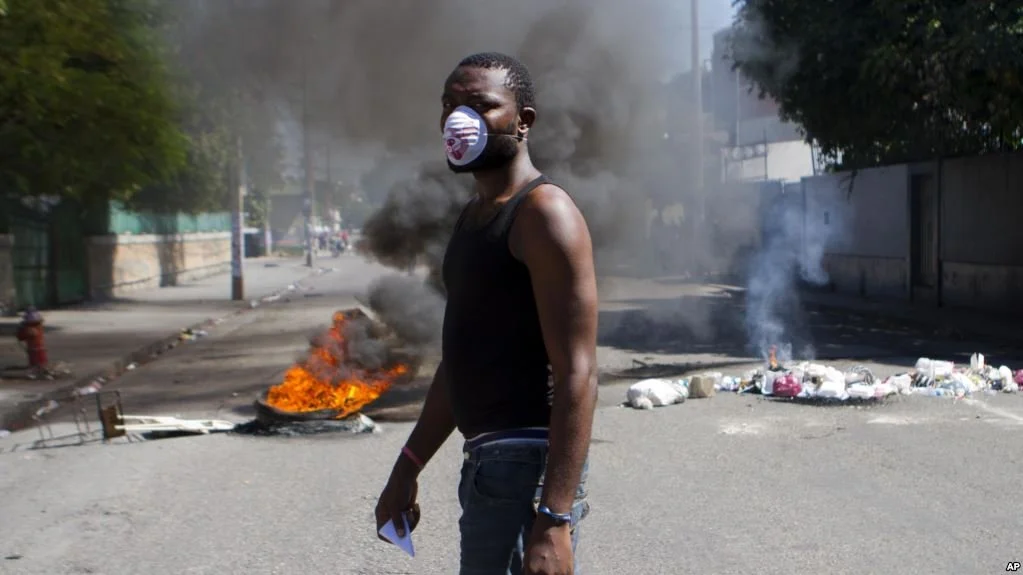
PORT-AU-PRINCE, Haiti (AFP) — Thousands took to the streets of Haiti's capital Wednesday to demand President Jovenel Moise step down following the publication of a national budget viewed as unfavorable to the country's poor."We do not agree with what Jovenel does: he is crushing the country," said Jean-David Senat, among a throng of demonstrators stretching down a main avenue."He said he would put money in our pockets, he did not. He said he would put food on our plates; we do not even have dirt to eat. So he and this team of thieves must leave," the protester said, referring to the president's campaign slogans.Since it was released in July, opposition lawmakers have decried the budget for fiscal year 2017-2018, saying it would balloon the debt of the poorest country in the western hemisphere.On Tuesday, protesters brought parts of Port-au-Prince to a standstill, setting vehicles alight and damaging local businesses.Protesters directed their anger toward senators who voted for the 2017-2018 budget last week and the deputies who approved it Saturday.Despite popular opposition, the government published the document in the official gazette late Tuesday.The lack of dialog has infuriated demonstrators.That the president "published the budget is a provocation to the Haitian people and to us the political leaders," said Moise Jean-Charles, an opposition leader who spearheaded the demonstration."The people will decide his fate," he said."An alternative is being prepared," Jean-Charles said. "This time we take our fate in our hands.""No one will be able to divert our movement to satisfy the bourgeoisie."The Haitian leader left the country Sunday to attend the UN General Assembly in New York and was due to deliver his speech Thursday and return to Haiti the following day.New anti-government demonstrations are already planned for Thursday and Friday in the capital.By: Jamaica Observer | September 20, 2017
Read More
News, Politics News, Politics

Strike Over New Transport Taxes Brings Haiti to a Halt

Protesters, unhappy with a new budget approved earlier this month, take to the streets for a second week.

The strike forced many shops and schools to close as employees and students could not get to work or class. [Dieu Nalio/AP Photo]
Much of Haiti has come to a halt because of a transportation strike over new taxes proposed by the government.Most Haitians do not have private cars, and they get around on motorcycle taxis or the often elaborately painted vans and trucks known as "tap taps". But none were available on Monday as drivers took part in a strike over driver's licenses, fuel and property, among other things."We don't want this budget [new taxes] to pass," one protester in the capital Port-au-Prince told The Associated Press. "We don't want it."Another protester, Eddy Edouard, said he supported the strike "100 percent because the situation is tough for us".

Most shops were closed, as were schools because students could not get to class. Government offices were technically open, but most employees could not get to work.President Jovenel Moise was out of the country to attend the UN General Assembly but has said the money will go back to the public in the form of services and new infrastructure.

'Revolution has just started'

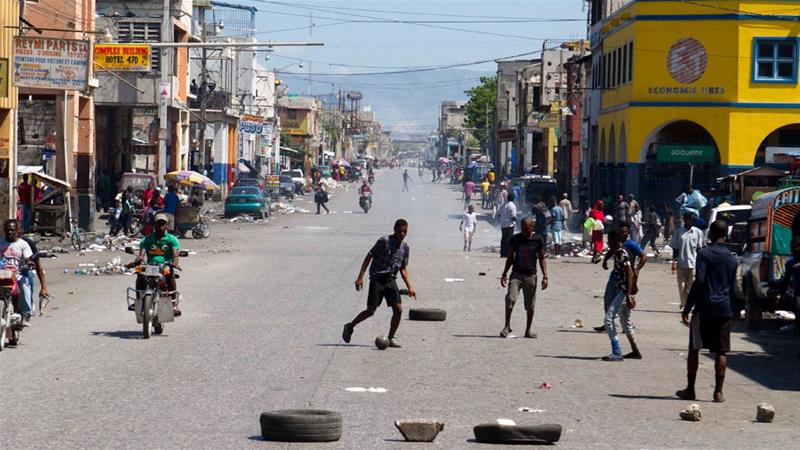
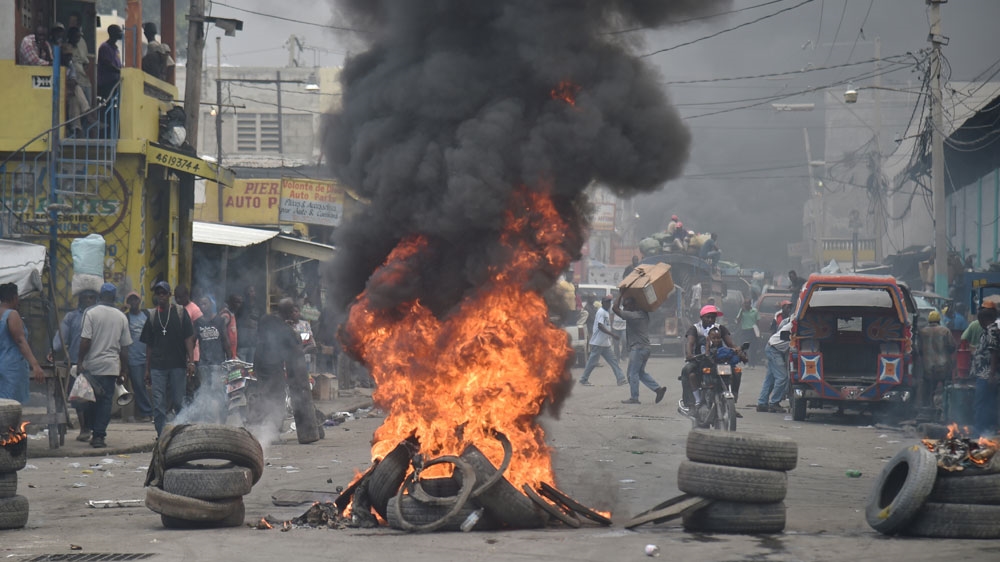
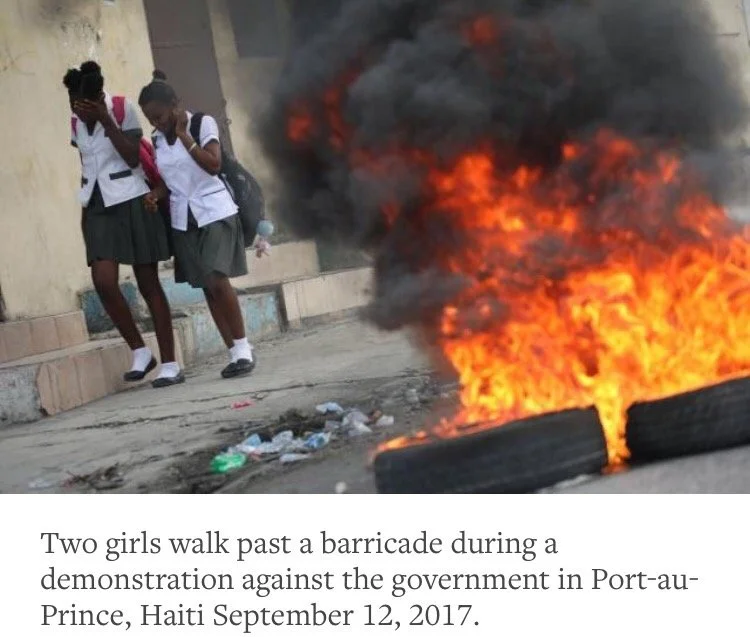
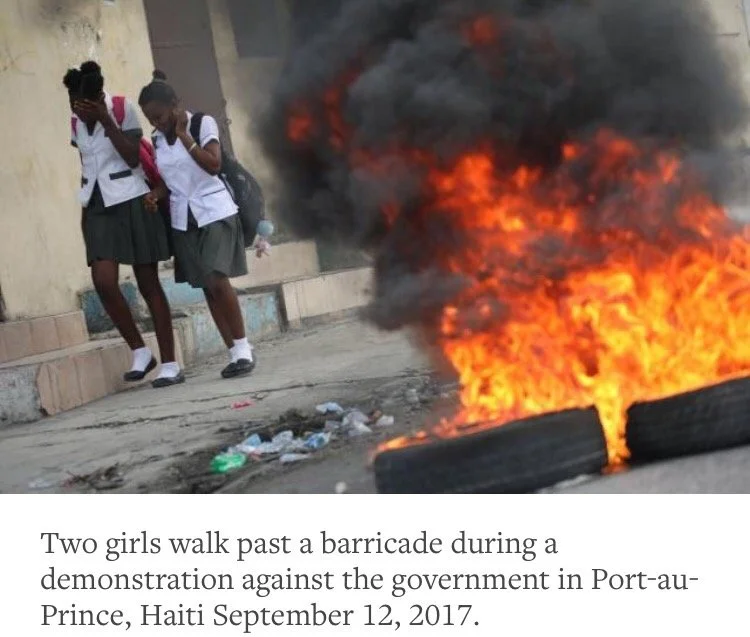
Last week, protesters brought parts of Port-au-Prince to a standstill to protest the government's budget plans. The demonstrations, at times, turned violent."These little thieves in parliament voted for this budget to help the government exploit the people," protester Marco Paul Delva, who stood by a barricade of flaming tires near the legislature, told AFP news agency.Traffic in the centre of Port-au-Prince and on key routes around the city grounded to a halt after protesters threw stones and tires across roads.Although demonstrators gathered in relatively small groups, the protest took police by surprise - and they were unable to intervene in some blocked-off areas.Protesters directed their anger towards politicians who approved an unpopular budget earlier this month that raises taxes on products including cigarettes, alcohol and passports.

Anti-government protests in the centre of Port-au-Prince on September 12, 2017 [Hector Retamal/AFP]

"The revolution has just started. Jovenel Moise will have to retract his taxes, or he will have to leave immediately," Jacques Menard, a 31-year-old protester, told Reuters news agency."And this is a warning because the next phase can be very violent."At the same time, foreign aid to Haiti is slowing. The country is one of the poorest in the Americas and suffered a devastating earthquake in 2010 and the worst of Hurricane Matthew last year."If Jovenel Moise is intelligent, he should refrain from publishing the budget; otherwise he will have to face a series of street demonstrations that will further complicate the situation," former presidential candidate Jean-Charles Moise said on local radio last week.The government has defended the budget, saying that many of the things protesters are unhappy with are untrue."There are people manipulating public opinion," Economy and Fiance Minister Jude Alix Patrick Salomon said before last week's protests.By: Aljazeera| September 18, 2017

Read More
Featured, News, Politics Featured, News, Politics

The Financing of the new Haitian Parliament

Youri Latortue Senate President announced the reconstruction of the Parliament at the cost of about 3 billion Gourdes ($48 million). The new parliamentary complex will consist of 3 buildings, a 10-story building for the offices of parliamentarians including the working and meeting rooms of the Standing Commissions and the offices of the administration. The second one will comprise of three large hemicycles (Chamber of Deputies, Senate, and National Assembly), and finally the 3rd will include a four-story closed parking lot for parliamentarians and visitors...On Friday Sep. 15th, 2017, President Moïse wished to silence criticisms relating to the high budget of Parliament by stating that 50% of the 7.2 billion gourdes allocated to senators and deputies in the budget would be used for the reconstruction of Parliament in his message to the Nation regarding the publication of the budget.However, in reality, it is stated in the budget that the 7.2 billion Gourdes of the Parliament are divided 50/50 between the Senate and the Lower House, ie 3.6 billion for each Chamber. For the Senate 2 billion are devoted to the functioning and an "investments" heading has an envelope of 1.5 billion which will be allocated to the reconstruction of the Parliament. As for the budget of the lower chamber, it is essentially devoted to functioning and does not include any heading "investments". This means that only 50% of the estimated costs of reconstruction of Parliament will come from Parliament's budget and not all as Moïse said and the other 1.5 billion gourdes to complete the cost of the work, will have to come from other items in the State budget...If Senator Latortue evokes an amount of about 3 billion Gourdes for the new parliamentary complex, Clément Bélizaire, the Director of the Unit of Construction of Housing and Public Buildings (UCLBP) shows more reserved "We do not know yet how much will cost Parliament nor the firm that will carry out the work because adjustments have been requested," specifying that there will be no traditional call for tenders for the construction of the Haitian Parliament.SL/ HaitiLibre

Read More

Violent Street Protests Break Out In Haiti Over Tax Hikes

Video Courtesy  of Miamiherald.com

PORT-AU-PRINCE (Reuters) - Protesters in Haiti damaged commercial buildings in the capital city and set cars on fire on Tuesday, angered by government tax hikes that

The Port-au-Prince protest, called by former presidential candidate Jean-Charles Moise, took many by surprise and represents the biggest outcry against the administration of President Jovenel Moise since he took office earlier this year.

“The revolution has just started. Jovenel Moise will have to retract his taxes or he will have to leave immediately,” said Jacques Menard, a 31-year-old protester. “And this is a warning because the next phase can be very violent.”

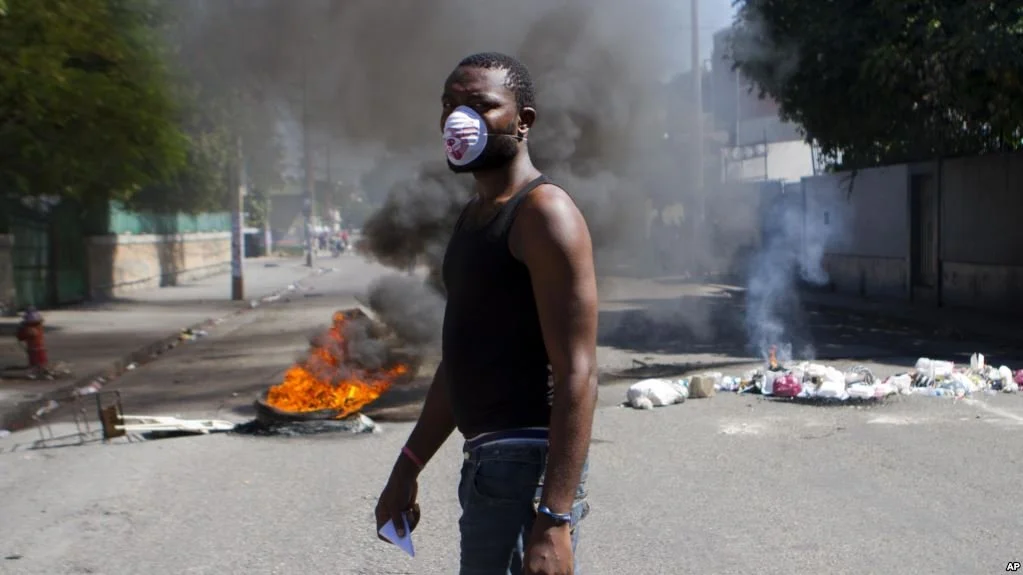
Protesters took to the streets in separate groups in several districts in the metropolitan area of Port-au-Prince, erecting flaming barricades, blocking traffic, and confronting riot police, who fired tear gas and warning shots in the air.

Several people were arrested, the police said, but there were no reports of any deaths or serious injuries.


Lawmakers last weekend approved an unpopular budget that raises taxes on products including cigarettes, alcohol and passports.


At the same time, foreign aid to Haiti is slowing. The country is one of the poorest in the Americas and suffered a devastating earthquake in 2010 and the worst of hurricane Matthew last year.

“If Jovenel Moise is intelligent, he should refrain from publishing the budget, otherwise he will have to face a series of street demonstrations that will further complicate the situation,” Jean-Charles Moise said on local radio.Government officials were not immediately available for comment, but Economy and Finance Minister Jude Alix Patrick Salomon defended the budget over the weekend.

 “There are people who are blaming many things on the budget that are not true,” Salomon told reporters shortly after the spending plan was approved. “There are people manipulating the public opinion.”

Read More

President Moïse announces the departure of 12,000 civil servants

President Jovenel Moïse announced last August 31 that "[...] have decided to withdraw 12,000 people from the State this year who are ready to retire from the 32,000 people who are at the age of retirement or at the end of their career [38.5% of the 83,000 persons working for the State] [...]"The Head of State said that this process of retirement will begin this year with the departure of 12,000 civil servants, in order through the Office of Management and Human Resources (OMRH). "To fill the vacancies of these 12,000 departures of public servants, another 12,000 will be recruited by competition from January 2018."HL/ HaitiLibre

Read More

Haiti - Social : The First Lady of Haiti in Belize

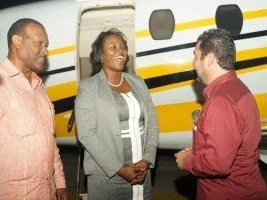
Monday, the First Lady of Haiti, Martine Moïse, left Port-au-Prince to Belize to attend the Forum of First Ladies and Wives of Heads of State and Prime Ministers from CARICOM member countries.This meeting, which will establish a Caribbean network of first ladies, aims, among other things, to highlight the health and well-being of women, girls and adolescents in the Caribbean by 2030, objective #5 of sustainable development.Martine Moïse will participate in a series of discussions to support proposals for the promotion and valorisation of women from all Caribbean countries, notably through the Caribbean Child Initiative (CARIWAC) networks, which also intend to :

  • Promoting the health and well-being of adolescents in the Caribbean and reducing teenage pregnancy by 20% ;
  • Encourage the prevention, early diagnosis and treatment of cervical cancer, improve access to screening and strengthen infrastructure through the promotion and use of HPV vaccine ;
  • Eliminating mother-to-child transmission of HIV and congenital syphilis in the Caribbean ;
  • Support advocacy for the reduction of gender-based and sexual violence against women and children (including trafficking in persons) through appropriate legislation, psychosocial support for victims and the inclusion of men and boys in solutions.

By: HL/ HaitiLibre | September 5, 2017

Read More

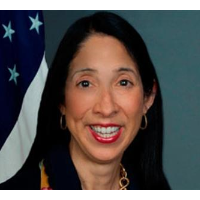
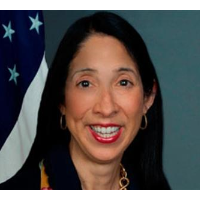
Ambassador to Haiti: Who Is Michele Sison?

Michele Sison was nominated to be U.S. ambassador to Haiti by President Donald Trump on July 20, 2017. Sison, who has been deputy permanent representative to the United Nations since December 2014, succeeds Peter Mulrean, who served in Port-au-Prince from October 2015 to February 2017.In her role at the United Nations, just a month before her nomination, Sison made it clear that the Trump administration did not intend to contribute to a UN trust fund to fight Haiti’s cholera epidemic because the U.S. had already contributed more than $100 million to the anti-cholera effort. It is widely believed that cholera was inadvertently introduced into Haiti by UN peacekeepers from Nepal in October 2010.Born May 27, 1959, in Arlington, Virginia, Michele Jeanne Sison is the first Filipino-American ambassador from the United States. Her mother is Veronica Travers Sison. Her father, Pastor Bravo Sison, originally from the province of Pangasinan in the Philippines, earned a master's degree from Harvard Law School and eventually spent 25 years with the World Bank, retiring as director for public affairs in its Asia Division. She has two sisters, Victoria and Cynthia. Sison earned her BA in Political Science from Wellesley College in 1981 and also studied at the London School of Economics.Sison joined the State Department in 1982 and served early career postings as a consular official in Port-au-Prince, Haiti, from 1982 to 1984; Lomé, Togo, from 1984 to 1988; Cotonou, Benin, from 1988 to 1991; Douala, Cameroon, from 1991 to 1993; and Abidjan, Côte d’Ivoire, from 1993 to 1996. Sison served as consul general at the U.S. consulate in Chennai, India, from 1996 to 1999.She was deputy chief of mission and chargé d’affaires at the U.S. embassy in Islamabad, Pakistan, from 1999 to 2002. Just one month before the terrorist attacks of September 11, 2001, Sison met with Taliban officials to try to secure the release of American aid workers who had been arrested in Afghanistan for allegedly showing a Christian video to an Afghan family. The following March, Sison was out jogging and waved to embassy employee Barbara Green and her 17-year-old daughter, Kristen Wormsley, who drove by on their way to church. Shortly thereafter, the two were killed in a grenade attack on the church.In Washington, Sison served as principal deputy assistant secretary in the Bureau of South Asian Affairs from 2002 to 2004, after which she was appointed ambassador to the United Arab Emirates (UAE), where she served from July 2004 to January 2008, putting a strong emphasis on promoting trade with the Dubai dictatorship, a strategy she referred to as “massive corporate diplomacy.”From the UAE she went to Lebanon, serving in Beirut as chargé d’affaires ad interim starting in February and as ambassador from June 2008 to August 2010. Her tour in Lebanon was a demanding one right from the start, as she had to deal with numerous controversial issues. For example, in April 2008, she sent a cable to the State Department explaining that Lebanon’s telecommunications minister, Marwan Hamadeh, had complained that Hezbollah (which held elected seats in the national legislature and a cabinet position) had set up its own fiber optic telecom network, which, in Sison’s words, “covers the Palestinian camps, and the Hezbollah training camps in the Bekaa, and is penetrating deep into the Christian Metn and Kesrwan areas.” On June 18, 2008, she was involved in a particularly unpleasant incident, when her motorcade in the southern Lebanon town of Nabatiyah was stoned by anti-American pro-Hezbollah militants.After her tour in Lebanon, Sison served as assistant chief of mission for Law Enforcement and Rule of Law Assistance in Baghdad, Iraq. She also served stateside as director of Career Development and Assignments in the Bureau of Human Resources from 2010 to 2011.Sison returned to South Asia to serve as U.S. Ambassador to Sri Lanka and Maldives from September 2012 to December 2014.As U.S. deputy representative to the United Nations, Sison again found herself in the thick of the action, particularly in 2016 when the Obama administration clashed with the Russian government over the war in Syria. In March 2017, she accused the government of South Sudan of conducting a “scorched earth campaign” that used man-made famine as a tactic in that country’s civil war.Sison has two daughters, Alexandra and Jessica; she and their father, Jeffrey J. Hawkins, are divorced. She speaks fluent French, basic Haitian Creole, and Arabic.By: David Wallechinsky, Matt Bewig | August 23,2017

Read More