
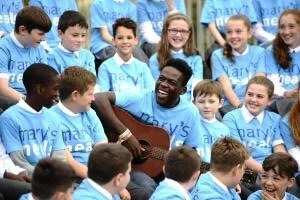
Haitian musician Jimmy Belabre tells Glasgow pupils how charity meals kept him from life of crime
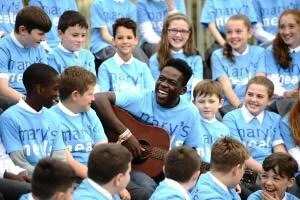
IT was a simple home-cooked daily meal but it encouraged him to stay on at school rather than join the lawless armed gangs that blighted his neighbourhood.Yesterday, Haitian musician Jimmy Belabre, 28, was in Glasgow to personally thank volunteers at global school feeding charity Mary’s Meals, which provided his daily food.He grew up in the violent slum of Cite Soleil and Mary’s Meals helped him to access the education that went on to change his life.Jimmy met school pupils at St Aloysius Junior School who have been fundraising for Mary’s Meals’ global school feeding programme for years.He was given the chance to share some of his music with the youngsters during a special assembly, where he also talked about his life and took questions from fascinated pupils.Jimmy’s home of Cite Soleil has around 500,000 people who live in houses made from rusting corrugated iron on a rubbish dump by the sea.He witnessed nightly gun battles there when lawlessness was at its peak, from 2004 to 2007, and remembers the night a bullet struck the wall just above his mother’s bed while she slept.But he resisted offers of money and guns from local gangs and stayed in school.His resolve was, he says, was fuelled by the daily meal he received in school and the kindness of the people from far away who made that possible. For many years, the daily school meal was all he had to eat.Jimmy is now the principal of the school he attended (St Francis De Sales Becky DeWine School) in Cite Soleil.During his three-week stay, Jimmy will meet supporter groups and volunteers in Glasgow, London, Manchester, Leeds and Edinburgh. Hewill also spend time in Dalmally, Argyll, where the work of Mary’s Meals began, in a small tin shed that still serves as the charity’s global HQ.He said: “When there is not enough food to eat, every morning you wake up asking: ‘What am I going to eat today?’ It makes it so hard to keep yourself positive, because you’re hungry and you need to feed your family. And you see people with extra food and money through negative activities. If I wasn’t being fed in school, it would have been very easy for me to become a gangster.”The Herald | August 2017
Timberland Will Get Cotton from a Nifty New Supply Chain – Haiti – if Experiment Soars
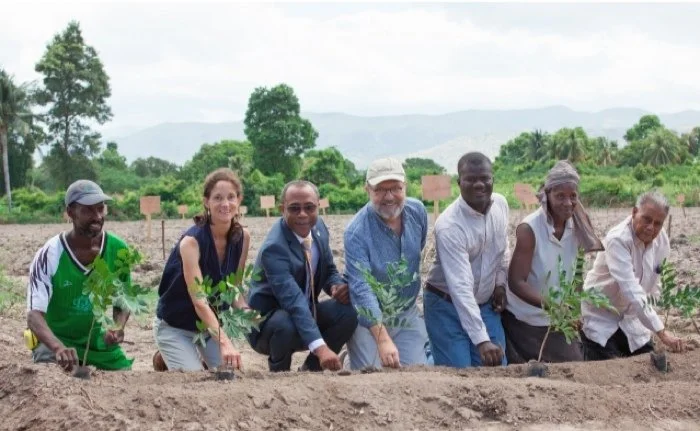
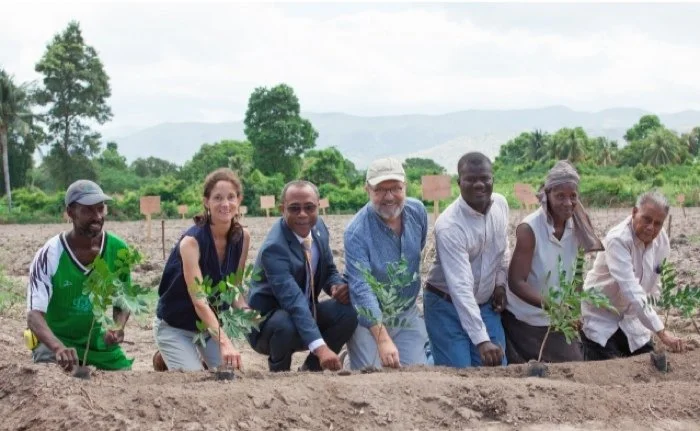
In a move that the company hopes will create a new cotton supply chain, outdoor clothing company Timberland is working with the Smallholder Farmers Alliance (SFA) on an effort to reintroduce cotton as a crop in Haiti, the company announced Tuesday. The company, along with SFA and Haiti’s Minister of Commerce and Industry, ceremoniously planted the first cotton seed to mark the start of the experiment. If the five-year initiative is successful, Timberland has committed to purchasing up to a third of the Haitian farmers’ annual global cotton supply (subject to price, quality and volume), the company says. Cotton, once the country’s fourth largest agricultural export, collapsed as a Haitian industry nearly 30 years ago due to a combination of politics and policies, Timberland says.
First, Is It Feasible?
Timberland and SFA’s cotton program was developed following a successful agroforestry model in Haiti that the two organizations had been working on in recent years. The program had Haitian farmers voluntarily tending a network of nurseries that produced up to a million trees each year. In return, farmers received training, crop seeds, seedlings and tools to help increase their own crop yields.With the success of that program, Timberland and the SFA engaged in a feasibility study to gage the potential of cotton’s return to Haiti. The groups studied ideal growing conditions, farmer interest and the availability of agricultural best practices gleaned from smallholder farmers in Africa and Asia. The study recommended that cotton be reintroduced – along with a comprehensive support system and a range of services that were not in place when cotton previously failed. By positioning cotton as a rotational crop in mixed farms that include vegetables, grain and livestock, the resulting agricultural benefits will extend far beyond a single crop, the study suggested.Next summer, the SFA will introduce cotton varieties that adapt best to local conditions and organic cultivation, and result in the highest quality cotton for cultivation in volume by smallholder farmers.With the reintroduction of cotton as an “anchor crop” in Haiti, Timberland says it also hopes to boost the economy and contribute to environmental restoration.
Wrangler Wants Sustainable Cotton, Too
In a related move – one which is also expected to help increase the supply of sustainable cotton – clothing manufacturer Wrangler recently joined a group called Field to Market: The Alliance for Sustainable Agriculture. Working with industry and academic partners, Wrangler is focusing on cotton-growing practices that will improve profitability for growers while reducing environmental impacts. Wrangler is also engaged in a pilot project for sustainable US cotton. The project involves a family of seventh-generation farmers from Alabama who will work with Wrangler and others to improve cotton yield, irrigation, energy inputs, greenhouse gas emissions and soil conservation. Forty thousand pounds of the family’s cotton will be used to make a special collection of Wrangler denim jeans that will be sold in 2018.
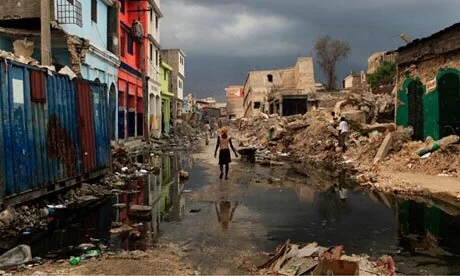
An excerpt from Lavil: Life, Love, and Death in Port-au-Prince
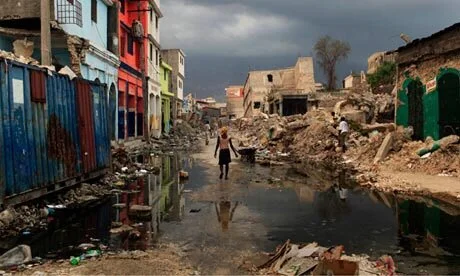
An excerpt from Lavil: Life, Love, and Death in Port-au-Prince
An excerpt from Lavil: Life, Love, and Death in Port-au-Prince, part of the Voice of Witness series of oral history.
Haiti-earthquake-
Fran is from Bainet in the southeast of Haiti. On the day of the earthquake, Fran was on an upper floor of a government building. We spoke to him in front of a church where a commemoration of the 2010 earthquake was taking place. When the quake hit, Fran was knocked unconscious as a government building collapsed around him. He then walked for miles to report from the quake’s epicenter. As a choir sang inside a church, Fran talked to us about the day of the quake and its aftermath.
On the day of the earthquake, I was at a government building to pay taxes... I heard the noise, and I thought that it must be a thunderstorm. I was on the fourth floor. I suddenly felt that I was flying. I can’t explain what happened because the next thing I knew, I was in a different part of the building. I don’t now how I jumped or flew, or whatever happened. I was jumping up, and then I quickly lost consciousness.
When I woke up, I heard a lot of yelling and screaming. It was me. I was the one screaming, screaming, screaming, screaming. Yes I was. And then people around me were crying and there was all this smoke. Black smoke, black dust, everywhere. As a journalist I felt that I had to report what happened at this damaged building, but that was impossible. There wasn’t any communication. My cell phone wasn’t working.
My first reflex was to go and find my own children. I left that damaged building and walked to the school to see my children. I have two kids. One girl, one boy. My son is eight and a half. My daughter is seven. When I got there, my kids were scared, but once they saw me they were ne. My house in Port-au-Prince is in the south part of town. In this area there wasn’t any damage because the structural support is very strong. I brought my children home to my wife. I told them that I would be back. They know that as a journalist, I have a passion, a need, to be where the events are happening.
I set out for Léogâne, the epicenter of the earthquake. I didn’t come home for three days. I didn’t realize that distance was so far. I’d always driven there. In a big event like that, you just walk and you don’t feel tired or anything. The only thing I remember is that I had to carry water. I took my water with me, that’s all I remember. I was not the only one walking. There were people all over the streets and everybody was walking for miles.
I knew Léogâne well. I’m a director of a network of journalists that meets periodically in that city. And even before the quake I knew that the houses in Léogâne were slowly sinking into the ground. I once interviewed a geologist, who is well known in Haiti, about this problem and what might happen in a possible earthquake.
When I got there, 70 percent of Léogâne was gone. It wasn’t like in Port-au-Prince, where you could see still some houses standing. I couldn’t call on a cell phone or radio or anything so I just got paper and wrote down what I saw. People were trying to pull friends and relatives from under the rubble. I heard people shouting: “Come and help, come and save me, come and save me.” But because there was nothing to be done to save most of those people, I began crying. They weren’t dead yet. They were under all that rubble. And they were asking us to come and save them, but we didn’t have any tools or materials to pull them out.
You know, in the immediate aftermath, some people didn’t call it an earthquake. They said that an enemy was attacking us. Some said this is the end of the world. There was a Haitian senator who said that there was a bomb, a big bomb that the U.S. was testing, and they dropped it on Haiti. People eventually received information about the earthquake through the telephone companies after the cell networks were repaired. They sent text messages to people saying that an earthquake happened. I didn’t receive messages about where people could get water or where people could get food, but some people said that they received messages like that.

It took Radio Galaxie three months to be able to report news again. After three weeks, we started broadcasting, not giving live radio news, but we were able to put songs on the air.
At this time in the aftermath of the quake, I would give news ashes, or brief reports to foreign journalists, for instance to a reporter I know from Miami. But I wasn’t able to do any local reporting. The little money that I made came from the outside.
Do you think that Bill Clinton has any real desire to help Haiti? He’s dealing with a group of people who don’t have any incentive to change. The reconstruction funds are doled out on the basis of nepotism and nepotism only. Clinton never asks, “Where is the reconstruction?” All those places that Bill Clinton said he’s going to build. None of them happened. You’ve seen the city. Look at some of the bourgeoisie. They’re the only ones who’ve had their houses fixed.
Those who have money get the help, not the poor. In many tent cities, people were given the deadline to leave, but they don’t have the money to move. Clinton never asks why. But I can’t say that on the air. I would be in trouble. I might lose my job. I’m not the owner of the radio station, I’m just a worker. There are certain things you can denounce, but there’s a limit in the denouncing.
What else can I say? I can show the reaction of the people. I can say they give some people 1,400 Haitian dollars, and then they kick them off a property. Where are they going to go now? That is something I can report. But I can’t say that it’s been three years that they said they were going to build, and they still don’t build. I can’t ask, “Where has all the money gone?” I can’t say that. I can say that Clinton and his committee didn’t do the reconstruction they promised, but I cannot say that the bourgeoisie have somehow gotten all the money. If the bourgeoisie hear something like that, they will call the director of the radio station.
What we’re starting to do now is to talk about these problems every day. If there is a fire in the tents or if someone dies for specific reasons, I can take advantage of that moment and say something that I wouldn’t say in normal times. But after that, everybody closes their eyes. That’s the system under which we journalists operate. We try, but we know our limits. Sometimes the radio owner will say, “I don’t want to lose my advertising revenue.”
Fran, excerpted from Lavil: Life, Love, and Death in Port-au-Prince, edited by Peter Orner and Evan Lyons.
VersoBooks | August 2017

Madonna Cuts Charitable Giving by Two-Thirds, Makes Sean Penn’s Haiti Group New Cause Over Kabbalah, Africa

Madonna– a lot has been made of the new medical building opened in her name this year in Malawi, home of her adopted children. In 2014, Madonna donated $1 million to Raising Malawi, the controversial charity she started with the sketchy Kabbalah Center of Los Angeles. It was part of a total $1.8 million she gave away in 2014 including $89,898 to Sean Penn’s Haiti fund.But now a new Form 990 is out for Madonna’s Ray of Light Foundation, and things have changed. According to the 2015 form, no more money went to Raising Malawi or to anything in Africa. She did send $30,000 to the Kabbalah Center, the lowest amount she’s ever donated to the cultish group ever. In all Madonna cut her charitable spending by two-thirds, to $666,982. I’m not sure if the ‘666’ is intentional.On the 2015 Form, Madonna’s found a new pet project: ex husband Penn’s J/P Haiti fund. She gave them a substantial increase over the prior year– $341,982. The donation lines up with her appearance and performance at Penn’s January 2015 gala dinner in Los Angeles where Madonna declared her love for her ex husband and sang “La Vie En Rose” accompanying herself on guitar. That was the same dinner into which Justin Bieber walked accidentally, then left when there was a discussion of poverty in Haiti.Forbes listed Madonna’s net worth in 2015 at $520 million.Roger Friedman - August 9, 2017
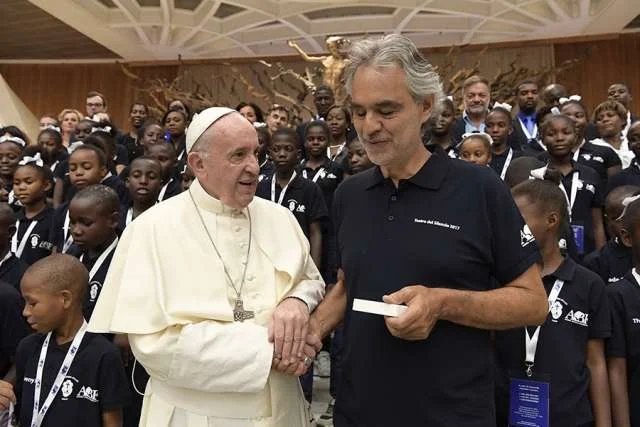
Haitian children, Andrea Bocelli sing for Pope Francis
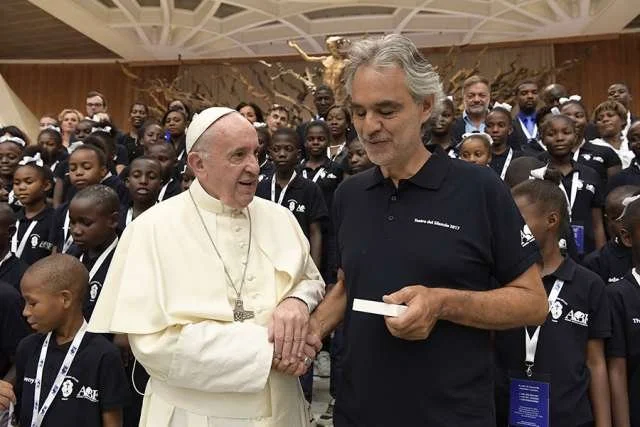
A choir of children from Haiti led by world-renown opera singer Andrea Bocelli sang for Pope Francis after his weekly general audience on Wednesday. The choir, called “Voices of Haiti,” is made up of youth ages 9-15 from the poorest areas of Haiti and are in Rome for their two-week-long European tour.
ROME - There was a special surprise at the end of Pope Francis’s general audience on Wednesday - a performance by acclaimed Italian tenor Andrea Bocelli and a choir of 60 children from the poorest areas of Haiti.The choir, called “Voices of Haiti,” sang three songs with Bocelli, including ‘Amazing Grace’ and ‘Ave Maria,’ following the general audience in the Vatican’s Pope Paul VI hall Aug. 2. After the performance the children and world-renowned singer were greeted by Pope Francis.The performance was part of a nearly two-week-long European tour of the children’s choir, made up of youth ages 9-15, coming from some of the poorest areas of Port-au-Prince Haiti. Besides Rome, the tour included stops in Pisa, Florence and Lajatico, Italy, Bocelli’s birthplace.In Lajatico they will perform with Bocelli in front of 15,000 people for the 12th edition of his annual concert at the famous Teatro del Silenzio. In Florence they sang for the inauguration of a foundation dedicated to the Italian director Franco Zeffirelli.According to a press release, the project, “offers the opportunity to children and young Haitians coming from extremely disadvantaged situations to enhance their talent thanks to a highly specialized training, benefitting also of a wealth of opportunities, precious for their future.“Grown up in a context of extreme poverty, thirsty for beauty, eager to learn, through a highly professional educational path, the young singers have reached a great understanding, have become aware of discipline, passion, love for music and of the joy of sharing. Therefore, what they can convey through their singing is pure joy.”The children of the choir and related projects come from the Citè Soleil slums where over 300,000 people live in tin shack houses, without access to water and sanitation.The project has been ongoing since January 2016. The children participate in weekly rehearsals on Saturdays, which include breakfast, lunch and game time in addition to vocal exercises, music therapy and song rehearsal. Buses pick them up and bring them home after.They learn both folk Haitian and international music and perform throughout the year in local celebrations in their community, such as Easter and the end of the school year. In September 2016 they traveled internationally for the first time, performing in New York City.“Voices of Haiti” is a project of the Andrea Bocelli Foundation. In addition to the choir, the foundation also introduces music into the 30 schools supported by the local St. Luc Foundation in Haiti.They also help to provide education, food, and health assistance to thousands of children, water and electricity to remote and poor communities, solar panels and libraries.According to their website, “because all the students come from poor economic and social backgrounds, through music they have been able to find a way to consolidate discipline, cooperation, and have moved away from the misery brought on by the grip of poverty.“Music becomes an additional means for social and intellectual development, not only personal, but for entire communities.”“Voices of Haiti” is directed by Malcolm J. Merriweather, a professor at Brooklyn College Conservatory in New York, and is run by a team of Haitian collaborators made up of musicians, teachers, and administrators.Why a choir? Because “music is the soul’s voice, its strength and beauty open minds, and develop thoughts…” the website continues.“From the secret melodies of celestial bodies to the beat of the fruit fly wings, creation is a sound metaphor of its Creator, and every element contributes, imperceptibly, but effectively to universal harmony, that with immeasurable perfection rules life and expresses a poetic, amazing synonym of God.”By: Hannah Brockhaus | August 2, 2017
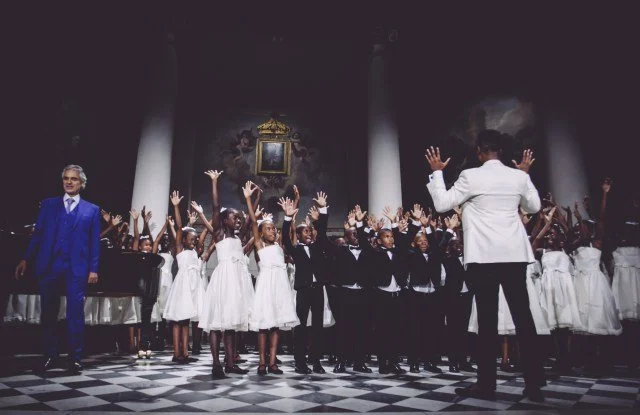
Dsquared2 Dresses Andrea Bocelli’s ‘Voice of Haiti’ Chorus
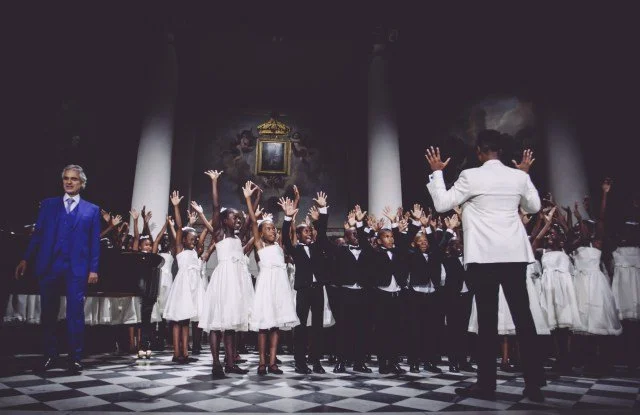
The Haitian kids will perform in Bocelli's Tuscan hometown on Thursday.
MILAN — Dsquared2 founders and creative directors Dean and Dan Caten are supporting Haitian kids.In particular, the twins designed customized dresses and tuxedos for the children’s chorus of Andrea Bocelli’s “Voice of Haiti,” which will perform at the 12th edition of the “Theater of Silence” event taking place at the Italian tenor’s native town close to Pisa on Thursday.Bocelli and the Andrea Bocelli Foundation, focused on finding opportunities for talented young Haitians in need, launched the “Voice of Haiti” project last September in New York with an event hosted at the Lincoln Center.“We met these talented and passionate children for the first time last year in New York. It is such a blessing and a great pleasure to be part of this special journey again,” said Dean Caten. “We created something that could emphasize the strength and the beauty of the Haitian singers. Through their amazing singing, the young choristers spread pure love and joy.”By Alessandra Turra | August 1, 2017

Rihanna Partners With Donna Karan, The New School’s Parsons School of Design | The collaboration will benefit Haitian artisans and the singer's Clara Lionel Foundation.

 Rihanna’s impact on the fashion world is indisputable. Now the singer has revealed that she will further strengthen her ties to the industry by collaborating with The New School’s Parsons School of Design, Donna Karan’s Urban Zen Foundation and Haitian artists to develop a line of merchandise.Sales of the product will help support the Grammy winner’s Clara Lionel Foundation, which was founded in 2012 to benefit impoverished communities worldwide in areas like health care and education.Select students of the art and design school will have the opportunity this summer to work with local Haitian artists at the Design, Organization, Training Center in Port-au-Prince. Karan, Parsons and designer Paula Coles founded the center as a creative meeting place offering vocational training and materials to the Haitian artist community.“We are ecstatic that our students will have the opportunity to work with and develop a merchandise line for Rihanna’s Clara Lionel Foundation, that, like Parsons, shares a strong commitment to creating positive social change,” explained Alison Mears, director of the Healthy Materials Lab at Parsons who was instrumental in launching D.O.T.On May 22, Rihanna will be honored at the Parsons Benefit in New York City and will reveal the winners of the Design Fellowship program, which sends three Parsons students to Haiti for six to eight weeks beginning in early June.By Andrew Nodell | May 5, 2017

Leonardo DiCaprio, Sean Penn Help Raise Money for Haiti

Leonardo DiCaprio bid on, and won, a VIP soccer experience with Real Madrid’s Cristiano Ronaldo at the first-ever Haiti Takes Root gala at Sotheby’s on Friday night. The event, which benefited Sean Penn’s J/P Haitian Relief Organization, also boasted some other one-of-a-kind experiences, including a five-star meal in New York City with Bill Clinton, Penn, and DiCaprio. In addition, artworks by Deborah Kass, Ed Ruscha, Thomas Houseago, and Jonas Wood were auctioned. Andy Cohen was hoping to pick up some art for his digs.“I’ve been on a little bit of an art tear lately,” Cohen divulged “I bought some lithographs from Christie’s and Sotheby’s at their last two sales, and I bought something at Frieze today. I just renovated my apartment, so this is my moment.” The Bravo star sported a five o’clock shadow that he put down to the fact that he didn’t have to tape an episode of Watch What Happens Live that evening.“I have to shave for the show every night, so any night that I don’t have to, I don’t,” he explained, before helpfully noting that he was wearing a purple suit, which was meant to offset the stubble.Donna Karan, who has her own Haitian charitable project, said, “We’re doing it together. You can’t take on this country. You need a posse. We’re part of the posse.”And as for why Karan is so committed to Haiti, she exulted, “I love Haiti. Love, love, love Haiti. The people are magnificent. They have such quality. They’re all artisans, they all have such potential . . . the energy in Haiti is amazing.”The designer revealed that she has started a school there with Parsons School of Design, and Rihanna has just signed up to do a project together.“We’re creating products, giving them jobs,” she said. “Instead of giving them money, you’ve got to give them fishing rods, and the one thing about them is that they’re all creative.”Also in attendance were Penn, Naomi Campbell, Ellie Goulding, and Gayle King. The evening finished with a spirited performance of “Rise Up” by Andra Day, which got the crowd on their feet. By NICKI GOSTIN MAY 8, 2017

Word on the streets ... O.T GENASIS and FABOLOUS in Haiti soon!

 Lets wait and see! #Summer2017 Source: partyinginhaiti IGWhat do you think these 2 mainstream artists have planned? Either way, seems like a good look for Haiti!!! #staytuned
Watch: Did This Reporter Just Blame Haiti's Deforestation on Tree-Eating Starving Children?
“They take all the trees down, they burn the trees,” Delgado said. “Even the kids there, they’re so hungry they actually eat the trees.”Needless to say, it did not take long for many people to come forward and demand an apology for the insensitive comments.Haiti is known for being extremely impoverished, but that does not mean that generalizations about the people can be so confidently made (and on national television, no less). After all, there is only one Lorax, and Jennifer Delgado does not speak for the trees.http://https://youtu.be/JZbRIcYqL5o