






But now the store must move. The commercial building and another across the street were recently sold to developer Thomas Conway, who also owns a nearby food hall and a co-working space. Conway has asked most of the businesses, nearly a dozen, to move so that he can transform the two strip malls. The business owners said Conway has given them about 30 days to leave.On a recent afternoon, Virgile shared the news with customer Daniella Eugene, who drove up from Key West to show here.“There’s a new owner,” he said. “And they want us out. It’s a shock to us all.”Little Haiti, a once predominantly Haitian enclave, has seen a burst of new development and interest from real estate investors and developers because of its central location in Miami. New projects are underway in the neighborhood, rent prices are soaring and Haitian business owners, such as those in the two buildings Conway plans to rehab, said that they are being pushed out. Some residents also believe that the threat of climate change is a factor as well.Conway did not respond to several requests for comment.Many of the businesses were operating with month-to-month leases and, in Florida, a landlord is allowed to give a 15-day notice to terminate a lease.
Pierre-Richard Maximilien, who runs a travel agency in one of the complexes, said he wrote Conway a rent check, only to have it returned a few days later with no explanation. Then he got court papers saying he was facing eviction for not paying rent. “He’s just killing the Haitian businesses and what we’re doing for the community because we’re serving the community,” said Maximilien, who has been renting his space for nine years.Maximilien said he asked Conway about returning after the mall rehab is complete and was told his rent would increase significantly. "I said, 'How much higher?' He couldn't tell me exactly."Jorge Isaac, an attorney representing Conway, said his client denies claims that he did not accept rent payments from the tenants.Several other business owners at the complex raised the same issue at a press conference in April, where they denounced one of the largest evictions of Haitian-owned businesses in Little Haiti.One of the signs in Creole read: "We want to pay. Thomas Conway doesn't want to collect."“To me, this is gentrification at its worst right now,” said Cartine Vilson, a community organizer with Family Action Network Movement, a nonprofit that works with Haitian businesses and homeowners in the area.Vilson said Miami must decide how to save small businesses from commercial gentrification to preserve neighborhood identity and the financial livelihood of business owners who invested in communities before they became trendy. “Do we count or do we not count?” she asked at the press conference. “We count and we need to be heard. We matter.”A few blocks south, a Little Haiti thrift store also called a press conference when it shuttered its doors late last year. Schiller Sanon owned the Little Haiti Thrift and Gift Store at Northeast 59th Street and Second Avenue for six years. He blamed a lack of foot traffic in the area coupled with ballooning rent costs for bringing down his business. “We wanted to be part of the well-being of the Haitian community, and it didn’t happen," Sanon-Jules said.At the strip mall on 82nd street that was recently purchased, Jean Luca is sweeping in front of the storefronts. He does odd jobs for several of the Haitian businesses. Sometimes he gets picked up as a dishwasher in one of the restaurants. He said he knows in a month or two the Haitian businesses he relies on to eke out a day-to-day living will be gone. “I don’t think the new businesses will hire me,” he said. “A person like me won’t get any work here anymore.”Some of the business owners said that they are struggling to find new commercial space to relocate.Marie-Janine Desir owns a variety store that sells clothes, lotion, pots and produce. "I can't find anything in this area," said Desir, who lives in Little Haiti and doesn't have a car. She said that she walks to work; at lunch she leaves to check on her disabled daughter, who is in the care of an in-home nurse. She said if she doesn't find a place to rent she'll have to put her inventory in storage. "That will kill my business," she said. "I won't be making any money. How am I supposed to live?"Virgile, the tuxedo and formal wear store owner, said it is heartbreaking to leave Little Haiti, the only place he has worked for 32 years. The most affordable space he could find was in North Miami, about 15 minutes away. He expects to lose some of his customer base in the move, he said.“It’s a lot to deal with as a business owner, but I have to pack up and go,” said Virgile. “I won’t be in Little Haiti anymore.”This piece originally appeared on WLRN.




 © SOIL -- Waste is collected in sealed buckets in Cap-Haitien
 © SOIL (used with permission) -- Compost produced at the end of the 9-month process
 © Lush Spring Prize (used with permission) -- Natalie Miller and Wisner Jean Louis at Emerson College, UK


 10Power
 10Power
 10Power













 Haiti has been at the forefront of the Chilean news since mid-February, when a video of the nighttime disembarkation of about 140 Haitians, published by Santiago’s RD Herald and disseminated by various other sources, went viral. The video was shot and narrated by an airport employee even as he received messages on his work radio, which were audible. What caught the imagination of many Chileans was not the number of Haitians or their skin color, about which much has been made since, but the details of this curious airport arrival, which many Chileans have interpreted as a case of human trafficking.
 In this video, a large group of Haitians descend single file from a Boeing 767 at Comodoro Arturo Merino Benitez International Airport, also called Santiago International Airport, and are led to four waiting buses as the narrator observes, “This plane just arrived at 21:00 full of Haitian immigrants. They are all stepping down, many with the typical yellow envelope…. It is a charter aircraft. It only carries a license plate, no logo that says which airline it belongs to….”He explains that the Haitians being put on the buses are about to be transported to places where they will be “subjected to heavy work at very low cost. There are between 135 and 145 Haitian passengers doing this; this is every day, all days.”[embed]https://youtu.be/XQhEg9iyGio[/embed]However one might spin the video evidence, some facts cannot be denied. First, every Haitian who stepped off of the airplane did indeed have in hand a yellow envelope: “sobre amarillo,” as this scandal is called, identical to those of his neighbors, front and back. Secondly, the volume of Haitian migration to Chile has been astounding. According to Chile’s Investigative Police (Policía de Investigaciones, PDI), between 2016 and 2017 the number of arriving Haitians climbed from 47,027 to 111,746: a 138 percent increase in one year! This hemorrhage from Haiti is all the more remarkable when one considers that the country’s population is only about 10 million and about 80 percent of the travelers are young men between 18 and 30 years old. Finally, such flights are quite frequent. Three carriers regularly deliver Haitians to Santiago: Latin American Wings (LAW), ONE, and COPA. The plane shown in the video was from LAW.
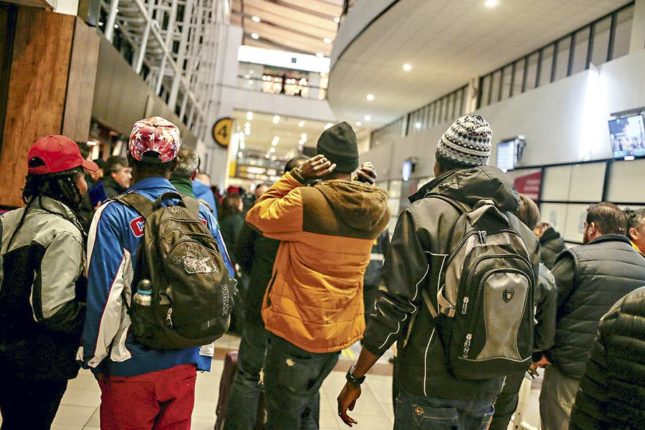 According to official documents, LAW carried 14,000 Haitians to Chile in the 10 months from January to October 2016 alone! It transported another 55,000 Haitians to Chile in 2017 from Haiti and the Dominican Republic. It had already brought four loads of Haitians to Santiago in 2018. A former executive of the company confided to journalist Gonzalo Cifuentes of BioBioChile that the airline, which was founded in 2016, had decided that its “business was no longer vacation, but ethnic.” Since the Haitian passengers were required to buy round-trip tickets to justify their status as tourists, the LAW flights made a profit of about $40,000 each, despite leaving Santiago on every return trip essentially empty.
 Attempts to rationalize the unmarked planes and yellow envelopes have painted an unintended picture of a human trafficking business on an unprecedented massive scale. Possibly the best explanation has come from Fre Foundation Executive Director, Jose Maria del Pino, who told journalist Consuelo Ferrer Duran of Emol that a series of “travel agencies” have sprouted that specialize in migration. “What comes in the yellow envelope is all the documentation for the trip, plus the cash that is required of any tourist entering the country” who lacks a bank account or credit card, del Pino explained. The planes are unmarked because the agencies hire charter flights. The passengers buy an air package for which payment plus interest are due as remittances after they arrive in Chile. Enforcers in Chile and Haiti make sure the payments get made. “We have information on migrants who have told us directly that their families are being threatened in Port-au-Prince. In exchange for this, they have to pay remittances and the money they have been given to remove the threat that weighs on their families,” del Pino added.
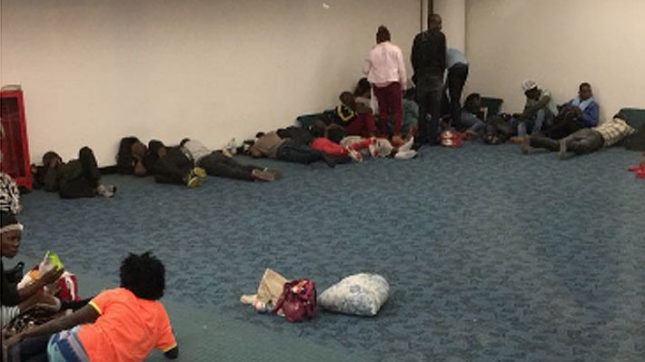
 The notoriety of the sobre amarillo affair has forced officers at Santiago International airport to check more closely the documents from supposed Haitian tourists on flights from LAW, ONE, and COPA airlines. According to an article in La Tercera, on Friday, March 2, 2018, out of a total of about 230 passengers, entry was denied to 90 passengers from ONE, 62 from LAW, and 17 from COPA, after they were found to carry invalid reservations to the same hotel. LAW flights were suspended for 15 days. The unfortunate migrants were kept in one room from early Friday morning until Tuesday afternoon, without food or a bath, after which they were put on return flights to Port-au-Prince. While it is true that those Haitians were treated more poorly than animals during their 90 hours in the airport terminal room, one must also consider that they were probably spared a worse fate with their traffickers for much longer. Since they had no hotel reservations, where would they have stayed? How would they have been forced to support themselves? What will happen to them and their families in Haiti when they cannot pay their traffickers?
 People of Haitian ancestry, and all those who want to punish the sordid practice of human trafficking, would do well to make common cause with the Chileans who are clamoring for an investigation into sobre amarillo. Haitian and Dominican human traffickers have previously been exposed and imprisoned in Chile, but instead of slowing down, the traffic of Haitians has been expanded and formalized. The sobre amarillo affair probably involves highly placed Haitians who want to increase the intake of government remittances as they discard their potentially troublesome population of educated and unemployed young men. An investigation into sobre amarillo might also expose Chilean business owners who order and exploit the cheap Haitian labor, as well as Chilean officials who, for years, have ignored the incongruities in this massive influx of supposed Haitian tourists. These employers and officials are probably racist, but that is a distraction and not the point.
 Haitian brothers and sisters: as dire as conditions might be in Haiti, it is vastly worse to be enslaved by human traffickers in a country where one does not fluently speak the language and has no citizenship rights or family members. There is no El Dorado. There is nowhere better to go. The time has come to fight in place for your birthright.