

Queen Letizia Ends Co-Operation Trip To Haiti

On 23 May, Queen Letizia spent her last day in Haiti, ending a three-day co-operation trip to the Dominican Republic and Haiti.

© Casa de SM el Rey
She first travelled to the Cité Soleil neighbourhood where she visited the Educational Centre of the Sisters of St. Vincent de Paul, in which Spanish Co-operation is financing several projects and, in particular, one on the sanitation of the complex.

© Casa de SM el Rey
Afterwards, Queen Letizia was received by the President and the First Lady of Haiti to have an official lunch at the Presidential Palace. The First Lady and the Queen then visited the National Museum of the Haitian Pantheon where the Queen of Spain held a meeting with a group of prominent Haitian women, to learn about the situation of women in that country.

© Casa de SM el Rey
At the Liceo Alexandre Petion, Queen Letizia attended a meeting with students and Spanish teachers, who will perform various performances before the Spanish delegation. This was the last event of the trip as the Queen then departed from Port-Au-Prince to travel back to Madrid.

© Casa de SM el Rey
Haiti is considered as Country of Association by the Spanish Co-operation. The Spanish Co-operation in Haiti focuses mostly on water, sanitation, and education. In addition to these, other essential intervention sectors have been established that have a large volume of funds: Economic Growth for the reduction of poverty, Rural Development and Fight against hunger, Environment, Democratic Governance and Culture, and Development. The Spanish Co-operation has concentrated its interventions in the capital, Port-au-Prince, and in the southeast of the country, especially in the city of Jacmel. During her co-operation trip, Queen Letizia had the opportunity to learn about all of the Spanish Co-operation’s work in both the Dominican Republic and Haiti.This was Queen Letizia’s third co-operation trip since becoming Queen in June 2014. Before that, Queen Sofía was the one taking part in those cooperation trip.By: Heaven Leemiller for Royalcentral.co.uk | May 24, 2018
Timberland Will Get Cotton from a Nifty New Supply Chain – Haiti – if Experiment Soars
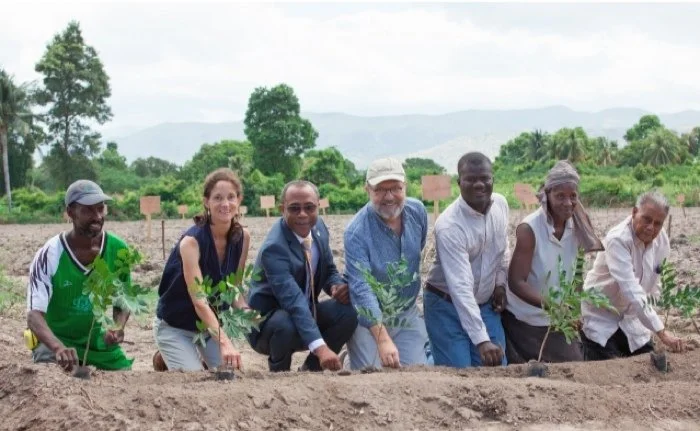
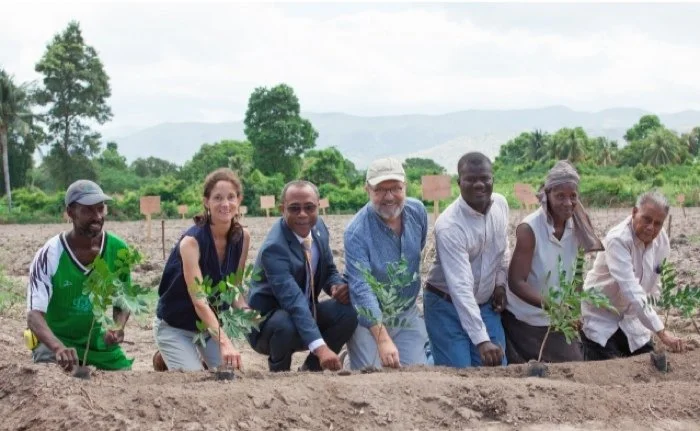
In a move that the company hopes will create a new cotton supply chain, outdoor clothing company Timberland is working with the Smallholder Farmers Alliance (SFA) on an effort to reintroduce cotton as a crop in Haiti, the company announced Tuesday. The company, along with SFA and Haiti’s Minister of Commerce and Industry, ceremoniously planted the first cotton seed to mark the start of the experiment. If the five-year initiative is successful, Timberland has committed to purchasing up to a third of the Haitian farmers’ annual global cotton supply (subject to price, quality and volume), the company says. Cotton, once the country’s fourth largest agricultural export, collapsed as a Haitian industry nearly 30 years ago due to a combination of politics and policies, Timberland says.
First, Is It Feasible?
Timberland and SFA’s cotton program was developed following a successful agroforestry model in Haiti that the two organizations had been working on in recent years. The program had Haitian farmers voluntarily tending a network of nurseries that produced up to a million trees each year. In return, farmers received training, crop seeds, seedlings and tools to help increase their own crop yields.With the success of that program, Timberland and the SFA engaged in a feasibility study to gage the potential of cotton’s return to Haiti. The groups studied ideal growing conditions, farmer interest and the availability of agricultural best practices gleaned from smallholder farmers in Africa and Asia. The study recommended that cotton be reintroduced – along with a comprehensive support system and a range of services that were not in place when cotton previously failed. By positioning cotton as a rotational crop in mixed farms that include vegetables, grain and livestock, the resulting agricultural benefits will extend far beyond a single crop, the study suggested.Next summer, the SFA will introduce cotton varieties that adapt best to local conditions and organic cultivation, and result in the highest quality cotton for cultivation in volume by smallholder farmers.With the reintroduction of cotton as an “anchor crop” in Haiti, Timberland says it also hopes to boost the economy and contribute to environmental restoration.
Wrangler Wants Sustainable Cotton, Too
In a related move – one which is also expected to help increase the supply of sustainable cotton – clothing manufacturer Wrangler recently joined a group called Field to Market: The Alliance for Sustainable Agriculture. Working with industry and academic partners, Wrangler is focusing on cotton-growing practices that will improve profitability for growers while reducing environmental impacts. Wrangler is also engaged in a pilot project for sustainable US cotton. The project involves a family of seventh-generation farmers from Alabama who will work with Wrangler and others to improve cotton yield, irrigation, energy inputs, greenhouse gas emissions and soil conservation. Forty thousand pounds of the family’s cotton will be used to make a special collection of Wrangler denim jeans that will be sold in 2018.