

Judge in Haiti issues arrest warrants accusing former presidents and prime ministers of corruption
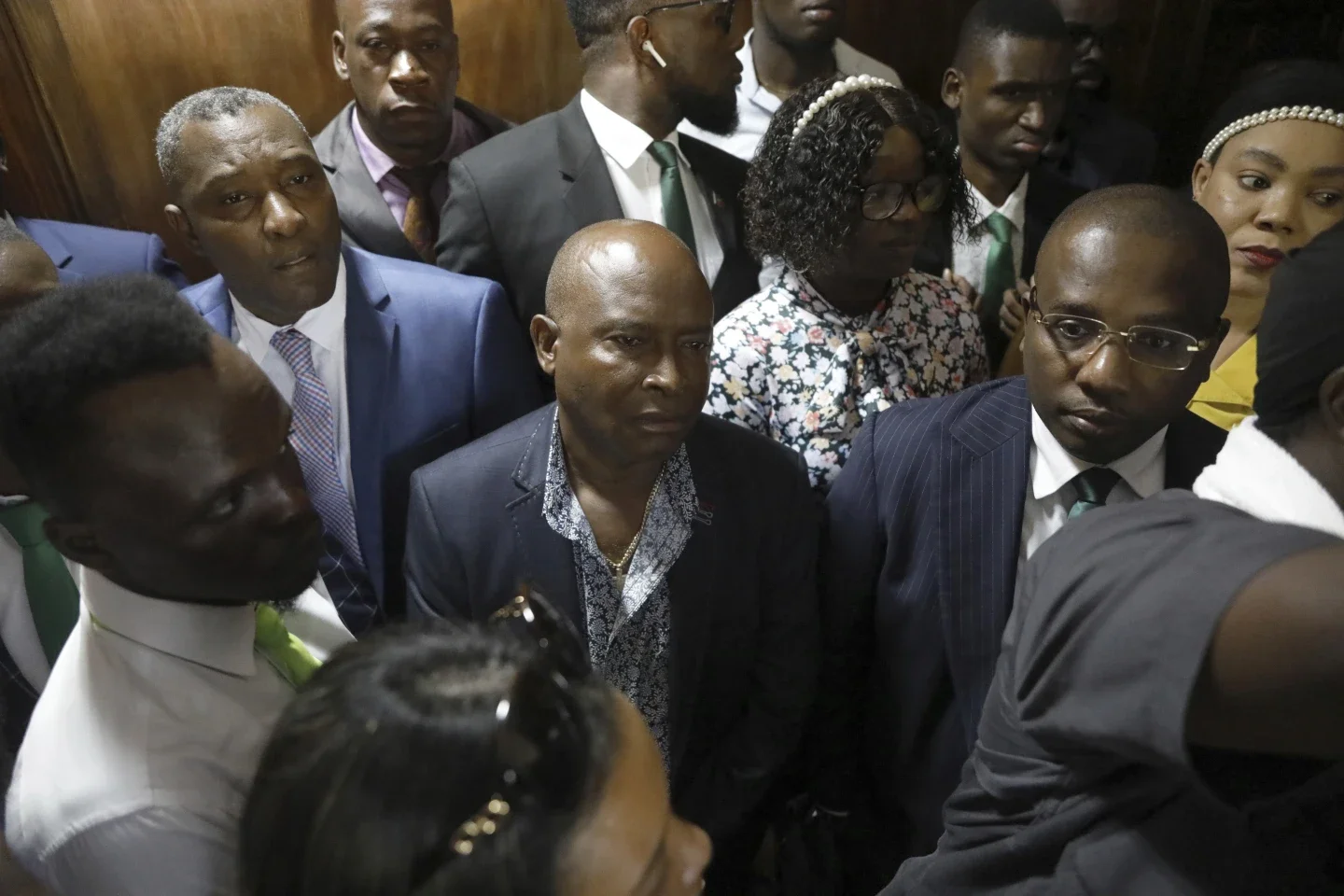
PORT-AU-PRINCE, Haiti (AP) — A judge in Haiti has issued arrest warrants for more than 30 high-ranking officials accused of government corruption, including numerous former presidents and prime ministers.
The warrants, issued Friday and leaked on social media over the weekend, accuse the officials of misappropriation of funds or equipment related to Haiti’s National Equipment Center. The center is responsible for using heavy machinery for tasks such as building roads or clearing rubble, especially after earthquakes.
Among those named are former presidents Michel Martelly and Jocelerme Privert, as well as former prime ministers Laurent Lamothe, Jean-Michel Lapin, Evans Paul and Jean-Henry Céant.
None of those named in the arrest warrant could be immediately reached for comment, although Privert and Lapin issued statements denying the allegations.
No one has been arrested in the case. No further details about the investigation were immediately available.
Judge Al Duniel Dimanche has requested that those accused meet with him for questioning as the investigation continues. The judge could not be immediately reached for comment.
It is common for Haitian government officials accused in a criminal or civil case to ignore arrest warrants or requests for questioning and face no punishment as they accuse judges of political persecution. It is also rare for any high-ranking Haitian official to be charged with corruption, let alone face trial.
Local newspaper Le Nouvelliste obtained a copy of a statement issued by Lapin in which he says that he was never officially notified of the arrest warrant. He also said that at no time during his 32-year political career did he ever become involved with the National Equipment Center.
“I have also never requisitioned or requested the use of any equipment from this institution for my personal needs or for loved ones,” he said.
Privert issued a statement accusing the judge of acting maliciously and thoughtlessly. He also asserted that the Court of First Instance in the capital of Port-au-Prince “has no jurisdiction over the actions taken by presidents, prime ministers and ministers in the exercise of their functions.”
Former prime minister Claude Joseph, who is not named in the arrest warrant, said he met with the judge on Monday in case he could help with the case.
“No one, regardless of the position you held in the state, is above the law,” he wrote on X, formerly known as Twitter, ahead of the meeting. “If a judge decides to abuse his office by abusing justice, that is his business. I will not despise the justice of my country. I will be present.”
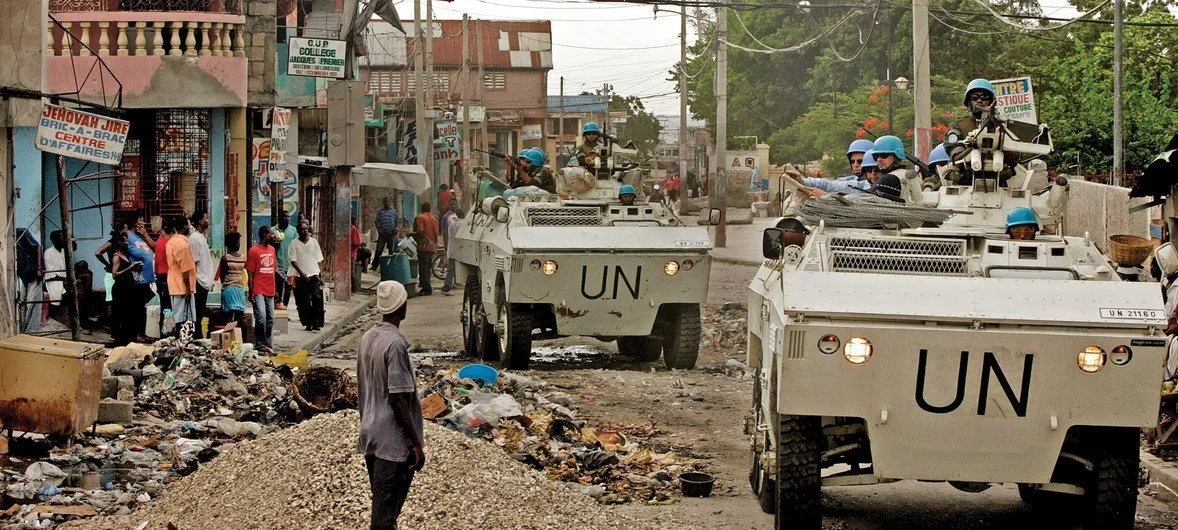
THE KENYAN-LED ‘MULTILATERAL’ INVASION OF HAITI IS A SMOKESCREEN FOR US IMPERIALISM
Haiti is about to endure its fourth foreign military intervention in 30 years. While the media reports irresponsibly about ‘gang violence,’ the country’s real issue is a total loss of sovereignty.
n Oct. 2, the UN Security Council voted to approve a “multinational security support mission” in Haiti—ostensibly for the purposes of stopping gang violence and restoring law and order. Led by Kenya, this multinational force will be comprised of security forces from mostly Caribbean and Latin American countries. Despite receiving the blessing of the Security Council, this “security support mission” is not an official UN mission. Rather than being funded by the UN, the mission will be primarily funded by the US, which has already committed $200 million.
This latest military intervention, should it materialize, will be the fourth foreign occupation of Haiti in 30 years. While the UN Security Council, the Haitian elite, and the ever-obedient corporate media spread a lurid narrative of a country engulfed by bloodthirsty gangs, the real situation in Haiti—not to mention the true story of how it got there—is far more complex.
To understand the situation today, we must look back to the role of the US and other countries in the Core Group in dismantling Haiti’s democracy and sovereignty over the past thirty years of military interference. Dr. Jemima Pierre of UCLA and Booker Omole of the Communist Party of Kenya speak with The Real News to break down what’s going on with the latest foreign invasion of Haiti, and why Kenya of all countries has been tapped to helm the operation, at least officially.
Jemima Pierre is Professor of African American Studies and Anthropology at UCLA and a research associate at the Center for the Study of Race, Gender and Class at the University of Johannesburg. She is the author of The Predicament of Blackness: Postcolonial Ghana and the Politics of Race and numerous academic and public articles about Haiti, including a very recent essay originally published in NACLA, and now reprinted at The Real News, called “Haiti as Empire’s Laboratory.” Pierre is also an editor for Black Agenda Report and a member of Black Alliance for Peace.
Booker Omole is the National Vice Chairperson and National Organizing Secretary of the Communist Party of Kenya.
TRANSCRIPT
Ju-Hyun Park: My name is Ju-Hyun Park, engagement editor here at The Real News. Today we’re turning our focus to Haiti, where yet another military intervention is about to take place. This time led, at least officially, by the seemingly unlikely candidate of Kenya.
Yesterday, Oct. 2, 2023, the UN Security Council approved what it is calling a multinational security support mission to Haiti for the duration of one year. 13 out of the 15 members of the Security Council voted to approve this new mission while Russia and China abstained, thereby declining to wield their veto power to stop or at least stall this latest intervention. So far, Italy, Spain, Mongolia, Senegal, Belize, Suriname, Guatemala, Peru, Jamaica, The Bahamas, and Antigua and Barbuda have all pledged equipment, funds, or personnel to the mission. Leading the charge, at least officially, is Kenya, which has committed 1,000 of its police officers to deploy in Haiti.
While the cover of UN approval may give the impression that this intervention is less imperialist than the many interventions Haiti has suffered in the past, the devil is in the details. Officially, the so-called multinational security support mission is not a UN peacekeeping mission because it will not be primarily funded by the United Nations. Instead, funding will be provided by pledges from UN member states, with the lion’s share coming from the United States, which has already committed some $200 million, half of which will come from the Defense Department.
Haiti is no stranger to foreign intervention. As the first Black republic and the only successful slave revolution in history, Haiti has never been allowed to prosper. For two centuries, the Haitian people have fought off invaders from France, Britain, and the United States. Shortly after achieving independence, Haiti was forced to pay France an indemnity on its freedom under the twisted logic that by liberating themselves from slavery, the Haitian people owed reparations to their former masters. This debt and the accruing interest was not paid off in full until 1947.
For the past century, the United States has become Haiti’s primary tormentor. US Marines first occupied Haiti for 19 years, from 1915 to 1934, waging a war of counterinsurgency against the people that killed at least 15,000 Haitians. Since the 1990s, three more foreign interventions have taken place in Haiti: one direct US invasion under Clinton and another two coordinated through the United Nations.
The most recent UN occupation of Haiti began in 2004 after a US-backed coup against Jean-Bertrand Aristide, Haiti’s first democratically elected leader. This occupation lasted until 2019, although the UN continues to have an advisory presence in the country to this day. During this 15-year UN occupation, known as MINUSTAH, systematic violence against Haitian civilians by UN troops were documented, and troops are also known to have been responsible for an outbreak of cholera that claimed up to 30,000 lives. In investigations since the end of MINUSTAH, the UN has additionally admitted responsibility for 29 known cases of underage victims of sexual abuse at the hands of MINUSTAH troops.
It is this legacy that shadows the latest moves by the UN Security Councils to stage yet another armed intervention of Haiti. Under the cover of multilateralism and the willful cooperation of planned governments in the Caribbean, Latin America, and Africa, the US continues its role in masterminding the oppression of Haiti’s people.
Given the history of violent military intervention in Haiti, it’s worth asking why another invasion now? What are the true causes of the present security situation in Haiti? And is the security question really Haiti’s greatest problem or a symptom of something deeper? Is another foreign military intervention really the solution? And what on earth does Kenya have to do with any of this?
To answer these questions and more, I’m joined by Dr. Jemima Pierre of UCLA and Booker Omole of the Communist Party of Kenya. Jemima Pierre is a professor of African-American Studies and anthropology at UCLA and at the University of Johannesburg. She’s the author of The Predicament of Blackness: Post-Colonial Ghana and the Politics of Race, and numerous academic and public articles about Haiti, including a very recent essay, originally published in NACLA and now reprinted at The Real News, called “Haiti as Empire’s Laboratory.” Jemima Pierre is also a research associate at the Center for the Study of Race, gender, and class at the University of Johannesburg.
Booker Omole is the National Vice Chairperson and National Organizing Secretary of the Communist Party of Kenya.
Jemima, Booker, thank you so much for joining us, and welcome to The Real News.
Jemima Pierre: Thanks so much for having me.
Booker Omole: Thank you. And it’s a pleasure to at least have a moment to discuss in The Real News.
Ju-Hyun Park: It’s a pleasure to have you both.
I’d like to begin with some questions for Jemima as our expert on Haiti today, and I’m hoping you can start by giving us an overview of Haiti’s very recent history. In 2003, Jean-Bertrand Aristide, Haiti’s first democratically elected leader, demanded that France pay reparations of $21 billion for the indemnity that Haiti was forced to pay after independence. One year later, Aristide was overthrown in a coup and the UN MINUSTAH force was deployed to Haiti, ostensibly under the auspices of protecting peace and democracy.
Could you describe for us the real impact of the MINUSTAH occupation on the ground and what political purposes it really served in your view?
Jemima Pierre: Yes, the real impact is what we’re seeing today. One of the things that’s been distressing in seeing the news media report on Haiti is the focus solely on gangs, so-called gangs, and not the actual ongoing MINUSTAH occupation.
So thank you so much for giving this background on Haiti. I want to go back to 2003 where you started with this question, because in the winter of 2003, there was a meeting in Ottawa, Canada, and it’s called the Ottawa Initiative, and it was a meeting of leaders from the US, Canada, France, the Organization of American States. It was a secret meeting in Lake Meech in Ottawa where they decided to do something about the Aristide problem. And this was a secret meeting that was reported in one of the Canadian leftist newspapers. And that’s how we found out about it. And they said that they wanted to remove Aristide and replace a malleable government.
And so that was put into play Feb. 28, 29, the night of the 29 where US Marines landed in Haiti, landed and then drove with the US ambassador to the home of the democratically elected president, Jean-Bertrand Aristide, put him and his aide on a plane, and flew them to the Central African Republic.
One of the things that people don’t realize is the way that the US has been using – And I think that’s why Haiti is a big laboratory – Multilateralism, the language of multilateralism, for its imperial ends. And so Haiti was one of the first places where, because France and the US have permanent seats on the Security Council, once they removed Aristide, there were already hundreds of French and US troops on the ground in Haiti by March 1, the next day. They then used their seats on the Security Council to call for an emergency Security Council meeting on Haiti in order to solidify the coup. And so it is through their positions in the UN on the Security Council that they were able to justify this coup and then get buy-in from the entire UN group to actually send military force to Haiti.
Now, the other part I wanted to talk about is the fact that the country that led the military invasion in Haiti with 12,000 soldiers was Brazil under Lula da Silva. And this is a leftist government, and I want to remind people of this because Lula’s back in power. And I’ve written a piece called “Brazil’s Haitian Training Ground” where we talk about how it is that it was Brazil’s soldiers that really created some of the biggest heinous crimes in Haiti: shooting into neighborhoods, murdering people left and right, protestors and so on.
And so what the US did with the removal of Aristide, and this is also the important thing, was the complete destruction of the Haitian state today, there are no elected officials in Haiti. When the US invaded, when the UN and the US invaded Haiti in 2004, we had thousands, thousands of regional local officials. We had senators, we had a Parliament. We have none of that today because they went systematically and dismantled the state. So what happens is they came in 2004, brought in a council of elders, set up the Core Group, which is a group of representatives from Spain, the European Union, the Organization of American States, the UN. And the Core Group, basically, from 2004, has been making every single political decision on Haiti.
So you have that, and then they said they called elections. But the reality is the US, in 2011, during the so-called Arab Spring, after the earthquake in 2010 that killed 300,000 people, the US forced elections and paid for these elections. And during the first round, they removed the most popular party, the Lavalas Party. They did not allow them to participate in the elections. And then they had three people run. Their chosen person, who was a US citizen. The Haitian Constitution does not allow foreigners to run for president.
They were able to change that, give him a Haitian passport to make it seem like he was a Haitian president, make him run for president, this is Michel Martelly, who was a Duvalierist, and Duvalier was our dictator for 30 years in Haiti.
And then Martelly did not win the first round of the elections. Hillary Clinton flew to Haiti from the Middle East and threatened the sitting president with exile if they did not allow them to change the result with the help of the OAS, the Organization of American States. So they changed the results of the first round of elections, and the guy who did not even make the first round of the elections, where we only had 21% of the people voting, supposedly he won the elections.
So once you have Michel Martelly put in place, you start having the dismantling of the state. Because he never ran regional elections, we start losing elected members. By the end of his term, which was marred by corruption and so on, we had lost half the elected officials and he was ruling by decree. And then Michel Martelly put in his puppet – And mind you, there’s always protests. Haitians have been protesting nonstop. You don’t see that because all you hear now is gang violence.
Then the US used the OAS to install Jovenel Moïse in 2016 under terrible conditions with the majority of the people not voting, and under him no more elections of regional and Parliamentary elections. And so we’ve lost everyone. And so by the time Jovenel Moïse was assassinated in July 2021, we only had three elected officials, and now they’re no longer in power.
And one more thing – And I know I’m talking so much, because there’s so much to say – One more thing is to say that when Jovenel Moïse was assassinated, Ariel Henry, the current prime minister, is implicated in that assassination. I have to tell you this, because he’s on record speaking to the main mastermind of the assassination. There was no prime minister because they were in transition. There was so much protest against Jovenel Moïse that he didn’t have a chance to put in a prime minister.
So what did the Core Group, which is our occupiers, our colonizers do? They sent a tweet announcing who the next prime minister would be. This is how Haiti’s supposed current government was chosen, by the Core Group, which has no Haitians in a bunch of outsiders.
So this original 2004 coup d’etat has left us under occupation, and it’s this occupation that’s completely destroyed the Haitian state, which is why we are where we are today. I’ll stop there.
Ju-Hyun Park: Thank you so much for that really expansive overview, and no worries at all about speaking at length. I think there’s a lot of information here to cover. We’re talking about many, many years of history. We’re talking about a very complex situation. So I just wanted to thank you for all of this context that you’re providing for our listeners today.
I think, from what it sounds like, what you’re describing is a process and a pattern where the language of multilateralism, the language of democracy is being wielded by the United States. But in fact, what is happening is really the stripping down of Haiti’s sovereignty. You’re describing a process through which actually existing democracy that was in Haiti under the government of Aristide is slowly being broken down through military force, through foreign intervention, through a process of installing puppet leaders blatantly breaking Haitian laws of acting as if Haiti has no right to decree laws for itself, and it needs to have laws imposed upon it from without. And I think that’s some really crucial context for us to understand how Haiti got to where it is right now.
And I think one other observation I would share is that this timeline we’re talking about, this occupation that begins in 2004 and, at least on paper, wraps up in 2019, that’s roughly parallel with the second Gulf War. And it seems that Haiti and Iraq have really had somewhat comparable experiences, at least in the 21st century. This experience of having their state completely destroyed, completely stripped down by a foreign power, and then having local power brokers empowered by forces from without who do not operate in the interest of the people, who effectively rule in a dictatorial fashion and openly flout the rule of law while you have outside forces claiming that there needs to be more intervention, there needs to be more meddling in the name of protecting peace and democracy.
I wanted to pivot us a little bit to understand a little bit better what the demands are from Haiti’s social movements and Haiti’s people. Because in the last five years, we have seen a growing social movement against foreign intervention, from the presence of foreign troops to the role of foreign NGOs. Can you tell us a little bit more about what these social movements in Haiti are actually demanding? What vision for society is driving them, and does it really gel with the narrative we are fed by the Western press, that all Haitians want is an end to the gang violence that is going on, and that ‘s the only problem in the country?
Jemima Pierre: Right. Well, the Haitian people, you would know. If anyone wants to know, just look at Twitter from 2018, 2019 when you had millions of people in the streets in Haiti demanding that the Core Group leave Haiti, that the UN leave Haiti, that the US stop its meddling in Haiti. So the Haitian people have been protesting no intervention, no meddling, and they want the Core Group to leave. That’s one of the first things that they’ve always said. They said, we don’t need the Core Group.
And the other thing, the most important thing right now is they want the US to take its prime minister that it imposed on us. The only reason Ariel Henry is still in power is because he’s protected by US special forces and the US upholds them in power. So the key thing is Haitians want to be left alone.
Haitian civil society came together in February 2021, and a lot of various groups came together and came up with an accord for a transition plan. This was before the assassination of Ariel Henry. One of the things that the US has decided is that they will not let the mistake that they let happen with Aristide getting popularly elected, they will not let that happen again in Haiti. So they’re going to control elections. I don’t know if even in the resolution, they’re like, we’re going to be there for a year and then we’re going to set up elections because they want to control the elections. And so the people don’t want Ariel Henry, they want the disbanding of the Core Group. They want to be left alone.
And back to the 2021 resolutions that the community groups came with, they had a two-year transition period that the US was completely dismissed and trampled on and supported Henry.
And I wanted to just say something quickly. In 1915, when the US first started occupying Haiti during the first occupation, because the US occupied Haiti from 1915 to 1934, those years are like World War I, the beginning of the League of Nations, Haiti was under occupation, but Haiti was one of the founding members of the League of Nations. And so the US called that sovereignty. They did not want the League of Nations to acknowledge that Haiti was under occupation because they said, well, we have a representative at the League of Nations. So I want to tell you, this goes back more than 100 years of us pretending that what they’re doing is for Haitian sovereignty and can claim that Haitians have sovereignty despite the fact that they’re under occupation. This is the exact same thing that’s happening now.
So anyways, what the people want, they want reparations from the UN for cholera. They want the US to stop supporting Ariel Henry. They want the US to stop dumping arms and ammunition, because we all know that the guns are coming from the US and from the Dominican Republic. There was a truckload of guns and ammunition found at the border of the Dominican Republic just last week.
And we all know that all the ports are owned by five families in Haiti, the oligarchs, the Haitian oligarchs, the non-Black Haitian oligarchs that own the ports, and they’re the ones that actually pay these young men, these paramilitaries to go in and shoot up the neighborhoods. And so they want an arms embargo, which is what China and Russia had asked for, an enforcement of the arms embargo.
And so all these things that people want, the first thing, they just want the US and the UN to get out, and then they want them to take Ariel Henry with them, and then they want them to stop dumping guns.
And I don’t know if people notice every time there’s about to be a UN vote on Haiti the past two years, the violence has swelled. The media, the machinery works on violence and gangs and so on and so forth. This almost as if it’s a planned action to make the world think that there’s nothing else that can help Haiti but more violence from foreigners.
Ju-Hyun Park: Right. The timing of everything is so convenient, and I think the point you made about the arms shipments is so true, because Haiti is not a country that is producing vast amounts of weapons on its own. The weapons must be produced somewhere. They must arrive in Haiti by some means. And I think the situation that you’re describing on the ground is really one where popular forces are demanding the sovereignty and the independence of their country, which is currently lacking, which has been lacking since the 2004 coup. And as you’re describing, has really led to a situation where those with the most wealth, those who control access to the ports, who are able to control not only the flow of commerce but ultimately arms, are able to manufacture situations that are very convenient for their own political aims and goals.
So thank you so much for that description and for really helping us break through some of the propaganda and the myth-making that has gone on around Haiti for so long. Because I think this narrative is something that comes up again and again, at least as rarely as Haiti ever gets mentioned in media, it’s always through this lens of uncontrollable violence, this narrative that for some reason this country is just so tragic. There’s some inexplicable reason for why this continues to happen again and again. When in fact, if we look into the history, we look into the actual conditions, there are very real explanations for why conditions in Haiti are as they are.
Before I pivot to Booker for a moment to talk about Kenya’s role, I wanted to actually circle back to what you mentioned about the role of Brazil and the role of Lula’s government in the original 2004 MINUSTAH occupation. You mentioned that it was Brazilian forces who comprised about 12,000 of those troops who committed some of the worst atrocities during that period of occupation. And I think you’ve pointed out elsewhere in your writing as well that many of these troops then returned to Brazil and ended up becoming Bolsonaro supporters, ended up becoming some of the people who are threatening Brazilian democracy to this day. So could you speak a little bit more generally about the role of anti-Haitianism in subordinating, not only Haiti, but other countries in the Caribbean and Latin America and also in Africa?
Jemima Pierre: I would leave Africa out of this in terms of the anti-Haitianism because I do think one of the things that we forget is how much Haiti is hated for its Blackness and for this revolution. Because part of it is the same way that people in Africa now believe that Haiti has a gang problem, it’s such a mess and we need to go help our brothers and sisters, they’re dying and so on and so forth.
The reality is the media onslaught of images of Haiti during the revolution, there are all these images… I printed out the way The New York Times described Haiti in 1890, especially right after the revolution. It said that they won the revolution by eating the whites, by killing every white person. There’s a New York Times headline that’s like, “A Haitian ate a US soldier,” things like that. This is a New York Times headline from what, 1919, during the occupation, so cannibalism. And then the religion of Voodoo, which the Haitians practice.
And so the Caribbean itself has a lot of anti-Haitian… The Caribbean did not become independent for years after Haiti. So you have the Francophone Caribbean really had bad views of Haiti because a lot of them are still French departments. And the Anglophone Caribbean never really liked Haiti. So CARICOM, which is the Caribbean Community of countries, did not even want Haiti as part of CARICOM until the 90s. And CARICOM just celebrated its 50th anniversary, and it was under P.J. Patterson that Haiti became a member of CARICOM. But the reality is they were always afraid of Haiti. They’re afraid of Haiti’s numbers. Haiti has 11 million people, so if Haiti joins CARICOM, they’re the largest component of CARICOM.
And then you have all the anti-Haitian migration laws in the Caribbean, the Black nation. The Bahamas have some of the worst laws and treatments of Haitians in the Caribbean followed by Jamaica, Barbados. So CARICOM has a way of travel among countries people can go except for Haitians.
And then you have Brazil, with its long history, with the largest Black population outside of Nigeria. They hate Black people already. They hate Haitians even more because our language is different. We speak the Creole, we don’t speak the French that the Francophone do. We don’t speak English. Our religion is different. We’re seen as more African and more Black.
So even Black people don’t like Haiti. And I think that pushes into the anti-Haitianism that you see even among the Black African countries. That’s why it’s so easy for the world to believe these stereotypes that Haiti is like a basket case, because the Black folks believe it about Haiti as well. And I think that’s important.
Brazil was in charge of this vote, this resolution vote. Brazil is in charge of the UN Security Council starting yesterday. And their first vote is on Haiti. This is the same Lula’s Brazil that led the other occupation that put us in this mess.
And so I do think it’s important because I think African countries, people on the continent need to understand how much hatred Haiti has gotten, not only from the white supremacist world, but also from the Black and Brown world. And I always say, in Latin America, people talk about the leftism of the Americas. There’s Lula, there’s AMLO, which is the Mexican government talking against imperialism. AMLO and Mexico were the ones pushing for intervention last summer against Haiti. They’re the ones that wrote the resolution last summer against Haiti. So everyone says, this is great, Lula, AMLO, the only two countries that have not talked against Haiti has been Venezuela under Hugo Chavez, and Nicaragua – And Cuba. I have to say three countries.
And so I think that is important too, because that’s why it’s so easy to turn off any feeling, any sense of solidarity with Haiti because there’s this long history. And this long history really goes all the way back to winning the revolution and destroying France, Spain, the British, and so on and so forth, and asserting our African identity in the Caribbean.
Ju-Hyun Park: Thank you so much for that really valuable framing. I think what you’re lifting up here is that this is really a hemispheric matter. The Haitian revolution sent shockwaves throughout all the countries of the Americas because all of those countries were slave countries, and they were terrified of the prospect that that experience could be repeated within their own nations.
And I think everything that you’re raising about Brazil’s complicity and role about the role of Mexico, even under so-called leftist governments, is really crucial, and indicates how far there really is to go towards achieving this kind of justice, this kind of vision of a more liberated America is that we say throughout the hemisphere that we want, but really has to deal with this question of Haiti’s independence, of respect for Haiti as a nation. And also, I would argue, gratitude for Haiti’s historical role in helping to be a light for the rest of the world and shine a path towards a better future for all, a debt that I think the entire world has yet to even acknowledge or begin to repay by any means. So thank you so much for that background for us.
Jemima Pierre: Thank you.
Ju-Hyun Park: I’m going to pivot now to Booker Omole, who is joining us from Kenya. And Booker, I’m hoping you can speak to us a little bit about the role that Kenya is playing here, and help us situate it within the context of the politics in Kenya at the moment. I think I speak for many people when I say that I was initially a little bit bewildered to hear that Kenya, of all countries, will be leading the charge on this UN intervention. So I’m hoping you can explain what’s the utility of Kenya playing this role from the perspective of the Core Group, and why is the Kenyan government going along with this? What does it stand to gain?
Booker Omole: First of all, thank you very much Ju-Hyun and also Jemima for giving that brilliant context with our solidarity with our brothers and sisters in Haiti.
First of all, it’s important for us to understand that in the history of Kenyan foreign policy, particularly its government, the ruling class in Kenya since the colonial period, we have not had what we call a progressive foreign policy, save for the last 10 years before this current regime. In fact, the government foreign policy, just like the United States foreign policy – Which for us we don’t consider that the United States even having a foreign policy because every time they actually act, it can only expose its bankruptcy in terms of articulating anything that regards a foreign policy.
But remember, the Kenyan government supported the apartheid regime. Remember the Kenyan government is the only government that did not support any liberation movements in Africa. And in fact, even the Kenyan government supported an attack on Uganda by the Zionist forces here. And even today we have seen the Kenyans are fighting war in Somalia and in other African countries, and even bragging of their so-called peacekeeping.
So when we look at the Kenyan situation, we must realize that there is the Kenya government, which is the ruling class, which is really a new colonial capitalist tribal system that dominates us today. But also there is the majority of the Kenyan people. Because the policy of the government is the policy of the minority, is actually the policy that reflects the ruling class in Kenya, which are mainly the comprador class. And this comprador class, they’re even so weak at home, so they have to form alliances of oppression abroad to be able to continue to further their repressive policies even to their local people here.
Now the Kenyan government has coined a policy which they call “economic diplomacy.” Economic diplomacy basically means that in President Ruto’s government, they have no principle. That what they’ll do is wait and see, and they’ll negotiate on how much they can exploit in terms of relating with other nations. They do not want to relate with other nations out of principles.
So such is the history we have. There was a little change in terms of our foreign policy in the last 10 years during the Jubilee administration. But at the moment, the young people that are in government today are, by and large, part of the failed dictatorship during the 1990s, because our current president today was the youth leader of the Moi dictatorship last time. So it’s his policies, or his government policies, are mainly going to form alliances with imperialism.
Now, in the case of Haiti, it also must be said that within the court of public opinion in Kenya, not many people support a deployment of the Kenyan police to Haiti, because they see it as a broader chessboard. Because now the current government, even in Kenya today, lacks its legitimacy at home. Because the purpose that this government actually exists, according to the majority of the people, is to advance the interests of the United States, both at home and abroad.
And the first recommendation even to justify that deployment of a police force of 1,000 people will be beneficial in terms of its economic content and also to provide employment. Because remember, the Kenyan government has been convincing the Kenyan population that they’re looking for jobs abroad instead of creating jobs at home. So you can realize that the particularity of the ruling class, especially within the African context, is that they’re looking for solutions to national issues from the people that control them, which is actually the dominance class in the Northern Hemisphere, the dominance class, particularly in the United States and their European allies.
Indeed, also, it is good to recall that the United States intervention, even within the African context, they keep changing the policy to make sure that they could get another country or even the local population to fight their own wars.
For example, of course, all of us remember the Black Hawk Down, where the United States soldiers were drugged in the streets in Somalia. From there, the policy has always been if we can use another African country to put boots on ground in Somalia.
In terms of Haiti, I also think that it is one of the policies of the United States that, for now, they were going to try to use some Black faces in Haiti to actually further their policy of intervention and to repress the Haitian people. So in our own context, we see that this is an imperialist intervention, and the United States is only using Kenya as a front to continue to dominate that country in terms of their political, social, and economic environment.
Ju-Hyun Park: Thank you so much for providing that really important background on the current Ruto government in Kenya. It’s very apparent that this is an extremely reactionary government. This is a government that serves the interests of a tiny minority who comprise a ruling elite who are really dependent on the power of outside forces. I think not unlike what we see in Haiti with Ariel Henry today.
I think the situation you described with the use of third countries to stage interventions on behalf of Western powers is very important and very cogent for the moment, not only in this case. We just wrapped an interview with the Thomas Sankara Center in Burkina Faso talking about the coups that have taken place in the Sahel, about the threat of the ECOWAS invasion that was very recent. And I think in that context as well we see that same dynamic playing out, where the main imperialist powers are no longer necessarily going to send their own troops on every occasion that they need to crush a peripheral country, but they will turn to these other neo-colonial actors who can then act on their behalf, who can then provide some cover for them in order to allow them to enact their political will, essentially, through violence.
I wanted to delve a little bit into what you were saying about the actual needs and the most pressing issues facing the working people of Kenya today. Because as you’re saying, the decisions that this government is making are not in line with the interests of the working people. And you are from the Communist Party of Kenya, which is a party that I really recommend that anyone listening or watching this check out if they can. The Communist Party of Kenya is doing some outstanding work, very connected to the working masses of that country. It really appears that there is also a lot of youth presence, which is always a really excellent thing to see.
So speaking from your particular position, could you inform us a little bit about what you would identify as some of the biggest problems facing the working people in Kenya today, and what the view of regular people of this intervention really is?
Booker Omole: First of all, most of the Kenyan problems, especially the problems facing the Kenyan working class, cannot be only analyzed within the context of the internal conditions in Kenya. Because I will say that from the 1990s, the policies that have been implemented within Kenya have been influenced mostly by the dominance class, particularly in the global North. So it basically means that the Kenyan masses have not had an opportunity to implement the policies that they see that are beneficial to them. Kenya has suffered heavily in the hands of neoliberal institutions, particularly World Bank and IMF, perfected by the United States.
So that has even exacerbated the problems of the Kenyan working class, because the unemployment rate in our country is rising every day. And in fact, at the moment, we have 60% of the youth population that do not know what to do when they wake up. Forget about meaningful employment. That means they go to school, and the schools are now being privatized, but they do not know what the future holds for them.
And the second element to it is that Kenya has been into a part of deindustrialization. That means the neoliberal policies that have been imposed upon the Kenyan people have reduced us only to a raw material exporter, and there is no meaningful job creation that is taking place. So that means most of the Kenyan jobs are being exported abroad.
And if you look at this President Ruto’s government, the Kenya Kwanza administration, they have been selling a rhetoric, but in terms of implementation, they’re implementing something else. For example, this government, more or less, President Ru’s campaign was anchored on a reality in the Kenyan masses, which was basically the war between the haves and the have-nots. And he made it clear to bring the young people on his side by saying that this country is dominated by a few families. Indeed, those few families have broken the Kenyan people’s future.
But himself, who he actually described himself as somebody who made genuine wealth through rising from poverty, and everybody else knows that he has been a beneficiary of state sponsored corruption. Just the fact that his parents are poor does not mean that, at the moment, he’s not part of the owning class that continues to oppress the Kenyan people. So in actual sense, this rhetoric of the bottom-up economic model that this government has been preaching is nothing but a fallacy.
In fact, they are implementing the trickle-down effect, the neoliberal policies. So every time they want to address the issue of unemployment. Remember a few months ago, the German chancellor was with us here, and they signed a pact to export the Kenyan youth to go and work in Germany. Now they’re saying that he was in the United States and he had a meeting with multinationals like Apple and all that kind, Microsoft. And he’s saying that the majority of the Kenyan people will get jobs abroad. That is the outward-looking policy that this government sees as a possibility to think that they can convince youth that they can provide dignity, including this embarrassment of exporting the Kenyan police to Haiti.
But in actual sense, what the Kenyan people need is a deliberate effort, first of all to address issues to do with land, which is at the core of the Kenyan activism. Because almost 75% of land in Kenya is owned by a few families, and mainly the rich people who continue to hold it on behalf of the multinationals. Once that has been rectified, then they can talk about agricultural land mechanization to go ahead and now start a deliberate policy towards industrialization.
But for now, the president talks about Pan-Africanism. He talks about the need for a new financial architecture. He also talks about the plight of the Black people, but it’s only a lip service. It is a total rhetoric. In actual sense, this government has failed at home and continues to fail abroad through even attacking the most vulnerable.
In fact, the Kenyan police, as we speak, majority of the poor people in Kenya die through extrajudicial killing, more than malaria, any disease that you can think of. So these police forces that they’re trying to deploy in Haiti are actually a killer squad. In fact, we call them thugs in blue here in Nairobi, because they wake up to murder innocent and poor Kenyans, trying to discourage them from even looking for their way of life.
Such a police force cannot say that they can be professionalized to go and have another imperialist intervention to help their Haitian people because the Haitian people all of a sudden have a gang problem, while Kenya’s gangs here are rioting every day, but the Kenya police are helpless. Why don’t they finish our gang at home here and the political militias before they can think of helping Haiti? And in the event that Haiti needed help, who is the Canadian government or the United States government to know who is good for what? Because the United States thinks that this world is their bucket and we are just children so they can move around and perfect and police the world only to their interests.
Ju-Hyun Park: Thank you so much for establishing that. And I particularly appreciate the point about the track record of Kenya’s own police force within Kenya itself. There’ve been a number of voices that have raised criticism, raised contention over this idea that Kenya can suddenly go from having many essentially documented human rights violations within its borders inflicted by its own police, and then suddenly this police force should be trusted to bring peace and stability to Haiti.
And I think another thing I really appreciate about your comments is the very clear parallels, actually, between Haiti’s situation and Kenya’s situation: You have the dominance over the state, the dominance over the economy by a handful of extremely wealthy, well-connected families. You have all these plans that are projected for improving these nations that really have nothing to do with developing them, really have nothing to do with investing in the social development of these countries or in the economic development of these countries, but really only provides the solution as more military intervention, more export of labor rather than the creation of economic possibility and opportunities within the countries themselves.
So I really appreciate the way that your response helps us to thread the needle on this and tie all these different facets together.
Now, to close us out, I’d like to turn back to Jemima for a moment. Could you help us understand how those of us who are not living in Haiti but want to be in solidarity with Haiti and the Haitian people, how can we support Haiti’s defense in this moment? What is most important right now?
Jemima Pierre: Well, what is most important is for people to come together and push back against this ongoing push for intervention in Haiti. I think there’s an onslaught against Haiti from all sides.
One of the things, just quickly, Ruto met with Luis Abinader, who is the president of the Dominican Republic, and it was clear with this meeting that Ruto knows nothing about Haiti. The Dominican Republic has had this fascist relationship with Haitian people because they don’t want to see themselves as Black. And so they’ve been killing Haitians.
In fact, what’s the saddest part about yesterday’s vote was it was the anniversary of the 1937 massacre of 30,000 Haitians by the Dominicans and throwing their bodies into the river, the Massacre River, the same river that Luis Abinader is using right now. And Ruto went and signed a deal with the Dominican Republic president in order for them to provide support for Kenyan troops when they’re in Haiti. Imagine how much of a slap in the face this is for Haitians watching this.
So I do think one of the things that we need to do is push back against the Western media narrative about Haiti around this vote. This vote was not a unanimous vote. It was abstained, the two major permanent members abstained. This is not a UN mission. I hope people go and tell people this is not a UN mission. It’s a US mission being given cover, which means that it’s a mercenary outfit. Kenyan police are acting as mercenaries in Haiti.
And I think people need to really push back against the media narrative about this gang violence. Sure, there’s gangs, but then Mexicans have cartels. No one’s calling right now to send a UN mission to Mexico or Jamaica, which has a bigger gang problem. And I actually think the biggest gangsters in Haiti are the Core Group and the US and BINUH, they’re the biggest gangsters because they’re the ones that are basically acting like gangsters ruling Haiti as if they can get away with everything.
And so I think we need to push back against the narrative. I think we need to talk to our brothers and sisters on the African continent, the masses, and tell them what’s really been going on in Haiti for the past 20 years: that Haiti’s under occupation, that the US is using the UN to push this multilateral imperialism. I think we need to change the narrative and we need to talk to our friends. We need to read, we need to see what’s going on. I think that’s the best thing.
And the most important thing, I think people need to ask their members of Congress to stop funding the Department of Defense, stop funding another imperial intervention using our tax dollars. The US is already losing in Ukraine using all this money, because it’s a proxy war, and we need the US to stop these proxy wars. And we need people to look at Haitians as human beings, not the savages that people present in the media.
Those are the key things. And I think if we did not treat Haiti as so exceptional, we would see the parallels of what happened with Iraq and Haiti. What happened with Libya. The last time China and Russia abstained from a vote, NATO was able to destroy Libya, right? We need to stop exceptionalizing Haiti and see Haiti as empire’s biggest laboratory. And if we see that, then we can see ways we can form solidarity and push back against the US empire.
Ju-Hyun Park: Well, thank you so much for that response. I think that’s a really helpful way for our audience to get a little bit of footing to understand where to go next. To add a little bit to your point, the United States also has something like 40,000, 50,000 gun violence deaths a year, I believe. Where is our UN peacekeeping mission? We can very easily say that any country, most countries around the world, really, have some kind of social problem that we could identify as a reason for intervention, and yet only some countries are repeatedly subjected to this treatment.
I want to pivot back to Booker for a moment. Booker, I’m hoping you can tell us a little bit about what the Communist Party of Kenya is currently doing to resist the Ruto government’s plans to intervene in Haiti. And what, if anything, those of us listening from outside of Kenya can do in order to support your efforts?
Booker Omole: Yeah, thank you very much. First of all, the deployment of the Kenya Police Service to Haiti is illegal even within the national laws in Kenya. So that means the president of the United States, including the president of Kenya, knows this illegality. So the first step is that the Communist Party of Kenya, of course, is going to challenge this within the legal framework of Kenya and to try and hold this government accountable and to expose its bankruptcy. Because every time that the people were saying that we were imposed upon a president, he denied to the hilt that he was never a puppet of the West. But now we can see he’s not just a puppet of the West, but what’s more, he’s only being asked how high he can jump when the West speaks.
The second is, of course, the most powerful court: the court of public opinion. We must continue to prosecute the Kenyan police’s crimes here in the court of public opinion. And also to tell them that probably the issues they’re dealing with here in our country are much more simpler than the Haiti situation. Because I can assure them that it is not going to be a walkover, because Haiti has a long history of resistance. So maybe they could carry more body bags as they head in that direction. And with a very minimal support base at home, the chances of success abroad will be non-existent. And in fact, the issue around the insecurities in Haiti are only going to be worsened by the arrival of a foreign military or a foreign police force on that ground.
So we also, the Communist Party of Kenya is quite happy to join, in fact, to join international solidarity movements against the intervention of the Core Group in Haiti, and also to continue to mount more pressure through street action here at home, and to bring out – And I know for a fact that when the casualties start to arrive from Haiti to Nairobi, there will be a big media to try and downgrade it.
But for us, we think that the Kenyan people should know the truth, that this war that is going to be abroad is actually also to advance the… The imperialists do not like Haiti, for one fact, because without the first slave revolution, probably they would have not inspired more movements across the globe. So the Communist Party of Kenya will just call upon that we are more than willing to be an internationalist party, and we will want to be in solidarity with our brothers and sisters in Haiti, and to tell them that the Kenyan masses are with them. And the ruling class, for a fact, the Communist Party of Kenya do not hide its intentions that our fight here at home is actually to overthrow those people who continue to actually sell out our country, to sell out the local majority population to the interest of capital, mainly the interest of the United States and imperialism.
Some comment also I wanted to make, which I might have forgotten, comrade, is the issue of coups in Haiti. Because we have been talking about coups, but now the United States supports coups in Haiti, but they say they cannot support coups here in Benin, Burkina Faso. Even here in Chad, they support another coup. They support a coup in Libya. So it’s interesting, the hypocrisy of the United States, because for a fact, we know that there are coups that enjoy the popular support of the people, but there are coups that are supported only from external purposes to oppress the general population.
So for us, at least, it’s clear from the Communist Party of Kenya that the United States is a degenerating empire. So they have to choose how they want to fall, because all empires shall fall. So do they want to fall with dignity in a [inaudible] disaster, or do they want to fall by actually accepting that the crimes they have committed is unforgivable, and they try to mend fences with the people they have brutalized for many generations?
That is how we see it. And for the people who think that the United States will continue to hold their hands to oppress their people, like the current Kenya Kwanza regime in our country, we will promise them that they will need more policemen here in Nairobi than to take them to Haiti. Because we are not going to keep quiet to make sure that even the Kenyan people see what actually is the true picture of their Haiti-African relations. Because we cannot be talking about the question of Haiti only on other platforms. But when it comes to our own towns here in Nairobi, we continue to support a backward policy that can only continue to worsen our relationship between our brothers and sisters in other places.
Ju-Hyun Park: Well, thank you both so much, and absolutely amen to that. Empires fall whether they like it or not, and it’s always a matter of time. And those at the seat of empire can always choose if they want to go with a whimper or with a bang, as it’s said.
I want to express really profound gratitude to you both for bringing such extensive knowledge and insight into this conversation. I think this is going to be very, very valuable for our listeners. To wrap us up, where can our audiences keep up with you? What’s the best way to stay abreast of both of your activities? Jemima, maybe you could begin, and Booker can wrap us up.
Jemima Pierre: Oh, yeah. Well, I’m one of the editors for the Black Agenda Report, so that’s where we publish a lot on Haiti. I’m on Twitter, it’s not under my name, but I’ve been outed, so at this point I can say it’s @grosmorne, which is G-R-O-S-M-O-R-N-E. That’s where most of my information, most of my things on Haiti. And of course I publish quite a bit on Haiti, so you could just look on YouTube under my name, and a Google search, and whenever something comes out, you’ll find it. Thank you.
And I have to plug the Black Alliance for Peace, the Haiti Americas Team, which has been the one group that’s kept Haiti on up in conversations, even when all the leftist organizations forgot about Haiti. So I just want to really plug in our organization and our work on Haiti, and I think it’s important for us to continue that work.
And I have to say one quickly for the audience, we have a resource page on Haiti that can actually trace the whole history of Haiti and also the beginning of this time. It’s blackallianceforpeace.com/haiti. And so there’s a page with all, we have a Haiti syllabus, we have zines, we have videos, we have everything that can bring you up to date on what’s happening in Haiti. We have that on that page.
Ju-Hyun Park: Awesome. Well, once again, thank you both so much for taking the time. I’m hoping that we will be able to continue these discussions as needed, and really appreciate having you both on. Thank you so much and have an excellent rest of your days.
Jemima Pierre: Thanks so much for having us on. Really appreciate that. And thanks so much for putting up Haiti, in solidarity with Haiti.
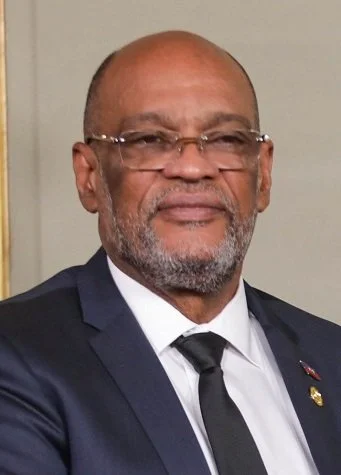
Haitian-American leaders call on Biden to dump Ariel Henry
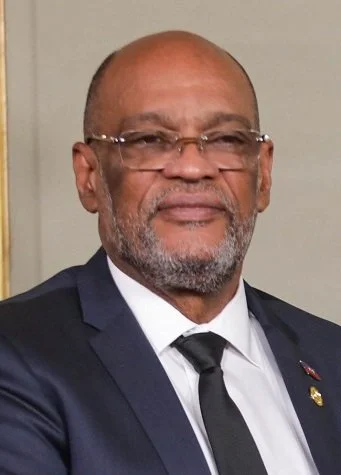
A group of Haitian-American elected officials is calling on President Biden to withdraw support for a Kenya-led peacekeeping mission in Haiti, which they say will bolster acting President Ariel Henry’s grip on power.
The National Haitian-American Elected Officials Network (NHAEON) and Family Action Network Movement (FANM) on Friday wrote Biden and Secretary of State Antony Blinken with the request.
“Any military intervention supporting Haiti’s corrupt, repressive, unelected regime will likely exacerbate its current political crisis to a catastrophic one,” they wrote.
“It will further entrench the regime, deepening Haiti’s political crisis while generating significant civilian casualties and migration pressure.”
Yet the plan to intervene in Haiti under the auspices of the U.N. is barreling ahead.
On Monday, the United States and Kenya signed a five-year defense agreement in Nairobi, and Secretary of Defense Lloyd Austin told Kenyan Defense Minister Aden Duale the Biden administration is working to secure $100 million for the Haiti intervention plan.
Conditions in Haiti have been worsening progressively since the 2021 assassination of former President Jovenel Moïse, which led Henry to take power as acting president and acting prime minister.
Many Haitian and Haitian-American civil society organizations have clamored for the Biden administration to withdraw recognition and support for Henry, which they say is the main factor keeping him and his Haitian Tèt Kale Party (PHTK) in power.
“If your Administration were to withdraw its support for Dr. Henry, he would have been forced to negotiate with Haitian civil society and other groups toward a peaceful solution to Haiti’s current political crisis,” wrote the groups.
Advocacy groups such as NHAEON and FANM have claimed for years that Henry’s government is complicit in gang violence, and is fostering violent conditions to remain in control.
“This regime has dismantled Haiti’s democratic structures while facilitating and conceding control of the country to many gang leaders. The PHTK governments did not run a fair or timely election,” wrote the groups.
“They have created a prevalent culture of corruption that deprives the government of the necessary funds to support the Haiti National Police and provide basic governmental services to the Haitian population.”
But the Biden administration has been mostly unwilling to risk destabilizing Haiti.
“PM Henry is a transitional figure and the head of Haiti’s government. We work with him and his administration on a range of bilateral and multilateral issues, as does the rest of the international community,” a State Department spokesperson told The Hill.
Despite conditions in the country, U.S. officials have continued to deport Haitians back there.
That deportation policy bit back at the administration early on, as Biden’s special envoy, Ambassador Dan Foote, resigned in 2021 with a scathing letter calling the decision to deport Haitians inhumane and counterproductive.
In late 2022, the Biden administration redesignated Haiti for Temporary Protected Status (TPS), a measure that allowed more than 100,000 Haitians to live and work in the United States, a measure advocates had called for.
TPS status is assigned to countries where conditions are too dangerous to humanely repatriate its nationals.
But in designating Haiti, the Biden administration was careful not to criticize the Henry government, and suggested the opposition had been unwilling to negotiate a peaceful path forward.
“The State Department insists that Dr. Henry must be part of any transitional government. Dr. Henry has used the U.S.’s indifference to clinch power and continues to veto any proposed consensus to create an inclusive transitional government without him,” wrote the groups.
The appeal for the United States to take its thumb off the political scale in Haiti is at the center of advocates’ concerns about U.S. policy toward the Caribbean nation.
The United States has a long history of intervention in the country, including an occupation from 1915 to 1934 and three troop deployments over the past 30 years.
Civil society organizations and some Haitian elites are at odds over the need for foreign intervention in Haiti, an exercise that at times has come with disastrous results.
In 2016, former U.N. Secretary General Ban Ki-Moon admitted that United Nations peacekeepers played a role in starting a cholera outbreak in Haiti that led to the deaths of 10,000 people, though Ban did not say the U.N. directly caused the epidemic.
Episodes like that intervention have led civil society and opposition groups to greater distrust of outside measures to pacify the country.
The recurrence of foreign intervention has also led many in Haiti’s civil society to accuse the United States of condescension and paternalism.
The official position of the United States is that conditions on the ground would currently not allow for a free election.
“The State Department believes certain security conditions in Haiti must be met before a free and fair election can take place,” said the department spokesperson.
“A Multinational Security Support (MSS) mission would support the Haitian National Police (HNP) to achieve improved security. We continue to support a Haitian-led, consensus-driven political solution to restore democratic order in Haiti.”
But talks between former rivals in civil society and the opposition have been rendered moot by Biden’s support of Henry, say advocates.
“Over the past three years, groups across the spectrum have gathered, often putting long-running political disagreements aside, to agree on practical, promising plans for a transitional government. But each time, the de facto authorities defeat the promising effort by refusing any compromise,” they wrote.
The groups also called for U.S. authorities to enhance their efforts to avoid weapons trafficking to Haiti.
“Haiti does not manufacture guns and ammunition, but they originate from the U.S. and continue to destroy many lives, including U.S. Citizens. We strongly urge your Administration to effectively investigate armed trafficking to Haiti and provide more resources to the U.S. Customs and Border Patrols to inspect cargo leaving the United States to Haiti,” they wrote.

Dominican president suspends visas for Haitians and threatens to close border with its neighbor
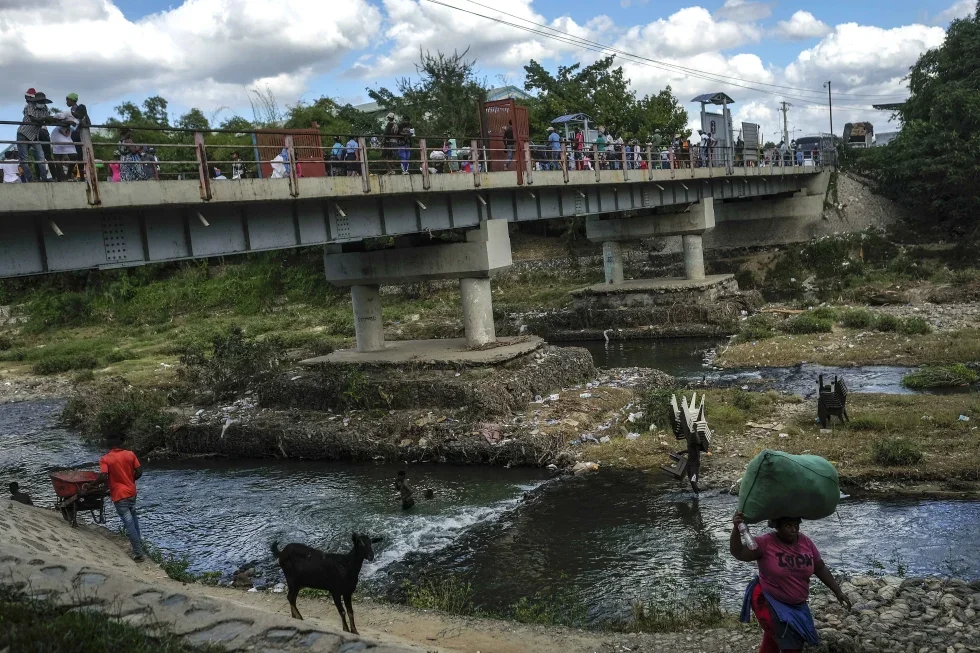
SANTO DOMINGO, Dominican Republic (AP) — The president of the Dominican Republic announced Monday that he has suspended issuing visas to Haitians, and he threatened to shut down land, air and sea traffic between the two neighbors over their latest dispute.
President Luis Abinader’s move follows the recent excavation of a supposed canal in Haiti that Dominican officials argue will divert water from the Massacre River and harm its farmers and the environment. The river, which runs in both countries, is named for a bloody battle between Spanish and French colonizers in the 1700s.
It is not clear who, if anyone, authorized the digging of the canal in Haiti.
“If the conflict is not resolved before Thursday, (officials will) completely close the border to air, sea and land commerce,” the Dominican government said in a statement.
That would be an economic blow to Haiti, which gets much of its imports from the Dominican Republic and where inflation has skyrocketed and poverty deepened amid a surge in gang violence.
It would also hurt Dominican businesses.
A study by the Dominican Republic’s Central Bank said $430 million in informal border trade was conducted in 2017 between the two countries, which share the island of Hispaniola. Of that amount, more than $330 million represented exports to Haiti.
Haiti is also the Dominican Republic’s third biggest partner in formal trade, with $1 billion in exports to Haiti last year and $11 million in imports, according to the Export and Investment Center of the Dominican Republic.
Last week, the Dominican government sent a crew to monitor the construction of the canal from across the border, with officials telling local media that it wasn’t an intimidation tactic but rather an offer to help detain, if necessary, civilians that might be working on the project without permission.
The excavation prompted Abinader last week to shut the border near the northern town of Dajabon, a crucial crossing for Haitians who sell and buy a range of goods there several times a week.
Former interim Haitian Prime Minister Claude Joseph recently defended the construction of the canal and accused critics in the Dominican Republic of being nationalists and racists.
Last year, Abinader banned Joseph from entering the Dominican Republic in an unrelated dispute that heightened the simmering tensions between the two countries.
Abinader has sought to limit the migration of Haitians into the Dominican Republic in recent years and has expelled tens of thousands of Haitians and those of Haitian descen t. His administration also has begun work on a 118-mile (190-kilometer) wall along the Haitian border that Abinader announced early last year.
The last time the Dominican Republic fully closed the border its border with Haiti was in July 2021, after Haitian President Jovenel Moïse was assassinated. Since then, it has occasionally closed parts of the border for security reasons.
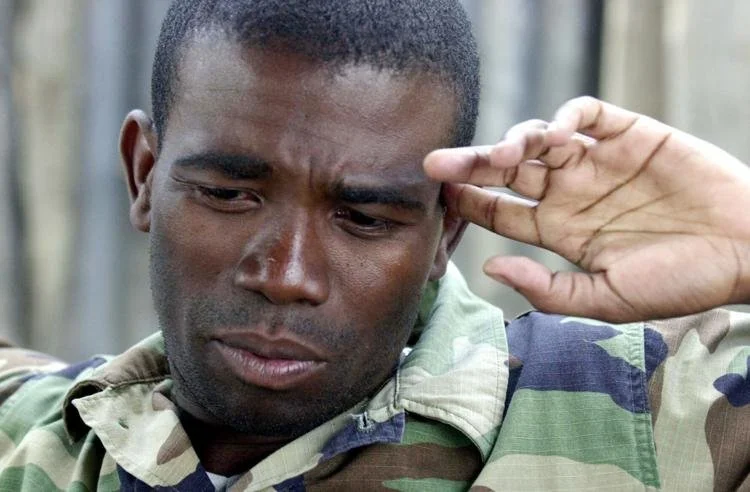
Coup plotter, money launderer Guy Philippe to be freed from US prison, deported to Haiti
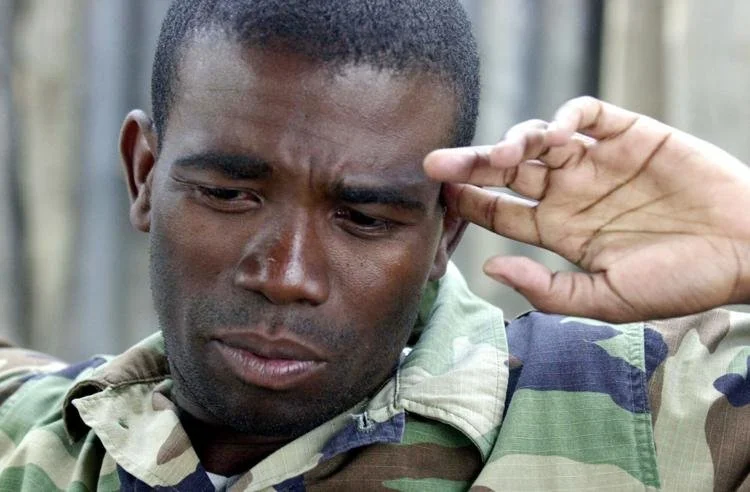
MIAMI — Guy Philippe is a man of many moves.
The former Haitian police commander once led a government rebellion against a president. He was later elected to a seat in the Haitian Senate just before being captured by U.S. authorities who had hunted him down for nearly a dozen years for pocketing more than a $1 million from Colombian cocaine traffickers.
Philippe cut a plea deal with federal prosecutors in Miami, but even then he still tried several times to get his nine-year sentence reduced while representing himself both before and during the pandemic era.
Now, the 55-year-old is scheduled to be released Thursday from a federal prison in Atlanta, transferred to U.S. immigration custody and eventually deported to Haiti, a country reeling from the July 2021 assassination of its president, Jovenel Moïse, and the terror of deepening gang violence since Philippe’s arrest more than four years earlier.
His possible return to Haiti as the United States is trying to stabilize the security situation is fueling concerns about how his presence back in the country might affect an already volatile landscape.
A State Department spokesperson did not want to discuss Philippe’s return to Haiti and directed questions about his deportation to the Department of Homeland Security.
“Mr. Philippe was lawfully arrested by the Haitian authorities and legally extradited to the United States,” the spokesperson said.
Nevertheless, Philippe’s pending return to his volatile homeland is raising questions about U.S. policy regarding Haiti and even has former U.S. diplomats who served in the country and are aware of Philippe’s controversial reputation baffled.
“I’m not close enough to the situation to comment on the facts, but this does seem a particularly bad time to add gasoline to a raging fire,” said Jim Foley, a retired diplomat who served as U.S. ambassador to Haiti between 2003 and 2005, during which time Philippe led a bloody coup against the then-sitting president, Jean Bertrand Aristide.
Luis Moreno, who overlapped with Foley and served as deputy chief of mission in Port-au-Prince from 2001 to 2004, said given how perilous the security situation currently is in Haiti, “it’s incomprehensible how anyone could think this was a good idea. Maybe there is something I don’ t know about.”
“He still has influence. He still has guns. He still has access to narco-trafficking,” Moreno said. “He also has intense political aspirations and ambitions. He wants to be the ruler of Haiti, he wants to be the dictator of Haiti. It has always been his dream and his objective. And that’s dangerous.”
Ahead of his release, Philippe filed a petition with the Inter-American Commission on Human Rights, requesting precautionary measures based on what he says is “a history of persecutions he had previously faced in Haiti and the fear of future harassment; threats and irreparable harm, on account of his political opinions and expressions.”
“Mr. Philippe is petitioning the Commission to actively appeal to the Government of Haiti to provide him with adequate security to protect his rights to life and personal integrity; to adopt the necessary measures so that he can carry out his activities without being subjected to acts of violence, intimidations, threats, or any harassments in the exercise of his daily life,” the petition, obtained by the Miami Herald, said.
Philippe who has passed the time in federal prison by releasing voice notes from prison about his case, refers to his Jan. 5, 2017, arrest by Haitian police as a “kidnapping” and his extradition to the United States on that same day as “illegal” and “politically motivated.”
The seven-member commission, an autonomous organ of the Organization of American States, has not yet ruled on Philippe’s request, stating that it requested information from Haiti on Nov. 17, 2022 but has received no response to date.
Philippe’s next move is anyone’s guess, but in court papers filed last year he expressed “his commitment to return to society as a law-abiding citizen” and “participate in the betterment of his community in Pestel, Haiti,” in the western region of the country.
“He had a vocal group of followers, many of whom are probably waiting for his return to Haiti,” said David Weinstein, a former assistant U.S. attorney who is now a Miami defense attorney. He led a team of prosecutors that brought indictments against Philippe and more than a dozen other Haitian police officers, politicians and business people on drug-trafficking and related money-laundering charges nearly two decades ago.
“The situation in Haiti today is even more fragile than when he was expelled in 2017,” said Weinstein, the former chief of the narcotics section at the U.S. attorney’s office. “The potential remains for him to mobilize his followers and return to a position of power in Haiti.”
Whether Philippe, who refers to himself as a senator, can run for office again in Haiti will depend on the yet-to-be-written electoral law and whether it continues its ban of individuals who have been convicted of crimes.
Philippe’s U.S. conviction
In April of 2017, Philippe pleaded guilty to a money laundering conspiracy charge, allowing him to avoid going to trial on a more serious trafficking charge that could have sent him to prison for the rest of his life. Instead, he faced up to 20 years on the money laundering conviction and got less than half that time from U.S. District Judge Cecilia Altonaga in line with a joint recommendation by prosecutors and defense lawyers.
The sentencing culminated a federal investigation into drug trafficking, money laundering and corruption at the highest levels of Haiti’s government that began in the 2000s when the island of Hispaniola, which Haiti shares with the neighboring Dominican Republic, became a notorious hub for shipping South American cocaine into the United States. For years, Aristide, who was ousted in 2004 in an armed revolt led by Philippe, had been investigated by a Miami federal grand jury for accepting drug bribes. Charges were never filed.
Philippe’s punishment was the result of a deal that became inevitable after Altonaga refused to dismiss the case based on Philippe’s claim of immunity as a senator-elect in Haiti. She also chastised the federal government for not trying harder to arrest Philippe since his 2005 indictment. He was arrested by the Haiti National Police and turned over to the Drug Enforcement Administration in early January 2017, days before his swearing-in.
The timing of his arrest in Haiti allowed the then-government of interim President Jocelerme Privert to govern the country without the looming presence of Philippe, who had threatened to divide the country shortly before Privert came into office. A supporter of Jovenel Moïse, Philippe openly campaigned with him before Moïse became president in 2017. Moïse would name the head of Philippe’s political party, Jeantel Joseph, to an important security post.
In Miami, federal prosecutors agreed to the lower end of the sentencing guidelines — ranging from nine to 11 years — for Philippe’s punishment because they believed the amount of time was in line with other Haitian officials who had pleaded guilty to similar money laundering offenses. They cited two defendants: former national police chief Jean Nesly Lucien and former presidential security chief Oriel Jean.
Lucien was sentenced in 2005 to almost five years after admitting he received $180,000 in drug proceeds as bribes. He did not cooperate with authorities.
Jean, bodyguard for Aristide, was sentenced in 2005 to three years in prison after helping the U.S. attorney’s office as a cooperating witness to convict several Haitians and Colombians of moving tons of Colombian cocaine through Haiti to the United States. He admitted receiving $400,000 in bribes. Jean, who testified in the only Miami trial that ended with the conviction and life sentence of a Haitian drug trafficker, was gunned down a decade later in Haiti’s capital. His assassination remains unsolved.
The U.S. government’s cases were built largely on cooperating witnesses involved in drug trafficking or protection in Haiti. In those cases, prosecutors relied mostly on witnesses and bank accounts rather than seizures of cocaine. The prosecutions of Haitian officials were challenging because the illegal activity happened in an impoverished foreign country where police officers were often on the take and tracing bribes was difficult. Also significant, the cocaine loads shipped from Colombia to makeshift airstrips in Haiti were long gone by the time U.S. investigators uncovered the trafficking through the island.
Philippe’s case was all the more difficult because he had been on the lam for almost 12 years while cultivating a Robin Hood reputation in the western reaches of the country far from the capital. For more than a decade, federal agents, in collaboration with the Haiti National Police, made at least 10 attempts to arrest Philippe: setting up checkpoints, paying informants, launching a U.S. military operation and pursuing him in a foot chase, only to lose him in dense vegetation.
In U.S. custody, Philippe admitted accepting at least $1.5 million in cocaine profits from Colombian traffickers between 1999 and 2003. According to a statement filed with his plea deal, Philippe admitted that he not only shared the bribes from narco-traffickers with fellow officers in the Haiti National Police, but he also wired hundreds of thousands of dollars to the United States to buy a home in Broward County, Florida, and support his U.S.-citizen wife.
Pierre Esperance, a human rights defender in Haiti, said Philippe has been issuing threats from prison, trying to intimidate individuals as he singles them out in recordings that have been shared on social media.
“Guy Philippe is someone who has been judged and condemned for drug trafficking in the United States,” said Esperance, the head of the National Human Rights Defense Network in Port-au-Prince. “I am hoping he is a changed man and has taken a lesson from his incarceration and will rehabilitate himself so he doesn’t continue with the threats, intimidations and what he was previously involved with.
“Even if it’s true that there are problems in Haiti, it is not a savanna that he is returning to,” Esperance said. “And if he continues doing what he was doing before, then his place is in prison.”
Philippe was the last high-profile defendant from a U.S. crackdown on cocaine smuggling through Haiti that yielded the convictions of more than a dozen drug traffickers, Haitian senior police officers and a former Haitian senator. Among them: Beaudouin “Jacques” Ketant, a Haitian narco-trafficker who accused Aristide of turning a blind eye to the cocaine. Ketant, initially sentenced to 27 years in a U.S. prison, was deported to Haiti in 2015 when his term was cut in half after assisting federal prosecutors in their probe.

The US keeps deporting people to a country that it says is too dangerous for travel
CNN —
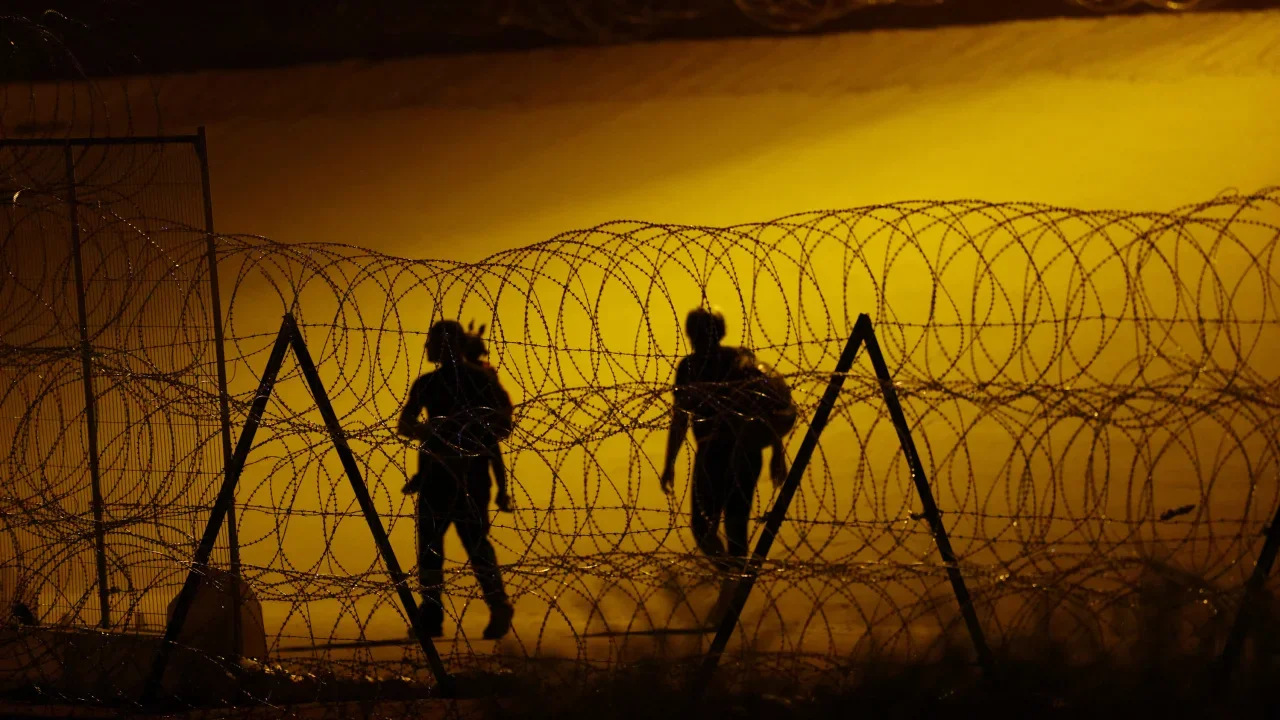
The Biden administration has taken mixed positions on its policies involving Haiti – with one federal agency warning that the Caribbean country is too dangerous for US citizens, while another agency deports Haitians back to the violence-torn country.
Violence in Haiti during the second quarter of 2023 jumped almost 14% when compared to the previous quarter, according to a United Nations report released Thursday.
On August 30, the US Embassy in Haiti urged American citizens to leave the country due to the “current security situation.” The next day, US Immigration and Customs Enforcement (ICE) deported an undisclosed number of individuals to Haiti.
With Haiti’s capital Port-au-Prince largely controlled by gangs infamous for kidnapping and murder, experts warn that the deportations could amount to death sentences.
“This act puts lives in danger,” Guerline Jozef, executive director of the Haitian Bridge Alliance, said in a statement. “We urgently call upon President Biden, Vice President Harris, Secretary Mayorkas, and the entire administration to cease all deportations to Haiti.”
Waves of crime and unrest have hit Haiti since the assassination of former President Jovenel Moise in 2021. His successor, Prime Minister Ariel Henry, has struggled to staunch the violence. More than 1,860 victims of killings, injuries, and kidnappings were documented between April 24 and June 30, 2023, the UN report said.
Nevertheless, Haiti was among the top three destinations for charter flight deportations from the US during the 2022 fiscal year, with 125 flights conducted during that time, according to ICE’s annual report.
In recent years, the US has deported more than 2,700 Haitians, with 895 deported in fiscal year 2020, 353 in fiscal year 2021 and 1,532 in fiscal year 2022, according to the same report.
Citing the Biden administration’s expansion of legal pathways for Haitians, a White House National Security Council spokesperson told CNN in a statement that Haitians seeking to enter the United States are urged to do so legally.
The US Departments of State and of Homeland Security “monitor the situation on the ground and coordinate closely with international partners to ensure migrants can be safely returned to Haiti,” the spokesperson also said.
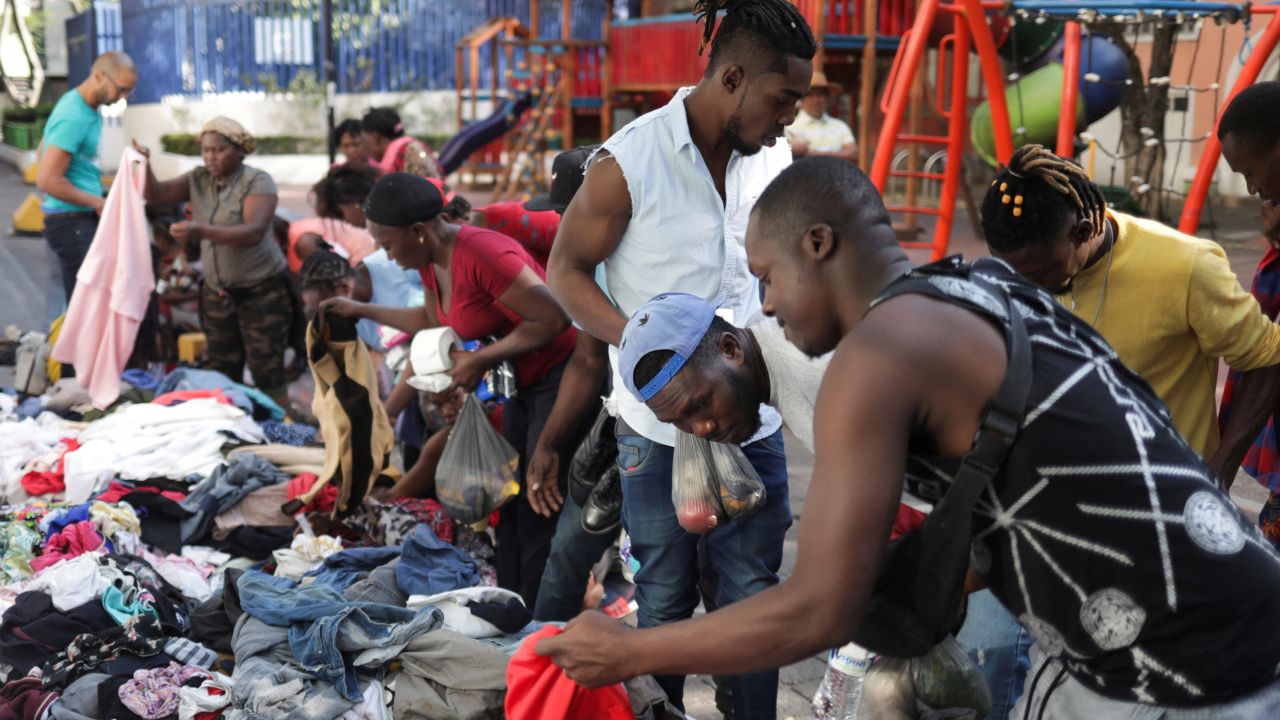
Migrants, mostly from Haiti, collect clothes donated by a group of volunteers, at the Giordano Bruno in Mexico City, Mexico, April 6, 2023.Henry Romero/Reuters
For months, Henry and the United Nations Secretary-General Antonio Guterres have called for a military intervention in the country. But Haiti’s neighbors in the Western Hemisphere have quietly declined a leading role.
In late July, the government of Kenya offered to lead a “multi-national force” of 1,000 police officers to help train and assist Haitian police “restore normalcy” to the Caribbean nation – an idea that has been embraced by the US government.
“The United States commends the Government of Kenya for responding to Haiti’s call and for considering to serve as the lead nation for a multinational force in Haiti to assist in addressing insecurity caused by gang violence,” US Secretary of State Antony Blinken said in a statement in August.
Blinken added he looks forward to advancing the process of Kenya’s involvement through a UN Security Council resolution authorizing a multinational force in Haiti.
During a White House news briefing Tuesday, national security adviser Jake Sullivan said he wouldn’t go into the operational details but reiterated the US’s commitment to “support a multinational force that is fundamentally a policing support mission, not a military mission, and one that is in support of the Haitian National Police, not taking over the sovereign policing capacities from the Haitian National Police.”
Previous UN peacekeeping missions to Haiti have left a bitter legacy, and critics point out that Kenyan security forces’ conduct has raised some rights concerns at home. In 2022, the US Department of State found Kenya had “significant human rights issues,” including credible reports of “arbitrary killings,” “extrajudicial killings,” “forced disappearances,” “torture,” and cases of “cruel, inhuman or degrading treatment”.
According to a White House National Security Council spokesperson, the US is “working closely with the Kenyan government to ensure that any prospective participants in this mission would be well prepared to bring greater security to the people of Haiti and would have a demonstrated commitment to respecting human rights.”
“Additionally, we will work with partners including Kenya to monitor and investigate any allegations of human rights abuses once the mission is deployed,” the spokesperson said.
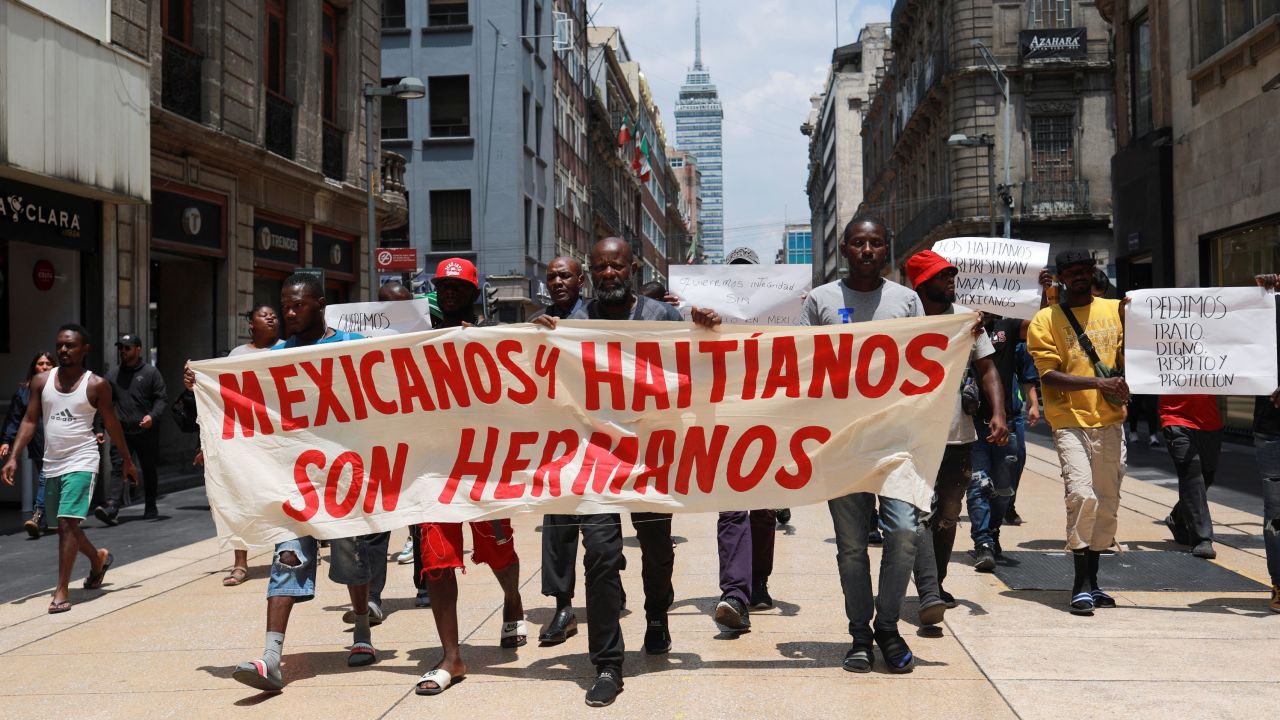
Migrants, mostly from Haiti, take part in a protest with a banner that reads "Mexicans and Haitians are brothers" in Mexico City, Mexico May 29, 2023.Henry Romero/Reuters
The UN Security Council is expected to consider the possibility of a Kenyan-led multinational deployment in the coming weeks.
In the meantime, as the United States creates new immigration programs and hardens its border enforcement policies – including increased deportations, among other tactics – Haitians fleeing the country appear to be looking for alternatives paths.
The Biden administration launched a parole program in January that allowed 30,000 people from Haiti, Venezuela, Nicaragua, and Cuba who pass vetting and had a US based financial supporter to enter the US legally every month. Haitians are the top nationality taking advantage of the program. Of the 181,000 people who have arrived legally from January to July, Haitians make up more than one third (over 60,000) of beneficiaries, CBP data shows.
Panamanian government data shows that since the beginning of the year, the number of Haitians transiting through the dangerous jungle between Panama and Colombia, known as the Darien Gap, has significantly dropped. This year Haitians have also become the top nationality seeking asylum in Mexico.
But many continue to take dangerous risks to reach US shores. From October 2022 to July 2023, more than 5,000 Haitians were interdicted at sea by the US Coast Guard.

Haiti News Round-Up: Kenya Offers to Lead Intervention Force
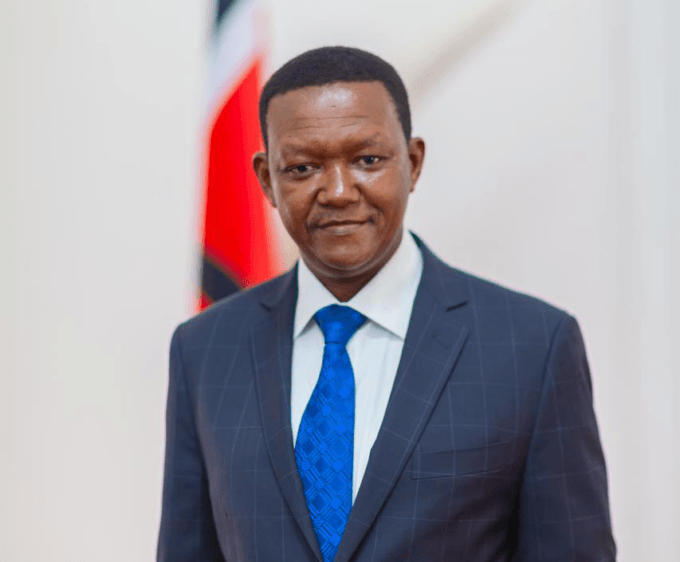
In a statement released on Twitter Saturday, Kenya’s foreign minister Alfred Mutua expressed his country’s intention to lead a multinational force in Haiti — a contingent of 1,000 police officers to “help train and assist Haitian police restore [sic] normalcy in the country and protect strategic installations.” An assessment mission is expected to travel to Haiti in the coming weeks.
The same day, US Secretary of State Antony Blinken spoke with Kenyan president William Ruto to discuss regional security issues, including the offer to lead a multinational force in Haiti. For many years, Kenya has been a key US military ally in East Africa, hosting US military bases and participating in US-backed operations on the continent, including the war against al-Shabaab in Somalia.
Kenya’s announcement comes after a high-level US delegation that included Todd Robinson, the head of the State Department’s Bureau of International Narcotics and Law Enforcement Affairs, traveled to Nairobi last week. Former US ambassador to Haiti Michel Sison, now the assistant secretary of state for international organization affairs, and former head of the UN mission to Haiti Helen Lalime, who now serves as an advisor to Sison, were both reportedly involved in the discussions.
On Monday, State Department spokesperson Matthew Miller said that the United States and Ecuador would draft a UN Security Council resolution to authorize deployment of the international force, though the mission would not be a traditional UN peacekeeping operation. The US is “committed to finding the resources to support this multinational force,” Miller added.
The offer of police assistance was welcomed both by the de facto Haitian authorities, who initially requested such an intervention in October 2022, and by UN Secretary-General Antonio Guterres, who is due to deliver a report to the Security Council this month on “the full range of support options the United Nations can provide to enhance the security situation.” On Tuesday, the Bahamian government, which has been intercepting record numbers of Haitian migrants, announced that it would provide an additional 150 officers for the planned force.
For the last year, countries have been reluctant to lead such a mission to Haiti, in part due to concerns about the mandate of de facto prime minister Ariel Henry and the lack of a broad-based political accord. Canada, which the US had pressured to lead an intervention force, has instead focused on financial and technical assistance to the Haitian police. On Monday, Prime Minister Justin Trudeau, while welcoming Kenya’s offer, appeared frustrated with the pace of reform and lack of political dialogue.
“We’ve been there in Haiti for three decades at different times to help counter the violence, the political instability, an appalling humanitarian situation, and we still find ourselves now in a situation that is among the worst ever,” he said. “We are here to put pressure on the political class in Haiti, which is not taking seriously the responsibility they have to compromise and restore security.”
The issue of foreign forces remains a point of contention for many Haitians. In particular, there are concerns about the Kenyan forces’ reputation. The Associated Press reported that, “as the U.S. government was considering Kenya to lead a multinational force in Haiti, it was also openly warning Kenyan police officers against violent abuses.” Haiti’s ex-prime minister Claude Joseph, a member of the opposition to the de facto authorities, also expressed concern: “Kenya […] is embroiled in its own internal socio-political crisis. […] The anti-government protests against the rising cost of living are violently repressed by the police. Can a police force that is not professional in its own country act as such abroad?”
In The New York Times, Jean Jonassaint, a professor at Syracuse who studies Haiti, questioned the choice of Kenya to lead such a mission, given the language barrier. “I don’t think 1,000 soldiers can solve the problem in Haiti, especially coming from Kenya, because they don’t speak French, don’t speak Haitian Creole and cannot communicate directly to the population,” he said. The US and UN have pledged to learn from previous failed interventions, but the language barrier was also a significant issue in the 13-year MINUSTAH operation, which was led by Portuguese-speaking Brazilian troops.
The announcement of a multinational force also threatens to derail ongoing political negotiations. For months, Haitian civil society organizations have warned that the imposition of a security intervention, without first establishing a more broadly acceptable and legitimate transitional government, would be unlikely to succeed, and would instead simply consolidate the de facto authorities’ power.
Escalation of violence prompts US Embassy to call for evacuation
The US State Department has ordered its nonemergency staff at the US embassy in Port-au-Prince to leave Haiti due to escalating violence. It also reissued its “Do Not Travel” advisory for the country, which advises US citizens to leave the country immediately. Earlier in the week, dozens of Haitians displaced by ongoing violence, and seeking refuge in front of the US embassy, were teargassed by the Haitian National Police (PNH). Those attacked included children and pregnant women.
In a July 26 press release, the National Human Rights Defense Network (RNDDH), condemned the PNH officers’ behavior, and in particular criticized the PNH’s acting director general, Frantz Elbe:
“RNDDH condemns with the utmost rigor the outrageous use of force by PNH agents against a population left alone to fight, who, by going to the premises of the US Embassy in Haiti, were only seeking refuge. RNDDH recalls that the right to seek refuge whenever one’s life, safety, or any other fundamental rights and freedoms are threatened or violated, is recognized for all persons.”
Those who sought shelter outside the embassy had fled violence perpetrated by the Kraze Baryè gang led by Vitel’homme Innocent, who is wanted by the FBI in connection with the kidnapping of missionaries in 2021. In its release, RNDDH accused Innocent of being Elbe’s “protege.” The organization claims that Innocent is known to travel accompanied by state vehicles and that in recent weeks he had met with state officials. Since then, attacks have intensified, RNDDH reported.
On the same day the US issued its travel advisory, a US nurse and her young child were kidnapped in the Cité Soleil neighborhood of Port-au-Prince, where she worked at a local clinic. The case has generated international headlines, President Joe Biden has been briefed, and the US government has said it is working for their release.
After a brief respite — seemingly as a result of the Bwa Kale citizen justice movement — local groups have documented a sharp rise in violence in recent months. RNDDH reported at least 40 people abducted and 75 murdered from May to mid-July.
US Senate holds two Haiti-related meetings
Last week, the Senate Foreign Relations Committee held two hearings related to Haiti. On Tuesday, the committee held a nomination hearing for Dennis Hankins, President Biden’s nominee for the next US ambassador to Haiti. This was followed the next day by a hearing with Assistant Secretary of State for the Western Hemisphere Brian Nichols and a top USAID official. Despite the high-level attention on Haiti and the looming prospect of a US-financed multinational intervention, only two senators showed up to ask questions.
EU amends rules to impose sanctions on individuals and businesses in Haiti
The Council of the European Union amended its sanctions regime in order to allow the EU to autonomously impose restrictive measures on “individuals and entities responsible for threatening the peace, security or stability of Haiti, or for undermining democracy or the rule of law in Haiti.” While no individual or entity has been sanctioned at this stage, the measures are comprised of a travel ban for individuals, as well as a freezing of funds for individuals and entities. In addition, EU entities and individuals will be forbidden from making funds available to those listed, either directly or indirectly.
“With this new framework for restrictive measures, we are sending a clear signal to Haitian gang leaders and their financiers: we know how they operate and there will be no impunity. The EU stands with Haiti and its people,” Josep Borell, EU High Representative for Foreign Affairs and Security Policy stated. The EU joins Canada, the US and the United Nations in issuing sanctions against Haitian individuals and entities.
The EU, however, has been reluctant to take leadership or an active role in the planned multinational force. In conversations with the press ahead of the EU-Latin America and Caribbean Summit, the EU Ambassador to Haiti, Stefano Gatto, said that the bloc could not support Haiti without the leadership of the United States and Canada. “Proposing to engage our security apparatus in Haiti when the Russian army is just 300 kilometers away from the European Union is quite complex,” he said, highlighting that the war in Ukraine had captured the bloc’s attention.
“In the field of security, we could not be at the forefront or take the leadership,” Gatto added. “There are countries much closer to Haiti that can do it on our behalf. Why would the Union help Haiti when countries in the hemisphere such as the United States, Canada, or the Latin American countries, are not doing it themselves? […] We can participate in any initiative if it is led by a country from the American hemisphere.”
Expulsions and deportations of Haiti continue
On August 2, ICE deported some 55 Haitians to Port-au-Prince. The move comes less than a week after US officials ordered the departure of all nonemergency staff, due to safety concerns. According to Witness at the Border, it is the 285th such flight to Haiti since the beginning of the Biden administration, sending a total of more than 27,000 individuals to Haiti.
While welcoming Kenya’s offer of security assistance, Dominican president Luis Abinader pledged to continue with his country’s draconian immigration enforcement. Over the last year, the Dominican Republic deported over 200,000 Haitians, while also building a wall along its border with Haiti.
A long interactive piece in the Washington Post looks at smuggling routes in the Bahamas that are transporting record numbers of Haitians seeking to make the journey to the US. “So far this year, Bahamian authorities have apprehended 1,736 migrants, 1,281 of them Haitian,” The Post reports. Meanwhile, this fiscal year the US Coast Guard has intercepted more than 5,000 Haitians.
Haitians around the globe march for relief
In more than 70 countries around the world, thousands of Haitians marched on July 9 to call for relief for Haiti. In the United States, marches led by pastor Gregory Toussaint in South Florida called on Congress to pass the Haiti Criminal Collusion Transparency Act, which was just approved by the House and is now pending in the Senate. The act would mandate the State Department to regularly report on ties between Haitian elites and criminal gangs and for the US to implement sanctions on those identified. The protesters also requested for the Biden administration’s Humanitarian Parole program to remain open.
The Humanitarian Parole program also remains highly controversial, with many PNH officers applying to leave the country, a disastrous blow to the force when it is already unable to tackle the country’s security crisis. Marleine Bastien, a Haitian community activist and immigration rights advocate in South Florida, called the program “ill-advised and ill-conceived” back in February. Others have argued that the program is further exacerbating the country’s brain drain. Florida governor Ron DeSantis and the leaders of 19 other Republican states are challenging the legality of the program in federal court. According to the Department of Homeland security, some 63,000 Haitians have been approved for travel and more than 50,000 have arrived in the US.
A different march was organized by several Haitian diaspora organizations on July 21 in Washington DC, titled “Haitian Solidarity Day for Change.” In an interview ahead of the protest, one of the organizers said the effort was aimed at telling the White House that they must change their policy toward Haiti and for the international community to stop deciding for Haitians. “The decision of the country is up to the Haitians, we want to be around the table and take charge of the destiny of our country,” they said.
Haiti loses an icon
On July 31, Liliane Pierre-Paul, a long-time journalist and outspoken champion for democracy and press freedom, died of a heart attack. “Liliane will always be remembered for her courage, her determination, her profound beliefs in the democratic ideals so many died for,” Michèle Montas, widow of the slain journalist Jean Dominique, told the Miami Herald. For more on the life and legacy of Pierre-Paul, read the entire Herald article.

In Haiti, a grassroots vigilante movement is fighting back against gang warfare
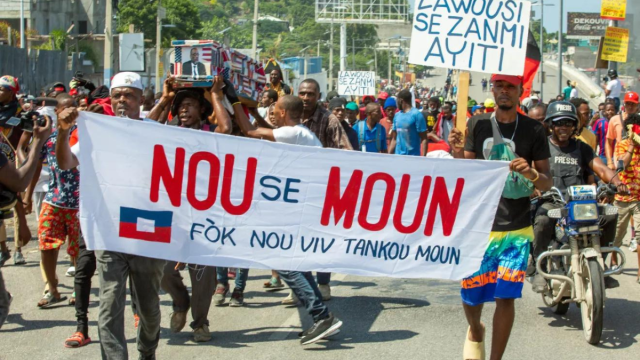
A powerful wave of vigilantism has brought both optimism and fear, leaving governments on the sidelines
Port-au-Prince is as violent as it has ever been, but for two weeks now the fear has also flowed in a different direction — thanks to a phenomenon known as "Bwa Kale."
"Bwa Kale" literally means "peeled wood" in Haitian Creole. It's also a metaphor for an act of swift justice.
While gang members continue their depredations in the east end of the Haitian capital, in other parts they have been forced to flee. Many have been lynched or summarily executed following capture by groups of citizens, sometimes acting alongside police.
Bwa Kale messages and memes are everywhere on Haitian social media, and recording artists like Tony Mix have put out tracks promoting the trend. There is even a Bwa Kale dance.
While many have reservations about the movement and where it might lead, large numbers of ordinary Haitians seem to have found a kind of joyous release in turning the tables on their tormentors.
Burned alive
A spontaneous event on April 24 appears to have been the catalyst for the movement. Police in the Canape Vert area of Port-au-Prince intercepted 13 or 14 members of a gang travelling on a minibus to join with an allied gang in the Dubussy district.
"This party didn't have any long guns with them," said Louis-Henri Mars, director of the Haitian peacebuilding non-profit Lakou Lape. "They only had pistols in their rucksacks, and when they were stopped, the police disarmed them."
A crowd quickly gathered at the scene.
"The police felt the pressure, or they felt threatened by the crowd, and they released those guys to die basically," said Mars. "And the crowd stoned them and burned them to death, and this was the start of it."
Cell videos from the scene show Haitian police holding a group of young men on the ground while civilians pelt them with rocks. Tires are piled over them. Other videos show the men on fire and display their charred remains.

"It dispelled the myth of their invincibility," said Mars. The next day, he added, "the group that they were going to meet in Dubussy was also attacked by the population with the police.
"They scrambled out of where they were and they were pursued and, one by one, killed. Some of them were lucky to get arrested and brought to the police station."
Calls for an "Operasyon File Manchet" (Operation Sharpen Machete) began to circulate on social media in Haiti on April 25. Some evangelical churches also spread the message.
"And so this has created a whole movement all over the city and even the country," said Mars, "a movement of the police in front and the people behind."
A fever of revenge
Subsequent days saw many districts of Port-au-Prince move to a war footing. When gangs entered a neighbourhood, people banged pots and pans to alert neighbours. Most neighbourhoods had just a few handguns to defend themselves from gangs armed with automatic rifles, but civilians took potshots and threw rocks from rooftops. Some were able to repel gang invasions.
Crowds went on the offensive, using their numbers to overwhelm gang safe houses, drag suspected gang members out of police stations and kill them in the street.
The anger in the videos is palpable. Haitian gangs have raped women and girls on a massive scale. They routinely kidnap children and use torture against kidnap victims. They have ruthlessly extorted even the poorest families.
In some instances, gang members have been made to confess to crimes or gang affiliations on video. Many are burned using tires — often while still alive.
Burning with tires is a practice that goes back to the era of President Jean-Bertrand Aristide. It's also meant as retaliation in kind against gang members who have taunted police with videos of indignities done to the bodies of slain officers. Many Haitians involved in Bwa Kale have also shared images of a young man who was burned to death with a tire by criminals for refusing to join their gang.
Governments reduced to spectators
"Canada is deeply concerned by the recent population movement and escalation of violence in Haiti stemming from the increase of killings and executions committed by criminal actors," a spokesperson for Global Affairs told CBC News, adding that Canada's focus is on "bolstering the capabilities of the Haitian National Police in the immediate term."
Haiti's Prime Minister Ariel Henry expressed disapproval of the Bwa Kale movement in his May Day speech.
"The insecurity we live in is appalling," he said. "But don't let bad plans make us play sordid games."
"I ask my compatriots, whatever they may have suffered at the hands of the bandits, to remain calm," he said, adding that Haitians should help police by giving information about suspicious people in their neighbourhoods.
But under Bwa Kale, cooperating with the police goes well beyond giving out tips. Abundant cell phone footage from Port-au-Prince shows police and civilians engaging together in street battles with gang members.
Cooperation between civilians and police is sometimes so close, it completely cuts out the Haitian government.
One neighbourhood's battle
Laboule and neighbouring Thomassin are well-to-do outlying suburbs of Port-au-Prince. In the small Laboule 12 enclave, a gang led by Ti Makak (Little Monkey) killed three police officers last September and a few weeks later ambushed and killed the district's most prominent resident, former presidential candidate Eric Jean Baptiste, together with his bodyguard.
"They started terrorizing the population, killing, shooting, raping, kidnapping, ransoming," the organizer of Laboule 12's self-defence group told CBC News. CBC is not identifying him due to the threat of gang retribution. He said he barely survived an ambush when gunfire struck the bulletproof windshield of his car.
The resident, a lawyer, said the community petitioned the government for help for months before taking matters into its own hands.

"It's as if the government is benefiting from the fact that this country is in limbo," he said. "They still get paid, they're buying brand new 2023 Land Cruisers for government officials. They're running with high security, they are safe, and the rest of the people [are] just abandoned."
He described how his group reached a deal with a local police inspector — they fixed a broken Canadian-made armoured vehicle for about $32,000 US in exchange for a police commitment to use it to defend their neighbourhood.
'It's horrific'
The group also hired private security to guard the approaches to the neighborhood.
A video the group shared showed a civilian checkpoint overlooking a footpath into the Laboule 12. People can be seen fleeing uphill from another neighbourhood, where automatic rifle fire can be heard. A man armed with an AR-15 rifle questions the refugees and makes them raise their shirts to show they are unarmed.
The group also rented pickup trucks to conduct surveillance and prepare ambushes. It all led up to what the resident called a "surge" operation that saw Ti Makak and his brother fatally wounded.
The unnamed resident estimates that at least 50 alleged bandits have been killed in his area since then.

"With that surge the entire population started to say that they had enough," he said. Ti Makak's death "emboldened some of them and they started going after (gang members) and tracking them. Soon it was the majority of the people against the gang and they started killing them.
"As a lawyer myself, it pains me to say, but there were, there was a bunch of summary executions … They were stoned to death and burned with tires, some of them even alive. It's horrific."
CBC News saw video that showed an accused gang member in Thomassin being stoned and burned in a fire.
"We've put back security on some of the territories we lost," said the resident. "So there's a sense of relief even though there's trauma.
"You start to see people coming back, coming out and starting walking again. You have some local shops that are reopening slowly. It's a slow movement, but there's a huge relief."
Innocents caught up
But as with all mob violence, this vigilante movement has claimed some innocent victims.
Police officer Emmanuel Derilien was lynched in St-Louis-Du-Nord on Monday when he was mistaken for a gang member after he shot and wounded two people in an altercation.
Crowds can quickly surround an unfamiliar face and sometimes don't give strangers a chance to justify their presence.
Though it's supportive of police, the Bwa Kale movement appears to pose a threat to the unpopular Ariel Henry government and to undermine Haiti's standing among the nations that back it, including Canada.

Most Haitians see the ruling Pati Ayisyen Tet Kale (Haitian Bald Head Party) as not only ineffective in fighting the gangs but as an accomplice of them — a conclusion supported by human rights groups.
"Whatever Ariel Henry is saying is not going to be listened to by the population because he and his government have not been able to to defend them," said Mars.
"The police, the street officers at least, have suffered quite a bit at the hands of the gangs who've been killing them, and hiding and destroying the bodies of those they kill so that their families would not be able to give them proper burial. So the street officers are also in a lot of ways taking things into their own hands."
New leaders rising
The wave of vigilantism in Haiti is bringing new leaders to the fore, such as Jean-Ernest Muscadin, the "komise" of Miragoane (a role somewhat like a district attorney).
A lanky man of serious demeanour who wears body armour to work and carries a rifle, Muscadin has become a star of Haiti's raucous citizen media channels for making his district an island of relative safety in a sea of chaos.
"I am a missionary. I came to restore order," Muscadin told Haitian reporters recently, adding the state gives him nothing beyond his salary of $445 a month.
Everything else "comes from the diaspora," he said. "You can't talk about the state. The state cannot help itself."
Haitian-Canadians based in Montreal formed a group called the Alexandre Petion Collective which has provided Muscadin with drones, fuel for vehicles and other assistance.
"We are marching with him 100 per cent. He is our inspiration for our collective and the whole Bwa Kale movement in Haiti," a member of the collective told CBC News. (CBC is not identifying this person either, due to the risk of gang retribution; they travel to and from Haiti regularly.)
Muscadin reportedly maintains rigorous control over people and goods moving through his area. Gang members captured in Miragoane can expect to be "shot while trying to escape."
"All revolutions have the potential of birthing that kind of leadership" said Mars. "And sometimes this is dangerous also because you don't know who, when and where and what kind of individual is going to show up on the stage. It's the start of something that could evolve into a very dangerous situation."
Unintended consequences
Self-defence groups formed to combat rampant criminality in Colombia in the 1990s morphed into violent paramilitary groups that stole land, displaced people and trafficked drugs. Mars warns something similar could happen in Haiti.
"In fighting the gangs, you are letting go of the restrictions of propriety, of due process, of state control of violence, and this movement can be the breeding ground for more gangs," he said. "In general, when you have vigilante groups, what happens is that some of them over the over weeks and months become gangs themselves.WATCH | Vigilante movement has swept Haiti:
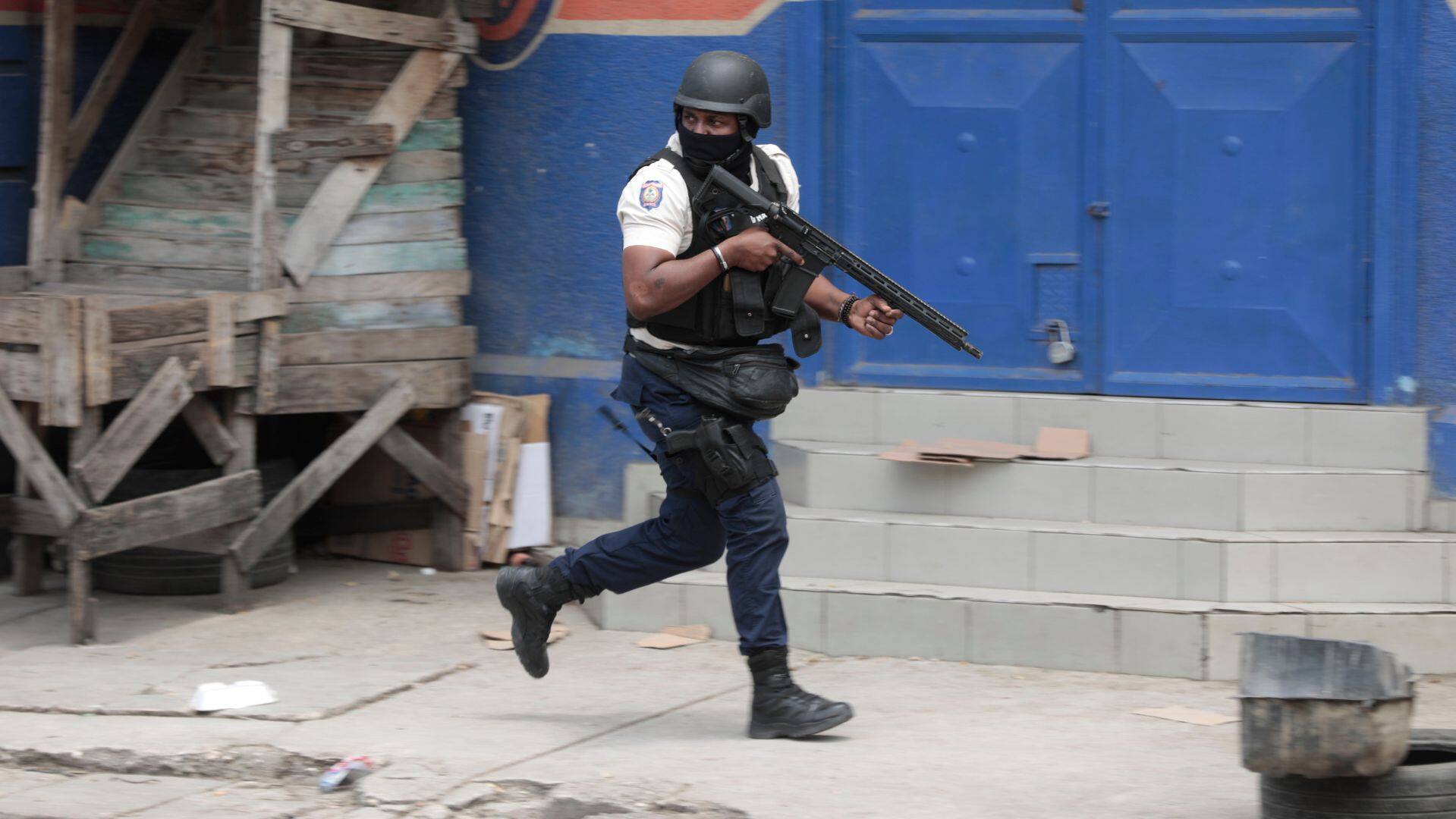
Vigilantes fight back against Haiti's gangs
18 hours agoDuration2:19Warning: Video contains graphic images | A rise in armed vigilante groups has opened an unpredictable new chapter in Haiti’s gang war, as ordinary civilians, tired of being terrorized, take matters into their own hands.
"Since the social situation has not changed, the space is there for the replacement of the present generation by another generation of gangs."
On balance, though, Mars said he shares the sense of optimism that Bwa Kale has brought to the Haitian capital for the first time in years.
"There is something that has changed. There's a window of opportunity that has opened. Now it is up to us Haitians to take this window of opportunity and move in the right direction and not continue to destroy, burn and kill."

Haiti's Notorious Gang Leader, Vitel'Homme Innocent, Named in Presidential Killing

Away from the besieged center of Haiti's capital, Port-au-Prince, one gang leader has gained notoriety for attacks in the city's suburbs. Now he's being linked to the murder of former President Jovenel Moïse.
A spokesperson for the Haitian National Police (Police Nationale d'Haïti -- PNH) named gang leader Vitel'Homme Innocent as a suspect in the July 2021 assassination of President Moïse during a March 10 interview with Radio Télévision Caraïbes. Police did not clarify Vitel'Homme's alleged role in the killing.
Vitel'Homme has made a name for himself in recent months as the leader of the Kraze Baryè gang, orchestrating a string of attacks on police and residents of towns on the outskirts of Haiti's capital.
The Kraze Baryè gang attacked a PNH police station in Fort-Jacques, a wealthy suburb south of Port-au-Prince, on March 1, stealing guns and bulletproof vests, and then setting fire to the station, Haiti Libre reported.
A month earlier, on February 29, the gang reportedly shot and killed four people, including a PNH officer, again in Fort-Jacques. The same day, Vitel'Homme's men burned down a police station in Pétion-Ville, while on January 21, the gang engaged in a shootout with PNH officers in Métivier, killing at least four.
In response to the attacks, the PNH announced "Operation Tornado 1," targeting Vitel'Homme and members of Kraze Baryè in the gang's traditional strongholds of Torcelle and Pernier, areas east and northeast of Port-au-Prince, Alter Presse reported.
Kraze Baryè's attacks have marked an increase in gang activity outside of the crime-ridden capital city, whose economy is "dead," according to Eric Calpas, a gang researcher in Haiti, who spoke to InSight Crime.
Up to 30 gangs now operate around Pétion-Ville, a suburb south of the capital, where the capital's financial and economic activity is now centered, Calpas added.
InSight Crime Analysis
The accusations of the Vitel'Homme's involvement in the murder of Moïse remain murky. What is more apparent is that Haiti's dire security situation permits smaller gang leaders to quickly grow in prominence.
Originally a political activist, Vitel'Homme turned to crime as an alternative route to gain political capital but has maintained ties to grassroots political movements and actors, Calpas explained.
The Kraze Baryè leader previously claimed he has direct connections with Ariel Henry, Haiti's prime minister and acting president, as well as the director general of the PNH, Frantz Elbé. Neither the government nor PNH has confirmed his claims, though links between criminal and political leaders are well-established in the country. The United States, Canada, and the United Nations have imposed sanctions against multiple former and current politicians for their links to a litany of criminal activities and crime groups.
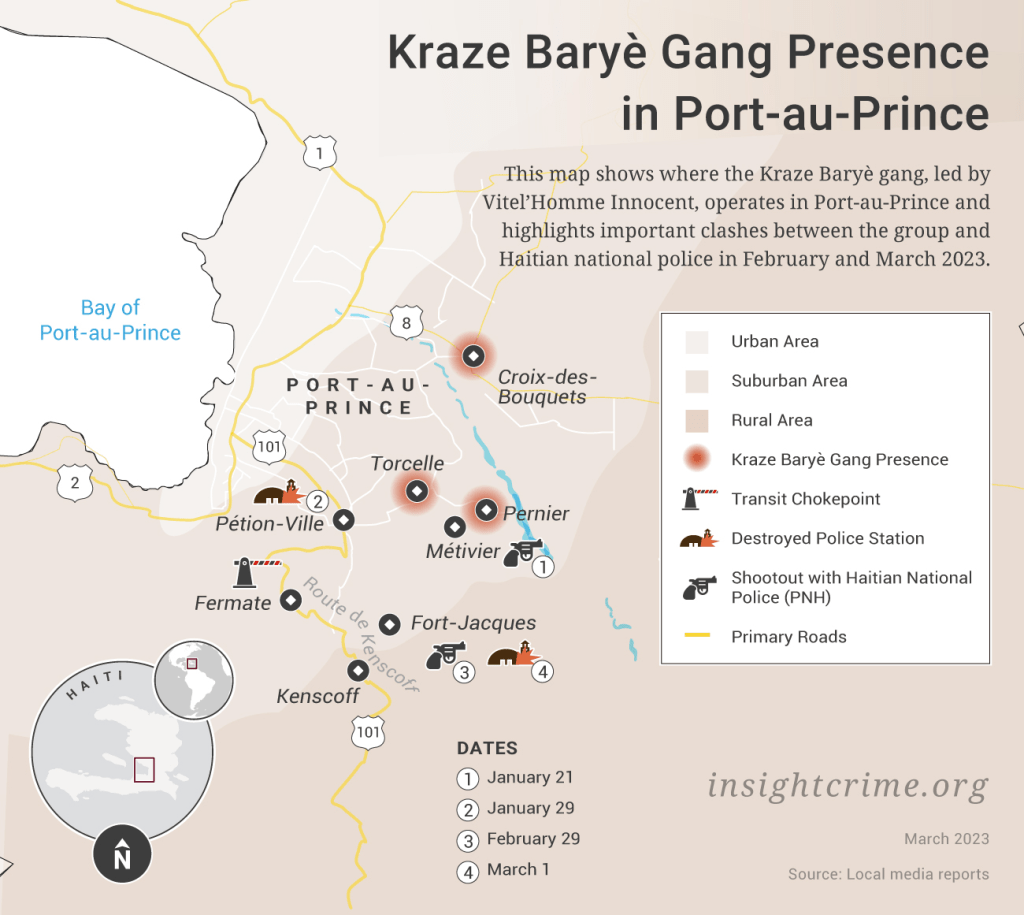
These most recent attacks in Port-au-Prince suburbs are not Vitel'Homme's first connection to serious crime. The US Federal Bureau of Investigation (FBI) accuses him of involvement in the kidnapping of 17 US and Canadian Christian missionaries in October 2021. It is offering a $1 million reward for information leading to his capture.
According to the US State Department, Vitel'Homme worked with the 400 Mawozo gang, one of the largest criminal groups in Haiti, to carry out the kidnappings of the North American missionaries. He also provided weapons and made ransom demands during the kidnappings, as well as serving as a bodyguard for Joly Germine, a senior leader of 400 Mawozo, the US State Department claims.
The Kraze Baryè gang has carried out kidnappings in the past, delivering victims to allied gangs in exchange for weapons and ammunition, with the other groups receiving the ransom payments, according to Calpas.
Now, with the gang increasing its presence in Fort-Jacques, and other suburbs like Fermate, Vitel'Homme and his men should have ample opportunities for kidnapping and associated crime.

Ex-Haiti mayor accused of killing, torture faces civil trial
BOSTON (AP) — Accusations of political violence and terror have followed a former Haitian mayor all the way to a Boston courtroom, where a civil trial began Monday that shines a light on the wider issue of bloodshed and unaccountability in the Caribbean nation’s politics.
Attorneys painted widely different pictures of Jean Morose Viliena during opening arguments in U.S. District Court in Boston. Those included claims of a killing, torture and arson — or a successful mayor who helped improve the town of Les Irois in the late 2000s.
Viliena, who now lives in Massachusetts, is being sued by three Haitian citizens who say they or their relatives were persecuted by him and his political allies.
The suit was filed under the Torture Victim Protection Act of 1991, which allows civil lawsuits to be filed in the U.S. against foreign officials who allegedly committed torture or extrajudicial killing — if all legal avenues in their home country have been exhausted. It was filed by the Center for Justice and Accountability in San Francisco.
The defense said Viliena was not involved in violence and increased services while leading Les Irois, a town of around 22,000 people on Haiti’s westernmost tip, about 140 miles (225 kilometers) from the capital Port-au-Prince.
Viliena’s attorney, Peter Haley told the 12-person jury during opening statements about a farmer’s son who got an education, ran for mayor in 2006 and brought more paved roads, a medical clinic, waste pickup and a better education system — all lacking before his election.
Viliena is a lawful permanent resident of the U.S., and he moved to the Boston suburb of Malden in 2009, drives a truck and is a “very productive member of the community,” Haley said.
Bonnie Lau, an attorney for the plaintiffs, told the jury that Viliena violently suppressed and intimidated his political foes, even after he moved to the U.S.
“This case is about murder, torture, arson and abuse of power,” Lau told the jurors
The plaintiffs — David Boniface, Juders Ysemé, and Nissandère Martyr — lodged legal complaints against Viliena in Haiti, but he was ultimately released and never tried.
Lau said they are bringing suit in the U.S. because they were failed by the corrupt Haitian justice system.
It’s not the first time a former Haitian official has gone before an American court to answer for alleged wrongdoing in their homeland. In 2006, a New York judge ordered former Haitian strongman Emmanuel “Toto” Constant to pay $19 million in damages to three women who said they were gang-raped by paramilitary soldiers under his command.
Viliena was elected as a candidate for the Haitian Democratic and Reform Movement and was backed by the Committee for Resistance in Grande-Anse, which according to the lawsuit dominates regional politics through patronage, threats and armed violence.
Armed paramilitary groups that ally themselves with particular political parties and candidates and function above the law are commonplace in Haiti, said Robert Maguire, an adjunct professor at George Washington University and Haiti expert who testified on behalf of the plaintiffs.
The paramilitary groups provide muscle for the politicians, he said, and in return get material rewards such as motorcycles, jobs, government posts and access to power.
They act with impunity because of Haiti’s weak government and justice system.
“When there’s no police or judiciary to keep you in check, you feel like you can act like you wish,” he said.
Haley, the defense attorney, pushed back, asking Maguire if he was in Les Irois at the time of the alleged violence, and Maguire acknowledged he had never been to the town.
The plaintiffs allege that in 2007 Viliena — a loyalist of former Haitian President Michel Martelly — began a “campaign of persecution” against Boniface, a supporter of the political opposition, after he tried to defend a neighbor who Viliena allegedly assaulted for piling garbage in the street
Viliena allegedly led a group of men armed with guns, machetes and clubs to Boniface’s home. In Boniface’s absence, his younger brother, Eclesiaste Boniface, was dragged out of the house and fatally shot by one of Viliena’s men, the lawsuit says.
“They left his body on the street all night to send a message,” Lau said.
The suit also alleges that Viliena and his men beat and shot Ysemé and Martyr at a community radio station in 2008. Ysemé was blinded in one eye, while Martyr lost a leg, according to the suit.
Nissage Martyr has since died and his son has taken his place as a plaintiff.
The plaintiffs also allege that Viliane’s allies burned down dozens of homes occupied by his political opponents in 2009. Even though Viliena was not present during the arson, his allies acted on his orders, Lau said.
The suit seeks unspecified damages.

Gérard Latortue, former interim Haitian premier, dies at 88
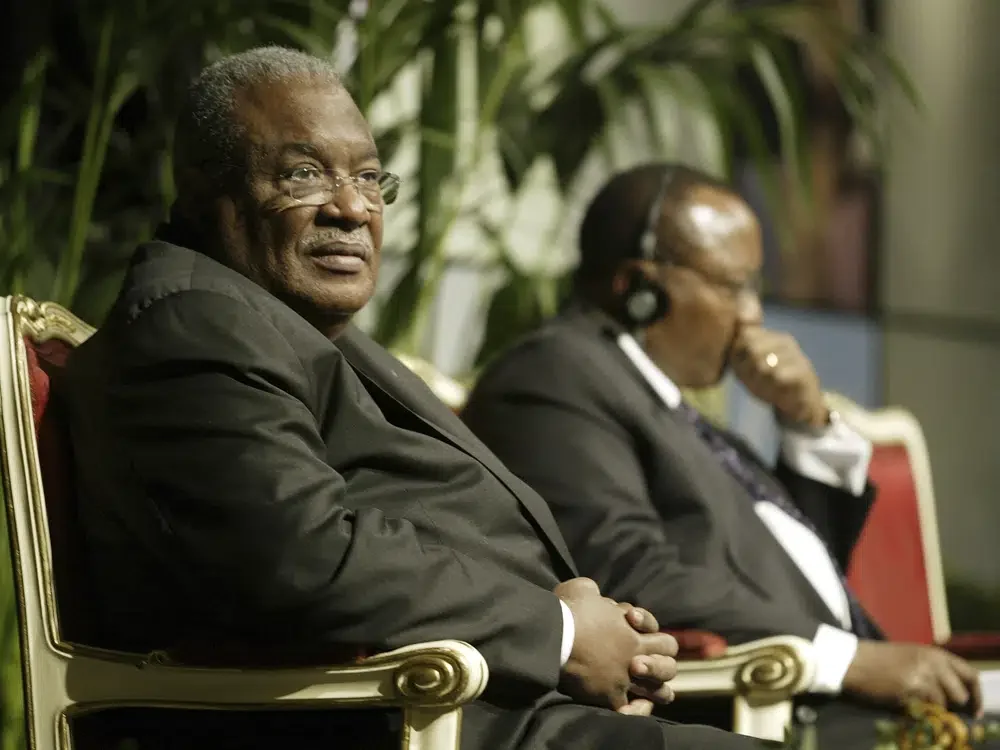
SAN JUAN, Puerto Rico (AP) — Gérard Latortue, a former interim prime minister of Haiti who helped rebuild and unite the country after a violent coup in the mid-2000s, has died. He was 88.
Prime Minister Ariel Henry announced Latortue’s death Monday, saying it was a tremendous loss for the nation. He described Latortue as “a reformer, a convinced patriot, an eminent technocrat, a voice of change, of development (and) a supporter of democracy.”
Latortue was a former exile who was sworn in as interim prime minister in March 2004 following months of bloodshed and political strife that left more than 300 dead and culminated in the ouster of former President Jean-Bertrand Aristide. The turmoil at the time prompted the U.S. military to escalate its mission in Haiti.
In a July 2004 interview with The Associated Press in Washington, Latortue vowed to fight corruption and disarm powerful gangs as he requested $1.3 billion from the international community to help rebuild Haiti after the violent revolt.
In September 2005, he welcomed former U.S. State Secretary Condoleezza Rice to Haiti, where she stressed the need for local officials to accelerate the process to hold general elections.
Latortue said at the time that his administration shared the same concerns as the U.S. government and the international community, and that the administration would honor the results of the upcoming elections.
“This government has no concerns whatsoever as to who will be the next president. Whoever that is, we will greet that person with open arms and pass power on to him or her,” Latortue said at the time.
In February 2006, Haiti held general elections to replace the interim government of Latortue, who was succeeded by former Prime Minister Jacques-Édouard Alexis. The provisional president, Boniface Alexandre, was succeeded by former President René Préval.
On Tuesday, former Prime Minister Jack Guy Lafontant tweeted that Latortue was “a pragmatic politician who knew how, in a very difficult context, to lead the country to free and democratic elections.”
Latortue had previously served as Haiti’s foreign minister, as a business consultant in Miami and as an official with the U.N. Industrial Development Organization in Africa.
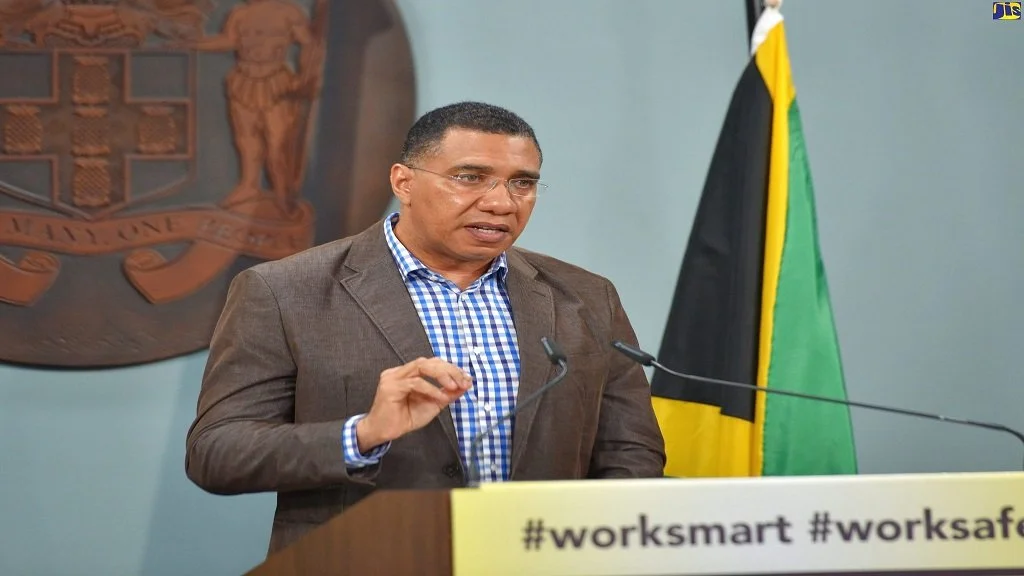
PM Holness leads special CARICOM mission to Haiti
Prime Minister Andrew Holness left Jamaica on Monday morning to lead a special Caribbean Community (CARICOM) mission to Haiti.
Representatives from the Bahamas, Trinidad and Tobago and the CARICOM Secretariat are part of the delegation.
A statement from the Office of the Prime Minister says as part of this mission, members of the CARICOM delegation members are expected to have discussions with several critical Haitian stakeholder groups.
Holness is expected to return to the island later in the evening.
Monday’s mission comes ahead of a planned stakeholder meeting in Jamaica in the coming weeks to discuss the situation in Haiti which is confronted with political turmoil and corruption, and unrelenting gang violence, with armed groups committing murder, rape, as well as kidnappings.
At the end of the 44th regular summit of CARICOM Heads of Government in The Bahamas less than two weeks ago, CARICOM chairman and host Prime Minister Philip Davis said the regional grouping had taken its moral obligation seriously as it relates to resolving the issues in Haiti.
He dismissed the idea of boots on the ground and this stage, saying that the first step would be to see how CARICOM can strengthen the Haitian national police to enable them to restore order and curb the criminal activities on the island.

Haiti’s Elites Keep Calling for the U.S. Marines
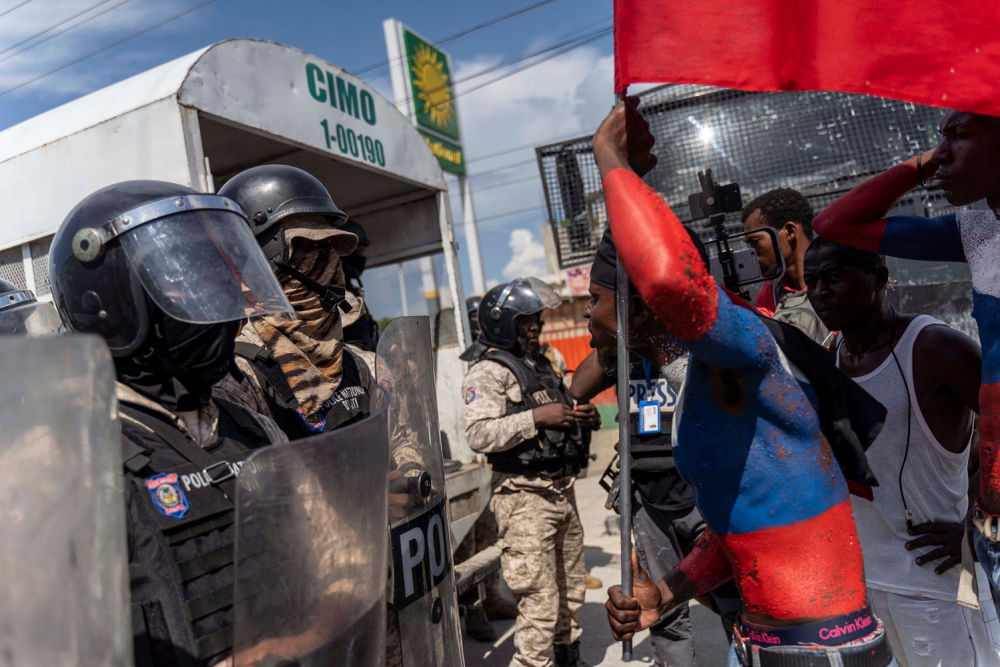
The United States must break the habit of disastrous intervention.
At the end of the first U.S. occupation of Haiti—a period of brutal domination from 1915 to 1934—a critic warned that U.S. forces would not be gone for long. U.S. President Franklin D. Roosevelt’s State Department had left Haiti in the hands of a man friendly to its core interests: the Haitian conservative Sténio Vincent, whose otherwise fervent nationalism was tempered by a deep affection for U.S.-centric capitalism.
The critic, the American journalist and orator William Pickens, wrote in the NAACP’s flagship magazine, The Crisis, in June 1935: “The marines are gone, but the American Financial Adviser is still there, collecting for American creditors, and if opposing Haitian factions start cutting each other’s throats with their machetes, [Vincent] may yell for the marines to come and help him protect the money bags.”
Now, another yell is coming from Port-au-Prince. In October, the government of Ariel Henry, Haiti’s de facto prime minister and president, called for a foreign military intervention—“the immediate deployment of a specialized armed force, in sufficient quantity” to stop the street gangs that are terrorizing the population and cutting off access to Haiti’s ports, most crucially the one that receives and stores Haiti’s imports of oil and gas. He did not specify which nation would oversee this armed force. But anyone with even a cursory knowledge of Haitian history—or access to a map—knew the only country he could be referring to.
Vincent never needed to call for the Marines, but in the main Pickens got it right: In the nearly 90 years since that first U.S. occupation ended, U.S. and U.S.-backed forces have remained the most constant factor in Haiti: training and arming Haitian militaries, meddling in elections, and alternately reinstalling and overthrowing Haiti’s leaders. In the last 30 years, U.S. troops have invaded or otherwise intervened in Haiti three times: in post-coup invasions in 1994 and 2004 and to quell feared unrest (which never materialized) after the 2010 earthquake.
In the intervening time, the United States explicitly outsourced its occupations to other countries’ troops: first, a U.N. mission from 1993 to 1997, and then under a mostly Brazilian-led multinational force that controlled Haiti’s streets and rural areas from 2004 to 2019. The latter force, known by its French initials as Minustah, left as its main gifts to Haiti an abandoned generation of children fathered by the U.N. troops and a catastrophic cholera epidemic started by a battalion from Nepal.
Two years after the last U.N. mission left, in July 2021, Haitian President Jovenel Moïse was assassinated at his home in a suburb of Port-au-Prince. Moïse was the hand-picked successor of Michel “Sweet Micky” Martelly, a popular singer-turned-right-wing nationalist who became president thanks to the electoral interference of the Obama administration in the post-2010 earthquake election. (Martelly had been allowed to go through to the second round after then-U.S. Secretary of State Hillary Clinton accused the sitting president of fraud to benefit his own protégé.) Though the plot that led to Moïse’s assassination remains unsolved, this much is clear: He was killed by a group of gunmen, mostly consisting of Colombians and claiming to be agents of the U.S. Drug Enforcement Administration (DEA). Indeed, at least two of them were in fact former DEA informants. A New York Times investigation found evidence that the men may have been looking for a list of drug traffickers Moïse was intending to expose. The Intercept reported that several had received U.S. military training.
By the time of his death, Moïse, with the tacit support of the Trump administration, had allowed Haiti’s already hollowed-out government to effectively collapse around him. There was no functioning parliament or plans to elect one. He had overstayed the end of his constitutional term and was ruling by decree. Gangsters, along with elements of the Haitian police and the reconstituted Haitian army, carried out a series of massacres; a Harvard Law School study detailed “a widespread and systematic pattern that further state and organizational policies to control and repress communities at the forefront of government opposition.”
The most notorious of those gangsters was and is Jimmy “Barbecue” Chérizier, a former Haitian National Police officer and head of a gang consortium that calls itself the “G9 Family and Allies.” (His nickname is said to be an allusion to a penchant for burning his victims.) The Harvard study reported that, in November 2018, armed gangs led by Chérizier carried out a massacre of at least 71 people in the slum of La Saline, raping at least 11 women and destroying 150 homes. According to the study, “In the weeks before the attack, two senior officials from Moïse’s administration, Pierre Richard Duplan and Fednel Monchéry, met with then-police officer and gang leader Jimmy Chérizier alias Barbecue to plan and provide resources for the attack.” (Chérizier has denied any links to the Moïse government.) Further massacres followed.
Moïse’s death left an inescapable power vacuum. Institutionally, it was filled by then-71-year-old Ariel Henry, a neurosurgeon who entered politics as part of the coalition that fomented the 2004 coup against the leftist Jean-Bertrand Aristide. Moïse had announced his intention to nominate Henry as his prime minister (the No. 2 role in the Haitian system), but given the lack of a parliament, that nomination was never confirmed. Instead, Henry was installed by press release: an announcement from the so-called Core Group (a consortium of ambassadors headed by the United States, France, and Canada that includes representatives of the United Nations, European Union, and Organization of American States), which called on Henry to form a government—despite his lack of a democratic mandate.
In the streets, the power vacuum has been filled by the gangs, particularly Chérizier’s G9 alliance, which among other things now controls access to the country’s main fuel port. Those gangs are, by necessity, allied with and financed by Haiti’s tiny clique of import-export oligarchs, who use them as muscle to grab territory and settle scores. The exact web of connections and alliances is opaque, for obvious reasons. But when something as profitable as a port is in play, it is not the nearby poor but people at the uppermost echelons of Haitian society who have the most to gain or lose from which areas the gangs control.
It was against that backdrop that Henry’s government requested the foreign force, in its words, “to avoid a complete asphyxiation of the national economy.” The United States responded with, ultimately, a pair of resolutions in the U.N. Security Council. The first, approved by the council last week, authorized a travel ban, asset freeze, and arms embargo against individuals it deems “as responsible for or complicit in, or having engaged in, directly or indirectly, actions that threaten the peace, security or stability of Haiti.” That could include some of Haiti’s oligarchs or politicians, but for now the only person explicitly named in the resolution is Chérizier. This prompted the spectacle of representatives of the world’s most powerful nations, including the United States, Russia, and China, taking a break from arguing over the war in Ukraine to talking about a gang leader named “Barbecue.” It was undoubtedly the highlight of the year for a man who has styled himself as a “revolutionary” and clearly dreams of even greater national power.
The second resolution, which has not yet been approved, proposes “a limited, carefully scoped non-UN mission led by a partner country with the deep, necessary experience required for such an effort to be effective, and whom the United States could find ways to support.” The “non-UN mission” part implies that this would not be a force directed by the U.N. Department of Peace Operations or outfitted in the trademark blue helmets, which have now been thoroughly discredited in Haiti thanks to Minustah’s malfeasance. (Ironically, a resurgence of the cholera epidemic that the U.N. caused, and has since entirely escaped accountability for, is one of the justifications for this new mission.)
The “partner country” is not specified. But it is likely Mexico, which co-sponsored the resolution along with the United States. Why would Mexico want to intervene in Haiti? Well, there has been a major surge in Haitians seeking refuge in or trying to enter the United States through Mexico. In 2021, Haitians became the largest group of asylum-seekers in Mexico, exceeding the number of people trying to flee violence in Honduras and nearly equaling all other sources of asylum-seekers combined.
Late last year, the Biden administration was chastened by a media storm surrounding the arrival of Haitian refugees crossing from the Mexican state of Coahuila to Del Rio, Texas. The Mexican army has been trained, financed, and equipped by the United States under the so-called Mérida Initiative, aimed at ending that country’s ongoing drug wars—which would fit the definition of “deep, necessary experience required for such an effort,” at least from the State Department’s point of view.
But as Michael Paarlberg has argued, the Mérida Initiative is a prime example “of dysfunctional U.S security cooperation arrangements with foreign governments” that foster corruption and violence instead of lessening them. In Mexico’s case, that is likely because it ignores the core U.S. involvement in narcotrafficking: providing a market for drugs headed north and a seemingly unlimited source for the weaponry heading south.
In Haiti—which has its own obvious problems with narcotrafficking—the U.S.-supported rot runs even deeper, to the democratic vacuum that a century of U.S. invasions, occupations, and interference has left in its wake. Sending an armed force to do battle with one Haitian gang and its sponsors may briefly win the de facto government (or Chérizier’s other rivals) access to the fuel port, but it will do nothing to make Haiti a safer or more stable place for its people to live in the medium or long term.
It is not clear when or if the resolution approving an armed force will be taken up by the Security Council. China and Russia have both signaled skepticism about the U.S.-backed mission. Asked for comment, a State Department spokesperson told me: “While we envision this mission would be authorized by the [Security Council], such a mission would rely on voluntary support from the international community, and our draft resolution explicitly asks for contributions of personnel, equipment, and other resources.” Already, the U.S. Coast Guard Cutter Northland has been dispatched to the Bay of Port-au-Prince, and the United States and Canada have jointly delivered tactical vehicles “and other supplies” to the Henry government.
This will, in effect, just bolster another gang: the clique that Henry currently represents, its allied elites, and whatever loyal faction they favor within the Haitian National Police. In other words, outside force may give a different group access to the fuel port and keep the current clique in relative power a little longer. But it will do nothing to prevent the violence and inequality that rive Haitian society. Only forcing the unpopular and manifestly undemocratic Henry government to share or cede power, preparing the ground for eventual elections and a return to Haitian democracy, and ending a century of destructive U.S. interference in their affairs, will give ordinary Haitians a shot at survival.
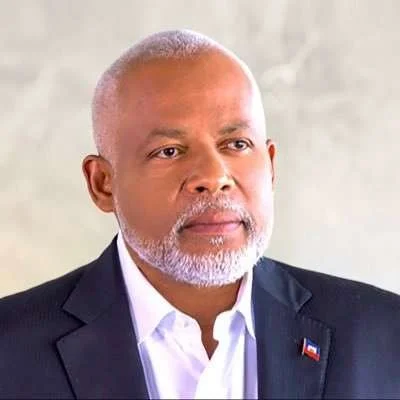
Haitian politician shot dead, as violent gangs and political turmoil push country to the ‘edge of collapse’
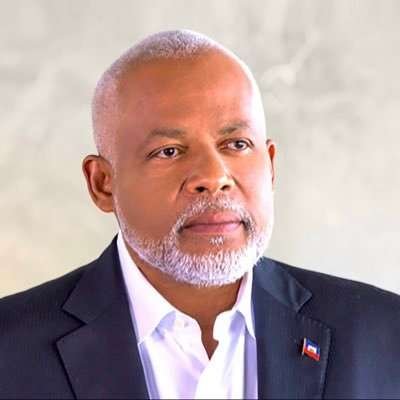
A Haitian politician has been shot dead outside his home, authorities have said, as international concerns intensify over the gang violence, political turmoil and humanitarian crises that have seized control of the country.
Eric Jean Baptiste was killed on Friday night outside his home in the capital Port-au-Prince, local police told CNN.
He was the leader of the Rally of Progressive National Democrats Party (RNDP), a minor political party in Haiti, and launched a longshot presidential bid in 2016.
A security guard was also killed in the attack, the police spokesperson said. Baptiste survived an earlier attempt on his life in 2018, escaping with a bullet wound.
The assassination is the latest killing in a country overtaken by violent gangs, and comes a year after the nation’s serving President Jovenel Moise was murdered. Port-au-Prince was the site of brutal gang battles this summer that saw whole neighborhoods set aflame, displacing thousands of families and trapping others in their homes, afraid to leave even in search of food and water.
The number of Haitians displaced by recent gang-related violence in the capital has tripled in the past five months, the United Nations International Organization for Migration (IOM) said on Friday.
The IOM report said more than 113,000 people were internally displaced from Port-au-Prince between June and August this year, with nearly 90,000 of them due to “urban violence linked to inter-gang, gang-police, and social conflicts.”
Criminals still control or influence parts of the country’s most populous city, and kidnappings for ransom threaten residents’ day-to-day movements. In recent weeks, demonstrators in several cities called for Prime Minister Ariel Henry’s resignation in the face of high fuel prices, soaring inflation and unchecked crime.
Earlier this month, United Nations Secretary-General Antonio Guterres condemned what he called an “absolutely nightmarish situation” in Haiti with gangs blocking the movement of fuel and other materials in the Port-au-Prince harbor. The country is facing a humanitarian crisis, while a cholera outbreak has also left dozens dead.
Haiti’s Ambassador to the US Bocchit Edmond told CNN Friday that the government will call democratic elections if the international community intervenes with military assistance in the country.
“It’s very important for all Haitians to work together… and while we are getting help from our international partners, that we make sure to prepare to have free and fair democratic elections. Because it is the most important thing… to have democratic institutions stand up again,” Edmond said, describing Haiti as a country “on the edge of collapse.”
“Before getting to elections, we need to restore law and order. And our national police itself cannot… because the gangs are well armed and their firepower is far more superior… we need international assistance,” the diplomat recently told CNN’s Sara Sidner.

The crisis in Haiti, explained
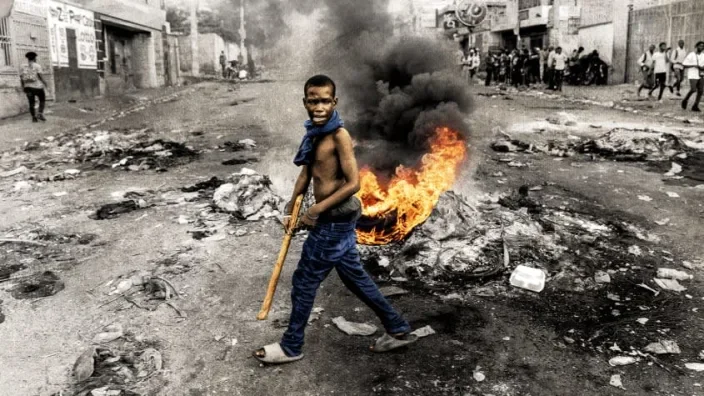
The small Caribbean nation of Haiti continues to face a slew of deep-seated humanitarian crises, with NGOs warning that the country could be on the verge of a complete societal collapse. Haitian officials have appealed to the international community for outside assistance, and while some have answered the call, there is still a barrage of issues, including supply shortages, rampant gang violence, and famine that threatens to derail foreign aid.
Humanitarian crises throughout Haiti are sadly not new, and there are a number of factors that have caused the country to reach this breaking point. Here's everything you need to know:
What is the driving force behind the humanitarian crisis?
Haiti has long suffered from poverty and economic hardships, stemming from massive external debt to its former French colonizers as well as decades of political instability. It remains one of the world's poorest nations and was ranked 163 out of 191 countries in the 2022 Human Development Index. However, the current blight facing the nation was set into motion this past summer, when armed gangs began seizing control of areas throughout the nation.
Most of this trouble was centered in Haiti's capital, Port-au-Prince, where a coalition of gangs called the G9 have taken de facto control of much of the city. While gang violence has been a historic problem, the assassination of Haitian President Jovenel Moise in 2021 plunged the country into chaos and created a vacuum that allowed gangs to seize power.
The humanitarian crisis began when G9 created a blockade around Varreux, one of the nation's most critical fuel terminals. This resulted in mass shortages of goods such as food, water, and other basic necessities. The blockade came in response to an announcement from Haitian Prime Minister Ariel Henry that his government would be ending fuel subsidies. G9 surrounded Varreux in protest and demanded Henry's resignation, though he remains in power.
What problems has the blockade caused?
Cutting off the Varreux terminal has had a domino effect on the nation, choking the country's supply chain and causing problems in numerous sectors of the economy. Reuters reported that most Haitian economic activity has come to a standstill as a result.
Beyond this, there have been reports of hospitals across the country being forced to shut down due to the supply shortage, as most of them are powered by diesel generators — a commodity that is no longer available. This has led to a whole host of problems within a nation that already struggles to provide adequate medical care, specifically due to the rampant diseases that are also currently plaguing Haiti.
Violence against children, rape, looting, civil unrest, and devastating levels of hunger have also become the norm within the country. More than 4 million people face food insecurity, according to the United Nations, with the U.N. deeming Haiti to be in a Level 5, or "catastrophic," phase of hunger for the first time in its history.
People living in Port-au-Prince additionally told Reuters that strong anti-government protests have often devolved into violence, with shootouts between rival gangs and law enforcement becoming a daily occurrence.
What other factors have contributed to the Haitian crisis?
Sadly, there have been a number of other variables that have added additional angst to the people of Haiti. One of the most prominent is the aforementioned diseases that are sweeping across the country — most notably, a deadly outbreak of cholera that has upticked in recent weeks.
According to the World Health Organization, cholera is an acute infection "caused by ingestion of food or water contaminated with the bacterium Vibrio cholerae." The crumbling infrastructure in Haiti, combined with the lack of clean drinking water, led to a massive spread of the disease starting in October. CBC News reported that at least 35 people have died and more than 600 people have gotten sick with cholera since the outbreak began.
Outbreaks of cholera have particularly been seen throughout the Haitian prison systems, where at least 200 of these cases are thought to have originated. One former inmate told CBC News that the country's main prison in Port-au-Prince had "the most unsanitary conditions you can think of. There's no running water ... the toilet is practically a hole in the ground that runs off into the outside — there's no sewage system."
If all of this wasn't bad enough, Haiti — and the Caribbean in general — is smack in the middle of earthquake territory, and Haiti in particular has become known for its devastating quakes. One such earthquake occurred in Aug. 2021, a 7.2 magnitude rumble that killed over 2,000 people and left more than 12,000 injured. Nearly 150,000 buildings throughout the country were destroyed in what would become the year's deadliest natural disaster, and the country was still in the midst of a massive recovery effort when this latest crisis began to unfold.
What is being done to try and help?
There have been calls for foreign intervention from both around the world and from within Haiti. The United States in particular has been urged by some to weigh in on the affair, and the Biden administration sent a delegation to the country to work on developing anti-gang strategies. The U.S. is also reportedly considering the plea from Prime Minister Henry to provide armed intervention, and has already accelerated the deployment of humanitarian aid to the nation.
While the U.S. has taken steps to impose massive visa restrictions in an effort to put pressure on the gangs, the Biden administration has been mostly uncommitted one way or another on armed intervention. It is easy to see why, especially since foreign meddling in Haitian affairs has often caused more harm than good, many times because of the Western assumption that Haiti is unable to govern itself. This plays in line with a long history of American leaders being reluctant to send troops to the country.
Despite what seems to be reluctance among some in the international community, the United Nations has taken a more direct approach, and urged countries around the world to assist Haiti via the military if necessary. It seems the U.S. may finally be getting on board with this idea as well, as The Washington Post obtained a copy of a federal government resolution to the U.N. pressuring the body to assemble "a multinational rapid action force." This marks the first real sign that the United States may be willing to involve itself in potential intervention in Haiti that could include a militarized component.
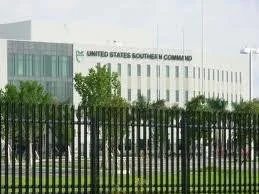
US Air Force Delivers Equipment To Haiti Police
MIAMI – The United States (US) Southern Command (SOUTHCOM) said it had transported “vital” security equipment to Haiti in response to a request for international assistance from the Haitian government to deal with the security situation in the French-speaking Caribbean Community (Caricom) country.
SOUTHCOM said that a US Air Force C-17 aeroplane, based at Joint Base Charleston, South Carolina, transported the security equipment to Port-au-Prince.
“The delivery of the vital equipment was part of a joint operation involving US Air Force and Royal Canadian Air Force aircraft,” said SOUTHCOM in a statement, stating that the equipment included tactical and armored vehicles, purchased by the Haitian National Police (HNP), from Canadian Forces Base Trenton in Ontario, Canada.
“The delivered equipment will help the HNP ensure access to vital resources and infrastructure urgently needed in Haiti to respond to a public-health crisis following a recent rise of cholera cases in the country,” it added.
SOUTHCOM, which is a joint US command, comprising more than 1,200 military and civilian personnel representing the Army, Navy, Air Force, Marine Corps, Coast Guard, and several other federal agencies, said the mission to Haiti comes three days after US Air Force Lieutenant General Andrew Croft, military deputy commander of SOUTHCOM, accompanied US Assistant Secretary of State for Western Hemisphere Affairs, Brian A Nichols, to Port-au-Prince.
Nichols led a US interagency delegation on a two-day visit to the country where they met with Prime Minister Ariel Henry, the Montana Group, private sector leaders, and broader civil society groups.
“They assessed how the US government can continue providing various forms of assistance aimed at helping the country improve security and respond to the growing humanitarian crisis,” SOUTHCOM said.
“Together with the Haitian government, the United States and Canada affirm the importance of working together to support the restoration of security in Haiti in partnership with the international community,” it added.
The United States and Canada also said in a joint statement on Saturday that the equipment will “assist the HNP in their fight against criminal actors, who are instigating violence and disrupting the flow of critically-needed humanitarian assistance, hindering efforts to halt the spread of cholera. The United States and Canada remain committed to supporting the HNP’s work of protecting and serving the Haitian people. In coordination with international partners, our governments are working with Haitian partners to strengthen Haiti’s capacity to train additional police officers and improve law enforcement operations.”
Noting that the United States and Canada commend the international community for mobilizing new commitments in support of Haiti’s most pressing needs, the statement went on to say that “we urge international partners to deliver on those commitments. We encourage partner nations to contribute to the UN Basket Fund to restore peace and citizen security for the Haitian people. Together with the Government of Haiti, the United States and Canada affirm the importance of working together to support the restoration of security in Haiti.”
Armed gangs have prevented fuel from being distributed in the country by commanding the primary fuel deports. Their actions, including inter-gang rivalry, have led to a state of insecurity in Haiti, where opposition forces have also been calling on Prime Minister Henry to demit office.
Henry came to office following the July 2021 assassination of President Jovenel Moise. The opposition has been calling for fresh presidential and legislative elections that are now overdue.
Last week, Henry urged the regional integration movement, of which his country is a member, to express solidarity and request assistance to alleviate what has been termed “the deepening humanitarian, security, political, and economic crises in Haiti”.
A statement issued by the Guyana-based Caricom Secretariat said Henry had written to the leaders of the 15-member grouping on the issue facing the French-speaking country.
“The actions of criminal gangs have resulted in the complete cessation of fuel distribution in several parts of the country forcing the closure of hospitals and schools and the shutting down of water pumps prohibiting the provision of clean water. The water shortage also has exacerbated the resurgence of a cholera epidemic particularly in poor neighborhoods,” Caricom said in the statement.
It said regional leaders “condemn the callous and inhumane actions of the armed gangs responsible for the roadblocks limiting movement of the Haitian people and of goods, the destruction of life and livelihoods and the deprivation of the basic needs of the people.
“Heads of Government call upon all stakeholders in Haiti to come together with urgency at this critical juncture in the country’s history to bring an end to the protracted political stalemate in the interest of the people of the country and choose a nation above self-interest.” CMC
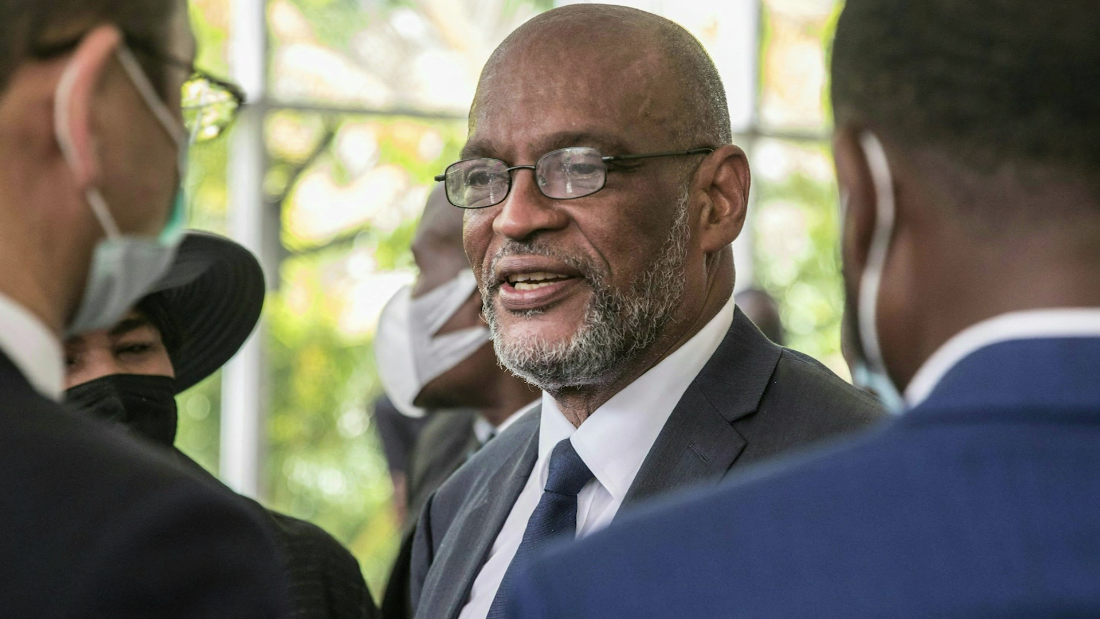
Haitian Prime Minister involved in planning the President's assassination, says judge who oversaw case
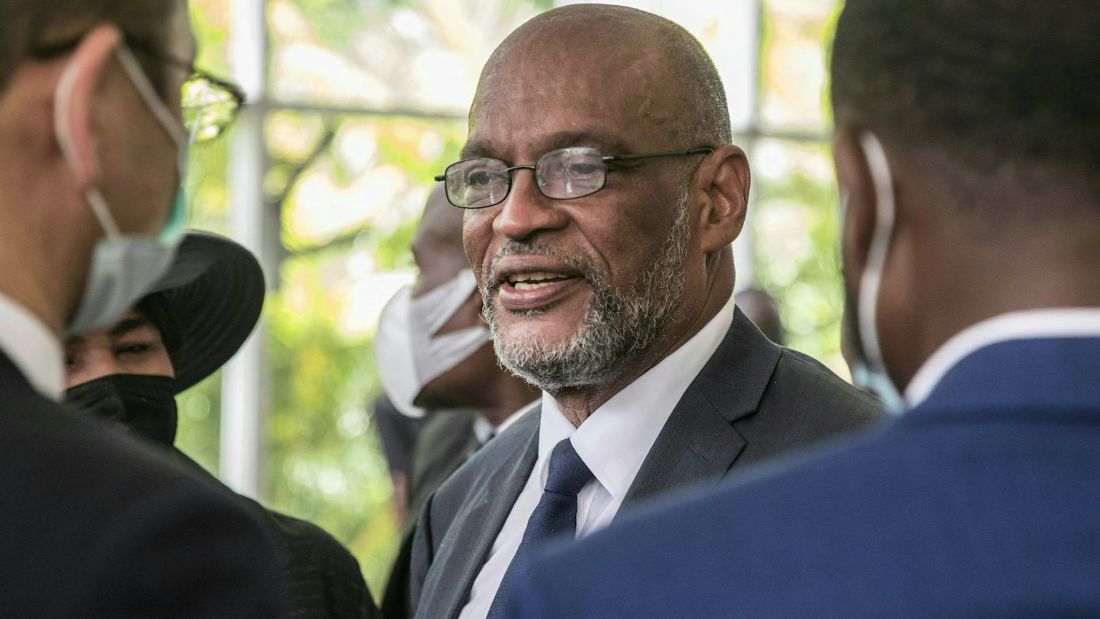
Port-au-Prince, Haiti (CNN)In early September, a dozen heavily armed members of an elite team of Haitian law enforcement sat quietly in several undercover vehicles in the capital of Port-au-Prince, the stillness of the night pierced only by the occasional motorcycle passing by.The veteran officers had all gone after high-profile targets before -- oligarchs, drug traffickers, gang leaders, even politicians.But this operation felt different, according to extensive conversations CNN had with two sources involved in its planning.This time, if they successfully executed their mission, the sources said it would change the trajectory of an entire nation by helping investigators prove their country's prime minister was connected to an assassination.Roughly two months earlier, in the early morning hours of July 7, 2021, Haitian President Jovenel Moïse was assassinated in the presidential residence.More than two dozen armed men swarmed the president's compound where they encountered little to no resistance from security forces there to protect the president.
Moïse was shot 12 times and killed. His wife, Martine Moïse, was also shot multiple times but survived.The man in charge of organizing the assassination squad, according to Haitian authorities, was a former Haitian anti-corruption official named Joseph Felix Badio, who was on the run.But on that early September night, those undercover officers thought they knew exactly where Badio would be: at a meeting with Haitian Prime Minister Ariel Henry, inside his official residence in the capital.
A confidential informant had told the officers that Henry would meet with Badio that night. Since the assassination, the pair had already met twice in-person, according to investigators.For weeks, Haitian investigators believed that Henry himself was involved in both the planning of the assassination and a subsequent cover-up.A private meeting between Henry and one of the top suspects in the case, they believed, would help connect those dots.The plan was to arrest Badio when he left the house and then, at a later date and with proof of the meeting in hand, arrest Henry as well.But Badio never showed up.Henry stayed inside all night, and after sunrise, the officers decided to abandon their mission.Investigators told CNN they later learned that word of the would-be raid had leaked. Badio and Henry had been tipped off, they said, so the pair called it off.The failed raid is just one example of Haitian investigators being thwarted in their attempts to investigate the assassination of the president.Multiple law enforcement sources have told CNN one man lies at the center of much of that obstruction: Ariel Henry. We are not identifying them for security reasons.
Those sources say they have laid out a series of questionable actions that, they say, detail the Prime Minister's alleged involvement in the assassination: both in plotting Moïse's death and in helping orchestrate the subsequent cover-up. And, when two of the top judicial authorities sought potential charges against him, they were fired."Henry is at the center of everything," one investigator told CNN. "All he has done since taking over as PM is obstruct (the investigation) and f**k us over."CNN's calls to Henry have not been returned, although he has previously denied any involvement in the assassination.The Prime Minister has often described solving the murder case as a personal mission."Nothing. Absolutely nothing. No political maneuver, no media campaign, no distraction can deter me from this goal to bring justice for President Moïse," Henry told world leaders at the United Nations General Assembly in September.
Judge: 'Ariel is connected ... to the mastermind'
The official case looking into the assassination is still proceeding in Haiti, but practically, it is all but dead. It has produced no new arrests, no new suspects or any evidence since August but technically, it continues.Dozens of suspects arrested in the first few weeks after the assassination are still being held in a Haitian prison. None of them have been formally charged.Until recently, Judge Garry Orélien was the top judicial official in Haiti overseeing the case.
In a recording taken in the fall of 2021, when he was still presiding over the investigation, Orélien makes his views on Henry's involvement very clear."Ariel (Henry) is connected and friends with the mastermind of the assassination. They planned it with him. Ariel is a prime suspect of Jovenel Moïse's assassination, and he knows it," Orélien said in the recording, obtained exclusively by CNN.CNN has verified the recording by comparing it to other known recordings of Orélien and through extensive conversations CNN has had with him, as well as from voice messages. Orélien did not know he was being recorded."I don't recall talking to anyone about the case in great detail," said Orélien when asked about the recording. "Lots of people are trying to influence the case and I will not play their game."
The assassination of Haitian President Jovenel Moïse
February 7, 2017
Jovenel Moïse is sworn in as Haiti's president after winning a controversial election. He succeeds President Michel Martelly, his political mentor and the man who launched his political career.
President-elect Jovenel Moïse arrives at the Provisional Electoral Council in Port-au-Prince on February 6. He will be sworn into office the following day.
Credit: Hector Tetamal/AFP/Getty Images
February 7, 2021
President Moïse says that his security forces have foiled an attempted coup against him, mounting suspicions that powerful political factions in the country are out to get him.
Credit: Dieu Nailo Chery/AP
July 5, 2021
President Moïse nominates Ariel Henry as Prime Minister. Henry still needs to be formally sworn-in to the position.
Credit: Valerie Baeriswyl/AFP/Getty Images
July 7, 2021, before dawn
More than two dozen heavily armed men breach the presidential residence compound while President Moïse and his wife Martine are inside. Moïse is fatally shot. His wife is left injured in the attack, but survives.
July 7, 2021, mid-day
A group of suspects — including more than 20 alleged Colombian mercenaries — are trapped by Haitian security forces shortly after leaving the presidential residence. During an intense firefight, several of the Colombian leaders are killed. Many others are captured. Several key suspects escape.
Alleged Colombian suspects and some of the weapons and equipment they allegedly used in the attack are seen at police headquarters in Port-au-Prince, Haiti on July 8, 2021.
Credit: AP Photo/Odelyn Joseph, File
July 20, 2021
Ariel Henry formally assumes leadership of a fractured transitional government as Prime Minister. His ascension to power is backed by the United States.
Designated Prime Minister Ariel Henry is seen at a ceremony honoring the late President Moïse on July 20, 2021.
Credit: Valerie Baeriswyl/AFP/Getty Images
August 2021
Sources tell CNN that multiple requests by investigators to expand upon the initial judicial inquiry into the assassination are ignored. No reasons are ever given to investigators as to why permission to continue investigating are not granted.
September 2021
A sting operation to catch top suspect at-large Joseph Felix Badio during a meeting with Henry is foiled after sources say the plans were leaked to one or both men. It would have been the third time Badio and Henry had met in-person after the assassination, according to investigators.
Badio's wanted poster, issued by Haitian National Police.
Credit: Haitian National Police
September 10, 2021
The country's top prosecutor, Bed-Ford Claude, accuses Henry of being connected to the assassination plot and requests that the Prime Minister appear for formal questioning.
September 14, 2021
Prime Minister Henry fires Claude and Justice Minister Rockefeller Vincent. Vincent had supported Claude's request to formally question Henry.
November 25, 2021
Attorney Berto Dorcé — who was once arrested for drug trafficking in 1997, according to a Haiti law enforcement source — is sworn in as Henry's nominee for Justice Minister. Dorcé had previously called the charges false. Prior to his appointment, Dorcé had argued on Henry's behalf that he should not face questioning in the assassination case.
Dorcé attends a ceremony for new cabinet ministers on November 24, 2021.
Credit: Ralph Tedy Erol/Reuters/Alamy
December 2021, January 2022
US federal prosecutors in the US Southern District of Florida indict two top suspects in the assassination case. They are charged with plotting to kill or kidnap outside the United States, signaling the US is ramping up its investigation into the assassination. According to the federal complaint, one of the men provided the arms and ammunition to kill Haiti's President.
Source: President Jovenel Moïse's inauguration, Justice Minister Rockefeller Vincent, Moïse's Twitter, Claude Joseph, Haitian government, a source close to the investigation, Haitian investigators, Bed-Ford Claude, a spokesman for Haitian Prime Minister Ariel Henry, a Haitian law enforcement source, US Department of Justice
Graphic: Sarah-Grace Mankarious, Marco Chacón, Mark Oliver, Kara Fox
Henry, the suspect
Henry became prime minister on July 20 after a power-sharing agreement was brokered in the wake of Moïse's death.Moïse had nominated Henry to the post two days before he was killed, but Henry had not yet been sworn in at the time of Moïse's death. In mid-July, the American, French, European Union and other embassies in Haiti all called for Henry to lead the country in the interim, paving the way for him to take power.But it didn't take long for questions to arise about Henry's alleged connections to at least one of the assassination's participants, or his alleged attempts to shut down the investigation and cover it up.In early August, just a couple of weeks after Henry's inauguration, police investigators produced an initial report on the assassination, as required by Haitian law.In that report, Haiti's then-top prosecutor Bed-Ford Claude, said that there was clear evidence that phone calls were made between Henry and Badio, a top suspect in the assassination, in the hours after the President's murder.Claude went public with the evidence in early September, barring him from leaving the country and requesting in a letter that Henry appear for formal questioning."It is confirmed you, Ariel Henry, had multiple phone calls, especially two on July 7, (about two hours after the president was assassinated) at 4:03 AM and 4:20 AM with one of the main suspect(s) wanted in the assassination of President Jovenel Moïse, Joseph Felix Badio," Claude said in the letter.Claude told CNN shortly after the letter was released that he was discussing charges against Henry with a judge.Henry declined to appear for questioning, and later, Henry told CNN he had "no recollection" of a phone call, "or if it took place."He said the allegations by Claude and his boss, Justice Minister Rockefeller Vincent, were merely political."I want to tell those who still have not understood, that the diversionary tactics to seed confusion and impede justice from doing its work serenely will not stand," Henry wrote in a series of tweets.Several days later, Henry fired Claude and Vincent."The evidence is overwhelming...Ariel is one of the main suspects in my opinion," Claude said to CNN recently when asked for comment."I wanted to indict Ariel Henry after questioning him and I think Ariel knew it, and fired me, and ignored my request (to come in for questioning)," he said.Vincent, the justice minister, has gone into hiding in Haiti, fearing for his safety. He spoke to CNN in the fall about Henry from an undisclosed location."He should resign. And we are still waiting for him to resign," he said. "Because on the night of the president's death, a few hours later ... he had phone conversations with the president's assassin," Vincent said.But multiple law enforcement sources have told CNN that any official inquiries into Moïse's death have been stalled for months.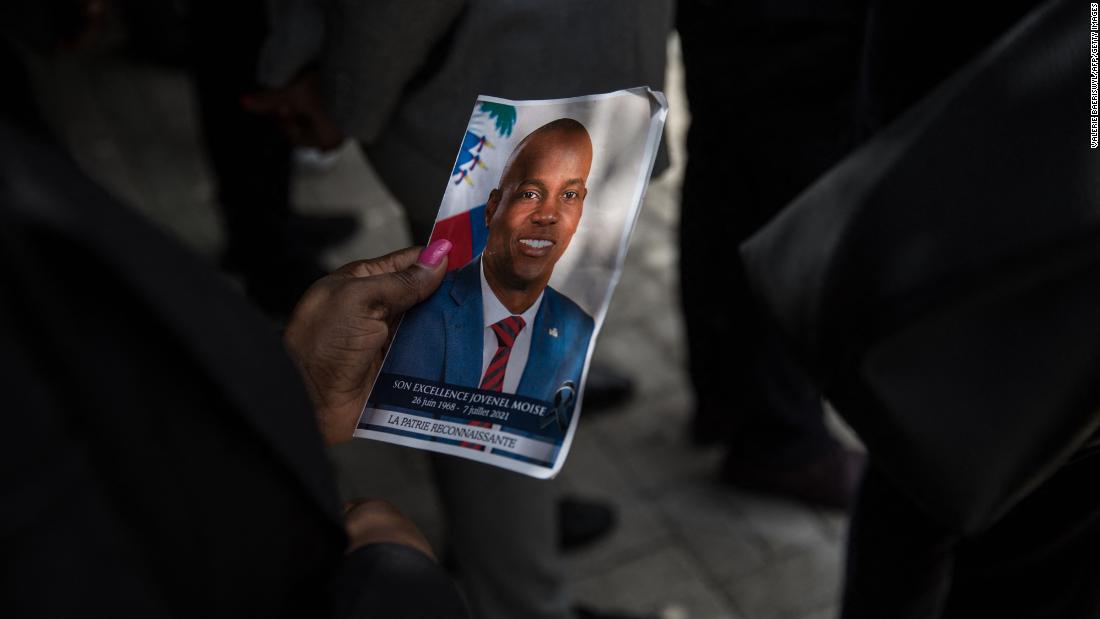 A ceremony for the slain Haitian President Jovenel Moïse in Port-au-Prince on July 20.As a result of that inaction, CNN has learned a small group of investigators have quietly continued their work investigating the assassination, determined not to let impunity rule the day."I'm not afraid for my life," one investigator told CNN when asked if he feared for his safety. "You can't kill a president and just get away with it."Several of those investigators now say that Badio, who still remains at large in Haiti, is currently under Henry's protection and is being hidden from authorities who would arrest him, if given the chance."Henry is doing his best to shield Badio from us because he knows that if we get Badio, he could give up the entire operation, including proving definitively who the masterminds are," one investigator told CNN.Henry's attempts at obstructing justice are clear, according to multiple Haitian law enforcement officials CNN has spoken to.But there are also a number of other developments that, while not directly attributable to Henry, have unfolded under his administration -- developments the group of investigators say are not coincidental.
'It won't see the light of day'
For one, the preliminary report about the assassination, produced in August, failed to progress into a full-blown investigation after it was submitted to judicial authorities.The report included evidence seized from the phones of suspects that had been arrested shortly after the president was murdered, according to a copy of the report seen by CNN.Investigators said they saw messages on at least one of these phones that alluded to bank transfers between the US and Haiti -- transfers that investigators believe could provide crucial evidence in finding out who funded the assassination plot.However, when investigators requested permission in August to expand their investigation, as required by Haitian law, including following up on the alleged bank transfers, they never received an answer from the head of the judicial police, Frédéric Leconte.A source close to the investigation told CNN that investigators have never been given any reason why their request was ignored."That means there is no longer a formal investigation in Haiti into the president's assassination," the source told CNN. "It's incredibly frustrating."Leconte, who reports to both the Minister of Justice and to Henry, could not be reached for comment.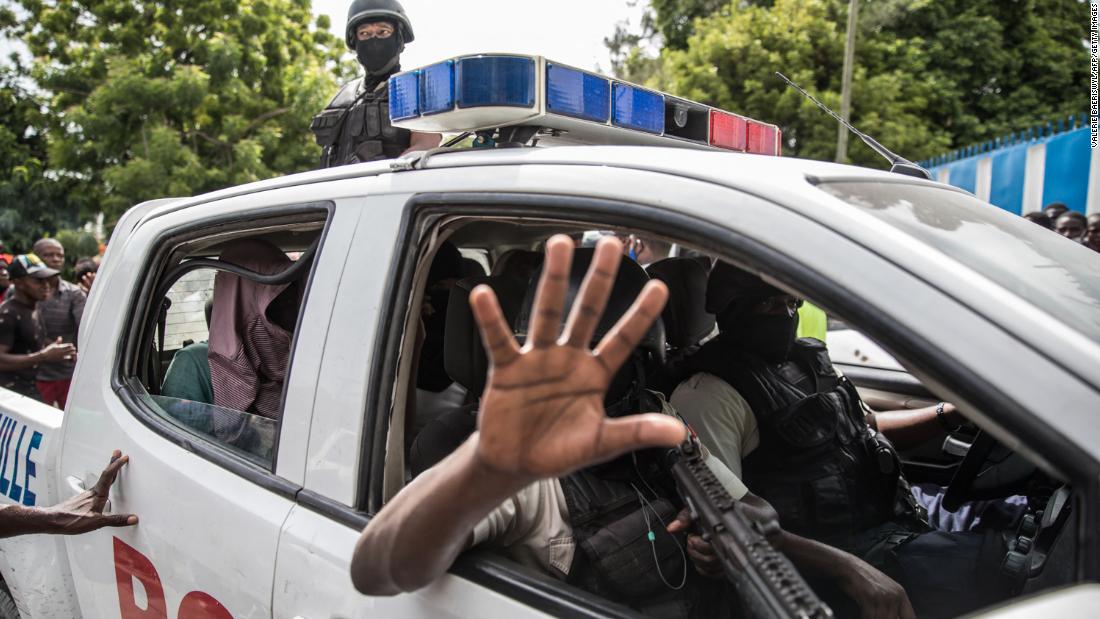 Haitian police transport two alleged suspects to a Port-au-Prince police station on July 8.Henry then reshuffled his cabinet in November, appointing a lawyer, Berto Dorcé, as justice minister.Prior to that appointment, Dorcé was among several attorneys who filed a letter to the country's top prosecutor arguing that Henry should not be forced to answer questions about his alleged complicity in the assassination, citing Henry's executive privilege.Dorcé was arrested for drug trafficking in 1997, according to a Haiti law enforcement source, a charge he said at the time was untrue.He now oversees huge swaths of the justice apparatus in Haiti. That gives him the ability to block any further requests from prosecutors or judges to question or charge Henry.There is no official record of him blocking such a request. But at least one of the judges, Orélien, who could have questioned Henry or sought charges against him while leading the investigation, believed he wouldn't get very far if he tried.
In the secret recording from November, Orélien is asked why he has not gone after Henry legally, given that he believes Henry is complicit in the assassination and the cover-up."Do you think I can touch Ariel (Henry) now? How can I do that? I won't be able to give (any order to indict him), it won't see the light of day," Orélien said.Dorcé did not respond to CNN's request for comment."It all can't be just a coincidence," one investigator said. "All of these things are connected."As the group of investigators continue to search for justice, there are growing calls for Henry to step down."Ariel Henry doesn't have any legitimacy or credibility to govern. His positions might send us to a deeper crisis," said James Beltis, president of the Transition National Council, a group of Haitian civil society leaders who want to install an independent transitional government to oversee the next round of elections.But Henry has no plans to step aside, something the US government has so far raised no opposition to.However, when asked by CNN why the US continues to support a prime minister that investigators have clearly implicated in the presidential assassination, a US State Department spokesperson conspicuously made no mention of backing Henry, and referred CNN to the US Department of Justice and to the government of Haiti.CNN also asked why the US government has stayed so quiet on the claims against Henry."The United States has vocally and repeatedly supported a thorough, independent investigation into President Moïse's assassination consistent with both Haitian law and international rule of law standards," said the spokesperson. "We want to see those who planned, funded, and carried out the assassination of President Moïse held accountable. The Haitian people need to see a transparent process and resolution to this investigation to demonstrate that perpetrators of such heinous crimes cannot escape justice."The US Justice Department has ramped up its own investigation into the assassination, recently extraditing and charging two top suspects in the case for allegedly planning the assassination on US soil. According to the federal complaint, one of the men provided the arms and ammunition to kill Haiti's President.Two Haitian investigators told CNN they believe that if their US counterparts keep digging, Henry will emerge as a key suspect for them as well.
Remaining missionaries kidnapped in Haiti released by gang, says justice minister
Port-au-Prince, Haiti (CNN) - The remaining 12 hostages kidnapped by an armed gang in Haiti two months ago were released Thursday, according to the country's justice minister Berto Dorcé.Seventeen missionaries representing Christian Aid Ministries (CAM), including 16 Americans and one Canadian, were kidnapped by armed men on October 16 while driving through the suburb of Croix des Bouquets, just outside of the capital city Port-au-Prince. The group had been returning from visiting an orphanage and were headed back to their home base.Two of the missionaries were released on November 21. Two weeks later, three more hostages were released followed by the remaining 12 on Thursday morning.
A source in Haiti's security forces said the remaining hostages were released around 5 a.m. ET in the neighborhood of Morne Cabrit.
According to the source, the missionaries were found by locals who dropped them off at a local police station, close to the territory controlled by the gang.
The freed group are undergoing a medical check and appear skinny, the source added.The gang that authorities said was responsible for the kidnappings, 400 Mawozo, had initially demanded a ransom of $1 million per hostage, according to Haiti's then-justice minister Liszt Quitel.
A ransom was paid to the 400 Mawozo, according to the source. A US official also said that a ransom was paid, but not by the US government. Though the exact amount is not known, the source said it was far less than the original request of $1 million per hostage.CNN has reached out to CAM for comment.CAM released a statement praising the release on Thursday."We glorify God for answered prayer -- the remaining twelve hostages are FREE! Join us in praising God that all seventeen of our loved ones are now safe. Thank you for your fervent prayers throughout the past two months. We hope to provide more information as we are able," the statement read."I will sing unto the Lord, for he hath triumphed gloriously" (Exodus 15:1b)," it concluded.The US State Department welcomed the news that the missionaries "are free and will soon be reunited with their loved ones."
A State Department spokesperson told CNN Thursday that they were continuing to provide "appropriate" assistance to the group and their families and thanked Haitian and international partners "for their assistance in facilitating their safe release.Kidnappings for ransom in Haiti are widespread and often indiscriminate, targeting rich and poor, young and old. Rising crime has accompanied the country's political instability, with kidnappings spiking in the months after the July assassination of President Jovenel Moise, according to local human rights organization CARDH. The 400 Mawozo group is particularly notorious for group kidnappings.
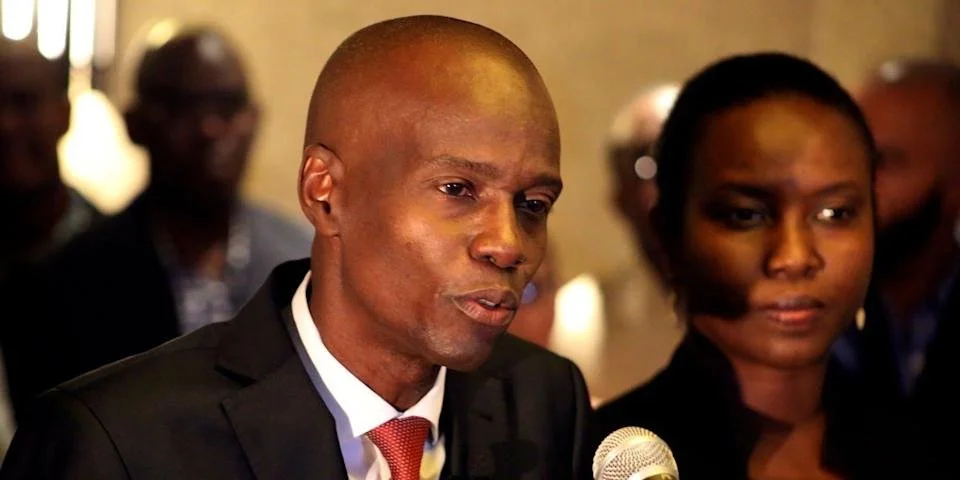
Did Anti-Drug Crusade Lead to Haiti President's Killing?
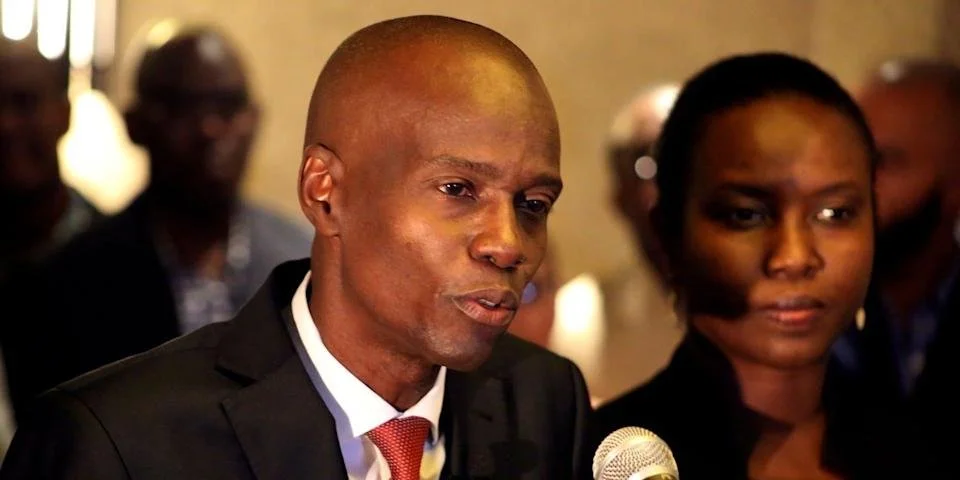
An explosive new report suggests that the high-profile assassination of Jovenel Moïse may have been related to a crackdown on drug trafficking and a list he was compiling of Haitian business and political elites involved in the trade, adding yet another theory to the possible motives for the former president's killing.
Before he was shot dead, President Moïse had planned to hand the names over to the US government, according to a New York Times report published December 12. The Times spoke to four senior Haitian advisers and officials who had knowledge of the document. Unnamed officials also told the Times that the hitmen had confessed to ransacking Moïse's house in search of the list.
"The president had ordered the officials to spare no one, not even the power brokers who had helped propel him into office," the Times reported.
A “central figure” included on the list, according to the Times, was businessman Charles Saint-Rémy, alias “Kiko.” The Times previously reported that US anti-drug officials who had worked in Haiti had suspected Saint-Rémy’s involvement in drug trafficking.
In 2015, Saint-Rémy allegedly met with senior Drug Enforcement Administration (DEA) officials, raising questions of corruption, according to Keith McNichols, a former DEA agent who was investigating the smuggling of hundreds of kilograms of cocaine and heroin from Colombia to Haiti. McNichols, and another DEA whistleblower, spoke out about how that investigation was grossly mishandled.
Saint-Rémy – who responded "no, no, no" to the Times when asked about alleged links to drug trafficking – is the brother-in-law of former President Michel Martelly, a close friend of current Prime Minister Ariel Henry. Haiti's former chief prosecutor previously accused Henry of being connected to Moïse’s murder.
The dossier wasn’t the only move Moïse's allegedly made against drug trafficking. In mid-2021, the DEA reportedly made Moïse aware of two clandestine airstrips used to receive drug flights in an area north of the capital, Port-au-Prince. Moïse ordered one of the airstrips destroyed, but local authorities reportedly refused to do so, according to the Times report.
Earlier that year, a close ally of the former president also allegedly ordered a crackdown on the country’s eel industry, which is used “as a way to launder illicit profits,” the Times report said.
These actions and the list he supposedly compiled were just one part of a “broader series of clashes Moïse had with powerful political and business figures, some suspected of narcotics and arms trafficking,” the Times reported.
InSight Crime Analysis
The latest reporting adds one more theory to the possible motives for President Moïse’s assassination. Yet his anti-drug crusade was never all that ambitious in a country that does not play a major role in the regional cocaine trade.
Aside from a few isolated arrests and extraditions, Haiti's security forces failed to capture any major drug traffickers - or the powerful elites protecting them - under Moïse’s watch. Arguably the last major blow to drug trafficking in Haiti came with the arrest of Guy Philippe, who the DEA tried to capture in 2007 before he was later convicted in 2017 of laundering drug money in the United States.
What's more, just eight percent of cocaine departing South America transited through the eastern Caribbean corridor via either Haiti or the Dominican Republic in 2019, according to the DEA’s 2020 National Drug Threat Assessment. Haiti's neighbor, the Dominican Republic, has emerged as a much bigger player in the transnational cocaine trade, thanks to its role as a regional hub for container ships, especially those arriving from Venezuela.

To be sure, in 2019, Haitian police seized a total of just 10 kilograms of cocaine. In 2020, the number rose to 103 kilograms, according to the State Department’s 2021 International Narcotics Control Strategy Report (INCSR). That said, the low seizure figures are likely more of an indication of the Haitian police’s woeful anti-narcotics operations, suggesting that the amount of cocaine passing through could be higher.
Indeed, notorious drug traffickers like Bedouin “Jaques” Ketant have in the past relied on Haiti as a transit point for large cocaine shipments. But the vast majority of cocaine heading north departs South America via the Eastern Pacific route off the shores of Colombia and Ecuador. The drugs then pass through Central America before continuing on to Mexico and eventually the United States.
In addition, clandestine airstrips like those reportedly targeted by Moïse do not abound in Haiti, as they do in other nations that serve as major aerial passageways, such as Guatemala and Honduras. In Honduras, the armed forces have destroyed 21 airstrips this year alone, according to local media reports. Since 2014, security forces there have uncovered more than 320 such airstrips.
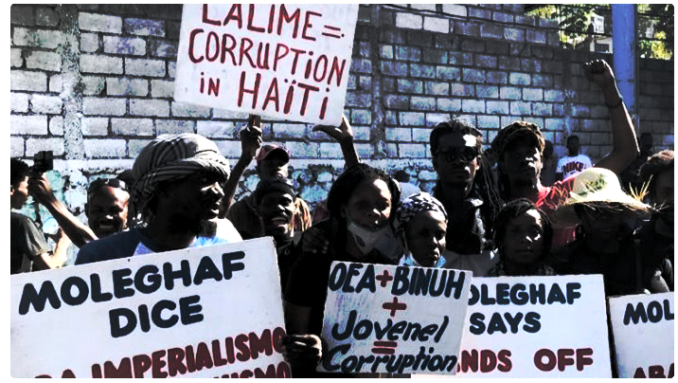
No quick fix for Haiti — but corruption comes first
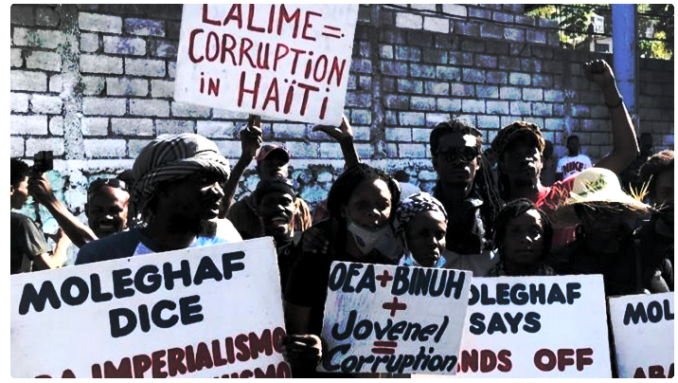
Recent headlines from Haiti portray a country in free fall. A president’s assassination, recovery from the massive August earthquake, fuel and hard currency shortages, kidnappings and criminal gangs operating with impunity all indicate a bleak future and possible failed state — all too close to the United States.
In this maze of challenges, a problem crying for solutions — and readily addressed — is corruption. This poison affects all sectors of the country and demoralizes Haiti’s people. Haitians alone cannot solve this challenge, but the United States has the key to doing so. Accountability and interdiction of illicit financial flows are not some esoteric undertaking, but are well within the legal means the United States already has in place.
Perhaps the most infamous of Haitian scandals is the $2 billion that was allegedly mismanaged in the PetroCaribe oil-loan program. The Haitian government purchased oil from Venezuela by paying 60 percent up front and borrowing the rest from the Caracas government. Proceeds from the sale of the oil in Haiti were to be used for social programs that rarely materialized. Despite a government inquiry alleging the extent of the crimes, Haitians continue to ask, “Where are the PetroCaribe funds?”
Corruption is sometimes seen by well-intentioned policymakers as a low-grade fever — something to observe but nothing to worry about. This is a fallacy and a root cause of failures to “help” Haiti from the outside. With “stability” often the most pressing goal of outsiders, a country’s wealth is siphoned away with bribes, extortion and phony invoicing, seen as the cost of doing business. Lacking a real fix to this syndrome, stability will never come. The fever, it turns out, could be fatal. Clearly, a new approach is needed.
President Biden’s Summit for Democracy, which begins today, provides a high-profile platform to announce an initiative that can be transformative. Not only can the administration promote an effort to help locate the PetroCaribe money, but it also can declare an innovative approach in a decades-long effort to help Haiti get on its feet.
Recent history in nearby Central America provides a roadmap out of this morass. Take Guatemala. In 2009, a new and independent institution, backed by the U.S. and the United Nations, was established to root out grand corruption by political figures — and it worked. During its 10 years, CICIG (its acronym in Spanish) helped dismantle 60 criminal networks, brought charges against 680 individuals, and had an 85 percent conviction rate. Seventy percent of Guatemalan people approved of it in a 2018 poll. Surely, a similar organization can flourish in Haiti.
A complement to a CICIG-like entity should be created to address petty corruption in low-level, public-facing government agencies that affect people’s everyday lives. An adjudication panel, composed of community and diaspora leaders, can review cases at a personal level. First-time offenders get a public reprimand and have to repay the bribes they demanded for driving permits and business licenses. A second offense slaps a fine on them; a third infraction means dismissal from their government job. This dual approach of attacking corruption of all types can readily establish a systems change in Haiti. Removing corruption as the status quo and relegating perpetrators to public shaming, or putting them behind bars, can be transformative.
There is fertile ground in Haiti for this type of effort. A large, cohesive and vigorous civil society community exists that will cheer such an idea. Indeed, the recent publication of a call to action by a broad coalition of groups seeks to “rebuild and reestablish [Haiti’s] institutions … in order to avoid the total collapse of the state.” Further, a presidential campaign due in 2022 could bring these anti-corruption bodies to the center of Haitian political discourse. The response from political parties to this anti-corruption approach will be revelatory. Anything less than full-throated support would indicate a desire to maintain the corrupt status quo.
From the U.S. perspective, fighting corruption in Haiti fits well with the Biden administration’s anti-corruption policy. CICIG provided tangible results in Guatemala for a mere $15 million per year. Such a high return on investment should prove attractive to both sides of the aisle.
The Biden administration can maintain our own status quo by fretting over who will be the next elected president of Haiti. Or it can address the source of instability and help build a secure, stable and peaceful Haiti over the long term.