
Utah Symphony Message to Haiti Musicians: We Are With You and Your Country
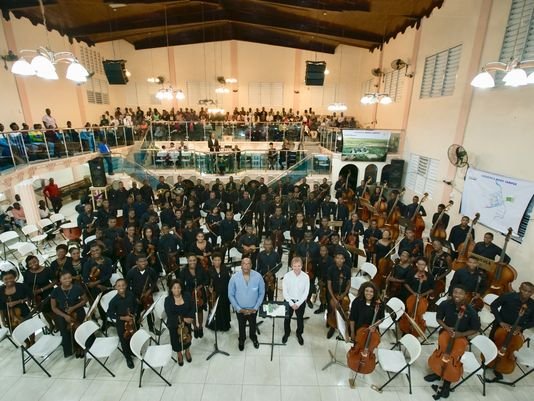
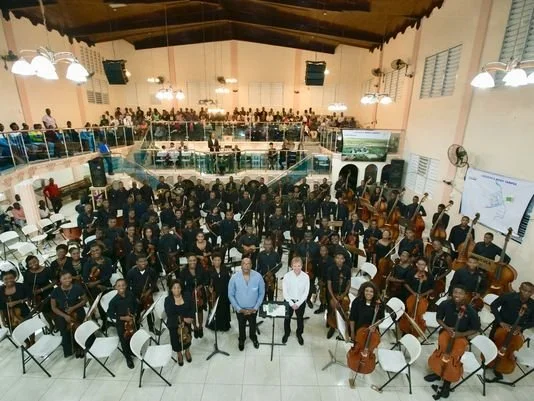
(Utah Symphony music director Thierry Fischer (right) and Haitian conductor Pierre Leroy with participants in the National Orchestra Institute, March 30, 2018, Cap-Haitien, Haiti.(Photo: Colby Bryson)
We are one orchestra, one American organization in Utah, sharing our music to show support for Haiti. We hope our actions will inspire U.S. political leaders.
About 20 of us from the Utah Symphony recently spent a week in Cap-Haitien, in the north of Haiti. It’s about an hour-and-a-half flight from Miami. Close and yet so very, very far.
We were there for the National Orchestra Institute, a partnership with Building Leaders Using Music Education. For the second year in a row, BLUME had brought together about 100 Haitian musicians for a week of intensive training.
I’m the conductor of the Utah Symphony and I first learned about the institute last year when John Eckstein, one of our cellists, told me in an email that “we just want you to know that 17 of us are going to Haiti on our week off to teach music.” The musicians were volunteers raising their own funds for the trip from private donors, he explained, and added, “you might want to think about supporting this institute…” But I didn’t even get that far. I was already thinking to myself, “Am I free that week? I want to join them.”
This year, I was even more determined to go after recent unfortunate comments attributed to our president about Haiti and other parts of the world. I was thinking that if we can show our Haitian counterparts that we are with them and not against them, or worse, ignoring them, then we have made a difference. Even if we are just a drop of water in an ocean.
So there we were, professional musicians prepared to talk about technique and intonation to people (some of them with no electricity, very little clean water) who are taking care of sick parents and struggling to have access to education.
Their instruments were often in disrepair. We had brought many with us, violins, violas, bows, a horn, trombones, music books and scores to give them. We also brought a luthier and bow maker so they could be instructed on how to repair their own stringed instruments.
My initial reaction was to go easy — to take into consideration the way they live and the obstacles they face. But then very quickly I realized, absolutely not. They didn’t need to feel apologetic because of their current level of playing, and I didn’t need to feel sorry because some of them don’t have a proper house. Art is not just about perfection, it’s about the experience and what that experience can bring. Art can create solidarity and fraternity, as opposed to divisiveness.
I was very demanding (in French, since I'm Swiss!) but also very patient. They have said they want to create a National Orchestra of Haiti one day, so they deserved to know what it means to be an orchestra. They were so hungry to learn. For many of them, this week is the highlight of the year.
They worked hard. They had four hours of lessons with Utah Symphony musicians in the morning and three more in the afternoon with me. Our musicians instructed them on their own playing and on how to teach their instruments to others. They also led section rehearsals to prepare them for the concert that would cap our week.
As a conductor, I had much to tell them. Nobody had ever shown them how to tune as an orchestra, so that took a few minutes. And in an ensemble, you have to listen to each other so precisely — with this idea that playing exactly together, they can create a wave of beauty. You have to give them encouragement and be very patient. But they are so committed, it is beautiful to watch. Honestly, when you see them achieve the right tone, it’s breathtaking. You know that you have opened doors, and that these doors will lead them to even more discoveries. They don’t need to tell you — you see it in their eyes, in their smiles, in their body language.
They just want to work, to learn, to be better.
The last evening they performed Tchaikovsky's Symphony No. 5, and after the concert we had a celebratory meal together. I made a little speech at the end. They kept telling us how grateful they were. But I told them they absolutely don’t realize how much we receive and learn from them with their genuine desire just to know more — about everything. Our commitment is our way to show them we love them.
It’s one thing to make yourself feel collaborative by making a donation, but it’s a completely different thing to give your time. To take the initiative and be prepared to be confronted by a different world and to give of yourself. The minimum we can do as artists is to share what drives us every day. A week a year to share and to translate what the notion of art can bring to life in general, it’s not too much.
I am so proud of the musicians of the Utah Symphony for bringing us there in the first place. We are an orchestra — just one American organization, committed to both our work in America and in developing countries like Haiti, and to the notion of sharing what sounds can bring. We hope to inspire our leaders through our actions.
Thierry Fisher is the music director of the Utah Symphony, principal guest conductor of the Seoul Philharmonic, and a frequent guest on international podiums.
By: Thierry Fisher for USAToday.com | April 30, 2018
Artist finds ‘calling’ after 2010 earthquake in Haiti

By: Kyoto Walker Special to The Palm Beach Post for the Palmbeachpost.com | November 29, 2017

Dsquared2 Dresses Andrea Bocelli’s ‘Voice of Haiti’ Chorus

The Haitian kids will perform in Bocelli's Tuscan hometown on Thursday.
MILAN — Dsquared2 founders and creative directors Dean and Dan Caten are supporting Haitian kids.In particular, the twins designed customized dresses and tuxedos for the children’s chorus of Andrea Bocelli’s “Voice of Haiti,” which will perform at the 12th edition of the “Theater of Silence” event taking place at the Italian tenor’s native town close to Pisa on Thursday.Bocelli and the Andrea Bocelli Foundation, focused on finding opportunities for talented young Haitians in need, launched the “Voice of Haiti” project last September in New York with an event hosted at the Lincoln Center.“We met these talented and passionate children for the first time last year in New York. It is such a blessing and a great pleasure to be part of this special journey again,” said Dean Caten. “We created something that could emphasize the strength and the beauty of the Haitian singers. Through their amazing singing, the young choristers spread pure love and joy.”By Alessandra Turra | August 1, 2017
From Haiti to Philly, From Nurse to Bridal Designer
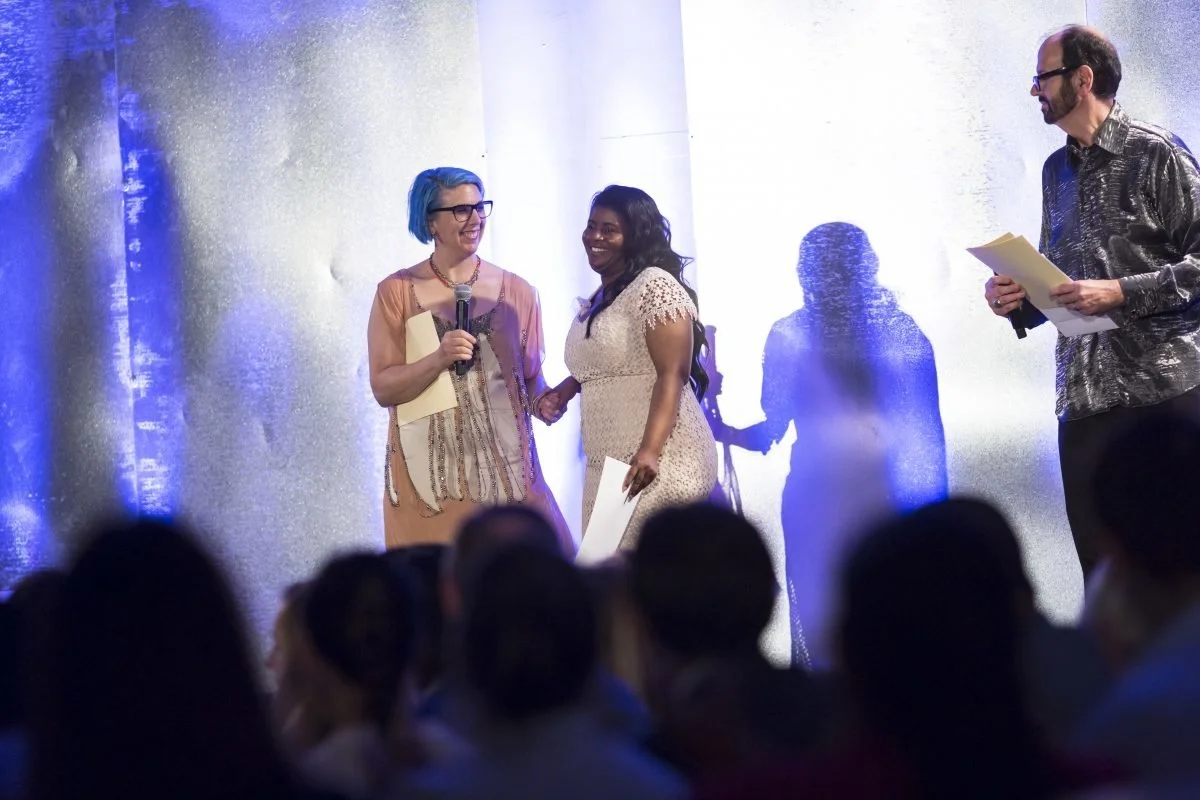
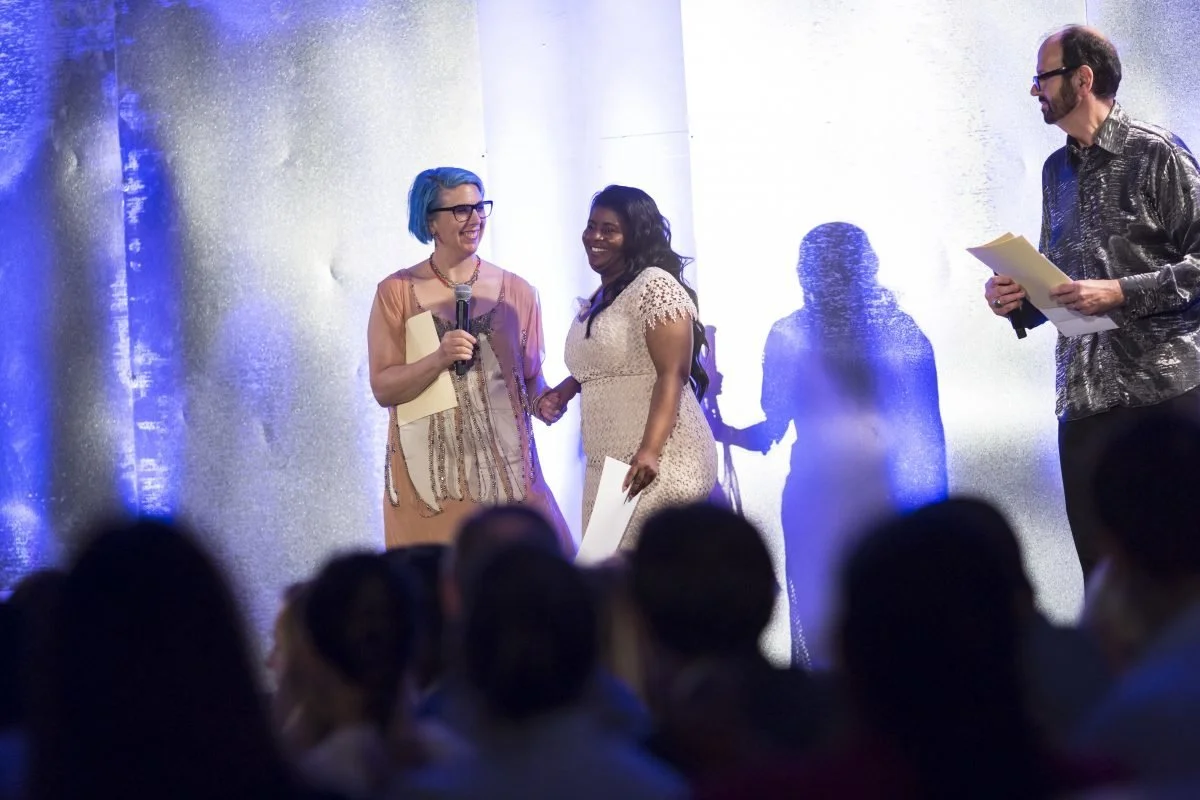
As a child in Haiti, Madelange Laroche dressed her dolls in fashions she’d made herself. As a teenager, she made school uniforms for herself and seven relatives. She dreamed of a career in fashion, designing formal wear and wedding dresses.Then life derailed her. Emigrating to the United States and learning a new language was challenging. To support herself and her brother, she took up nursing, working her way up from home health aide to certified nursing assistant to licensed practical nurse.“I thought, ‘Well, I can do fashion on the side and be a nurse full-time,’ ” Laroche said.That didn’t quite happen. Four years ago, she began studying for a bachelor’s degree at Moore College of Art and Design. She dazzled in the classroom while working more than 40 hours a week at two nursing jobs. Her work won designer Frank Agostino’s critic’s choice award at a student showcase. Last week, a dozen friends and family members — many of whom had traveled from Haiti and Florida — came out to support her at her senior fashion show at the Barnes Foundation.At 36, the new Moore graduate is finally finding her way into fashion. She’s not deterred by her age or her responsibilities. Those who know her say they have a difficult time imagining anything can hold her back now.“She’s absolutely driven, and I think she can make a go of it,” said award-winning fashion designer Danny Noble, who worked with Laroche at Moore. “I’m sure she makes a decent income as a nurse and it’s incredibly admirable that she has such courage and drive.” Agostino, who has been judging Moore student contests for about 12 years, said Laroche was definitely in his top 10, maybe even the top five. “I have great respect for her. If anyone could make a living at it, she’s the one.”Laroche’s unique background and life experiences infuse her design aesthetic. She paints or weaves fabrics as she learned to do as a child. Classic silhouettes are embellished with details and embroidery, and extremely complex designs are superbly constructed, Noble said.Her dream is to create formal wear, specifically wedding gowns. When her bridal wear first appeared on the runway last week, there was a collective gasp from the audience.“It’s just a matter of time,” said Le Tran, who teaches technical design to Moore seniors. “She can do anything.”Laroche was largely raised by her grandmother while her mother worked as a dry cleaner and seamstress in the U.S. She remembers picking up scrap fabric and making her first doll dress at 7. She showed it to her sister.“She said, ‘That’s very nice,’ but I didn’t know if she was telling the truth or not, but since that day, I started making doll dresses,” Laroche said. When Laroche was 12, her mother returned to Haiti after five years away. To reconnect with the family, Laroche’s mother asked whether any of the children would like to learn how to sew.“Nobody said anything,” Laroche recalled, “and I felt so bad for her, so I raised my hand and said OK.”Laroche and one of her brothers sat down and learned how to take measurements and cut fabric and made a pencil skirt. It was Laroche’s true start as a designer.“I never stopped. I never stopped looking for fabric,” Laroche said, describing how she’d hide in her grandmother’s closet and hand-sew the older woman’s garments into new shapes and styles that would fit her.Then, she said, she’d wait until the rest of the family had gone to church to emerge wearing her grandmother’s now-altered clothes.When she was 16, Laroche persuaded her grandmother to let her make the school uniforms — a white blouse and an olive green skirt or pants — for the family. She changed the design, adding olive green accents to the shirts. School officials protested and demanded the uniforms be, well, uniform. But within weeks, about half of the school’s students had altered their shirts accordingly. Administrators gave in. “They said, ‘Well, it’s a lost game’ and it became our school uniform and it made us stand out,” Laroche said. “I don’t know but I think they were proud that a 16-year-old could do that.”In 2001, with high school completed, Laroche moved to Florida to live with her mother. After two aborted attempts at attending a fashion school — cost and the language barrier held her back — Laroche took a friend’s advice and tried nursing.It was steady work, just what she needed after she settled in Philadelphia and took in her 33-year-old brother, who has mental handicaps that weren’t fully understood in Haiti. She decided to get her bachelor’s degree in nursing and began taking classes at Manor College. She still designed and made clothing — dressing the entire bridal party for a relative’s wedding, designing both a ceremony and a reception dress for a teacher — but fashion design became a hobby, not a destiny.And then, during a meeting with her college adviser, the truth burst out: She wanted to go to fashion school. She would love to open a made-to-order wedding dress business. The adviser was surprised. Another student who’d overheard the conversation told Laroche to look into Moore, where Project Runway Season 10 winner and Philly native Dom Streater had studied.Four years later, her senior show was about to begin and Laroche was nervous and excited. She wore an off-white lace appliqué formfitting dress that she had started making at 11 p.m. the evening before.It fit perfectly.by Natalie Pompilio | May 16, 2017

"Jeu de Bâton" A Fighting Art of the National Army

Monday in Lagrange (Artibonite Department), as part of the Day of Agriculture and Labor, the National Bureau of Ethnology (BNE) in collaboration with the Ministry of Tourism and Ministry of Culture organized a show of «Jeu de bâton» (stick game). This tradition that has existed since the colonial period in St Domingue, was also a means of combat used by the native army during the war of independence. It is also a martial art inspired by the forms of African combat. A variety of stick styles such as : "Baw Blan", "Migel" and "Pati kola" were used during this activity. An intangible cultural heritage strongly practiced and preserved in the Artibonite. Jessy C. Menos, the Minister who traveled to encourage stick Practitioners and BNE dancers, said the show "is part of a promotion of the 'Jeu du bâton' and a duty to remember."According to Erol Josué, the Director General of the BNE "This ritual was the means of combat of the native army" recalling that "Gran Toya", great aunt of the Emperor Jean Jacques Dessalines, was a great warrior and would have initiated the Emperor at this game from a young age. Other peoples like the Amazons of the former Dahomey also practice stick fighting.From this collaboration around the development of Ethno-Tourism in Haiti, an inventory of cultural practices and sites will be launched, which will begin in the Department of Artibonite in order to highlight the riches Haitian heritage. HaitiLibre | May 3, 2017