
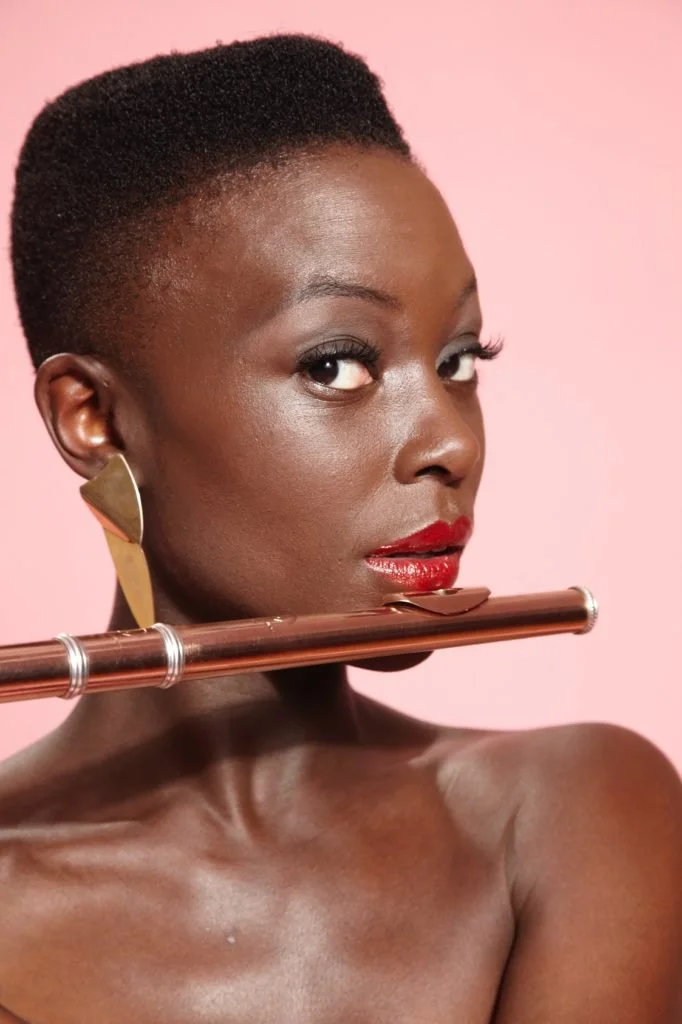
Haitian American musician Nathalie Joachim pays tribute to underrepresented women of Haiti
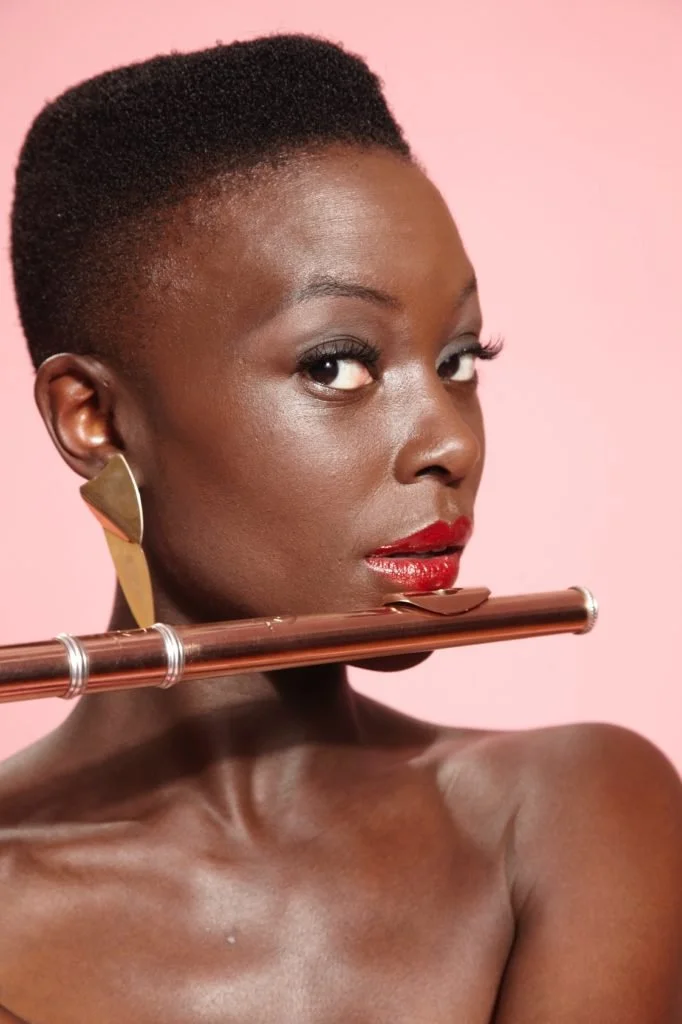
Flutist and composer Nathalie Joachim first came up with the idea for her debut album in late 2015. She was in Haiti, exploring her Haitian heritage and wanted to know about female artists from the island. Together with her parents, she could only come up with a dozen or so.
"I was really inspired to make an album centered around the voices of female artist from Haiti largely because they're left out of Haiti's musical history."
"I was really inspired to make an album centered around the voices of female artists from Haiti largely because they're left out of Haiti's musical history," she said.
Some women on the list included singer Emerante de Pradines, Milena Sandler (daughter of Toto Bissainthe), and vodou revolutionary Carole Demesmin.
Joachim's Grammy-nominated album, "Fanm d'Ayiti," sets out to correct some of the omissions of women underrepresented in Haitian history. She thinks this is "a beautiful way to represent the women of Haiti."
"Fanm d'Ayiti" translates into "Women of Haiti." On the album, Joachim features new song arrangements and snippets from recorded interviews with some of the women. One voice heard is that of Joachim's own musical hero and maternal grandmother, Ipheta Bellegarde, because "her voice was one that was quite important to me throughout the course of her life."
The song featuring Bellegarde's voice is also one her grandmother wrote. It's called "Madan Bellegarde." Bellegarde died in 2015. Joachim says her grandmother was "criticized her whole life because she became a widow when my mother was still an infant, quite young, and never remarried. She really chose to live a life independently of her own design."
Joachim would often hear her grandmother share stories about what life was like as a single mom in Haiti in the late 1940s and early '50s. She says her grandmother wrote the song because she was being "judged by all of the sinners around her, people who committed much grander sins than being an unmarried woman, but that she knew at the end of the day she would not be judged by God. And so she wrote this song and would sing it." Now, Joachim sings it.
Joachim also recorded with a girls' choir in her family's farming village Dantan. "[It's] a very small place with just one street that has a church and a school and that's it," she said. "And I hope that any one of them, if not all of them, are inspired by how we've been able to spread their voices from this small spot in Haiti across the world."
Joachim says she hopes her album touches young women everywhere and that they will "take away the strength and the power and continue to lift each other up ... [and to] look to your elders and find strength in their stories and to be sure to leave a pathway for those coming up behind you. We're all connected."
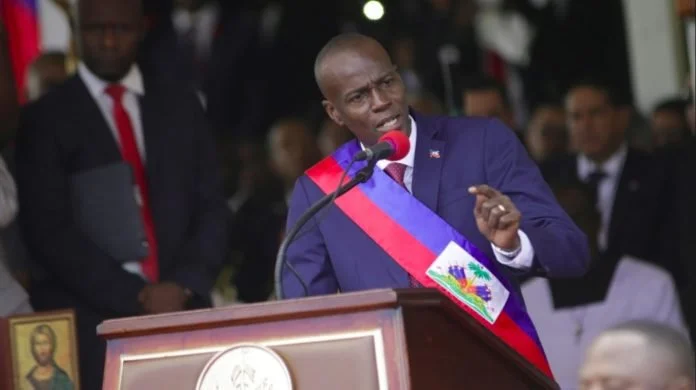
Moise Calls for Solidarity in Building a New Haiti
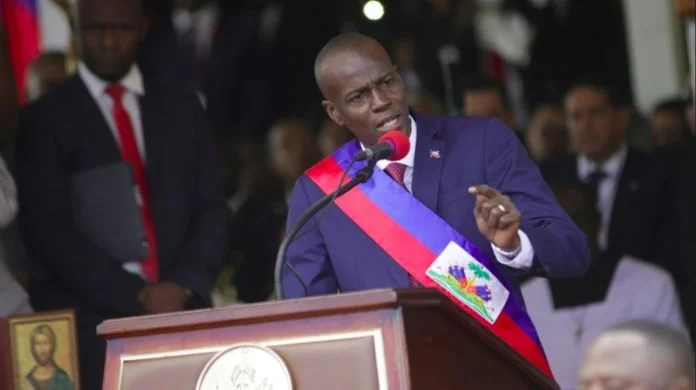
PORT AU PRINCE, Haiti (CMC) – President Jovenel Moise says 10 years after an earthquake devastated Haiti and forced the country into an unprecedented state of cooperation, the country is now offering “another image” to the world.
Moise had joined Haitians and the international community on Sunday in observing the 10th anniversary of the earthquake that killed an estimated 300,000 people and caused widespread damage in the country.
Moise, who came to office in 2017, is facing pressure from the opposition political parties to step down from office over allegations of corruption and other charges. The opposition parties have been staging violent street demonstrations in support of their calls.
Moise has denied the allegations and is moving towards forming a government of national unity despite the opposition boycotting the talks on the matter.
But Moise said that the “great inter-Haitian solidarity where compatriots, with their bare hands, freed our brothers and sisters from the masses of reinforced concrete,’ has been replaced with anger and hatred.
“We have seen people risking their lives to save the life of someone whose only voice they know is the trickle of voices filtering through the rubble. We have seen traders empty their stores to offer drinks and food to children on their own. We have seen women carrying men twice their weight on their backs, for miles and miles so that they can receive treatment.”
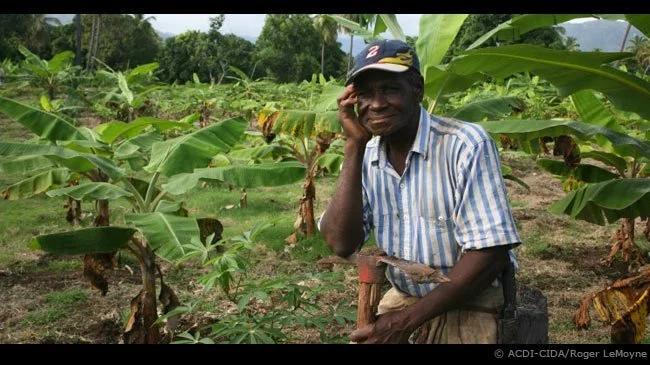
Haiti farmers eager to receive compensation after 'groundbreaking' land deal
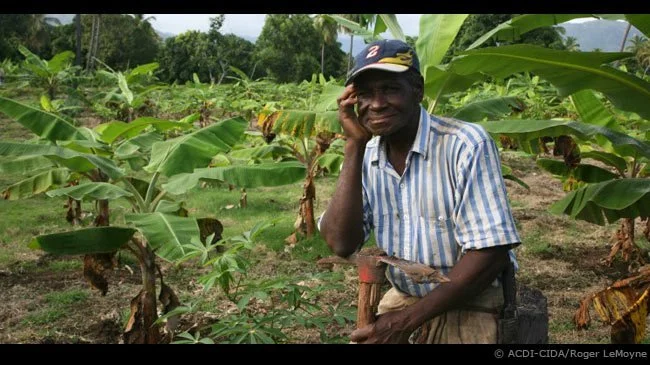
CARACOL, Haiti (Thomson Reuters Foundation) - On a hot morning in December, Haitian farmer Remy Augustin lifted a pickaxe that was taller than him and began digging holes in a small plot of land. In each hole he dropped a few kernels of maize, which he covered with loose dirt.
“I don’t have money to pay for a tractor, so we’re aerating the land ourselves,” said Augustin, 55, lamenting the days when the land he tilled was his own.
“The land I had was better — it gave me so many bananas, peas, beans.”
Nine years ago, the father of five was working on government land he rented when “a tractor destroyed everything”.
The land was earmarked for the Caracol industrial park, a venture led by South Korean textile firm Sae-A Trading Co Ltd and financed by international donors to spur development following Haiti’s devastating 2010 earthquake.
Located in Haiti’s northern region, the $300 million park opened in 2012 and now employs approximately 15,000 people, most of whom work in clothing factories there, according to the Inter-American Development Bank (IDB), one of the park’s main financial backers.
In 2018 farmers like Augustin who had been evicted from their land in 2011 struck a rare deal with the IDB to provide Caracol’s 100 most vulnerable families with new, titled land.
But 10 years after the earthquake that killed more than 200,000 people and made 1.5 million homeless, the farmers are still waiting to receive compensation for their land used to build the Caracol park.
Augustin now works as a laborer on a plot owned by his niece, struggling to pay his children’s school fees for the coming year.
“I have to share this land with my whole family,” Augustin told the Thomson Reuters Foundation. “I don’t have anything of my own.”
DRIVEN FROM LAND
International donors pledged nearly $10 billion to help Haiti recover after the 2010 earthquake, which destroyed or damaged 300,000 homes in the capital Port-au-Prince and surrounding cities, said the International Organization for Migration.
To make space for the park, in 2011, 366 Haitian families - including 720 farmers - were evicted from their land, according to charity ActionAid Haiti.
Neither the government, the IDB, nor USAID - another of the park’s main funders - responded to requests to verify those figures.
A spokeswoman for Sae-A Trading Co Ltd described the textile firm as a “tenant of the park”, adding it had been involved neither in its construction nor in the 2018 land deal.
Local farmer and activist Milostene Castin said that from 2011 to 2013 the IDB gave the farmers an annual living stipend of $80 per family member, and paid $1,450 for each hectare of land, well below the land’s value.
“The cash compensation that was received by the vast majority of the farmers was not sufficient to purchase new land or to establish new livelihoods,” said Lani Inverarity, a lawyer at San Francisco-based charity Accountability Counsel, which promotes human rights.
The IDB later promised the farmers new plots of land, but “year after year the land never came”, said Castin, who works for local organization Action for Reforestation and Environmental Defense (AREDE).
Families that once lived off of the food they grew “were struggling just to eat”, he said.
Eventually, the IDB identified a swath of replacement land, but when Castin went to inspect it, other farmers were there already, he said.
COLLECTIVE ACTION
Fed up with waiting, hundreds of farmers formed a collective in 2014 to fight for land.
In 2017, with the help of ActionAid Haiti and AREDE, the farmers filed a complaint against the IDB, demanding new land with legal titles to prove ownership so they could resume farming.
Their self-organizing paid off: After more than a year of meetings, the IDB agreed to purchase new, titled land for 100 of the most vulnerable families.
Others were offered alternative compensation such as irrigation schemes or money to invest in personal businesses. One member of each family will also be offered employment at the industrial park, according to the IDB.
“The farmers’ story is a really incredible one of persistence in the face of incredible power imbalances,” said Inverarity of the Accountability Counsel, which supported the farmers throughout the complaints procedure.
“Typically, IFIs (international financial institutions) try their best to stay out of these disputes, leaving it to the company or government entity to respond. However, here the IDB genuinely turned up,” said Inverarity.
Andy White, coordinator of Washington-based advocacy group Rights and Resources Initiative, agreed, calling the land agreement “groundbreaking for Haiti”.
“We are seeing more and more cases like this around the world where communities have fought back against international investors to demand respect for their land rights,” he added.
“But this is the first case I’m aware of this scale and this nature.”
COMPLEX PROCESS
Implementation of the agreement is behind schedule due to logistical challenges in identifying the most vulnerable families - among other hurdles - who are still waiting to receive compensation, according to the Accountability Counsel.
It is meeting with all farmers to figure out how they would like to receive financing to obtain title deeds to a parcel of land.
Assuming the IDB disburses the funds soon, Accountability Counsel said what happened in Haiti’s north could be seen as a successful model of how communities displaced by development projects can self-organize to demand new, titled land.
The group is currently monitoring more than 1,200 cases in which local communities are facing similar issues in 129 countries across the world.
“About 13% of concluded cases have gone through a dispute resolution process like in Haiti,” resulting in 90 agreements globally, said Sarah Singh, the Accountability Counsel’s global communities director.
‘JUST WAITING’
Meanwhile, the farmers are trying to eke out a living with what they have got.
Ever since her father’s land was taken over to build the Caracol park, Seliana Marcelus leaves her home at 5am to sell breakfast to the factory workers as they enter the industrial park gates.
All night long she fries potatoes, breadfruit and other produce, things that her family once grew on that same land but that she now must purchase at the local market.
“I don’t even go to bed. I work all night,” said Marcelus. “It’s the only work I have.”
Since losing his plot, Rony Comper has been doing odd jobs, from temping as a motorcycle taxi driver to crossing the border into the Dominican Republic to work as a mason.
Like Augustin, he found a titled plot he will buy once IDB releases the funds - which is expected to happen this year. “We’re just waiting.”
(This story was supported by the Pulitzer Center.)
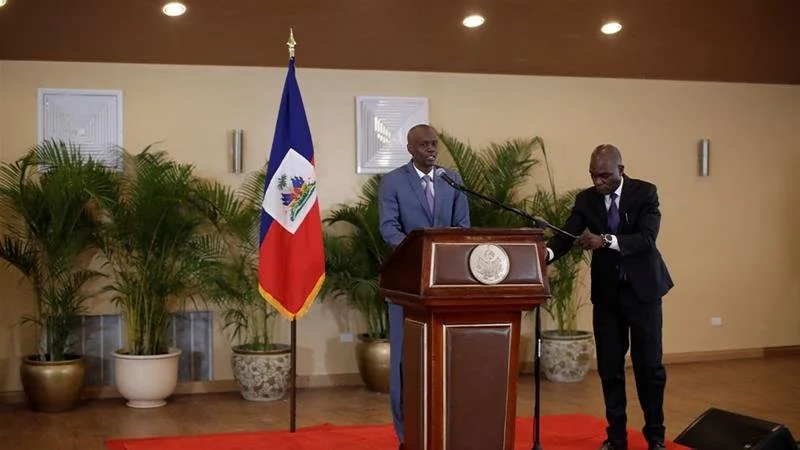
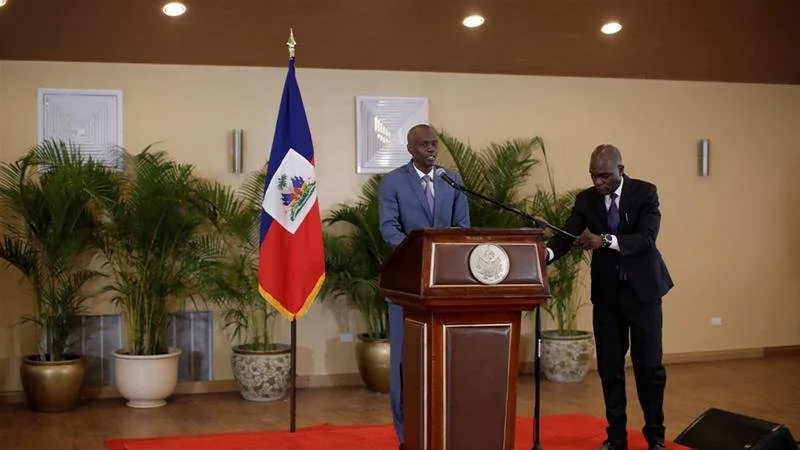
Political vacuum in Haiti could let president rule by decree
Protesters have vowed to return to the streets to demand President Jovenel Moise step down.
Haitian President Jovenel Moise could be ruling by decree later this week, a scenario he said would help break the Caribbean nation's political deadlock, but one in which critics fear will undermine its fragile democracy.
In the early hours of Monday, the president said the mandates of lower house deputies and most senators formally expired because no successors were elected in October after the troubled country failed to hold elections.
The power vacuum could deal a significant blow to democratic governance in the poorest country in the Americas, three decades since the end of the Duvalier family dictatorship.
Moise, however, sees the side-lining of Haitian legislators as a positive.
"The current situation is an opportunity to stop the permanent crisis," said Moise, who has come under pressure from months-long street protests and opposition groups to resign or hold early elections.
"The biggest problem Haiti has is the weakness of its public institutions," Moise told Reuters News Agency in an interview.
Moise has faced widespread anger over inflation, rampant insecurity and allegations of corruption. Moise has denied any wrongdoing related to the accusations of corruption, but waves of street protests have gripped the country in recent months, with calls for Moise to step down.
Haiti has had 15 presidents in the past 33 years.
Under his predecessor, Michel Martelly, the Haitian Parliament was dissolved in January 2015 when last-ditch negotiations for a deal that would have extended legislators' mandates failed.
Martelly ruled by decree until the end of his term.
"Without the opposition, the government seems less legitimate," said Jake Johnston, a senior research associate at the Center for Economic and Policy Research in Washington, DC. "Will he make efforts to work for the whole or will he just pursue his own agenda without checks and balances?"
A former banana exporter, Moise is nearly three years into his five-year term. He won an October 2015 election that was later scrapped over fraud allegations; in January 2017, he was declared president after a repeat election in November 2016.
Moise's political base has been weak from the start. Electoral turnout for the 2016 election was low and 10 percent of sheets tallying votes were thrown out because of irregularities. In a country of 10 million people, he received just 600,000 votes.
"He won an election, but there's a question around how much of a credible and legitimate mandate that provided him given the extremely low turnout and the lack of faith in the democratic process to begin with," Johnston said.
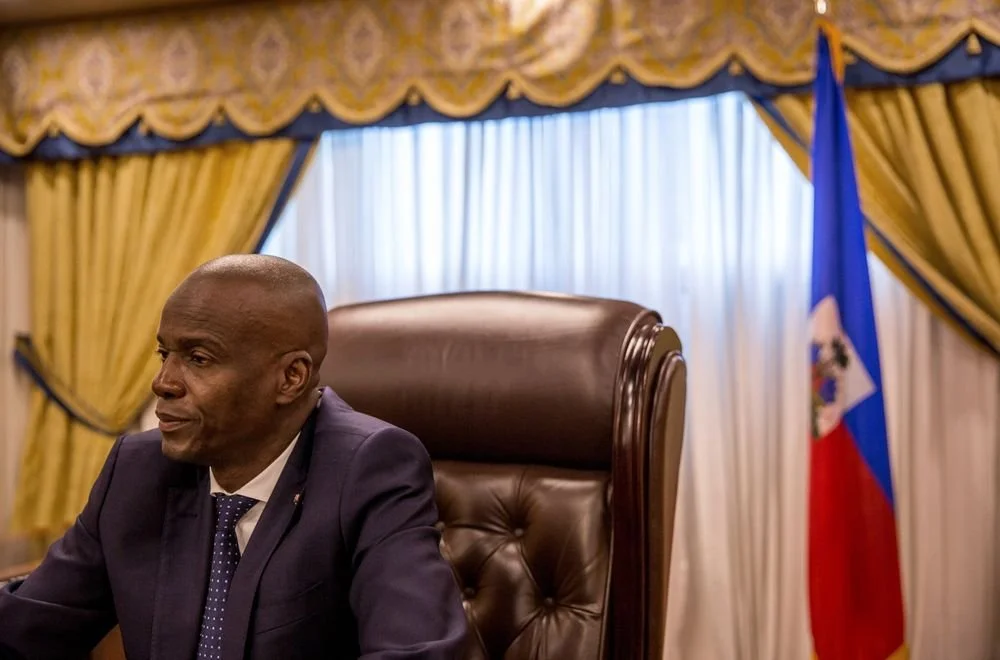
Haiti Seeks IMF Deal to Revive Worst Economy Since 2010 Quake
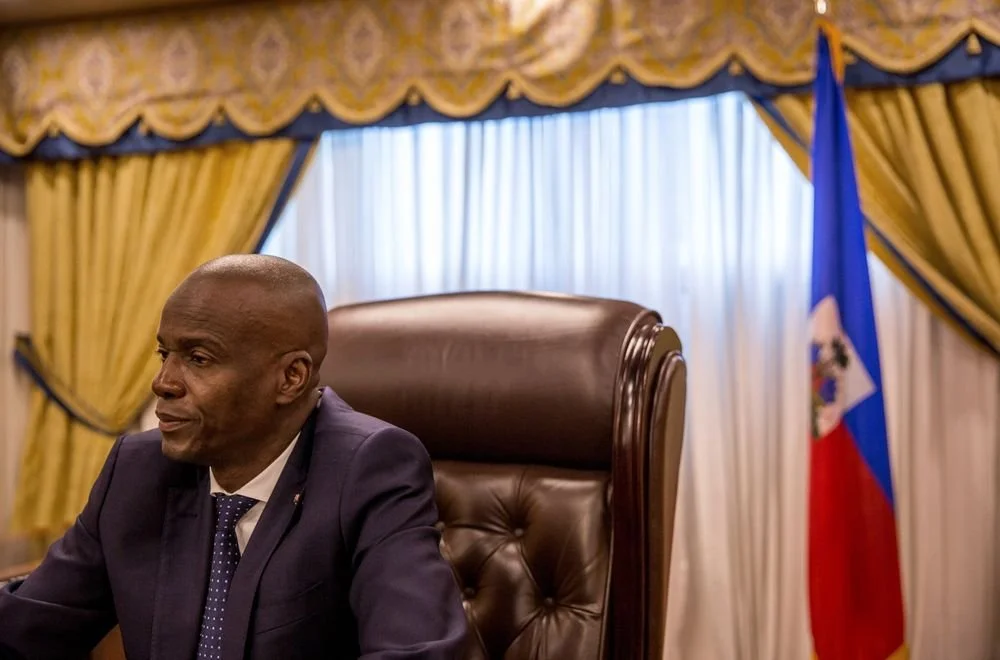
Haiti’s embattled president Jovenel Moise is seeking to reactivate a deal with the International Monetary Fund to revive the weakest economy since the nation was devastated by an earthquake in 2010.
Speaking on the 10th anniversary of the disaster, Moise said he is seeking an agreement to end political deadlock and unblock the IMF deal, which was shelved in March after Haiti’s parliament dismissed the government.
The legislature has since rejected his choice for prime minister. During an October vote, lawmakers threw furniture and pushed and shoved each other. Meanwhile, protesters calling for Moise’s ouster unleashed social unrest the IMF described as “without precedent.” In a November review, the Fund estimated Haiti’s economy would contract about 1.2% in the 2019 fiscal year.
“The year 2020 cannot, in any way, be the same as 2019. There has to be permanent dialog,” Moise said in a phone interview from Port-au-Prince. “We are working to find a political agreement so that we can put in place a government of national unity.”
The IMF didn’t immediately reply to an email seeking comment.
Protests initially erupted in July 2018 against fuel price hikes and evolved into anti-government demonstrations over graft allegations, misuse of funds from a Venezuela oil aid program, high inflation and poor living conditions. Haiti is the poorest country in the Western Hemisphere with more than half of its 11 million citizens living on less than $2.41 per day, according to the World Bank.
Social Turmoil
Moise, who was sworn in to a five-year term in February 2017, said he’ll seek to calm social turmoil this year and ramp up rebuilding efforts. An IMF deal would also facilitate additional loans from the World Bank and the Inter-American Development Bank and help the country rebuild, he said.
The government has a history of swiftly sacking prime ministers ever since the role was created in the 1980s, with few making it a full two years in office. Lawmakers removed former Prime Minister Jean-Henry Ceant in March with a 93-6 no-confidence vote following protests. He served 185 days. The IMF suspended implementation of a $229 million, zero-interest, three-year loan after the move.
The crisis hampered the government’s ability to boost revenues and enact economic reforms, Moise said. A deal with political opponents would help put the country back on track to growth and help the government fight tax fraud and evasion, he said.
“We need stability, we need solidarity and we have to live together so we can begin the necessary reforms,” Moise said.
National Palace
The government unveiled designs on Sunday to rebuild the country’s National Palace, which was partly destroyed in the earthquake that killed some 220,000 people and left more than a million homeless, according to the United Nations. Moise said construction on the palace could begin this year.
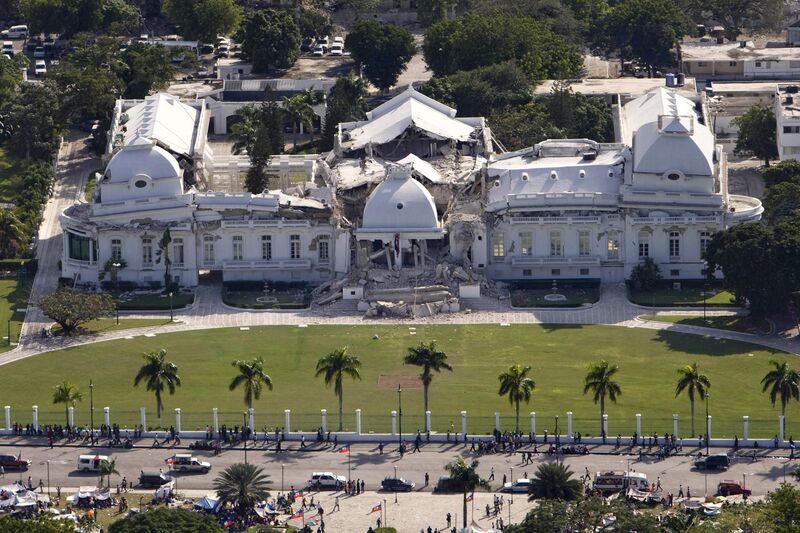
The government is also pushing to finish building the finance ministry and an “administrative city” which will house government offices, he said.
Haiti’s capital Port-au-Prince, which was cluttered with tent cities for years following the quake, is still in need of social housing developments, Moise said, adding that schools that remain in areas prone to disaster must be relocated.
“I sincerely believe the beginning of this year to be a decisive beginning,” he said. Political and economic actors “will find good solutions to finally put the country on the path to development.”
Ten years after a devastating earthquake, some Haitians say they're losing hope
Ten years ago today a massive earthquake struck Haiti, transforming capital city Port-au-Prince into a nightmare in seconds. Some 70,000 people would be buried within a week's time. Hundreds of thousands more would follow them to the grave.The devastating force of the 7.0 quake on January 12, 2010, split the country's history into a before, and an after. Before had been a long, tangled history of dictatorship, occupation and resistance, shot through with the pride of a slave revolution that defeated Napoleon Bonaparte's army. After was unimaginable -- a blank slate."I think they just dropped a bomb on Port-au-Prince," is what Francoise Chandler, a local UNICEF communications officer, told her daughter after the first tremor struck. She had just picked her up from school."Everything was shaking, and there was a lot of noise. I thought it was like September 11 in New York, because I had been in New York in that period," Chandler says. Thick dust rose in the air around their car."Are we going die?" she remembers her daughter asking. Chandler replied, "I don't have the answer to that, but if we're going to die, we'll die together."
Her daughter stopped asking questions then, she says.
Hope and hopelessness
According to the US Geological Survey, the earthquake itself lasted less than 30 seconds. The immediate aftermath was horrifying. But an outpouring of solidarity within the country, and between Haiti and the rest of the world, gave many Haitians hope."The world really did come together around Haiti," says CNN's Sanjay Gutpa, who covered the aftermath extensively and even treated injuries while on the ground. "Not every part of the world, but I think if you were to turn on your televisions, if you were to read the newspaper, if you were to talk to your friends, colleagues at work, there was this collective outpouring of support and compassion for Haiti."
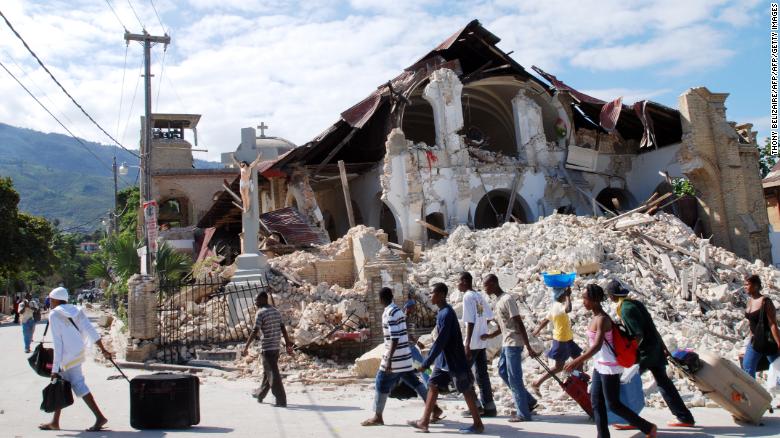
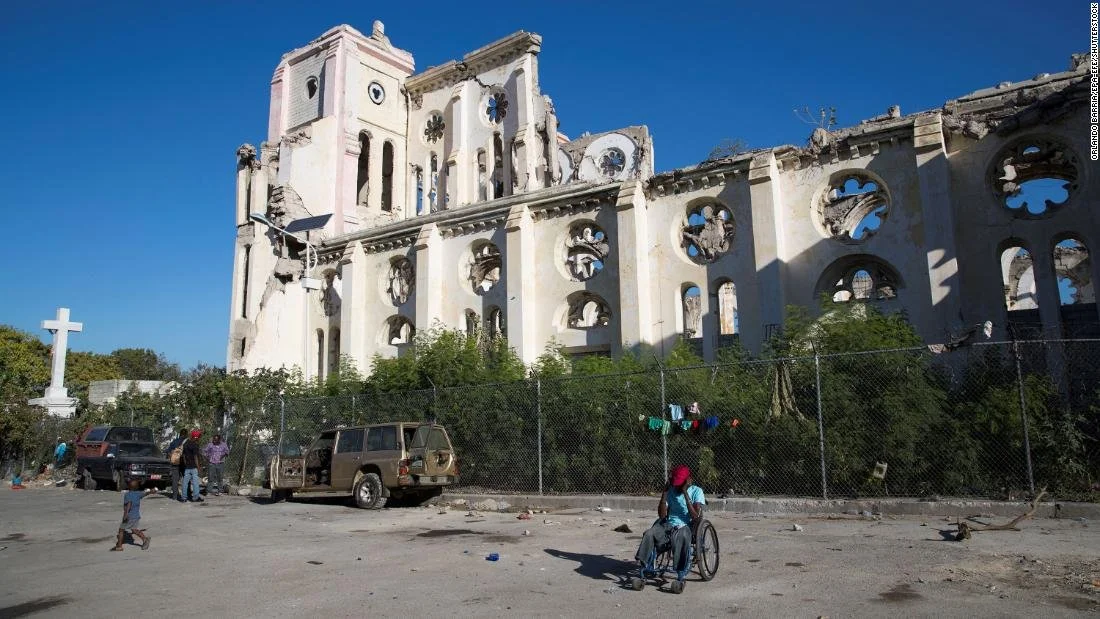
People walk by the collapsed Sacre Coeur Church in Port-au-Prince two days after the earthquake that devastated Haiti on January 12, 2010.The world sent firemen from New York City, rescue workers from Iceland, hospital tents from Israel, sniffer dogs from China, oil from Venezuela. NGOs that were already in the country leaped into action. Chandler recalls working out of an open-air tent in the days after the quake because the organization's offices had crumbled.International donors pledged millions, which eventually tallied up to more than $10 billion for reconstruction. The earthquake had been particularly lethal due to the fragile construction of Haiti's buildings, which crashed down upon their inhabitants."Right after the earthquake I felt a lot of hope, because I thought emerging from the catastrophe would make everyone a better person in the service of this country," says Harold Prévil, an obstetrician and head of Sacre Coeur hospital in Haiti's northern city of Milot.But a decade later, he and many others tell CNN they are now disillusioned and have far less hope for their country than they did in the gory aftermath of the earthquake.
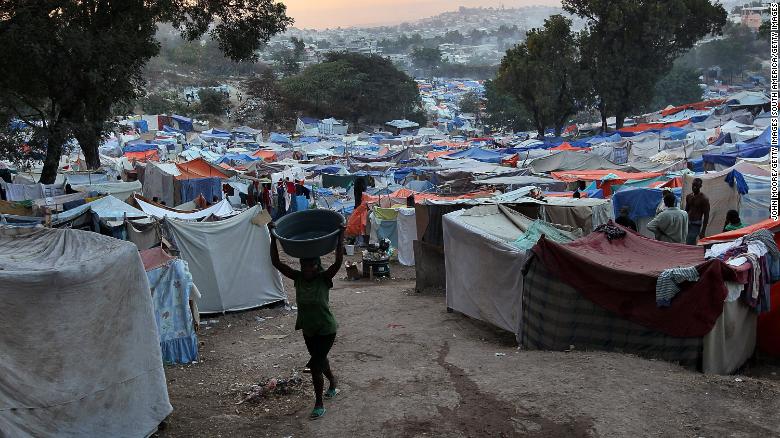
The earthquake left many thousands homeless and turned large parts of Port-au-Prince into refugee camps."A lot of money was spent after the earthquake, but the results are meager," Haitian President Jovenel Moise told CNN in an interview Sunday.Moise has publicly acknowledged how little Haiti had had moved forward in the past decade. "Despite our best efforts to rebuild after the earthquake, the scars of this tragic event remain," he said in a statement on Saturday. "Ten years on, we still lack the basic infrastructure and services to support the people of our country."
Haitians are 'living with permanent stress'
Parts of Haiti that were destroyed in 2010 still have not been rebuilt, including the seat of government, the National Palace. And there is little sign that buildings which have been reconstructed are structurally sound enough to keep inhabitants safe through the next earthquake.Whiplashed between disasters both natural and political over the past decade, many Haitians have not had a chance to rebuild mentally or emotionally either, says Marline Naromie Joseph, a Haitian psychologist who has worked with Medecins sans Frontieres (Doctors Without Borders) for 12 years. She was on the frontlines of emergency medicine in the aftermath of the quake, working with patients who had lost limbs, children who had lost their parents and colleagues who had borne witness to the quake's horrors.Joseph recalls witnessing the first bodies being collected in a city street on the day after the earthquake."The sound that the bodies made falling into the truck was nauseating," she says. Further along that same road, workers were separating the dead into piles of children and adults, she recalls -- an image which would return to her every time she walked on that street for years and which she eventually realized was evidence of her own trauma.Haiti Earthquake Fast Facts"Even though there were no longer the children, no longer the dead, it was as if it were the first day that I was seeing them," she says. "My brain had saved this image and became stuck on it."Some patients still have flashbacks to the sensation of the earth moving beneath their feet when revisiting certain settings -- like the hospital's operating room, she says.According to Joseph's diagnosis, the country's misfortunes over the past decade have piled stress upon trauma. In the years since the earthquake, the country has been pounded with hurricanes, floods and drought. It's also been betrayed by human error -- tied to a devastating cholera epidemic, for example -- and government corruption that has sparked Haiti's current political unrest."We can live with stress, but living with permanent stress will not leave the body without consequence. Eventually, you fall directly into exhaustion," says Joseph, who notes she has observed more mentally ill people living on the streets than before the earthquake.
The country is crippled by hunger, inflation and fuel shortages
One particularly bitter frustration on the earthquake's 10-year anniversary is how weakened the country's economy and infrastructure seem to be."Ten years after, I am a physician, I am the chief executive officer of a 210-bed facility, but believe me, I am hopeless," says Prévil, the doctor. "Haitians have not had the opportunity to do things differently and better."Some things are better. Haiti's medical system has widened since the quake, and UNICEF reports that no new cholera cases have been diagnosed since February last year.
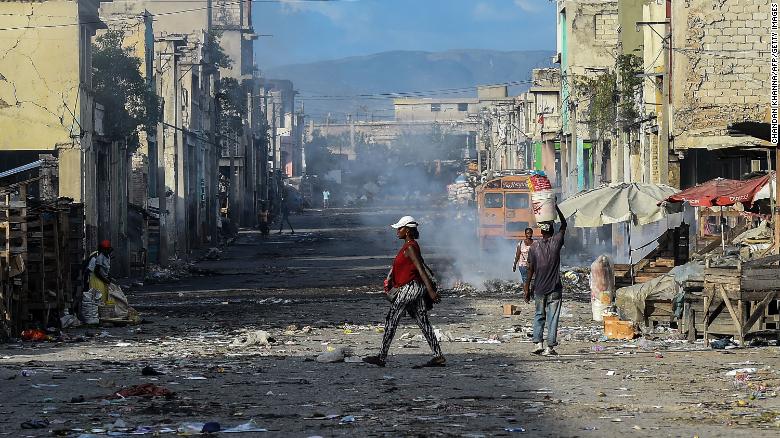
People walk in downtown Port-au-Prince on December 20, 2019. The country's infrastructure remains in dire need of repair.But Prévil and Joseph both say that the country's medical and mental health resources would nevertheless be insufficient for another disaster on the scale of the 2010 earthquake."I would not say we have an institution capable of dealing with all the psychological trauma of another catastrophe like that," Joseph says.The country is currently gripped by skyrocketing inflation, while fuel shortages slow the gears of industry and government. According to a new report by the UN's disaster relief agency OCHA, rising prices mean even basic supplies are now out of reach for the poor.Hunger also threatens Haiti now. Forty percent of Haitians will face food insecurity by March, the agency predicts. For least 1 in 10, food insecurity will reach "emergency levels."In his Saturday statement, Moise rebuked the rest of the world for failing to follow through on its promises."The initial flurry of attention received from the international community quickly quieted down, with many of the financial pledges not delivered -- causing devastating consequences for our recovery," he said."Little of the aid that was received ended up in Haitian hands and much of the money that was so generously given was not spent on the right projects and places," Moise added, echoing a common criticism that aid money focused on short-term relief rather than sustainable, long-term systems.By 2012, $6.4 billion of the more than $10 billion pledged had been disbursed, according to a report by Paul Farmer, a Harvard medical anthropologist who served as the UN's Deputy Special Envoy for Haiti.And while there is little consensus over how much more of the money has been spent, the report on the first two years of spending supports Moise's point. It noted that "less than 10 percent was disbursed directly to the [Government of Haiti] using its systems; less than 0.6 percent was disbursed directly to Haitian organizations and businesses as program grants."
Claims of corruption have fueled mistrust
What Haiti's government has done with the funds it had at its disposal is also a cause for complaint for many citizens.
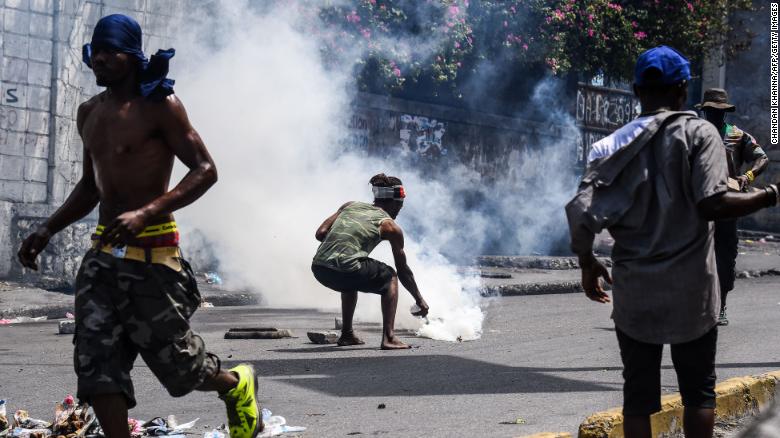
A demonstrator douses a tear gas canister with water during a protest demanding the resignation of President Jovenel Moise in Port-au-Prince on September 27, 2019.For nearly two years now, Haiti has been in political crisis -- sometimes punctuated with country-wide lockdowns -- over dissatisfaction with the government and how it has dealt with allegations of extraordinary corruption.The protests were sparked by a fuel price hike and an official report alleging that past administrations had wasted millions of dollars intended for critical infrastructure projects, paying through the nose for contracts on new roads and buildings that went entirely unbuilt, in some cases. That money, stemming from a pre-earthquake deal with Venezuela known as PetroCaribe, will eventually have to be repaid by Haiti's next generation."What frustrated me a lot and made me feel really sad and sick was that I thought that the Haitian people and the Haitians who were in charge of the country would have taken [the earthquake] as an opportunity to make the country better," says Prévil."But it has not happened. My leaders have become more selfish, they have been robbing more. So instead of taking the opportunity to change the country, they've made it worse."Haiti has never come out of the darkness of the 2010 earthquake, says Etzer Emile, a Haitian economics researcher and entrepreneur in Port-au-Prince who identifies himself as one of the activists calling for change. He credits the PetroCaribe scandal with drawing local corruption into focus and creating a movement for change, disruptive as it is.
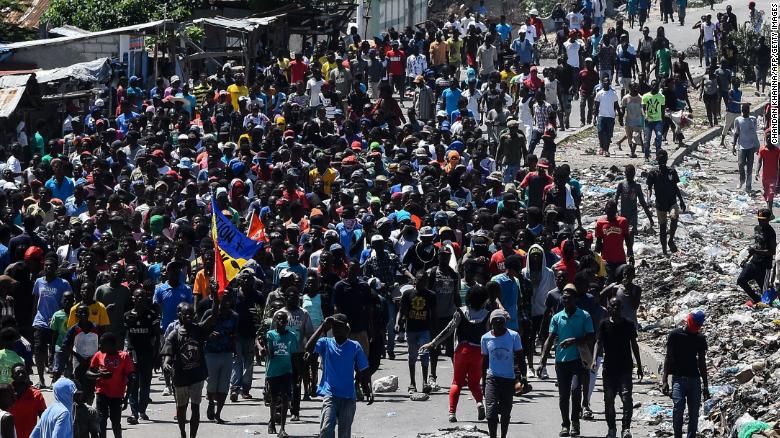
People march in Cite Soleil during the anti-government protest on September 27, 2019."You know, that can make us feel (like) ... there's something actually we had, and we didn't really take advantage of it."Now that the government has publicly documented funds lost or disappeared, Emile says the numbers are accessible in a way that they weren't before. They also can be shared easily thanks to social media, which has fanned outrage and calls for change -- including for Moise's resignation -- as anti-corruption activists accuse the President of turning a blind eye to the PetroCaribe allegations.Moise told CNN that fighting corruption is still a priority of his administration and said that the past months of political unrest have exacerbated Haiti's economic problems."We need the same solidarity we had after the earthquake," he said, emphasizing this time he means solidarity with "the actors who are putting the country on a path to change, to economic growth, and development."
What will happen next
Haiti is considered one of the most vulnerable countries to climate change, and its location in the Caribbean lies squarely in the middle of a hurricane belt. As it looks toward the future, how Haiti can prepare for the next great disaster -- and what kind of help it might receive -- are urgent questions.Emile believes Haiti no longer commands the same interest and compassion that it did in 2010."If Haiti's reconstruction had been a success, maybe we could have been interesting to people as a case study. But it was a failure, so people feel fed up ... they don't even want to talk about it that much," he says. "The further we go from the earthquake, the less interested people are in Haiti."The drop in interest is, in fact, measurable: A 2019 UN plan for humanitarian aid to Haiti only managed to raise a third of the funding it needed.Vania André, publisher of the Haitian Times, a paper of record for the Haitian diaspora, says that the earthquake galvanized the loyalty -- and a certain defiance -- of generations of Haitian Americans.
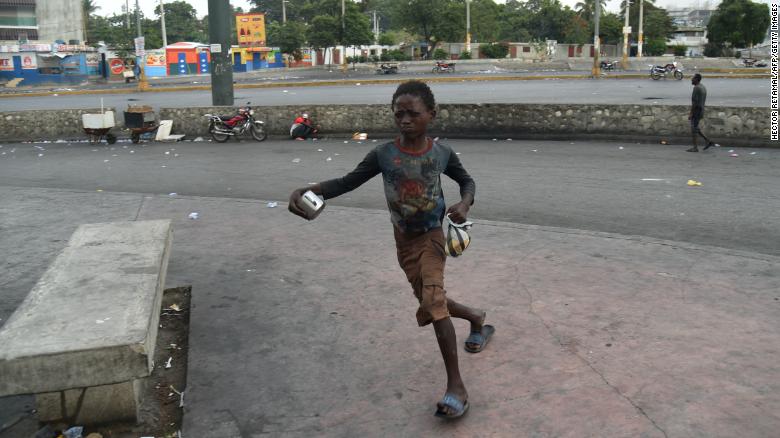
A boy flees from tear gas during clashes with Haitian police in Port-au-Prince on February 15, 2019.It became common to hear stories of Haitian-Americans "leaving their corporate jobs in DC or Florida and moving to Haiti to create a nonprofit," she says. "They wanted people to see that Haiti is much more than the devastation that happened with the earthquake, that Haiti is much more than this republic of NGOs."But she also notes that many of those same foreign-born idealists did not stay long, discouraged by the skepticism they encountered and the difficulties of doing business.As the flow of foreign aid money ebbs and Haitians lose faith in their government, some say they only thing they can rely on is their own experience.Prévil, the obstetrician, says another earthquake would be Haiti's "worst nightmare" and that he still gets flashbacks to the feeling of the ground moving under his feet. But at least he now knows how to react."If there is another earthquake, I have a good strong desk. I will go under the desk," he says. "And then I will call for my contingency plan and start right away to take care of as many people as I can. Because I know what to do now."
Haiti Is in the Eye of the Storm
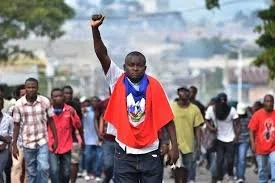
Port-au-Prince—My friends in Haiti told me not to come—too much chaos, too much violence. if i insisted on coming, they advised, I had to find a bodyguard, a driver, and an armored car. They said: Bring expired credit cards to give to armed robbers; don’t bring cash. Dress down (as if I ever dress any other way) and don’t wear jewelry. And of course, don’t visit any ATMs or banks. Don’t go near the shantytowns, where I previously spent hours talking to people, hanging out. Don’t drive late at night. Don’t go downtown.
It all seemed a little extreme. But then, a week and a half before I arrived, a French couple who had never been to Haiti before were killed shortly after they flew in to adopt a kid—gunned down in front of their hotel, in an area you pass all the time, no matter where you’re going.
For more than a year, the country has been rocked by protests against its corrupt president, Jovenel Moïse, a former banana dealer known in Haiti as Neg Banann, and against the corrupt political system more broadly. Peaceful sit-ins came together outside government buildings in the capital, and large, stirring marches took place throughout the country. The system responded: Well-armed police in battle gear fired on many of the protests, and at least 187 people were killed, some execution style. Journalists were assassinated.
By the time I was planning my trip, Haiti seemed on the edge of a crisis or breakdown. I’d seen such moments there before. Sometimes they would swing in favor of the people, more often in favor of the ruling elites and the status quo.
Haiti was cornered—exhausted, hungry, exasperated with the old, afraid of the new. To make matters worse, in mid-January, the 10th anniversary of the earthquake that killed more than 100,000 people would arrive, and so would the international media, to show Haitians and the rest of the world how little the country has changed for the better during the past decade, how deeply it has sunk back into the old, bad ways. Yet new threads of hope were gleaming and glittering through this dark material, new ideas coming from young people who feel that without change, they have no future in this country. Older opposition figures—some valuable, some not—are also trying to figure things out, a fractious but united group whose breadth hasn’t been seen here recently.
By the time I was planning my trip, Haiti seemed on the edge of a crisis or breakdown. I’d seen such moments there before. Sometimes they would swing in favor of the people, more often in favor of the ruling elites and the status quo.
Haiti was cornered—exhausted, hungry, exasperated with the old, afraid of the new. To make matters worse, in mid-January, the 10th anniversary of the earthquake that killed more than 100,000 people would arrive, and so would the international media, to show Haitians and the rest of the world how little the country has changed for the better during the past decade, how deeply it has sunk back into the old, bad ways. Yet new threads of hope were gleaming and glittering through this dark material, new ideas coming from young people who feel that without change, they have no future in this country. Older opposition figures—some valuable, some not—are also trying to figure things out, a fractious but united group whose breadth hasn’t been seen here recently.
Meanwhile, Haitians continue to face what Pierre Esperance, executive director of the Haitian National Human Rights Defense Network (RNDDH), has called “the ongoing gangsterization of the state.” Armed gangs—estimated to number in the dozens—regularly receive funding, automatic weapons, and ammunition, although as Esperance points out, Haiti doesn’t make weapons or ammo, and the country has been under an on-and-off arms embargo for many years. These gangs have carried out five massacres during the Moïse administration, the worst of them in a shantytown known as La Saline, a hotbed of anti-government protest that borders one of Port-au-Prince’s best-known open-air markets; at least 71 people were brutally murdered there.
All the protests have posed a question central to national sovereignty: Who owns the nation—the people or the government and business class? “Kot kob PetwoKaribe?” (Where’s the PetroCaribe money?) has been the protesters’ cry, a reference to the late Venezuelan president Hugo Chávez’s aid program for Haiti, whose funds have been ruthlessly plundered by government officials and their friends. The plunderers include Moïse, according to a damning 656-page report by the Haitian government’s own auditors. The PetroCaribe funds were meant to develop housing, sanitation, roads, health care—things that Haitians need desperately. But most of the money is gone, vanished into political pockets and, through various kinds of nepotistic zombie contracts, into the wallets of good friends of the current administration and its predecessor.
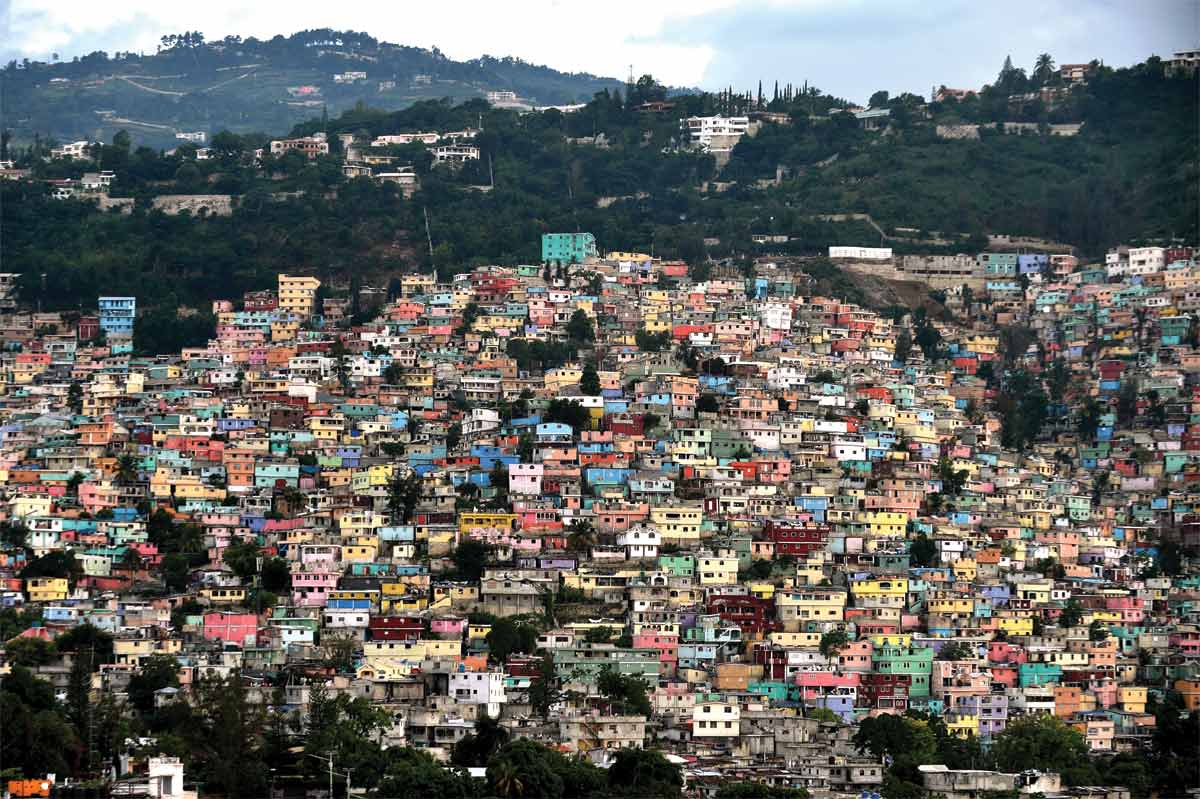
(Hector Retamal / AFP via Getty Images)
More damningly, in February 2019 supporters of Moïse (and possibly the president himself) sent a band of US mercenaries to protect an official who went to the central bank downtown to transfer $80 million from the PetroCaribe fund to an account controlled exclusively by the president.
For three months this fall, the opposition put the country on repeated lockdowns. No one violated peyilok, as it is called. People starved but didn’t (or couldn’t) go out to buy food; people were sick but couldn’t get to the doctor. You couldn’t work. By the time I arrived in December, kids hadn’t been able to go to school since the term began in September. The dead couldn’t be taken to the morgue. During these days and weeks of peyilok, the opposition called on various sectors of society to march in protest—labor, clergy, artists and musicians, medical workers, students, and others. But meanwhile, armed gangs of no clear provenance roved the streets, shooting at will.
Still, Moïse says he is committed to serving his full term, which ends in 2022. Late last month he moved from virtual silence into neo-Duvalierist mode, saying there were a number of people whose heads he intends to “cut off.” He threatened that there will be “accidents” if people get in his way. Silent regarding the massive opposition against him, Moïse focused his rage on an energy provider that sells electricity to the state-run Electricité d’Haiti, another trough of possible corruption that he has long desired to control.
“What happens when the unstoppable force meets the immovable object?” asked Kim Ives, a veteran Haiti observer, referring to the protests and the president. “In Haiti, the answer seems to be: You form a commission.”
There are now several commissions militating for Moïse’s orderly departure, the resignation of the useless Parliament, and the installation of a replacement government in some form. They range ideologically from fairly far left to pretty far right. What is unprecedented is that they’ve been trying to work together. Still, for the young, who make up the majority of the country’s population and have been crucial to the protests, the results have been less than spectacular.
“We are against corruption and impunity, and we are for social justice,” said Pascale Solages, a young leader of the group Nou Pap Dòmi (We Will Not Sleep). NPD is part of the enormous Petrochallenger opposition, which mostly consists of young people who have come out repeatedly to protest the government’s impunity over its plunder of the PetroCaribe funds. Solages and I sat at a long table at a restaurant NPD often uses as a headquarters. Surveying the various groups clamoring for Moïse’s ouster, Solages added, “I don’t have a single view of the opposition. But for the most part, it is run by a political class that the population does not trust. For the last 30 years they’ve been destroying Haitian institutions, which are now on their knees. We need a new political class and a profound change.”
After months of peyilok—and amid concerns about further instability in this “shithole” country—the Trump administration, previously indifferent to Haitian affairs, sent down three US officials in turn for brief visits and photo ops with Moïse. The meetings changed the tenor of the national conversation. Each American bureaucrat advised the Haitian president to meet with the opposition, but none suggested that he depart. Then they left. It was clear the US government was not going to whisk Moïse away; he was its obedient friend. At the United States’ behest a year earlier, Haiti’s ambassador to the Organization of American States (OAS) voted against recognizing the legitimacy of Nicolas Maduro’s election in Venezuela. Maduro is the successor of Chávez, who had provided all the PetroCaribe money for Haiti.
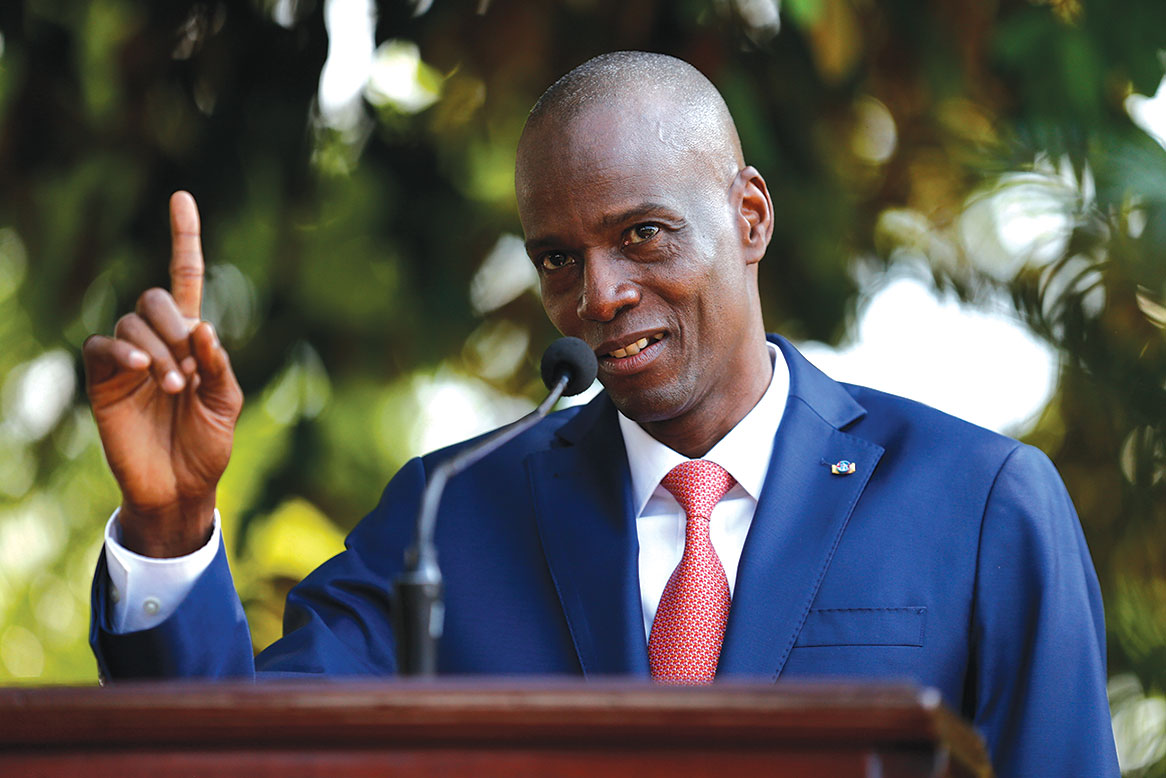
Not going: Haitian President Jovenel Moïse has defied repeated calls to resign—warning that there will be “accidents” if people get in his way. (Rebecca Blackwell / AP)
After the visits, Moïse reached out to the opposition, as recommended by his American friends, always with the understanding that he was not going to leave. The opposition initially refused his invitation. That’s when I arrived, expecting peyilok, armed gangs, paralysis. I took an armored car to my hotel with two big bodyguards in the front seat. In spite of all the dire warnings, everything was calm. Feeling ridiculous—even foolish—and extremely white, I quickly abandoned the security detail. From then on, my stay was in many ways like every other time I’ve spent in Haiti. Although we drove high up into the hills above town and then far downtown into the poorest and most crowded areas and then over to the shantytown where I’d been told I absolutely could not go, we had no problem.
What accounted for this relative peace? It was the opposition unlocking the country. Haitians were growing restive and resentful under the strictures of peyilok. “People are tired of it,” Solages said. Also, the opposition did not want to seem unaware of the US position; they needed a space from which to negotiate that didn’t appear intransigent.
Interestingly, Haiti has now gone from peyilok, which exerted real pressure for a change of government, to a political paralysis from which it’s hard to see an escape route. Moïse’s position remains precarious. On one side, he faces an angry, organized, and militant population trying to push him out. On the other, his friends need him to remain in power so the plunder can continue. Moïse is no doubt worried about both the people and his friends. In French they call his position coincé, or cornered.
In the midst of all this, no one but the current president believes in the value of future elections. Elections brought Haitians the corrupt Moïse—even though it took 14 months from the initial ballot to the final result, with all sorts of shenanigans in the process. An earlier, questionable election, the results fudged with the connivance of OAS personnel, brought them the corrupt Michel Martelly, whose sole qualification for the presidency was his fame as a singer and entertainer.
Most Haitians simply don’t believe in elections as they are currently run. To quote the former president Jean-Bertrand Aristide, who was elected in a 1990 landslide that no one has yet questioned (or duplicated), elections in Haiti have since turned into “selections.” Aristide, by the way, was ousted in a coup green-lit by George H.W. Bush’s administration just nine months after that landslide. So much for the legitimately elected.
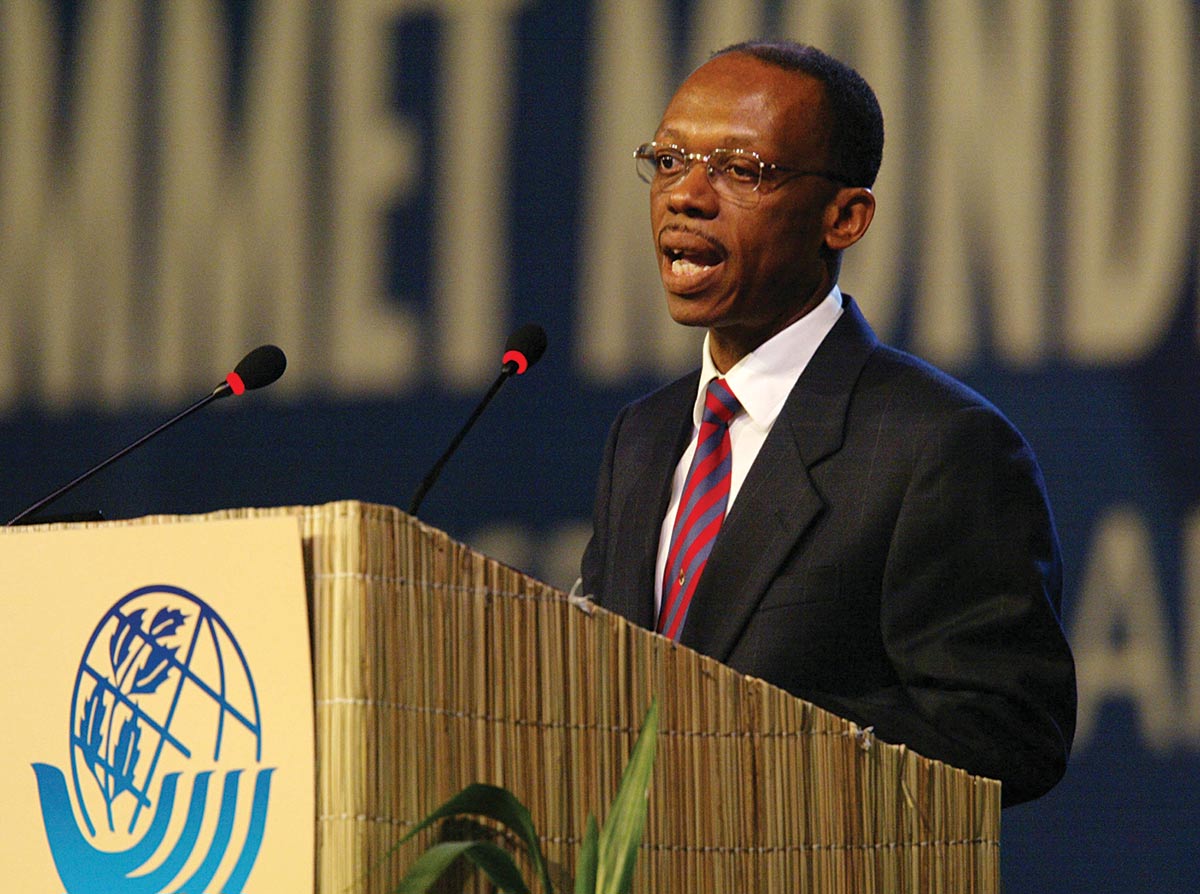
Yesterday’s man? Jean-Bertrand Aristide was elected president in a 1990 landslide that none of his successors have matched—which didn’t protect him from a US-sponsored coup. (Anna Zieminski / AFP via Getty Images)
Today Aristide lives in a large white house in Tabarre, a suburb of the capital that was farmland when he built his home there some 30 years ago but is now part of the growing Port-au-Prince metropolitan area. There are peacocks and peahens roaming his front lawn.
Aristide seems to have retired from political life after the presidential candidate he backed lost the contested election that Moïse eventually won. But in Haiti, tou sa w we, se pa sa, as the expression goes: All that you see is not what it seems. And many think Aristide is still working behind the scenes.
He greets me in his very presidential office: huge desk in the center, white walls, white tile floors, bookshelves, the Haitian flag. He is wearing a formal white guayabera and pressed pants and doesn’t seem substantially changed from the person I first met back in 1986, when Jean-Claude Duvalier (aka Baby Doc, the son of François “Papa Doc” Duvalier, the country’s notorious longtime strongman) had just fallen. Back then, Aristide was a firebrand priest from the poorest parish in town. His break with the church, his two presidencies (or three, depending on how you count them), the two coups d’état against him, his two forced exiles, marriage, fatherhood, projects of all kinds—nothing seems to have changed him. He remains the kind of person who would love a peyilok movement. No doubt he’d like to lead it.
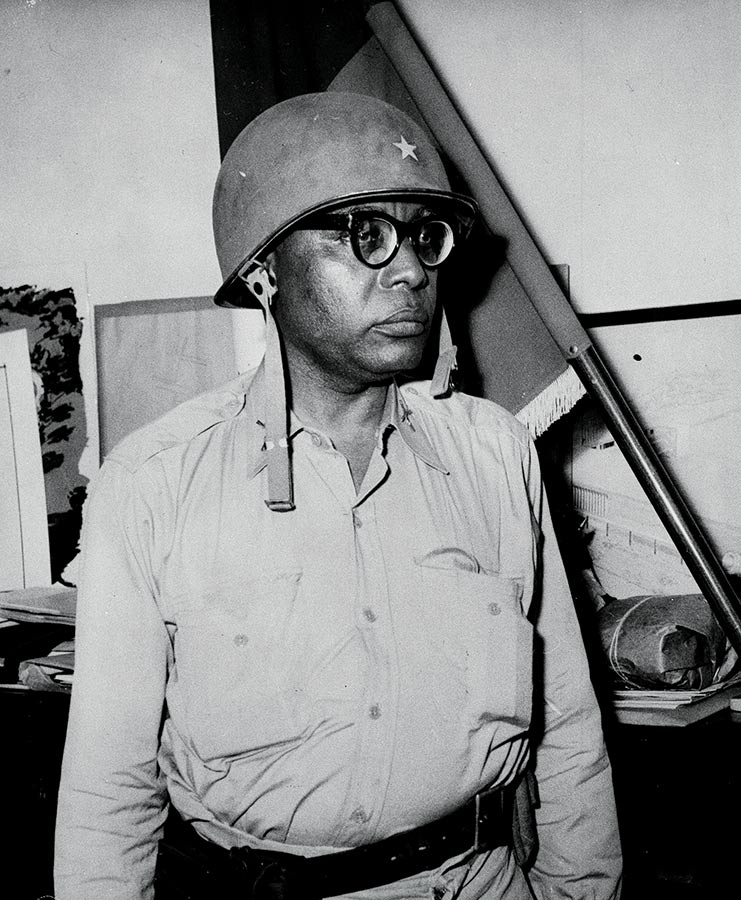
Papa Doc at war: President for Life François Duvalier fighting off a military coup in 1958. He led his despotic regime for 13 more years, until his death. (AP)
Aristide’s radicalism in the mid-1980s, which grew out of liberation theology, seemed unacceptable to the moderates then running the world. It might be more acceptable now, especially since it has been embraced by the new generation, both in Haiti and elsewhere. In 2003, long before Ta-Nehisi Coates’s famous piece in The Atlantic, Aristide presented France with a $21 billion bill for the 90 million gold francs in reparations that Haiti (the victor, remember) was forced to cough up to France (the loser) after the Haitian Revolution in 1804. (France cavalierly rejected Aristide’s payback demand and promptly collaborated with the United States to remove him from the presidency—for the second time.) Still, in spite of Aristide’s historic feats, it seems unlikely that a person with his vexed history, in Haiti and the hemisphere, can carry the banner for a new way forward.
But Aristide is not the only name from the past that gets mentioned in discussions of Haiti’s future. As a toddler, Nicolas Duvalier fled the country with his family when his father, Baby Doc, was overthrown by a popular uprising in 1986. Though Nicolas Duvalier grew up mostly in France, he’s been toying recently with a future in Haitian politics. “We are not there yet,” he said when asked if he’ll run for president. But there’s a saying in Haitian Creole (there’s one for every occasion): Ptit tig, se tig. The son of a tiger is a tiger.
Haitians are thinking about the earthquake as its anniversary approaches. They’re always thinking about the earthquake, actually, because everyone lost someone in it and because the rebuilding effort has been such a massive disappointment. Most of the money promised to Haiti for reconstruction has been squandered or stolen or lost—or was never delivered in the first place. Bill Clinton’s Build Back Better campaign for post-earthquake Haiti has been a total failure, despite the campaign’s declaration amid the rubble that the country was “ready for business.”
Clinton was appointed the United Nations special envoy for Haiti eight months before the quake struck. (He and Hillary Clinton spent part of their honeymoon there in 1975.) Much of the funding that came in after the earthquake went to US contractors for projects, fees, housing, food, and security. Less than a penny on every dollar ended up with Haitian groups.
A few banks downtown have been rebuilt, but there is still earthquake rubble in the area behind them, topped with burning garbage, through which the poorest of the poor are scavenging. Even on Grande Rue downtown, once the city’s business center, you can see 19th century buildings ready to collapse. People live and work precariously amid the rubble or are constructing concrete buildings that don’t abide by any seismic code. A few shantytowns were created during reconstruction, but they are now overrun with gangs and drugs.
There are some new hotels, most functioning at a reduced level because of peyilok and because the post-quake international relief caravan has moved on to more fruitful fields. Interestingly, the most lucrative clients the hotels have attracted recently have been the opposition factions that met to produce what are known as the Marriott Accord, which seeks the replacement of the entire Moïse government, and the Kinam Agreement (at the Hotel Kinam), which calls for the replacement of the entire government—except for Moïse.
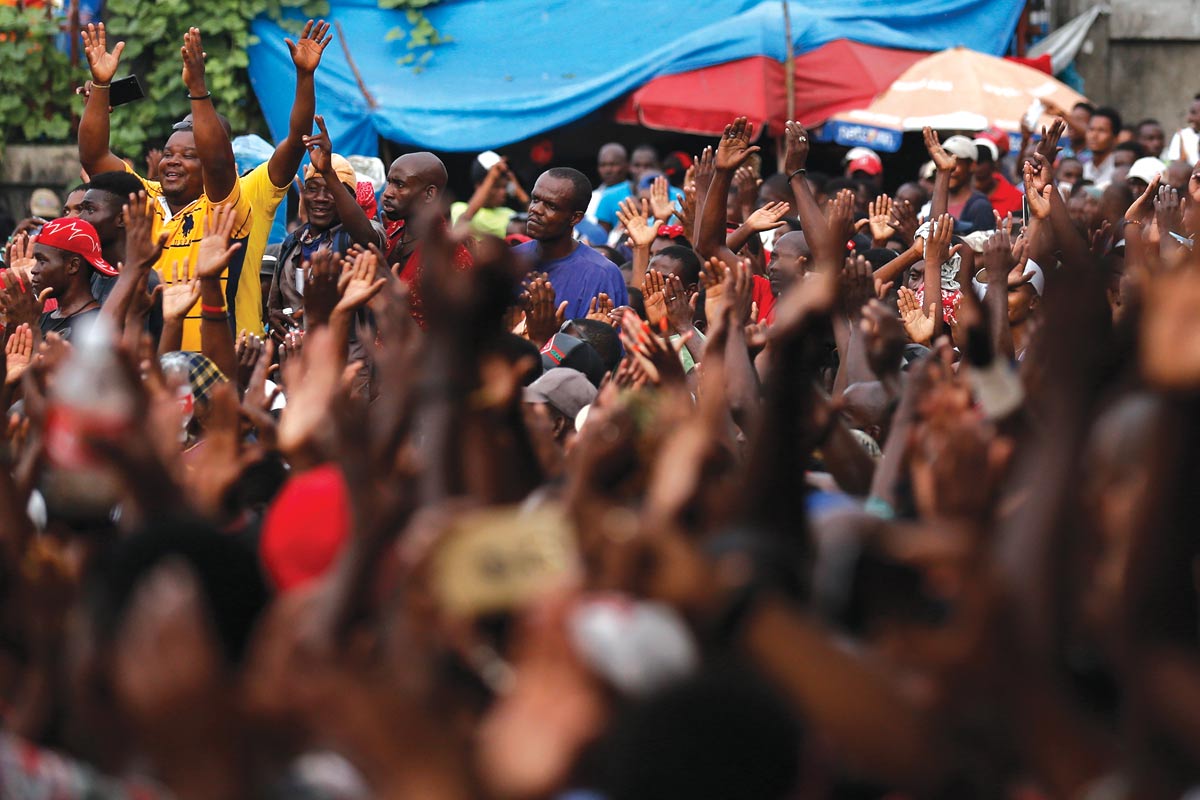
A country in lockdown: During the months of peyilok, different sectors of society each marched. Here, artists from Port-au-Prince take to the streets. (Rebecca Blackwell / AP)
“Haiti is a little machine that produces gigantic amounts of corruption,” said Frantz Duval, the editor of Le Nouvelliste, the French-language daily in Port-au-Prince. “The earthquake was like PetroCaribe. All that money suddenly turning up was an opportunity for thievery. And there’s kind of an entente cordiale among the thieves splitting up the booty. There was a period of enjoyment after the earthquake when everyone was in the game—just like PetroCaribe.”
This is why Petrochallengers like Solages don’t just want to displace Moïse; they want to get rid of the whole damn system. Most people here don’t go into government for the love of statecraft or out of a desire to serve the public. They do it to enrich themselves as much and as quickly as possible before they’re ousted by the next batch of thieves. Periodic elections do little to intrude on this musical-chairs mechanism; they simply offer an illusory authenticity to each successive wake of vultures.
By the middle of December 2019, the opposition began to send out feelers to Moïse. The message that the United States wanted him to stay had been received. This doesn’t always play out, though. At the end of January 1986, President for Life Jean-Claude Duvalier stood before the Haitian people and told them, “I am here, stronger than a monkey’s tail.” A week later, he was on a US C-141 transport plane bound for Paris.
It turned out the Reagan administration had other ideas about who could run Haiti. The State Department put together a claque of Haitian political figures and army officers known officially as the National Council of Government but called by Haitians what it was: the junta. The Trump administration, au contraire, apparently can’t imagine an alternative to its pliant Haitian banana dealer.
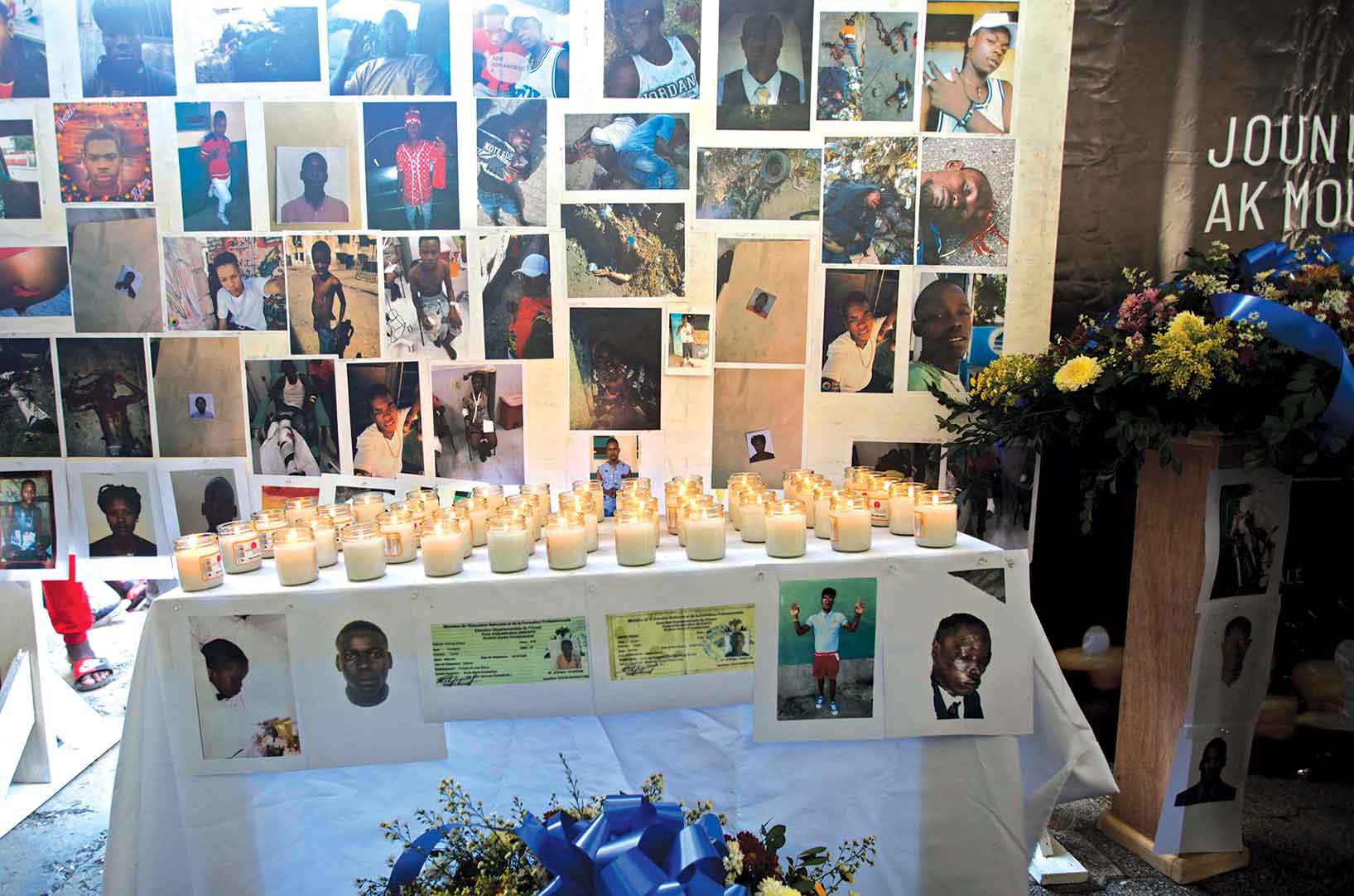
Not forgotten: An altar commemorating the victims of La Saline massacre. (Dieu Nalio Chery / AP)
Idrive to an end-of-the-year picnic in the mountains above Port-au-Prince in a convoy with a group of businesspeople, diplomats, and their families. On the way up, the city falls away, and then you’re in the Haitian countryside. The hills are steep, and terraced emerald farms climb the sides of the canyon. Strong, thin farmers—kiltivatè, as they’re called—walk by the side of the road carrying their machetes. Women walk there too, carrying produce to market in baskets or black garbage bags, a more modern accessory, on their heads. Roadside shacks and little stalls sell fruit and water in the smallest to-go plastic bags.
At the picnic, a beautiful little blond girl is swinging from a hammock and talking about her grandparents’ house in Palm Beach—“not on the beach, though.” But where do you live? “In Haiti, of course, but we’re moving.” Where to? “I don’t know. Bahamas, Croatia….”
“We are all moving out of the country,” says one glamorous matron from an old and wealthy family. “We’re all selling our houses. Except, of course, no one is buying. Because the people who could buy are all selling, obviously. The situation in the country is unacceptable. We can’t sit through another one of these episodes. We have to go. And the thing is, what these people don’t understand is, we are the state.”
The implication is clear: When they go, Haiti fails. Though from what I’ve been told, the elite moved most of their money out of the country a long time ago.
Richard Widmaier runs Radio Metropole, which in one form or another has been in his family for four generations. He’s not a big enthusiast of Moïse (“He has a passion for two things: agriculture and himself”) but still thinks he should remain in office. “OK, he really should have just been minister of agriculture, which maybe he could have handled,” Widmaier says. “But a president who’s elected for five years should serve for five years.” It’s a point of view held mostly by people with connections to the present government—or who understandably fear the chaos that might ensue if Moïse steps down.
Later that day, I’m with a businessman up in Pétion-Ville, which used to be a safe haven from the craziness of downtown until the earthquake came and downtown moved uptown. We’ re having a lovely dinner on a covered terrace, palm fronds shaking in the breeze, pretty little sconces and chandeliers over the tables. My friend is eating the biggest crab I have ever seen. We’re chatting in a preliminary way when he gets a call.
“Another kidnapping,” he says as he takes the phone out of the restaurant. “I can fix this,” I hear him say to the person on the other end. Four minutes later, he comes back to the table, and we finish our meal almost as if nothing out of the ordinary had happened. Two days later, the victim is released. A ransom was paid. Kidnapping is a business in Haiti now.
Ihave an old friend in Haiti who has worked in difficult political situations there for pretty much her whole life. She has moved up and down through nongovernmental organizations, and she’s Haitian, so she understands the lay of the land—and doesn’t want me to use her name. After Duvalier fell, she says, Haitian civil society burst into activity. There were all sorts of meetings—tet ansanm (heads together) is the term in Creole—of intellectuals, artists, professionals thinking about ways to jump-start the country. “And the thing is, they were all doing it on their own,” she says, “without start-up funds or not-for-profit status or money from foreign groups.” Farmers were still managing to grow and survive on their small plots of land. Back then, Haiti still had food self-sufficiency.
Now, she points out, Haiti is the second-largest importer of US rice, after Mexico. I hear this fact mentioned everywhere I go, because it is astonishing to Haitians. The country’s fertile Artibonite Valley once provided more than enough rice to feed Haiti. The story of how rice production failed is long, but it includes subsidized US rice being dumped on the Haitian market during the Clinton administration, with much of the grain coming from Arkansas farms. As cheap US rice undersold locally produced rice, farms in Haiti collapsed, and people from the countryside moved to the capital, where they eventually lived in shacks and shanties and ended up eating US rice. When Duvalier left, my friend continues, the Haitian poor were still fit and healthy. Now they eat “really scary” imported stuff, and illnesses that used to be rare—like heart disease, diabetes, and cancer—are increasingly common.
She paints a picture of the pastoral Haiti that I remember. There were ideas and activism and a lot of energy. Living was cheap. Professionals could reside in leafy neighborhoods, and even though they earned only $600 or $800 a month, rent was just $50. But in 1991, when the first UN observers arrived (after the initial coup against Aristide), some were earning $6,000 a month, and rents rose.
“Every natural disaster here brought with it new outsiders,” my friend says. “The value of things is no longer measured by the national but by the international market. Haitians are priced out of everything, including food. To put together a group, you have to rely on outsiders to fund you, and your innate Haitianness gets lost or muddled.”
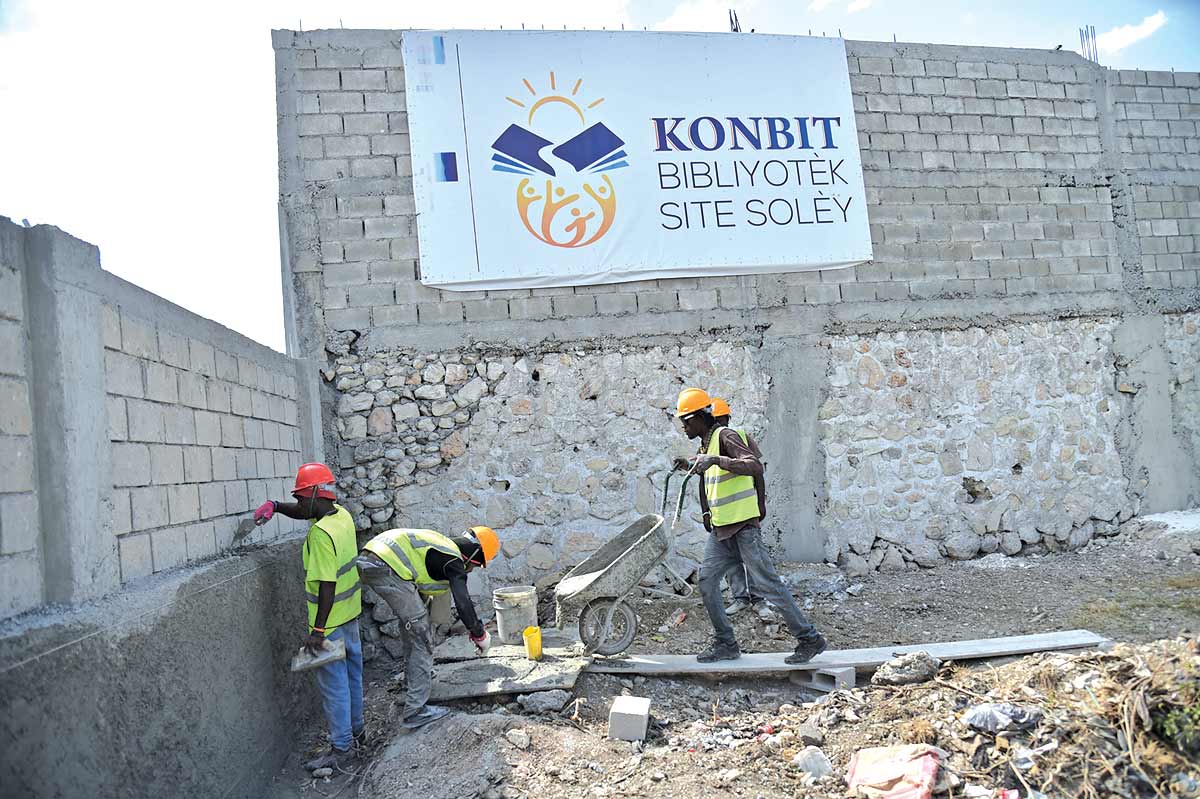
Book by book: In Cité Soleil, where armed gangs roam the streets, a library is being built by the community. (Hector Retamal / AFP via Getty Images)
“Haitians aren’t the same as they were in 1986,” says Marcus Garcia, a longtime editor and radio host. “There’s not much hope. And the politicians are not the same. There are no éminences grises. All the communists are dead. The intellectuals are dead. The objective press is finished. The diaspora is desperate and disappointed. There’s just a big void everywhere.”
What is new and good in the country, he adds, are the young. For a while, after the earthquake, they fled; there were two planes a day to Chile and Brazil. “With the changes in those countries’ governments, that’s no longer an option,” Garcia says, “and so the kids have nowhere to go. They have to fight for their lives here, and that’s what we’re seeing.”
My old Haitian friend from the NGO world agrees that there is healthy protest right now, and she’s cheered by this. But she also has ideas for Haiti’s long-term future. Like many, she believes that it would be healthier for Haiti to avoid the global economy than to participate in it. There is a nostalgia for decent poverty these days, for what Aristide called sitting at the table, not under it.
This same idea was proposed by the Haitian geographer Georges Anglade in his 1983 book Elegy for Poverty. Anglade—who died in the earthquake—argued for the brilliance and know-how of the Haitian peasantry against a global economy that, at best, provides assembly jobs for the poor and the loss of all tradition. Nearly 40 years after the book’s publication, his Haiti has been almost eradicated.
In Haiti there was once something called the konbit, a cooperative handed down from the early days of the colony, when the enslaved population was responsible for any improvement in their lives. Roof raising was a particular activity of the konbit, and the tradition continued long after the revolution. During a konbit, the community would assemble. Food was cooked, songs were sung, stories were told, and children frolicked; meanwhile, a roof was raised for a neighbor. Or a path to a field was built. Or a community garden was planted. The konbit would be repaid with later good deeds for other members of the group.
What my friend is mourning and what Anglade worried about decades earlier is the loss of such communal effort and competence as cash—in the form of international aid—enters the economy. After the earthquake, for example, people didn’t form groups to protect women in the camps from rape. Instead, victims went from one foreign relief organization to another, seeking funds and rape kits. This didn’t protect them from more attacks, but it did bring in cash, and the aid organizations could add another rape to their fundraising lists. The konbit builds solidarity on the ground that can be sustained, unlike a cash influx.
In the old days, a big konbit could have gotten rid of the earthquake rubble near the port downtown within a month and without pay, because it had to be done. Today, with no one paying and the big yellow trucks from the international relief organizations gone, the rubble remains. When your country is no longer your own, you wait for others to fix it for you or pay you to fix it. Pride of ownership has faded in Haiti, which used to be one of the country’s signal characteristics, since it was precisely ownership of themselves—their bodies and their land—for which Haitians fought a revolution.
There is a realism in Haiti-pessimism, but Haitians’ struggle for the soul of their country is not yet entirely lost. In Cité Soleil, one of the most battered shantytowns, where armed gangs roam and people live near a much-photographed river of sewage, there is a library being constructed opposite the police station where shantytown residents can go to borrow books; study for tests; learn to use computers; record in the recording studio; work in the language lab on their Creole, French, Spanish, English, or Arabic; rent a room as an office or workspace; or just hang out at the cafeteria or play in the playground, and it’s being built mostly with small contributions from the community and from visitors. (Everything described above is still en train but visibly underway.) It’s a form of konbit.
Downtown there is the Ghetto Biennale on Grand Rue, where foreign artists come and meet Haitian artists and work for a week. (Despite the current unrest, more than 30 foreign artists turned up for this great tradition, which begins in mid-December.) There’s the annual jazz festival, during which musicians play all over town. There’s Grande Plaine, the tiny peasant community outside the town of Gros Morne that has reforested its area with the help of family members living abroad. There’s the park in Martissant that neighbors—including gang members—cultivate and use for recreation and craft markets. Little shoots of possibility everywhere.
The Ghetto Biennale: This December, more than 30 foreign artists arrived for a week of work and conversation with their Haitian counterparts. (Fungus Collective)
Later, I’m driving up a hill to get away from downtown and look at art, but really I’m already in a Haitian tableau. Sky blue. Puff of bright white cloud. Strange wisps of smoke along the roadside: garbage burning, corn grilling. Small businesses dot the landscape, everything terraced, shacks topped with corrugated tin and stairways leading to nowhere (a Haitian architectural specialty). Rebar sprouts in bunches from concrete like some strange heliotropic plant, awaiting further building instructions that may or may not come. Small cardboard churches with colored cellophane windows hang from trees. These are the annual fanales, for sale as Christmas decorations, because everyone is hoping things will stay quiet and Haiti will have its beloved Christmas this hard year. Beyond the road hides the countryside as we limp up the hill.
Finally we arrive.
And now I’m having lunch with a member of the country’s 1 percent, in a rambling stone house that once belonged to a Haitian president. We (a Swiss artist-intern, a young Haitian assistant, and me) sit down at the table. We’re waiting for the master of the house; the rest of his family has left Haiti because of peyilok. He walks in with a certain measured gait and looks at life with an infinite, patient condescension. A dark-skinned Haitian girl brings in lunch. Now we’re in France: two poussins surrounded by perfectly cooked boiled potatoes with parsley. A bottle of French malbec is the table’s centerpiece. More bottles sit on the sideboard.
The master of the house is definitely a Haiti-pessimist. Of course, he loves Haiti as well, but he would never say so. At the end of the meal, he gathers all our bones on one plate and calls in his eight big dogs—six recently purchased for security. Each dog gets some bones; favorites get a little more. They don’t fight because they know that if they do, they’ll get kicked out. One cocks her head, waiting.
When I get back to Los Angeles, I tear the brown wrapper off the painting I bought that day. Here it is on my desk, a tiny thing with all of Haiti in it: blue sky and sea, mountains behind mountains, canyons and ridges in the foreground, palms blowing, dirt roads going down the hillsides, a strip of pale diamond beach, and everything flecked with a shimmering green, gold, and purple. All that’s missing are the people. Even though, of course, they are the ones who hold the future of this country in their hands. They have two terrible disadvantages: a low caloric intake and no money. Yet their protests have brought Jovenel Moïse to the brink and forced a nervous US to send envoys to protect him. It’s cruel to wish the hardships of peyilok on anyone, and it’s not a strategy that can work indefinitely. But expect the protests, in some new form, to start up again after Christmas—or after Carnival in late February.
Haitians are not going to give up on this konbit. Or their country.
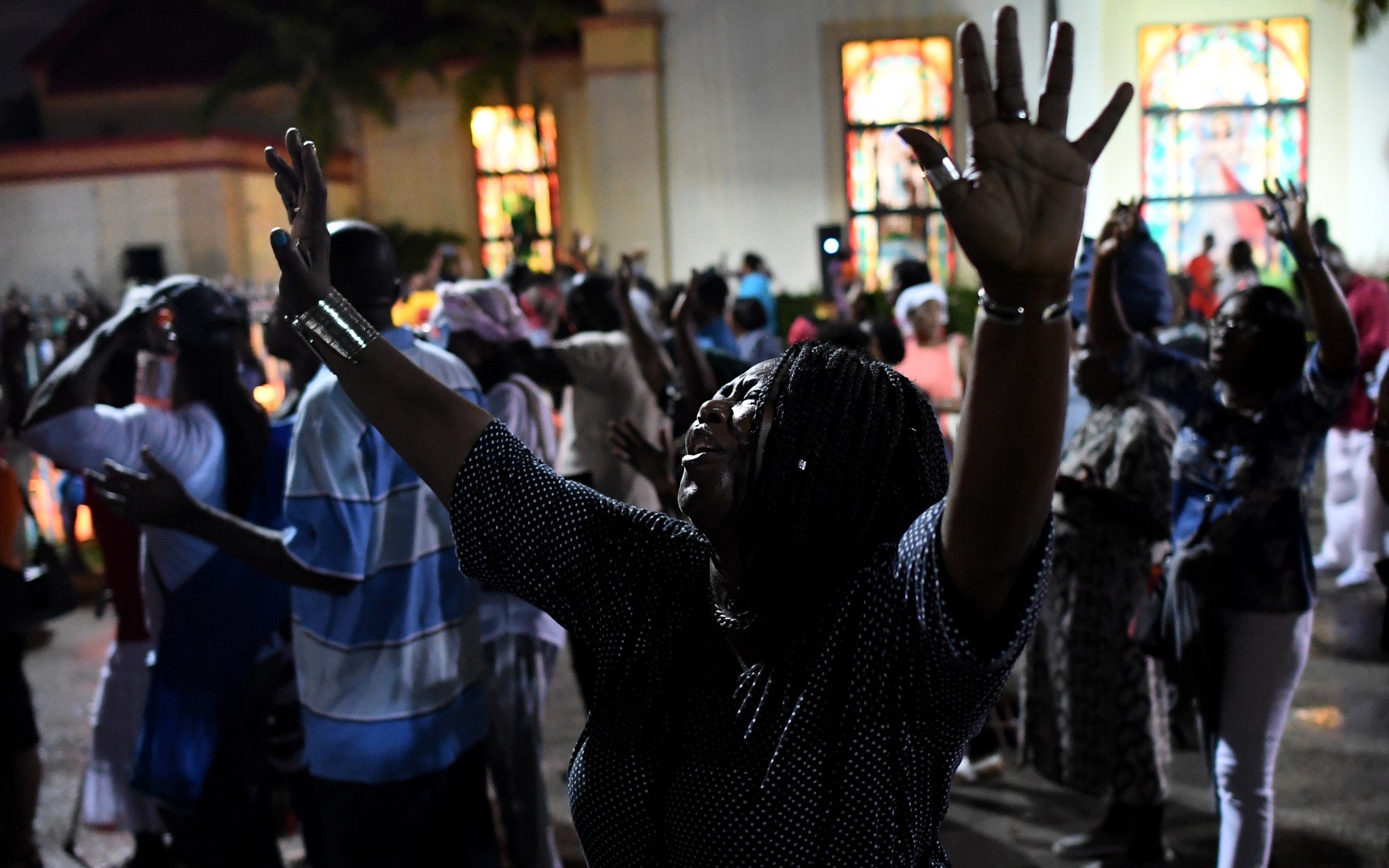
Haitians gained protections to stay in the U.S. after a devastating quake. A decade later, Trump wants that to end
MIAMI —
Almost every day, it seems, a parishioner comes to Father Reginald Jean-Mary with the same plea: Pray for us, we’re scared. We can’t go back, not now.
They live in fear of a forced return to Haiti, a country where they were born and that they love, but one that’s been paralyzed by poverty, violent protests and a debilitating cholera epidemic.
They fear even more for their American-born children, who, unlike them, would be eligible to remain in the only country they’ve ever known. For many Haitian immigrants, the idea of uprooting preteens to live for the first time in a deeply impoverished country seems out of the question.
“Haiti will always be my home by birth, but this is my new home,” said Luce Janvier, a parishioner at the church. “It’s not safe in Haiti — not now, maybe never.”
Here in the Miami neighborhood of Little Haiti — along the asphalt streets where chickens run wild and Creole is the predominant language— Jean-Mary’s cream-colored Catholicchurch serves as a refuge for Haitians from across the city.
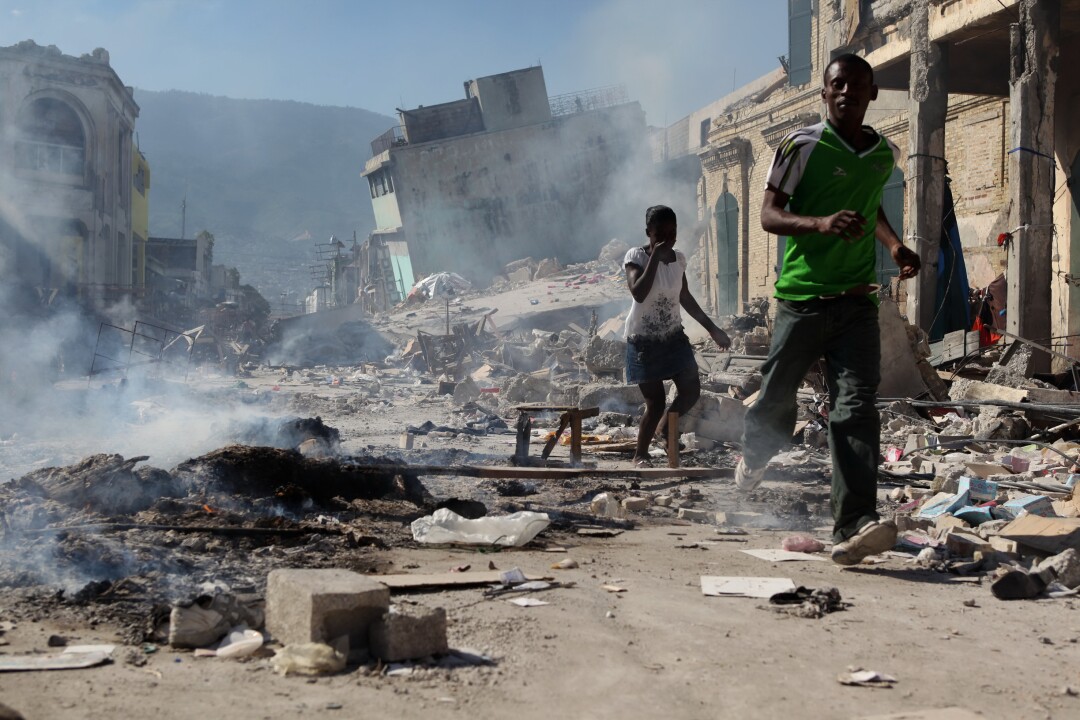
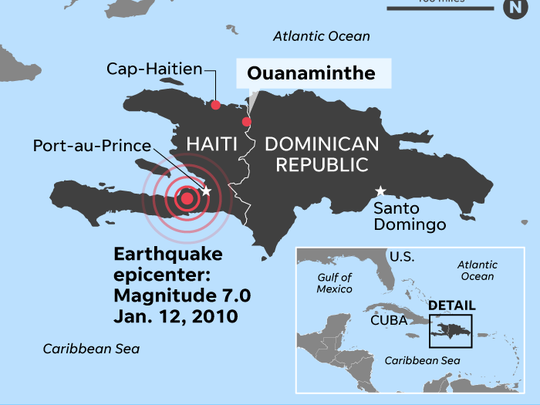
After a magnitude 7.0 earthquake devastated Haiti in January 2010, leaving hundreds of thousands of people dead and crippling infrastructure in Port-au-Prince, the capital, tens of thousands of survivors fled to south Florida.
In a humanitarian gesture, President Obama swiftly designated Haiti as a country whose nationals could receive Temporary Protected Status, meaning they could live legally, but temporarily, in the U.S. Some found work as housekeepers and cooks, others enrolled in community colleges, and many joined churches. For nearly a decade, they have scraped together what’s left of their paychecks and sent it home to family still in the Caribbean.
Today, an estimated 46,000 Haitians have Temporary Protected Status, which was granted to those who migrated to the U.S. within a year of the quake, or who were already in America, no matter their legal status, at the time of disaster.
Nationwide, roughly 317,000 people from 10 countries, including Haiti, have the protected status, which is granted in six- to 18-month intervals by the federal government for people from countries devastated by natural disasters or war.
Shortlyafter taking office, President Trump, who had run on a platform hostile to immigrants, abruptly announced he would end TPS for Haitians as well as immigrants from El Salvador, Honduras, Nepal, Nicaragua and Sudan. Immigrants from South Sudan, Somalia, Syria and Yemen, who also have TPS, were not targeted by the administration. Even so, the status is set to expire for immigrants from the latter four countries in 2020 and 2021 if the administration does not grant an extension.
Immigrant advocates responded with lawsuits, and in 2018 a federal judge issued a preliminary injunction, allowing Haitians and immigrants from El Salvador, Nicaragua and Sudan to remain in the country through this month.The Department of Homeland Security recently announced that the agency would hold off evicting those from Haiti and the five other countries initially targeted until January 2021 as part of the ongoing litigation.
As the 10-year anniversary of the Haitian quake approaches, the legal limbo has left many law-abiding families in serious peril, said Ahilan Arulanantham, senior legal counsel for ACLU, which helped file the lawsuit that resulted in the injunction.
“They are a part of our society,” said Arulanantham, estimating that 80% are in America’s workforce, “and deserve to be treated with dignity and respect, not wanton cruelty.”
For immigration attorney Vanessa Joseph, recently elected city clerk of North Miami, Fla., the extension provides “a welcome sigh of relief, but it’s not a permanent solution,” she said.
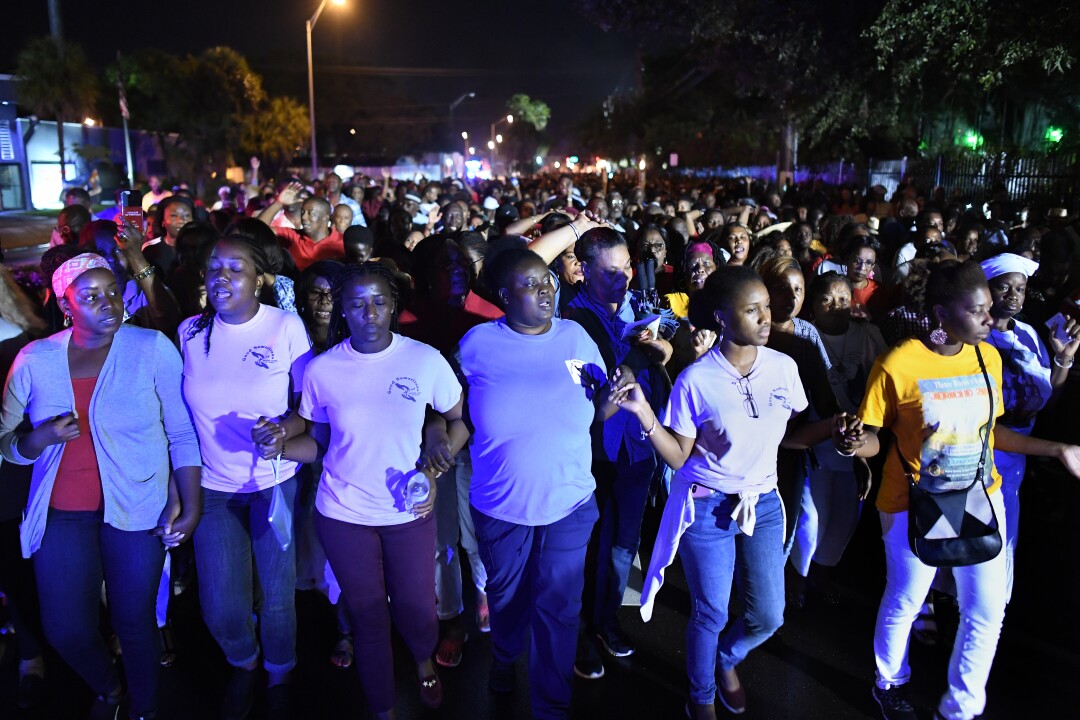
Haitian immigrants had always known that, in theory, the protections weretemporary. But over the years, as they worked, worshiped and had children — more than half in south Florida — Haiti began to feel very far away.
Fear started to grow in the months before Trump’s announcement following then-Homeland Security Secretary John F. Kelly’s trip to Haiti to assess the situation. Kelly declared that conditions had improved, leaving many in the Haitian community concerned that the administration would soon end TPS.
Anxiety now runs deep, said Marleine Bastien, executive director of the Family Action Network Movement, a group that hosts information meetings for immigrants in Little Haiti.
Bastien still shakes her head at the decision, noting that even the National Palace, where Haiti’s president lives, remains under construction.
“The country is still in ruins,” she said. “There are the protests and violence in the country. It’s not stable.”
Trump administration officials, including in the Department of Homeland Security, have not responded to a request for comment about its decision to end TPS for Haitians.
Bastien’s group estimates that since the earthquake, Haitians with protected status have given birth to about 30,000 children — all of whom are American citizens.
“Parents wake up and do not know if they will be taken from kids,” said Bastien, who travels to Haiti and Washington, D.C., several times a year to offer on-the-ground updates to lawmakers. “Families right here in south Florida are scared.”
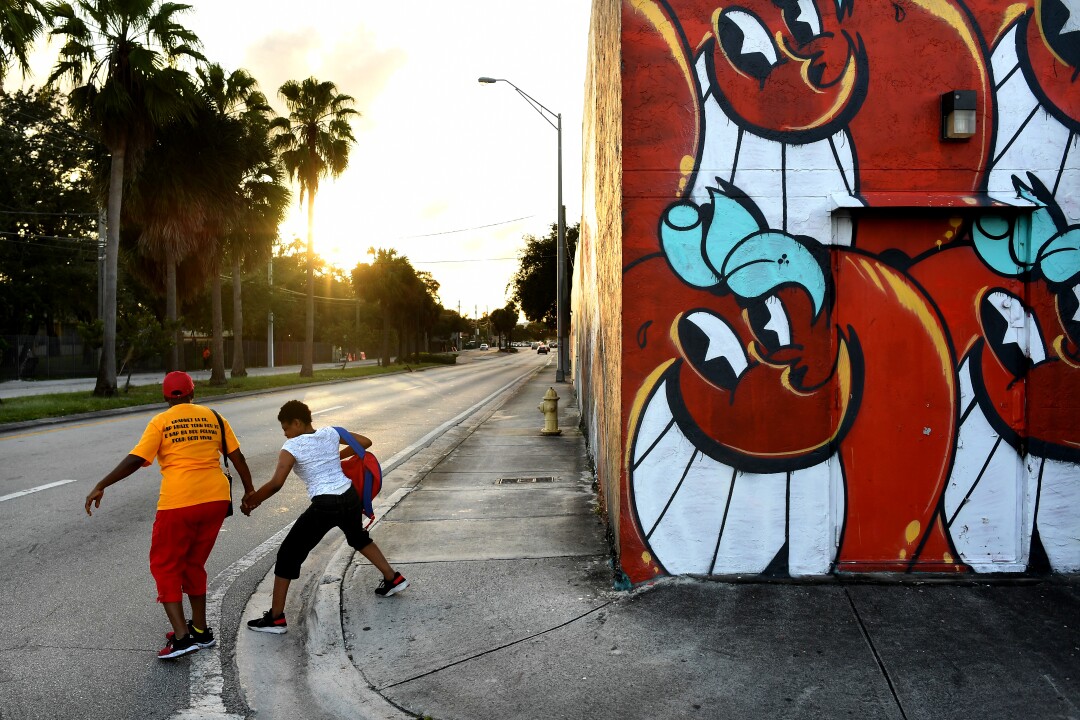
A report from the University of Miami School of Law found that people deported after being convicted of crimes — including nonviolent drug offenses — are much more likely to become homeless once they return to Haiti, where they are often viewed as extensions of the United States government, with which Haitians are deeply angry.
“Finding gainful employment is out of reach for many deportees,” the researchers concluded. “Many deportees do not speak fluent Creole or speak Creole with an accent that is recognizably ‘American.’”
To Bastien and many Haitians, Trump’s comments about the country have been racist. Several news outlets, including The Times, reported in January 2018 that Trump referred to Haiti and several African nations as “shithole countries” in a meeting with a bipartisan group of senators.
“There is animus toward black people — toward Haitian people — by this president,” Bastien said.
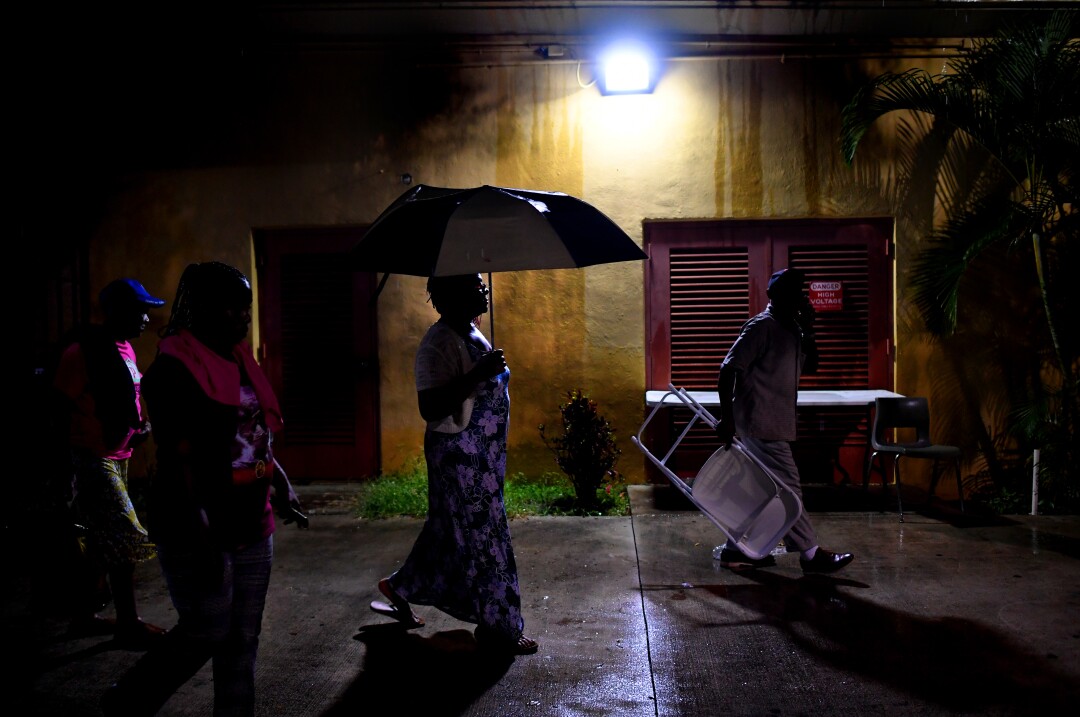
Jacsonny Nelson, 31, agrees.
Leaving behind his mother and six siblings in Haiti to come to south Florida,he received TPS in 2011 and now shares a one-bedroom apartment with his wife, their infant son and his mother-in-law.
Nelson works long hours doing kitchen prep at a diner, but when he can, he stops by Bastien’s office, wondering how much longer he can live in Fort Lauderdale, where he feels welcome.
These days, Nelson said during an interview in his family’s living room, he often worries about being separated from his wife and son.
“We all cannot stop thinking about it,” his mother-in-law, a U.S. citizen, interjected, caressing her grandson’s chest with her index finger.
Nelson sees more opportunity here in Florida for his son — better education, quality of life — and says he would not uproot him for the instability of Haiti.
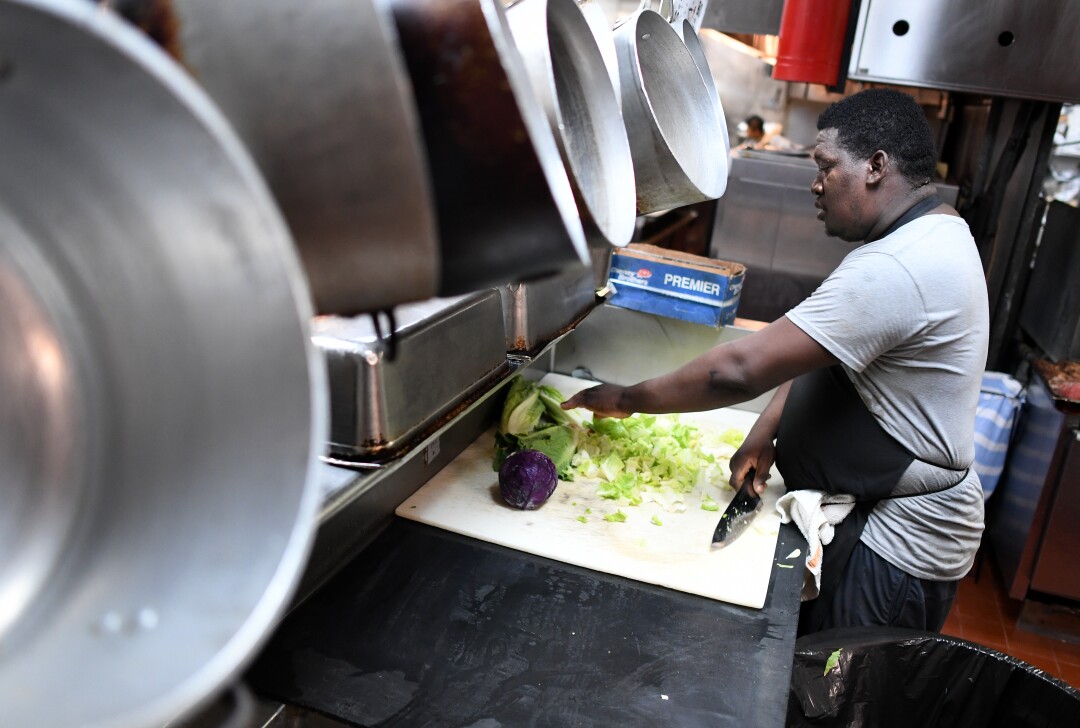
For Nelson, a decade in the U.S. has served as a balm from tragedy. He lost cousins and close friends in Port-au-Prince in the quake, and images of the destruction are seared in his mind.
“It was chaos,” he recalls, “people running in the streets.”
Since he arrived in south Florida, he says, he has worked six days a week at the same diner. And each month, he says, he sends about $400 home to his mother, who uses the money to support his siblings.
“I’m all she has for income some months,” he says.
For parishioner Janvier, life in south Florida is also about providing for family back in Haiti. Most days she wakes up before 5 a.m. and takes a bus to her minimum-wage housekeeping job at a hotel in Miami Beach. Janvier moved to Miami in 2004, and since she was already in the U.S. when the earthquake hit, she qualified for temporary status.
Janvier, who has two sons remaining in Haiti, regularly sends them part of her check.
“It’s great money, compared to what I would make in Haiti,” she said.
Janvier has traveled to Washington with Bastien’s group to meet with Florida’s members of Congress to express concerns over the looming termination of TPS.
In July, Sen. Marco Rubio, citing the ongoing “volatile” situation in Haiti,introduced legislation for an extension specifically for Haitians.
“During my recent visit to Haiti,” Rubio wrote to the Trump administration, “it was clear to me that the country is unable to absorb a large number of returnees at this time.”
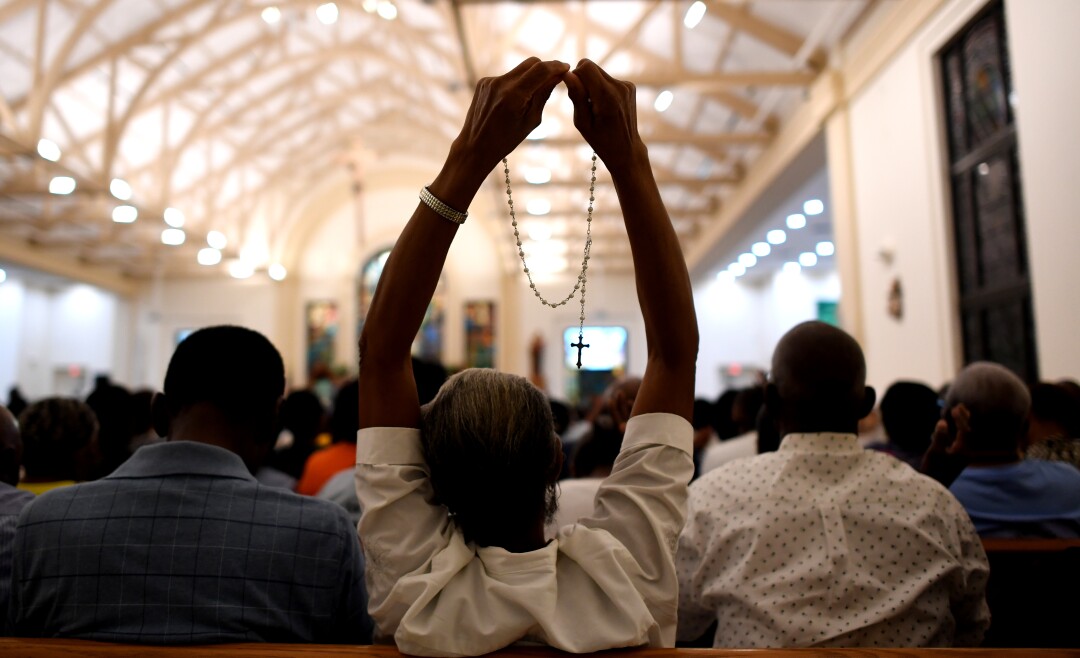
For Jean-Mary, the pastor, the legal limbo means hours of prayer.
“We ask for guidance and for strength,” he prays with families. “We look for a path forward.”
On a recent evening, local elected officials flanked Jean-Mary on the tiled altar of his church. Hundreds of parishioners packed into wooden pews at his church, Notre Dame d’ Haiti, celebrating Jericho, an annual days-long spiritual revival. Outside, people ate fried fish and sweet plantains from styrofoam containers.
Jean-Mary thanked the politicians for their work in the community, at the church and in the halls of the state Capitol. Then, he singled out Joseph, the immigration attorney, who had attended the church as a child.
“She is always here bringing legal guidance,” he said in Creole, “especially for those who are on TPS.”
Joseph smiled.
A woman toward the back of the church clasped her hands and looked up at the vaulted ceiling. A toddler in her mother’s arms cried, and then a hush fell over the church. Jean-Mary asked everyone to bow their heads — there was a lot to pray for.
Haiti 10 Years After The Earthquake: Why So Little Recovery Progress In A Decade?
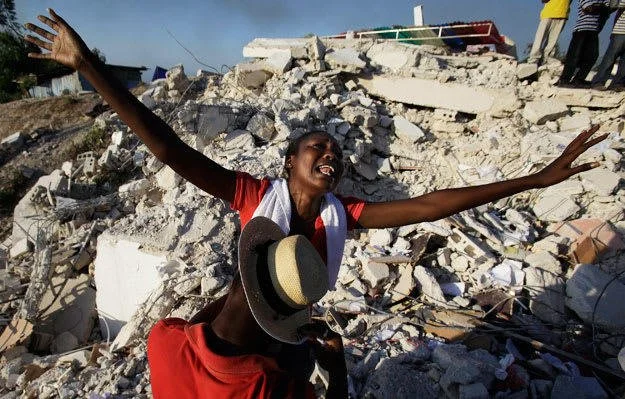
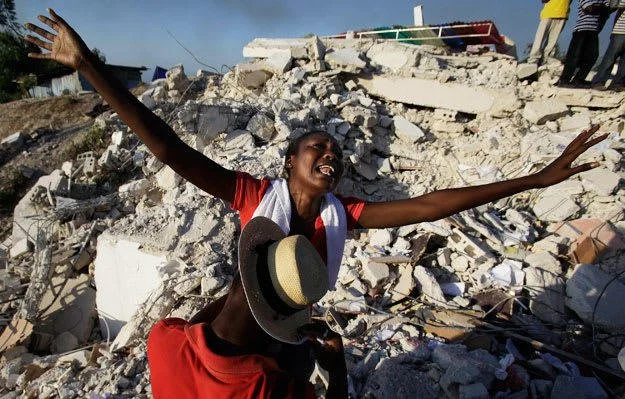
Port-au-Prince was a canyon of crushed concrete and horrified screams as Jean Samson Edouard ran panicked and barefoot through the capital’s Carrefour-Feuilles district.
It was shortly before 5 p.m. on Tuesday, Jan. 12, 2010 — a decade ago this Sunday. A magnitude 7 earthquake had just destroyed much of Haiti — and killed anywhere between 100,000 and 200,000 people, according to most estimates (although the Haitian government had put the toll as high as 300,000).
“The longest night in my life,” Edouard says.
He was 23, a communications student and engaged to Joselene Saint Phard, a nursing student at the Université Saint Gérard.
The school had collapsed; Saint Phard was inside the rubble.
After racing through the streets, stumbling over people killed by falling walls, “I reached the university building and I asked someone, ‘Where is Saint Gerard?’” Edouard remembers. “And he said, ‘There.’ No building anymore. Now I lose all hope to see my fiancée again.”
Edouard says he felt especially hopeless as he scanned corpses crushed in Saint Gerard’s wreckage.
“Horrible,” he recalls. “Body on body, literally broken. Arms, feet – God, it’s undescribable.
CREDIT AP
“So I — I go under the concrete. ‘Joselene, Joselene, where are you?!’ And … when I’m calling her,” he says, choking back tears, “it be for one hour … I hear some voice.”
It was Joselene. Her legs badly injured. But alive.
Today, Jean Samson and Joselene are married and have two daughters. They also have a deeper sense of purpose — in no small part, he says, because he also called out to someone else while searching the rubble that night.
“I said, ‘God, if you give me my fiancée back, I will serve you for the rest of my life.'”
To him, that meant: serve Haiti. I spoke with Edouard in a restaurant in West Palm Beach, where he was visiting relatives. Like so many Haitians after the earthquake, he could have come to live in South Florida.
“But I can’t,” he insists, “because I have Haiti. I need, when I pass away, my children can say, ‘Hey, my father struggled to change something in Haiti.’”
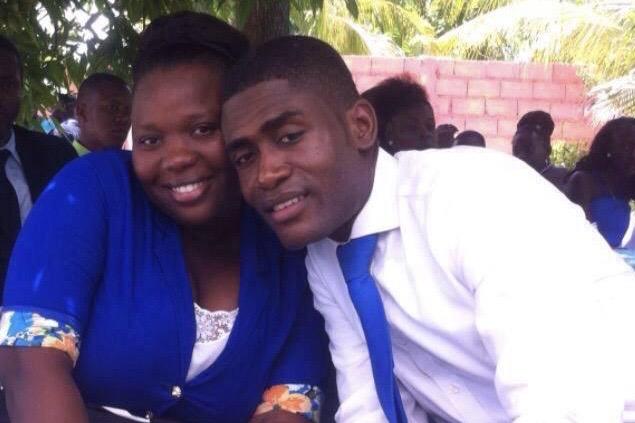
Jean Samson Edouard, right, and his wife Joselene today in Arcahaie, Haiti.CREDIT COURTESY JEAN SAMSON EDOUARD
So Edouard returned to his hometown of Arcahaie, Haiti, just northwest of Port-au-Prince, and became a schoolteacher. Today, he’s a principal; Joselene is a nurse. Edouard also began studying economic development — and he helps run a nonprofit called ECODA whose “sustainable village” project promotes local economic opportunities.
But Edouard realizes that kind of effort remains rare in Haiti, even after all these years — and he concedes the larger effort to rebuild the impoverished Caribbean nation has mostly failed.
“The earthquake gave Haiti an opportunity to take off, to learn development,” he says. “Unfortunately, nothing [has] happened. No planning. No leadership. No project.”
It’s hard to argue with him. It took a year after the quake just to get real debris removal started. It took seven years to reopen Haiti’s major hospital. Today, Haiti is facing one of the worst food shortages in the Americas. That’s not to mention the country’s endless political upheaval — and protesters now demanding the ouster of President Jovenel Moïse, who is accused of involvement in a $2 billion corruption scandal involving infrastructure project funds (which he denies).
So why, after a decade, has Haiti made so little recovery progress?
Many Haitians say one big reason is that the country’s spirit itself has yet to recover.
“When you need to be psychologically healed first, then it’s hard for you to think about development,” says Marie Guerda Nicolas, a Haitian American and a psychology professor at the University of Miami.
Nicolas was in Haiti during the earthquake, and she says it’s hard to exaggerate how brutally traumatic it truly was.
DEEPENED DESPAIR
For one thing, modern Haiti had never dealt with earthquakes: This was the first there since the 1700s. That’s a big reason so much caved in: Haiti’s building codes were some of the world’s most lax.
But the quake dealt another gut punch to Haiti's psyche: At that time, before the earthquake, Haiti was finally looking up after decades of dictatorship and dysfunction.
“We had more stability in terms of the political situation,” Nicolas says. “Economically, there was more exporting; infrastructure being built. We were moving in the right direction.”
To then have that optimism so suddenly and violently shattered only deepened Haitians’ despair. So Nicolas threw herself into creating clinical networks like Rebâti Santé Mentale (Rebuilding Mental Health) to help Haitians pull through.
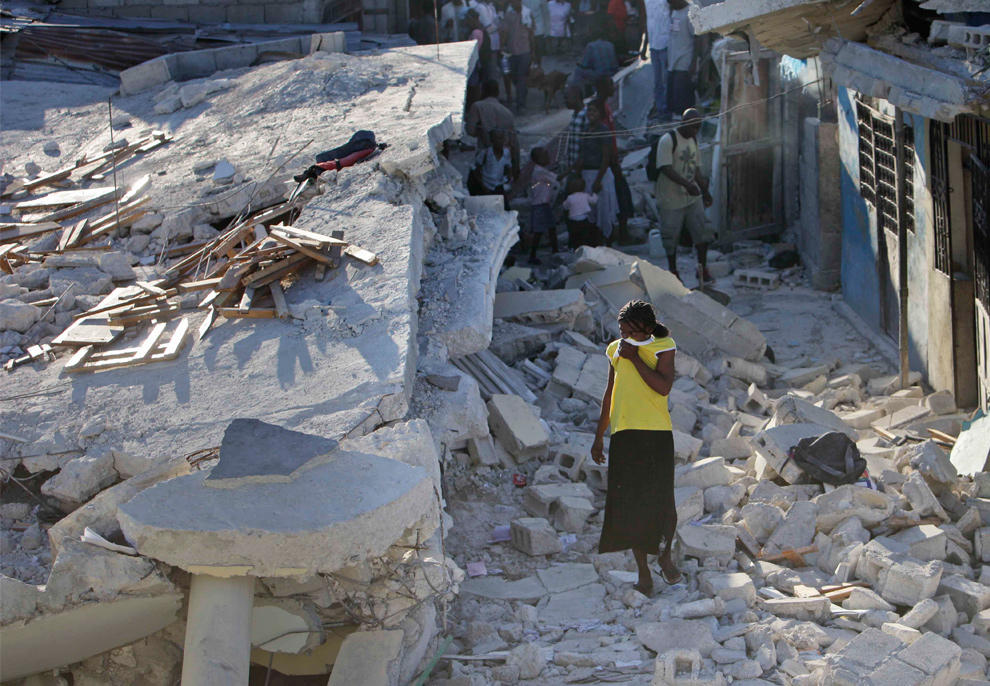
A Haitian woman wanders the rubble of her neighborhood in Port-au-Prince after the 2010 earthquake.CREDIT GREGORY BULL / AP
Among her tougher cases was a woman in Léogâne, near the earthquake’s epicenter. She’d lost her 8-year-old daughter in the disaster. But she found one of the girl’s legs — by identifying her sock and shoe.
“She went home, she washed the leg and she put it in the daughter’s bed and she kept it there,” Nicolas recalls.
Neighbors, fearing the woman had gone mad, plotted to take the leg away. But Nicolas told them: “It’s a normal response for her to have. The incredibly abnormal is the earthquake.”
She ultimately persuaded the woman to have a burial ceremony for the leg. Like that mother, tens of thousands of Haitians weren’t able to bury loved ones after the earthquake.
Nicolas points to one other circumstance that made recovery more difficult: The earthquake, which destroyed the National Palace in Port-au-Prince, effectively crushed Haiti’s government, too. In fact, then President René Préval (who died in 2017) seemed to disappear.
"I think he was traumatized himself," says Nicolas.
The international community had to fill the vacuum — and its performance was controversial at best. More than $10 billion pledged by governments never fully materialized. Worse, U.N. troops were responsible for a cholera outbreak that killed thousands more people, prompting months of angry Haitian street protests against the U.N. and, in some cases, global NGOs in general.
Critics argue that many of those NGOs that flooded into Haiti, many well intentioned but others with what Nicolas calls arrogant “savior complexes,” had scant oversight — and effectively shut Haitians in Haiti out of their own recovery effort.
“The people with the skills and the abilities to do good in their own country weren’t being utilized,” Nicolas says. “That fuels the sense of helplessness.”
Haitians protesting the U.N. and international NGOs in Port-au-Prince in 2010.CREDIT AP/YOUTUBE
But on this side of the Caribbean, especially in South Florida, the earthquake fueled a heightened sense of purpose in the Haitian expat community.
“The diaspora that always wanted to step up and be engaged self-organized and mobilized in record proportions,” says Karen Andre, a Haitian-American attorney and political consultant in Miami.
Andre says her grandmother spent the night of the earthquake outside in Port-au-Prince’s Delmas district, singing psalms to neighbors trapped in rubble to help locate them. During those same moments, in Miami, Andre heard about the disaster driving home after work on Biscayne Boulevard.
“I immediately just made a U-turn,” she recalls, “and went straight to Little Haiti, went to 54th Street.” There she helped coordinate an expat relief effort that eventually grew into an NGO: Konbit for Haiti, or Cooperative for Haiti, which steered funds to Haitian development projects run by Haitians.
Political and business elites in Haiti had always kept the Haitian diaspora at arm’s length. But Andre says the aid work emboldened expats to demand a larger role in Haiti’s affairs. And to a certain extent they got it, including the granting of dual citizenship to Haitian expats.
“The earthquake knocked a lot of dominoes down,” Andre says, “so that in Haiti we can go in and move the needle.”
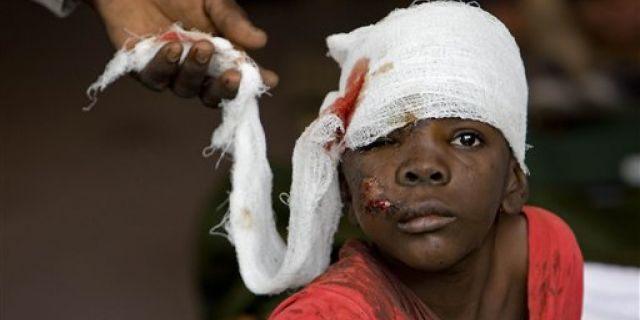
A Haitian boy injured in the 2010 earthquake.CREDIT LOGAN ABASSI / AP
Since then, critics say that diaspora commitment has waned. But one Haitian expat — and earthquake survivor — who wants to help move the needle is South Florida college student Arielle François.
“Haiti’s a part of me,” says François, who studies criminal law at Florida Atlantic University in Boca Raton. “I feel like it’s my responsibility to [go] back.”
François was a schoolgirl when the earthquake hit, traveling in her parents’ car in Port-au-Prince’s Pétion-Ville suburb.
“I remember seeing a pink house literally crumble down on this man, and you just see … a line of blood,” she says. “And I saw this woman who fell on her knees and started praying. I was just 11, seeing people die in front of me is, like, even to this day I’m traumatized by it.”
Arielle Francois as an elementary school student in Petionville, Haiti, a decade ago, before the 2010 earthquake.CREDIT COURTESY ARIELLE FRANCOIS
François’ best friend Paula also died in the earthquake. Soon after, François and her family moved to South Florida — and she, admits, a better life. Now a U.S. citizen, she feels conflicted about the good fortune she’s had since the earthquake.

Arielle Francois today, a junior at Florida Atlantic University.CREDIT TIM PADGETT / WLRN.ORG
“I could have died like my best friend,” she says. “And the fact that we were blessed enough to come here, alive, and pursue education, I feel like I have no choice but to help my country where I was born. I can only give back now.”
François says the earthquake anniversary reminds her how urgent that is. Haitians like her hope that 10 years later, Haiti’s leaders start feeling more of that urgency too.
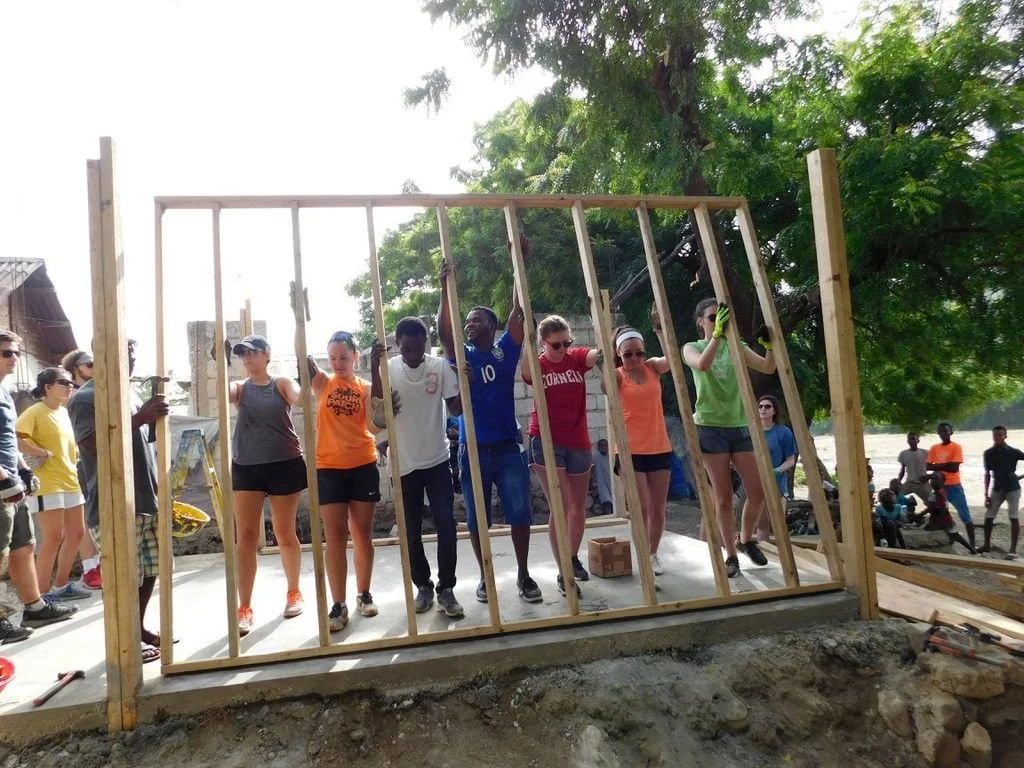
How a 10-year-old wish changed Haiti
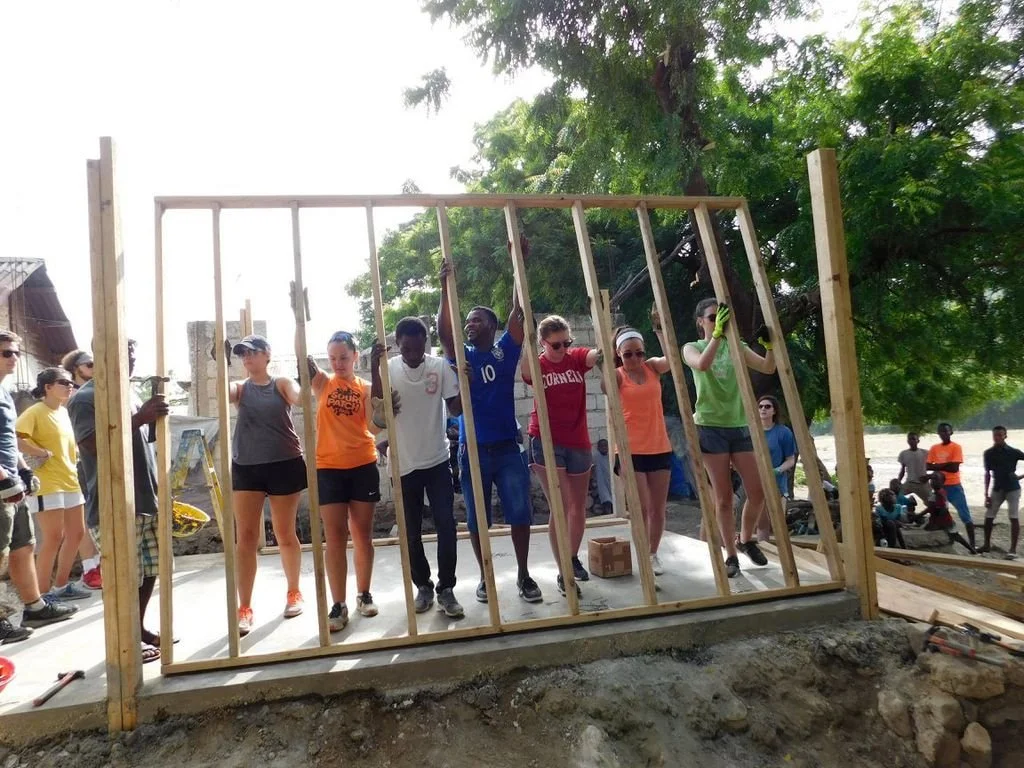
Patrick Mead keeps a photo of a Haitian woman named Madame Selavie on his phone.
In it, she stands next to a home that Patrick helped build for her in Grand Goave, Haiti.
The two met when Mead was on a service-immersion trip during his senior year at St. John’s High School in Shrewsbury.
Before Patrick arrived, the woman lived in a shack made of scrap metal and tarp. She and her four children slept on a dirt floor where floodwater from the mountainside poured in through their roof.
When Mead, now a 20-year-old student at the University of New England in Biddeford, Maine, visited the family’s new home a year later, he didn’t recognize her at first.
“When I met her on that first trip, she didn’t smile once,” Patrick said.
“But, that second time, she smiled because she recognized me. She just looked physically younger. She felt loved.”
Mead calls that moment the best of his life.
Today, Mead is among 1,800 people who have built 148 homes in Grand Goave through Worcester’s Be-Like-Brit Britsionary Program. They stay in a guesthouse located next to Brit’s Home, which cares for 66 Haitian children. Together, the children’s home and the house-building program keep alive the last wish Britney Gengel sent to her mother — 10 years after her death.
That wish, or rather a three-sentence text message, greets those who walk inside Be-Like-Brit’s Operation Center in Worcester. It decorates the walls inside Brit’s Home too.
“They love us so much and everyone is so happy,” the text reads in bright blue words.
“They love what they have and they work so hard to get nowhere, yet they are all so appreciative. I want to move here and start an orphanage myself.”
Gengel, a 19-year-old Rutland native who studied at Lynn University in Boca Raton, Fla., sent her mother, Cherylann Gengel, the message a few days before the magnitude 7.0 earthquake struck Port-au-Prince, Haiti, on Jan. 12, 2010. A few days into her humanitarian trip with Food for the Poor, she had fallen in love with the people of Haiti.
The State Department spent 33 days looking for Britney Gengel, only to find her beneath the rubble of the hotel she’d been staying in.
Remembering that text, Britney’s mother and father, Len Gengel, founded Be-Like-Brit to provide a safe, nurturing children’s home for Haitian orphans.
“[Britney] wanted to go back and help, and I knew that,” said Cherylann Gengel.
“I understood that there was a bigger picture here.”
Gengel said they chose Grand Goave as the home’s location when they found their daughter’s trip itinerary. It told them that their daughter was supposed to visit Grand Goave, a fishing community located 40 miles southwest of Port-au-Prince, the day after the earthquake.
According to Len Gengel, thousands of people from around the world heard about their story via social media and donated to their cause. Within days, they had received over $150,000 from complete strangers to kick-start their daughter’s dream.
“The positive that came out of our tragedy was that we got to see how good people really are.”
It took two years to build the home. Len Gengel, who spent 30 years in the home building industry, said he made 39 trips to Haiti over those two years. Cholera outbreaks and sanitary conditions often shortened his trips.
“I would go into Haiti and build with a group of Haitians until I couldn’t stay any longer due to the water,” he said.
In January 2013, Brit’s Home opened. It now houses 66 orphaned children; 33 boys and 33 girls, symbolic of the 33 days it took to find Britney Gengel’s remains.
“We built a first-world building in a third-world country,” Len Gengel said.
“After the earthquake, we were the first earthquake-proof structure with the same seismic standards as San Francisco,” he said.
Through Be-Like-Brit’s service-immersion Britsionary Program, volunteers live at the Be-Like-Brit guesthouse. During their weeklong stay, they meet the children living inside Brit’s Home and build a home for a family living in the neighboring Oceanside community.
Each family receives beds, mattresses, an outdoor stove, and their own pregnant goat, which gives the family a source of revenue.
Francky Janvier, a 34-year-old Haitian man who received a home, now works as a Britsionary coordinator. He believes his job keeps him safe from the violence and protests that occur regularly in downtown Grand Goave, where he use to live.
“I have water and power; I have everything,” said Janvier.
“They treat me well and I’m so happy. Be-Like-Brit is my life.”
More than 110 Haitians work at Brit’s Home, making Be-Like-Brit the largest employer in Grand Goave.
Beyond Grand Goave, the partnerships between Be-Like-Brit and local high schools and colleges have brought Worcester County closer together, said Melissa Provost, the program’s community relations director.
“Haiti isn’t just a place on the map anymore here in Central Mass.,” said Provost.
In May 2012, Becker College sent the first official volunteer group to help build the home’s base. Less than a year later, St. John’s sent the first group of high school students.
“We don’t want to be called [missionaries] because we’re not trying to change the children, we’re trying to support their overall development,” said Len Gengel’s sister Christine Steinwand, a member of Be-Like-Brit’s programming committee.
Tim Williams, a faculty leader on the St. John’s trip, now works as a part-time trip leader.
“Any Britsionary I meet always tells me how much they want to go back,” said Williams.
Debra Pallatto-Fontaine, a former professor at Becker College, not only returned, but offered a new element to Brit’s Home. After retiring from Becker this past May, she opened a fourth-through-sixth-grade school called “Brit’s Academy” in September.
While offering basic writing, reading, and math classes, the academy also provides students with the business and medical skills needed to navigate adulthood in Haiti.
It’s only the latest ripple of good will from a text message sent 10 years ago.
“Our kids are only there because of Brit and that text,” said Provost.
“It’s this big ripple effect. [Britney’s] text was the pebble in the water.”
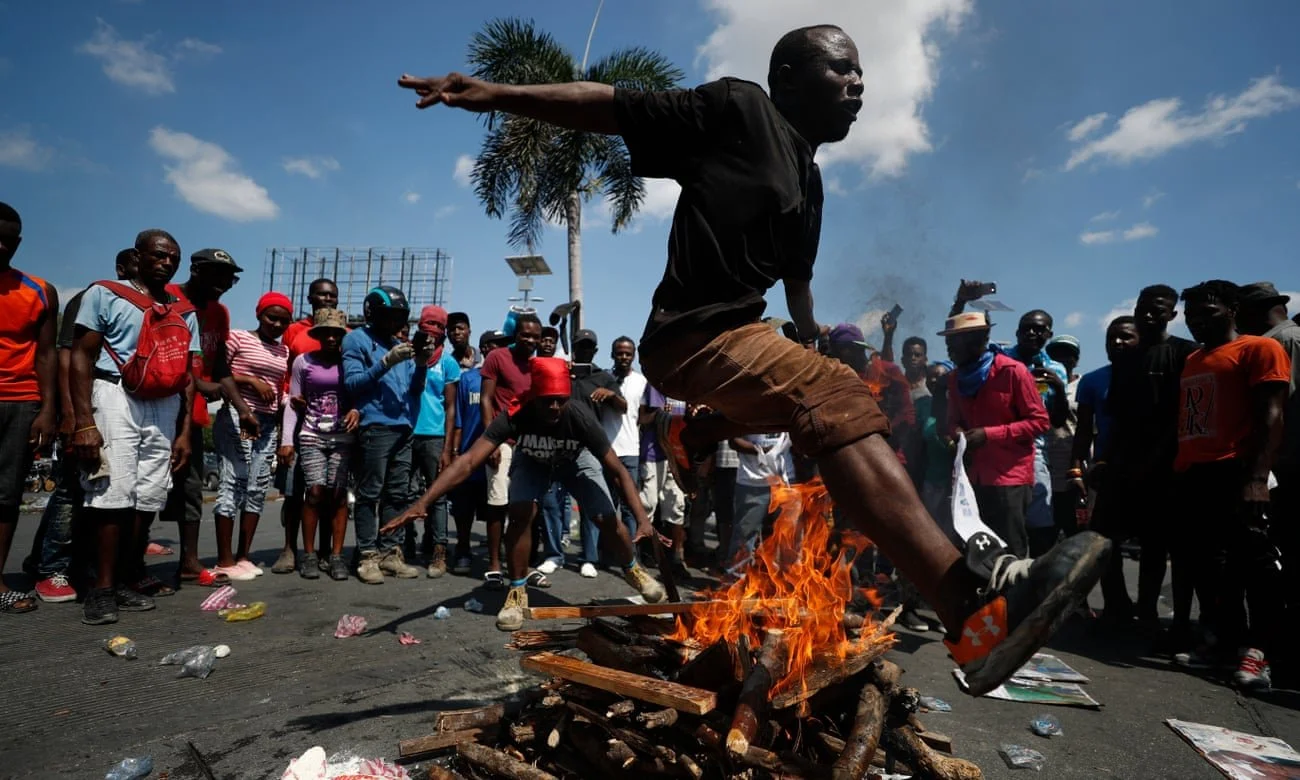
Sick of corruption, Haiti looks back to its revolutionary hero for hope
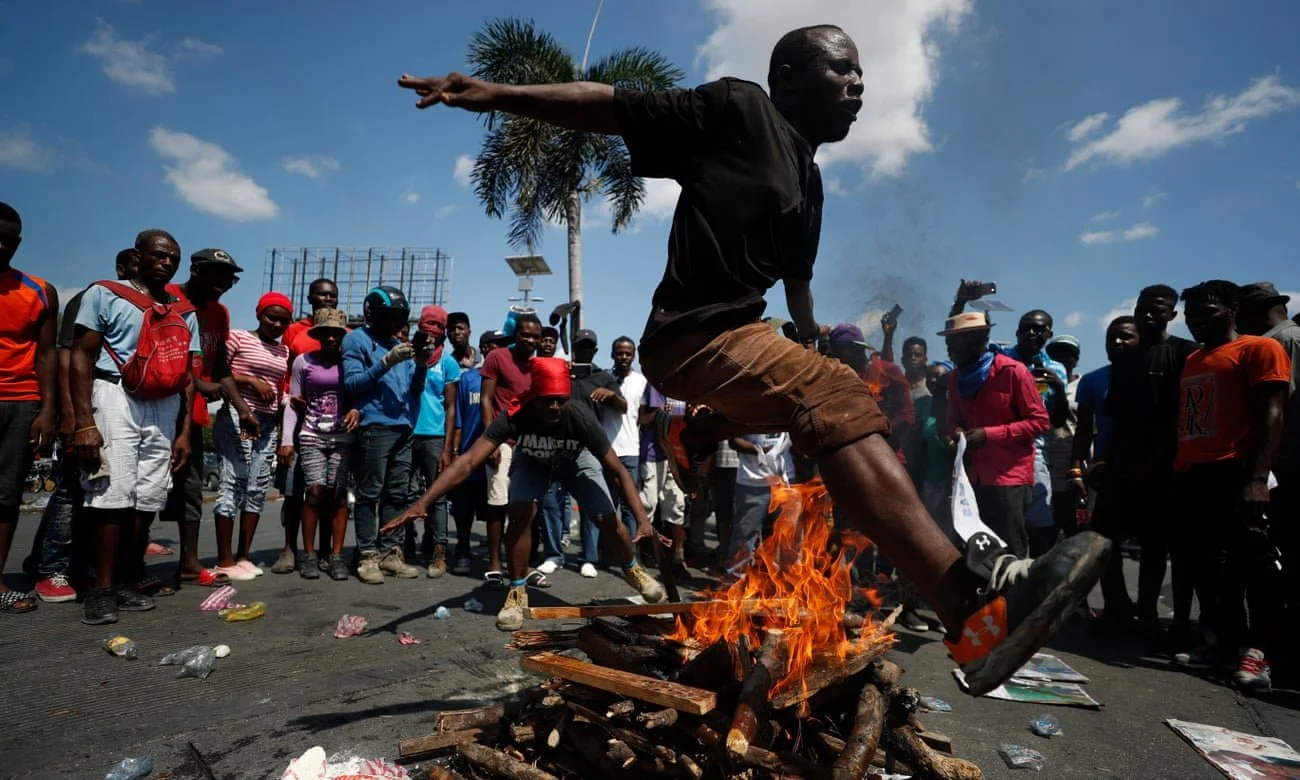
As conflict racks the nation and anger at a political scandal grows, Haitians are rallying to the country’s founding father more than 200 years after his assassination.
On the walls across Haiti’s capital, Port-au-Prince, a stencilled image can be found. Depicting a figure in a Napoleonic-era cocked hat and military frock coat, it first emerged amid the country’s long-running political and security crisis that began last year.
The man portrayed is Jean-Jacques Dessalines – Emperor Jacques I of Haiti – the rebel general who defeated French forces at the battle of Vertières to found the state of Haiti in 1804. And it is not only in graffiti that Dessalines’s two centuries-old legacy has been seen in the recent months of political turmoil that has gripped the country.
At the mass street protests that have flared intermittently throughout this year against the government of president Jovenel Moïse, roiled by allegations of a multibillion-dollar corruption scandal, Haitians have appeared in the streets dressed as Dessalines – not least during the huge demonstrations on 17 October that coincided with the national day marking the anniversary of his assassination in 1806.
That commemoration saw Moïse forced to mark the usually public events at the National Pantheon Museum in private as hundreds of armed police officers closed down the surrounding area. Protesters demanding his resignation were gathered nearby.
But above all, it is in the national conversation around the continuing crisis that the spirit of Dessalines has been most starkly in evidence.
In the almost endless and sometimes heated exchanges on the country’s news and talk radio stations, discussion will inevitably turn to the modèle Dessalines – the ideal Dessalines model – a nostalgic idea of the different path Haiti might have taken but for his assassination.
The reality is that the current evocation of Dessalines is one that speaks to Haiti’s myriad social woes and is a powerful critique of the failure of its political system over generations and centuries through dictatorship, chronic inequality and grinding poverty.
And the intractability of Haiti’s current crisis – which has rumbled on since Moïse’s contested election two years ago – appears custom-made for an appeal to an almost mythological figure amid widespread popular distrust of the political elite.
Implicated in the loss of about $2bn to corruption in a controversial scheme to buy cheap energy on credit from Venezuela, a deal that would free up funds for social development, the security forces in Moïse’s government have responded by firing on demonstrators, even as he has refused repeatedly to resign.
Opposition figures, too, have been implicated in political violence, often involving the arming of criminal gangs, some touched by the same scandal as Moïse. All of this has elevated the status of a figure from the distant past who appears untainted by the current failure of Haiti’s political system.
Sitting on the lawn of a cultural centre in Port-au-Prince’s Delmas neighbourhood, Lyonel Trouillot, one of Haiti’s most celebrated novelists, considers the importance of Dessalines – not least in comparison with Toussaint Louverture, the anti-colonial leader who is far better known elsewhere in the world through his depiction in CLR James’s 1938 account of rebellion in Haiti, The Black Jacobins.
“For Haitians, Dessalines is practically the only figure in our history who has attained this mystical status,” he says. As he points out, Dessalines’ standing is such that he is the only figure to have been incorporated into the vodou pantheon as Ogou Desalin, a warrior associated with defending liberty.
“He was a slave from the fields originally. And he was the leader who founded the state. He wanted a society that was based on equality and a common sphere of citizenship.”
Central to all this is the radical constitution of 1805, signed by Dessalines, which held up the equality of both the newly emancipated nouveaux libres, slaves of direct African heritage, and the anciens libres caste of mixed heritage [called mulattos] who would come to dominate Haiti’s political and economic system.
“The modèle Dessalines was the idea of a country for all of us, based on a common destiny in which everyone had the same chance. The murder of Dessalines in 1806 put an end to that process,” says Trouillot.
“Since then,” he adds, “there has been an informal alliance between the mulatto bourgeoisie and those occupying political power.
“The meaning of Dessalines in the current context is the desire in Haitian society for a new beginning. That’s what people in the streets are fighting for. It is a response to domination, exploitation and exclusion.”
And Dessalines has meant very different things at different times.
He was written out of Haiti’s history for four decades after his murder amid the country’s early diplomatic isolation. For its centenary in 1904, however, an anthem commemorating him was commissioned, La Dessalinienne, popularised during the two decades of US occupation that began in 1915.
The close association with the Duvaliers’ rule (1957-1986) was followed by another period when Dessalines and his red-and-black flag became seen as difficult. Anyone flying the flag was suspected of supporting the former dictatorship. And Dessalines, the historical figure, as historians point out, is not without problems. He ordered the massacre of between 1,000 and 5,000 French citizens, including women and children in the “Haiti massacre” – prompted by fears of a French plot against the new republic – although he notably protected other non-French white people living in Haiti.
And while Dessalines abolished slavery, he supported a restrictive labour system that tied workers to plantations even if they were paid for their efforts.
Julia Gaffield, an academic at Georgia State University who is writing a book on Dessalines, sees appeals to his memory in Haitian politics as a reaction to both anxiety over the country’s sovereignty, faced with perceptions of foreign interference including from the US, and in appeals to a fairer society.
“When the memory and legacy of Dessalines is called upon it is to serve contemporary needs, often when a very radical shift happens. When a revolution needs to happen. When there needs to be a complete overhaul of the system.”
In his home, high in the hills above Port-au-Prince, the Haitian historian Pierre Buteau cautions against elevating the myth of Dessalines above the reality of a complex historical figure.
“Every time we have difficulties,” he explains, “Haitians think of Dessalines. During the period of the US occupation. During the Aristides era. Now in the 21st century that emotion is becoming stronger and more intense amid all the political battles.
“I think what is surprising for us as historians is how the myth has become mixed with the truth.” He adds that the problem confronting Jovenel Moïse is that he cannot talk about or ally himself with the historical figure because he is viewed as having abandoned many of the things Dessalines stood for.
But perhaps the last word should go to Félix Morisseau-Leroy, whose 1979 Creole poem Mèsi Papa Desalin [“Thank you Father Dessalines”] long prefigured the current mood, not least his almost messianic assertion of the founding father’s legacy and transformative return . “The day will come when Dessalines will rise [again],” wrote Morisseau-Leroy. “That day everyone will know.”
MSF Opens A Trauma Hospital in Port-Au-Prince As Health Crisis in Haiti Deepens
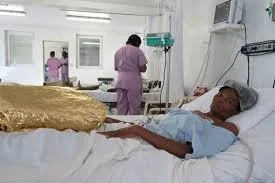
PORT-AU-PRINCE, December 3, 2019—A deepening political and economic crisis is putting a severe strain on all aspects of medical care in Haiti, the international medical humanitarian organization Doctors Without Borders/Médecins Sans Frontières (MSF) said today, as it announced the opening of a hospital in Port-au-Prince for patients with traumatic injuries.
The hospital opened in the Tabarre area of Port-au-Prince on November 27 and specializes in treating patients with life-threatening injuries including open fractures and gunshot wounds. In its first five days of operations, the hospital admitted 21 patients, about half of whom had injuries from violence.
"We are responding to a vital need with the opening of the Tabarre emergency trauma hospital, but this will not be enough," said Jane Coyne, MSF head of mission in Haiti. "The country is undergoing a severe economic and political crisis, and hospitals are struggling to stay open."
MSF originally opened a hospital in Tabarre in 2012 to provide emergency care to people with traumatic injuries in the years following the earthquake that struck the country. The hospital, named "Nap Kenbe," progressively reduced its services in recent years and admitted its last patient in late 2018.
As Haiti's economic and political crisis grew since September 2019, MSF decided to launch a new initiative to care for patients with life-threatening injuries, who the Haitian medical system is struggling to treat. Working in the same building in Tabarre, the new MSF hospital currently employs 170 medical personnel, including eight surgeons. After opening with 25 beds, the hospital is preparing to increase its capacity to 50 beds.
As economic troubles and political tensions have intensified, medical facilities, including those operated by MSF, have struggled to meet the needs of patients. Since September, streets have regularly been blocked by barricades made of burning tires, cables, and even walls built overnight. These have made it more difficult for ambulances to move and for medical facilities to receive fuel, oxygen, blood, medicines, and other supplies.
MSF's medical facilities in Haiti are seeing a high level of need amid the current crisis. So far in 2019, MSF's emergency stabilization center in the Martissant area of Port-au-Prince has received an average of 230 patients per month with gunshot wounds, lacerations, or other injuries from violence. MSF's hospital in the Drouillard area of Port-au-Prince saw a peak in activity in September, when it admitted a total of 141 patients with severe burns, primarily caused by accidents.
Insecurity affects health care workers as well. For months, the national Haitian ambulance service has experienced repeated incidents affecting its ability to respond to medical emergencies.
To keep MSF's health facilities functioning during the tensions of recent months, MSF has needed to transport hundreds of staff to work each day in MSF vehicles.
"Thanks to the positive reputation of MSF in Haiti, our vehicles are generally respected and are able to pass through the barricades," said Ella Lambe, MSF project coordinator in the town of Port-à-Piment. "However, some health centers where we have referred our patients have been looted, and some of our vehicles have been hit with stones."
In rural areas such as Port-à-Piment, in western Haiti, the broader challenges facing the Haitian health care system are very evident. A local health center where MSF has long supported emergency and maternal health services now struggles to refer patients to hospitals for higher-level care.
"Before, we could refer patients to another medical facility in one hour for urgent needs such as cesarean sections," Lambe said. "Now it takes from three to five hours to reach a hospital that can care for them."
In collaboration with Haiti's Ministry of Public Health and Population, MSF is also supporting public hospitals in various ways. These include rehabilitating a part of the emergency room at Haiti's State University Hospital, organizing trainings for health personnel and providing donations of medicines and essential supplies such as oxygen.
MSF first worked in Haiti in 1991 with programs to respond to emergencies such as natural disasters and other crises. The day after the January 12, 2010, earthquake, MSF launched the largest emergency response in its history. Today, MSF teams in Port-au-Prince and in southwestern Haiti are filling important gaps in health care services and are reinforcing the capacity of local health systems.
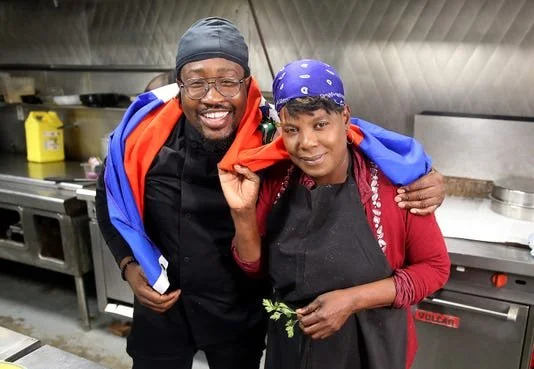
Rooted in history: The Haitian influence on New Orleans cuisine
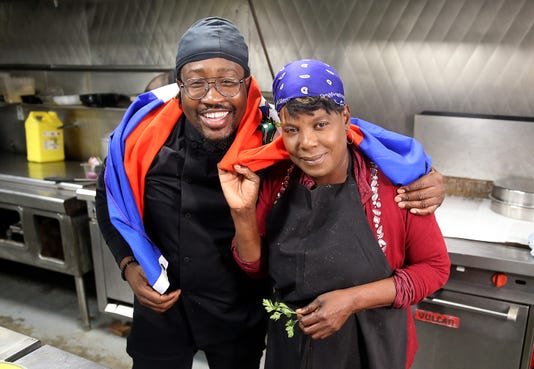
Ricardo Jean-Baptiste was born in Haiti. In the United States, he became a chef. He moved to New Orleans in 2015 for a job at a large hotel that caters to tourists and conventioneers.
“When I came here the first day, I’m almost crying because everything looks similar,” Jean-Baptiste said. “It was like memories, memories running through my head.”
The shotgun houses, those narrow blocks that form many New Orleans neighborhoods, were just like houses in Haiti, down to the exact dimensions. The bright colors on buildings edged with Victorian frills were reminiscent of the vivid hues that decorate Caribbean homes. The second line parades through New Orleans streets were like the rara. And the food of New Orleans took Jean-Baptiste back to his childhood in Haiti.
“The gumbo, so flavorful. Reminds me of home,” he said. “We do something similar to gumbo, except we don’t use roux.”
Before he first ate in the city, Jean-Baptiste was already familiar with the taste of New Orleans’ Monday staple of red beans and rice, the starchy but bland mirlitons, also called chayotes, and the many ways Louisianans cook okra (except for pickled okra, that was new for him). Each dish had an analog in his native Haiti.
The city of New Orleans, citing the latest census data, puts the local Haitian population at 1,500. Members of that community, however, think it might be as large as 6,000 or 7,000, having grown since the massive earthquake in 2010 that devastated Haiti.
Since New Orleans was founded three centuries ago many people have added layers to its culture. But the wave of immigrants at the turn of the 19th century, fleeing the revolution that created Haiti, transformed New Orleans from a minor outpost to a major city. That influence has not always been recognized.
Those refugees doubled New Orleans’ population. They found a place where French was spoken, and as Americans poured in after the Louisiana Purchase in 1803, they bolstered the city’s French identity. They came to a land that, like the colony they left, had free people of color. In the United States, they also found a place, like Haiti before its revolution, where enslaved blacks still worked the land.
They brought their experience and skills farming lucrative sugarcane to Louisiana and “helped reduce the risk of failure in a nascent industry that required large capital outlays and production on a massive scale,” according to Alfred N. Hunt’s “Haiti’s Influence on Antebellum America: Slumbering Volcano in the Caribbean.” Here, white people and free black people from the colony the French called Saint-Dominique succeeded as bakers, shop owners, musicians, cabinet makers and engineers. They added sidewalks and installed streetlights in New Orleans. They founded newspapers, opened schools and created theaters.
The flavors they introduced to New Orleans are harder to trace than their businesses that left behind buildings and logs of taxes paid and profits made. And cooking, in the time before global transportation, was forced to adapt to different ingredients when the cooks moved to new lands. Two centuries later, though, the familiar flavors that Jean-Baptiste and other recent Haitian immigrants taste in New Orleans prove the depth of that influence.
Chef Donald Link, who grew up in Cajun Country and runs the celebrated New Orleans restaurants Herbsaint, Cochon, Gianna and Pêche Seafood Grill, noticed the same culinary kinship. The more he traveled across the Caribbean, the more he found “mirror dishes” for what he knew from Louisiana and the South.
"In looking at the history of this food and the Caribbean, this food really exists solely in the Caribbean for 200, 300 years before it ever shows its face in the United States of America," Link said.
Stewed beans. Collard greens. Thick stews like gumbo. Rice dishes that looked like the ancestor of Louisiana's jambalaya.
"That's the one thing I can say throughout the Caribbean with compared to here," he said, "is the salt level and the heat level are almost identical between Creole, Cajun, soul food and Southern food."
The arrival of the refugees from Saint-Domingue kept those flavors strong at the moment when Americans brought blander palates to Louisiana.
"When we talk about the influence of the islands in general, especially Haiti, we cannot help but think that they've formed the cooking styles of the Africans that eventually made their way into the kitchens of New Orleans," said John Folse, chef and culinary historian.
Folse said the "black pot cooking" of Louisiana, where gumbos, gravies and vegetables simmer slowly in cast iron, has its roots in the Caribbean and before that in West Africa.
"Everything we start with, we nearly burn it before we get to the next thing," said Charly Pierre, who runs the Haitian stall Fritai inside New Orleans' St. Roch Market. "We really pull out the flavors."
Pierre, who was born in Massachusetts to parents from Haiti, clearly sees the influence of the island nation in New Orleans, even if that connection at times gets concealed.
"The food and all, it's still here. It's just that people don't know about it," he said. "The history, New Orleans has never allowed us to speak for it. I always think about how come there's no Haitian plaque? Well, because it's a Confederate statue in the place of that."
This summer, Jean-Baptiste partnered with other New Orleanians from Haiti to opened Rendez-Vous Creole on the West Bank, across the Mississippi River from downtown New Orleans. It's the neighborhood where most Haitians now live.
Decorated in a bold patchwork of colorful murals, Rendez-Vous Creole restaurant houses a pool table, DJ booth and a small stage. It's somewhat the unofficial clubhouse for the Haitian-American community. It is also a place to teach New Orleans about a cuisine that may be foreign but not unfamiliar.
Jean-Baptiste wants the city to know about epis, the blend of garlic, peppers and herbs at the foundation of so many Haitian dishes. He wants them to taste conch simmered in Creole sauce, the sharply spicy slaw pikliz, the starchy, smashed plantains called bannan fri and gratine, a mac and cheese he makes with ground beef.
Jean-Baptiste hopes the city will come to crave griot, the chunks of pork washed with lime, braised until tender and then fried crisp. It's the national dish of Haiti, he said. He will serve it at Rendez-Vous Creole on a plate with rice and fried plantains or, in a nod to his new home, on a loaf of soft French bread as a po-boy, the local sandwich of New Orleans. He is building new bridges between the two cuisines.
Rendez-Vous Creole: 3402 Gen. Collins Ave., New Orleans, 954.934.4055
Fritai at St. Roch Market: 2381 St. Claude Ave., New Orleans
US Marine, who enlisted after surviving Haiti earthquake, charged with smuggling guns
Authorities in Haiti seized weapons three weeks ago from a U.S. Marine who is now facing gun-smuggling charges in North Carolina, according to reports.
Jacques Yves Duroseau, 33, had flown to Haiti on Nov. 11 with eight weapons, according to federal prosecutors. They said he told investigators that he went there to train Haitian soldiers in marksmanship and to help defeat “thugs” threatening the country’s stability, the Associated Press reported.
The prosecutors also said a person who was with Duroseau when he went to Haiti told federal agents Duroseau “was in contact with the U.S. Embassy in Haiti to tell them that he wanted to be president of Haiti.”
The North Carolina charges against Duroseau were contained in a criminal complaint filed in Raleigh Federal Court last week.
According to the complaint, Duroseau had filled out a firearm declaration form with American Airlines stating he was carrying unloaded guns, but he didn’t have permission from the U.S. Marines to leave the country or permission from U.S. authorities to export firearms.
The firearms included five handguns and three rifles, and they were able to trace at least five of them to purchases made by Duroseau, the complaint said.
It said Duroseau also had an officer’s uniform and body armor with him when he went to Haiti.
Duroseau was a Marine sergeant in 2016 and grew up in Haiti, according to a profile at the time that was written by a Marine public affairs officer.
The profile said Duroseau survived the earthquake that devastated the country in 2016 and he had been rescued after being pinned between two walls in his home for four days. He joined the Marines soon after.
The article said Duroseau was an instructor in marksmanship at Marine Corps Base Quantico in Virginia.
“Whenever I come home I try to share a lot of things with my friends and I tell them if you want it you can make it, even when you thought you lost everything,” Duroseau was quoted as saying. “Whenever you put your mind to it and you want it there’s nothing stopping you.”
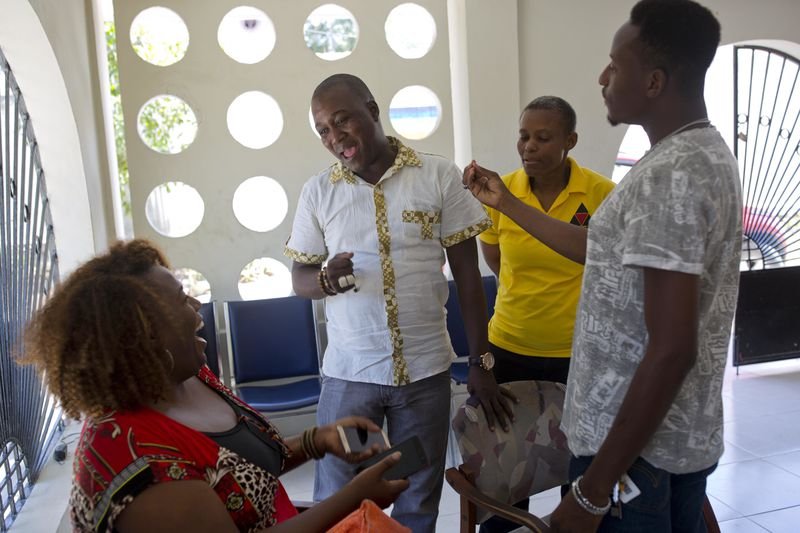
CARIBBEAT: Death of LGBTQ leader Charlot Jeudy in Haiti puts spotlight on discrimination and violence
Early in Thanksgiving week, the news came that the Haiti LGBTQ leader Charlot Jeudy was found dead in his home in the capital city of Port-au-Prince. He was 35.
Concerns about foul play in his death and calls for thorough investigations have been raised since his body was discovered on Nov. 25.
The Associated Press reported it wasn’t immediately clear how Jeudy died, and police did not return calls for comment.
Jeudy was the head of a Haiti-based organization that worked to defend human rights for homosexuals and transgender people in Haiti and combat discrimination and violence. The organization is called Kouraj in Haitian Creole — which means courage in English.
According to the AP, Jeudy — an outspoken advocate against homophobia — was forced to cancel a Afro-Caribbean LGBTQ community festival in 2016 due to threats of violence.
The U.S.-based Haiti Advocacy Working Group coalition is one of the organizations praising Jeudy for his commitment and calling for an investigation into his death.
“Charlot carried his message promoting gender equal-rights for all people, not just across Haiti but onto the international stage as an example for others to follow. We urge local authorities to continue a full investigation into the cause of his premature death,” the group tweeted last week.
The AP reported that Haiti’s LGBTQ community remains mostly underground because of a strong social stigma, but unlike English-speaking Caribbean islands, there are no Haitian laws criminalizing homosexual relations.
However, a 2015 human rights report on Haiti by the U.S. State Department said “local attitudes remained hostile to outward” LGBTQ identification and expression, especially in the capital, said the AP.
The U.S. Embassy in Haiti issued a statement on Jeudy’s “untimely passing,” his tireless advocacy for human rights and equality in Haiti and offered condolences to the late leader’s friends, family, and colleagues.
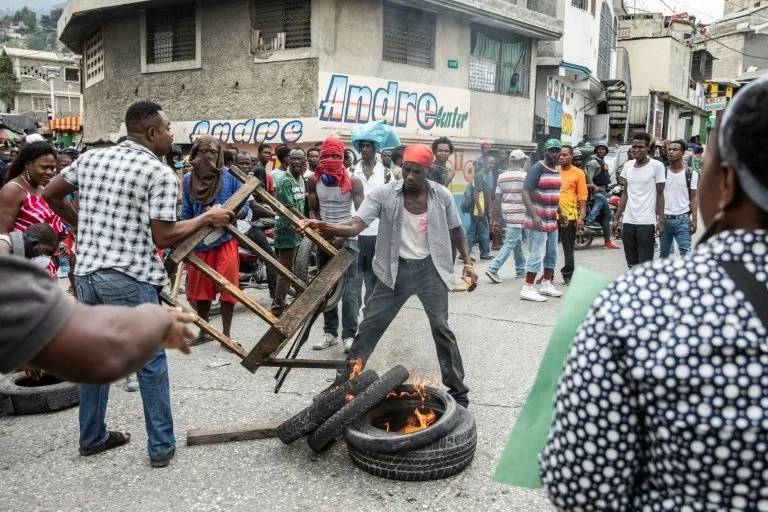
French couple shot dead in Haiti while seeking adoption, officials say
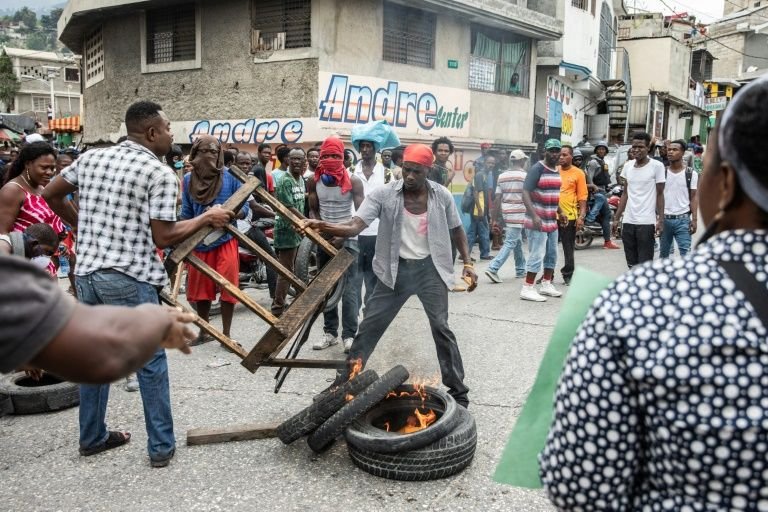
Port-au-Prince (AFP) - Two French citizens were shot dead in Port-au-Prince at the weekend shortly after flying into the Haitian capital to adopt a child, diplomatic and other sources told AFP Monday.
An official at the French embassy confirmed that a French couple had been killed, without giving further details of the exact circumstances of their deaths.
According to two other sources, however, the couple were from the Ardeche region of southeastern France and had arrived in the Caribbean country to adopt a child.
One of the sources said they were killed in an armed robbery that turned deadly.
A spokeswoman for the Ardeche department confirmed to AFP that the couple, from the town of Saint-Martin-d'Ardeche, had been given a green light last year to adopt their first child.
Haiti, the poorest country in the Americas, has been roiled for two months by protests, which were triggered by fuel shortages but have turned violent and morphed into a broader campaign against President Jovenel Moise.
According to UN figures, at least 42 people have been killed and dozens injured during anti-government protests since mid-September.
The French foreign ministry recommends visitors "postpone their trip to Haiti until further notice."
"Demonstrations, accompanied by blockades on the main roads and violent acts (rock throwing, shots...) are very frequent. Violent groups are active and fueling a climate of insecurity," the foreign ministry warned last month.
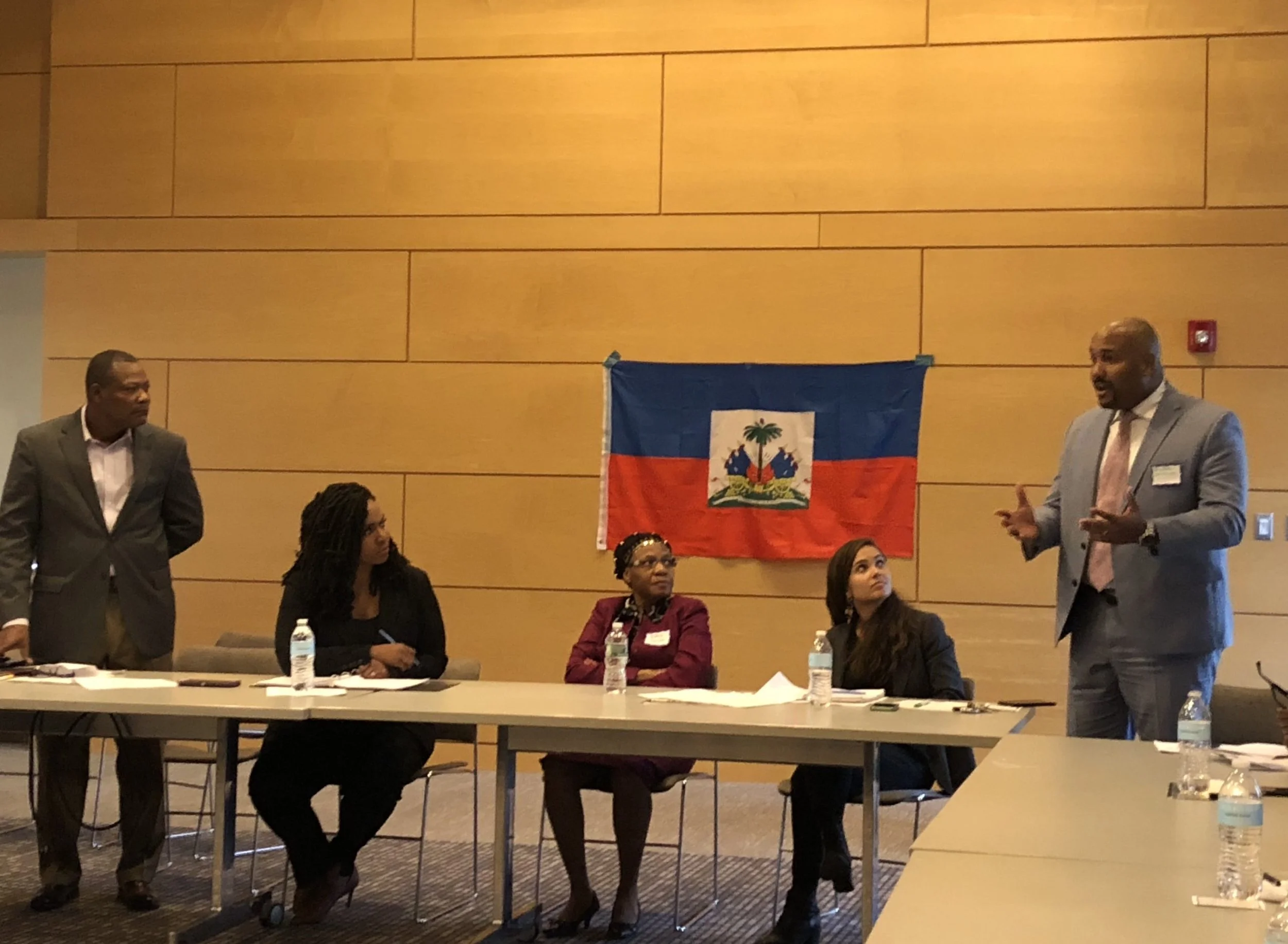
‘I’m in pain’: Boston-area community leaders urge Congresswoman Ayanna Pressley to respond to Haitian political crisis
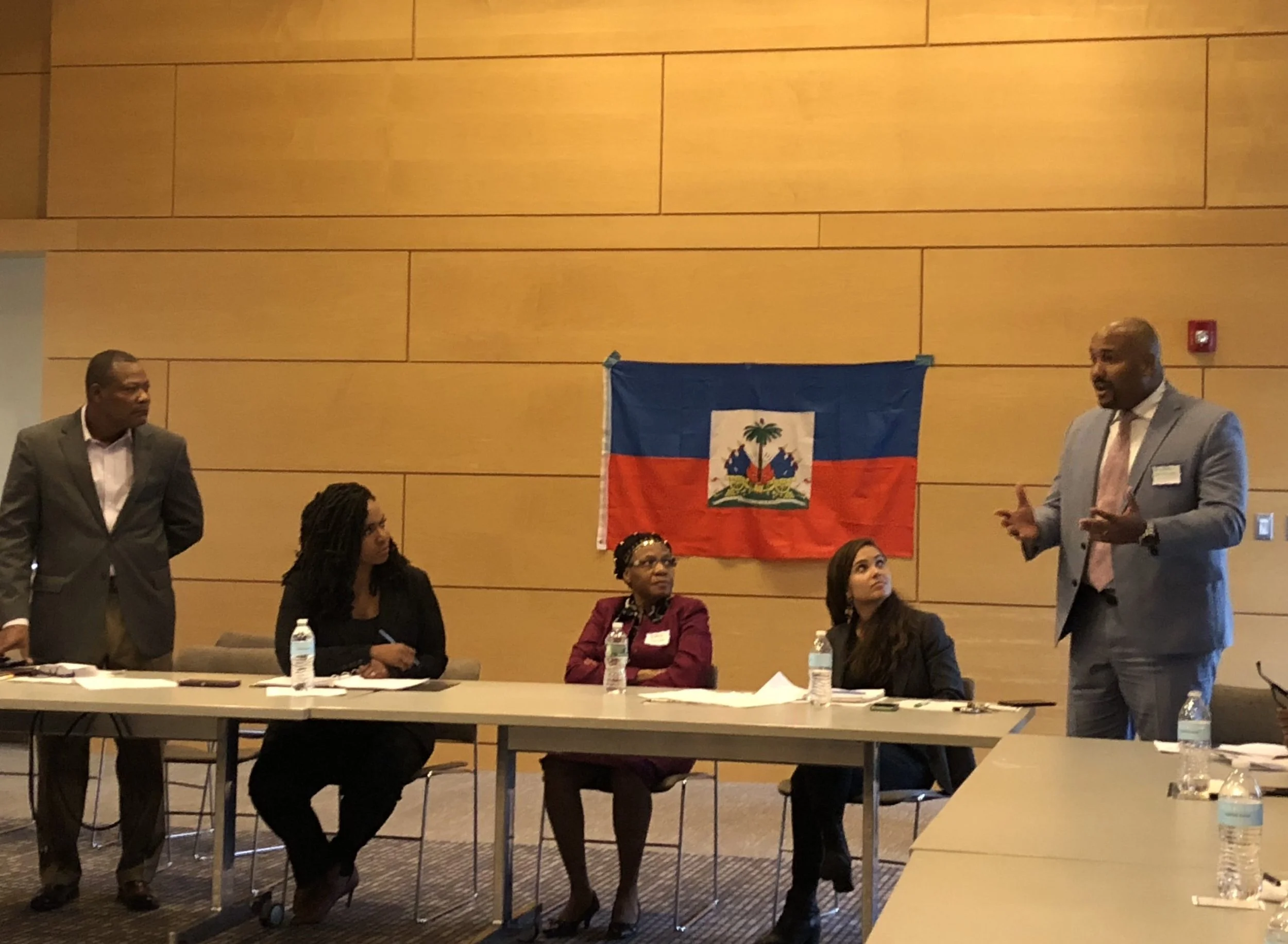

While most people are tuning into the impeachment inquiry or the 2020 election coverage, Haitians in Greater Boston are glued to news updates about the unrest back home.
The latest wave of protests has waged on for two months, calling for the resignation of President Jovenel Moïse over corruption allegations and soaring inflation. The conflict has shut down roads, schools and hospitals, bringing the country to the brink of collapse.
Haitian community leaders on Saturday relayed their fears and frustrations Saturday in a meeting with Congresswoman Ayanna Pressley at the Mattapan Branch of the Boston Public Library.
Some missed funerals because relatives told them it was too dangerous for them to return to the Caribbean nation. Others have children there who can no longer attend school. Many say they fear for their relatives and hurt to see their country in turmoil.
“I’m in pain … even in my bones,” Joujou Myrtil told Pressley, a Boston Democrat. “It hurts me because what’s happening in my country is so painful.”
Myrtil said she lost her cousin six months ago. As she went into labor, Myrtil’s cousin and aunt took a taxi to the hospital. They were confronted by armed men as they reached their destination, and the pregnant woman’s blood pressure shot up. She collapsed.
Myrtil didn’t get a chance to say goodbye to her cousin. She was told it wasn’t safe to return for the funeral.

At the center of the protests are allegations of corruption and misappropriation of funds under the Petrocaribe program, an oil distribution agreement between Haiti and Venezuela that started in 2008.
Under the program, Haiti had to pay only a portion of its oil bills in the short term and put the rest into a fund allocated for infrastructure improvements and social projects, Reuters reported. A Haitian Senate investigation released in late 2017 found that nearly $2 billion had been embezzled and stolen by Haitian leaders, primarily under President Michel Martelly’s tenure between 2011 and 2016.
Moïse, who was elected amid historically low voter turnout, was implicated in a January 2019 report by Haiti’s court of auditors. The report found that his company had been paid hundreds of thousands of dollars to reconstruct a road — and it never happened, according to the Miami Herald.
Protests broke out in July 2018 after Venezuela stopped sending oil and fuel prices soared. The demonstrations grew into a groundswell of opposition to Moïse, calling for his removal.
Sienna Merope-Synge, legal director at the Institute of Justice and Democracy for Haiti, noted that dozens have been killed in the protests or in gang violence, including at least one attack believed to have had state involvement.

While the unrest is unfolding more than 1,600 miles away, the conflict has Boston-area families stressed. Massachusetts is home to the third-largest Haitian diaspora in the U.S., behind Florida and Michigan.
Pressley said about 86,000 people of Haitian descent live in Massachusetts, citing census data. More than 25,000 of them live in the 7th District, which she represents. That includes most of Boston, Somerville, Randolph, Everett, Chelsea, Milton and part of Cambridge.
Haitian immigrants with Temporary Protected Status, which offers protections and work permits every two years to eligible foreigners fleeing natural disasters or political crises, fear being deported as the Trump administration pushes for an end to the protections.
Joelle Gamere, director of the Toussaint L’Ouverture Academy at Boston’s Mattahunt Early Elementary School, said some Haitian American students are stressed about the Haitian political crisis and fear that their parents with TPS or with no legal status may be deported.
Carline Desire, executive director of the Association for Haitian Women, said some Haitian mothers sent their young children back to Haiti to stay with relatives because the cost of living in Boston was too high. Now they fear their children are in danger.
“They don’t have the necessary means to provide proper housing and supervision because of the high cost of living in the Boston area, yet they are afraid that their children will not only be not going to school today, but they might get hurt," Desire said.

A handful of business leaders, pastors and activists raised questions about the U.S. foreign policy stance toward Haiti.
The second oldest democracy in the Western Hemisphere, Haiti has faced periods of unrest for decades. The U.S. has often played a role in the nation’s politics, from its 1915 invasion of Haiti after the assassination of the country’s president, to the country’s backing of dictators François Duvalier and Jean-Claude Duvalier because of their anti-communist stances.
The U.S. maintains that Moïse was democratically elected president and that the government officials and the opposition need to sit down and open dialogue about resolving the political crisis, VOA Creole reported last month.
But Americans have come under scrutiny in the past year as former military officers have been accused of helping the embattled Haitian president. Two weeks ago, a former U.S. Marine who took a flight from Miami to Haiti was arrested after police said they found him carrying three cases of guns and ammunition, the Miami Herald reported.
Pressley said whatever the U.S. foreign policy stance on Haiti is, it wasn’t working for the Caribbean nation and loved ones in the United States.
In the meantime, she said, the American Dream and Promise Act that she co-sponsored could offer a path to legal status to various immigrants with temporary protections, including TPS holders. The bill passed the U.S. House but has yet to be taken up by the Senate. Pressley also co-sponsored the Global Fragility Act, which would create initiatives and funds to stabilize conflict-stricken areas with help from grassroots organizations.
Pressley said she did not have an immediate solution to propose. Instead, she said she would confer with colleagues who represent other Haitian American communities — namely Democrats Andy Levin of Michigan and Frederica Wilson of Florida — to figure out their next steps.
“I do not want to create false promises and expectations here because there’s too much hurt,” she said. “There are already broken hearts because of broken promises, because of systems that have already failed you and I do not want to be one more person on that list.”
“Now I can leave here with a charge, but I needed the education,” she added.
Desire said she was grateful for having Pressley meet with them, calling her leadership phenomenal, but she worried the political crisis in Haiti would end up drowned out by the political clashes in Washington, D.C.
She said, “My interpretation of what she understands is, ‘We have a lot of challenges. We hear you. We’ll bring it back, but there’s so much going on right now in D.C.'"

‘Voodoo Is Part of Us’

Inside a religious Haitian soiree in Brooklyn .
In a dark club in Downtown Brooklyn, surrounded by more than 100 people, Agathina Ginoue Nozy took a sip of Haitian rum. She stood near an altar stacked with skulls, lit candles, cigars, rum, coffee and bowls filled with charred salt fish, boiled plantains, cassava and piman (spicy peppers).
“You typically drink white liquor during Fet Gede, but if there is none you drink rum with no ice to feel the heat,” Ms. Nozy said. “Gede is a hot thing.”
Her face was painted to look hollow, like a skull, and she wore a dark skeleton bodysuit and a black veil. With her fingers wrapped around a smoking pipe and an austere look on her face, Ms. Nozy had become the embodiment of Maman Brigitte, a Haitian lwa (or goddess) of death.
Voodoo believers, Haitians and curious partygoers gathered last Saturday night to celebrate Fet Gede, or the Festival of the Dead.
Similar to Mexico’s Day of the Dead, Gede invites revelers to dress up, eat, drink and dance to honor the lwas and the ancestors who came before them. It is one of the most anticipated celebrations in the Haitian voodoo religious calendar.
Ms. Nozy, a 29-year-old Haitian immigrant who was born and raised in Port-au-Prince, moved to New York City just before she turned 17. As someone who believes in voodoo, she looks forward to the celebration each year, but acknowledges that many people, including Haitians, lack an understanding of what it is.

They believe that the religion “has something to do with black magic,” Ms. Nozy said. “Voodoo is part of us. It’s who we are. It’s the culture. Voodoo is the food that we eat. It’s the language that we speak.”
What voodoo is not, contrary to popular belief, is a dark spell-casting practice full of pin-dolls and demonic prayers, said the party’s organizers, Monvelyno Alexis, 43, and Riva Précil, 30, a husband and wife musical duo who have organized one of the city’s most popular Fet Gede events for the past seven years.
This means that the event of Fet Gede can be somewhat misunderstood, too.
“I know a lot of Haitians that dress up their kids for Halloween. But when it comes to Gede they say I am not interested in that thing,” Ms. Nozy said.
“Our generation is more open-minded when it comes to the voodoo religion,” said Ms. Nozy, who was part of a large crew at the party that night.
At the club, guests were dressed in the official Gede colors — black, purple, and white — and danced to rhythmic drumming. The room was thick with smoke from incense and cigars.
The night kicked off with a rum tasting at the altar, which helped guests get in the Gede mood. As Ms. Nozy and her crew danced, one man splattered Florida Water — a perfume used in voodoo for spiritual cleansing and protection — over their heads, leaving a sweet citrus and floral scent that covered the room. At times, Ms. Nozy and others would scream, throw their hands in the air or slam a wooden cane into the ground.
Fet Gede is observed typically in early November, although it can be celebrated all month.
Rituals include a special Gede dance, Banda, and making offerings to the spirits, the most famous of whom is Baron Samedi, known as the god of death (he is also the husband of Maman Brigitte, the goddess of death), Ms. Précil said. Together, both spirits — the Baron and Maman — revel in eroticisms, obscenities and drinking.


The ancestors, Ms. Précil said, like to party. “They don’t have the same restrictions or rules as we do here on earth,” she said. “They’re very fearless, so it’s a time where we sort of channel their ways and celebrate them by taking on their way of life.”
Haitian voodoo is a religion that emerged out of institutional slavery.
Starting in the mid-1600s, many Africans who had been brought against their will to the Island of Hispaniola (now Haiti and the Dominican Republic) arrived with their own spiritual traditions, eventually integrating them with those of the indigenous people of the island. As a result, voodoo, which means “spirit,” was born.
Voodoo, often spelled Vodou, is still regarded by many Haitians as the spiritual source of the country’s strength, healing and resilience.
Mr. Alexis said that voodoo isn’t something he practices or follows with a strict set of rules; it is more of a connection. He emphasized the importance of working to help Haitians reconnect with voodoo through events like this one.
“Whenever somebody asks us questions we always answer them,” he said. “We want to bring the Haitian way back to Haitians.”

Despite more than 80,000 Haitian immigrants in New York City, Gede celebrations aren’t that common, Ms. Précil said. If her ever-expanding parties are proof, however, she sees a growing interest in the event. The couple has been asked recently to bring their party to parts of Canada and even Haiti.
Music and dance are key for a successful Gede. Last weekend, Mr. Alexis and Ms. Précil each sang, accompanied by a live band, and Ms. Nozy performed a Haitian folklore dance, gyrating and chanting to the drummer’s beat. The energy of the crowd swelled as the room became more congested, everyone trying to inch closer to the show.
Folks could be seen taking shots of liquor and eating different Haitian dishes, including griot (fried pork) or banan peze with pikliz (plantains with spicy pickled cabbage).
There was a tarot card reader and a face painter. At one point there was even a trivia contest, testing partygoers on their knowledge of Gede trivia and traditions.
“This is something that our ancestors left for us and we need to cherish it,” Ms. Nozy said. “Even though you’re not in Haiti, if you’re living in a foreign country, the culture is still alive. And it’s in you.”
Understanding the turmoil in Haiti
Haiti has experienced many protests this year. The protests have primarily focused on a myriad of economic concerns and were initially sparked by a fuel crisis within the country. The underlying impetus of these protests, however, are allegations that many senior officials in the Haitian government, including President Jovenel Moïse, have been implicated in the misappropriation of 2 billion USD in profits from an oil deal between Venezuela and Haiti.
The intensity of these protests has been exacerbated in recent weeks by a series of domestic and international catalysts.
1. Shortages
The protestors were initially spurred by a national shortage of fuel earlier this year. Haiti’s primary fuel source for many years has been imports from Venezuela. As Venezuela’s political stability started to deteriorate, Haiti began to rely on imports from other international sources. The US-based company Novum Energy Trading Corp, soon became the primary fuel source for the country, supplying 80 percent of Haiti’s fuel last year.
As the western hemisphere’s poorest country, Haiti has fallen behind on its payments to Novum. In February, Novum anchored a vessel containing 150,000 barrels of gasoline, half of Haiti’s monthly usage, outside of Port-au-Prince, and refused to deliver the cargo until the Haitian government made payment. The Haitian government stated that “fuel distribution companies in Haiti had not paid the government for gasoline and diesel it purchased on their behalf from Novum.” As a result, the government could not make their payments, and Novum held the fuel for over a month before diverting the shipment to Jamaica on April 4th.
The cost of fuel in Haiti skyrocketed and caused many other necessities to rise with it. As the nation’s fuel supply diminished, electrical blackouts increasingly occurred throughout the country. Many Haitians frustrated with their inability to access basic necessities, and the apparent lack of government response to the problem took to the streets in protest. These continuing energy shortages are also accompanied by deficiencies of other vital resources, including food and medicine throughout the country.
2. International Aid:
There has been international support seeking to provide aid and relief to Haiti. The World Food Programme recently conducted a study in Haiti that found “more than one in three people need urgent food assistance,” or nearly 3.7 million people. The US has therefore pledged “$20 million in emergency food assistance from USAID” as well as releasing “2,000 metric tons of emergency food stocks prepositioned in Haiti for distribution via the United Nations World Food Programme.” Despite this increased aid, many of the suppliers have had issues in their distribution to the Haitian people. “Fuel shortages, roadblocks, protests, and violent incidents are severely restricting the movement of USAID staff and implementing partners” and preventing them from adequately disseminating supplies.
The recent chaos has also effected many domestic and international medical programs. Several Hospitals have closed, many have surpassed capacity, and many more are running low on or out of critical medical supplies. The USNS Comfort arrived in Haiti, on November 4th, to carry out a ten-day medical mission in the country. This stop is part of the “U.S. Navy’s Enduring Promise operation,” in which “Medical teams from USNS Comfort will be working alongside host nation medical professionals in providing a variety of medical services to adults and children.” This mission appears to have been well received by those who were able to attain access, but the presence of a single ship cannot abate the increasing need for medical supplies.
Despite widespread issues in getting aid to where it is needed most, there has also been a domestic backlash against the current role of the international community as a whole. One area of concern derives from what many Haitians believe is a tacit endorsement of the Haitian government. Many protestors feel that the US not condemning the Haitian government is tantamount to an endorsement of their actions. The US supply of aid is also seen as merely treating the symptoms rather than the sickness itself. Additionally, the US calls for a dialogue between the two sides is viewed by many protestors to undermine the validity of the protests themselves and the long history behind them. Finally, although the aid provided by foreign powers is needed by many, there are concerns that this aid will over saturate the Haitian market and destroy local markets as it did after the earthquake in 2010.
3. End of UN Peacekeeping Mission:
Amid Haiti’s current instability, the UN has ended its 15-year peacekeeping mission to Haiti and withdrawn. The last of the UN peacekeeping forces departed at the end of September. This departure turned the sole control of the military forces and their oversight back into the hands of the Haitian government. There has been sharp criticism that this move was timed poorly, and that considering the pressure the government is currently facing this new lack of oversight may allow the government to revert to other tactics.
UN troops in Haiti have faced several legal challenges since their arrival in 2004. These include allegations that the UN brought cholera to Haiti and that some troops sexually abused Haitians. The cholera outbreak, which started in 2010, killed thousands of people and is widely believed to have been brought by peacekeepers from Nepal. Despite this belief, international courts have widely refused to hear the issue over jurisdictional concerns. Many of the allegations of sexual abuse by peacekeepers remain unresolved, and several paternity cases are pending in international courts.
Haiti’s UN peacekeeping mission has been replaced by the United Nations Integrated Office in Haiti (BINUH), which was established by the UN security council on October 16th. BINUH is tasked “with advising the Government of Haiti on strengthening political stability and good governance through support for an inclusive inter-Haitian national dialogue.”
4. Excessive use of force:
Amnesty International has recently verified evidence that Haitian police have used excessive force against protesters in Haiti since the departure of UN peacekeepers. Amnesty alleges that police have fired live ammunition at protesters and indiscriminately used less-lethal weapons in violation of international law.
The evidence takes the form of several videos from October, showing a series of incidents in the Haitian capital of Port-au-Prince. Amnesty published three videos that it believes prove the indiscriminate use of less-lethal weapons by Haitian police. The videos show police firing tear gas from a moving vehicle into a crowd, firing rubber bullets a close range, and an officer beating a fleeing protestor in the stomach.
Amnesty also alleges that Haitian police have used live ammunition in their attempts to break up protests. The first video shows presidential guards firing combat rifles into the air towards protesters in an attempt to force them to disperse. At least two protesters are believed to have been injured during this incident. However, attempts to verify how they were injured have been unsuccessful. The second incident shows a police officer firing a handgun directly at fleeing protesters. Amnesty believes that the protest was peaceful and that the video shows there was “no evident or immediate risk to the officer.” It should, however, also be noted that not all of the Haitian protests have been entirely peaceful and there have been many violent actions by groups within the demonstrations.
Under international law, “the use of less-lethal weapons – such as tear gas, water cannon, or rubber bullets – should be limited to specific situations after careful consideration and only when it is necessary and proportionate to a legitimate police objective.” Additionally, “live ammunition is only [to be] used as a last resort and when strictly necessary to protect against an imminent threat to life or serious injury,” and, “if the use of force is required to disperse violent public assemblies, it must conform to the principles of strict necessity and proportionality.”
The Haitian government has yet to comment on Amnesty’s allegations.
5. The threat to Journalists:
The Office of the United Nations High Commissioner for Human Rights (OHCHR) recently published a statement on the unrest in Haiti. It found that “at least 42 people have died and 86 have been injured” in the most recent round of protests. OHCHR has attributed at least 19 of the 42 deaths to government security forces. It also found that at least one journalist had died, and many others had been injured. OHCHR has urged all actors not to endanger journalists in the country further. “We urge all actors to refrain from targeting journalists and respect the freedom of the media to report on the situation.” The growing danger to journalists in Haiti has diminished the ability of the media to cover the country. Additionally, the murder of Nehemie Joseph, a prominent Haitian journalist and critic of the government has further served to galvanize the momentum of the protestors.
In its statement, OHCHR also acknowledged the recent allegations made against the government forces.
We welcome the launching of investigations by the General Inspectorate of the Haitian National Police into allegations of human rights violations by police and stress the need for investigations to be thorough, transparent and independent, with a view to ensuring accountability, justice and truth for victims and their families – including through judicial action.
The US Embassy in Haiti recognized the International Day to End Impunity for Crimes against Journalists in a press release. The statement said that “the United States remembers those reporters killed while doing their jobs, and calls for an immediate end to all threats, intimidation, and violence against journalists and other media professionals for their work.”
Other Concerns:
There also many other seemingly “smaller” concerns in this sea of political upheaval that in less muddied water might be front-page news.
- Doctors without Borders has declared that Haiti is facing a medical emergency as new “Antibiotic-resistant infections are a growing problem for burn patients.” As violence grows throughout the country, these far more difficult to treat infections could have deadly implications for those wounded.
- The USCIS field office in Haiti has announced that it will permanently close its doors on November 29th. This decision was made under a wider Department of Homeland Security (DHS) effort to close 13 offices globally. However, it will restrict access to some immigration services for many Haitians.
- The future of Temporary Protected Status (TPS) for many Haitians living in the US continues to be uncertain. Many are concerned that the end of TPS could result in their deportation back to Haiti despite the current danger inherent in such deportation.
Many other concerns are facing Haiti that its government and people will have to overcome if the country is going to experience stability.
An Uncertain Future:
The protests in Haiti are currently ongoing. Neither side has given significant ground to the other, and tensions have continued to build over the last few months. With no clear path forward and an ever-lengthening political stalemate, the continuation of the protests is seemingly limited only by the willpower of the two sides.
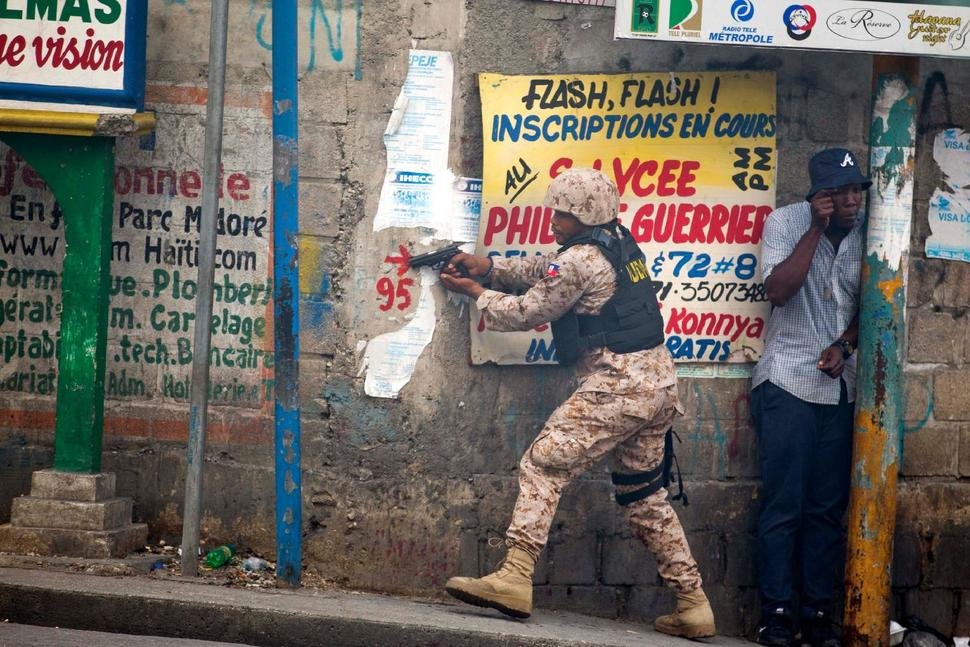
Haiti Mourns 5 People Killed During Ongoing Protests
PORT-AU-PRINCE, Haiti (AP) — Wails filled a church in Haiti’s capital on Tuesday during funeral services for five people killed in anti-government protests that began more than two months ago.
Among those killed was 15-year-old Jasmine Pierre, whose father told The Associated Press that she was hit inside their home by a stray bullet when police began firing at protesters.
“This really hurts,” said her father, Macene Pierre. “I lost my little girl. I don’t know what I’m going to do.”
Hundreds of people attended the funerals for Pierre and four men, three of whom were allegedly shot by police while participating in the protests.
The fourth victim, 25-year-old Bernard Vaudreuil, was working as a moto taxi driver when he was shot, said cousin Marie-Ange Laroche.
“He was not involved in the turmoil,” she said. “He was just trying to survive.”
More than 40 people have been killed and dozens injured in more than two months of demonstrations organized by opposition leaders demanding the resignation of President Jovenel Moïse amid anger over corruption, ballooning inflation and a scarcity of basic goods.
The protests have shuttered many businesses and schools across the country as Moïse continues to urge dialogue after stating he won’t resign.
The mourners joined a small group of protesters after church services as some of them jogged down the street with one casket while tires burned around them. Among the mourners was Guerline Jeremie, a mother of two whose husband, Desir Jean Belleville, 34, was killed last week.
“We want justice for them,” she said of those who died. “I don’t know exactly what I’m going to do to feed these kids.”
The United Nations has said that 3.7 million people in the country of nearly 11 million lack access to enough food amid the political turmoil, and that the number is expected to reach 4 million early next year.