
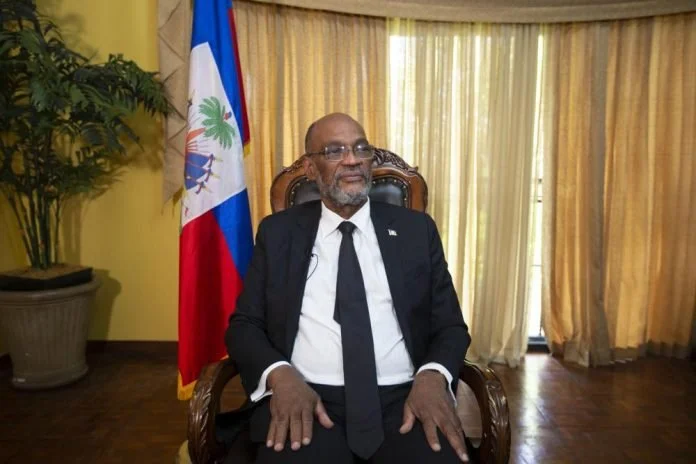
Haiti PM Promises Full Support to Ensure Security
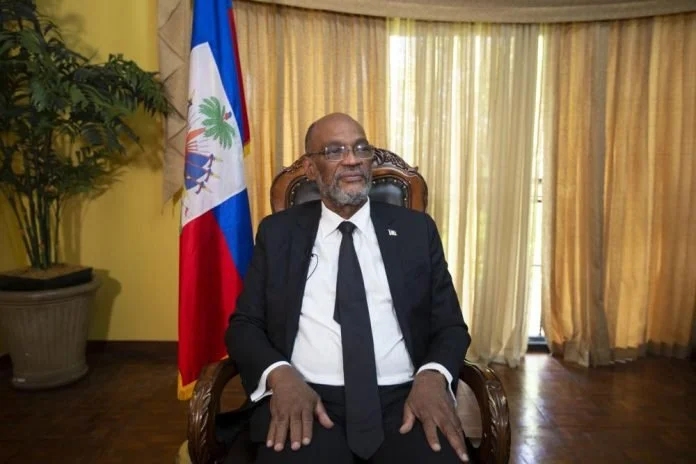
Prime Minister of Haiti, Ariel Henry has pledged his government’s support for the Haitian National Police (PNH) in their efforts to curb the high incidence of criminal activities in the country.
“My team is committed to restoring security and protecting lives and property throughout the country. I take this opportunity to salute the titanic work of the police, especially in the context of fuel transport safety. My government is firmly committed to improving the working conditions of our police officers and their environment,” said Henry, who met with the PNH Commander-in-Chief, Frantz Elbe and other members of the high command.
The visit by Prime Minister Henry accompanied by senior government ministers, including Justice Minister, Litz Quit, came 48 hours after police said that the body of second in command of the 400 Mawazo gang, was found on the street on Sunday.
The PNH said that Mortimé alias “Gaspillage” was fatally injured during an exchange of gunfire with h law enforcement authorities last Friday.
Police sad that they had also arrested at a hospital in the capital, Wimson Hyppolite a suspected gang leader while he was being treated.
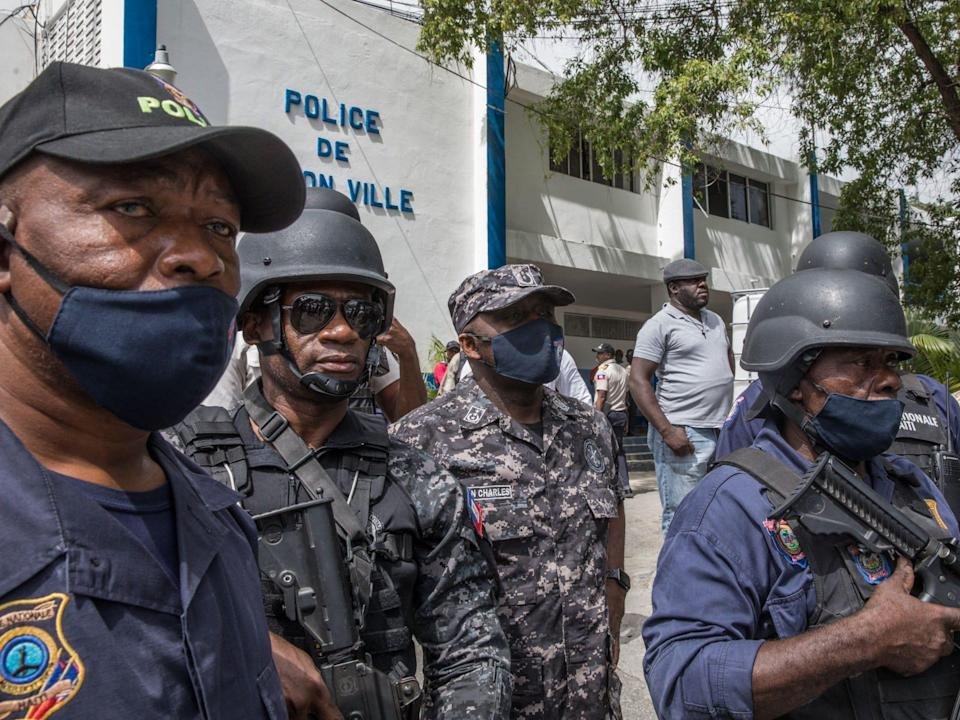
On Monday evening, heavily armed men attacked the sub-police station located at Pernier. But they were repelled by members of the specialized units of the PNH that were sent to reinforce the police. The police believe that the gunmen belonged to the “400 Mawozo” gang, who are also blamed for the recent abduction of 17 missionaries from the United States and Canada.
The gang has demanded a ransom of US$17 million.
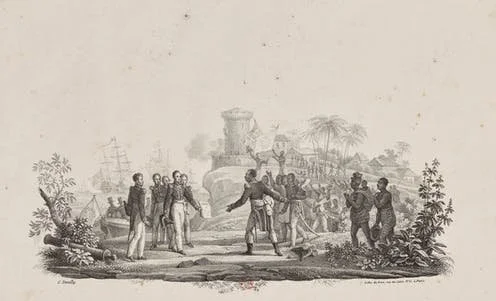
'The Greatest Heist In History': How Haiti Was Forced To Pay Reparations For Freedom
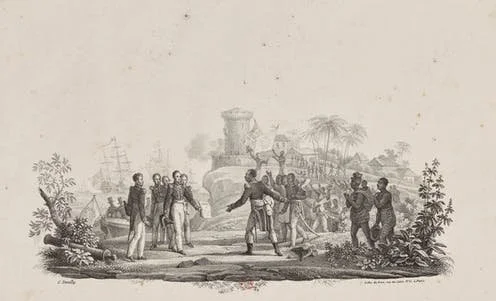
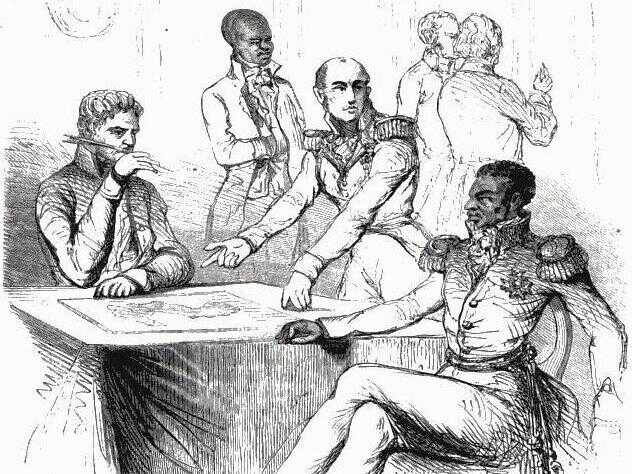
The Baron de Mackau of France presenting demands to Jean-Pierre Boyer, President of Haiti, in 1825Wikipedia
In recent weeks, thousands of refugees from Haiti have arrived at the U.S.-Mexico border, desperate for a better life. Most left Haiti years ago, after a 2010 earthquake ravaged what was already one of the most dismal economies in the world. They had originally settled in places like Chile, but the politics of the region have made them feel unwelcome, discriminated against, and fearful of the future.
The Haitian refugees hoped the United States, under President Biden, would offer them a lifeline. They were wrong. The Biden administration has been sending thousands back to Haiti, even though Haiti is a disaster zone, and many of the refugees fled it years ago. Some of those the U.S. government forcibly sent to Haiti are kids who have never lived there.
Ambassador Daniel Foote, who was appointed by President Biden as the U.S. special envoy to Haiti in July, resigned in protest against his administration's policy. "I will not be associated with the United States' inhumane, counterproductive decision to deport thousands of Haitian refugees," Foote wrote in his resignation letter.
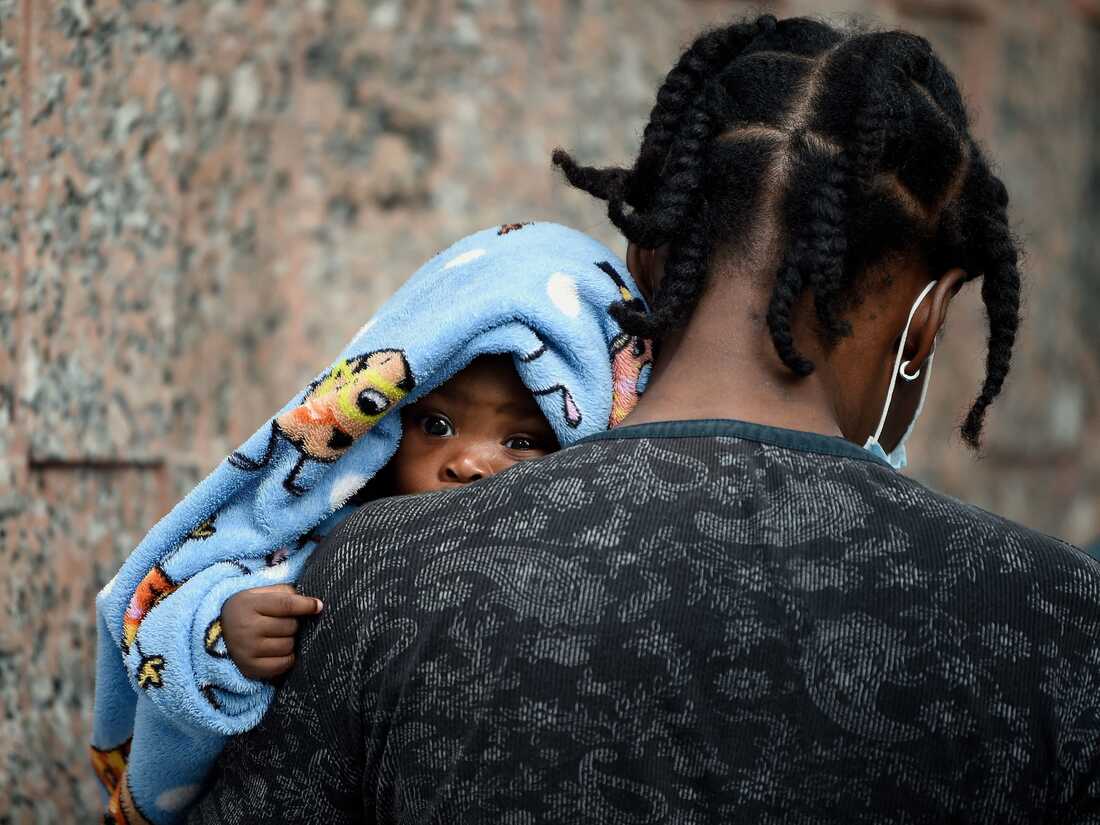
Tens of thousands of migrants, many of them Haitians previously living in South America, have arrived in recent weeks in Mexico hoping to enter the United States.ALFREDO ESTRELLA/AFP via Getty Images
The Haiti that refugees are being sent back to is a nation in crisis. With its unlucky coordinates on the map and its poor infrastructure, Haiti has been devastated by multiple hurricanes and earthquakes in recent years, including a 7.2 magnitude earthquake in August. In July, Haiti's president, Jovenel Moïse, was assassinated by Colombian mercenaries, some of whom had received U.S. military training. A Florida-based security company reportedly connected whoever wanted Moïse killed with the mercenaries, but the details of why Moïse was killed and who directed the mercenaries are still murky.
What is clear, however, is that Moïse's assassination continues Haiti's centuries-long political instability. In 2015, the World Bank concluded that Haiti's biggest political problem is that "a social contract is missing between the state and its citizens." Ambassador Foote, in his resignation letter, blasted the United States and other nations for contributing to this problem for the umpteenth time by unabashedly backing Moïse's unelected replacement, Ariel Henry. Henry was appointed Prime Minister by Moïse in July, and took on the additional role of President after Moïse's assassination. Haiti's chief prosecutor said he found evidence linking Henry to the president's killing, and Henry promptly fired him. Some Haitian authorities have asked Henry to step down and pleaded with the international community to stop supporting him. "This cycle of international political interventions in Haiti has consistently produced catastrophic results," Foote wrote.
Haiti is one of the poorest nations in the world, and rich countries have their fingerprints all over the nation's stunted development. The United States worked to isolate a newly independent Haiti during the early 19th century and violently occupied the island nation for 19 years in the early 20th century. While the U.S. officially left Haiti in 1934, it continued to control Haiti's public finances until 1947, siphoning away around 40% of Haiti's national income to service debt repayments to the U.S. and France.
Much of this debt to France was the legacy of what the University of Virginia scholar Marlene Daut calls "the greatest heist in history": surrounded by French gunboats, a newly independent Haiti was forced to pay its slaveholders reparations. You read that correctly. It was the former slaves of Haiti, not the French slaveholders, who were forced to pay reparations. Haitians compensated their oppressors and their oppressors' descendants for the privilege of being free. It took Haiti more than a century to pay the reparation debts off.
The Tragic Hope of Revolutionary Haiti
Haiti won its independence from France in 1804, and it was almost immediately made a pariah state by world powers. It was an independent, black-led nation — created by slaves who had cast aside their chains and fought their oppressors for their freedom — during a time when white-led nations were enforcing brutal, racist systems of exploitation around the world.
Haiti, then known as Saint-Domingue, had been the crown jewel of the French empire. It was the most lucrative colony in the whole world. French planters forced African slaves to produce sugar, coffee, and other cash crops for the global market. The system seemed to work well. That is, until the French and American revolutions helped to inspire, in 1791, what became the world's largest and most successful slave revolt. Against all odds, the slaves won. Former slaves sent slaveholders scurrying to France and America — and Haitians successfully fought back subsequent efforts to re-enslave them. Haiti was the first nation to permanently ban slavery.
But as a nation of freed black slaves, Haiti was a threat to the existing world order. President Thomas Jefferson worked to isolate Haiti diplomatically and strangle it economically, fearing that the success of Haiti would inspire slave revolts back home. With the invention and spread of the cotton gin, slavery was becoming much more lucrative at the very same time a free Haiti was coming into existence, and slaveholders in the United States and other countries clung to and expanded the inhumane means of production. Haitian success was perceived as a threat to this system for decades, and the United States didn't officially recognize Haiti until 1862, as slavery began being abolished.
During Haiti's critical period of development, France intervened even more directly than the U.S. to thwart its success. In July 1825, the French King, Charles X, sent an armed flotilla of warships to Haiti with the message that the young nation would have to pay France 150 million francs to secure its independence, or suffer the consequences. That sum was 10 times the amount the United States had paid France in the Louisiana Purchase, which had doubled the size of the U.S.
Almost literally at gunpoint, Haiti caved to France's demands in order to secure its independence. The amount was too much for the young nation to pay outright, and so it had to take out loans with hefty interest rates from a French bank. Over the next century, Haiti paid French slaveholders and their descendants the equivalent of between $20 and $30 billion in today's dollars. It took Haiti 122 years to pay it off. Professor Marlene Daut writes it "severely damaged the newly independent country's ability to prosper."
Righting The Wrongs
After the 2010 earthquake completely devastated Haiti, scholars and journalists wrote a letter to the French president demanding that France pay back Haiti. The French economist Thomas Piketty resurrected the idea in 2020, arguing that France owes Haiti at least $28 billion. The French government, under multiple presidents, has balked at the idea, and it is unlikely to pay Haiti back anytime soon.
But if the rich world wants to help right the wrongs done to Haiti in the past, perhaps the most effective policy right now would be to accept more Haitian refugees. This wouldn't only be a humane policy that would improve their and their future families' lives. It would also likely be a boost to the Haitian economy. According to the World Bank, Haitian expatriates sent $3 billion in remittances back home to Haiti in 2018, which was almost one-third of the island nation's entire GDP.
Inhumanity on the border forces NBA players to question if the US has changed

“We want fair treatment for Haitian refugees”.
Those are the words NBA hall of famer Dikembe Mutombo used when I asked him about the Haitian refugees being brutalized and subject to mass deportations at the US-Mexico border. It’s a statement that shouldn’t need any more explanation in a country that once said: “Give me your tired, your poor, your huddled masses yearning to breathe free”.
Unfortunately for Haitians, those words don’t appear to apply to them. Refugees from the Caribbean nation have been forced from their country by a combination of devastating natural disasters, poverty and political instability.
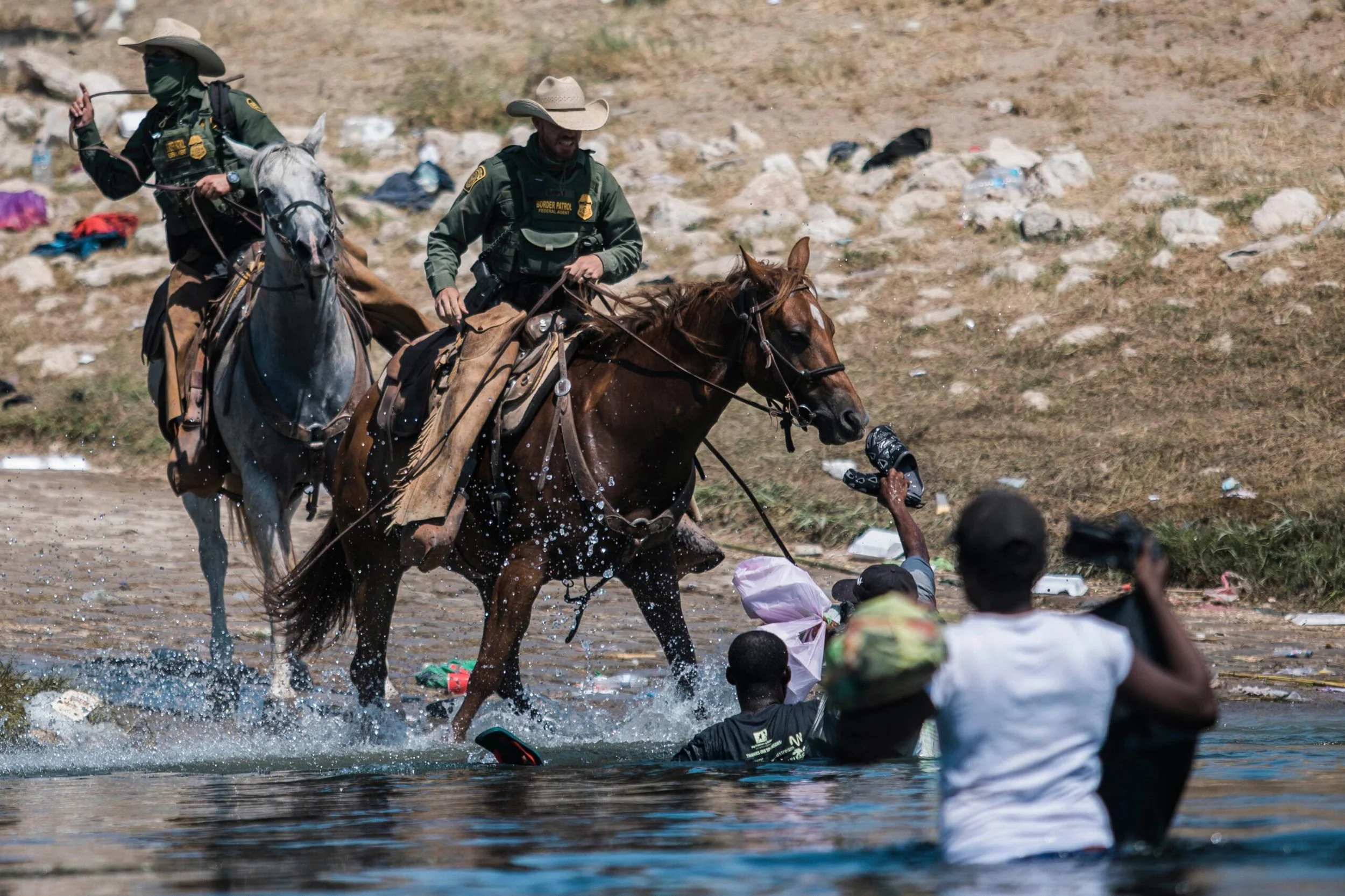
America’s welcome has included deporting thousands of the refugees to Haiti, a country some of them have never been to. But as well as the bureaucratic indifference to the plight of the refugees, there have been more visceral examples of the inhumanity shown by the United States. Images at the US-Mexico border captured by photojournalist Paul Ratje showed two Black men being pursued by a white security agent on horseback, who used his reins like a whip. Humans being treated like cattle is horrifying enough in any context, but the images were particularly repellant in a country founded on slavery.
There was relief when the regime of Donald Trump left the White House. But Ratje’s photos left many wondering if this is the change they voted for. Is trading someone who promotes, initiates, and supports evil (Trump) for someone who allows evil to continue (Biden) an improvement?
And those who have doubts include athletes in the NBA, where 75% of players are Black – some of them with roots in Haiti. Olden Polynice, a human rights activist and 15-year NBA veteran, was born in Port-au-Prince, Haiti. During a recent appearance on my podcast, I asked him for his thoughts on the treatment of Haitians at the border.
“My first reaction was sadness. I’ve seen this movie before. In 1993 when I did my hunger strike [to protest US policies on Haitian refugees] we had the same situation. But it wasn’t the coronavirus back then, it was the Aids epidemic. And America was spreading the false notion that Haitians were bringing Aids into the country and they began putting them in Guantanamo Bay. So I have already seen this. It’s history repeating itself.”
The end of historic injustices are exactly what NBA players have fought for in recent years – highlighted most clearly in the months after the police murder of George Floyd. Former NBA All-Star Joakim Noah told me the scenes at the border were a reminder that the journey is not over.
“The images of border patrol agents on horseback whipping Haitian asylum seekers are appalling and unacceptable. These are human beings who have lost everything and are knowingly willing to face such injustices to their human rights because there aren’t any better options,” he said.
“Of course immigration is complex, but no human being should be treated like an animal in order to find a better life – it’s shameful and inhumane. We fought so hard over the past few years to shed light on police brutality in brown and Black communities and to hold accountable those who abuse their positions of power. We need to hold the Biden administration accountable to process immigrants and asylum seekers according to international law and to hold border patrol and vigilantes accountable for their abuse of power.”
It is not just Polynice and Noah who were saddened by America’s treatment of the refugees. After a few days of anger from the public, Biden condemned the inhumane treatment of the Haitians and said that anyone who has mistreated refugees at the Mexico border “will pay”. It’s important to note that details about actual policy change were absent from Biden’s remarks, as well as those of Vice President Kamala Harris. There is no suggestion that America will now abandon the mass deportations and give the Haitians the same dignity and opportunities they give to refugees of other nationalities.
Biden’s comments far exceed anything Trump was willing to do – after all, he couldn’t even condemn white supremacists after the 2017 Charlottesville hate rally. But “better than Donald” is a low bar for Biden to set himself.
“We voted for these people, and politicians can be some of the biggest gangsters in the world. And whatever they say to get elected, isn’t always what they do after getting in office. They say bring us your tired and your huddled masses and come to a place of freedom, but the problem is, it’s not for everyone. It should be about human rights, but these people don’t see it that way,” says Polynice.
“The Haitians deserve the same that you gave to the Cubans that came over here, the same that you gave to the Afghans, the same that any other group of people receive from the United States. No more no less. Just give us the respect of valuing our human rights. That’s all we want.”
America voted for a changing of the guard, and in some cases NBA players actively assisted in that change. The expectation was for a massive change in policy. But rounding human beings up like cattle at the border seems like the same old America to many of us.
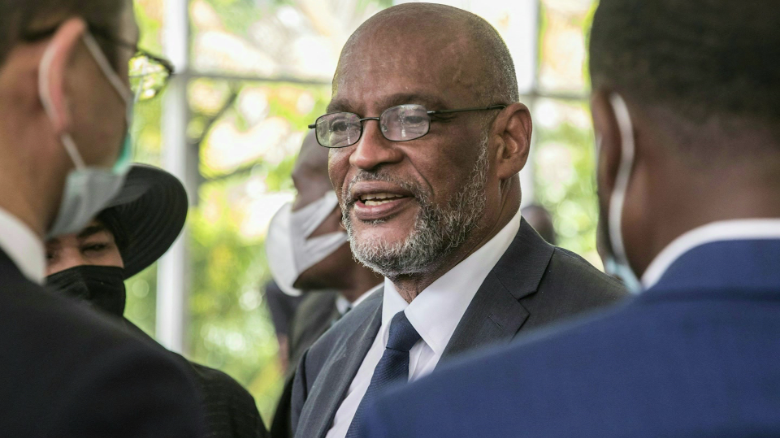
Haiti prosecutor seeks charges against Prime Minister in connection with President's assassination
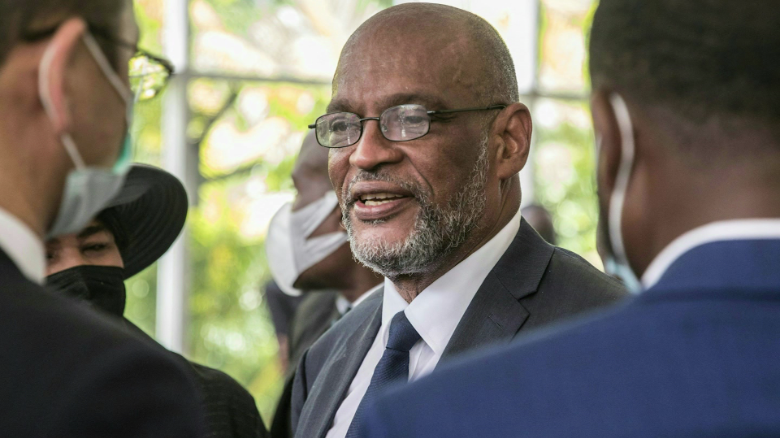
(CNN)Haiti's top prosecutor is seeking charges against Prime Minister Ariel Henry in connection with the assassination of the late President Jovenel Moise. He has also barred the Prime Minister from leaving the country.Port-au-Prince's chief prosecutor, Bed-Ford Claude, previously invited Henry to testify about the case, citing evidence that a key suspect in the assassination called him in the hours after the murder. Henry was due to testify on Tuesday morning.That suspect, former Haitian Justice Ministry official Joseph Felix Badio, is believed to be on the run. CNN has not been able to reach him for comment.Claude told CNN that he is discussing possible charges against Henry with the judge.
The late President Moise was brutally killed during an attack on his private residence on July 7. The investigation into his killing is ongoing and has turned up dozens of suspects, including US and Colombian citizens.
Moise's death prompted a weeks-long standoff over succession in the country's leadership between the recently nominated Henry -- a neurologist by training -- and then-acting Prime Minister Claude Joseph, before Henry ultimately took power.
In a series of tweets Saturday, Henry appeared to reference the case, writing, "I want to tell those who still have not understood, that the diversionary tactics to seed confusion and impede justice from doing its work serenely will not stand.""The true culprits, the intellectual authors and those who ordered the odious assassination of President Jovenel Moise will be identified, brought to justice and punished for their crime," he also wrote.The early months of Henry's tenure have been troubled by continuing intrigue over the assassination, deadly gang violence in capital city Port-au-Prince, and a catastrophic August earthquake in the country's south that left more than 2,100 dead and injured more than 12,200.
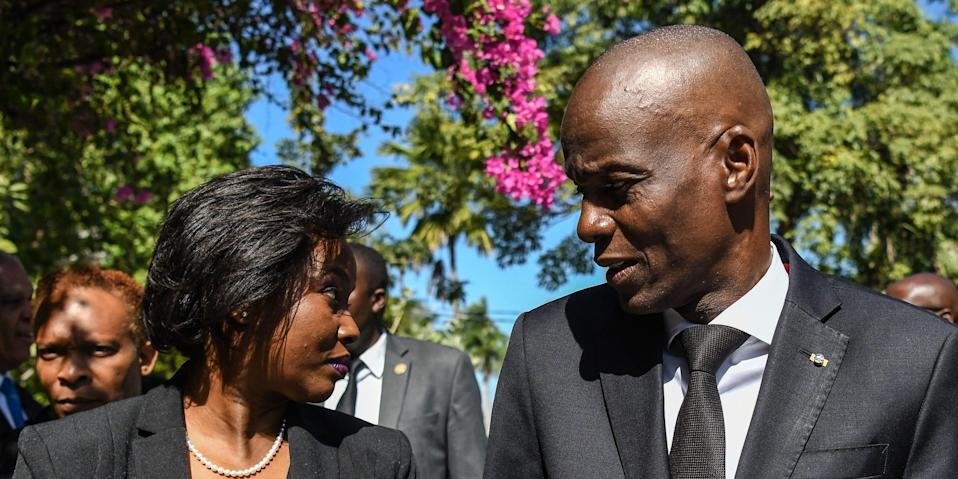
Haiti former first lady calls for help in unraveling husband's murder
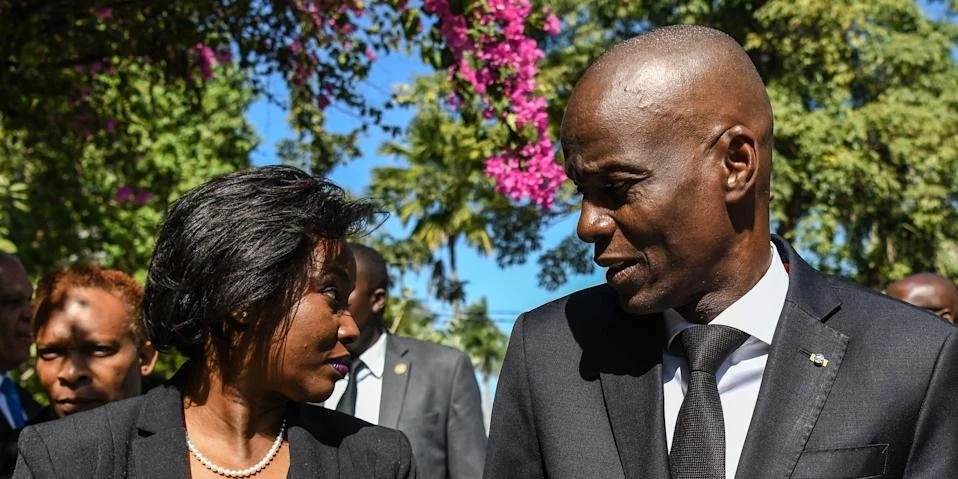
(Reuters) - The widow of Haiti's slain President Jovenel Moise called on the international community to help track down those responsible for gunning down her husband in a late night raid by suspected mercenaries at the couple's home in July.
Moise's assassination https://www.reuters.com/world/americas/haitian-president-shot-dead-home-overnight-pm-2021-07-07 plunged the Caribbean nation, already plagued by hunger and gang violence, further into chaos, and triggered a hunt for the masterminds across the Americas.
Wearing a black dress and sling following the injuries she suffered during the attack, Martine Moise told Reuters in a room flanked by bodyguards on Monday that while Haitian authorities had made some advances, she feared progress had slowed.
"I feel that the process is... stalling a little," she said. "The people that did this are still out there, and I don't know if their name will ever be out. Every country that can help, please help."
Nearly two months after the July 7 assassination of her husband, key aspects of the murder remain shrouded in mystery. Haitian police have arrested more than three dozen suspects, including 18 Colombian mercenaries, an obscure Haitian-American doctor they say aspired to be president, and the head of Moise's security team.
But they have made public little in the way of evidence.
"Those people (they have arrested) did it, but someone gave the orders, someone gave the money," Moise told Reuters.
She said she had spoken twice with the U.S. Federal Bureau of Investigation (FBI) and felt they could "find the people that financed that odious crime."
As security worries have dogged the investigation in Haiti, one judge investigating the case stepped down, citing concerns for his safety.
First lady Moise said Haiti's Prime Minister Ariel Henry, who is also now dealing with the aftermath of an August earthquake that killed more than 2,000 people, must call for elections as soon as possible to ensure stability.
"I think the advice that my husband would give him (is) try to have an election. With the election you can have peace, you can think long term," she said.
Elections initially slated for September have been postponed until November, and some have speculated they could be delayed further following the quake.
"If they want elections to happen, (they) will," said Moise.
Moise confirmed previous comments she had made in interviews on her interest in running for president herself but said that she would take care of her family first.
"I want to run for president. I won't let the vision of the president die with him. With the earthquake too, there's a lot to be done in Haiti," she said.
HAITI RUMOR MILL
Amid the ongoing investigation and arrests, conspiracy theories about the murder in Haiti have swirled for weeks.
Friends of the murdered president have told https://www.reuters.com/world/americas/he-never-stood-chance-fateful-downfall-haitis-president-2021-08-22 Reuters he feared for his life immediately before he was killed.
His wife on Monday said he had not talked to her of a specific plot against him.
"If he knew he would talk about it... but he never did," she said. "Because having Colombians, having soldiers here in Haiti, they are here for something."
She denied social media rumors that Moise had squirreled away millions in cash in his official residence in the upscale suburb of Petion-Ville.
"It is a president. There is some money. But the amount of $48 million that I heard in social media, that can't be true. Where in the room (can you stick) $48 million?"

New judge tapped in Haiti to oversee Moïse slaying case

LES CAYES, Haiti (AP) — A Haitian justice official has appointed a new judge to oversee the investigation into the killing of President Jovenel Moïse, acting more than a week after his predecessor withdrew from the case and as the country struggles with recovering from the devastating magnitude 7.2. earthquake that killed hundreds and injured thousands.
Magistrate Bernard Saint-Vil, dean of the Court of First Instance in Port-au-Prince, confirmed Monday to The Associated Press that he chose judge Garry Orélien to be in charge of the case.
Orélien replaces judge Mathieu Chanlatte, whose resignation from the case was announced Aug. 13. Chanlatte cited personal reasons without giving more information, but he left the post a day after one of his assistants died under unclear circumstances.
Orélien will supervise a case that it doesn't seem close to be solved. Police have arrested more than 40 suspects, but there is no clarity about who was behind the plot to kill Moïse on July 7. Among the detainees are 18 former Colombian soldiers and 20 Haitian police officers.
Also on Monday, Public Security Minister Rockefeller Vincent requested in a letter to the National Police that the Colombians be held in cells away from other detainees to minimize risks, although he didn't elaborate.
The earthquake that struck Haiti's southwestern peninsula July 14 killed more than 2,000 people, according to authorities, and it had distracted national and international attention away from Moïse's assassination. While Haitians work to recover from the disaster and look for the Moïse investigation to advance, the country also is expected to hold a presidential election Nov. 7.
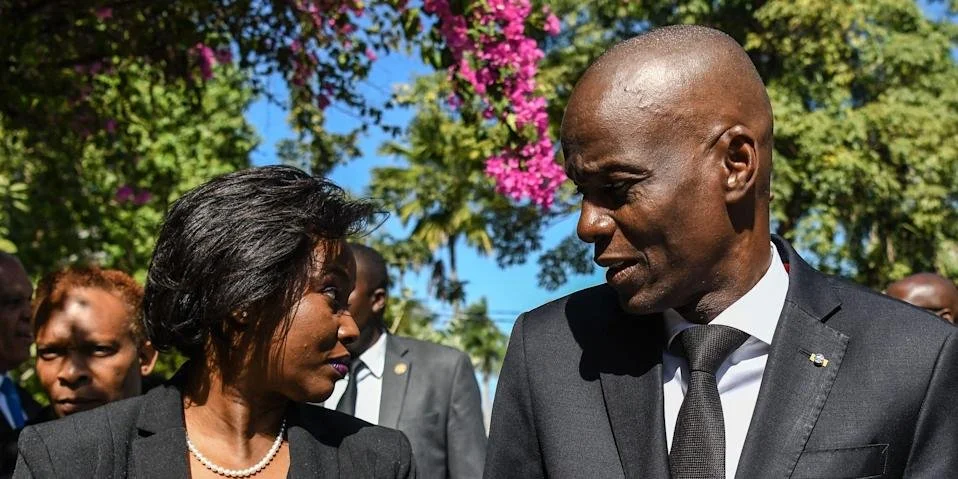
The wife of Haiti's assassinated president said she used her dead husband's tie as a tourniquet after the attack
- Haiti's president was assassinated next to his wife. She said she was later found by a maid.
- Martine Moïse, who was shot, said she asked the maid for one of her husband's ties to use as a tourniquet.
- She questioned where security staff were, and if someone had ordered them to leave.
- See more stories on Insider's business page.
The wife of Haiti's assassinated president said she was found with a gunshot wound by a maid after the attack, and needed to use her dead husband's tie as a tourniquet.
Jovenel Moïse was assassinated in his home on July 7. Martine Moïse was shot in the arm and was left in critical condition.
She told CNN that it was the maid, rather than security staff, that found her in their bedroom after the attack.
She said she asked her maid to bring her one of her husband's ties so she could use it as a tourniquet.
She previously told The New York Times that she had told her children to hide in a bathroom. They survived the attack.
In the CNN interview, Martine Moïse questioned how the attackers were able to reach the couple: "The guards wouldn't leave without an order. Maybe they received an order to leave - this is what I think," she said.
"I've been thinking a lot about how this could have happened."
Haiti has detained several Colombians, Haitians, and Haitian Americans over the attack. But Moïse said authorities need to find who ordered and paid for the attack.
"Someone gave the order, and someone paid the money. Those are the people that we are searching for. I want the United Nations Security Council's help to find those people," she told CNN.
She previously told The Times that she survived the attack because the attackers thought she was dead.
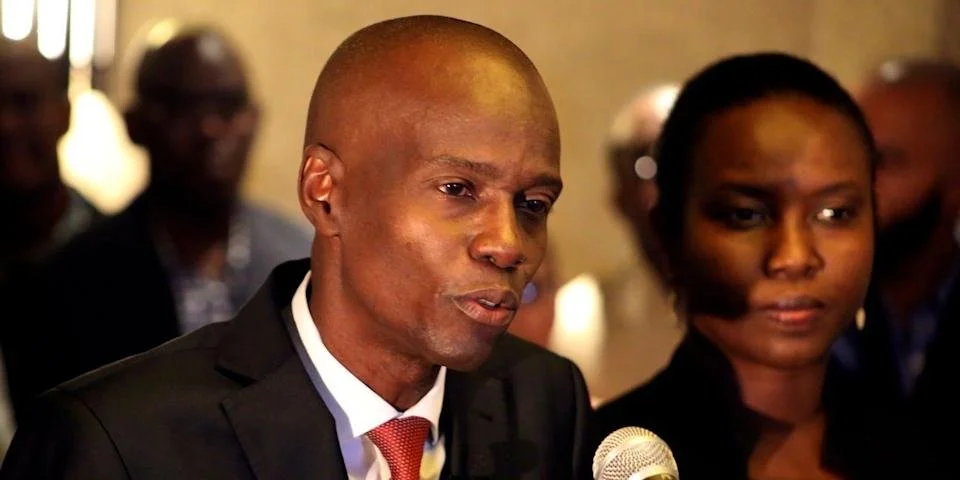
The Haitian president's assassins appeared to identify him by confirming he was 'tall, skinny, and Black' on a phone call before killing him, wife says
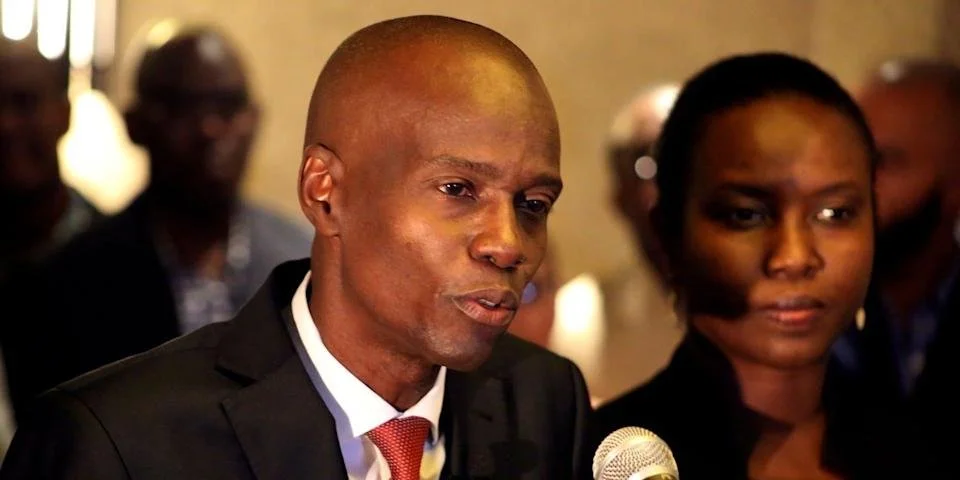
- Haiti's president was assassinated in his bedroom on July 7.
- His wife said the killers made a phone call and said he was "tall, skinny and Black" before shooting him.
- She says she survived because the attackers thought she was dead.
- See more stories on Insider's business page.
The wife of Haiti's assassinated president said his killers appeared to identify her husband by confirming that he was "tall, skinny and Black" on a phone call before they shot him.
Jovenel Moïse was assassinated in his home on July 7.
His wife, Martine Moïse, told CNN that the attackers came into their bedroom and appeared to find something they were looking for. She said they then turned to her and her husband on the floor and made a phone call.
"He was alive at the time. They said he was tall, skinny and Black, and maybe the person on the phone confirmed to the shooter that was him. Then they shot him on the floor."
Haiti has detained several Colombians, Haitians, and Haitian Americans over the attack.
Martine Moïse said she believes someone must have ordered and funded the attack, and that person needs to be found.
She told CNN: "Someone gave the order, and someone paid the money. Those are the people that we are searching for. I want the United Nations Security Council's help to find those people."
She was shot in the arm during the attack, and was left in critical condition.
She told The New York Times that she survived the attack because the attackers thought she was dead.
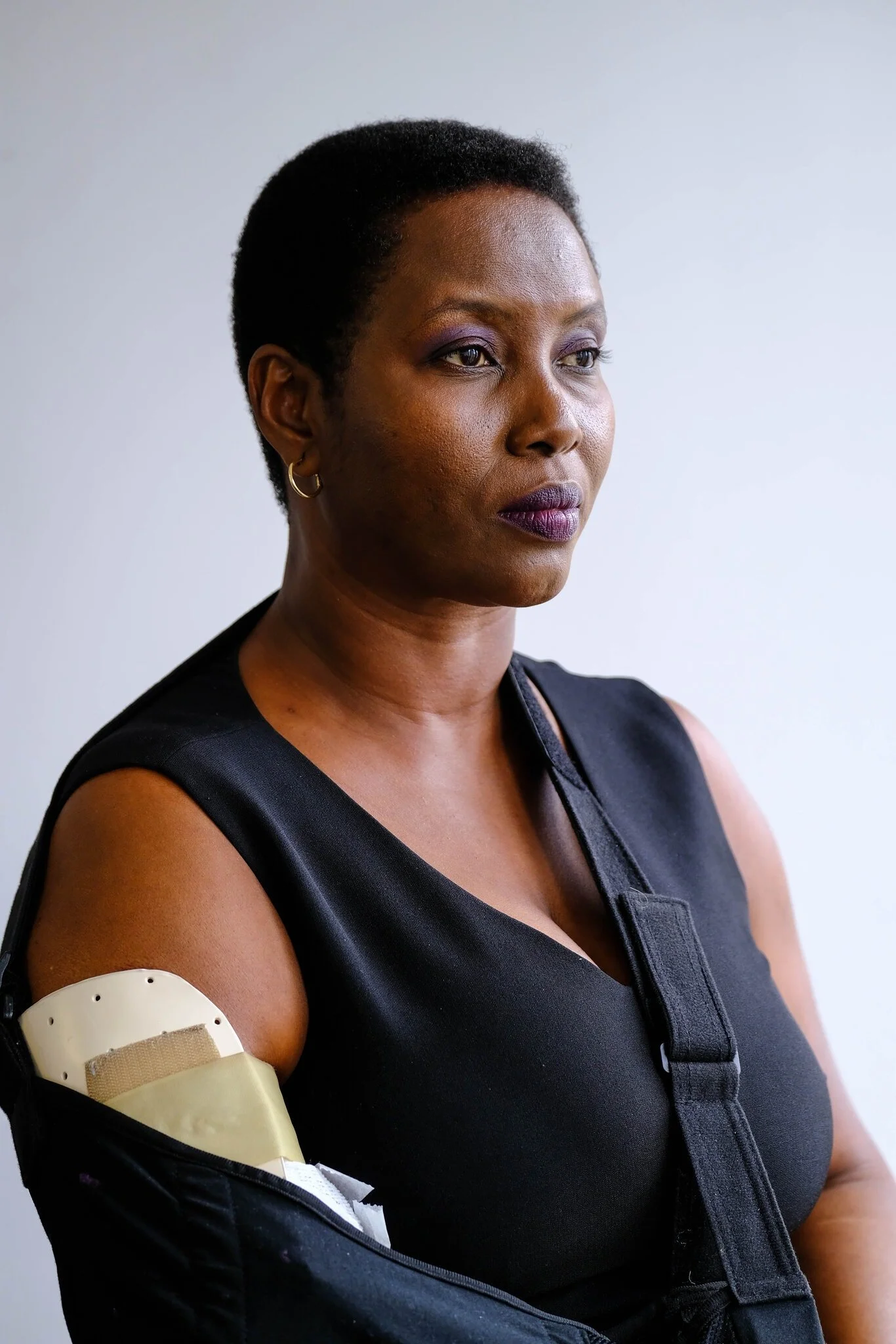
‘They Thought I Was Dead’: Haitian President’s Widow Recounts Assassination
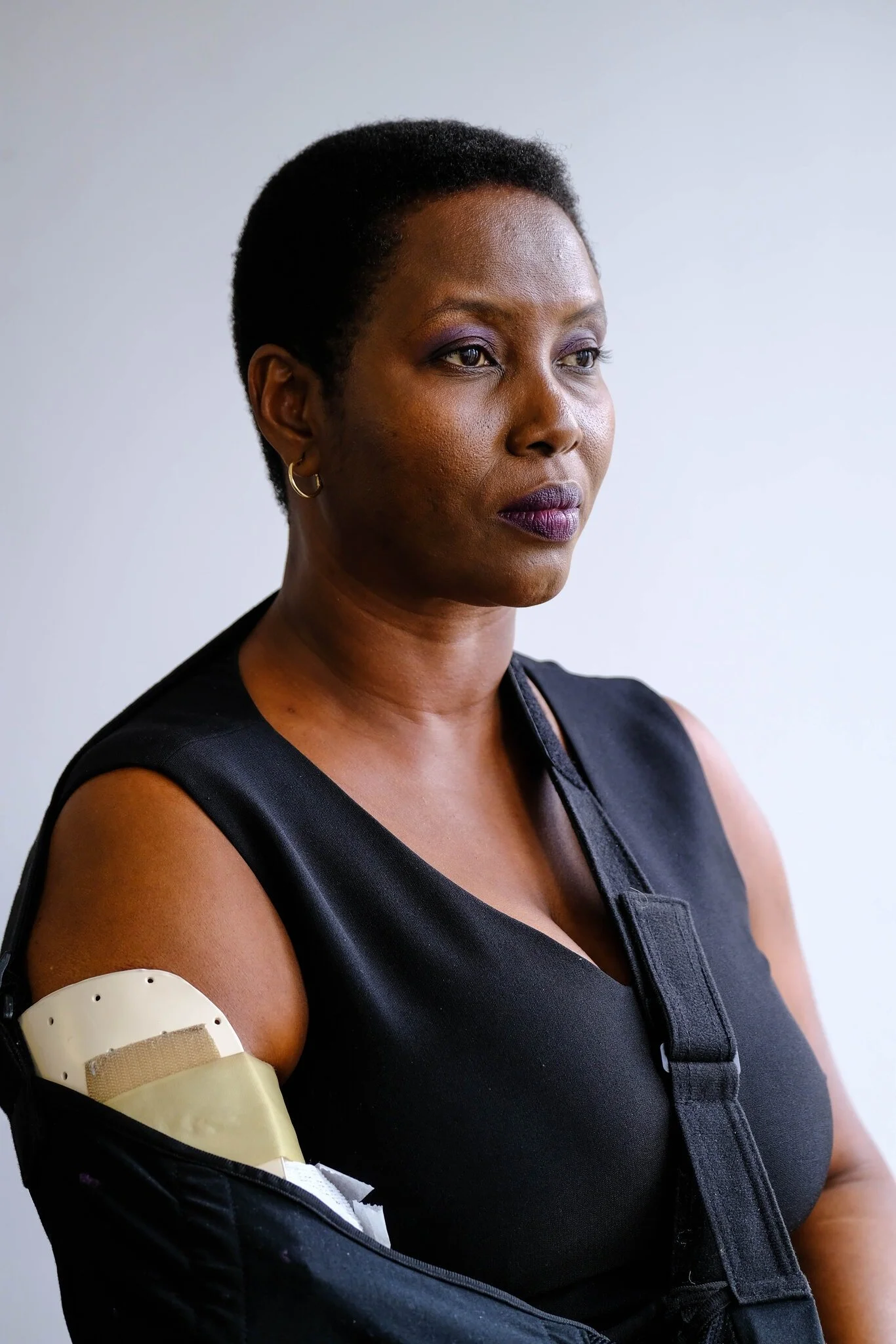
Struck by gunfire, Martine Moïse lay bleeding as the assassins who killed her husband ransacked her room. Now, she says, the F.B.I. must find the mastermind behind the attack.
MIAMI — With her elbow shattered by gunfire and her mouth full of blood, the first lady of Haiti lay on the floor beside her bed, unable to breathe, as the assassins stormed the room.
“The only thing that I saw before they killed him were their boots,” Martine Moïse said of the moment her husband, President Jovenel Moïse of Haiti, was shot dead beside her. “Then I closed my eyes, and I didn’t see anything else.”
She listened as they ransacked the room, searching methodically for something in her husband’s files, she said. “‘That’s not it. That’s not it,’” she recalled them saying in Spanish, over and over. Then finally: “‘That’s it.’”
The killers filed out. One stepped on her feet. Another waved a flashlight in her eyes, apparently to check to see if she was still alive.
“When they left, they thought I was dead,” she said.
In her first interview since the president’s assassination on July 7, Mrs. Moïse, 47, described the searing pain of witnessing her husband, a man with whom she had shared 25 years, being killed in front of her. She did not want to relive the deafening gunfire, the walls and windows trembling, the terrifying certainty that her children would be killed, the horror of seeing her husband’s body, or how she fought to stand up after the killers left. “All that blood,” she said softly.

But she needed to speak, she said, because she did not believe that the investigation into his death had answered the central question tormenting her and countless Haitians: Who ordered and paid for the assassination of her husband?
The Haitian police have detained a wide array of people in connection with the killing, including 18 Colombians and several Haitians and Haitian Americans, and they are still seeking others. The suspects include retired Colombian commandos, a former judge, a security equipment salesman, a mortgage and insurance broker in Florida, and two commanders of the president’s security team. According to the Haitian police, the elaborate plot revolves around a 63-year-old doctor and pastor, Christian Emmanuel Sanon, who officials say conspired to hire the Colombian mercenaries to kill the president and seize political power.
But critics of the government’s explanation say that none of the people named in the investigation had the means to finance the plot on their own. And Mrs. Moïse, like many Haitians, believes there must have been a mastermind behind them, giving the orders and supplying the money.
She wants to know what happened to the 30 to 50 men who were usually posted at her house whenever her husband was at home. None of his guards were killed or even wounded, she said. “I don’t understand how nobody was shot,” she said.

At the time of his death, Mr. Moïse, 53, had been in the throes of a political crisis. Protesters accused him of overstaying his term, of controlling local gangs and of ruling by decree as the nation’s institutions were being hollowed out.
Mr. Moïse was also locked in battle with some of the nation’s wealthy oligarchs, including the family that controlled the nation’s electrical grid. While many people described the president as an autocratic leader, Mrs. Moïse said her fellow citizens should remember him as a man who stood up to the rich and powerful.
And now she wants to know if one of them had him killed.
“Only the oligarchs and the system could kill him,” she said.
Dressed in black, with her arm — now limp and perhaps useless forever, she said — wrapped in a sling and bandages, Mrs. Moïse offered an interview in South Florida on the agreement that The New York Times not reveal her whereabouts. Flanked by her children, security guards, Haitian diplomats and other advisers, she barely spoke above a whisper.
She and her husband had been asleep when the sounds of gunfire jolted them to their feet, she recalled. Mrs. Moïse said she ran to wake her two children, both in their early 20s, and urged them to hide in a bathroom, the only room without windows. They huddled there with their dog.
Her husband grabbed his telephone and called for help. “I asked, ‘Honey, who did you phone?’” she said.

“He said, ‘I found Dimitri Hérard; I found Jean Laguel Civil,’” she said, reciting the names of two top officials in charge of presidential security. “And they told me that they are coming.”
But the assassins entered the house swiftly, seemingly unencumbered, she said. Mr. Moïse told his wife to lie down on the floor so she would not get hurt.
“‘That’s where I think you will be safe,’” she recalled him saying.
It was the last thing he told her.
A burst of gunfire came through the room, she said, hitting her first. Struck in the hand and the elbow, she lay still on the floor, convinced that she, and everyone else in her family, had been killed.
None of the assassins spoke Creole or French, she said. The men spoke only Spanish, and communicated with someone on the phone as they searched the room. They seemed to find what they wanted on a shelf where her husband kept his files.
“They were looking for something in the room, and they found it,” Mrs. Moïse said.
She said she did not know what it was.
“At this moment, I felt that I was suffocating because there was blood in my mouth and I couldn’t breathe,” she said. “In my mind, everybody was dead, because if the president could die, everybody else could have died too.”

The men her husband had called for help, she said — the officials entrusted with his security — are now in Haitian custody.
The Assassination of Haiti’s President
- An assassination strikes a troubled nation: The killing of President Jovenel Moïse on July 7 has rocked Haiti, stoking fear and confusion about the future. While there is much we do know about this event, there’s still much we don’t know.
- A figure at the center of the plot: Questions are swirling over the arrest of Dr. Christian Emmanuel Sanon, 63, a doctor with ties to Florida described as playing a central role in the death of the president.
- More suspects: Two Americans are among at least 20 people who have been detained thus far. Several of the people under investigation met in the months before the killing to discuss rebuilding the country once the president was out of power, Haitian police said.
- Years of instability: The assassination of Mr. Moïse comes after years of instability in the country, which has long suffered lawlessness, violence and natural disasters.
And while she expressed satisfaction that a number of the accused conspirators have been detained, she is by no means satisfied. Mrs. Moïse wants international law enforcement agencies like the F.B.I., which searched homes in Florida this week as part of the investigation, to track the money that financed the killing. The Colombian mercenaries who were arrested, she said, did not come to Haiti to “play hide and seek,” and she wants to know who paid for it all.
In a statement on Friday, the F.B.I. said it “remains committed to working alongside our international partners to administer justice.”
Mrs. Moïse expected the money to trace back to wealthy oligarchs in Haiti, whose livelihoods were disrupted by her husband’s attacks on their lucrative contracts, she said.
Mrs. Moïse cited a powerful Haitian businessman who has wanted to run for president, Reginald Boulos, as someone who had something to gain from her husband’s death, though she stopped short of accusing him of ordering the assassination.
Mr. Boulos and his businesses have been at the center of a barrage of legal cases brought by the Haitian government, which is investigating allegations of a preferential loan obtained from the state pension fund. Mr. Boulos’ bank accounts were frozen before Mr. Moïse’s death, and they were released to him immediately after he died, Mrs. Moïse said.

In an interview, Mr. Boulos said that only his personal accounts, with less than $30,000, had been blocked, and he stressed that a judge had ordered the release of the money this week, after he took the Haitian government to court. He insisted that, far from being involved in the killing, his political career was actually better off with Mr. Moïse alive — because denouncing the president was such a pivotal part of Mr. Boulos’s platform.
“I had absolutely, absolutely, absolutely nothing to do with his murder, even in dreams,” Mr. Boulos said. “I support a strong, independent international investigation to find who came up with the idea, who financed it and who executed it.”
Mrs. Moïse said she wants the killers to know she is not scared of them.
“I would like people who did this to be caught, otherwise they will kill every single president who takes power,” she said. “They did it once. They will do it again.”
She said she is seriously considering a run for the presidency, once she undergoes more surgeries on her wounded arm. She has already had two surgeries, and doctors now plan to implant nerves from her feet in her arm, she said. She may never regain use of her right arm, she said, and can move only two fingers.
“President Jovenel had a vision,” she said, “and we Haitians are not going to let that die.”

Haiti gang leader rallies hundreds to honor slain president
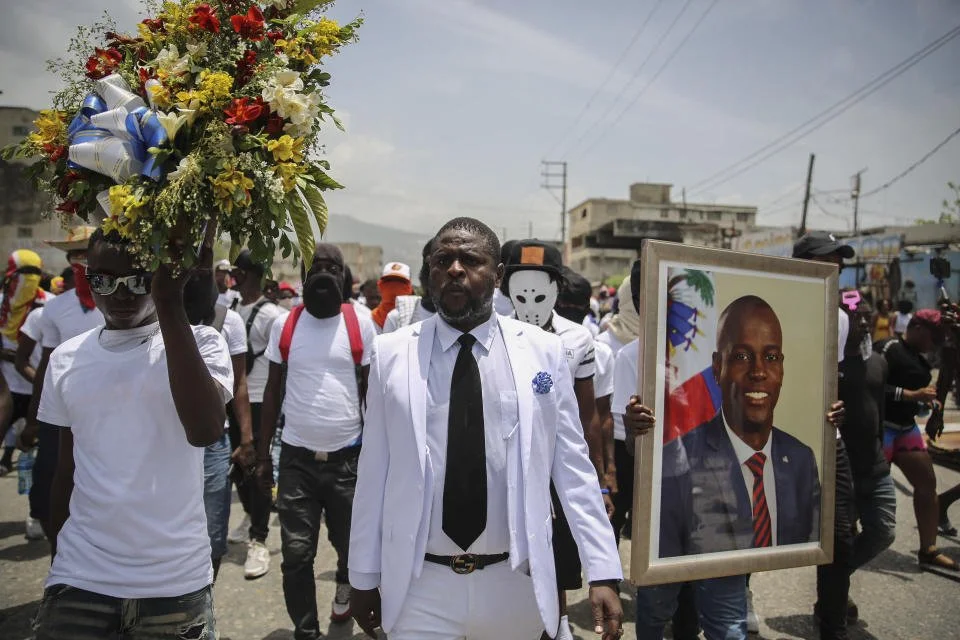
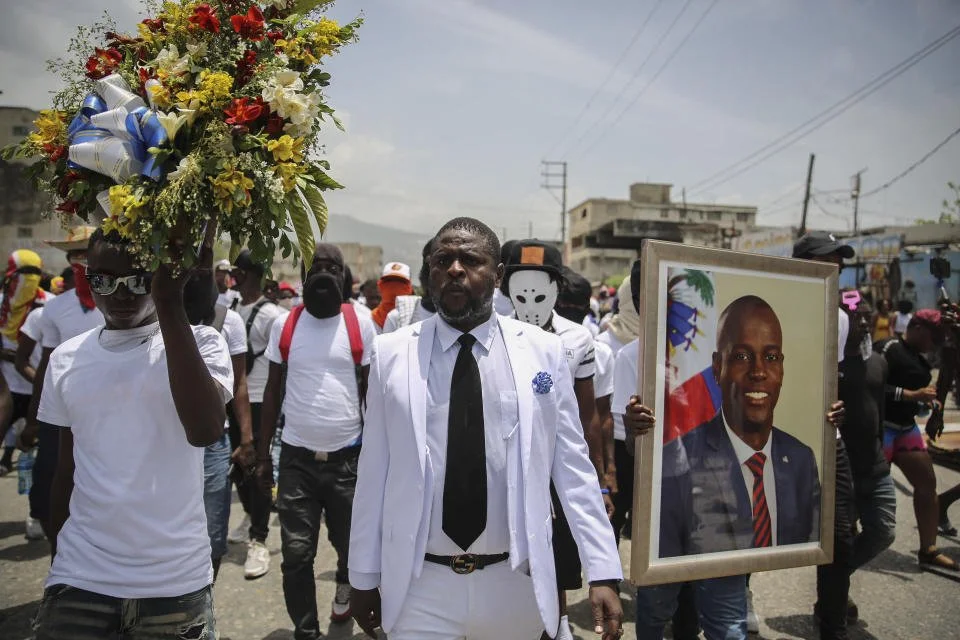
PORT-AU-PRINCE, Haiti (AP) — More than 1,000 demonstrators gathered around one of Haiti's most notorious gang leaders on Monday to commemorate slain President Jovenel Moïse.
The crowd was mostly dressed in white as they cheered on Jimmy Cherizier, a former police officer who now leads “G9”, a federation of nine gangs whom officials have blamed for a spike in violence and kidnappings in recent months.
“Everyone needs to wait on my order before we respond to the killing of Jovenel Moïse,” said Cherizier, who goes by the name of “Barbecue" and whom police say is behind several recent massacres that targeted civilians living in communities run by other gangs.
He was wearing a white suit and black tie as he spoke to the crowd at the seaside slum of La Saline in the capital of Port-au-Prince. A nearby truck played music as Cherizier knelt down before a large portrait of Moïse and began to light candles.
“No justice, no peace!” he said.
Earlier, the crowd sang as they made a circle around a bonfire and threw salt into it as part of a ceremony to honor Moïse. Many had their faces covered so as not to be identified.
Moïse was shot several times during a July 7 attack at his private home in which his wife was seriously injured. At least 26 people have been arrested, including 18 former Colombian soldiers. Police are still looking for various suspects, including a former rebel leader and an ex-Haitian senator. On Monday, they identified another suspect: Haiti Superior Court Judge Windelle Coq Thelot.
Haitian president's funeral takes place amid violent protests
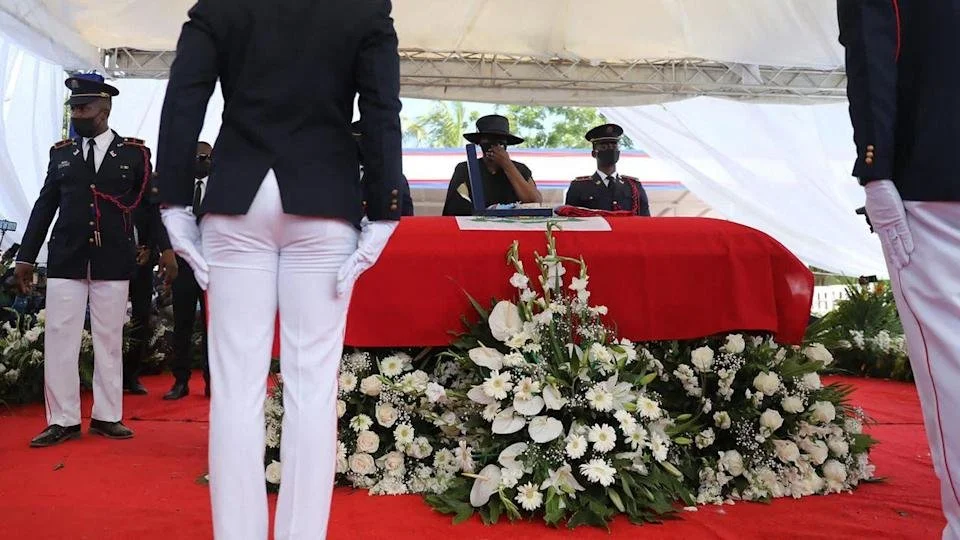
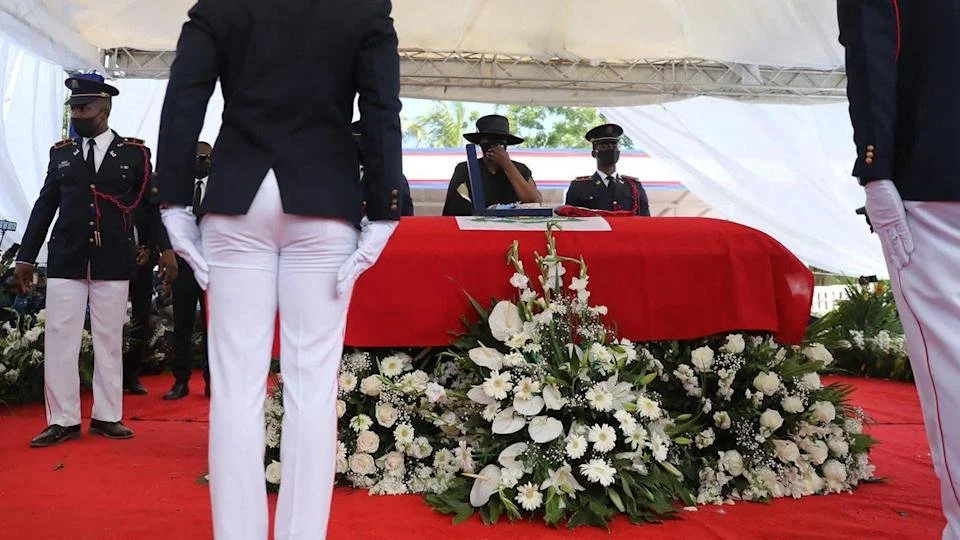
The private funeral for assassinated Haitian President Jovenel Moïse took place on Friday as protests continue to erupt in the country, AP reports.
State of play: At the start of the ceremony, several Moïse supporters stood outside, the residence, shouting, "Justice for Jovenel!" and "Justice! Justice!" as politicians arrived. When León Charles, Haiti's national police chief, arrived, people surrounded him, calling him an "assassin," per AP.
- Protesters clashed with police outside the event, and shots were fired into the air, U.S. officials told AP. There were no immediate reports of injuries and funeral guests were not put in danger, Reuters notes.
- U.S. Ambassador to the United Nations, Linda Thomas-Greenfield, was in attendance, but departed less than a half hour into the funeral, per the New York Times.
- "[T]he presidential delegation is safe and accounted for in light of the reported shootings outside of the funeral," White House press secretary Jen Psaki said at a press briefing on Friday.
- "They’re on their way back to the United States, we are deeply concerned about unrest in Haiti, and this critical moment, Haiti’s leaders must come together to turn a united path that reflects the will of the Haitian people."
- "We remain committed to supporting the people of Haiti in this challenging time."
The big picture: The funeral comes two weeks after Moïse's assassination and the investigation into what happened remains ongoing. Some protesters "were angry that the president would be buried before the investigation into his assassination was completed," the Times writes.
- Several suspects have been arrested in connection to the killing.
- Haiti's Ambassador to the U.S. Bocchit Edmond told CNN earlier this month that "there is no doubt" the assassins had inside help.
What they're saying: "They’re watching us, waiting for us to be afraid," said Martine Moïse, wife of the late president.
- "We don’t want vengeance or violence. We’re not going to be scared."
Hundreds greet Aristide on return to troubled Haiti
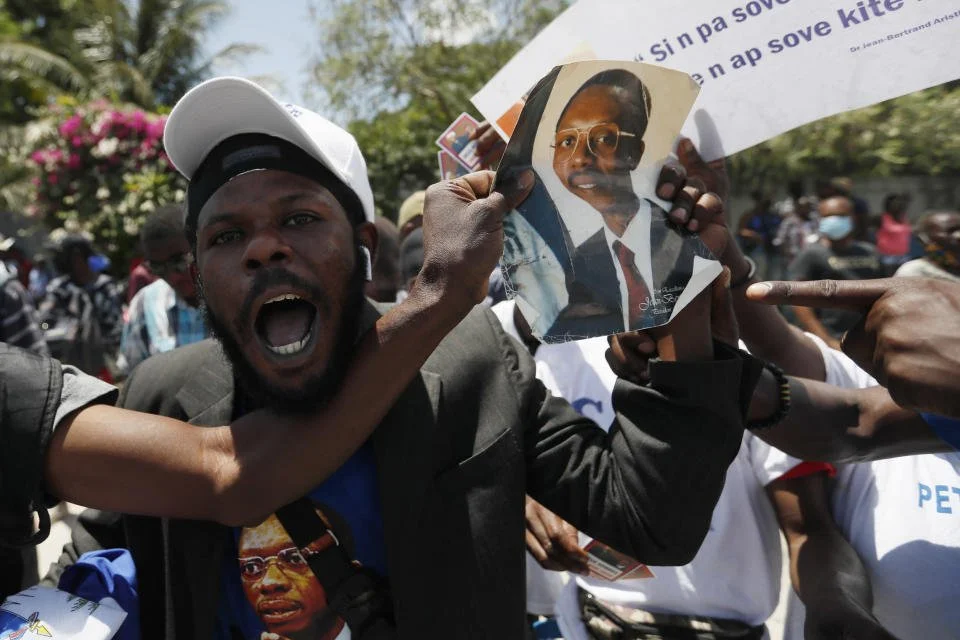
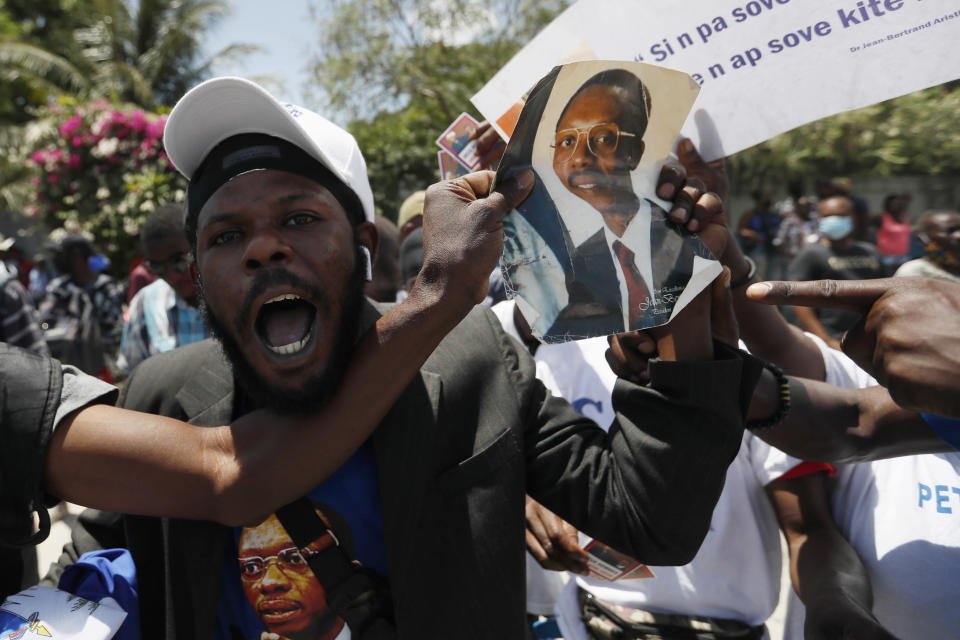
PORT-AU-PRINCE, Haiti (AP) — Former President Jean-Bertrand Aristide returned to Haiti on Friday after a nearly a month in Cuba, thrilling hundreds of supporters who gathered at the airport at a time of tensions over the recent assassination of the country's leader.
Aristide, a charismatic yet divisive figure in Haiti who was receiving unspecified medical treatment in Cuba, arrives back in a country simmering with tension over the July 7 assassination of President Jovenel Moïse as new details about the investigation emerged.
Colombian Police Chief Gen. Jorge Luis Vargas on Friday accused a former Haitian government official of ordering ex-Colombian soldiers to kill Moïse. He said Joseph Felix Badio told Colombians Duberney Capador and Germán Rivera that “what they have to do is kill the president of Haiti.”
Vargas said Badio gave that order roughly three days before the assassination during a meeting in Haiti with the two Colombians, who had been in the country since May 10.
Capador was killed in a shootout with Haitian police hours after Moïse was slain. Rivera remains detained in Haiti while police are still searching for Badio, who previously worked for Haiti’s Justice Ministry and then the government’s anti-corruption unit until he was fired in May.
More than 20 suspects accused of direct involvement in the slaying have been arrested, the majority of them former Colombian soldiers. At least three other suspects were killed, and police have said they are still looking for at least seven others.
Colombia’s government has said only a small group of Colombian soldiers knew the true nature of the operation and that the others were duped.
Also on Friday, Police Chief Léon Charles said 24 police officers were standing guard when the president's house was attacked. He said they have been interrogated and that a fifth high-ranking police official has been placed in isolated detention with four others, although none have been named as suspects.
Interim Prime Minister Claude Joseph said the government will continue to bring those responsible to justice.
“We will continue to pose questions,” he said.
Tickets for most of the former soldiers, at least, were purchased through a Florida-based company, Worldwide Capital Lending Group, Vargas said Friday.
Officials earlier said they had been bought by another Florida company, CTU Security, which allegedly recruited the men.
Worldwide issued a statement Thursday saying it helped provide a loan to CTU, but said it was meant to help finance infrastructure projects sought by Christian Emmanuel Sanon, a Haitian physician and pastor who has been arrested in the plot.
“At no time during any meeting or conversation with Dr. Sanon or with any of his representatives was there any mention, discussion or suggestion of an assassination plot against President Moïse or the intention to use force to bring about a change of leadership in Haiti,” the company said.
Meanwhile, throngs of Aristide supporters cheered when they saw the former president arrive. They had arrived a couple of hours before the plane landed, holding pictures of the former priest, some saying, “The king is back!”
Aristide was taken home in an ambulance that made its way through the crowd. Some touched the vehicle’s windows before being pushed away by police. Some supporters lingered outside after the ambulance entered Aristide’s home, but the former leader did not come out and speak.
Joel Edouard “Pacha” Vorbe, an executive committee member of Aristide’s Fanmi Lavalas party, told The Associated Press that Aristide “is completely recovered,” although he didn't have details about his condition. Neither Aristide nor the government have described the health issue.
Aristide’s return adds a potentially volatile element to an already tense situation in a country facing a power vacuum. Aristide has long been one of Haiti’s most polarizing politicians and is still popular with many.
Aristide became a global figure of resistance when, as a slum priest known for fiery oratory, he led a movement that ousted the hated dictator Jean-Claude “Baby Doc” Duvalier in 1986.
He was elected president in 1990, forced out in a military coup a year later and restored to power by the U.S. military in 1994 to serve out the remainder of his term. As a champion of the poor and advocate of leftist “liberation theology,” he was deeply hated by members of the elite.
Reelected in 2000, he was ousted four years later in a rebellion led by opponents with ties to the elite and the old Duvalierist regime. Aristide spent seven years in exile in South Africa before returning in 2011. He has largely kept a low profile, except when campaigning for his party's unsuccessful presidential candidate in 2016.
Joseph is currently governing Haiti with the backing of police and military, although he faces growing challenges to his power.
While Haiti's government has asked for military help, U.S. President Joe Biden said Thursday that sending troops was “not on the agenda." However, he said U.S. Marines would be deployed to boost security at the U.S. Embassy.
Mathias Pierre, Haiti's elections minister, said he believes the door is still open for potential U.S. military assistance, noting that the country is in a “fragile situation” and requires a secure environment to hold elections in upcoming months.
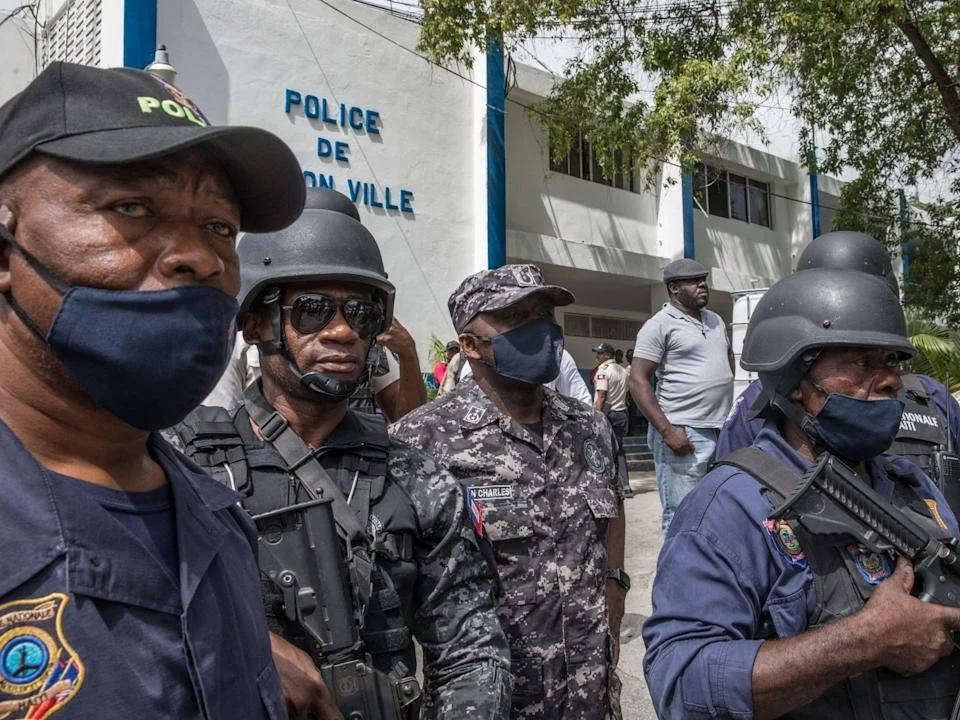
A U.S. citizen is among those arrested for the assassination of Haitian President Jovenel Moïse
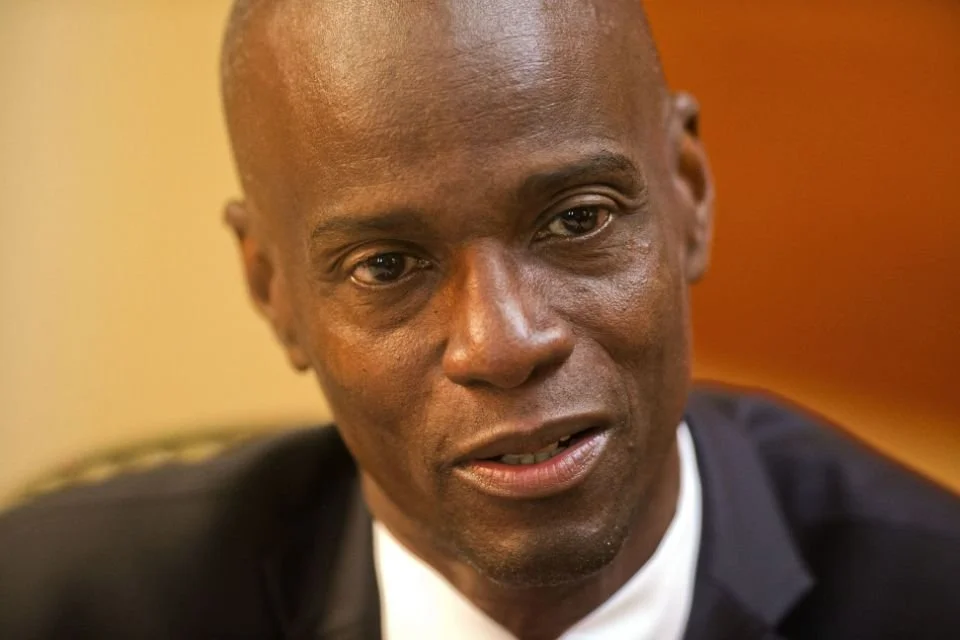
- A US citizen of Haitian descent was reportedly among those arrested in connection with the assassination of Haitian President Jovenel Moïse.
- The Haitian-American was identified as James Solages by the Associated Press and The Washington Post.
- Moïse was assassinated by a group of armed assailants who burst into his home at around 1 a.m. Wednesday.
A US citizen of Haitian descent has reportedly been arrested in connection with the assassination of Haitian President Jovenel Moïse.
The Haitian-American, identified as James Solages, is among the six people who have been nabbed for the early Wednesday killing of Moïse at his home, The Washington Post and the Associated Press reported Thursday.
The AP and Washington Post cited Mathias Pierre, Haiti's minister of elections and inter-party relations.
Pierre told The Washington Post that at least one other person who was apprehended is also believed to be a Haitian-American.
Moïse, 53, was assassinated by a group of armed assailants who burst into his home at around 1 a.m. Wednesday.
Haitian first lady Martine Moïse was also critically injured in the attack. She was later flown to Miami, Florida for treatment for her gunshot wounds.

Léon Charles, the director of Haiti's National Police told reporters Thursday that a total of six suspects have been busted in connection to fatal ambush.
Authorities have said that four other suspects believed to be involved in the assassination were killed in a gun battle with police.
Haitian authorities were still looking for more assailants, Charles said Thursday, according to the Associated Press.
"The pursuit of the mercenaries continues," Charles said Wednesday night. "Their fate is fixed: They will fall in the fighting or will be arrested."
Pierre told The Washington Post that the nabbed suspects were being held at a police station in the capital and that an anrgy mob of people had surrounded it.
"The special units are trying to protect the police station, because the population is very mad and is trying to get to them, to burn them," Pierre told the news outlet. "We're trying to avoid that."
The identities of the other suspects were not immediately released.
Haitian Communications Minister Pradel Henriquez has called them "foreigners,"according to The Washington Post.
Official: Haiti President Jovenel Moïse assassinated at home
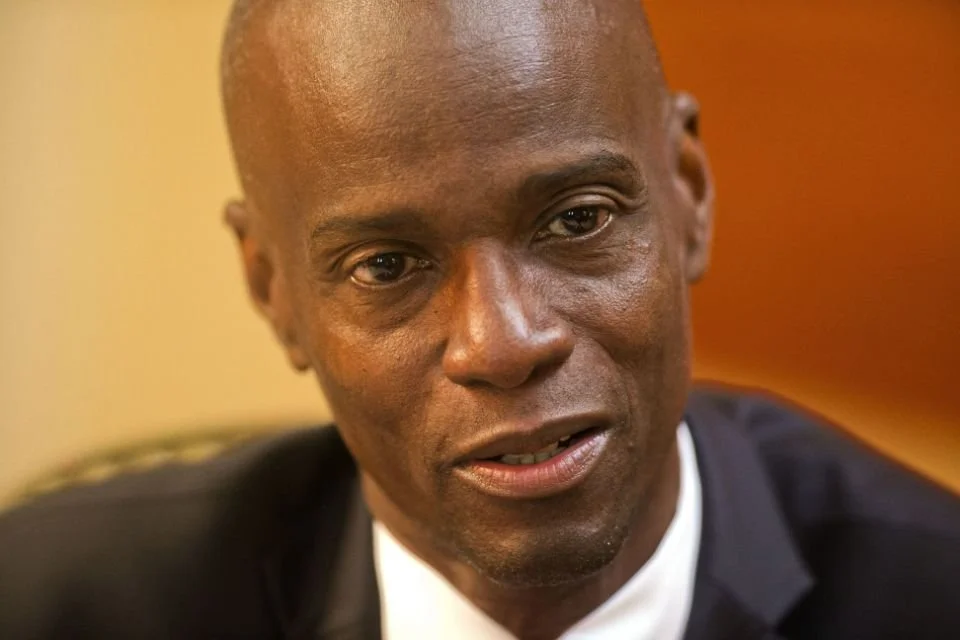
PORT-AU-PRINCE, Haiti (AP) — Gunmen assassinated Haitian President Jovenel Moïse and wounded his wife in their home early Wednesday, inflicting more chaos on the unstable Caribbean country that was already enduring an escalation of gang violence, anti-government protests and a recent surge in coronavirus infections.
Claude Joseph, the interim prime minister, confirmed the killing and said the police and military were in control of security in Haiti, where a history of dictatorship and political upheaval have long stymied the consolidation of democratic rule.
While the streets of the Haitian capital, Port-au-Prince, were quiet Wednesday morning, some people ransacked businesses in one area. The country appeared to be heading for fresh uncertainty ahead of planned general elections later this year. Moïse, 53, had been ruling by decree for more than a year after the country failed to hold elections and the opposition demanded he step down in recent months.
Former President Michel Martelly, whom Moïse succeeded, said he was praying for first lady Martine Moïse, calling the assassination “a hard blow for our country and for Haitian democracy, which is struggling to find its way.”
Joseph said Martine Moïse, 47, was shot and in a hospital. He condemned the president's killing as a “hateful, inhumane and barbaric act.”
“The country’s security situation is under the control of the National Police of Haiti and the Armed Forces of Haiti," Joseph said in a statement from his office. “Democracy and the republic will win.”
In the statement, Joseph said some of the attackers spoke in Spanish but offered no further explanation. He later said in a radio address that they spoke Spanish or English.
A resident who lives near the president’s home said she heard the attack.
“I thought there was an earthquake, there was so much shooting,” said the woman who spoke on condition of anonymity because she fears for her life. “The president had problems with many people, but this is not how we expected him to die. This is something I wouldn’t wish on any Haitian.”
The U.S. Embassy in Haiti said it was restricting U.S. staff to its compounds and that the embassy would be closed Wednesday because of ‘’an ongoing security situation.''
The White House described the attack as “horrific” and “tragic” and said it was still gathering information on what happened. U.S. President Joe Biden will be briefed later Wednesday by his national security team, spokesperson Jen Psaki said during an interview on MSNBC.
“The message to the people of Haiti is this is a tragic tragedy,” she during a previously scheduled interview on CNN. “And we stand ready and stand by them to provide any assistance that’s needed.”
Haiti's economic, political and social woes have deepened recently, with gang violence spiking heavily in Port-au-Prince, inflation spiraling and food and fuel becoming scarcer at times in a country where 60% of the population makes less than $2 a day. These troubles come as Haiti still tries to recover from the devastating 2010 earthquake and Hurricane Matthew that struck in 2016.
Opposition leaders accused Moïse of seeking to increase his power, including by approving a decree that limited the powers of a court that audits government contracts and another that created an intelligence agency that answers only to the president.
In recent months, opposition leaders demanded the he step down, arguing that his term legally ended in February 2021. Moïse and supporters maintained that his term began when he took office in early 2017, following a chaotic election that forced the appointment of a provisional president to serve during a year-long gap.
___
This story has been updated to correct that Moïse ruled by decree for more than a year, not more than two years.
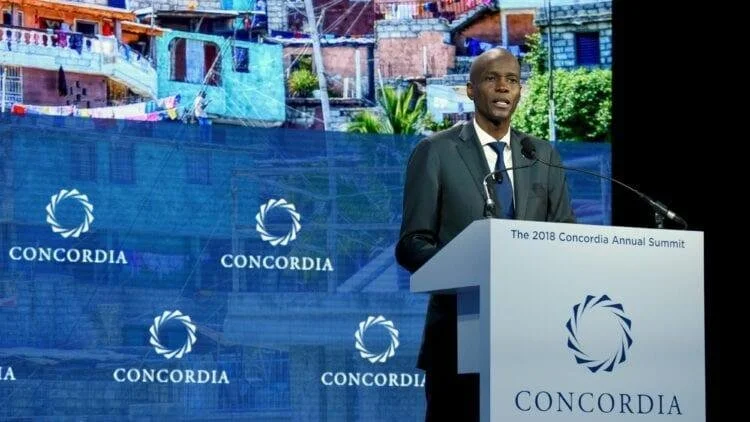
Haiti is on its 6th prime minister under the Moïse administration and many are wondering why?
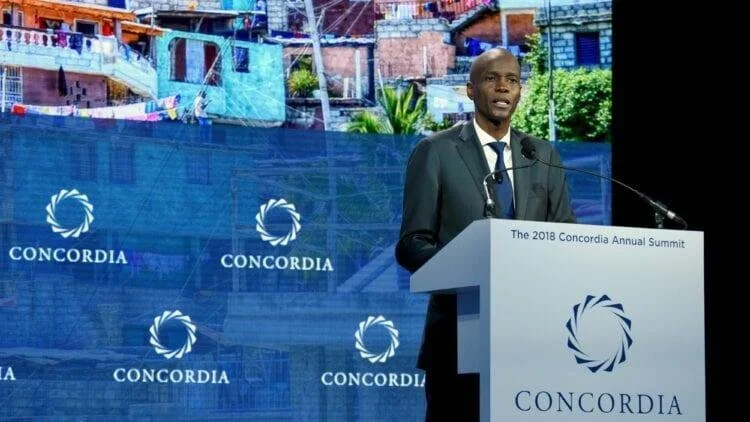
OPINION: To understand the constant turnover of prime minsters, it is paramount to first understand how Haiti’s system of government works
In the midst of the chaos and civil unrest that has plagued Haiti this year— the Haitian people have been dealt yet another blow. Prime Minister Joseph Jouthe resigned from his post under President Jovenel Moïse last month.
Shortly thereafter, Moïse appointed Foreign Minister Claude Joseph as his replacement—making Joseph the sixth prime minister appointed under the Moïse administration. Six prime ministers in the last four years (see below for a complete list of prime ministers under the Moïse administration).
To any outside country or international organization that would explain why Haiti’s government seems to be crumbling underneath the very feet of those in power. To understand why this is occurring, it is paramount to first understand how Haiti’s system of government works.
1. Jack Guy Lafontant. He was the longest serving prime minister under the Moïse administration, serving for a year and a half. He resigned following deadly protests as a result of the government raising gas prices.
2. Jean-Henry Céant. He was ousted while he was out of town on official government business by a vote of no confidence after an accusation of censuring the government largely related to the Petro-Caribe scandal.

3. Jean-Michel Lapin.* The former acting prime minister was appointed by President Moïse but failed to be confirmed by Parliament four times.
4. Fritz William Michel.* Michel was nominated to succeed Lapin but also failed to be confirmed by Parliament.
5. Joseph Jouthe. Jouthe resigned after a year as Haiti’s rates of insecurity, crime and political violence continued to surge. This resignation came on the heels of the recent attacks on an orphanage and the kidnapping of several clergymen and women.
6. Claude Joseph.* Joseph has been appointed as Haiti’s current prime minister. He previously served the Moïse administration as the Minister of Foreign and Religious Affairs.
When a Haitian president is elected, he/she also inherits the power to appoint a prime minister. The National Assembly must ratify this prime minister, and his cabinet. Haiti’s cabinet is led by the prime minister, who is largely considered the head of government. He/she is able to appoint ministers and secretaries of state and is responsible for national defense as well as enforcing the law.
To many, the prime minister may actually be regarded as the most powerful position within the government. Thus the issue lies therein, that the prime minister serves at the pleasure of the president. This, quite frankly, explains why the Moïse administration has gone through six PMs in the last four years.
The theory that President Moïse is insistent on running Haiti via presidential decree starts to seem less and less implausible when understanding the storied history of Haiti’s multiple prime ministers. Typically, when a president appoints a prime minister, the National Assembly must approve of them.

However, as quorum has been breached, the last two prime ministers (Joseph and Jouthe) did not have to go through that government confirmation process. Instead they were simply appointed and approved by Moïse himself—leaving no room for the traditional checks and balances system put in place by the constitution.
Moïse is no fan of the constitution as is—in fact he hopes to single handedly reconstruct it with his June 27 referendum. Although the referendum has not been presented as finished, some of the proposed changes directly address many of the present instabilities.
For example, Moïse’s proposal to eliminate the office of prime minister altogether, instead replacing it with a vice president who is elected alongside the president. Moreover, the president wants to implement the inability to impeach or prosecute a president during his first year in office and also seeks to restrict how often the president can be accused criminally.
Meanwhile much of the country remains skeptical that Haiti will have elections at all. This is because of an issue stemming from the imposition of new voter Identification cards and the notion that it will take anywhere between 10 and 18 months to complete the project of procuring Voter ID cards for all citizens.
These cards are due to be produced by ONI, Office National D’Identification—the office for state archives in Haiti. But as we’ve learned in the United States, with any change in voting requirements there comes the possibility of voter suppression.
Many Haitians have found themselves left with countless questions, with little answers. Will ex-President Michel Martelly run again? What is the timeline for elections in Haiti? Will legislative and presidential elections occur in September? Will municipal and local elections occur in November? Who will replace Ambassador Michele Sison? Yet sadly, most of these questions remain just as ambiguous as President Moïse’s future as president.
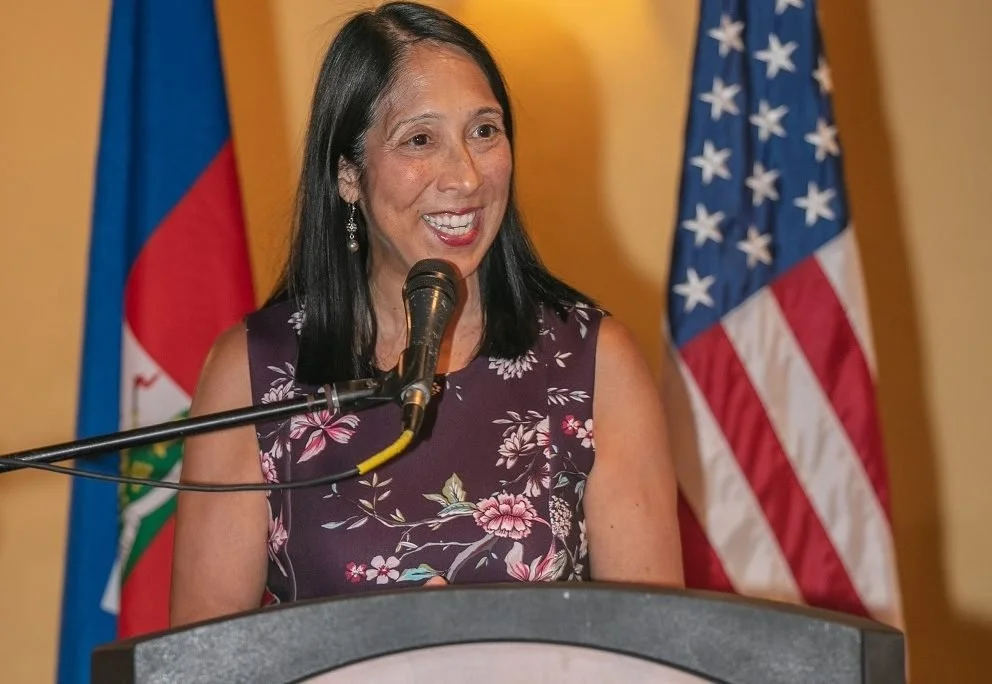
Biden Nominates US Haiti Ambassador to State Department Position
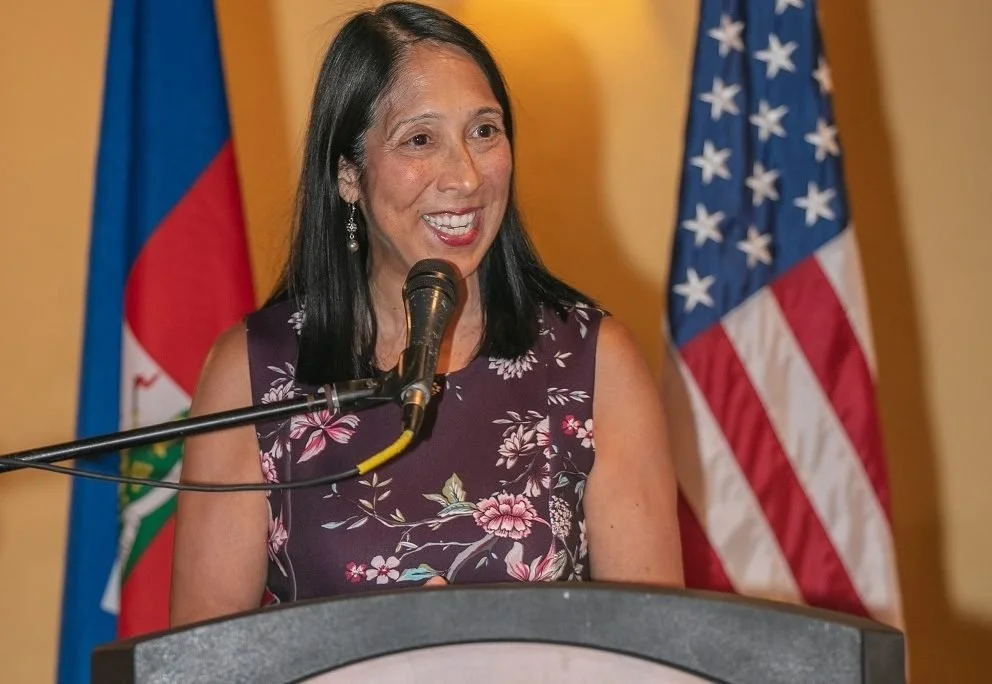
WASHINGTON - U.S. President Joe Biden has nominated U.S. Ambassador to Haiti Michele Sison for the position of assistant secretary of state for international organization affairs.
Sison, a career ambassador, the highest rank in the U.S. Foreign Service, has served in Haiti since 2018. She is a respected diplomat in Port-au-Prince, where she has been outspoken about democratic governance, the rule of law and respect for human rights.
"We are very concerned about any action that risks undermining democratic institutions in Haiti," Sison told VOA during an exclusive interview in February.
Before arriving in Port-au-Prince, she served as U.S. deputy representative to the United Nations with the rank of ambassador from 2014 to 2018.
She is experienced in global coalition building, transnational threats, peacekeeping, international development and humanitarian relief.
Among Sison's prior posts are U.S. ambassador to Sri Lanka, the Maldives, Lebanon and the United Arab Emirates; assistant chief of mission in Iraq; and deputy chief of mission in Pakistan.
At the State Department, she held the position of principal deputy assistant secretary of state for South Asian affairs.
Sison has been recognized with multiple awards, notably the Distinguished Service Award and the Presidential Meritorious Rank Award.
The U.S. Senate must confirm her nomination before it becomes effective.
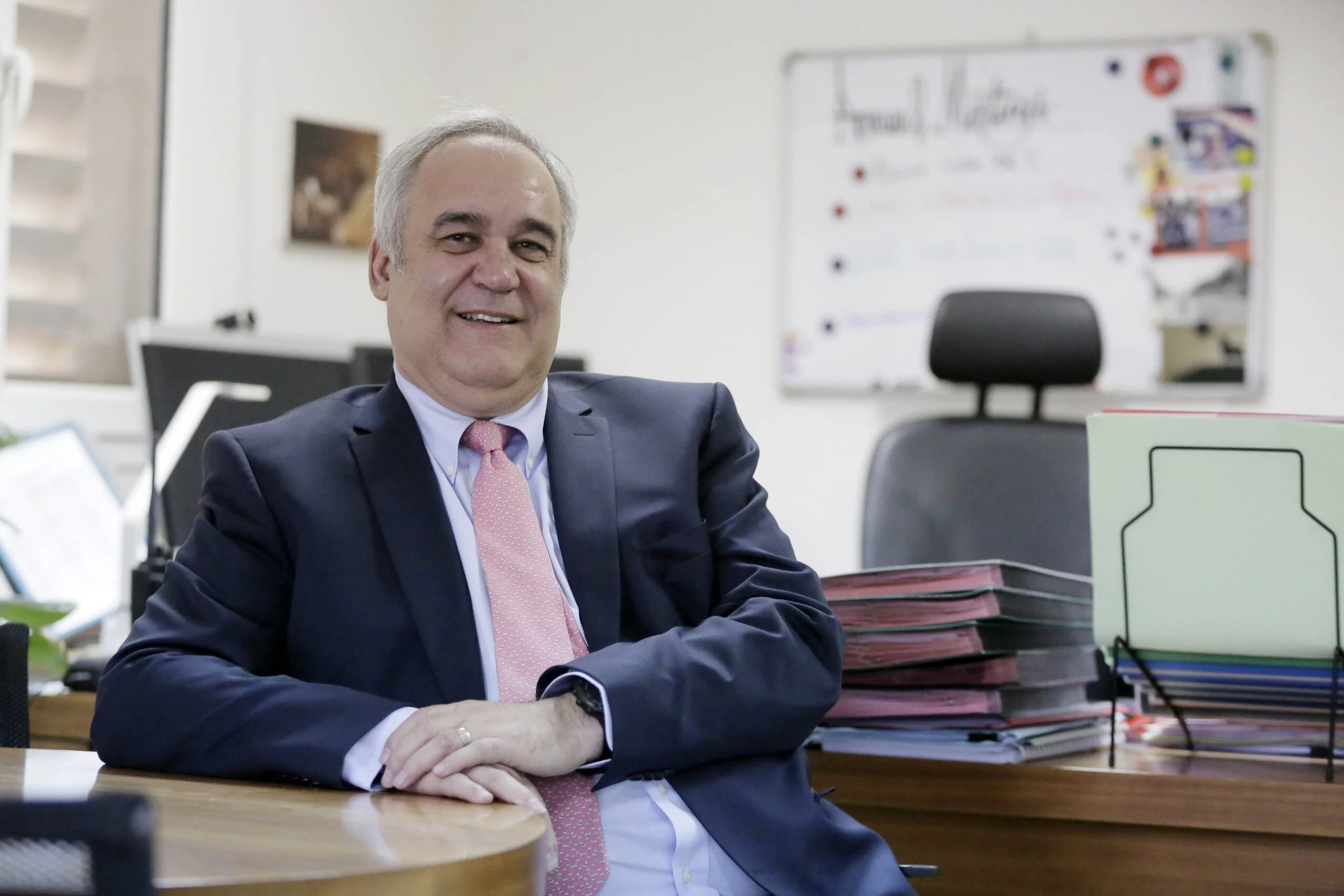
Laurent Msellati Appointed Country Manager for Haiti
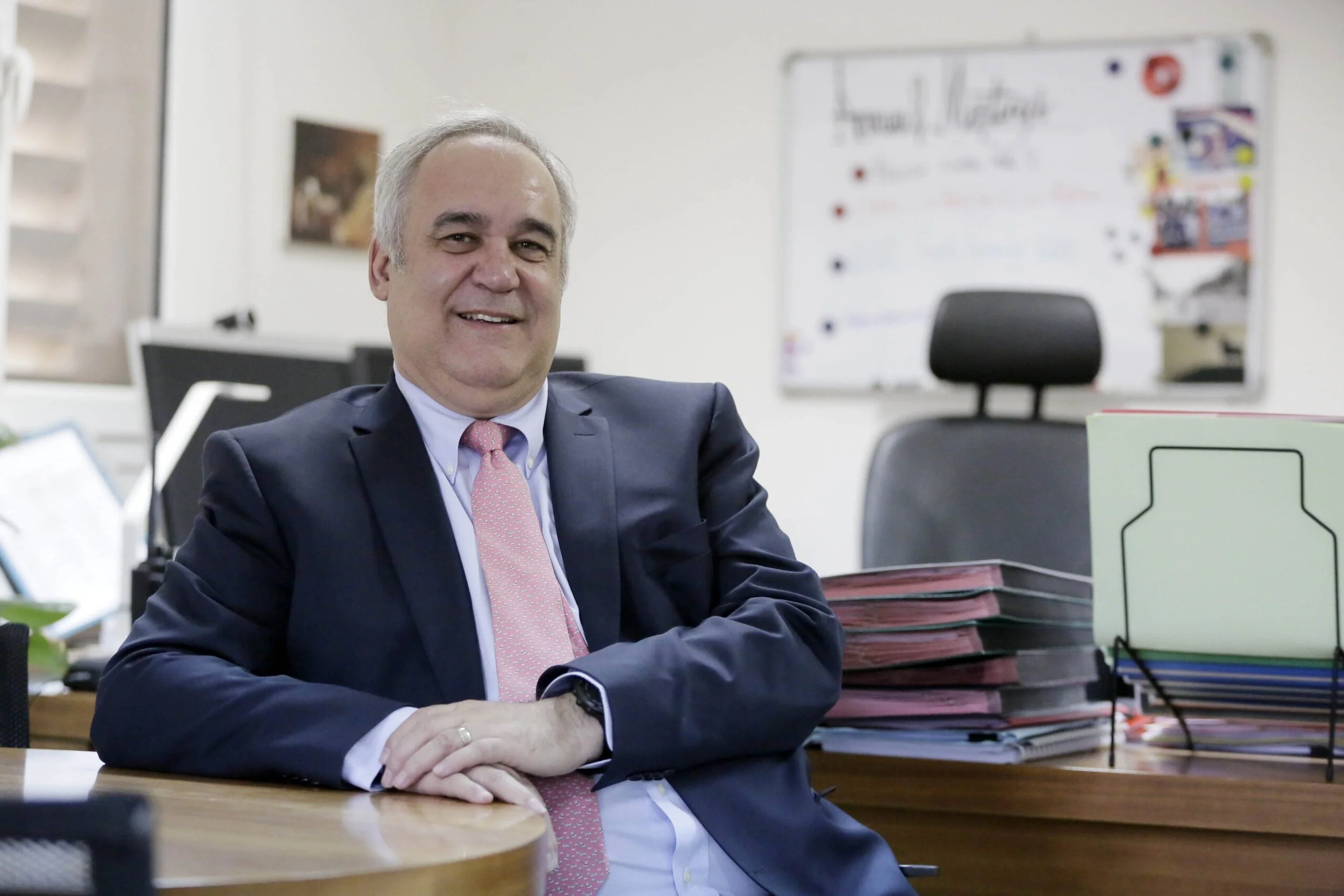
PORT AU PRINCE, April 1, 2021 – Laurent Msellati, a French national, has been appointed as the World Bank’s new Country Manager for Haiti, effective April 1, 2021. He will be based in Port au Prince.
In this new role, Mr. Msellati’s top priorities will be to lead the World Bank’s engagement with the Government of Haiti, work closely with key development partners and stakeholders, manage the country program and team, and support staff in the Haiti Country Office.
“Haiti has experienced several challenging years, and the social and economic impacts of the COVID-19 pandemic have been severe. I look forward to continuing our work to support the Haitian people, focused on inclusive growth, and building resilience. I will work closely with stakeholders across Haitian society to support the country’s development priorities, and provide support for the most vulnerable,” said Laurent Msellati.
Since joining the World Bank in 1991, Mr. Msellati has held several positions in the Africa, Middle East and North Africa, East Asia and Pacific, and Latin America and the Caribbean regions. He recently served as World Bank Country Manager for Mauritania and has also been Practice Manager of the Agriculture Global Practice in Latin America and the Caribbean region. Mr. Msellati holds a Master’s in Business Administration in Finance and Economics from the Università Commerciale Luigi Bocconi (Italy), and a Doctorate Degree in Veterinary Medicine from the Ecole Nationale Vétérinaire de Nantes (France).
Mr. Msellati will lead the implementation of the World Bank’s program in Haiti, which includes an active portfolio of 20 projects worth about US$915 million, financed by the International Development Association and trust funds. Project areas include transport, energy, agriculture and food security, health, education, water supply and sanitation, finance, governance, macroeconomics, social protection and jobs, and digital development.
Haiti’s Doctors, Lawyers and Handicapped Join Pro-Democracy, Anti-Kidnapping Protest
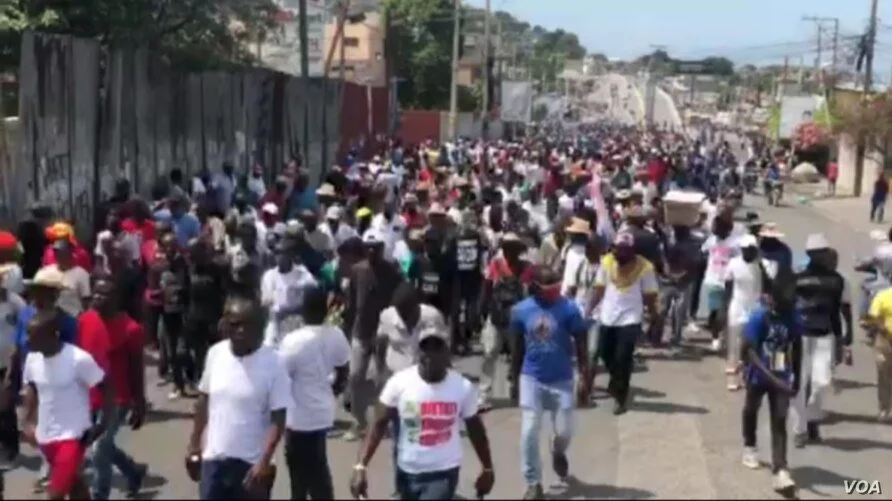
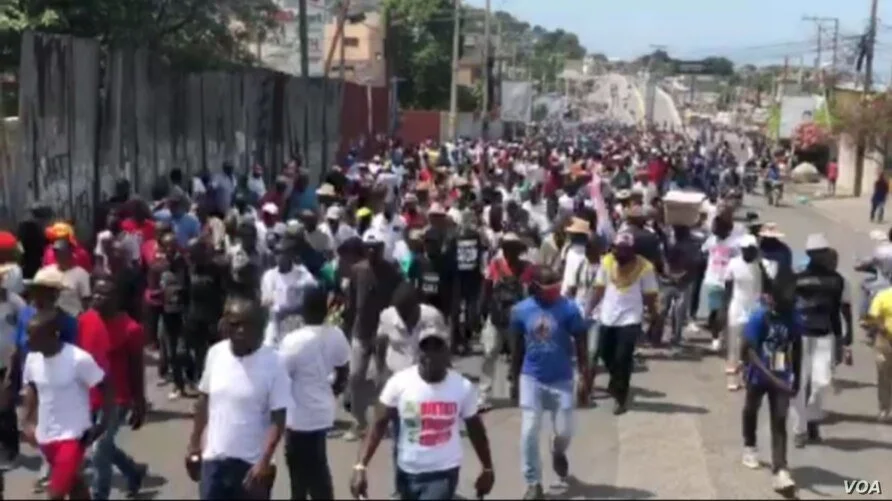
WASHINGTON/PORT-AU-PRINCE - Thousands of Haitians filled the streets of the capital, Port-au-Prince, again Sunday to call on President Jovenel Moise to step down and to demand a crackdown on kidnappers, who they say are holding the nation hostage.
“We cannot accept this kind of society,” said a doctor, who was part of the protest but did not give his name. “We have an incapable government. We need the proper conditions to work and treat patients.”
Medical professionals who spoke to VOA said they are outraged over the Feb. 28 attempted kidnapping and killing of one of their colleagues. They organized a two-day work stoppage March 2 in a show of solidarity and took to the streets Sunday.
Haiti has seen a spike in the last year in abductions targeting citizens from all sectors of society. The criminals have been indiscriminate in their targets, asking for ransoms as large as $5 million from the poor as well as the rich. Protesters hold the president responsible for failing to bring the perpetrators to justice.
During the first week of March, Moise took several steps to respond to the kidnappings, which have raised alarm among officials from the U.S., the United Nations and the European Union. The president held a series of meetings with law enforcement officials and members of his cabinet. Moise said a special anti-kidnapping unit of Colombia’s police force will help Haiti shape a more targeted response.
“Law enforcement has been instructed to intensify their efforts against insecurity. They must better coordinate their strategies, share intelligence, launch interventions and take all necessary actions to this end,” Moise tweeted on March 2.
Lawyers from the legal human rights group Collectif des Avocats pour la Défense des Droits de l’Homme (CADDOH) also joined Sunday’s protest, offering free legal assistance to anyone who might be arrested. Lawyer Arnel Remy decried the government’s disregard for the rule of law and had a message for the international community.
“It’s important for the international community to respond to this protest. … Jovenel (Moise the president) has been here for five years, and the judicial system has not functioned properly during that time,” he told VOA.
Remy took issue in particular with a communique announced this week by Prime Minister Joseph Jouthe that outlaws tinted glass on all vehicles except government and diplomatic cars. The measure outraged Haitians who have spent a lot of money to have their windows tinted as a measure against kidnappers and will now lose their investment and that protection.
The prime minister defended his communique, saying it was aimed at kidnappers who ride around in cars with tinted windows, preying on victims.
“Kidnapping is state-sponsored. So of course it will never be defeated,” alleged ex-Senator Steven Benoit, who marched with protesters. “Just wait, two or three weeks after Jovenel (Moise) is no longer in power, the kidnappings will stop.”
The president has denied any link to kidnappers.
Businessman Wolfi Hall, himself a kidnapping victim, said people need to understand that the trauma of the crime lingers long after a person is freed.
“There are pains that remain with you for the rest of your life,” he told VOA. “God only knows why your life was spared. Because after you’ve been traumatized, it doesn’t go away in a day. It’s an ugly experience — I don’t wish this on anyone — and you can only understand what I mean if you’ve been kidnapped.”
A group of handicapped people told VOA they had decided to join the protests for the first time to send a clear message to the president and the international community.
“Jovenel Moise, you are Haitian just like me, you say you love the country, please leave us the key to the (national) palace. You can’t be pleased with the situation we are in now. You represent everything that is wrong,” a blind woman told VOA.
She then turned her attention to U.S. officials.
“You say you are the friends of Haiti. Jovenel Moise does not represent us. I know the United States can’t do anything for Haiti — we know you have your own interests (to defend),” she said. “You take good care of dogs in your country, they get special care — I know you love people, too — well, we the handicapped are in the streets of Haiti today. You understand what that means. This is something we never do. We are the most disadvantaged (people) in society and look USA today we are in the street.”
It is rare for handicapped people to participate in street protests due to the grueling nature of the course, largely on foot at a brisk pace, climbing up steep, winding hills on roads that are sometimes not well paved, do not have sidewalks, in a hot and humid climate.
On March 5, two men linked to kidnappings were arrested in Haiti and turned over to U.S. Drug Enforcement Agency and FBI agents.
Peterson Benjamin, also known as Ti Peter Vilaj, and Lissner Mathieu, also known as Ti Nwa and has used the last name of Joseph, were flown to the United States where they are wanted in connection with drug trafficking, violating terms of probation and kidnapping.
Mathieu, a U.S. citizen, pleaded guilty in 2006 to drug charges in the U.S. but fled to Haiti in 2008.
Benjamin has been linked to a dozen kidnapping cases, some of which involved U.S. citizens, the Miami Herald reported.
After a Decade of Misrule, the People of Haiti Have Had Enough
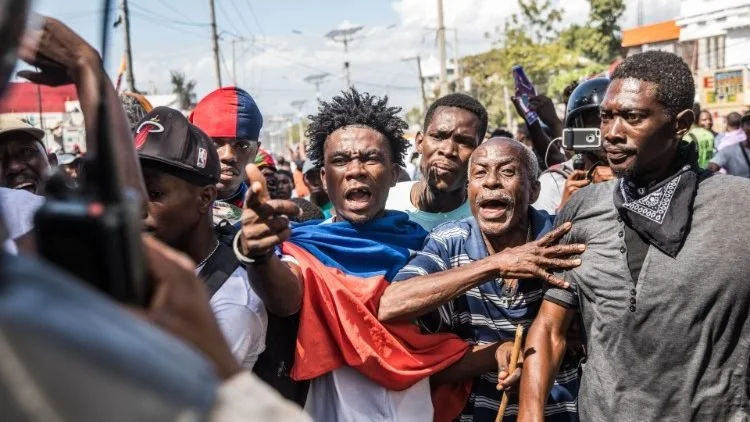
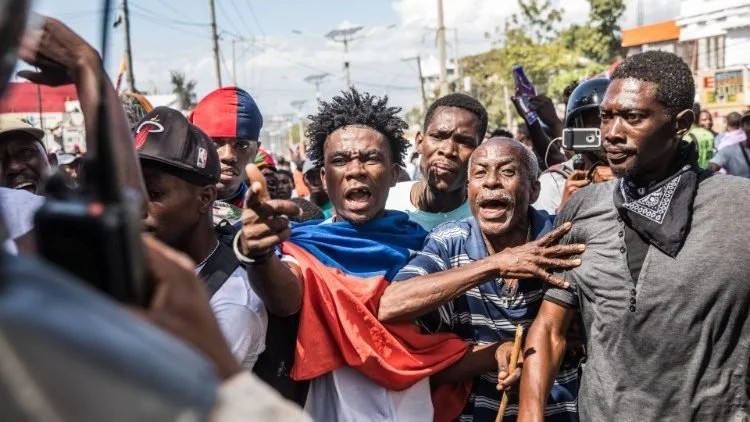
On Sunday, the people in Port-au-Prince filled its broad boulevards, blowing the traditional celebratory one-note vaksen horn, waving Haitian flags and branches of trees, and singing improvised songs, as well as the rousing Haitian national anthem. And I mean “filled,” curb to curb and out of sight against the horizon, coming and coming. There were similar protests in six other cities in Haiti. The Port-au-Prince demonstration was not like the lesser, though important, protests we’ve seen in Haiti in recent years against cost-of-living increases and food prices and gas taxes and government corruption. This well-organized, massive protest was an economy-stopping, throat-swelling, regime-changing political demonstration, more like the ones that preceded and followed the ouster of the Duvalier dynasty in February 1986. “Aba diktati,” read many of the handwritten pancartes held up by people in the surging crowd. Down with dictatorship.
A population with too much experience in the methods of dictatorship sees in President Jovenel Moïse an emerging strongman. In August 2020, a respected human rights group accused his government of outright collusion with the gangs in a Port-au-Prince shantytown, in a report ominously titled “Assassinations, Ambushes, Hostage-Takings, Rape, Arson, Home-Invasions.” Another much-feared gang, under the leadership of the strangely charismatic criminal Jimmy Cherizier (aka Barbecue), has staged marches honoring Moïse. Meanwhile, Moïse allowed the Haitian legislature to lapse, and has been ruling by decree for more than a year now. He is trying to amend Haiti’s constitution to permit consecutive presidential terms, which were outlawed in order to prevent the development of presidential cults of personality, as in the Duvalier era. Last month, Moïse, facing rising unrest, falsely accused opposition leaders of staging a coup against him and of planning to assassinate him, and rounded up 23 of them, many still languishing today in one of Haiti’s inexcusable prisons. Among them are health care workers and judges from Haiti’s Supreme Court. Because during this spate of arrests, Moïse also shut down the Supreme Court.
Here’s what’s really going on, and it circles around disputed elections—an incendiary topic that we in the United States now understand more intimately than we used to. Moïse and his predecessor, pop musician Michel Martelly, were each elected in highly questionable votes. Martelly seemed to have lost his election in 2011, but the OAS—with the support of then–Secretary of State Hillary Clinton and her husband, the UN’s special envoy to Haiti, as well as the French and Canadian governments—investigated the balloting and decided that Martelly had won enough votes to participate in the runoff voting. In this OAS-sanctioned runoff, Martelly emerged as the victor. A wide sector of the Haitian public did not believe in this election’s validity.
Five years later, Moïse, tapped by Martelly to run for president after Martelly’s term ended, was elected in balloting with very low turnout and vote-counting issues. That election was annulled, and an interim president installed until a new election could be held, which also suffered from low turnout and questions about the final count, but was eventually validated by the OAS. Along with the OAS, the same outsiders, known as “the international community” or the Core Group, continued to support the Martelly-Moïse relay of the presidential office, and continue to this day. That means they’ve supported a decade of rule by presidents chosen in highly suspect elections.
Martelly’s was a crucial election for all involved, though, because it was the first election after the earthquake of 2010, and the aid moneys that were about to flow into Haiti had all the traditional partners in corruption salivating: politicians, businessmen, contractors, bankers, and the international charitable funders and development investors who also play their part in the depraved dance. It was important to have the right person as president, putting the right people in the way of all the millions and even billions of dollars that were supposed to begin flowing. In Haiti, charitable and entrepreneurial funding goes to members of a class of people already well known to those outside funders: people who are familiar, the people whom those people suggest, Haitians who speak English and have already done business with the donors.
Haitians are almost never surprised to hear who’s received a donation to build a school or a sanitation system or a power plant, or to start or expand a small business; nor are they ever surprised to find that the school, or sanitation system, or power plant has never been actually finally fully built nor the business expanded. And bigger projects, like hotels, agribusiness, mineral extraction, and free enterprise zones, also offered a chance for investment for foreign interests, if the right Haitians were in place to give the go ahead. The people who are left out of this big money giveaway are the people whose misery is the excuse for the funding in the first place: the masses of suffering Haitians.
But the people of Haiti have now had enough. Ras le bol. Enough of the corruption that milks money out of the public coffers, enough of the rampant violence that keeps taking the lives of everyday Haitians, mostly people who can hardly be expected to pay heavy ransoms. And the murders and kidnappings haven’t stopped, even after a seeming hunt by authorities for some of the more egregious gang leaders, and the timid 2020 US sanctions against Cherizier and two government officials for their involvement in the notorious 2018 massacre at the La Saline market in Port-au-Prince. It’s not about one criminal; it’s about a criminal system, supported by very heavy hitters, including the international community.
On Sunday morning, the morning of the incredible and inspiring demonstration against the Moïse government, a beloved and dedicated pediatrician, Ernst Paddy, was killed on the street in Port-au-Prince by five or six heavily armed kidnappers as he resisted his attackers. They reportedly kidnapped his wife, who was with him. The day before, a highly coordinated and dazzling prison escape by the infamous gang leader Arnel Joseph ended soon after in his point-blank execution by the Haitian police, along with 25 other deaths, including the prison director. It’s assumed among Haitians that Joseph was freed and then targeted and killed because of his connections to the Moïse regime and to others involved in violence and criminal retribution. To stop Joseph from talking, in other words. (An estimated 400 more prisoners escaped during the break.) Also this week, a film crew from the Dominican Republic and their Haitian translator were released by gang-associated kidnappers into the custody of the police who had demanded complete control over negotiations for their release and who in turn kept them incommunicado for 44 hours, despite pleas from the Dominican Republic that they be released to the embassy: They were kidnapped again, essentially, the second time by the Haitian National Police.
My WhatsApp feed has been full of blood and guns this week, simply following the lives of Haitians living in a country plagued by systemic corruption and violence. I scroll down and there is Arnel Joseph, in a bloody T-shirt, slumped over a motor bike. Pictures of others killed during the prison break follow. Blood on cement floors, bodies in strange positions. Scroll further, and I find a bleak black-and-white video of the killing of the poor pediatrician. The SUV arriving, the men and their machine guns leaping from within, the doctor dragged from his car… A few messages further down, and there’s a still of the two Dominican cameramen being interrogated by police. More messages and then a video of Dr. Paddy’s grown son sobbing over the loss of his father and the abduction of his mother.
A Haitian protest is never just a mass of disgruntled and hungry citizens. Participants always have certain interests in mind, and particular targets of their anger and frustration. They are filled with purpose and the desire for change. The huge protest yesterday stopped in front of BINUH, the United Nations Integrated Office in Haiti, and called for the removal of its director, Helen Meagher La Lime, by name. La Lime is seen by Haitians as a symbol of the continuing unwanted hand of foreign powers in Haitian affairs. She’s made many unfortunate statements and seems to consort with all the wrong people in Haiti. She’s continued the UN’s almost unstinting support of Moïse, though his recent egregious activities seem to have diminished her enthusiasm slightly. Meanwhile, we have Joe Biden continuing Trump’s support of Moïse—a real slap in the face to the Haitian Americans who voted for him with high hopes.
It’s not as if there aren’t scores of Haitians who are more responsible, politically astute, law-abiding, and patriotic than Moïse. Some have been around for years, and others are newer to the scene. Any one of them or all of them could participate in an interim committee of government that could organize respectable and credible elections. They are lawyers, human rights workers, community organizers, women’s group leaders, doctors, educators—everyone in Port-au-Prince knows them by name; the US Embassy knows them by name. They stand at the ready to do their duty to the Haitian people, I’m sure. But the government currently in place, illegitimately, must get out of the way before this can come to pass. And if recent Haitian history is any guide, no matter how large the peaceful demonstrations against Moïse may grow, he will never leave as long as he retains the unswerving support of the international community.
Haitian protesters, police clash after president moves against top judges
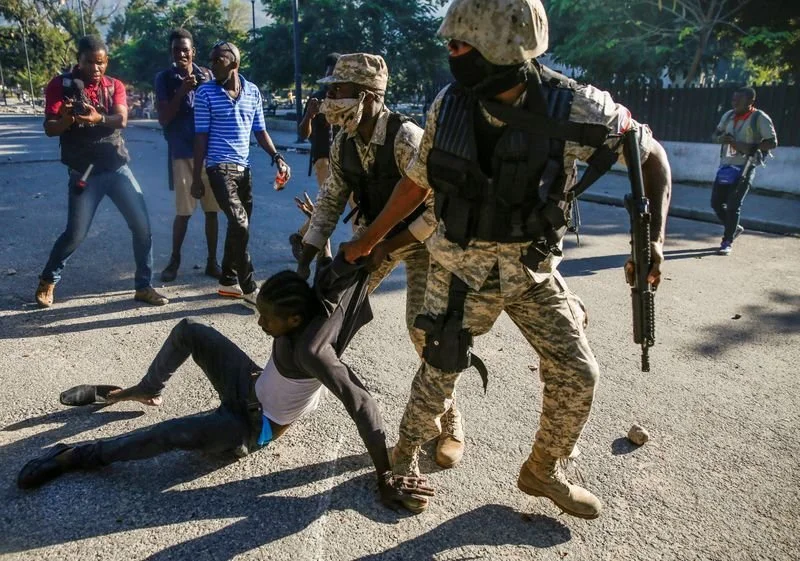
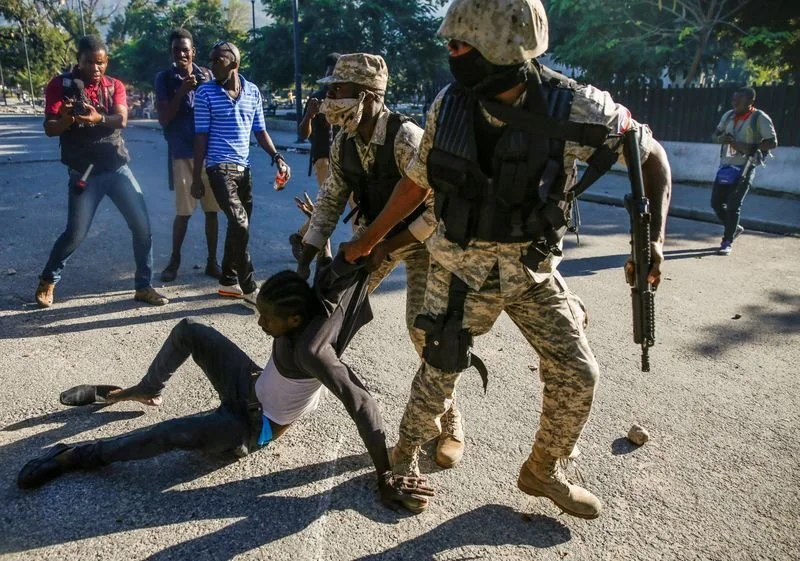
PORT-AU-PRINCE (Reuters) - Haitian police on Wednesday clashed with rock-hurling protesters in the capital Port-Au-Prince amid street demonstrations against President Jovenel Moise after his government retired three Supreme Court judges earmarked as his potential replacements.
Police fired teargas and shot in the air in an attempt to disperse pockets of protesters, who pelted the security officials with rocks, according to a Reuters witness.
"We are back to dictatorship! Down with Moise!" the protesters shouted as music blared from speakers amid chaotic scenes in the poor Caribbean nation of about 11 million people.
The protesters also yelled "Down with Sison," a reference to the U.S. Ambassador to Haiti, Michele Jeanne Sison. Washington has so far backed Moise's claim that he should step down in February 2022 after presidential elections are held this year.
The latest political tumult in the volatile island nation comes amid a crippling economic crisis and a sharp rise in crime, especially kidnappings for ransom.
The opposition is demanding Moise leaves power immediately, accusing him of acting like an authoritarian leader and violating the constitution.
Tensions intensified over the weekend after Moise alleged there was an attempt to overthrow his government. Authorities on Sunday arrested 23 people, including a Supreme Court judge and a senior police official.
On Monday, the government issued an executive decree retiring the arrested judge and two other Supreme Court justices.
All three had been approached by the opposition as possible interim leaders to replace Moise and head a transitional government. In the end, the opposition chose magistrate Joseph Mecene Jean Louis, 72.
The opposition says Moise should have stepped down on Feb. 7, when they say his five-year term in office expired, following disputed 2015 elections.
Moise rejects that, citing a term that began in February 2017 after he won fresh elections in 2016. He has pledged to step down in February next year.
A group of journalists on Wednesday also complained to security officials about heavy-handed policing.
Two journalists covering the protests received minor injuries when the police dropped a tear gas canister into a pickup truck, labeled as media, which was transporting journalists, according to reporters and television footage.
Police could not immediately be reached for comment.