

Brattleboro Business Supplies Diapers to Children in Haiti

BRATTLEBORO — Cloth diapers are better for babies. That's what Karen Amidon believes, and she's built a business around it.Green Mountain Diapers is a small family-owned business based in Brattleboro. It sells all sorts of cloth diapers and accessories, and while it can't afford to run its own subsidized cloth diaper program, it donates to nonprofits dedicated to giving cloth diapers to families in need.One of those organizations is Jake's Diapers based out of Fox Valley, Wis.Six years ago, Stephanie Bowers, Jake's Diapers' founder, went on a women's mission trip to an orphanage in Peru where she said adults were reusing disposable diapers on the orphans.Diapers, Bowers said, are a precious resource in developing and remote countries. In Haiti, after the 2010 earthquake, things were especially bad. Bowers said worms and chronic diarrhea were a big problem for babies, who often times sit on the ground without diapers. Many homes don't have floors."They were praying for diapers," Bowers said.So Bowers started Jake's Diapers, a nonprofit dedicated to providing cloth diapers to children and families living in extreme poverty.The goal of this project is "to help the babies and their families not only survive but thrive."Bowers hopes that providing babies with diapers will allow families to spend money on other crucial items like food.In the areas Jake's Diapers serves — Haiti, Guatemala, Ecuador, Peru, Democratic Republic Congo, Ethiopia, Tanzania, Wisconsin and Papua New Guinea — healthcare is not always available to families."Maternal health care, or any health care, in Haiti is pretty much nonexistent," Bowers said.Walking to clinics can take days, she said. Baby mortality rates are under-reported but, Bowers said, 30 to 40 percent of babies are reported to die. She said Haiti has the highest infant mortality rate in the world. The maternal mortality is also high, she said."It takes only $115 in the U.S. to provide babies with cloth diapers for life," she said.Providing babies with diapers is a mission that Bowers is passionate about."This is a calling for me," she said, adding that she was deeply affected visiting developing nations. "It's a level of poverty that we cannot even comprehend," she said. "I start to lose words because the concept is challenging but real. They're just like you and me. I was born in Albany, N.Y. These babies were born in Haiti."Jake's Diapers only uses cloth diapers, which Bowers said are more economical and practical for families living in extreme poverty. Many areas don't have trash service and cloth diapers are reuseable, so tend to be cheaper for some families.Green Mountain Diapers donates diapers the company doesn't think it can sell, but that are still usable. The company doesn't sell in-store, but products are available for pick up. Amidon has a similar passion for diapers. Rather than discovering her passion while abroad, Amidon's interest in cloth diapers came from necessity, while at home taking care of her two children.Amidon believes cloth diapering is what's best for children because cloth diapers are softer and more natural for babies. She tried cloth diapering with her first child, but it proved disastrous. Eventually, Amidon solved her cloth diapering woes. She and her husband, Doug Amidon, opened Green Mountain Diapers to offer more products to the cloth diapering industry.Elizabeth Ellis, the customer support handler, started working for Green Mountain Diapers when Amidon asked her for help. Ellis was a stay-at-home mom who knew Amidon from church.Along with handling customer relations and support, Ellis is in charge of coordinating the company's donations.Green Mountain diapers also donates to The Rebecca Foundation, Giving Diapers Giving Hope, Share the Love, Cover Your Bum and Cloth for Everybum."We want to see babies who need cloth diapers to be in cloth diapers," Ellis said. "We know not everyone can afford it."When Ellis started cloth diapering she assumed it would be more economical. Not all cloth diapers are cheap, though. Many new parents are attracted to the all-in-one diapers that have the diaper and diaper cover attached, but they're the most expensive diapers the company sells.The diapers donated to places like Jake's Diapers are foldable. They're the sort of diapers used about 50 years ago, Ellis said. She showcased the Cloth-eez Flat Birdseye diapers, which come in one large size and can be folded multiple times. "They're easy to wash, so they're good for orphanages," Ellis said. She said they could be intimidating to newer parents, who are scared of the folding process, but for many moms they are therapeutic.Cloth-eez is a brand designed by Amidon. Prefoldable diapers used to just come in infant and large, but Amidon designed newborn, small, medium, large and extra large. "They're effective and easy to wash," Ellis said. "They're middle of the road on price."Green Mountain Diapers recommends that parents have about 36 diapers that fit their baby and about six to eight diaper covers.Jake's Diapers takes new or used cloth diapers and monetary donations. To donate to Jake's Diapers, go to www.jakesdiapers.org.Harmony Birch | August 1,2017

Subcommittee on the Church in Latin America Awards nearly $6 Million in Grants to Projects Including Pro-Life Centers, Hurricane Matthew Affected Areas

 WASHINGTON—The U.S. Conference of Catholic Bishops' (USCCB) Subcommittee on the Church in Latin America awarded nearly $4 million in funding in the form of 244 grants to support the pastoral work of the Church in Latin America and the Caribbean, and nearly $2 million in funding for continued reconstruction in Haiti after the 2010 earthquake. The grants were approved at the Subcommittee's meeting on June 12 in Indianapolis, Indiana.Projects that received funding include:Argentina, GRAVIDA—Centro de Asistencia a la Vida Naciente: This network of diocesan centers in Argentina works to promote, care for, and defend life from the moment of conception and promotes the dignity of parenting. These centers are located in 21 dioceses across the country and care for pregnant women at risk of having an abortion as well as with men to help them understand the value of fatherhood. The centers provide education and formation about the dignity of human life and conduct solidarity and awareness campaigns.Haiti, Catechetical Formation: This project will provide formation for 400 pastoral agents from four parishes that were impacted by Hurricane Matthew. The formation will be centered around the theme of the Christian family, and will take place over the course of three days. Seminars, workshops and group discussions will be facilitated, along with opportunities for prayer and daily Mass.In addition, the first grant to help rebuild churches on the western part of Haiti after Hurricane Matthew was approved. More of these requests will be considered at future meetings of the Subcommittee."I am continually inspired by all of those who support the Collection for the Church in Latin America," said Bishop Eusebio Elizondo, auxiliary bishop of Seattle and chairman of the Subcommittee on the Church in Latin America. "The generosity of Catholics across the United States makes a difference in the lives of countless people in Latin America and the Caribbean. This generosity reflects the love and compassion of God. I can see this especially in the response we received to help the victims of Hurricane Matthew. With that help, we not only fund pastoral projects, but help rebuild churches in some dioceses of Haiti."Other areas of funding include lay leadership training, seminarian and religious formation, prison ministry, and youth ministry. Grants are funded by the annual Collection for the Church in Latin America, taken in many dioceses across the U.S. on the fourth Sunday in January. The grants to Haiti are funded by the Special Collection for Haiti, which occurred after the 2010 earthquake. These reconstruction efforts are managed through the Partnership for Church Reconstruction in Haiti (PROCHE).The Subcommittee on the Church in Latin America oversees the collection and an annual grant program as part of the USCCB Committee on National Collections. It allocates revenue received from the Collection for the Church in Latin America as grants across Latin America and the Caribbean. More information about the Collection for the Church in Latin America and the many grants it funds, as well as resources to promote it across the country, can be found at http://www.usccb.org/catholic-giving/opportunities-for-giving/latin-america/index.cfm.By: United States Conference of Catholic Bishops | July 31, 2017
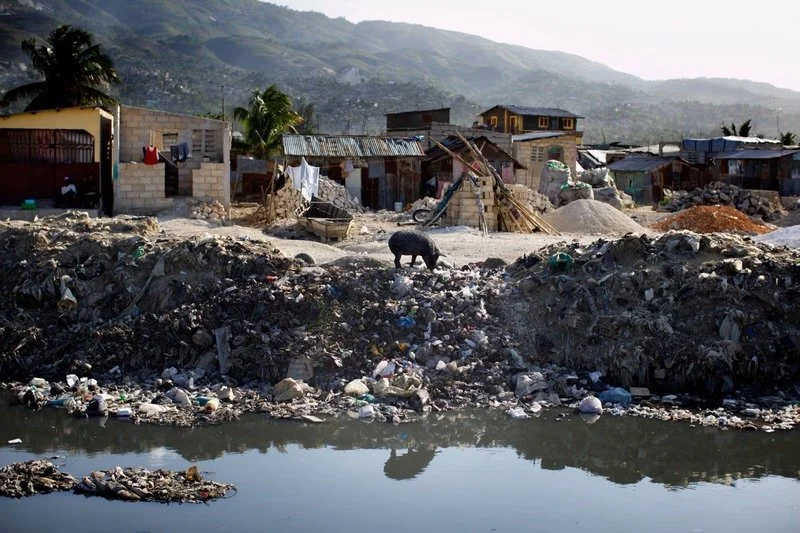
You Probably Don't Want To Know About Haiti's Sewage Problems
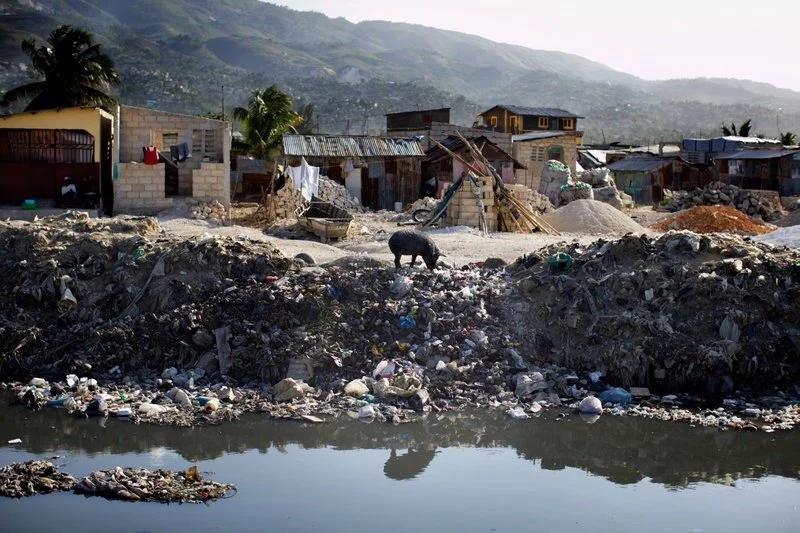
The rain began on Good Friday. It fell into the roofless ruins of Port-au-Prince's Catholic cathedral. It swirled through stalls in the market downtown. In the hills above Haiti's capital, the rain ran off the clay roof tiles of upscale homes.No matter where the rain fell, it was all destined for the same place: the system of concrete canals that cut through the city and down to the sea.At the edge of the city next to the shore, the rain pounded on the zinc roof of Jean Claude Derlia's single-story cinder block home. His neighborhood, Project Drouillard, is dense with families packed into homes like his. Most people who grew up in Project Drouillard have stayed, as he has. The community is close-knit, poor and socially isolated from downtown Port-au-Prince.It is also extremely vulnerable to flooding from the canal full of trash and raw sewage that bordered it on one side. After a rainstorm a few years ago, Derlia had been swept away by a wave of sludge and nearly died before neighbors fished him out. He was sick for weeks after it happened, but he survived.Now, over the sound of the rain, Derlia heard people shouting, "The water is coming!" There was nothing he could do but wait and pray that the water, or the things the water carried with it, wouldn't kill him this time.A city without a systemPort-au-Prince, Haiti, is one of the largest cities in the world without a central sewage system. There are no sewers connecting sinks, showers and toilets to hulking wastewater treatment plants. Most of the more than 3 million people in the metro area use outhouses, and much of that waste ends up in canals, ditches and other unsanitary dumping grounds where it can contaminate drinking water and spread disease.It's a problem that has attracted international donors, some of whom have acted to do what the Haitian government cannot afford to: build a sewage treatment system. Since 2010, international groups have spent millions of dollars on a plan to build open-air sewage treatment plants across Haiti. In 2012, the first facility opened at a site called Morne a Cabrit, about an hour from downtown Port-au-Prince. At the time, a government official told NPR that funds were in place for facilities in seven other cities.But five years later, that construction plan has stalled. Morne a Cabrit is still the only operational sewage treatment plant in the country, another $2.1 million facility is all but abandoned and the volume of sewage being disposed of safely in Port-au-Prince is actually decreasing.At its core, the floundering sewage treatment strategy is about money and power. Haitian economist Kesner Pharel, who has advised both the Haitian government and international nongovernmental organizations on investment and development in the country, says the stalled plan reflects a fundamental flaw with how infrastructure projects are funded and implemented in Haiti.Because the Haitian government is so dependent on outside money for infrastructure, "it is very easy for [international donors] to come in and say, 'I'm going to do this, I'm going to do that,' " he explains. The result is that the country's leaders become more responsive to funders than to Haitian voters. "Where is the accountability?" he says, "not to international donors, but to your people?"In the past five years, the story of one failed sewage treatment plant project offers the clearest example of the good intentions, poor governance and bad luck that contributed to Haiti's current sanitation crisis. It began with a young woman and a huge earthquake.How not to build a sewage treatment plantEdwige Petit has been called Haiti's "sanitation champion." Trained as a civil engineer, Petit, the current director of sanitation at the Haitian water and sanitation agency DINEPA, has also been called less laudatory names because of her expertise. "Sewage wife, trash wife, lots of names," she says, laughing.Her first experience with sewage treatment came a few months after the 2010 earthquake that destroyed much of Port-au-Prince. Aid groups provided clean water and toilets to hundreds of thousands of people in displaced-person camps. The groups needed somewhere to dump the more than 10,000 gallons of human waste the camps generated each day. Initially, the government directed them to an unlined pit at the edge of the landfill.Petit was an expert on the landfill and immediately knew dumping there was not a good solution. The pit was unlined and right next to the sea, so the sewage could easily contaminate fishing areas and sources of drinking water. But for months after the quake, with the economy in shambles and the city in ruins, large-scale sanitation projects were never a political priority."People don't have enough money. What can you say when people cannot even eat? You're talking about waste?" she says, channeling her detractors. "They cannot eat, they cannot s***! So that's the deal. Too much poverty."Then that fall, U.N. soldiers from Nepal brought cholera to Haiti. "Only the cholera could make us have [the first sewage treatment facility]," Petit says. "Only cholera. Because we were afraid, totally afraid of cholera. For this reason, everyone agreed."In October 2010, the government of then-President Rene Preval announced it had found a location for the country's first sewage treatment plant, on land formerly leased by the Haitian American Sugar Company and left empty for years. The site was named for the nearby area of Titanyen, where thousands of people had been buried in mass graves after the earthquake.The initial budget inscribed on a now-faded sign at the entrance was $1.9 million — it would later grow to $2.1 million — to be paid by the Spanish government, which would also fund a public education campaign about cholera prevention. Construction began immediately, but just three months later, it stopped.Powerful people had leveraged their connections to the president, alleging that they owned the land under the sewage plant and demanding compensation under eminent domain before construction could go forward."For each [piece of] land, we had not one, but two or three people who said they were owners!" Petit remembers, still fuming more than six years later. "They went directly to president."For nine months, nothing was built at the Titanyen sewage treatment plant. In that time, disease surveillance data suggests more than 2,500 people died of cholera in Haiti. Without a safe dumping site open, DINEPA data suggests more than 100,000 cubic meters of raw sewage was dumped elsewhere in and around the city.In the end, the Haitian government had little choice but to pay the alleged landowners, since the rest of the Spanish funds were unavailable as long as construction was stalled. In the meantime, funding the plant appeared to be a point of pride for the Spanish government. Queen Sofia of Spain even traveled to see it.When the sewage treatment plant finally opened in May 2012, after the cholera epidemic had peaked, a press release from the Spanish aid agency AECID said nothing about the construction delay. It pointed to the project as an example of "strengthening of Haitian institutions" and said it would "contribute significantly to the health of the population and halt outbreaks of diseases such as cholera."The facility operated for just 18 months before a technical problem — huge bubbles in the lining of the second waste treatment pool — forced it to close. Since then, it has remained closed. DINEPA says the aid agency plans to spend an additional $617,000 to repair it beginning this fall.A spokesperson for AECID declined to comment on its sewage treatment plant projects in Haiti, citing turnover in its staff in the region.Haiti's sewage champion, Petit, still believes that sewage treatment plants are a good investment for Haiti. She is using the agency's investment funds, 96 percent of which came from international sources last fiscal year, to build at least 30 waste treatment facilities across the country. Three, including the still-shuttered site at Titanyen, are under construction or repair."The government has a duty to build the plants we should need," she says. "I can say I am doing my part."Meanwhile, the one sewage treatment plant that is already open is below capacity and struggling to cover its operating costs. International money covered its construction, but domestic funding and customer fees are insufficient to cover long-term maintenance and payroll. Inadvertently or otherwise, the availability of international money for infrastructure appears to have motivated the construction of sewage treatment plants in Haiti, whether or not there is local demand for the facilities.The Easter floodWithout a sewage system to divert waste out of clogged canals, the Good Friday rainstorm filled the streets and alleys of Project Drouillard with 3 feet of raw sewage. Seven people drowned in the canal. Jean Claude Derlia got an infection that still hasn't gone away.Residents blamed the flood on poorly excavated canals and on the waste dumped by rich people who live on higher ground. Both are undoubtedly true, but the waste clogging the canal also came from right there in Project Drouillard. Scattered throughout the neighborhood are sets of cinder block pit latrines, most of which are filled to the top with waste."We can't use these," says 27-year-old Bernard Paulemon, gesturing to a set of six stalls near the headquarters of his neighborhood group, Foundation Alovie. "The people here, they can't pay."He is referring to the cost of maintenance. When a latrine fills up, residents see two options: They can padlock it and leave it, at which point some people resort to relieving themselves in an open field near the canal, or they can pool money to hire someone to clean out the pit.Magdala Simeone lives a few houses away from a block of six pit latrines, each with a padlock on the door. Four of the six stalls are too full to use. Kids come and go with the keys for the other two. A few weeks ago, Simeone and her neighbors raised money to hire someone to clean one of them out.The total cost: $75. Her share: about $8. She never saw who cleaned out the latrine and doesn't know where they dumped the contents. A trip across the waste-strewn field adjacent to the canal holds a hint — the canal is completely filled with muddy excrement.She would prefer to have a company clean out the latrine. "The company will clean it better" than the informal latrine cleaners known as bayakou, she says, but "a private company will ask you for a lot of money."Sanitation companies in Port-au-Prince see the potential for big profits in neighborhoods like this one. "There are lots more people who could pay us, but they haven't heard of the company. They don't know what we do or why they should give us money," says Marguerite Jean Louis, the CEO of the Port-au-Prince-based sanitation company Sanco.She is banking her new company's future growth on educating middle- and low-income Haitians about the importance of paying for sewage pickup and disposal.This is the "market first" model of sanitation reform in Port-au-Prince. Simply put, it's the belief that the limited cash available for sanitation should be invested in increasing the demand for sewage removal rather than in large-scale infrastructure projects like sewage treatment plants.Flaure Dubois, the financial director at Jedco, the largest sanitation company in the country, says the government's focus on sewage treatment plants is frustrating because there is so much public education work to be done around sanitation. She sees her company as more aligned with aid groups doing sanitation campaigns than with DINEPA and its construction plans."We need to change the culture," says Polyanna Domond, Jedco's marketing director, showing off a Jedco sign that explains in Creole how to use a portable toilet (Sit on it, don't hover above it!). "We are investing in public education, so people know that waste can make them sick. The government should ask us for help."The worst job in the worldEveryone in the neighborhood could smell it; a heavy, earthy stench, like rotten eggs and feces.In the back corner of a neat courtyard surrounded by single-story houses, four men were getting ready to empty out a pit latrine. The leader, a 35-year-old who said his name was Gabriel Toto, was standing over a 15-foot pit filled with human excrement, his pants rolled up to his knees, shirtless with yellow rubber gloves and a cigarette dangling from his lips.He explained that Toto is a nickname he used when he discusses his job, to minimize the stigma and ostracization he and his family face because of his occupation.For the same reason, he and his men work only at night."I am a working man," he said, just trying to make a living without getting caught up in the organized crime that dominates the economy in his neighborhood near Project Drouillard. "I don't want to do anything bad. So, whatever I need to do — whatever I have to do — I will do it. Anything."For the last decade, doing "anything" has meant working as a bayakou. The job is dangerous, disgusting and difficult. To watch Toto work is to see an expert perform his craft, moving confidently and carefully to remove about 400 gallons of human waste from an underground, candlelit hole in less than three hours, using only his gloved hands, a bucket and a rope.Even for a pro, the work is risky. "I have had stitches on my legs, my feet," Toto says. "I even lost one of my toenails one day when I was working." Another bayakou, Derisma Merisier, says an infection is responsible for his red and puss-filled eyes. He has been living with it for years.And the latrines are full of hidden dangers as well. People throw all sorts of things in the hole. Sticks, rocks, trash and razor blades are nightly hazards. On this night, an excrement-covered handgun shows up in one of the buckets.The owner of the outhouse paid Jedco about $170 for the cleaning service. As subcontractors, Toto and his men will each take home about $3.90 for the night's work. They make eight to ten times more working for themselves, but as the companies have moved into the market, many bayakou feel forced to work as contractors.Working for a company could theoretically offer perks. On this night, Jedco provides five pairs of coveralls (in plastic packaging), rubber gloves, boots, goggles and even blue Jedco baseball caps (new with the tags still on). The men laugh wryly when they see the protective gear."They usually don't give us these things," says Toto. The clear implication was that the protective gear is related to the presence of journalists. Usually, the men work in little or no clothing. By the end of the night, the goggles are fogged up and useless, gloves are ripped and most of the men have discarded some or all of the gear.As it is, Toto says he doesn't make enough to support himself and his three children. After a night's work, he spends the day looking for hourly labor jobs, although a lot of people won't work with him or even touch him."You've seen what I have done," he says, standing in the parking lot of the sewage treatment plant at 2:30 a.m., his hair still wet from a bucket bath. "Some people will never stand close to me, talking to me the way you are talking to me, as close as you are. They'll stay away from me because they see what I'm doing with my own hands."The Haitian government and private sanitation companies talk about public education campaigns and sanitation market development and infrastructure. But as the person who does the work of bringing human waste from the city to the dumping site, Toto feels ignored and abused."The first people in the community who should give value to the work we're doing are the companies," he says. "When they sit behind a desk in the air conditioning, they don't care. If they don't give value to what we're doing, who else will give value to that?"Rebecca Hersher | July 29, 2019

Soup Joumou (Butternut Squash Soup)





VIII Games of La Francophonie : Between medals hope and disappointment

As part of the cultural component of the 8th Games of La Francophonie, held in Abidjan (the capital of Ivory Coast) until July 30, 2017, our 10 Haitian artists in competition (5 Hip Hop dancers, 2 Puppeteers, 1 Photographer , 1 Painter and 1 sculptor) try to get medals against high-level opponents...After the first few days, Haiti swings between hope for medals and disappointment...Update on our artists :Hip-Hop Dance :After two days of intensive repetitions, the Hip-Hop dancers of the UNISTEP group entered the final round at Canal aux Bois on Tuesday to face 17 other competitors. Despite a good performance more or less appreciated by some spectators, they did not manage to qualify among the 8 countries retained for the final phase (Battle) of the contest. Rendez-vous in 2021 for our Haitian dancers...Photography :Tara E. Levros, the Haitian photographer, is awaiting deliberation of the Jury of the Museum of Civilizations. Tara has been subjected since the beginning of the Games to practical exercises which have led her to various sites in the Ivory Coast. She will be judged on the basis of the works she had already sent to the organizers and the photos she has just produced during the competition.Sculpture:Yvens Orélien is one of our great medal hopes for the moment as his work exhibited at the Museum of Civilizations has aroused admiration. Yvens has already realized a Sculpture on the spot on the subject of immigration and awaits the verdict of the Jury.Giant Puppets:Wednesday, July 26, the band of Ernst Saint-Rome, jumped into the competition with 9 other nations. Unfortunately the performance of the puppets of Mackendy and Steeve Marcéus did not convince the members of the Jury to grant them the right to move to the last phase of the five qualified countries.Painting :Jaboin Darthon, always focused on his work, is determined to return in Haiti with a medal. As part of his practical work, he has already painted in two days, two paintings on the theme of Love. And awaits the decision of the Jury.HL/ HaitiLibre 27/07/2017

Inauguration of the Baseball Academy in Haiti

Following the bilateral initiative of the project of development of the Baseball in Haiti initiated last June http://www.haitilibre.com/en/news-21266-haiti-dr-bilateral-development-project-for-baseball-in-haiti.html , Friday 27 July will take place at the Hotel Orix (Ouanaminthe), the inauguration ceremony of the International Baseball Academy, in the presence of the highest sports authorities of Haiti and the Dominican Republic and businessmen of the Diaspora Haitian, confirmed Dr. Seymour Coffy, Director of the Academy.Saturday, starting at 3:00 pm a baseball demonstration match will be held between young Dominicans. Ten young Haitians will benefit at the beginning of this important project, which aims to promote this sport in Haiti.Dr Coffy said that several Haitian businessmen from Florida, New York and Canada will be present, as well as the Directors of the Roberto Clemente Foundation of Puerto Rico.BF/ HaitiLibre 27/07/2017

USMNT lifts Gold Cup after late victory over Jamaica

The guy who almost cost the United States the 2017 CONCACAF Gold Cup for the regional champions was also the one whose goal won it.
Just after halftime, Jordan Morris let Jamaica’s Je-Vaughn Watson slip away from him at the second post on a corner, and Watson scored with his header. But in the 88th minute, Morris latched onto a ball in the other box and fired it home to win the match 2-1 and make the Americans champions of the region for a sixth time overall and a second time in three editions — dethroning a Mexican side that had been knocked out in the semifinals by the Reggae Boyz.
Granted, this was a so-called off-year Gold Cup, meaning the full A-teams didn’t participate because of World Cup qualifying priorities. And both of the aforementioned American triumphs, in 2013 and 2017, came during off-year competitions, which many argue shouldn’t even be played.
Jozy Altidore had put the U.S. ahead before halftime on a stunning free kick to break a lamentable deadlock before Jamaica equalized just after the break.
It was a largely ponderous and sluggish game. Jamaica clogged the central spaces well in the first half. And the U.S. was clean enough on the ball that it didn’t create any chances on the break for its opponent. That basically meant the sides negated each other.
The seminal moment, then, came on an injury in the 19th minute. Jamaica’s captain and star goalkeeper Andre Blake made a marvelous save on swerving Altidore shot. Then he bravely closed down Kellyn Acosta on the rebound, but got badly hurt in the process, finding himself left with a clearly beat-up hand, all trembling and bloody.
…
Finally, in the late going, Gyasi Zardes’s cross wasn’t cleared and was settled for Morris by Dempsey. The young forward’s finish took a very minor deflection on its way into the net.
Working out how to celebrate this trophy for the U.S. is tricky. On the one hand, it doesn’t count nearly as heavily as when all the big teams bring their best players. (The U.S. cycled in a handful of A-team stars before the knockout stage to shore up the campaign. Arch-rival Mexico didn’t.) On the other hand, the Americans nevertheless don’t win this thing very often. And this is just the sixth trophy of any kind in the United States Soccer Federation’s more than 100 years of history.
Meanwhile, any kind of momentum builder at all is useful as the clock ticks down to another World Cup — presuming the Americans wrap up qualification. Even if this tournament is a diminished version of itself in every other edition of it, you still can do worse than to win it. And that’s worth letting out a little cheer for. Especially when late last year, the national team program appeared to be in a rather sorry state, before Bruce Arena was brought back to succeed the ousted manager Jurgen Klinsmann. Arena is yet to lose in 14 games.
“This is what it’s all about,” Bradley said after the game. “It’s a final. Each team is going to give everything until the end. The only thing that matters is we’re the ones with the trophy.”
That’s the thing about this tournament. Even if it comes with asterisk, winning it can’t possibly hurt.
It may yet prove useful down the line. As a confidence-builder. As another few competitive knockout round games won, to build further experience in that area. And perhaps as the foundation upon which an even bigger achievement can be built.

her sweat story: olympian naomy grand’pierre talks training & swimming for haiti

It was a simple question asked by Naomy Grand’Pierre’s parents after watching Michael Phelps and Collen Jones swim their 2008 Olympic relay.“Wouldn’t it be cool if you guys started a Haitian swim team?”With Haiti’s recent controversial presidential election, lack of governance and soccer being the country’s national sport, the 19-year-old Canadian didn’t think it was possible to swim for her parents’ homeland, Haiti. But she did. Reaching out to organizations like the Haitian Swimming Federation, the Atlanta-bred athlete became Haiti’s first female Olympic swimmer. Yet, Grand’Pierre knew that there was more work to be done to help Haiti’s small swim community. Her next game plan was to bring their resources to the masses.“I talked to the Federation and realized that we have a 50-meter pool sitting here,” Grand’Pierre told her sweat. “It would be great to see what it takes to get it renovated and really have a project where we could open some pools in Haiti, where not only I can come back and train but other people can join me and learn how to swim.”For the young go-getter, her eyes aren’t only on 2020 Olympic Games in Tokyo. Grand’Pierre is training for the Federation Internationale De Natation (FINA) World Champs in Budapest by representing Haiti along with two other swimmers in the international swim competition. Grand’Pierre will compete on Saturday (July 29) in the 50-meters breaststroke and 50 meters freestyle while the championships will run from July 23 – 30.In between her training for FINA, school and work, Grand’Pierre discussed the most valuable lessons she learned in the 2016 Olympic Games, her advice to young swimmers and her favorite Haitian delicacies to eat on cheat days.What I learned from Rio 2016: The most valuable lesson is that dreams do come true. It’s super cliché, but when I was 10 years old, I really wanted to go to the Olympics. I would tell everybody and would always get negative feedback. People would say ‘You know how hard it is to do that? You’re not fast enough.’ So I learned very early on, dreams are super fragile and you only share it with people who are there to encourage you and share that journey with you.My pre-game routine: Most of the time before a big race, I have a lot of nerves, so I [listen to my] go-to album, Wiped Out by The Neighborhood. It’s a very California chill, vibes-y album. I listen to the entire album and that’s kind of what really calms me down and gets me in my element to focus on nothing else but what I need to do.What my coach has taught me: The main thing he told me was to trust my training. When you train for anything, you have very intense practices and weight sessions, and right before a championship, you start tapering down the amount of practices. It’s actually a very scary and mental aspect of training because you have to hold everything that you have been training. Trust your training and [don’t let] the small details psych you out.My workout regimen: I work out every single day except Sundays. I go to the weight room three times a week for about an hour session. I have two dry land practices, where I can do anything from sit-ups to running, then I’m swimming from six to 10 times a week. Obviously, when I’m in school, I’m swimming less outside of school. Swim practice is about two hours, dry land is about an hour and weight room is an hour. I’ll lift in the morning and swim in the afternoon. On Friday, I’ll just swim in the morning.On my cheat days: I definitely sleep in. I don’t really eat processed foods that aren’t good for you. If I go to a restaurant and I’m getting a really nice dessert then I’ll do that. I love Haitian food. My favorite is legume with diri (rice and legume), banan pezé (fried plantains) is my favorite. I love Haitian hot chocolate because nothing is as ever as thick and sweet as hot chocolate. I love Haitian macaroni gratin. Whenever I go to Haiti, I get lambi and lobster.My least favorite workouts: They’re called croggle reps because you’re crying in your goggles. It’s a best average set— high intensity, high threshold, not a lot of reps [but] very hard grueling reps. Those sets are very painful and to get the best out of those sets, you need to stay at that pain threshold so you can increase your pain tolerance. You’re pushing your body to the limit.My meals during training season: Strictly protein and only healthy food. In the morning, I’ll eat three scrambled eggs, ham, cheese and tomatoes. For lunch, I’ll have a salad with two pieces of chicken and for dinner, it’ll be pasta or another salad with hard boiled eggs. I’ll add fruit or orange juice but the centerpiece of each meal is having as much protein as I can.My advice to young swimmers: One: get things in perspective. For me, there were a lot of days when I would wake up at 5 in the morning so exhausted from staying up late from the night before doing homework. I’m sore from lifting and I just want to snooze my alarm, but keep things in perspective. I’m getting up because I’m training. I’m trying to make a difference in Haiti. I’m trying to qualify in the next Olympic games. Keeping things in perspective helps you for the days you lose motivation, you feel like giving up and quitting. Having that perspective really helps you have the will to continue.My second piece of advice is to never give up on your dreams. There’s this quote that really spoke to me, “If your dreams don’t scare you, then you’re not dreaming big enough.” There’s nothing that’s too big that I can’t do. It’s just a matter of writing your goals down and figuring out the baby steps you need to take in order to achieve what you need to do. It’s funny because for a long time, I really wanted to go to the Olympics and everyone told me that it wasn’t possible and it was something that I couldn’t do and I was able to do the impossible. It’s just a matter of having that mindset and realizing that anything you want to do is definitely doable. Naomie Grand'Pierre

Haiti To Cut International Missions Due to Economic Crisis

The Ministry of Foreign Affairs stated they will be closing and reducing approximately 66 percent of their missions around the world.In a series of cuts made by the Ministry of Foreign Affairs, Haiti announced its plans to reduce its diplomatic missions by 60 percent.Minister of Foreign Affairs Antonio Rodrigue confirmed the decision Tuesday, citing the country’s budgetary issues. The minister reported that the government’s contractual staff from around the world will be the first to be cut, with more than 40 missions closing due to the economic crisis."For now we spend US$4.2 million a month on missions and we want to reduce it to US$2.5 million," the minister said in a statement. "We are aware of the economic situation of the country and we have to act according to reality.”The administration’s plan is to reduce its diplomatic presence worldwide and concentrate on constructing missions only where large numbers of Haitians reside. Already government staff and officials have been recalled from Germany, Argentina, Bahamas, Belgium, Canada, Chile, Taiwan, France, Italy, Japan, the Dominican Republic, the Vatican, the OAS and UNESCO.Haitians have been protesting the devastating economic conditions in the country which have not been addressed by successive governments.TeleSUR | July 26, 2017

Mais Moulin (Corn Meal)


Ingredients
1 cup corn meal4 cups water1 minced garlic clove½ finely chopped onion1 tsp. thyme1 tsp parsley1 tbs. oilsalt, black pepper, and hot pepper for flavor
Directions
1. Sauté garlic and onion in oil.2. Add water and bring to a boil in a medium pot sauté garlic and onion in oil.3. Combine remaining ingredients4. Must stir mixture repeatedly to avoid clumps and lumps5. Serve this dish with fresh avocado slices on the side.(You can also add sauce pois- as seen in the picture)

Skal Labissiere has heartwarming return to Haiti

Skal Labissiere has long expressed his desire to return to his native country, Haiti.
The former Wildcat and now Sacramento King left Haiti after surviving the devastating earthquake of 2010, and now has returned for the first time since before he entered high school.
Labissiere returned to Haiti to set up a basketball camp for high schoolers in Port-Au-Prince, the nation’s capital. According to Chris Fisher at 247 Sports, the camp is for 50 of the country’s best high school basketball players and coaches.
The first Camp S.K.A.L. clinic runs from July 19-21.
The camp is made possible through the Reach Your Dream organization, the same organization that helped Labissiere relocate to the U.S. to further his education and play basketball.
The non-profit promotes spiritual awareness, self-confidence, and innovative thinking for future generations in communities throughout the world.
The Sacramento Kings Twitter account posted this video of Labissiere visiting his childhood neighborhood.
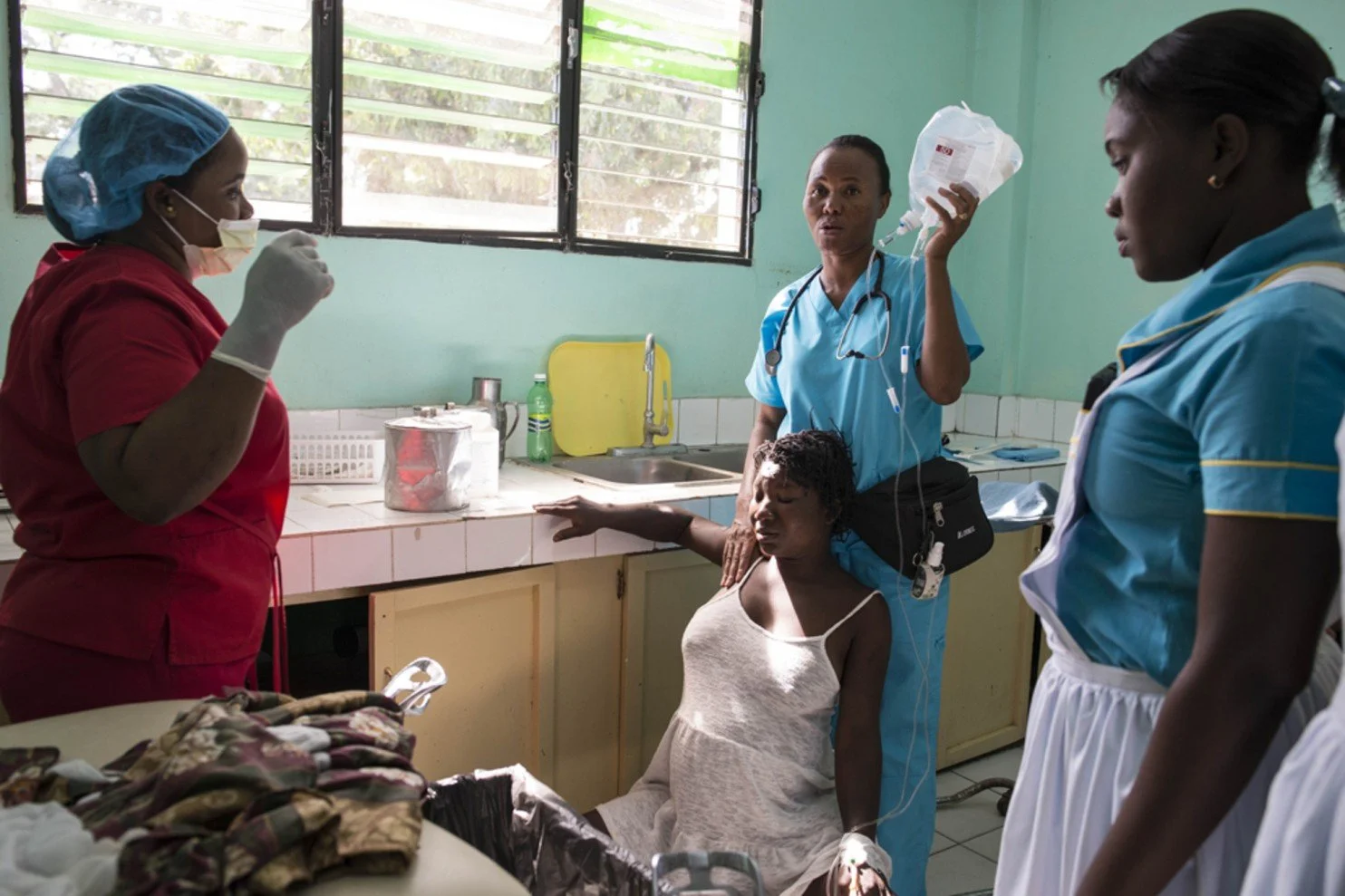
“I saw a lot of women who died during delivery, but I did not know how to help them.”
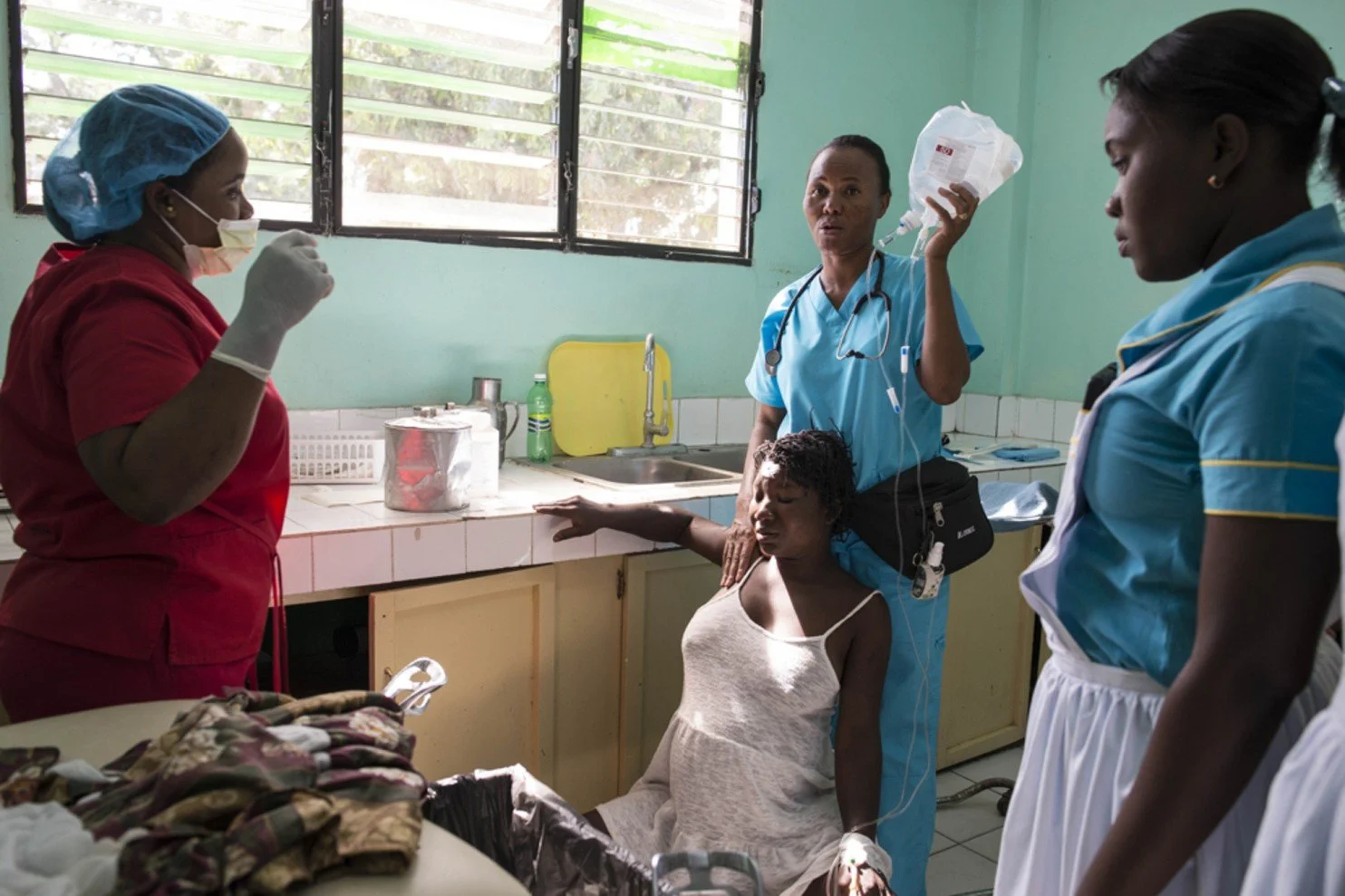
The maternity ward at St. Therese Hospital in Hinche, Haiti, doesn’t have running water. Waste is collected in buckets. When the electricity cuts out, as it does throughout the day, the midwives put on headlamps and keep on delivering babies. Nurses use antibacterial gel sparingly, not knowing when the next shipment will arrive.

The staff is small and overworked. The country has just one midwife for every 50,000 people, according to the United Nations Population Fund. And the lack of resources shows up in the statistics: Haiti has the highest infant mortality rate in the Western Hemisphere.
“I saw a lot of women who died during delivery, but I did not know how to help them,” midwife Juslene Regulus says between rounds one afternoon at St. Therese. “I have a cousin who died during delivery, and I said to myself that if I had the skills of a midwife, I could help her. That’s why I got into midwifery.”
Regulus was trained through a program operated by Midwives for Haiti. With funding from Every Mother Counts, a New York-based nonprofit founded by Christy Turlington Burns, and other donors, the program is working to change the statistics by training skilled birth attendants. Having skilled care at birth is considered the most important intervention to make childbirth safe.
Haiti’s infant mortality rate was 52.2 per 1,000 live births, according to a 2016 United Nations report. (The U.S. rate was 5.6.) The maternal mortality rate was 359 per 100,000 live births, the United Nations Population Fund reported in 2015. Although the infant mortality rate has been dropping since 2000, progress was hampered by the 2010 earthquake that destroyed the country’s only school for midwives, which also killed many health-care workers and led to the emigration of others.
Only 67 percent of women receive prenatal care, and only 37 percent have a skilled attendant at delivery, according to Countdown to 2030, a global health-care collaboration.
Midwives for Haiti, which has six Haitian teachers and help from visiting volunteers, has trained 124 birth attendants; another 32 students are in a year-long class that will graduate in 2018. Students are taught at St. Therese, as well as at mobile clinics.
 Early one morning, the current class begins the day by singing and praying. Then they settle down to learn about pain management for women in labor.
“Many people are suffering in Cabestor, where I’m from,” says one of the students, Sheila Pasquet.
After completing the program, Pasquet and other midwives will work in places such as Cabestor, a remote community where the maternal mortality ratio is roughly three times the national average and where about 1 in 5 children don’t make it to their fifth birthday. Mortality began to decrease there, Pasquet says, after a birth center was built.
The Cabestor center is run by Eclide Michel, a Midwives for Haiti graduate. She makes daily rounds to mothers who have recently given birth, sometimes walking up to two hours to remote locations.
Before the clinic opened, women seeking a skilled birth attendant would have to walk up to four hours and cross 20 rivers and streams to reach the nearest hospital.

“The terrain is so difficult that the women are carried down to the birth center by stretcher,” Pasquet says.
The students get practical and classroom training, learning how to educate women about pregnancy. Each morning a team piles into a truck that leaves Hinche for rural areas that don’t have medical professionals. They set up folding tables in the village square, where they offer lessons in family planning and suggestions for how pregnant women can monitor their health.
Eventually, they hope, their folding tables will be replaced by new clinics. By Wendy Galietta July 24

Diri djion djion (black mushroom rice)


Ingredients
- 2 Cups of Dried Black Mushrooms (djon djon)**
- 3 garlic cloves minced
- 2 tablespoons olive oil
- 1 small onion chopped
- 2 cups long-grain rice
- 2 teaspoons salt
- 1 tsp Ground cloves
- 1 (12-ounce) can lima beans (or green peas)
- 1 to 2 thyme sprigs
- 1 green Scotch bonnet pepper

** If you don't have the dried djion djion, some super market sales the GOYA cube djion djion. Skip the first 3 steps. Boil the cubes in the water until it dissolve before adding the rice**
Method
- In small pot, soak mushrooms in 4 cups water for 10 minutes.
- Boil mushrooms on low heat for 10 minutes.
- Strain the mushroom water into another container for later use. The mushrooms in the strainer will no longer needed.
- In a large pot, sauté the garlic and onions on medium heat for 2 minutes.
- Next, add the mushroom water, salt, cloves
- Add the rice
- Bring the water to a boil and reduce the hear when most of the water evaporates (approximately 10-15 min) then add the lima beans- Stir the rice, set the temperature to low.
- (optional) Add Scotch bonnet pepper and thyme.
- Cover the pot and steam the rice for 15 min.
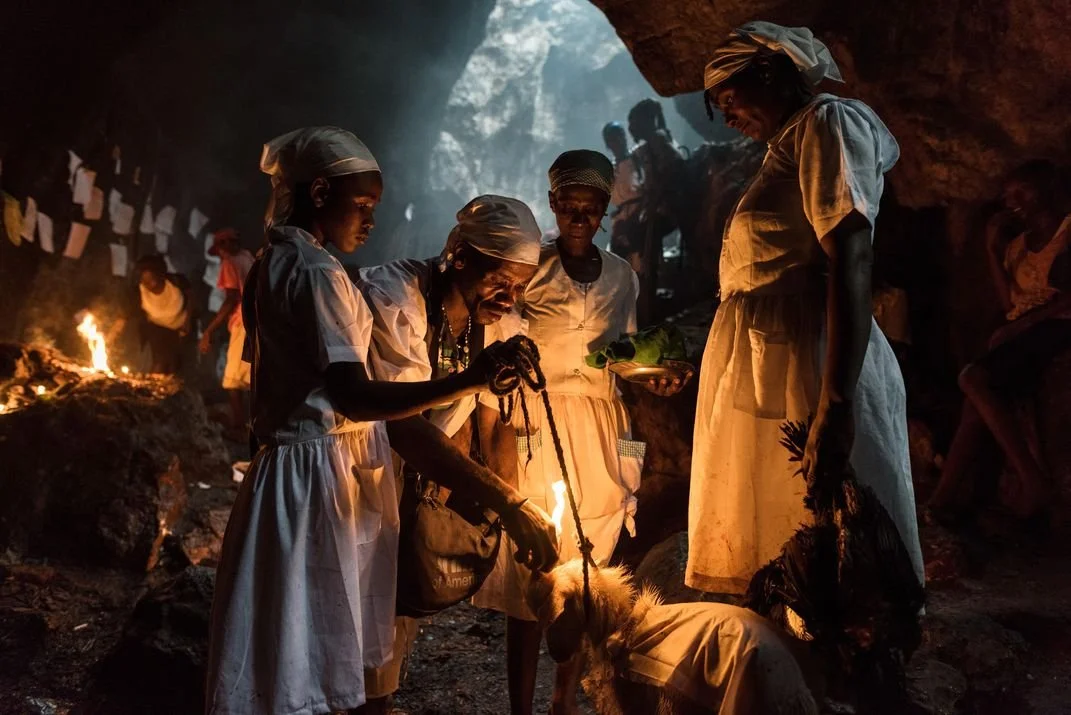
Explore the Timeless World of Vodou, Deep Within the Caves of Haiti
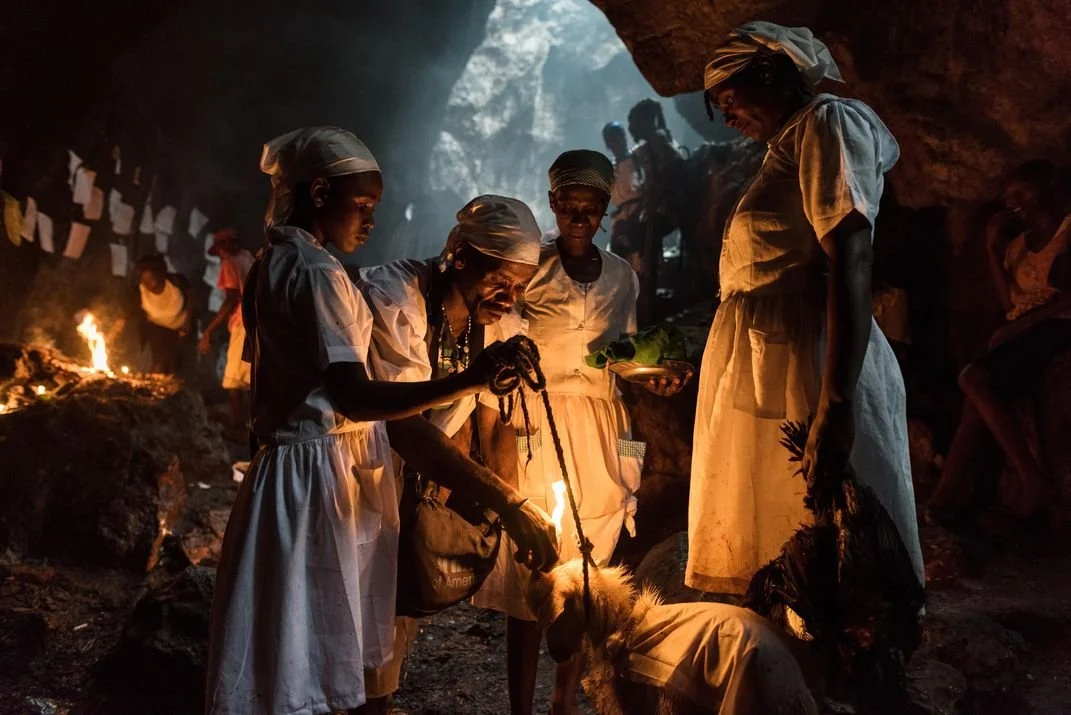
Written by: Jonathan M. Katz Dressed in white, symbolic of their purity, Voduisants begin a ceremony by reading prayers of thanks aloud with a priest. (Photo by: Troi Anderson)It was the height of the summer solstice, the brightest day of what had already been a long, hot year in Haiti. But deep within the caves outside Saint-Michel de l’Attalaye, beneath the mountain-ringed northern edge of the island nation’s central plateau, there was no light. Troi Anderson had to feel his way along the cool limestone walls and follow the worshipers’ singing to find his way to the Vodou ceremonies below. A photographer based in Oregon, he had come for the pilgrimage of St. John, an annual event that generally draws hundreds of participants.
Vodou has roots in the religious traditions of West and Central Africa, where most Haitians’ ancestors were born, and in the Roman Catholicism of European colonizers in Africa and the French who colonized the western third of the island of Hispaniola in the 17th and 18th centuries. Its beliefs and practices were forged in one of the most brutal slave regimes the world has known.The religion honors a supreme creator god who is considered too remote to reach directly. Worshipers venerate intermediary spirits, such as the orisha gods of the Yoruba people who inhabit what is now Nigeria, Benin and Togo, and figures from Haitian history. The faith is decentralized. It is practiced creatively, not prescriptively, which helps to account for the differing forms practiced elsewhere, such as in New Orleans. Like many great religions, throughout its history Haitian Vodou has provided both solace and an intimate sense of community to the oppressed.
This sense of Vodou as a primitive practice also shaped American impressions of Haiti. The U.S. military occupied the country from 1915 to 1934, during a formative period in the U.S. empire-building in Latin America and Asia. Marines who served on the island, and journalists who covered them, returned with lurid tales of what they called “voodoo” and characterized as black magic. Pop-culture distortions, in both books and films, weren’t far behind. In 1932, the year after Bela Lugosi starred in Dracula, he played an evil sorcerer in Haiti named “Murder” Legendre in White Zombie.Read more: http://www.smithsonianmag.com/arts-culture/explore-timeless-world-vodou-haiti-180963673
![Women's Football U-20 : Cuba defeated by our Grenadières [3-1]](https://images.squarespace-cdn.com/content/v1/68e70239ce60bd21b04f1e3f/1765740153131-K12YUMA22N9Z9GL9B89B/image-asset.jpeg)
Women's Football U-20 : Cuba defeated by our Grenadières [3-1]

On Sunday, as part of the first phase of the CONCACAF U-20 qualifiers for the U-20 Women's World Cup (FIFA), which will take place in France from 7 to 26 August 2018, our Grenadières in Group A, led by Nerilia Mondésir, faced on the lawn of the national stadium Sylvio Cator the Cuban team, only major opponent for our National Selection.After two easy wins [16-0] against Anguilla http://www.haitilibre.com/en/news-21576-haiti-women-s-football-u-20-grenadieres-without-mercy-crush-anguilla-[16-0].html then [7-0] against Dominica http://www.haitilibre.com/en/news-21594-haiti-news-zapping.html our Grenadières defeated the Cubans [3-1]. For Haiti the goals were scored by Nerilia Mondésir [27 ', 56'] and Sherly Jeudy [45 ']. For Cubans the goal was scored by Lilian Perez [11 ']Our Grenadiers with their ticket in their pocket, now continue their way to France with the next elimination phase that will be played in Trinidad in January 2018.Also Saturday evening in Abidjan (Ivory Coast) national U-20 men's team taking part in the football tournament of the VIIIth games of the Francophonie, did Draw [1-1] against France. While the French led [1-0] Stevenson Guillaume of the Racing des Gonaives equalized for Haiti. The Grenadiers will play this Monday 2:00 pm (10:00 am Haiti) during their match against the Democratic Republic of Congo at the Abidjan Sports Palace.In Haiti, the Camp-Nou Academy of the Haitian Football Federation shone in Minnesota by winning the U-17 category of the USA CUP 2017 after sweeping everyone in its path !Finally, note that it is this week that will begin the Presidency Cup, which will take place in 63 regions and cities of the country With the participation of 80 clubs, from the D3 to the elite via the D2.BF/ HaitiLibre 24/07/2017

Skal Labissiere went to Haiti. Why the Kings forward says it was important to go home

Traveling is not allowed in basketball. However, for some Kings players this offseason, that word has taken on a much different meaning.Days after Sacramento center Willie Cauley-Stein visited Vietnam to work on his painting skills, another Kings player got on a plane and traveled to his homeland.In a feature he wrote on the team’s website, Kings forward Skal Labissiere discussed his first trip to Haiti in almost seven years.He recalls the massive earthquake in Haiti that killed more than 200,000 people in January 2010. He also talks about family and friends, his faith and starting a youth basketball camp.
“I was one of those kids growing up who always wanted some guidance, wanted to talk to people in the NBA,” Labissiere said in a video posted on the Kings’ YouTube page. “For me to go back and help the kids ... I just want to be an inspiration to them.”He said that although he’d teach skills on the court, he wanted to do more with the children.“After all, it wasn’t so long ago that I was in their position – roaming the streets of Haiti looking to make my dreams come true,” he wrote. “Whether future basketball stars or not, these kids are going to make Haiti proud. It’s bigger than basketball.”Labissiere left for Haiti after playing with the Kings in the NBA Summer League, which ended Monday in Las Vegas. The forward who will begin his second NBA season in 2017-18 averaged 10 points, five rebounds and 1.5 blocks in six summer league games.Another Kings player had an opportunity to travel to his native country this offseason, but decided that work comes first.Kings guard Buddy Hield was invited to the Bahamas to participate in the Basketball without Borders Camp but opted to stay stateside to play in the summer league.“This is my job,” Hield told The Bee before summer league began. “I’ve got to be here. This is more important.”BY NOEL HARRIS JULY 20, 2017

Haitian Immigrants With Temporary Status Await Trump’s Next Move

Jean Jubens Jeanty, a Haitian Uber driver who lives in Brooklyn, has his future mapped out. After completing a high school diploma program at Brooklyn College next month, he plans to start college next year. He would then seek further schooling to become a nurse or pediatrician. But the clock is ticking on his plans.Mr. Jeanty, 29, came to the United States from Port-au-Prince in September 2006 with his eldest brother and stayed after his tourist visa expired. He has what is known as temporary protected status, or T.P.S., which was granted to Haitians who were visiting the United States or living here illegally when a devastating earthquake struck their homeland in 2010. T.P.S. allows him and other Haitians to live and work legally in this country, until conditions in Haiti have improved enough to return home safely.Now, the Trump administration is monitoring earthquake recovery efforts to determine whether temporary protected status for Haitians should be terminated in January when its recent six-month extension ends. The Homeland Security secretary, John F. Kelly, said in a news release in May that Haiti has been making significant progress, advising T.P.S. holders to begin to “prepare for and arrange their departure” should the special designation end in January.That advice has left Haitian T.P.S. holders — as many as 58,000 in the United States, with 20,000 in New York — mired in fear. Some who have established lives here said they feared losing their dreams. Others who have lived in the United States for many years may find it difficult to adjust to life in Haiti, the Western Hemisphere’s poorest country. And those with American-born children could be parted from them.“I basically grew up here,” said Bianca, 22, a senior at Queens College, part of the City University of New York, who asked to be identified by her middle name because of her uncertain immigration status. “It’s very nerve-racking in a way. It’s very unsettling to know that you’re here and you don’t know what tomorrow is going to bring, or what is going to happen in the next couple of months.”Bianca came to the country in 1998 with her mother and brother on a tourist visa, and they overstayed their time. Her father, who also has T.P.S., later joined them. She has two siblings, 14 and 18, who are United States citizens. Bianca, an aspiring educator, studies English literature and expects to graduate in December. At CUNY, the country’s largest urban public university system, there were 60 students with T.P.S. last school year, the university said.Congress created the T.P.S. program in 1990 to aid countries ravaged by war, natural disasters or catastrophic events that make it too dangerous for citizens to return. Their status is renewed periodically, and recipients have to keep their permits updated to avoid deportation, at a cost of $495. Under the Obama administration, Haiti’s T.P.S. permits were reviewed every 18 months, with the current extension ending today. In May, the Trump administration said the next extension would be for six months, ending on Jan. 22, 2018.The program was created to provide temporary aid, but some designations have stretched as long as two decades. Immigrants from Honduras and Nicaragua have been allowed to stay in the United States since 1999, when Hurricane Mitch devastated their countries. The United States currently provides T.P.S. to more than 300,000 foreign nationals from 10 countries.Emmanuel Depas, a lawyer who is Haitain-American and assists T.P.S. recipients, said Haiti is far from ready to take its citizens back. Mr. Depas said the country’s dire condition had been exacerbated by a cholera outbreak caused by a United Nations peacekeeping force, which killed 10,000 and sickened nearly a million, and by Hurricane Matthew last year, the biggest storm to hit Haiti in 50 years.“Haiti just got a president in 2017,” Mr. Depas said, noting that the country had had months of political instability. “To say that the country is ready to take its people back is asinine.”Mr. Depas said some T.P.S. recipients have decided not to renew their status for fear of giving immigration authorities information that could locate them should the program end.But Ira Mehlman, a spokesman of the Federation for American Immigration Reform, which supports stricter immigration controls, said the decision on whether to extend the program should not center on subsequent misfortunes. Mr. Mehlman argued that T.P.S. was intended only to “give some people a ride out of the circumstances in their countries” temporarily.“At some point, we expect you to go home,” Mr. Mehlman added. “To simply say we are going to keep expanding it, then it’s no longer temporary. It’s a backdoor immigration system. There seem to be some expectations that the countries have to be a paradise before we send people back home.”Though the Trump administration has taken a hard line on illegal immigration, Nisha Agarwal, commissioner of the New York City Mayor’s Office of Immigrant Affairs, said “there’s still time and ability to influence” Mr. Trump’s decision. But the “pack your bag type of messaging immigrants are hearing from the federal government” is discouraging, she added. Ms. Agarwal said her office was assisting T.P.S. holders with legal support and urged them to prepare regardless of their expectations.Support for extending the program for Haitians crosses party lines: Gov. Rick Scott of Florida, a Republican and Trump ally, also wants to see their T.P.S. eligibility extended. Florida has a large Haitian population.Ending the program would deal a significant blow to a lifeline of Haiti’s economy: remittances. Haitians in the United States sent $1.3 billion back to the island in 2015, according to the Pew Research Center.As for Mr. Jeanty, he is hoping that immigration authorities will grant a longer extension in January. “A person like me who is working and paying taxes, going to school and have nothing on my record — why not keep me here?” he said. “I have nothing to go back to.”By Khorri Atkinson | July 21, 2017
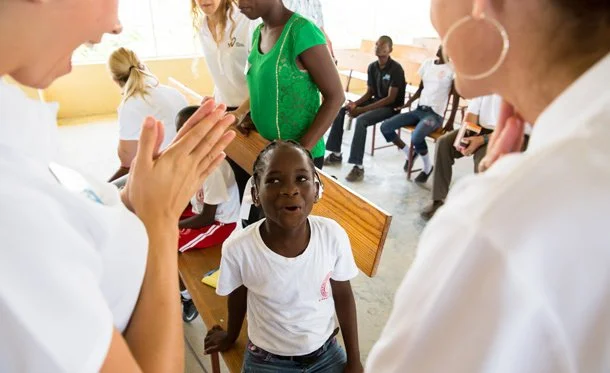
Organization Works to Help Haitian Youth with Hearing Loss
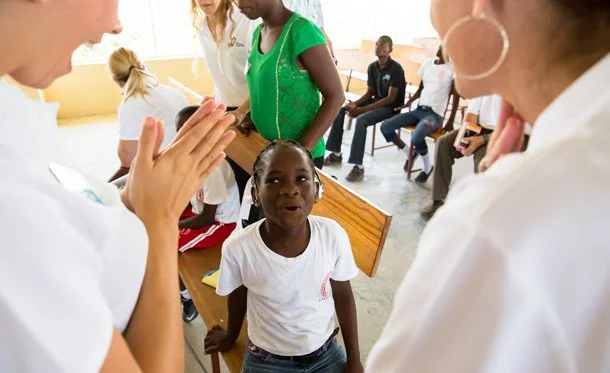
ADVOCACY Hearing loss or deafness can be devastating for a child, but in Haiti, they can be far more limiting than in the United States.The day we know that Joulie heard her first sound, she was already 8 years old.At 8 years old, Joulie would have probably enjoyed hearing a bedtime story from her mother, or saying goodbye to her sisters on her way to school each morning. At 8, she might have had a growing group of friends with whom she could have giggled and whispered secrets. She might have also had a chance to dance to her favorite music, and maybe even start playing an instrument.
Monstrous obstacles
But Joulie’s childhood was very different. She was born with hearing loss in Haiti. Families all over the world rally around children who are deaf or suffer from hearing loss, but for the multitudes of children in Haiti who are affected by this condition, the hurdles are often insurmountable due to the extreme poverty and lack of health care in the country.The Hear the World Foundation has partnered with several organizations, including the Haiti Deaf Academy and the Commissioned Believers Deaf Ministry, to set up a long-term project called Hear Haiti.This program is designed to provide early diagnosis for Haitian children with hearing loss through comprehensive hearing assessments, and to provide repair and maintenance services for existing devices. The Hear Haiti program also supports training for local residents to continue the work of providing follow-up care, a program feature that creates sustainability.As part of the program, teams of volunteers from the Sonova Group, the corporate parent of the Hear the World Foundation, travel to the region multiple times a year to provide services and train new hearing care providers.
A Brighter Future
Today, Joulie is flourishing with her newfound abilities to reach out to others. When her device was first turned on, she was excited to listen to every new sound that she could. Now, she can sign amazingly well. Best of all was the day she went home and said "Momma" to a woman that likely never believed she would hear those words from her child. Thanks to Hear Haiti, Joulie and many other children on this island will have a chance to live an abundant life and fulfill their promise, and maybe be part of leading their country into a new and brighter future. Haitian youth get help with hearing loss

Griot (Fried pork)


Ingredients
3 lbs of pork shoulder (cut into cubes/pieces)3 cloves2 garlic cloves1/4 cup of parsley1/2 cup onions2 teaspoons salt2 teaspoons black pepper1/4 cup green pepperpaprika2 lime (cut in half & juiced)1 or 2 habanero peppers3 to 4 cups of water4 to 5 cups of vegetable oildeep fryer2 sheets of paper towel
How to clean and Marinate Pork
Blend habanero pepper, parsley, onion, cloves, garlic and paprika into a paste with about 1 tablespoon of lime juice, then set aside. In the sink, rub pork with limes rinse with cold water. In a medium sized bowl, add pork, lime juice, paste of ingredients and mix with hands. Cover and refrigerate for 45 minutes to 24 hours.
Directions
In a saucer pan, add water, marinated pork and boil until tender, probably 30-45 minutes. Heat oil in deep fryer. Separate pork for liquid and set pork aside, do not discard liquid. Separate pork into batches for frying and fry until a light dark brown color. Set aside on paper towel. Once all the batches are completed you can used liquid as sauce for the rice or fried plantain.
Garnish with pikliz!
Enjoy
(Pikliz recipe is up)