
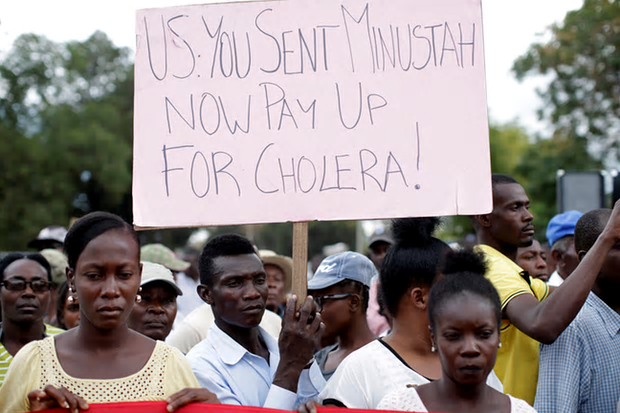
In June, the UN secretary general, António Guterres, asked member states to allow him to repurpose $40.5m (£30m) of leftover money to the Haiti cholera fund, which he said could have an “immediate impact in saving lives”.The appeal to reallocate unspent money designated for Haiti in 2015-16 has met with strong resistance from major donors. None of the five UN security council’s permanent members, which includes the US and the UK, approved the proposed funding reallocation. The UN Haiti cholera multi-partner trust fund, which gathered more than $2m, now lies almost empty.Brian Concannon, executive director of the Boston-based Institute for Justice and Democracy in Haiti (IJDH), said: “We have had conversations with the UK about cholera for years. They have been saying, ‘This is a matter of principle and we need to expect the rule of law.’”“Now that the money is on the table, the fact that the UK is not reallocating it is very concerning. No one else is going to step up.”Concannon, who was in the UK this week to meet the all-party parliamentary group on Haiti, said: “We’re asking the UK to take a leadership role in the UN security council. All the [permanent security council members] spend hundreds of millions of taxpayers dollars on the UN. But the UN is flouting its legal responsibilities towards the people of Haiti on cholera.”The UN only admitted its role in the outbreak last year. Former UN secretary general Ban Ki-Moon issued a carefully worded apology and said that the UN and member states had a “moral obligation” to relieve the Haitian suffering. The agency promised to raise $400m from member states to provide assistance to the Haitian victims. Since the fund was set up, however, only about $2.6m has been collected. The UK has donated $623,000 to this fund. Its share of the unspent $40.5m would be more than double that amount, at $2.3m.The IJDH works with thousands of cholera victims through the Bureau des Avocats Internationaux, a Port-au-Prince based human rights law firm. A lawsuit the groups filed on behalf of 5,000 cholera victims in a New York federal court in 2013 was dismissed by a judge, on the basis of UN immunity. After an appeal, the UN second circuit court of appeals in New York upheld the decision in 2016.Concannon is also working with the US Senate, to mobilise support for reallocating the funds. Democratic and Republican lawmakers have in the past criticised the Obama administration and the UN for failing to ensure Haiti’s victims were helped.Concannon said it was “shameful” the UN couldn’t come up with even a tenth of the amount originally promised. “The underspend idea wasn’t supposed to be the end result, but low-hanging fruit.“People in the UK or the US can forget about people in Haiti, but the people in Haiti cannot forget people in the UK or US.”Mario Joseph, a lawyer with BAI, said: “Imagine what would have happened if the Nepalese had brought the disease to the UK? What would be the reaction here – would there be the same disregard as people have shown the people of Haiti? For that reason alone, the UK should take a leadership role.”A Foreign and Commonwealth Office spokesperson said: “The UK recognises the devastating impact that cholera has had on the Haitian people, and we welcome the crucial role the UN is playing to eradicate it. The UK is the fourth largest donor to the UN trust fund, in addition to other contributions to tackling cholera in Haiti.“It is for each UN member state to decide how to use returned unspent peacekeeping funds. We call on all countries to volunteer contributions to the UN trust fund from whatever source is appropriate for them.”By: Karen McVeigh for TheGuardian.com | November 2, 2017
'Shameful': UK and US Under Fire Over Blocked Funds For Haiti Cholera Victims
China, France and Russia also among major UN donors resisting appeal to spend $40m of UN money on victims of cholera epidemic, claim lawyers
Haiti's First Female-Directed Movie Bids For Oscars
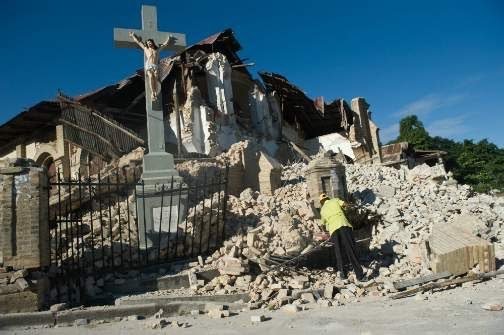

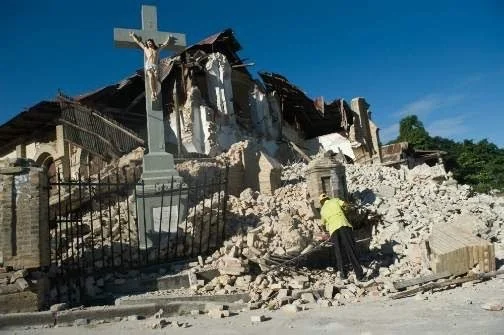
Set in Kabic, a small southeast fishing village where the sea is gaining ground thanks to climate change, Felin's camera shows life moving on, five years after the earthquake.A teenager grieving his father discovers he has developed a literally electrifying superpower while an old fisherman who talks to his cow thinks the cure for his ailing wife can be found only in the sea.Elsewhere, the beautiful, mysterious muse of a struggling novelist and the main character in his book, becomes restless and decides to leave him and pursue her own life.Born in Port-au-Prince, Felin divided her childhood and adolescence between New York and Haiti, although she came of age artistically in Paris, where she studied for a graduate degree in film and ended up staying 20 years.Felin fell in love with cinema at the drive-ins of Port-au-Prince, her escape during the brutal dictatorship of Francois "Papa Doc" Duvalier, who was followed by his despotic son Jean-Claude, or "Baby Doc.""I grew up in this space knowing that the dictatorship existed, but at the time it was a space of joy," she said, recalling her childhood home as a place of music and parties."There were moments where you were totally afraid someone might get taken away. So the fragility of life — that dance that my parents had to do all the time — totally inspired me.""Ayiti Mon Amour" — which is looking for a US distributor — stars just one professional actor, while the rest of the cast and much of the crew were culled from the local community and Felin's own family.Her French husband, veteran cinematographer Herve Cohen, was in charge of filming and her oldest son Yeelen acted as her assistant, while his girlfriend performed second camera duties.The real star of the movie, though, is Felin's youngest son, Joakim Ethan Cohen, a 17-year-old beginner at the time of the shoot who has won acclaim for an accomplished debut performance."He knew that what he was doing meant a lot to me. It was like his gift to me," said Felin."I directed him but it was so easy — every take was really good — and I think he knew the story inside out."Haiti's film industry was already struggling before the earthquake. Its last picture house closed the year before amid rampant film piracy, and no movies were publicly screened anywhere for five years after that."It's hard to make films in a place like Haiti because there's always something that happens that's prioritized, whether its political instability or there's a disaster or something like that," Felin said."Filmmaking is really not a priority for the Haitian people.""Ayiti Mon Amour" was born out of the rubble of buildings levelled by the quake but Felin, who lost a close friend and says she feels "survivor's guilt," didn't want her movie to be just about grief."I kind of like to say that it's a love letter to this place, because it's a place at the same time that frustrates me, haunts me and angers me," the director said."But I'm deeply, deeply passionate about it."By: JamaicaObserver.com | November 1, 2017
Haiti & New Orleans: Is The Feeling Mutual?
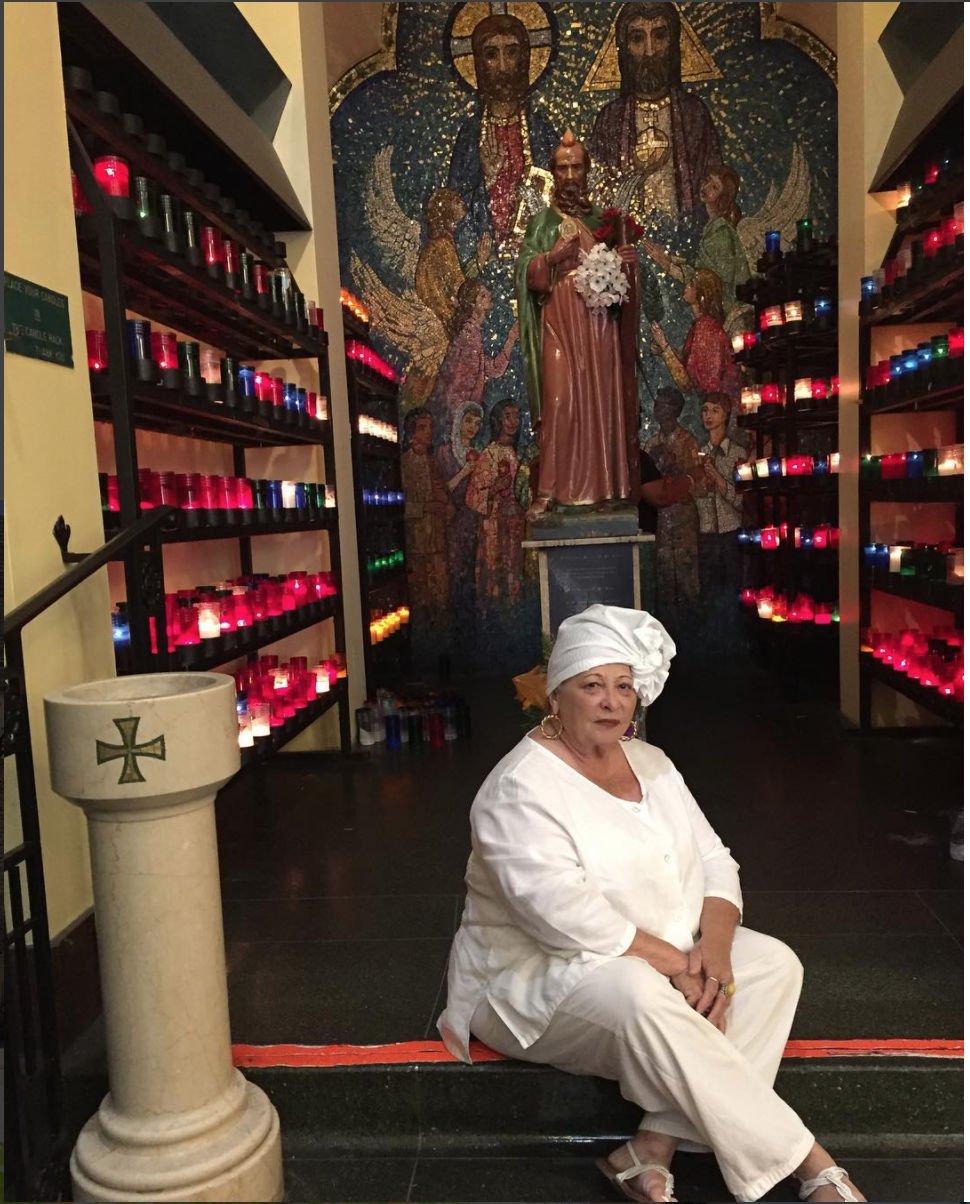
By "we," Barbara means native New Orleanians. And then, as if it was a setup, Barbara turns to a woman sitting a few pews behind her, and asks, "You have ancestors from Haiti?"The woman replies that she does not, but has friends that do. "Do you know the Burns? Or the Dumas?" responds the woman. "Yeah!" said Barbara. Those families come from Haiti, the woman responds. Barbara smiles and says "Ha! Same tribe, Same tribe."Barbara’s relatives leaving Haiti and making their way to New Orleans, is part of a larger migration of people fleeing Haiti during its revolution at the turn of the 19th century. The Haitian Revolution is the only successful rebellion by enslaved people in the Americas. And when it ended, and Haiti became independent, thousands of white, free black, and enslaved people -- fled or were forced from the island. Most went to New Orleans and Cuba. Then, a few years later, those same Haitian refugees that went to Cuba were expelled from Cuba, so they also came to New Orleans. This was 1809, when 10,000 Haitians arrived, and doubled the population of the city. This is partly why so many New Orleans families today are people of Haitian descent. And why a creole culture, born from African and European ancestry, define both places, and bind them together.They’re these similarities in heritage and homelands, and there’s also the architecture, religion, music, dance, food, carnival, and vulnerability to natural disaster. For all these reasons, Barbara believes Haiti is part of her city’s identity, and says other New Orleanians do, too. I’m not a native New Orleanian, but a lot of locals associate this connection with who they are as people. Even all these generations later. There’s this saying that New Orleans is "the northernmost point of the Caribbean," that basically comes from the city’s relationship with Haiti, and is one reason why New Orleans fancies itself part of the Caribbean, and Haiti, in particular, something of a sister city. But is New Orleans just fancying itself? Do Haitians think of New Orleans this way? Do they think of New Orleans at all? These two places were tied at the hip 200 years ago, But where does their relationship stand today?This story is told in three parts: The history of the original connection between these two places, what happened over time, and what the future can hold.PART I: The One-Way TripAndre Paultre belts his brains out behind the wheel of his forest green 4runner as it shakily bumps down a dirt road. Andre’s what’s called a fixer, he works with reporters when they travel to Haiti. We’re driving to a city called Jacmel, about three hours south of Port-au-Prince.
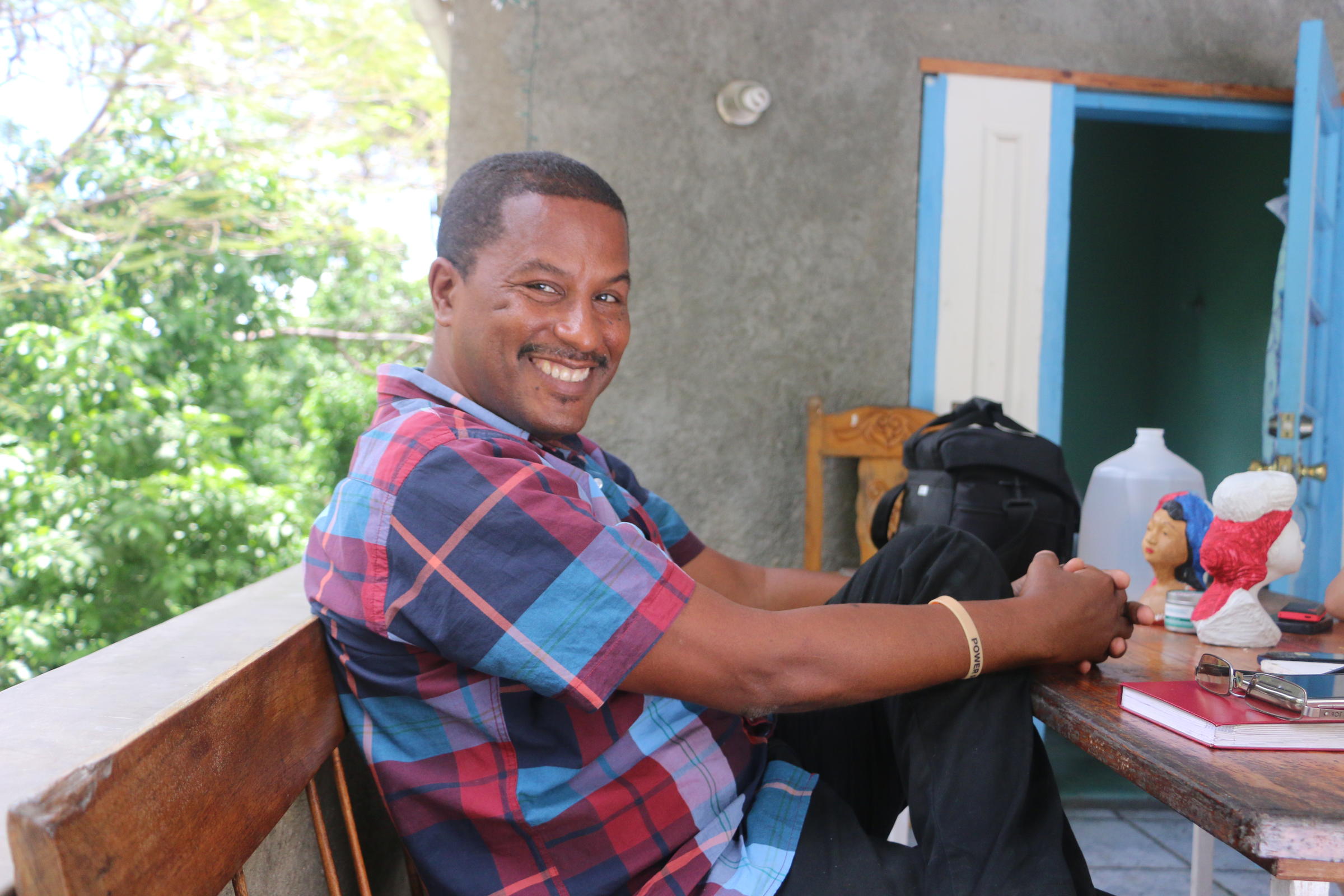
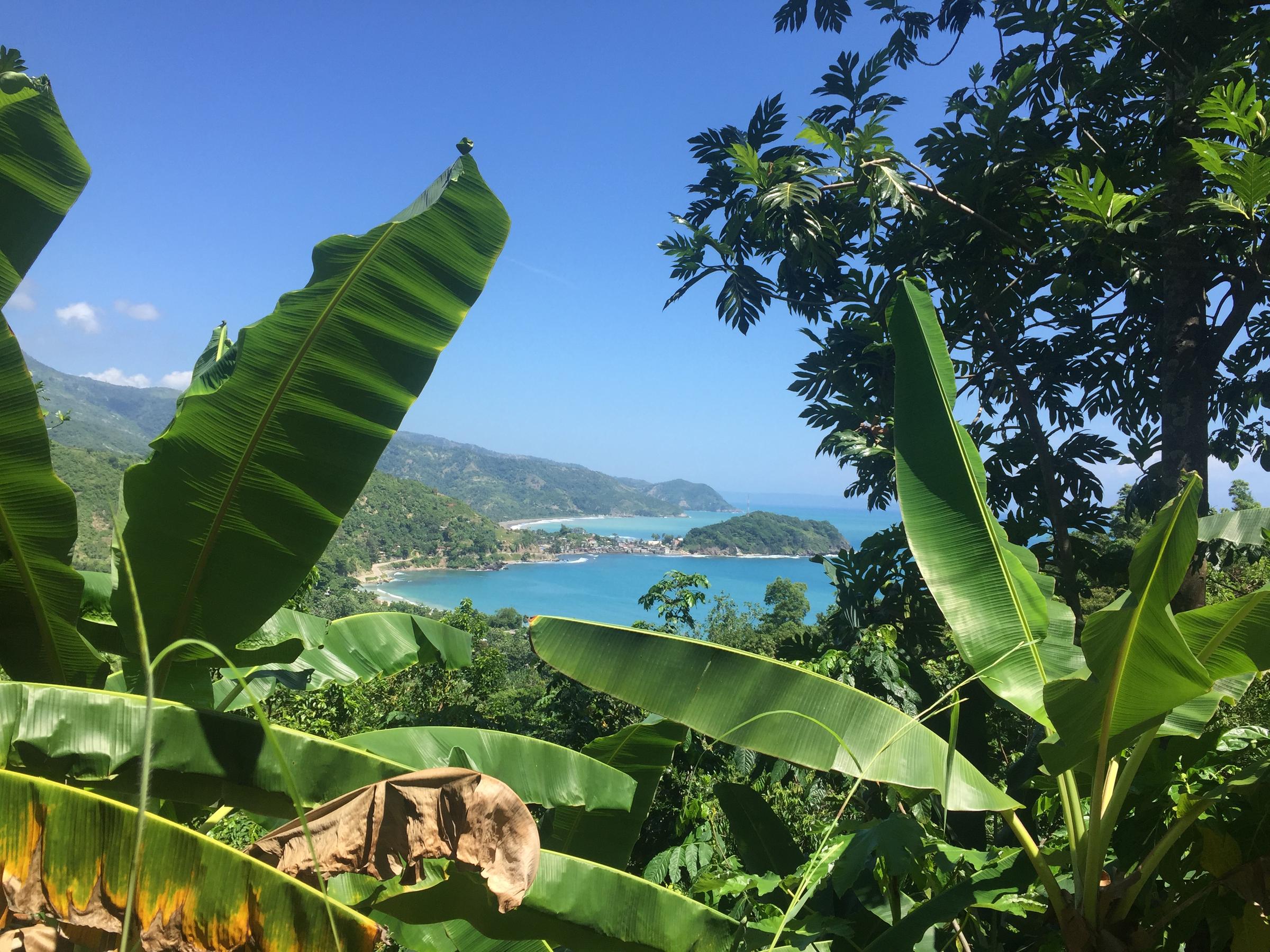
Jacmel is right on the coast, and feels like a beach town, surrounded by lush, green mountains. It gets more tourists than Port-au-Prince these days, not only because there are beautiful beaches, but because Jacmel is known for its Carnival celebration. The city is famous for its paper maché Carnival masks that people collect year round, and no matter when you visit, you’ll find artists painting them as you walk through the streets.We arrive at our first stop, and meet our tour guide for the day, Jean-Elie Gilles. He’s an opera singer, a professor, and the author of many books about Jacmel. He leads us towards the Florita Hotel, where he orders a round of drinks.
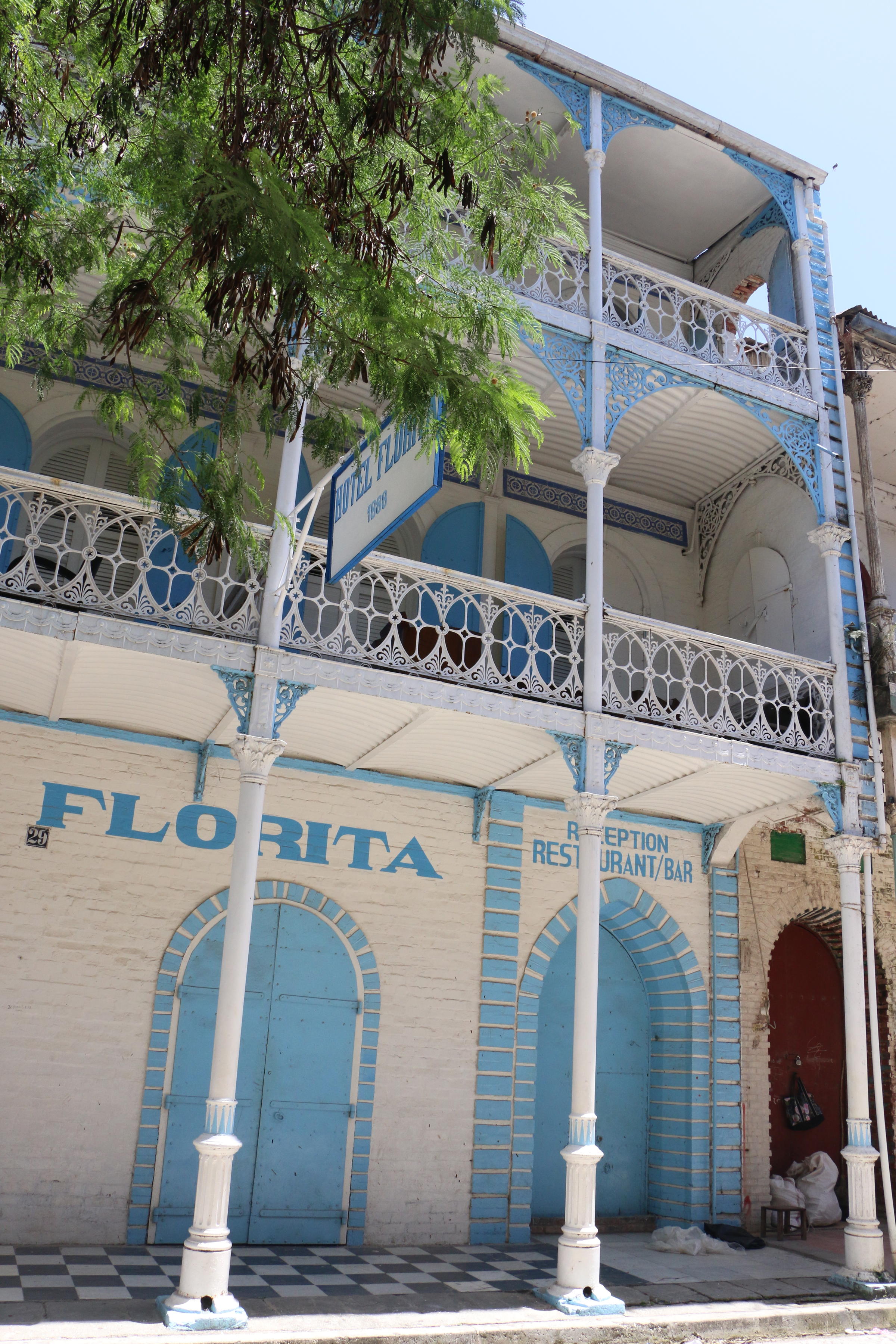
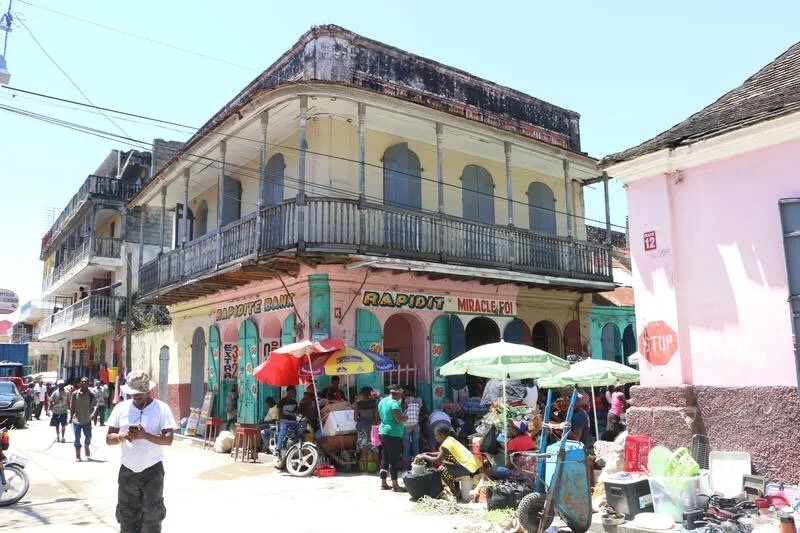
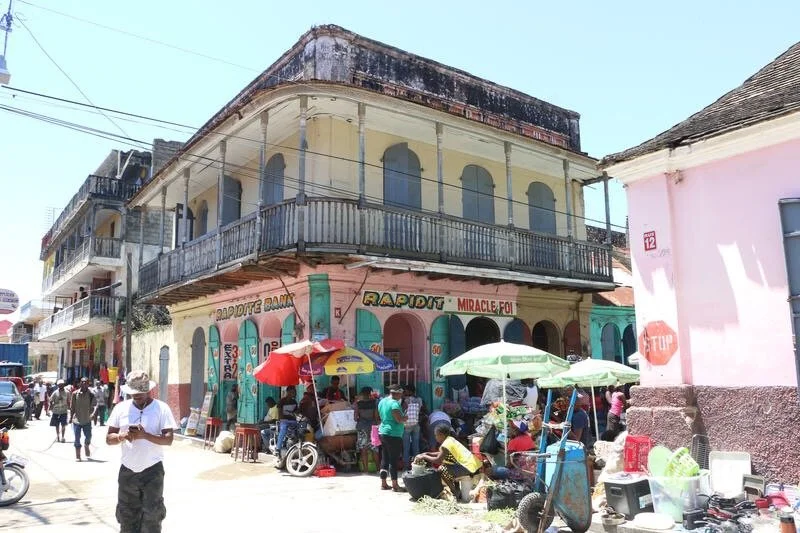
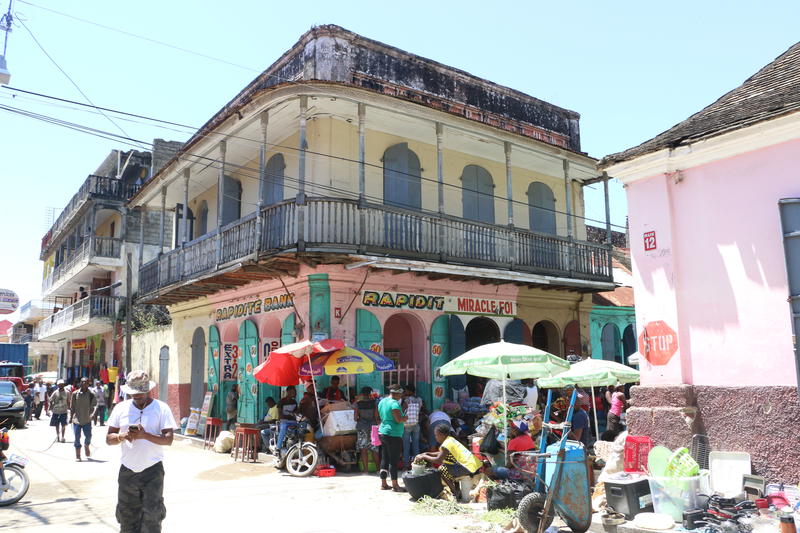
"The best rum sour is here in Jacmel, in Florita hotel," Jean-Elie says. It’s the best rum sour in Haiti, because this guy has a secret of doing something, I don’t know what! But it is good."That rum sour wasn’t the only reason Jean Elie brought us to the Florita Hotel. First of all, it’s beautiful -- the exterior is painted a cream-colored brick, the doors sky blue. Slim columns support an iron-lace balcony off the second floor that have huge ferns with water dripping through the bottom of their planters down to the curb. Everything about it looks exactly like what you would find in the French Quarter.It’s not just the Florita Hotel. Most of Jacmel is built in the same colonial style seen in the French Quarter, the Treme, the Marigny, and all over New Orleans. Two story buildings with wrought iron railings stuffed with hanging ferns. Bright colored shotgun houses, creole cottages. It was like a spitting image. To literally see the connection through this architecture was almost dizzying."This is what remains from that connection with Jacmel, and New Orleans, and Louisiana," says Andre, meaning this is what remains of that connection. Which makes it seem like something happened to this connection, something’s changed. But when did this connection start in the first place? Where does this shared history begin?Let’s start with the Haitian Revolution, says Henry Robert-Jolibois, an architect and historian who lives in Pétion-Ville, a wealthy suburb about 20 minutes -- or two hours -- south of Port-au-Prince, depending on the traffic. Most people who can afford it, choose to live in Pétion-Ville over Port-au-Prince. Unlike most towns in

Haiti, Pétion-Ville’s got sushi restaurants, yoga studios, iced coffee, and has its own private trash pickup service. It’s a stark contrast from Port-au-Prince, where poorer residents often get rid of their trash by burning it on the side of the road. This type of disparity is not new to the island."Well, everybody wanted their freedom," says Henry. Before Haiti was Haiti, it was a French colony called St. Domingue. Sugar and coffee ruled, and made the colony wealthy, on the backs of thousands of enslaved Africans. By the 1760s, St. Domingue was the most profitable colony in the Americas. This prosperity came at the expense of brutal, often fatal labor in the fields. Large numbers of enslaved people fled the plantations for the mountains, where they established maroon colonies. And started planning a revolution."The revolution started with the French Revolution," Henry says. When the French Revolution began in 1789, there was lots of division, to put it mildly. Some whites in St. Domingue opposed the Revolution in France, while others supported it in hopes of gaining the colony's independence. The free people of color, or gens de couleur, pressed for the equal rights that French Revolution seemed to promise. Then there were the enslaved and maroon populations -- which by the way, outnumbered whites on the island 10 to one -- they saw this political crisis as an opportunity to strike for their freedom. Which led to The Boukman Eksperyans, what’s widely considered the start of the Haitian Revolution. This happened in 1791, when a vodou priest named Dutty Boukman led a religious ceremony to kick off the first successful slave rebellion in the northern part of the colony.
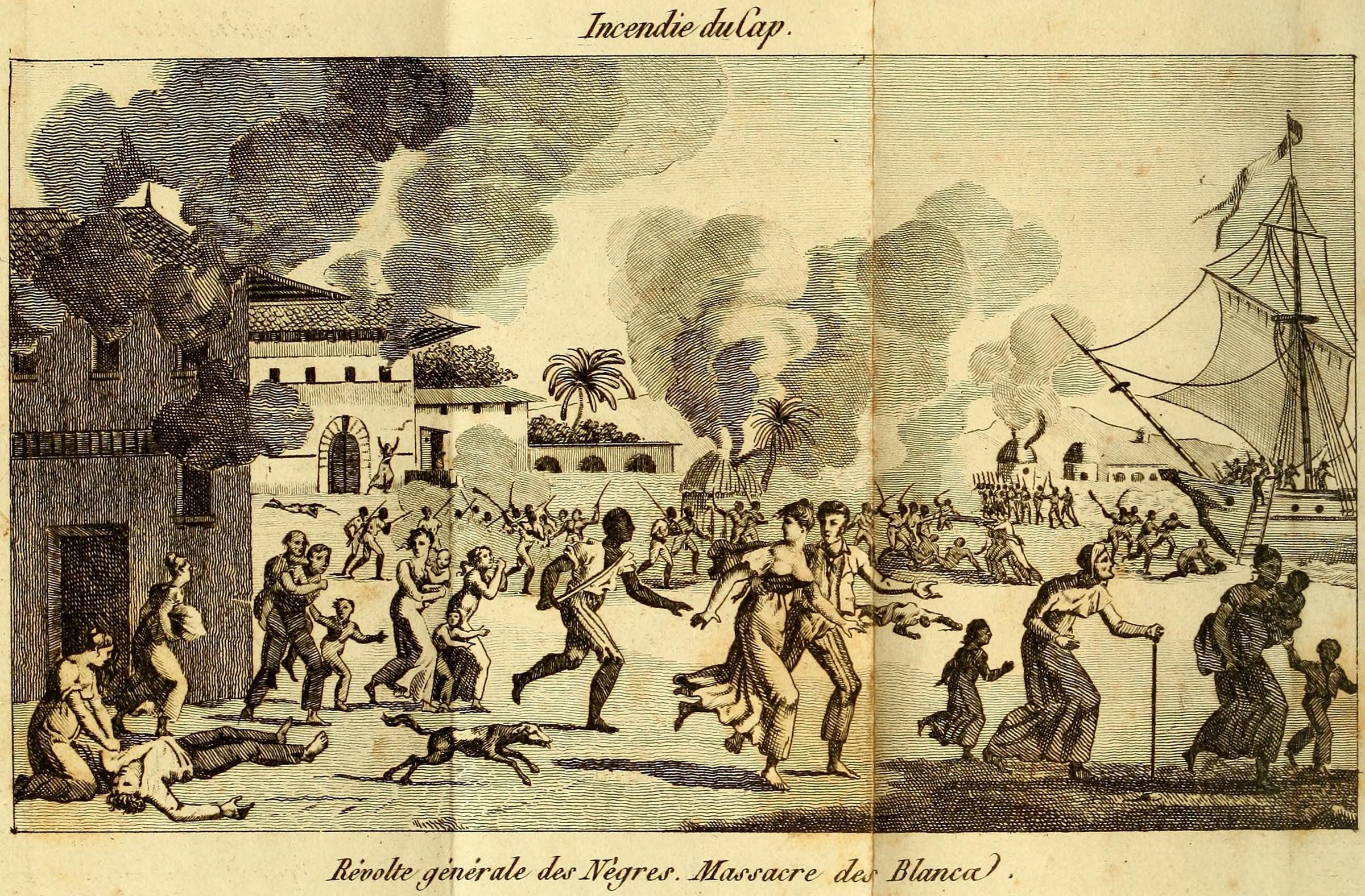
"The revolutionaries, their idea was simple: at the end of it all, we will be able to better negotiate agreements, and freedom for all," says Henry. "When finally we stopped fighting, the Haitians had won, and they had created one nation."It was 1804. Thirteen years after the Boukman Eksperyans, the enslaved population liberated itself, and their victory remains the largest and most successful slave uprising in the Americas. This uprising shed the colonial name St. Domingue, and the new black nation was called Haiti. The name Haiti comes from the indigenous language of the Taíno people who were native to the island. It means "land of high mountains." So they ditch the French name, and all the French are like, we should probably go."They went to Louisiana because it was another colony of France," says Henry. "It was part of the French network."Now, people had been fleeing Haiti over the course of this 13-year revolution to go live in other French colonies. Some went to Caribbean islands like Guadeloupe and Martinique, a lot went to Cuba, and many went to Louisiana. And it wasn’t just white people who fled -- a lot of enslaved and free people of color went with white Haitians to New Orleans, either with their master, or to escape the violence and turmoil that was happening on the island. When the revolution finally ends, Napoleon realizes he’s spread too thin. He decides to forget about Haiti, and double down on Europe. This led to the Louisiana Purchase.When you put the last battle of the Haitian Revolution and the signing of the Louisiana Purchase on a timeline, they happened just months apart in 1803. Now fast forward to 1809. Spain's at war with France -- and all that bad blood seeps into the Caribbean. Cuba is a Spanish colony, but it's full of French emigres that left Haiti during the revolution. So during this war, Spain up and kicks out all the French. Which means that all the people who had fled to Cuba from Haiti need to leave again. Where do they know a guy? Louisiana.Jean Marie Theodat is a geographer who lives in a town also called Theodat. "A part of our society just went to reproduce itself there. Like a chemical process. A lot of slaves, a lot of masters, escaped from St. Domingue, went to Louisiana and created a creole culture."
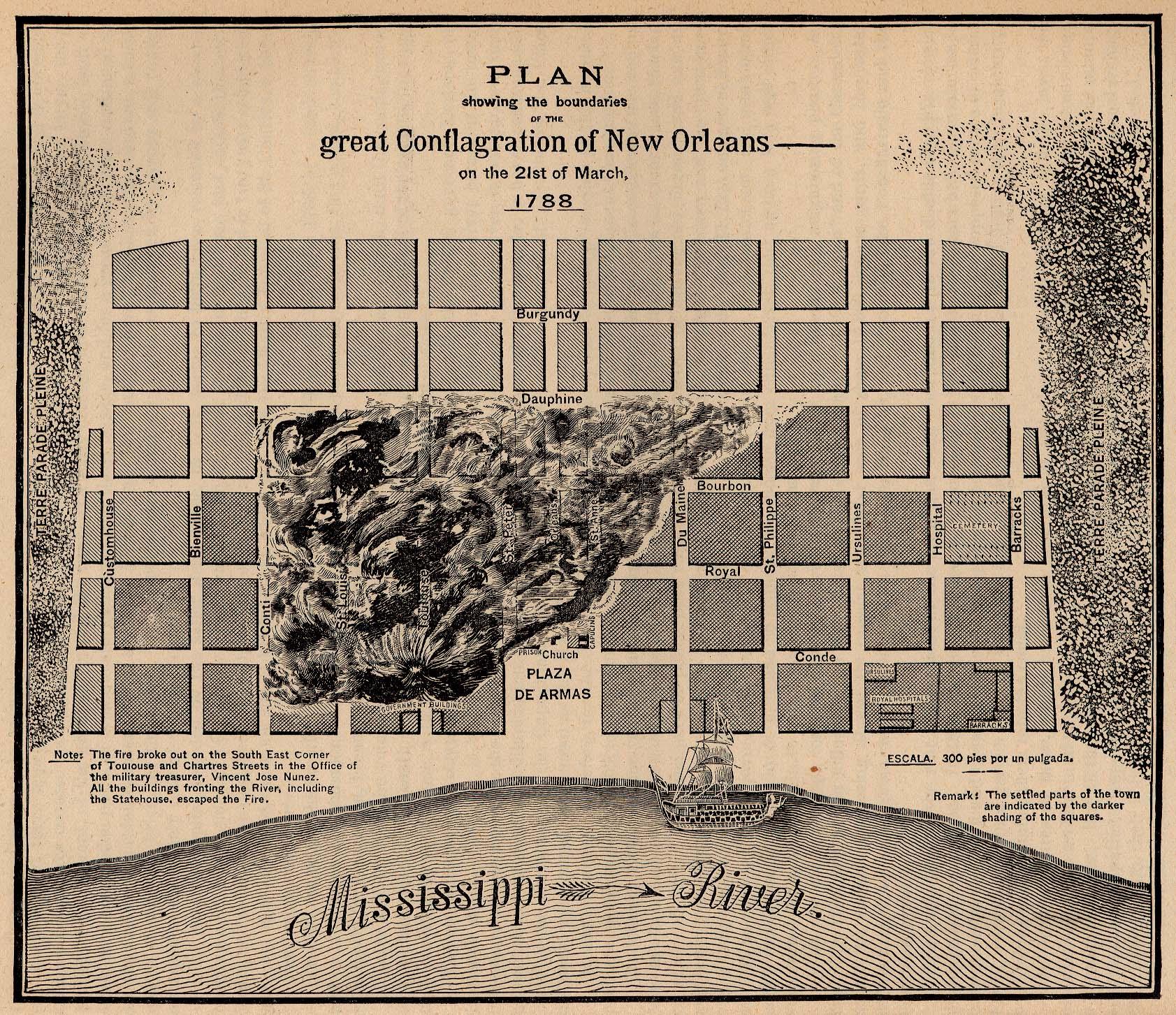
Almost overnight, 10,000 people of Haitian descent, ⅓ white, ⅓ enslaved, and ⅓ free people of color arrived at the port of New Orleans, and straight up doubled the size of the city. And it shows, Jean Marie says, "I mean, when I listen to your music, and sometimes taste your cook -- the dish, I think, this is ours!"This is how Jean Marie sees it: the St. Domingue colony didn’t disappear, parts of it just kind of picked up and started over again somewhere else. Which had a big impact on both economies. The Revolution devastated Haiti’s economy, leaving the new nation with almost nothing but burnt sugarcane fields. But when all these refugees, many of them planters, came to Louisiana, they started new plantations along the Mississippi river. The sugar industry exploded, and brought a lot of wealth to Louisiana, and New Orleans. This influx of Haitian refugees also came at an oddly convenient time to reshape the city. Even though New Orleans had been around for almost a century when they arrive, in a lot of ways the city was also a blank slate at that moment. The refugees pull up to this little frontier town that’s recovering from two massive fires that almost entirely wiped out New Orleans in the late 1700s. The first fire happened in 1788 and destroyed roughly 80 percent of the city. And then six years later another fire wiped out another 212 buildings.
New Orleans was rebuilding itself, and at the same time had just become an American city. It was a prime time for all of these Haitians to come and develop this old and new town. This is the root of the connection between Haiti and New Orleans: These major migrations transformed the future of the city during such a pivotal time, influencing its culture in every aspect -- food music, art, dance, language -- but with all that was brought to New Orleans, was there a reciprocal influence happening back in the new country of Haiti?Again, Jean Marie Theodat. "I mean, I personally, as a geographer, I know about it. I’ve heard and I’ve read about it. But still I think, that the average Haitian don’t know about that."For him, it’s simple: "I look to Louisiana, it’s like another island, far away. It was a one-way trip."PART II: Two IslandsMy field producer Wynne Muscatine Graham and I are walking around one of the main public squares in Port-au-Prince called the Champs de Mars. It’s a series of public parks that are separated by large boulevards congested with cars, motorbikes, and colorfully painted public transportation buses called Tap Taps. It’s late afternoon, and street vendors push carts offering freshly chopped coconut, candy, beer, ice cream. Others ring bells as they call out the service they’re offering, like a shoe shine, or a small bag of drinking water. People walk through the park and pass us in business attire, on their way home from work. Others sprawl out under a shady tree and watch a pickup game of soccer on an open patch of dirt.We wonder how many of these people know about the connection between New Orleans and Haiti? How many people walking past us in the heart of Port-au-Prince, have ever heard of New Orleans, period? We ask people as they pass by, if they’ve heard of New Orleans. And we did this in a few different cities in Haiti. Port au-Prince and Jacmel in the south, and up north in cities like Gonaïves, Cap-Haïtien, and villages in between. Everywhere we went we got mostly the same response: No.

The average person on the street had never heard of New Orleans. With a few exceptions. Some high school students had heard of Hurricane Katrina, through hearing it on the news. Others knew that New Orleans celebrates carnival, just like they do in Haiti. And then someone who knows New Orleans because he’s an NBA fan. "Because there’s a good basketball team from there," he says. Maybe he’s talking about The Pelicans?Wynne asks him if he knows any people who live in Louisiana. "Well, I’ve heard Haitians live there, but me personally, I don’t have family living in Louisiana. My family lives in Florida or New York City, if they live in the United States."Florida, and New York. That’s where you’ll find much of the Haitian diaspora today, the man tells us. So, if thousands of Haitians moved to New Orleans 200 years ago, why’d they stop coming? What happened?"Louisiana has largely forgotten Haiti, and Haiti has largely forgotten Louisiana exists," says historian George Michel. "Louisiana has sunk into oblivion." George Michel is knowledgeable and dramatic. He started to list links that once existed between New Orleans and Haiti. Links that are now gone."When I was a boy, you had a thrice a week direct flight by Delta Airlines from Port-au-Prince to New Orleans. No more. So that was a link," he says. This direct flight he mentions was active in the mid 20th Century. He adds that there used to be a Haitian consulate in New Orleans. That’s also gone. George Michel continues: "We used to have shipping lines between New Orleans and the Haitian ports. This is long gone, as New Orleans dropped as an important port in the United States."New Orleans still has an active port. But it’s not what it used to be. The port employs a lot fewer people. Haitians looking for a better life in the United States can find more prospects in other cities. Like Miami, the city with the highest Haitian population (by a lot), followed by New York and then Boston. There is still an active Haitian community here, but it’s also not what it used to be. New Orleans doesn’t even crack the top 10 for Haitian populations in the United States.So to explain why Haitians stopped migrating to New Orleans, we arrive at factor #1: Jobs.Vladimir Laborde, a Haitian businessman who lives and works in Port-au-Prince. "New Orleans is not the most prosperous place." He says when Haitians think of the United States, "You don’t think of New Orleans. And then the proximity, as far as logistics, people go to Miami. Miami is less than an hour in the air."Factor #2: Geography. Michele Pierre Louis is a former Prime Minister of Haiti who now teaches the history of the Caribbean at a University in Port-au-Prince. "Getting into the Gulf was too difficult, whereas the tides take you to Miami," he says. Plus, Miami’s population exploded in the 20th Century. In 1910, Miami was brand spanking new. Only 5,000 people lived there. Ten years later, there were 30,000. And people just kept on coming. As Miami grew, so did the economy. So why go to New Orleans, when you can get to a faster growing city, even faster?Michele says Haitians went to cities in the United States, even though they might have felt more at home in a city like New Orleans. "But I don’t think it was in their mindset. They didn’t travel with an idea that that particular state had a connection to Haiti."Why not?"History is not well taught, at all, in Haiti," he says. Factor #3 to explain why Haitians stopped coming to New Orleans: Education."I’m telling you, I’m teaching at the University and I can see the ignorance of our students with so little knowledge of our own history which is so incredible," Michele says. "The dictatorship killed a lot of things here. There was a big darkness, in a way."The Duvalier dictatorship started when Haiti elected Francois Duvalier, aka Papa Doc, on a populist platform in 1957. He ruled the country with his own militia called the Tonton Macout. When he died in 1971, his son Jean-Claude, aka "Baby Doc" took over.
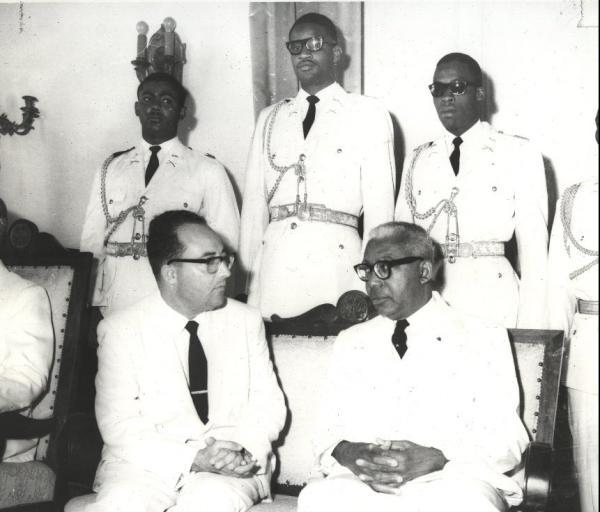
"Duvalier had changed the curriculum of teaching history at the primary and secondary level. Our heroes were the most important," he says. Michele’s point here is that Haitians are mostly unaware of the connection that they have to New Orleans, because that’s just one of many gaps in their history curriculum. But it goes both ways- there’s a parallel gap going on here in the United States. Did you learn about the Haitian Revolution in high school?There’s a big silence on this end.Dennis Kelly has been doing business with Haiti for the past 30 years, and splits his time between New Orleans and Port-au-Prince. "Many Haitians, or people of Haitian heritage who live here, have never been to Haiti."New Orleanians talk about Haiti. But they don’t actually go to Haiti. Factor #4: Not going to Haiti. Which explains why these two islands are no longer close. And they’re being referred to as two islands, but it’s important to remember that one is a small country, one of the poorest in the world, and the other a small city, that’s part of the wealthiest country in the world.So these "two islands" are no longer close. Vladimir Laborde, the Haitian businessman you heard from earlier (who actually moved to New Orleans from Haiti with his family when he was a kid, and went to high school here), he has a phrase for this kind of unconsummated love: "Affinity diaspora." New Orleans, he says, "don’t know how they’re related to Haitians. They really can’t put their finger on it. They just feel a connection. Sometimes I’m uncomfortable because they haven’t been here yet, and they’re talking about something they don’t know."Loyola University professor Angel Parham agrees. She wrote a book called American Routes, that traces the experience of Haitian descendants in Louisiana. She interviewed a lot of folks in New Orleans for the book. And how many of those people had actually visited Haiti?Angel says, "I don’t think any of them have visited Haiti. I do not recall anyone making a real trip to Haiti, and really being there for any length of time. No."Remember Barbara Trevigne, the woman in the beginning, wearing all white and praying at the St. Jude Shrine? We met at that shrine because it’s a place in New Orleans that reminds Barbara of Haiti. But Barbara has yet to visit Haiti. She wants to, but hasn’t made Haiti happen -- yet.
"People may be interested in talking about it," Angel suggests, "but how interested are they in actually traveling to Haiti? Are they going to feel that it’s a place that they will be safe? Haiti does not have this image as much of the Caribbean as a tourist destination that everyone wants to go to." A lot of the people Angel interviewed feel this nostalgic affinity towards the Haiti they have in their minds, but it’s almost like they want to keep it that way."It’s one thing to kind of claim this Caribbean heritage and memory, but then to not be supportive of it, I think is problematic," she says.Some of this could be financial. As Vlad Laborde said, New Orleans is not the most prosperous place. There may be plenty of folks who would love to travel to Haiti, but simply can’t afford it. That’s real. But there are other reasons why New Orleanians, and others, don’t visit."We have bad press," says Vladimir Laborde. "The perception is this is a no man's land. People think of Haiti and they say, 'dude, I need security you know? My insurance won’t let me go down there.'" And this negative image of Haiti, has been broadcast to the world since day one."We paid a dear price for that revolution," said Gigi Dupuis, a Haitian woman now living in New Orleans. It all goes back to the Haitian Revolution. It’s like what brought New Orleans and Haiti together, is the exact same thing that was used to keep them apart. "For doing away with the slave system. And we were isolated because of that," Gigi says. Architect Henry Robert- Jolibois agrees, "We were punished many times, and many times over, for daring to free ourselves. And we have been paying for it a long time."Ron Bluntschli is an American who lives with his wife, Carla, in the mountains outside Port-au-Prince. They run an organization called NASONJ, which in Creole means "We Will Remember.""They could not accept that a group of black people could win a battle against France and establish their own country and have it work. Because that would destroy the whole ideology of racism. Europe, France, and the United States were determined to see Haiti fail from the start. So they set the course in motion to destroy this country, and they never let up," Ron said.In the 1820s, South Carolina Sen. Robert V. Hayne made the U.S. position absolutely clear when he stated: "Our policy with regard to Haiti is plain. We never can acknowledge her independence." It took the United States until 1862 to recognize Haiti as an independent country. Almost 60 years after the revolution.

Now fast forward to 1893, the Chicago World Fair. Frederick Douglass is the U.S. ambassador to Haiti, and in a speech at that world fair Douglas says: "Haiti is black, and we have not yet forgiven Haiti for being black."Dennis Kelly is the businessman who lives in New Orleans and Port au Prince. He says the revolution remained unthinkable into the 20th century, because it overturned white power. "Haiti was still viewed as a slave colony that was insurrectionist and just didn't affirm any values of the power elite in the South, shall we say. I think that sums it up right there," he says.Dennis says that that can likely be traced back to the events of the beginning of the 19th century of the successful revolution. "Absolutely. That's directly traced to that."Haiti’s been painted as a dangerous place since the beginning, and people are still not encouraged to visit there. The poverty, the threat of natural disaster, the political instability, all of this dominates what we hear on the news about Haiti, and has done permanent damage to the country’s reputation, economy, and tourism industry. Americans are not eager to go over there. So while many New Orleanians may appreciate all the cultural ties they share with Haiti -- the music, the food, the architecture -- they’ve never actually seen it for themselves. This is the complicated nature of the current relationship: New Orleans might love Haiti, but at arms’ length.Andre Paultre, our driver in Haiti, has a cousin named Lionel Pressoir. He’s a tour guide outside Port-au-Prince. Some of their ancestors actually left Haiti for New Orleans during the Revolution. And Lionel says both places were neck-and-neck back then. But now, he says, they’ve gone in different directions. "There is not the connection that I thought that there was between Haiti and New Orleans. But we are looking for it. We need it."Pressoir says it’s not enough just to say that Haiti and New Orleans are "Sister Cities.""You know, we can talk about it. But let’s see what we can do as far as bringing something positive," he says.PART III: More Than A FeelingGigi Dupuy was born in Haiti, but her family moved to the states when she was a kid. Now her kids are all grown up, and they live in New Orleans. They urged her to move here, and said she would feel at home. So, she did.
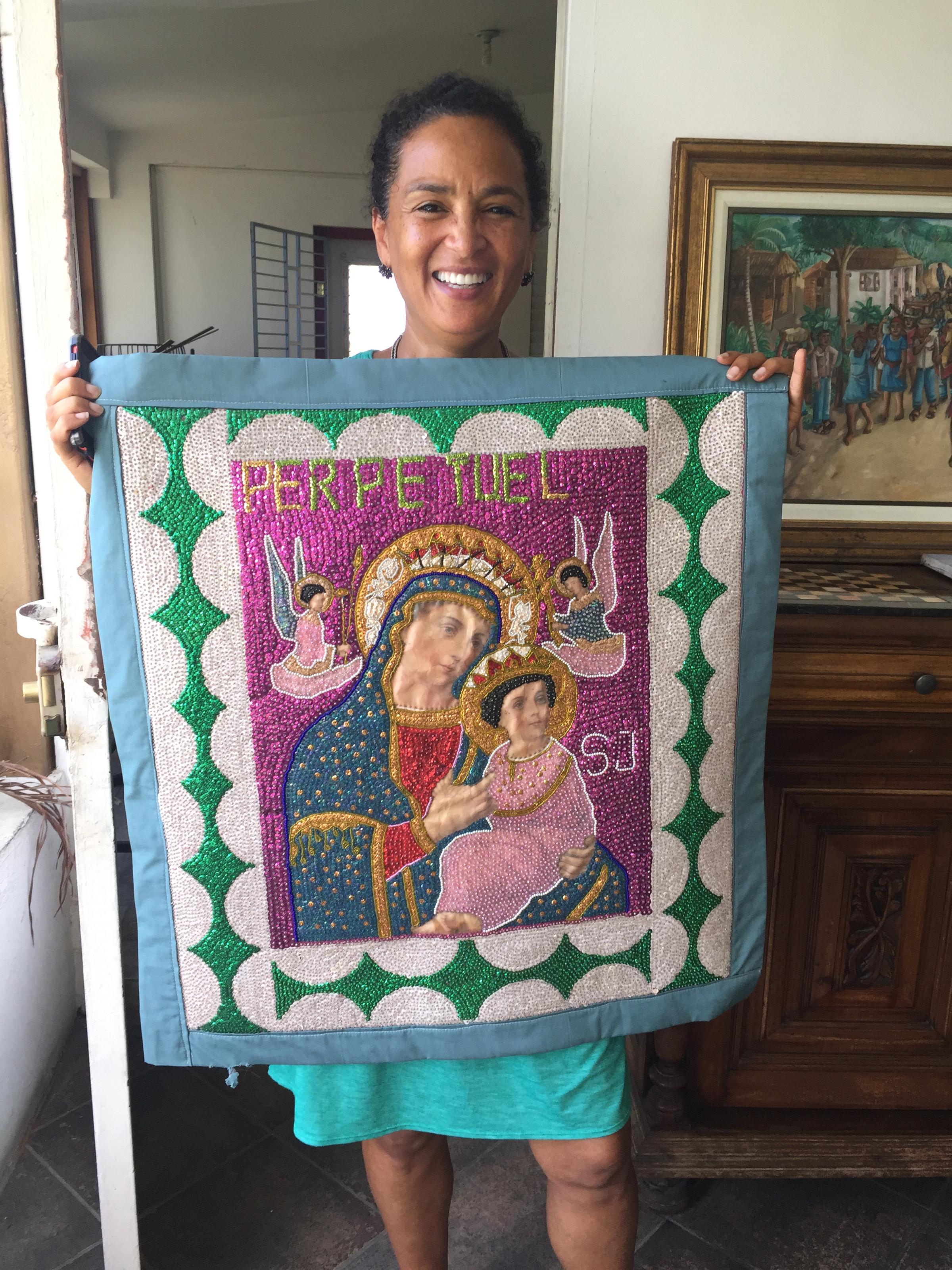
"Leyla, my daughter called me, and she said, 'Mom, you need to move to New Orleans. It's so much like Haiti, you're gonna love it. There's corruption, there's potholes. It's just an incredible place,'" says Gigi. "Of course that's not what I love about Haiti but…"With a last name like Dupuy, a lot of people assume Gigi is from New Orleans. "But it took me a while to realize that," she says. "Until I went to yoga class. The woman registering participants said to me, ‘What's your first name?’ And I said, 'well, I'm sure there's only one Dupuy,’ because there never was more than one Dupuy! And she said, ‘no, actually I have six.’ And I was like what?!""You go into the phone book in New Orleans, and it’s like you’re looking in the phone book in Haiti," says Vladimir Laborde, the Haitian businessman who went to High School in New Orleans, and then moved back to Haiti. "You find Labordes, you find Toussaints, you know. All those people have my family’s last name.When Gigi goes back to Haiti to visit her cousins, she talks about New Orleans. "I say it's very similar. The most similar."No matter what’s happened to this relationship over time, New Orleans and Haiti still have so much in common.

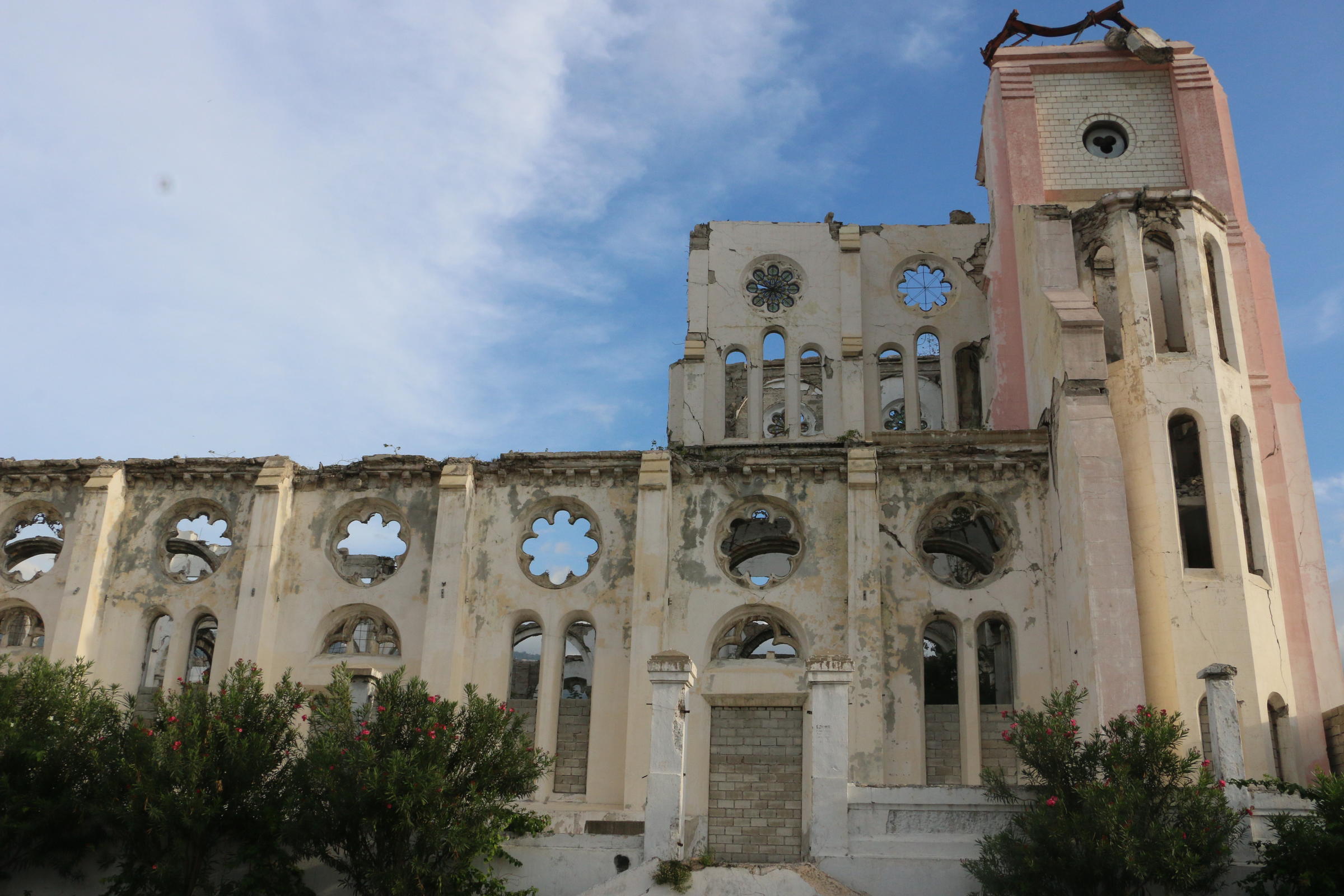
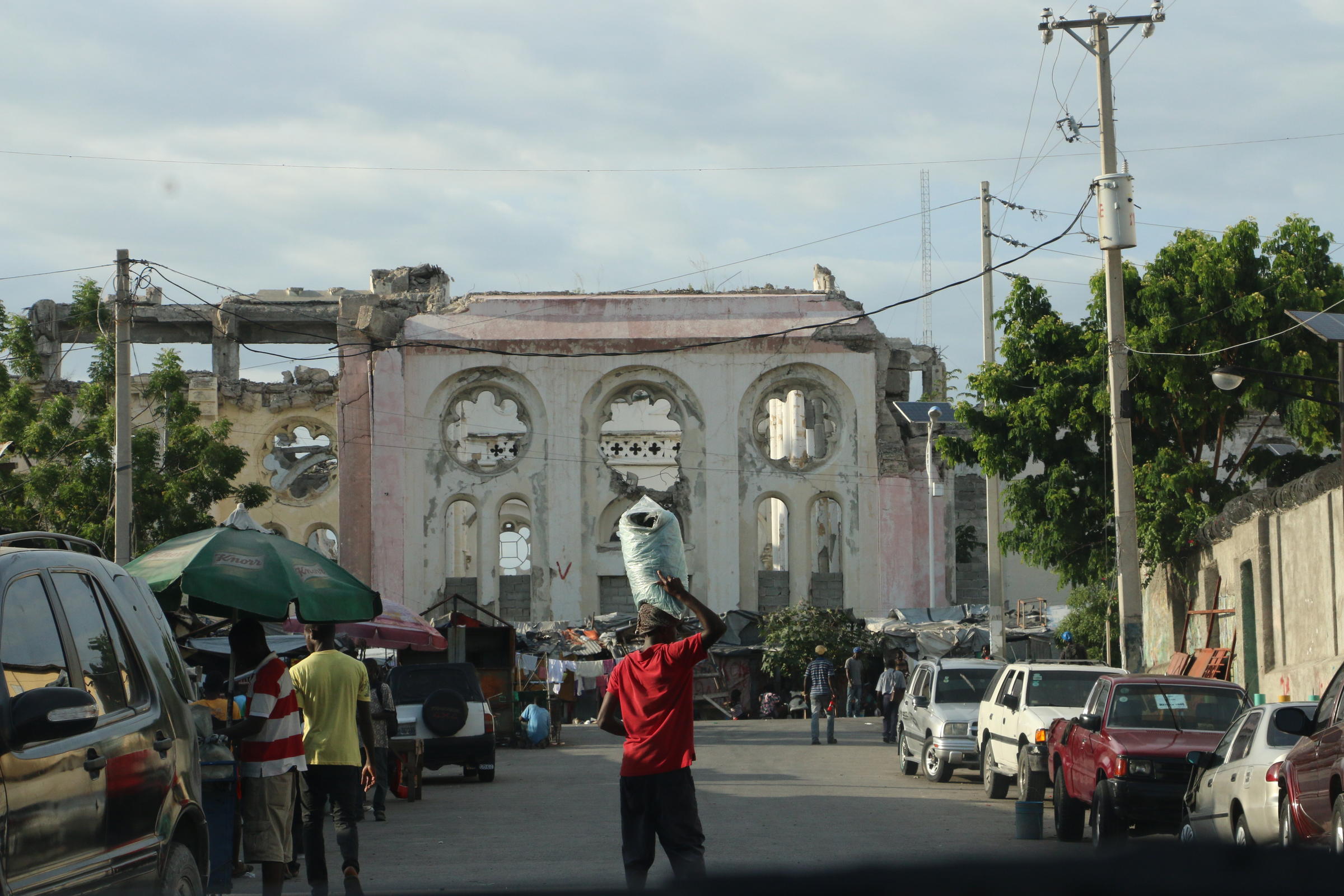
"Not only do we have historical and cultural ties, but we have a traumatic experience that almost wiped us out," he says.New Orleans has Hurricane Katrina, which ravaged the city in 2005, and Haiti has its earthquake that hit in 2010. The quake devastated most of the country, leveling cities and destroying major landmarks, that, as of 2017, are still piles of rubble. The degree of blight reminded me of some of the largest buildings in New Orleans that have been left virtually untouched since Katrina. Like Charity Hospital in the center of downtown. And, like in New Orleans, the aftermath of disaster isn’t just seen. It’s heard.
Jean-Elie Gilles, the tour guide in Jacmel, gave us a long tour of his house that day, because he has a large collection of Haitian art and antique furniture he wanted to show off. He started talking to us about a coffee table in his living room. There must have been something about that table, because before we knew it, Jean-Elie was back in 2010.
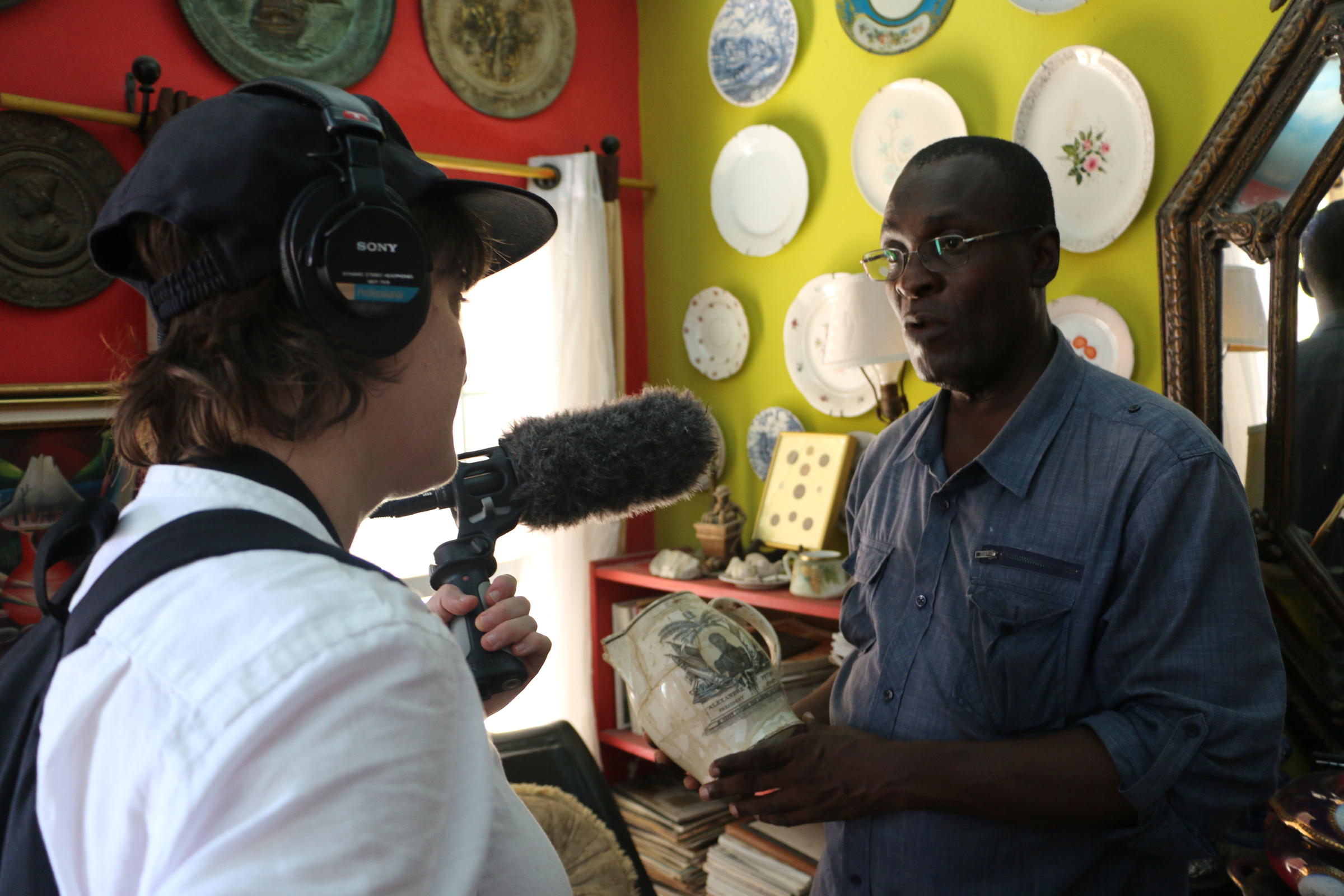
"I was living on the 6th floor and the house went down. I was inside. I was all the way living upstairs, and then I fell. And then I look up outside and I saw the house that was beside me, that was taller, didn’t exist anymore. That house became a pile of crap. And then pretty soon, the house just went down like that. It was like a pile of cards, you know? Like nothing," he says.He went on, with no idea how long ago he had stopped at the top of his staircase, looking beyond all of us, past the house we were all standing in, at the house he lost. "Now I am telling you, I am swearing that I could hear the sound of the earth crying. It’s worse than anything that you have ever heard. It’s like the sound of 10,000 women screaming from the womb. Oh it’s scary. I heard it, and I was not the only one! Very painful, painful. OK let’s go." And then, just like that, he turned on his heels and flew down the stairs.This kind of time travel, this relived trauma, still happens in New Orleans, too. "New Orleans went through Katrina, so they know a lot about disaster," Vlad recalls.And they know what it’s like to see a city full of holes. When our driver Andre gave us a tour of Port-au-Prince, most of what he stopped to show us were things that used to be there. Things that aren’t there anymore. "And that's why after the quake we felt like we were lost. Because all the landmarks that we could use to indicate a place...like we say, 'near the Cathedral,' 'near the national palace,' most of them were gone. Same as after Katrina, I guess."After the earthquake slammed Haiti in 2010, and again after Hurricane Matthew in 2014, people around the world asked themselves what their obligations are to this country. A country that, throughout history, has been cast aside, and treated as "other." Well, Vlad Laborde says, New Orleans knows what that’s like, too.

"New Orleans, Louisiana, often times feels apart from the rest of the United States. Haiti often times feels itself apart from the rest of the Caribbean," says Laborde.After Katrina, people threw around the idea of not rebuilding the city, period. Like New Orleans was an expendable part of the United States. Or not part of it at all. The same way Haiti has been punished for its blackness, New Orleans was shunned, many say, for that same reason. Still, thousands of people did rush in to try to help. Haiti and New Orleans have both been on the receiving end of countless recovery projects, and NGO missions. And both places have felt exploited, seeing too many of these fail, over and over again. This shared experience and the mutual understanding it creates might put Haiti and New Orleans in a position to work together.There’s a fear in Haiti that things are disappearing. Literally. Much of Haiti’s built environment is deteriorating. Whether it’s an earthquake that swiftly wipes huge landmarks off the map, or the slow crumbling of a 300-year-old shotgun house. Because New Orleans shares this distinct architecture, it knows how to restore -- and preserve -- Haiti’s historic buildings. John Williams runs Williams Architects in New Orleans. He’s done over 500 projects in the French Quarter and has also done a lot work in the Lower 9th Ward since Katrina.
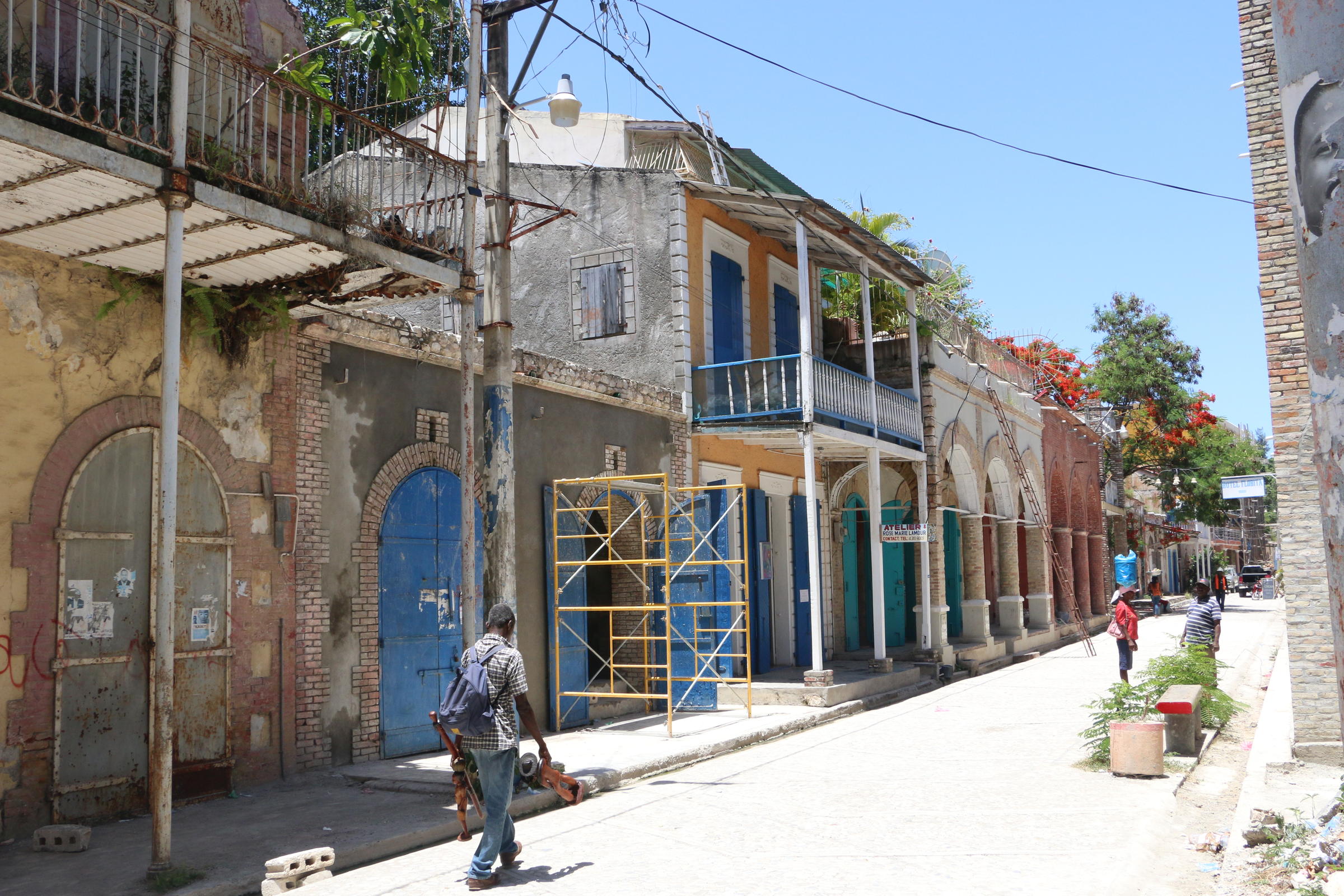
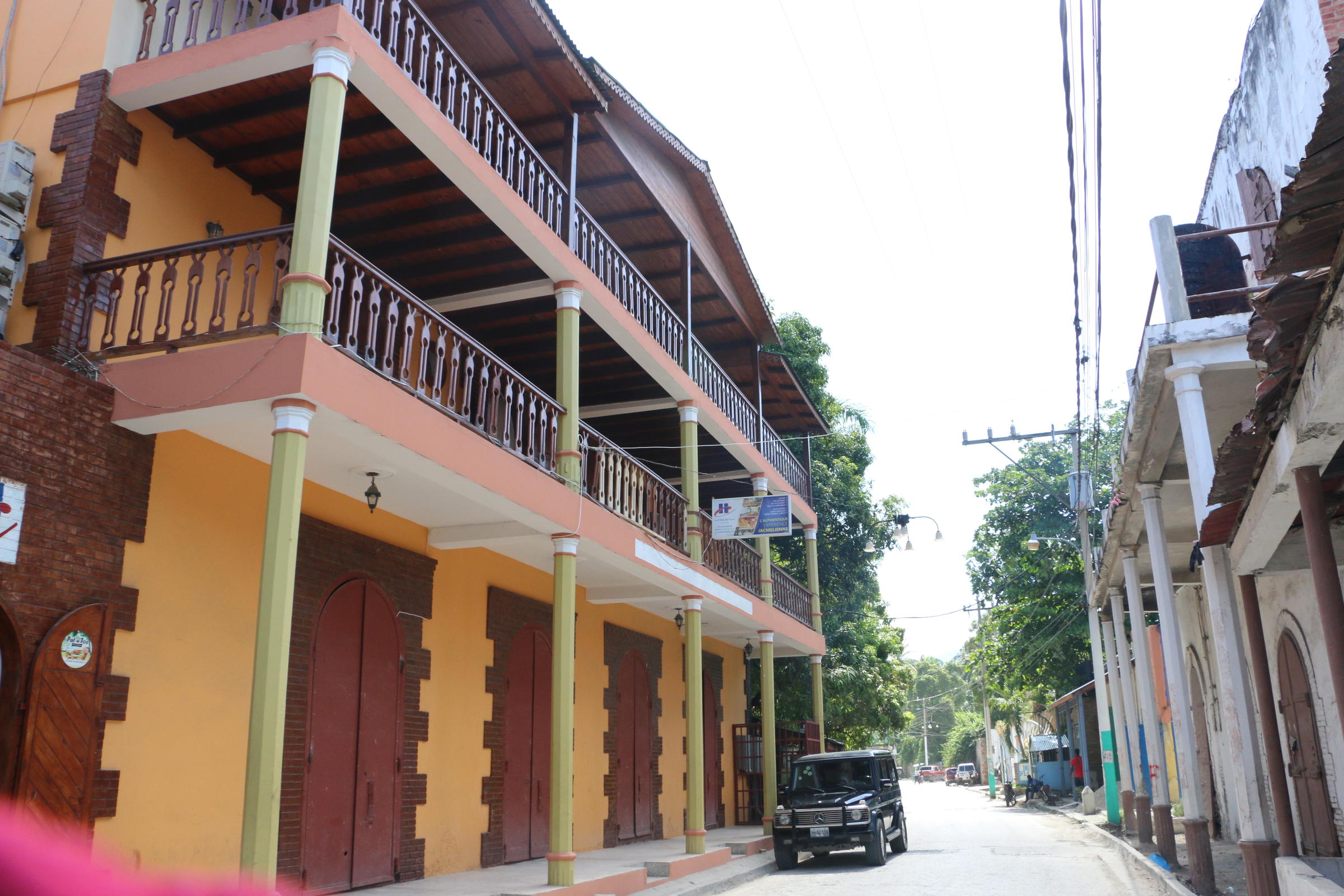
"I didn't ever intend to go to Haiti," he said. Nor did he want to. But after the earthquake, Vlad Laborde came a knocking."Well he brought me two bottles of Barbancourt," he said. (Barbancourt is Haitian rum.) "So it was over then, you know? And I said OK."Since then, John’s been to Haiti more than 10 times, visiting cities devastated by earthquakes and hurricanes."I know little teeny hardware details and woodwork details that I saw in Cap Haitian that are exactly copied in the French Quarter," he says. "Which means, he knows how to repair those details."
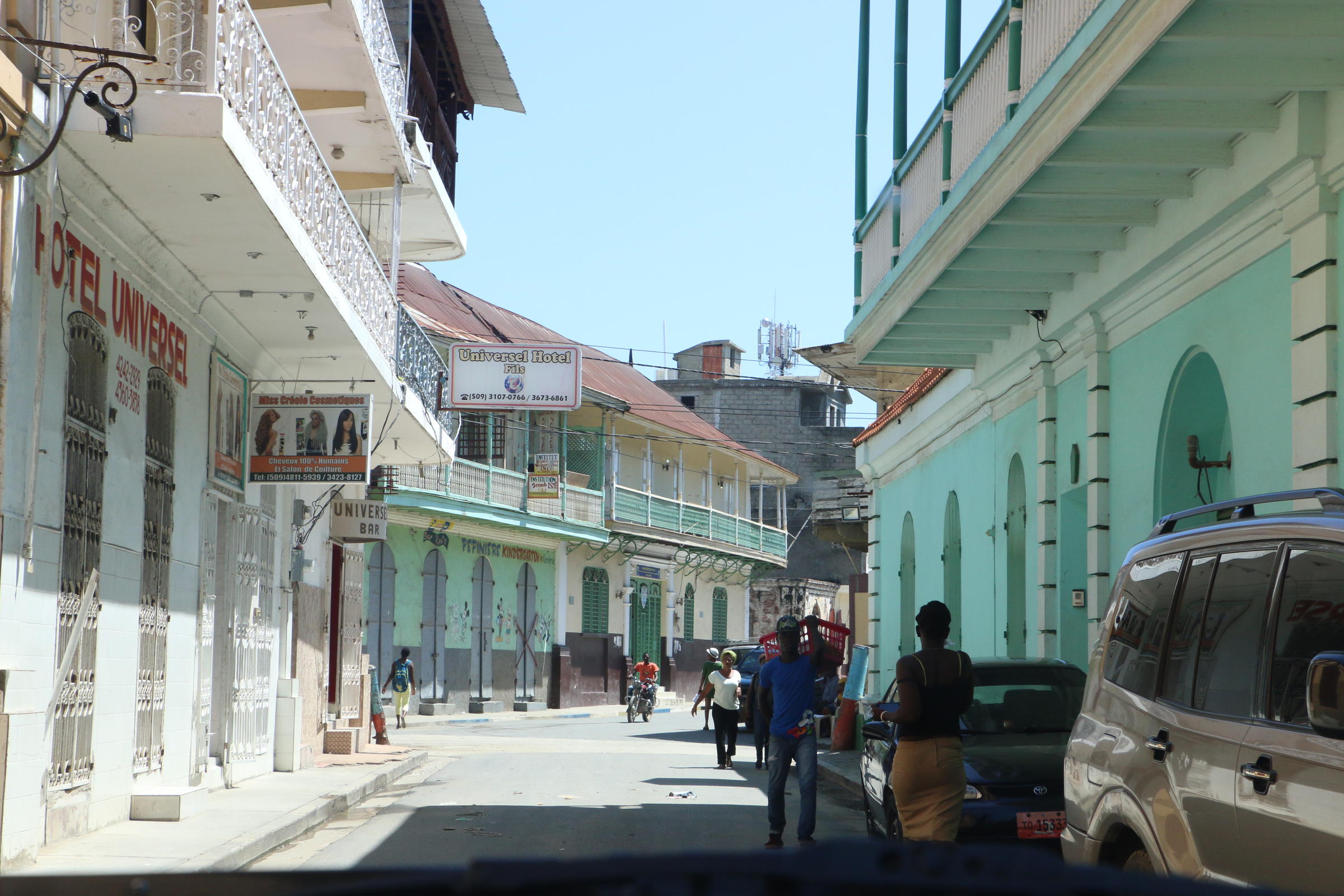
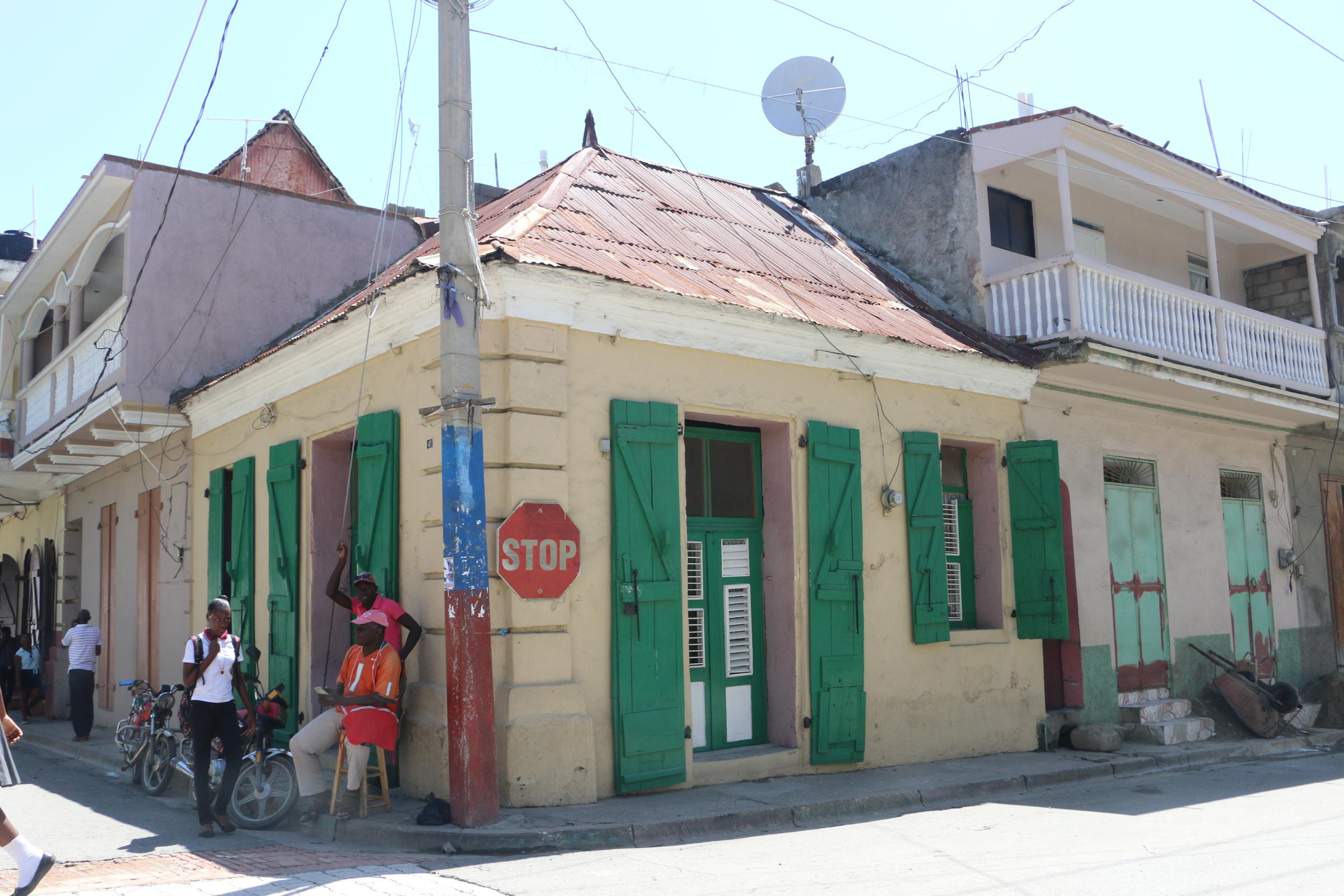
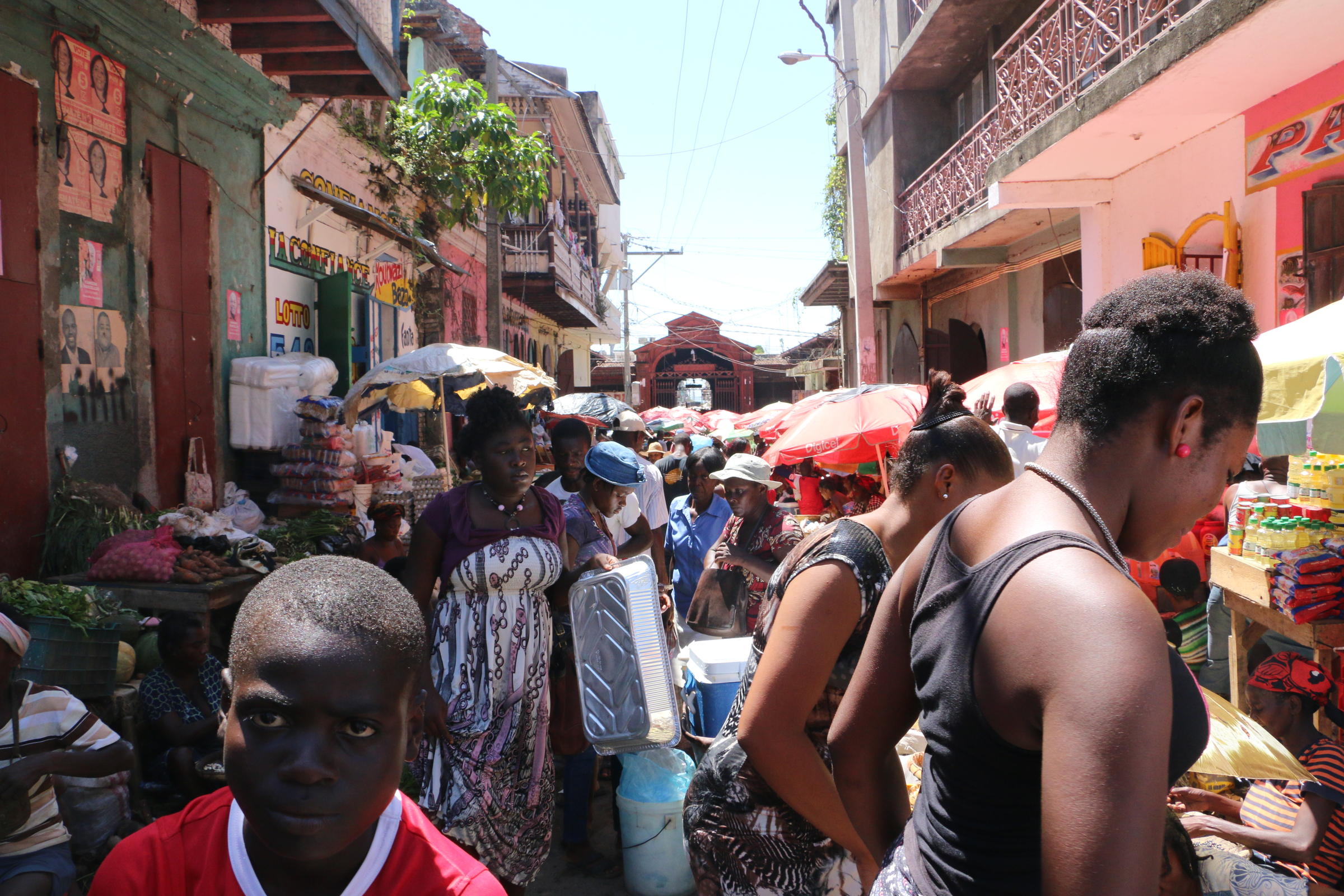
This is crucial, says Pierre Chauvin. He’s the former minister of tourism in Haiti, and says architecture in New Orleans is a huge attraction for tourists. Those walking tours of the Garden District, they’re all about ‘oohing and aahhing’ at old buildings. An artist named Paul Baruk knows this. "This is what I want Jacmel to look like. Nouvelle Orleans."Paul runs one of the many Carnival themed art galleries in Jacmel. When I told Paul where I was visiting from, that’s when she said she wished Jacmel looked like New Orleans. Or, even more like it.
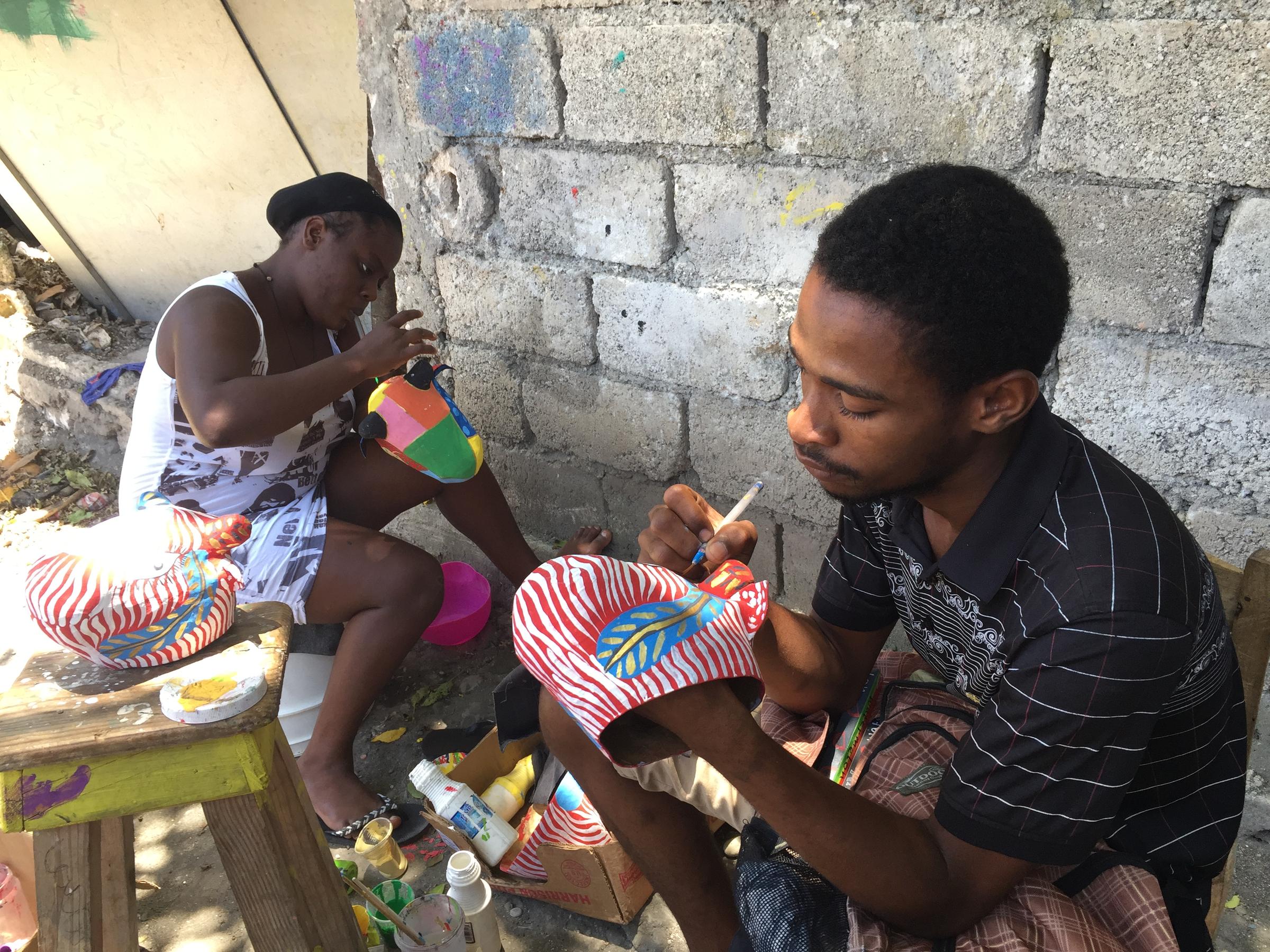
"Because New Orleans looks like Jacmel, but Jacmel is not well taken care of. New Orleans is well taken care of, you see. And that would bring tourism. That would bring a new life for the people here. And it’s really what we need. Why don’t you send us some tourism?" She laughed too, but she was serious. Like she was egging us on to share the wealth. Which is an interesting thought. Just because New Orleans can do this stuff, does that mean it should?Dennis Kelly, the American businessman who works part-time in Haiti. Says there’s no way New Orleans can be responsible for Haiti or Haiti responsible for New Orleans, "but what you can do is look at what's coming down the road and say what opportunities are there that I want to take advantage? So I would say that there are many opportunities for the city of New Orleans and the city of Jacmel, and others, to mutually benefit one another."Vladimir Laborde is all about the mutual benefit, and says an obvious opportunity here, is Mardi Gras. "Imagine the Miami Herald, the Times Picayune, and The New York Times: ‘New Orleans and Jacmel, Haiti, Share Carnival 2018.’"

He sees Mardi Gras as an overlapping tradition that could raise the big bucks to revitalize cities like Jacmel. And that these revenue streams will make communities more livable for Haitians, and more hospitable for tourists. But these are tricky words in New Orleans. There’s endless debate surrounding who’s actually benefitting from preservation and tourism efforts. There’s skepticism towards these projects; are they actually improving the quality of life for the New Orleanian, or the quality of experience for the visitor?These are some of the questions Haiti has to reckon with as it grows its tourism industry and preservation program. And both those things are important, not only for the economic boost, but that more existential fear of disappearing.Pierre Chauvin, the former minister of tourism, will never forget a conversation he once had with a European colleague. "He came to visit Haiti and after one week, we ask him how do you find the country? And he said ‘you know, I have come to realize that in Haiti, you are full of diamonds. The whole country is full of diamonds. But you know, diamonds are stones. They have to be polished. Yet in Haiti, you don't polish them at all.’ And he was talking about these old houses, and you know our nature, and everything else that we have...And certain things are really crumbling. And you cannot re-create them."Haiti’s former prime minister Michele Pierre Louis says it’s not just about tourism dollars, or physical structures. It’s about Haiti reclaiming its image. "It’s extremely important that little students, little pupils know that the country is not deductible to violence and misery and poverty. Because we don’t have just drug dealers and bad politicians! We have Haitians that are great, that are artists, that are creative, that live with dignity."
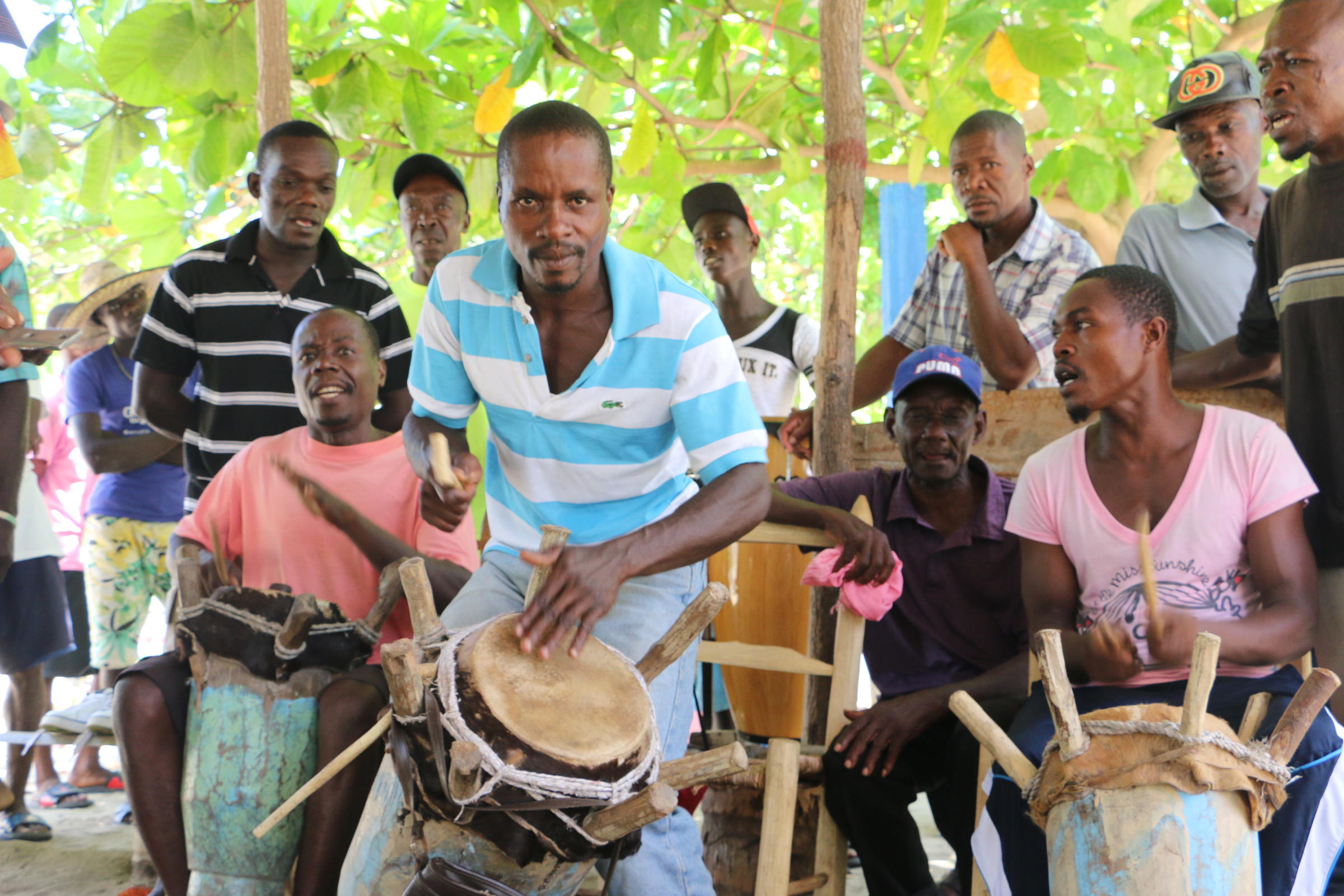
It’s a reminder that so much of what we love about New Orleans, the culture we package to the outside world, and profit off of, a lot of that we got from Haiti. So what can New Orleans do in return? Michele says stop looking backwards 200 years when you think of Haiti, and make some new memories. "That would be great! That a new generation creates a momentum for, I wouldn't say reconciliation, but creating a connection back! That’s a good utopia."When I got back to New Orleans, I took a walk in my own neighborhood in Midcity. It was a Sunday afternoon, and I saw a group of people standing around this now empty pedestal where a statue of Jefferson Davis once stood. The city removed this and three other confederate monuments in the spring of 2017. People took turns passing around a crappy PA system and climbing up onto the empty pedestal, sharing their visions of replacement statues. This is where I met Nic Aziz. "Looking forward I think we need to have monuments that reflect the true identity of the city. For me I think that identity is Haiti."

Nic is 26. His mom was born in Haiti, and he’s a first generation New Orleanian. "Many people do not realize all the contributions that Haiti has to this city. I think a lot of the issues that we see, whether it's violence or you know economic opportunity or whatever some of that is rooted in identity issues. And I think if you show people who they are and like where they come from, that can have an impact on where they go."We’ve heard about folks not visiting Haiti. But Nic is one New Orleanian that did, back in 2011. He was 20. "As soon as I got there I felt something like you just felt...it was one of the most unique feelings of my life."But it became more than that. He met family members he had previously only known on facebook. He played soccer and talked about Kobe Bryant with kids in the neighborhood he was staying in. He got made fun of for not speaking Kreyol...and that’s when Nic was like, yeah, you’re right, I wanna know Kreyol. "I had this very deep desire that like I want to find that side of myself more. Because like I said I don't speak Kreyol but like I have a Haitian mother and my grandfather is from Haiti but still at the same time I don't feel enough of that side of me."In a lot of ways he embodies the utopia the former prime minister Michelle Pierre Louis talked about -- the young generation returning to Haiti to dig further into their roots, and reignite an exchange. When Nic goes to Haiti and talks to Haitians about New Orleans, they learn how they’re tied to the States. That forms them, the way it forms him, Nic says. It’s about shaping his home. Both of his homes.
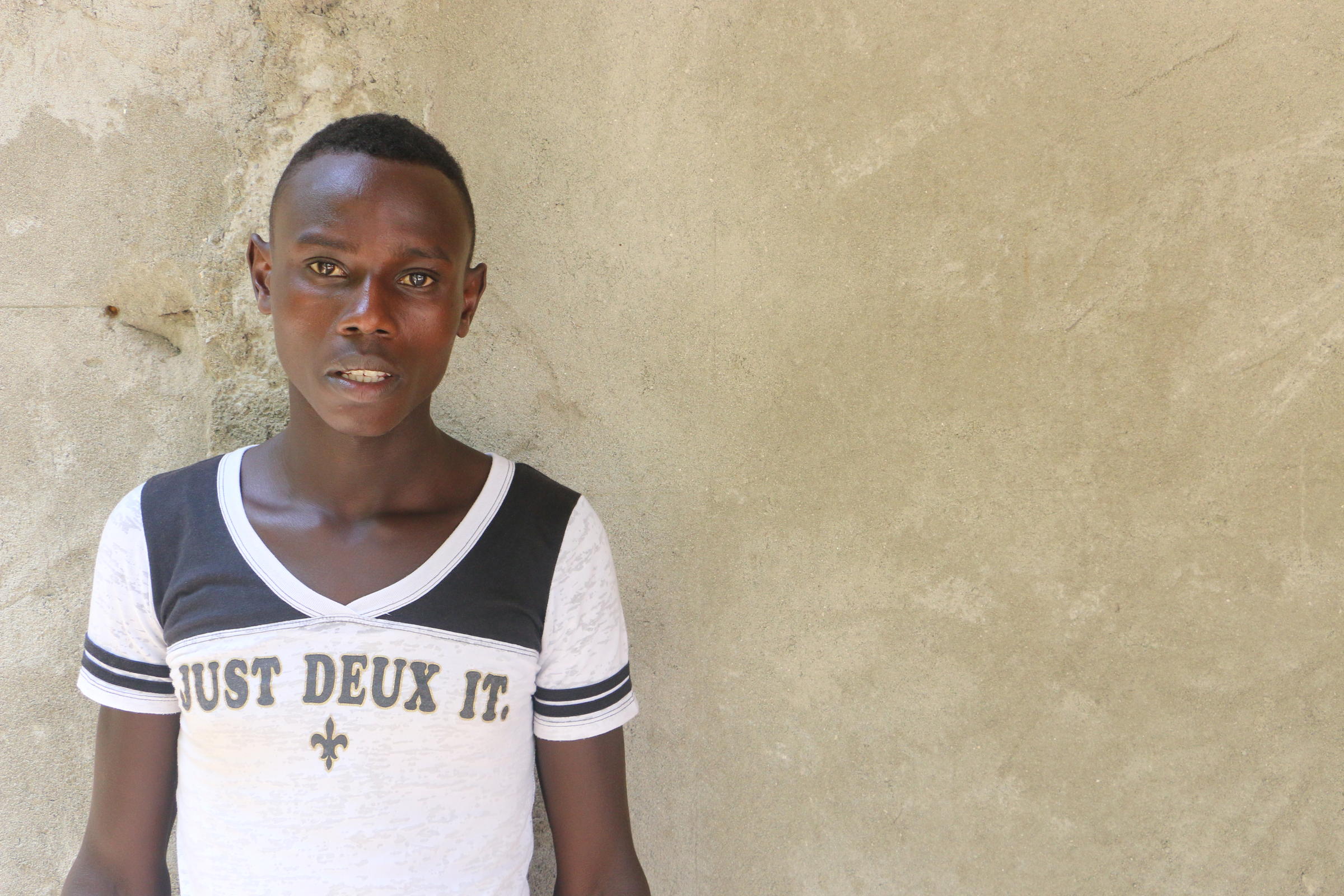
"There should definitely be like, so much more cultural connecting going between two cities," says Nic. "Just creating that channel to share that knowledge will allow both places, you know, really seeing the sides of its identity that you know really doesn't see and know yet."That’s why he sees the New Orleans Tricentennial as a perfect opportunity to move beyond the warm and fuzzy feelings the city has for Haiti, and formally acknowledge it as a key part of the city’s identity, past and present. And he’s got an idea for a new monument to replace the white confederate statues. Nic envisions a sculpture that celebrates one of the most iconic and meaningful traditions that Haiti gave to New Orleans: people second lining. Second lining has roots in West Africa, but in Haiti it became a celebration called Rara. It came to New Orleans from Haiti during the migration following the Revolution."Put a scene that people can obviously identify and resonate with because everybody in New Orleans knows a second second line, everybody loves second lining, that part of our culture," he says. "But then have a historical blurb by it that shows like, 'Oh wow, like I didn't know this came from Haiti. Wow.'"Epilogue: Same Same, But Different
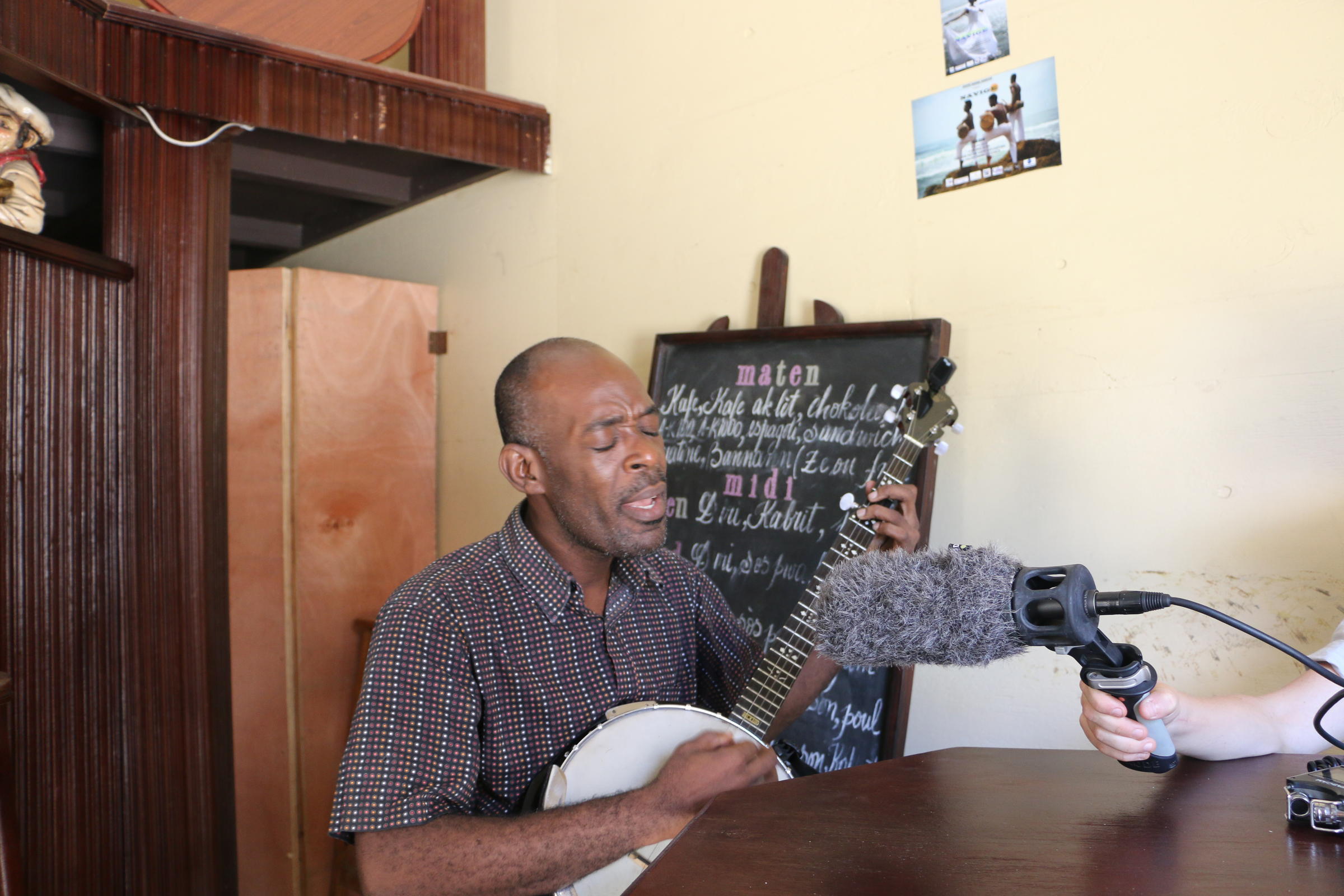
A banjo player named Pierre Ronnel Antoine sits in a little coffee shop around the corner from his apartment in Cap Haitien, with floor to ceiling shuttered doors that open out onto the busy street. He talks about his life as a musician in Haiti, about Jazz, and why he chose the banjo. He plays one of his favorite songs, a children’s song called "Panama M Tombe." It’s based on the Haitian proverb that says: When one’s hat falls, trouble is coming.The song reminded me of a a classic New Orleans tune called "Iko Iko" about two Mardi Gras Indian tribes that have a confrontation in the street. I play him the version by the Dixie Cups to play for Ronnel. "It sounds like Haitian music," he says and he starts humming along. "I thought it was a traditional Haitian song when I heard it. It’s the rhythm that does that. It’s almost the same music."It’s almost the same he says, not exactly, but almost. TriPod is a production of WWNO New Orleans Public Radio in collaboration with the Historic New Orleans Collection and the Midlo Center for New Orleans studies at UNO. This TriPod special was made possible with support from the New Orleans Center for the Gulf South at Tulane University through the Global South Fellowship program. Thanks to Evan Christopher for our theme music, and a special thanks to Bruce ‘Sunpie" Barnes for providing us with some of his original music that you heard in the program. Eve Abrams is the editor of TriPod. Molly Mitchell and Jess Dorman are TriPod's senior advisers, along with the rest of the Tripod editorial board Kevin Harrell, Connie Atkinson, Lee Leumas, Karen Leathem, Charles Chamberlain, Christina Bryant, and Christopher Harter. Special thanks to field Producer Wynne Muscatine Graham, fixer Andre Paultre, sound engineers Thomas Walsh and Peter Klingelhofer, and TriPod interns Ann Hackett, Tori Bush, and Michael Ceraso. Additional thanks to Alexis Erkert and Ben Depp, Nicole Phillips, Jacques Bartoli, Maryse Dejean, Mehdi Chalmers, Ned Sublette, Elektra Carras, Zach Niles, Rolando Bunster, Gregory Mevs, The ASB Hospital in Borgne, Haiti, The George Family in Cap Haitien, Viki Merrik, Maggie Herrman, Sanga Tabb, and Marina Magloire.By: Laine Kaplan-Levenson for wwno.org | October 27, 2017
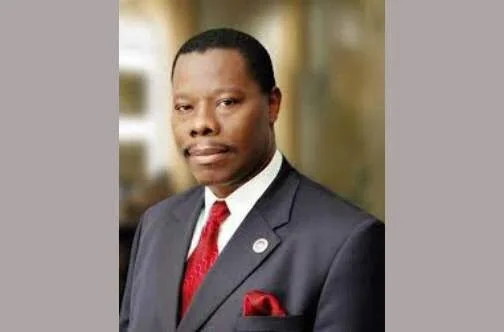
Haitian legislator reiterates appeal to US President to extend TPS for Haitians
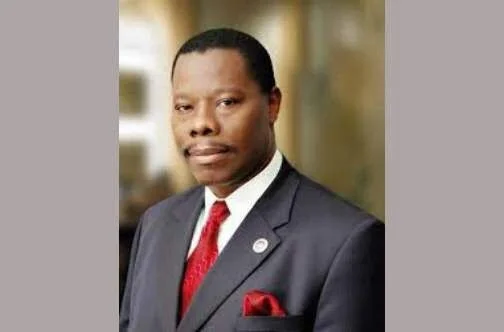
NEW YORK, United States (CMC) — A Haitian-born legislator in New York has reiterated his appeal to US President Donald Trump to extend Temporary Protected Status (TPS) for undocumented Haitians living in the United States.Dr Mathieu Eugene, who represents the predominantly Caribbean 40th Council District in Brooklyn, New York, told the Caribbean Media Corporation (CMC) on Saturday that he will be joined Sunday at a rally in Brooklyn by immigration advocates, elected officials, clergy members and constituents reiterating their calls on the Trump administration to extend the status granted to almost 60,000 Haitians.Eugene, the first Haitian to be elected to New York City Council, said he will also re-launch an online petition requesting that the US Department of Homeland Security (DHS) grant an 18-month extension of TPS for Haitians and protect the Deferred Action for Childhood Arrivals Programme (DACA), initiated by former US President Barack Obama that Trump plans to rescind. TPS for Haitians is set to expire in January.Eugene said the online petition has amassed over 30,000 signatures “and has brought much-needed attention to the plight of thousands of immigrants seeking to remain in the US.”In May, DHS issued a six-month extension of TPS for Haitians, stating that eligible Haitian nationals must be prepared to return to the French-speaking Caribbean country in January 2018.Eugene said the DHS will formally declare next month if it will keep the six-month extension in place or if it will grant a longer extension to TPS recipients.The petition also requests support for recipients of the DACA immigration programme, which currently protects over one million young Caribbean and other immigrants, who came to the United States as children, from deportation.In 2009, Eugene said he “successfully introduced” legislation in New York City Council in support of TPS Haitians. He said he has continued to lobby for its renewal in subsequent years.Despite being granted TPS, Eugene said Haiti has “suffered additional devastation from four tropical storms, an outbreak of cholera, and, most recently, a destructive hurricane.“Haiti cannot withstand an influx of over 58,000 people, who would be forced to return to the country if TPS is not extended,” he told CMC.“That is why I am asking the community to sign this petition and let the federal government know that we need to continue this humanitarian gesture. TPS recipients are valued members of our community; they hold jobs and work hard to contribute to our community, our city, and our country,” he added.“We are also here to support the DREAMERS, young people in the immigrant community, who came here with their families in pursuit of the American dream,” Eugene continued.“This is their homeland; we must do all we can to ensure that their ability to receive an education and pursue their career ambitions is protected under the DACA programme.”By Jamaica Oserver | October 29, 2017
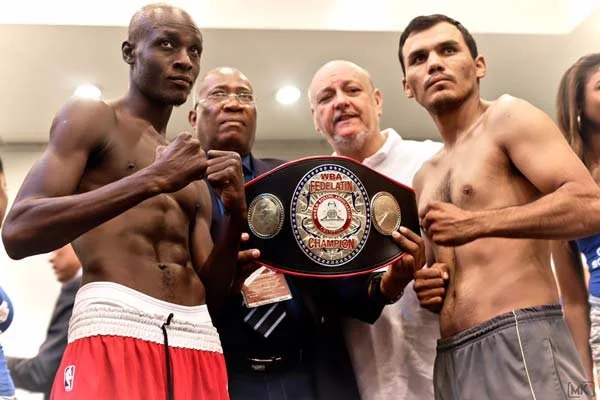
Fighters Make Weight for Gala in Haiti
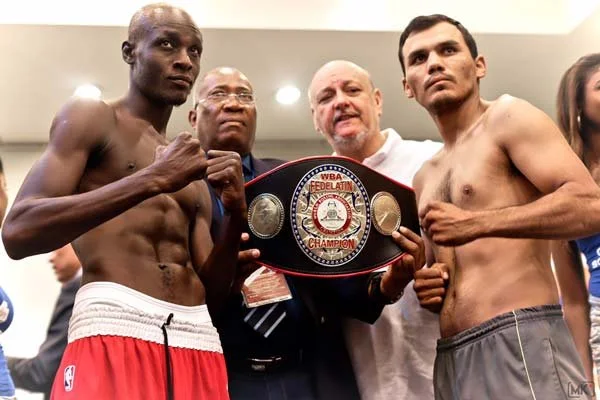
 Pierre’s fourth defense of the regional belt heads the Gala Des Champions III event promoted by Jacques Deschamps Fils’ Boxe Internationale on Thursday Night at the Karibe Convention Center in Port Au Prince, Haiti which includes other two regional titles.
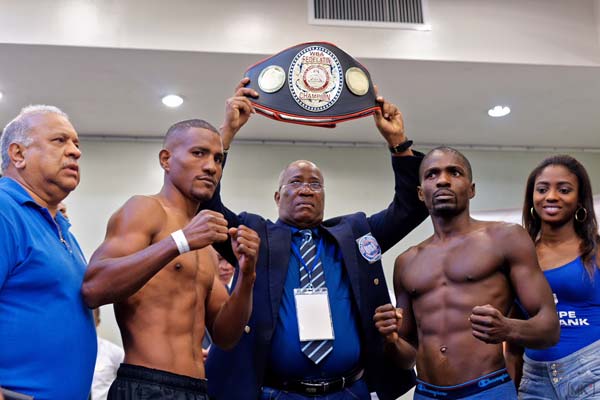 Superwelter Wilky Campfort (23-3, 12 KOs), also a Haitian native, weighed at 154 pounds to risk his Fedelatin belt against Venezuelan Jean Carlos Prada (33-4-1, 23 KOs) who hit the scale half a pound under the limit.
 On a special attraction, two World ranked light flyweights, Panamanian Gilberto Pedroza (17-3-2, 8 KOs) and Mexican Saul Juarez (23-6-1, 12 KOs) fight for the vacant WBA Fedecaribe title.Pablo Vicente 132 vs Pedro Verdu 132.5Fernando Piña 153 vs Adrian Perez 152Roger Gutierrez 134 vs Brayner Vasquez 134Melissa Saint Vil 132 vs Diana Garcia 140Both camps agreed to fight if Garcia doesn’t exceed 145 pounds on Thursday 9:30 amBy: Héctor Villarreal for Fightnews.com | October 25, 2017
Minustah Leaves Haiti Only to Be Replaced by a New UN Mission
The latest mission, which has a six-month renewable term ending April 15, 2018, is being met with much skepticism from some quarters in the Carribean country. The U.N. mission in Haiti, MINUSTAH, which ran from 2004 until Oct. 5, has quickly morphed into a deployment of the U.N. Mission for Justice Support, Minujusth, described as an effort to bolster Haiti's police force, democracy, justice system and other institutions. The latest mission, which has a six-month renewable term ending April 15, 2018, is being met with much skepticism from some quarters in the Carribean country.Former Haitian presidential candidate Eric Jean-Baptiste criticized Haitian President Jovenel Moise for pulling out the red carpet for Minujusth. "The country should expect nothing positive from this new mission which is only a tactic to continue with the occupation that the Haitian people have rejected," he said.Jean-Baptiste went on to argue that the new mission weaves an external "social contract" between elected officials and the people.A strong rebuttal of the mission was also offered by another former presidential candidate and retired Army Colonel Himmler Rebu.The UN stabilization mission has been here for the past 13 years and they have done nothing, except for preventing armed thugs from taking over the presidential palace," he said.Mamdou Diallo, acting head of the new mission and deputy special representative of the U.N. Secretary-General in Haiti, said the new mission's aim is to build upon the work done by Minustah.Of the previous mission, however, most Haitians recall the controversies and scandals, including allegations of sexual abuse by U.N. troops and the introduction of cholera, which led to thousands of deaths in the country.A total of 1,276 U.N. police will incorporate into the Minujusth mission and are tasked with training Haiti's police force.By teleSUR | October 24, 2017
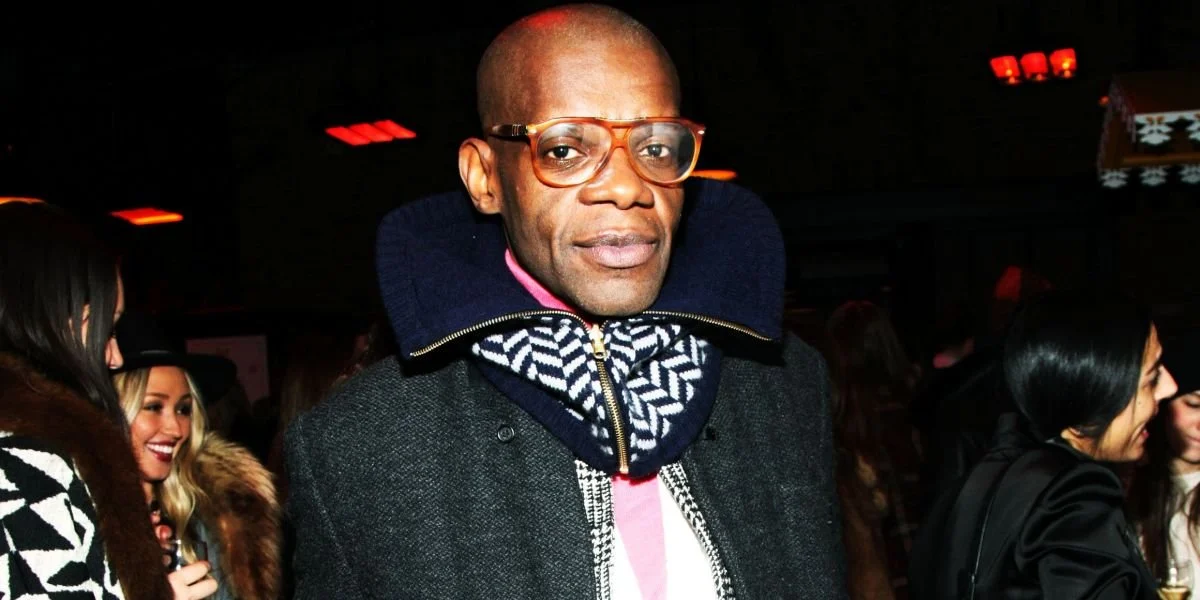
See Why Haitian Born Designer Victor Glemaud Was Honored In Washington


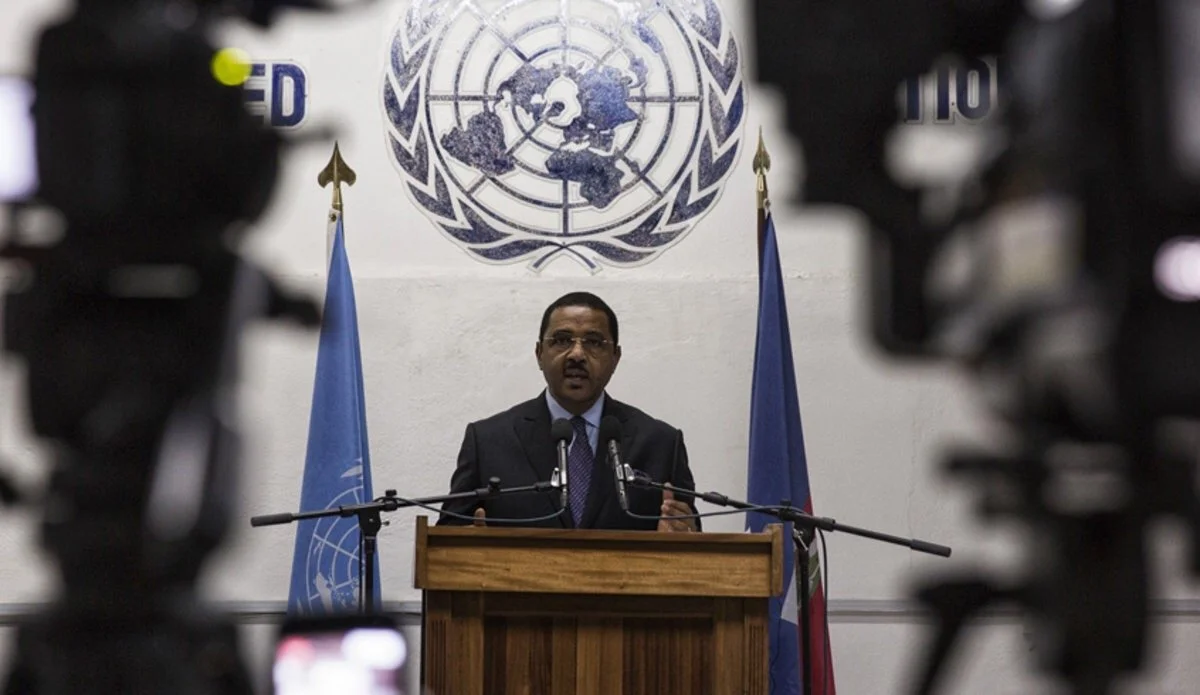
A New Window of Opportunity for Haiti
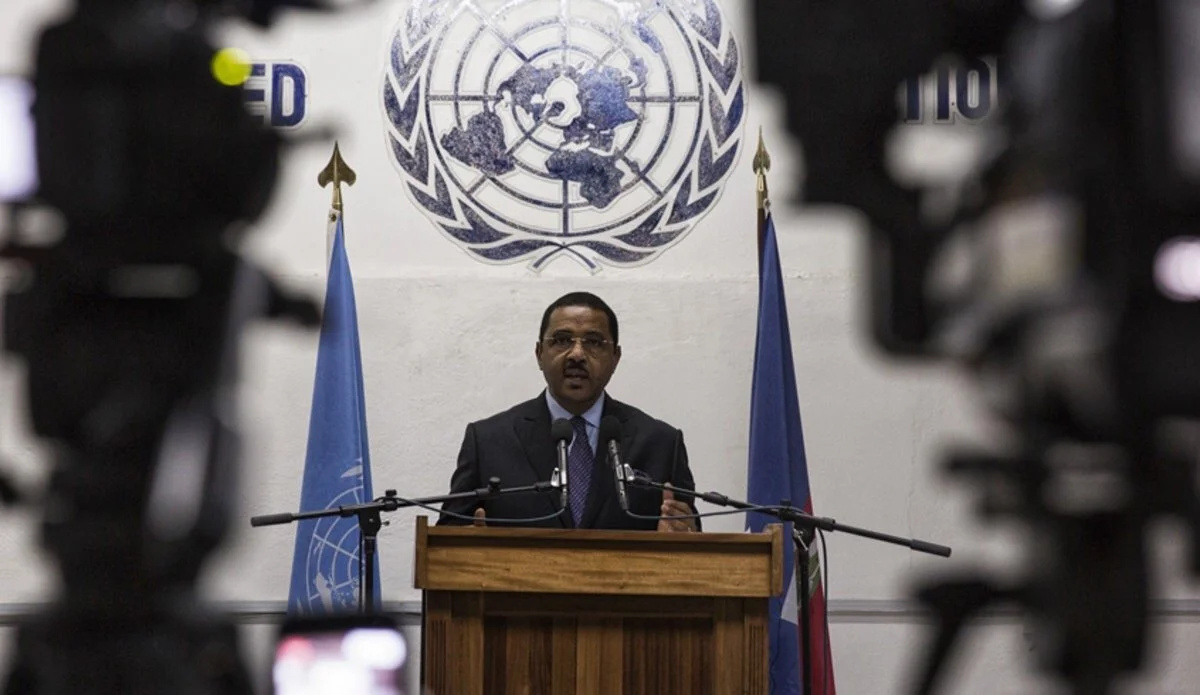
MINUJUSTH Deputy Special Representative's first Haiti press conference in Port-au-Prince Eight days after the opening ceremony of the United Nations Mission for Justice Support in Haiti (MINUJUSTH) on 16 October 2017, the Deputy Special Representative of the UN Secretary-General for Haiti, and Oic Head of Mission, Dr. Mamadou Diallo, held his first press conference in Port-au-Prince today to mark UN Day celebrated each day on 24 October."Haiti is one of the 193 countries that have adopted the Sustainable Development Goals (SDGs) and has set itself the goal of becoming an emerging country and economy by 2030. Not only these objectives are possible, but they represents the commitment of Haiti with its children and grandchildren for a better future and the United Nations will remain side by side with Haiti on this path."Regarding MINUJUSTH, he reaffirmed the new window of opportunity the new mission represents, to foster sustainable development in the country."MINUJUSTH is a window of opportunity to consolidate the political stability achieved during the last years in order to give to open and give a voice to a democratic, stable and prosper future for all Haitians," he stated.Speaking to the media at MINUJUSTH HQ, in the Haitian capital, the Oic Head of Mission, Mamadou Diallo, called on the country’s youth to help address the challenges facing the nation. He considers Haitian youth and women as crucial actors for the development and stability of Haiti."I would like to stress that the United Nations regards youth and women as a priority sector of the population and driving forces for the country’s development, since their participation is essential for the stability and sustainable development of Haiti."Representatives of UN agencies in Haiti and MINUJUSTH’s leadership were also present at the press conference. On his capacity of UN Humanitarian Coordinator and Resident Coordinator, Mr. Diallo affirmed that the UN System, Funds and Programs in Haiti remains engaged with the Haitian people when it comes to humanitarian assistance and development."The UN and the Humanitarian Country Team will continue to support national and local authorities in their response to humanitarian needs, always on the direction of Haitian institutions, as was the case after Hurricane Matthew in 2016 and hurricanes Irma and Maria this year" he added. "Nevertheless, the UN’s priority and approach will strengtheng the resilience of institutions and the population to better prevent, respond to and overcome external shocks and humanitarian situations. We are convinced that this is the way to gradually reduce the need for humanitarian assistance and build a solid foundation for development. "Recognizing that Haitians are responsible for choosing and shaping their own future, Mr. Diallo acknowledged that it is the UN priority to accompany them in that regard. « We the United Nations are partners in supporting the authorities and the people in this process, with an approach that prioritizes capacity building of institutions and the people."It is a priority to recognize that Haitians are primarily responsible for choosing their own future and making it a reality. We, the United Nations, are partners in supporting the authorities and the people in this process, with an approach that prioritizes capacity building and institutions and people. "UN Day: A global call to transform the futureThe Head of MINUJUSTH also delivered a message on behalf of the Secretary-General António Guterres' United Nations Day call for people from around the globe to overcome their differences and to address global challenges that go beyond national borders."Our world faces many grave challenges. Widening conflicts and inequality, extreme weather and deadly intolerance, [and] security threats - including nuclear weapons. We have the tools and wealth to overcome these challenges. All we need is the will" said Mr. Guterres in his message.The UN chief also stated in his message that the challenges faced by the world transcend borders and, therefore, everyone needs to transcend their differences to transform our future. "When we achieve human rights and human dignity for all people – they will build a peaceful, sustainable and just world," he added.The SG also urged humanity to respect the values, purpose and principles of the United Nations Charter insisting that " ‘We the Peoples’, have to make this vision a reality.Observed since 1948, the 24th of October -UN Day marks the anniversary of the entry into force in 1945 of the UN Charter, the world body’s founding document. As a founded member of the UN, Haiti has been one of the first to sign the Charter in 1945 and participates since then, in the work of the organization for the benefit of the Haitian people and others around the October 24, 2017
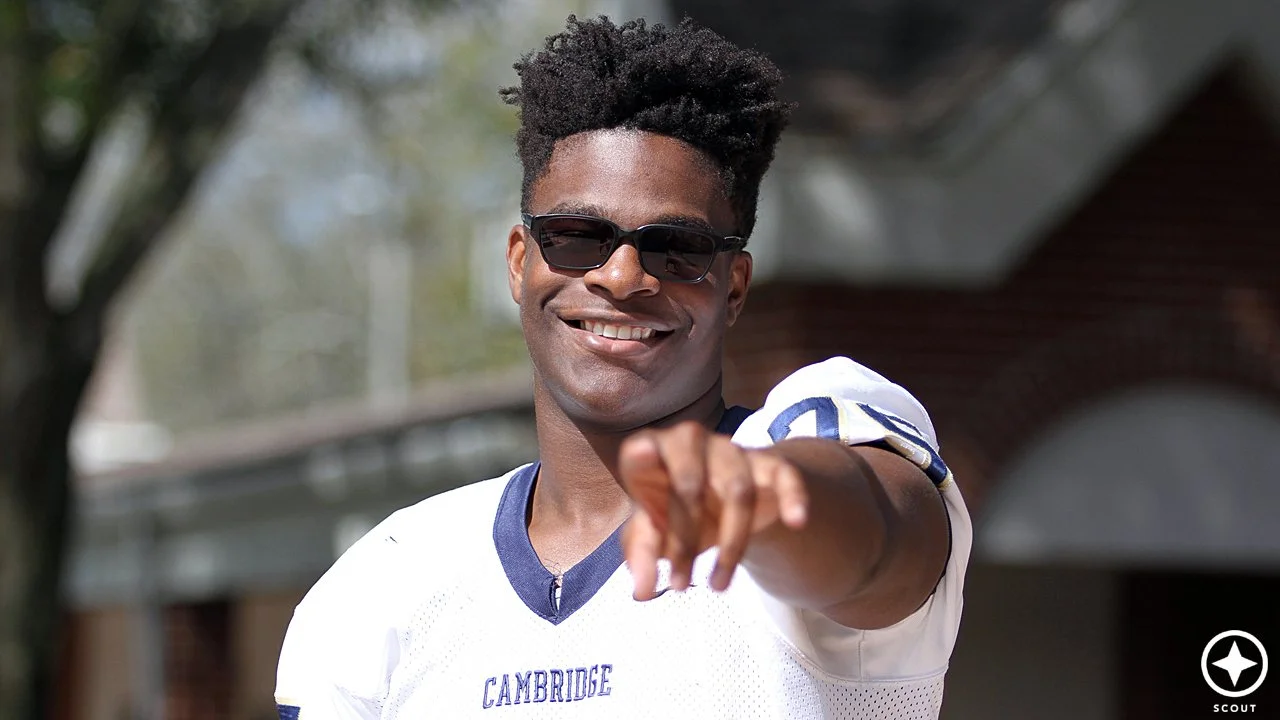
Florida commit Richard Gouraige motivated by mother’s triumph from Haiti
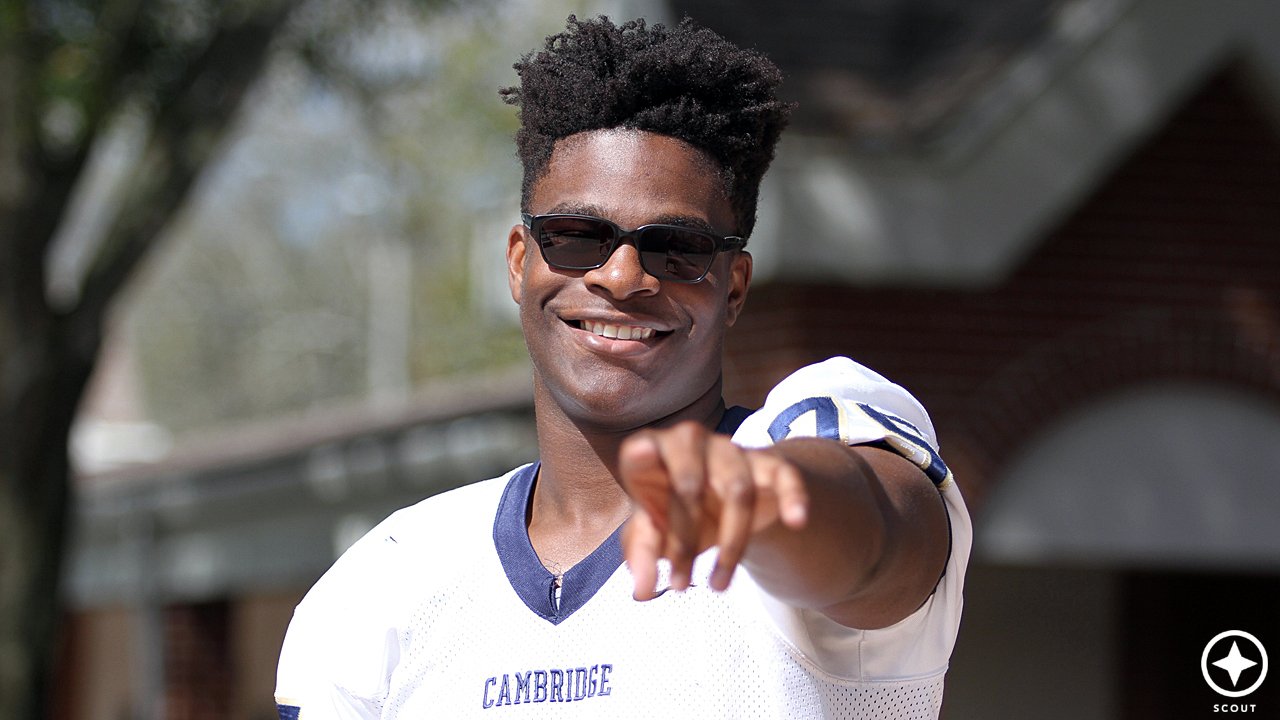
TAMPA, Fla. — Gator Nation got a jolt of enthusiasm Friday from Richard Gouraige.The 4-star offensive tackle from Cambridge Christian School (Tampa, Fla.) sent Florida football fans into a frenzy when he released his commitment video.As the tweet took off and news got out, Gouraige wasn’t celebrating. He didn’t obsess over the attention, text messages and Twitter notifications.No, the big man was in a team meeting for some last-minute game prep.“My main goal in life is win at everything I do with football,” Gouraige said. “It’s my only way out. Whatever I gotta do, I do it. I don’t have an excuse.”His mother, Kerlange, never had one. Her journey from Haiti to the United States serves as constant motivation for Gouraige.“She only came with the clothes on her back,” Gouraige said. “So coming over here was pretty hard. She had to go to school and work three jobs. Could barely speak English. She only knew Creole and French, so she struggled.”
Gouraige wakes up regularly at 6 a.m., whether it be for practice, school or team workouts. He’s also used to being up that early.“From the time I was little, my mom would wake me up at 5 in the morning every day to ride the bus,” Gouraige said. “Growing up, it was kind of rough for me before my siblings were born. But seeing my mom make it through all that, it taught me a lot.”Specifically? How to deal with failure.“Don’t let it bring you down,” Gouraige said. “Let your failure fuel you. Add more gas to that fire.”Gouraige is one of the nation’s top prospects at his position and accumulated more than 35 offers. But when his mother and siblings shared his desire to attend Florida, the decision was a done deal.“I’m just ready to play football, which is what I love,” Gouraige said. “I don’t really care about this recruiting process. I’m grateful to be here and humbled by it. But at the end of the day, you still have to go on the field and be a dog.“I’m very grateful that I had the opportunity to play football and stay off the streets. It led me to a better path really. That’s why I got this chip on my shoulder and it makes me keep working hard every day.”Gouraige has NFL aspirations after college and hopes to return to Haiti one day and build houses with non-profit organizations.His mother already has.“I want to help,” Gouraige said. “I’ve been to Haiti once. It’s hot, but there’s always dancing. That’s my culture and I just love those people.“I want to give back and show appreciation for the way they raised my mom, because she’s a very strong lady. You can’t get another lady like her.”By: Zach Abolverdi - October 22, 2017
80 years after the massacre that changed the Dominican-Haitian border, an effort to heal
Love, art and respect are the three words that Cynthia Carrion, 36, believes encompass the goal of the collective Border of Lights, a group that is looking reconcile relationships at the fraught border of the Dominican Republic and Haiti.
Earlier this month, Carrion boarded a plane to join dozens of organizers, educators, artists and locals on the northern side of the Haiti-Dominican Republic border to commemorate the 80th Anniversary of the 1937 massacre that targeted Haitians on the border of the Dominican Republic and Haiti. The acts were carried out under the orders of Dominican dictator Rafael L. Trujillo.
The number of victims as a result of “Masacre de Perejil,” is still unknown. Edward Paulino, a professor of global history at John Jay College in New York City and author of “Dividing Hispaniola: The Dominican Republic’s Border Campaign Against Haiti” estimates approximately 15,000 lives were lost.
And the effects went beyond the loss of life. It sought to end a culture of collaboration. The porousness among the border communities didn’t fit Trujillo’s ultranationalist views for the Dominican Republic.
“Since [the massacre] you had this stark difference of what side you were on and what that meant,” says Carrion.
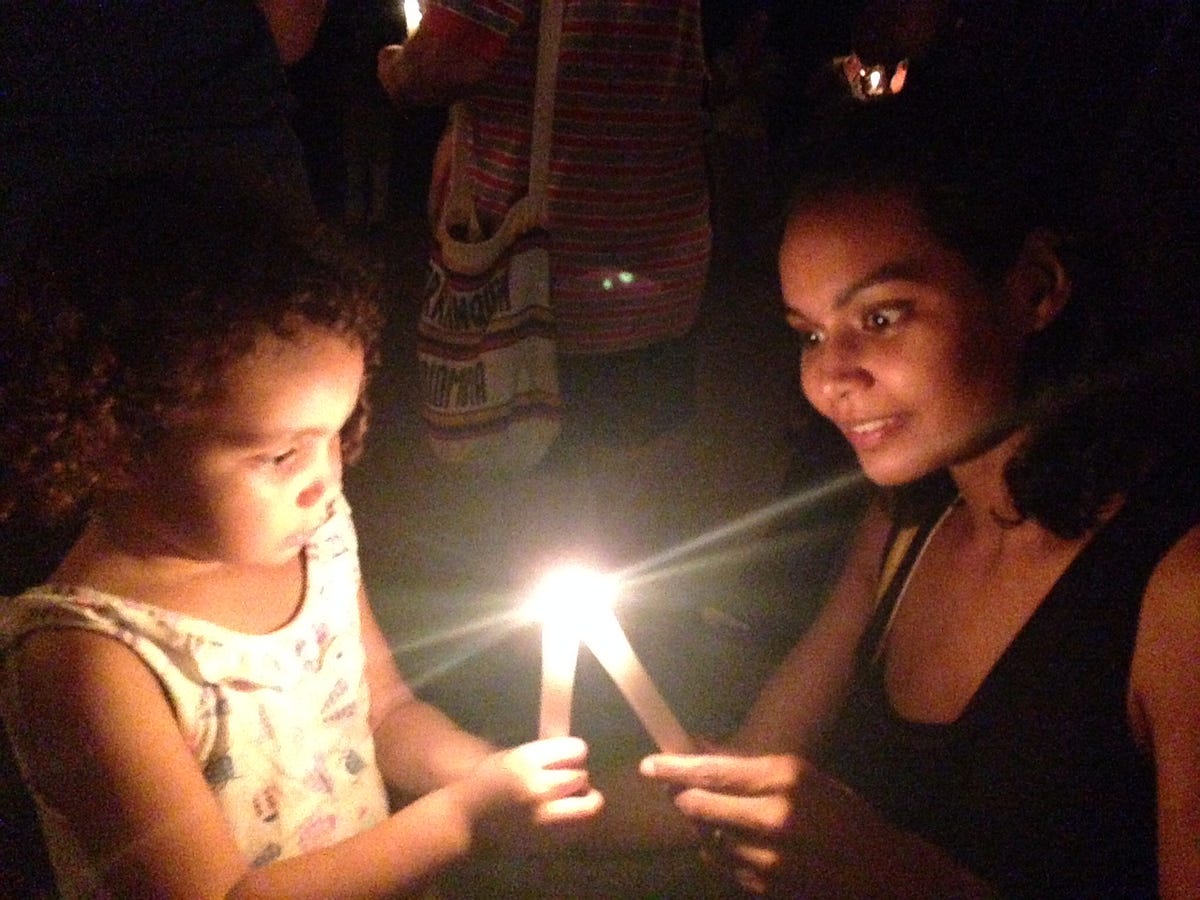
“What Border of Lights means to me now is this community of amazing and courageous people, both in the [Dominican Republic] and in Haiti, and around the world, but especially in the diaspora, who against all odds are still holding a light to this tragedy and this truth, which isn’t that easy,” she says.
The project started from a vision that renowned author Julia Alvarez shared at an event five years ago in New York City. Carrion approached Alvarez to get involved.
Every night for the next few months, organizers gathered by Carrion and Paulino would have conference calls to help plan an event surrounding the 75th anniversary.
At first, action around recognizing the anniversary was marked with skepticism.
“People would come up to us and say some of them would say ‘Why are you trying to unify the island?’ or this ultra-nationalistic kind of fear of what that meant, to be able to talk out loud, or to say that this occurred,” says Carrion.
As a mother of two and a proud Dominicana, it was important to Carrion to continue this work. “I want for [my daughters] to understand that they’re part of the shared struggle and shared beauty,”
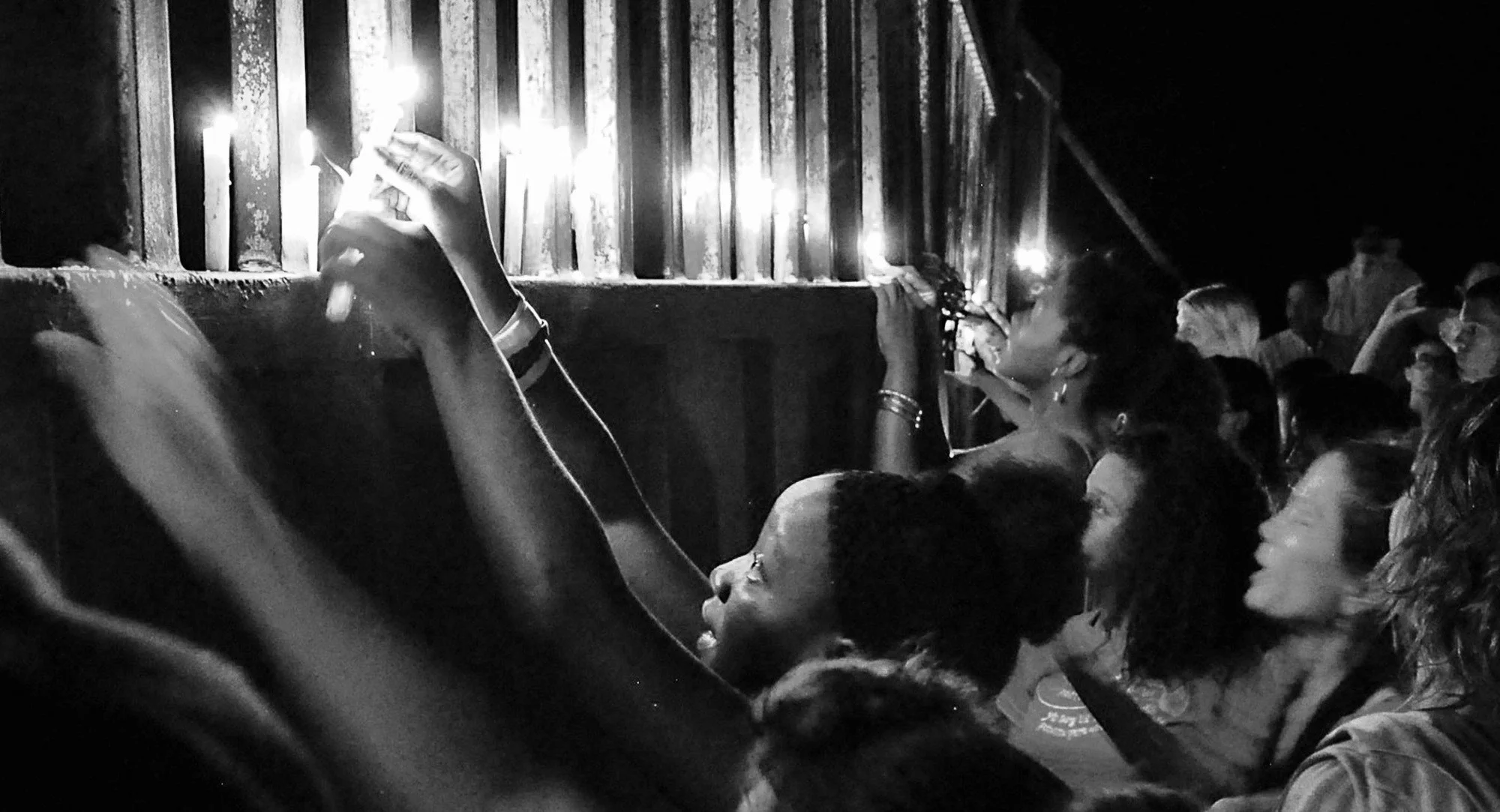
Border of Lights kicks off every year with two masses followed by two processions and candle lightings happening in two places at the same time: one in the Dominican town of Dajabon, the other in the Haitian town of Ouanaminthe.
During the vigils, participants stand across from another, divided by the river that is between the two countries. and view each other from the distance.
Carrion has been present during four of the past five years (the exception was when she gave birth to her youngest daughter, Maya Soleil, on the evening of the procession two years ago).
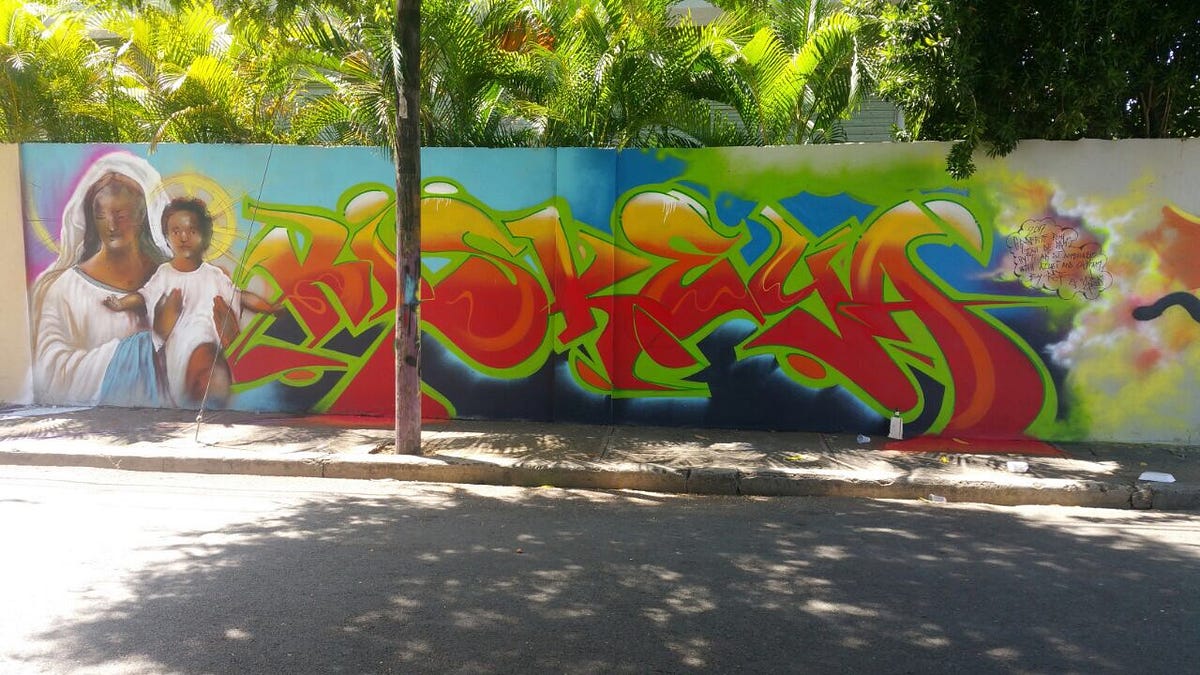
For the 80th Anniversary, the mission is expanding. The group is building a curriculum to be tested out in 10 schools and pushing for the date to be recognized on both the calendar of the Dominican Republic and Haiti as a Day of Remembrance. In Dajabon, there is a mural to commemorate the massacre.
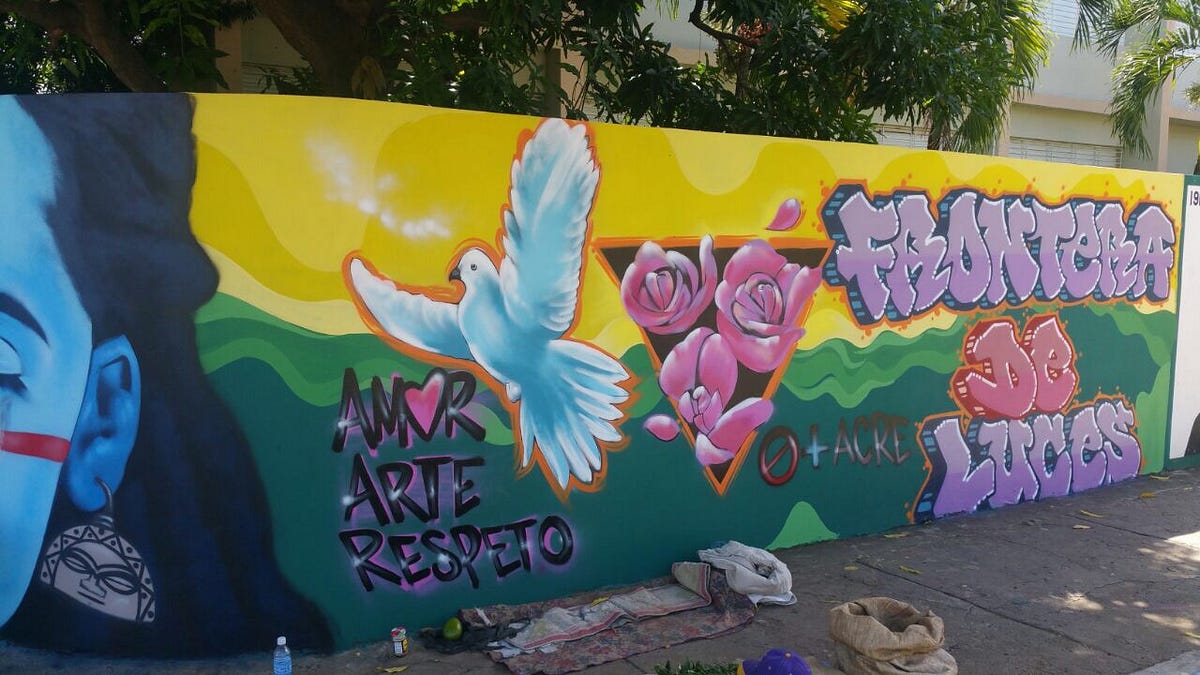
Organizing is made more difficult by strict border laws. This is in part due to sentences passed in 2015, one that stripped Dominicans of Haitian descent of their citizenship, followed by another sentence that sought to regulate immigration.
Carrion says she can’t help but find parallels between the struggle at the Haiti-Dominican Republic border and the politicization of the United States-Mexico border.
Borders have been regarded as a place for violence internationally, says Carrion, but she believes that can change.
We want “not just pay respect to [the massacre] but to also highlight collaboration among the [countries], you see it among the younger generation, people want to have stronger relationships with each other.”
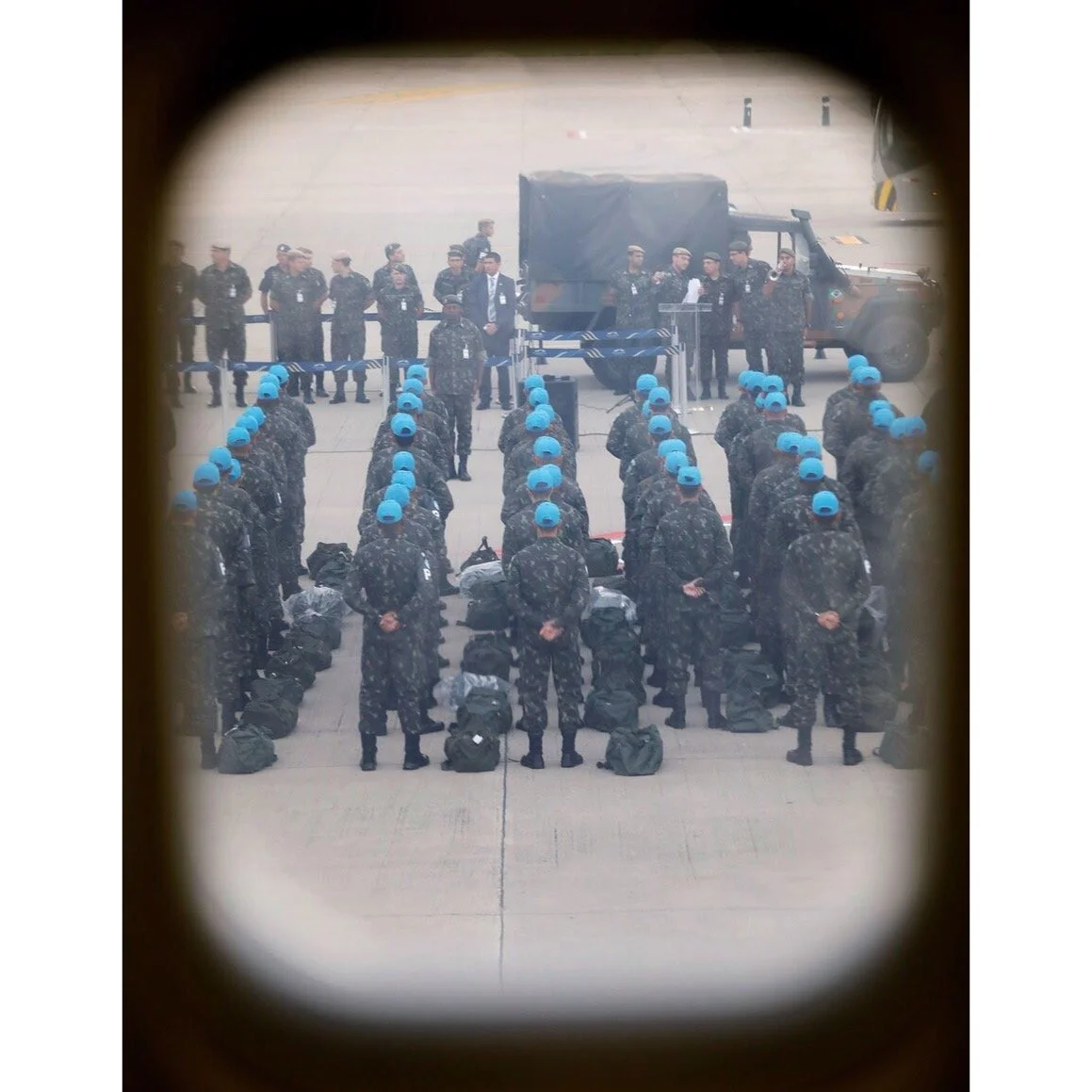
A New Chapter for the Disastrous United Nations Mission in Haiti?
The year the United Nations Stabilization Mission in Haiti (MINUSTAH) came to the country was a deadly one for my family. In February of 2004, Haiti’s first democratically elected President, Jean-Bertrand Aristide, was forced out of office for a second time, having been reinstated, and then reëlected, after a 1991 military coup. This time, Aristide was replaced by Gérard Latortue, a former United Nations official, who called those who took up arms against Aristide “freedom fighters.” (Their leader, Guy Philippe, is serving a nine-year sentence in a U.S. prison after pleading guilty to receiving multimillion-dollar bribes from cocaine traffickers.)
That April, claiming that the situation in Haiti constituted “a threat to international peace and security in the region,” the U.N. Security Council passed Resolution 1542, establishing the Brazil-led MINUSTAH. The mission, which officially began in June, 2004, lasted thirteen years and five months, and cost more than seven billion dollars, before officially ending this past Sunday.
Part of MINUSTAH’s mandate was to assist the transitional government in insuring “a secure and stable environment.” This is where my loved ones and others came into the mission’s crosshairs.
I spent the first twelve years of my life in an impoverished neighborhood in Port-au-Prince called Bel Air, where many Aristide supporters live. My eighty-one-year-old uncle, a minister, had called this neighborhood home since the nineteen-fifties, and was there on September 30, 2004, when protests began on the thirteenth anniversary of the first coup d’état. In response, the Haitian national police and MINUSTAH soldiers conducted joint raids in Bel Air that led to dozens of mostly unreported injuries and deaths. The following month, U.N. soldiers and Haitian riot police climbed up to the roof of my uncle’s church and killed some of his neighbors below. My uncle was forced to flee to Miami, where he died in the custody of U.S. immigration officials after being denied asylum.
Bel Air was not the only area subjected to these raids. During one of their bloodiest operations in Cité Soleil, another poor and densely populated neighborhood in the capital, MINUSTAH used more than twenty-two thousand bullets and seventy-eight grenades, among other artillery, to kill seven alleged gang members. No other deaths were acknowledged despite further raids until early 2007, when the mission head at the time, Edmond Mulet, brushed off such killings as collateral damage. This combat terminology was not incidental. MINUSTAH was a continuous military operation in a country in which there was no war.
There would be more collateral damage. In October, 2010, nine months after an 7.0-magnitude earthquake nearly flattened Port-au-Prince and the surrounding areas and killed more than three hundred thousand people, and while more than a million people were still displaced or living in makeshift tent camps, Nepalese peacekeepers stationed in the north of Haiti allowed raw sewage from their base to leak into one of Haiti’s largest and most intensively used rivers, causing a cholera epidemic. The U.N. at first refused to investigate the source of the outbreak and instead blamed Haiti’s lack of sewerage and water-treatment facilities. More than ten thousand people have died from cholera since 2010, and more than eight hundred thousand have been infected.
It took the U.N. six years to acknowledge its role in the cholera epidemic, and even though the former Secretary-General, Ban Ki-moon, declared last December that the U.N. needed to “do the right thing”, the U.N. continues to reject victims’ legal claims by citing immunity. The U.N. has also failed to deliver on Ban’s promise of a four-hundred-million-dollar fund to halt the spread of cholera and compensate the “most affected” victims. The fund has only raised $2.7 million, and the current U.N. Secretary General, António Guterres, seems unwilling to provide direct payments to the cholera victims and their families, many of whom have lost their sole breadwinner.
Neither the U.N.’s impunity nor the lack of accountability would surprise the women and boys and girls, many as young as twelve, who have told of being raped—one boy says that he was gang-raped—by MINUSTAH peacekeepers, who, according to the Associated Press, have used sex rings, offers of food, and other methods to trap their victims. Unacknowledged “MINUSTAH babies” and their destitute mothers are treated as though they do not exist. Though MINUSTAH rapes remain underreported, those who have come forward have had to confront the same type of repudiation faced by the initial cholera victims. Their rapists were rarely punished. They were simply sent home.
MINUSTAH has now been replaced by MINUJUSTH, a smaller mission which began on Monday. MINUJUSTH , the United Nations Mission for Justice Support in Haiti, has a mandate to “help the Government of Haiti strengthen rule-of-law institutions, further develop and support the Haitian National Police and engage in human rights monitoring, reporting and analysis.” MINUJUSTH, which will will consist of twelve hundred and seventy-five officers and support personnel, seems like a rebranding effort, an attempt by the U.N. to give itself a clean slate and erase MINUSTAH’s past. But if the U.N. were serious about justice and human rights in Haiti, it would wind down its presence in the country by having MINUJUSTH also investigate the damage done to both individuals and entire communities by MINUSTAH. Or, better yet, assign an independent body to do so, then offer the warranted compensation for the extrajudicial and civilian killings, the sexual assaults, and the introduction of cholera.
Haiti’s current President, Jovenel Moïse, whose two heavily contested election cycles are often touted as a MINUSTAH success, told the Miami Herald in an interview this month that “the conversion of MINUSTAH to MINUJUSTH is the recognition of the progress made by our country in recent years. Today, Haiti is no threat to regional and global peace and security.” To fill in the gap being left by MINUSTAH, Moïse plans to revive the defunct Haitian Army, whose history of human-rights abuses, the coup d’état against Aristide, in 1991, and its subsequent reign of terror led to an earlier United Nations mission, UNMIH, in 1993.
Moïse’s proposed budget for 2017, which calls for new tariffs and increased taxes on goods and services, has been a subject of mounting protests in Haiti. MINUJUSTH, like its predecessors, will likely find itself facing angry Haitians, or training those who do. Why should Haitians trust another group of U.N. “peacekeepers” who claim to promote the same human rights, justice, and rule of law that have been so blatantly violated by their colleagues? The U.N. may want to leave MINUSTAH’s dark chapter behind, but Haitians will have to suffer the consequences of the group’s actions for generations to come. And no new mission, under whatever acronym, will change that.
Edwidge Danticat is the author of many books, including, most recently, “The Art of Death: Writing the Final Story.”
By: Edwidge Danticat, The New Yorker | October 19, 2017
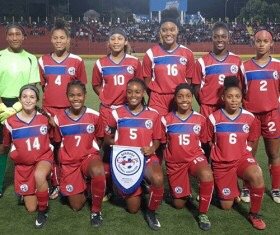
U17 Football: Haiti Defeat Bermuda 4 – 1
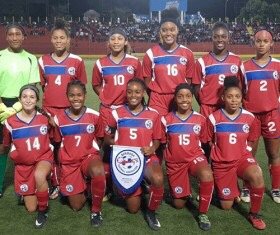
Bermuda’s Under 17 Women’s National — who have already secured a spot in the CONCACAF Finals in Nicaragua — matched up against the host Haiti for their final match of this round.Bermuda’s starting line-up was Za’khari Turner, Koa Goodchild, Delia Ebbin, Danni Watson, Zekiah Lewis, Trinae Edwards, Jadae Steede Hill, Emily Cabral, Nia Christopher, and Leilanni Nesbeth. Bermuda was up against the host in the Final, both teams already assured of a spot in the CONCACAF Women’s Under 17 Final in Nicaragua.In front of a large crowd, Haiti were able to win 4 – 1, with Bermuda’s lone goal coming from Nia Christopher in the first half.By Bernews | October 23, 2017

Haitian artist Didier William conveys current events, life in homeland through painting

Artist Didier William visited the college Monday to discuss his career and present several of his works to students. William, who is currently the Chair of the Masters and Fine Arts Program at the Pennsylvania Academy of Fine Arts, was born in Haiti and moved to Boston, Mass. at six years old.Several of the pieces William presented focus on his own gender and sexuality, his Haitian heritage and the nation’s history and military. During the talk, William presented his painting “His Life Depends on Spotted Lies” and said his inspiration for the piece came from the Trayvon Martin case, in which unarmed teenager Trayvon Martin was killed by neighborhood watchman George Zimmerman, an act for which Zimmerman was acquitted.William said that his art comes from a small idea that expands and that he wants his artwork to reflect how difficult the process is. William is interested in a painting’s ability to “amaze and offend,” he said.William said his painting “Erzuile Toujours Konnen” focuses on his life in Haiti. His piece “This Pig is Heavy” focuses on an outbreak of swine flu that occurred in his homeland of Haiti. William also said that his painting “I Remember When I Was A Little Girl” is meant to tell a story about life in poverty.In his time as an artist, William has also taught at numerous prestigious schools, including Yale University. William shows his work in galleries and is currently based in Philadelphia, Pa.The paintings William presented to audience members included “Tumble,” “Sanitizing Sanity,” “Keyhole,” “I Remember When I Was A Little Girl” and several more. William also presented his most recent work titled “Camouflage.”William discussed his artistic background with the audience, explaining that as a young man he took numerous art classes. William started out as a sculptor and spent his time in graduate school digging through material. After a hesitant start, he ended up being successful in his craft, he explained.Many of William’s paintings also focus on the use of space and color, frequently including eyes. According to William, he has been inspired by artists like Robert Colescott, Helen Frankenthaler, Sigmar Polke, Carroll Dunham, Belkis Ayón and Azil Politik. He said that print has changed the way he has thought about painting. William explained that he didn’t choose to be an artist, but that art found him and he was always compelled to make art.According to art professor Nestor Gil, he invited William to the college for a variety of reasons, saying that William is an artist from whom “we can learn a great deal.” Gil knows William from collaborative work at the Experimental Printmaking Institute at Lafayette.“[William] treats themes and subjects that are current and urgent in our culture and society,” Gil said.William will exhibit his work in Miami this December and will return to the college in January to show his work in a collaborative effort called “Swarm” with Professor Gil. “Swarm” will be on display in the Grossman Gallery.By Anthony Orlando | October 20, 217

Cafe Erzulie’s Haitian Spirit of Love

On any given night at this bar, named after the vodou goddess, there might be events like Afrofuturist lecturers, lobster festivals, or live jazz.Erzulie, the Haitian spirit of love and beauty, holds Thursdays sacred. After reading a longer list of her preferences, it may seem that the vodou goddess had a hand in more than just the name of this new café-cum-cocktail-lounge in Bushwick. Erzulie likes pink and light blue (the color of the floor tiles), sweet-smelling flowers and sparkling wine (provided in the form of the bubbly Kir de Jacmel), and small cakes (sticky buns are sold at the counter). The storefront is also home to Flowers by Leslie, a fifteen-year-old plant shop that was struggling to make rent. Instead of displacing it, the Erzulie owners preserved it as a business, and as a drink. Now patrons can browse the lilies and the basil for sale near the front on their way to grab a Flowers by Leslie cocktail, a pleasantly sour medley of vodka, mint, and St. Germain with crescents of cucumber. If they move farther along, to the back patio, they may chance on an event that would make Erzulie smile: on any given night, there might be Afrofuturist lecturers, a Jamaican lobster festival described as “Kingston meets Kennebunkport,” or live jazz. One evening, a steel-drum player, backed by a snare and an electric bass, performed an instrumental cover of Sam Cooke’s “Bring It on Home to Me.” Around eleven, as the musicians started tapping out the notes to “Signed, Sealed, Delivered,” a listener in red jeans and a blue button-down leapt up to become their vocalist, singing through the chorus about a dozen times. When the song finished, she twirled over to the band and asked if they knew her. They did not. “It’s all good!” the mysterious singer said. “I’ll see you next Thursday!” Was it the goddess herself? Perhaps. Thursday, after all, is her holy day. By Neima Jahromi | October 30, 2017
Haiti mourns the death of «Papa Pyè»
Haiti mourns the death of «Papa Pyè» Limond Toussaint, Minister of Culture, learned with astonishment the news of the death of the haitian actor, comedian and playwright , Jean Claude Joseph, aka "Papa Pye" occurred Wednesday, October 18 in Orlando, United States following his hospitalization on the weekend due to illness. "Papa Pyè has marked his time of an oil stain and leave again happy remembrances in the memory of all those who, one day or the other, had the chance to live a sequence of his famous performances on the National Television of Haiti (TNH), with "La vi nan Bouk", his various scenic performances whether in Haiti or abroad where he immigrated and his involvement in the production of some feature film where he showed his outstanding talent.In this painful circumstance the Minister of Culture bows to the immense talent of this Haitian cultural man and once again pays tribute to him for all his contribution to the radiance and emancipation of the theater of Chez nous, an essential element of Haitian culture.Jean Claude Joseph, Papa Pyè, is one of those pioneers of Haitian theater that has marked a whole generation and transcended all the social strata by telling our daily life with an artistic fluidity without measure. He is the witness of a whole section of history of the Haitian culture which leaves, with its departure for the beyond.The Ministry will never end by thanking and bowing to the immensity of the Intangible Cultural Heritage represented by Papa Pyè, still today [...]While expressing his profound regret, Minister Limond Toussaint sends his sincere sympathies to the whole family of the deceased, to the members of the 'La vi nan Bouk' Troupe and to the cultural actors affected by his brutal disappearance."By: HaitiLibre | October 19, 2017
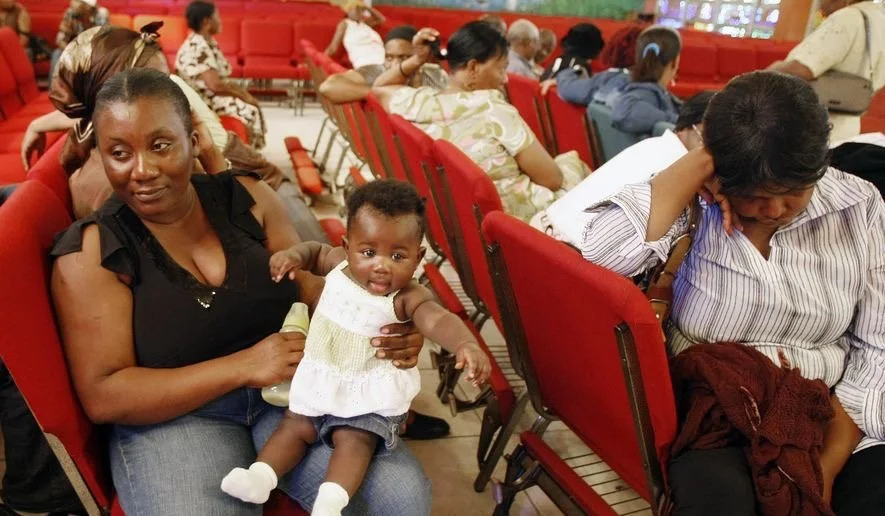
Haiti begs for 18-month stay of deportation for Haitians in U.S. after 2010 earthquake
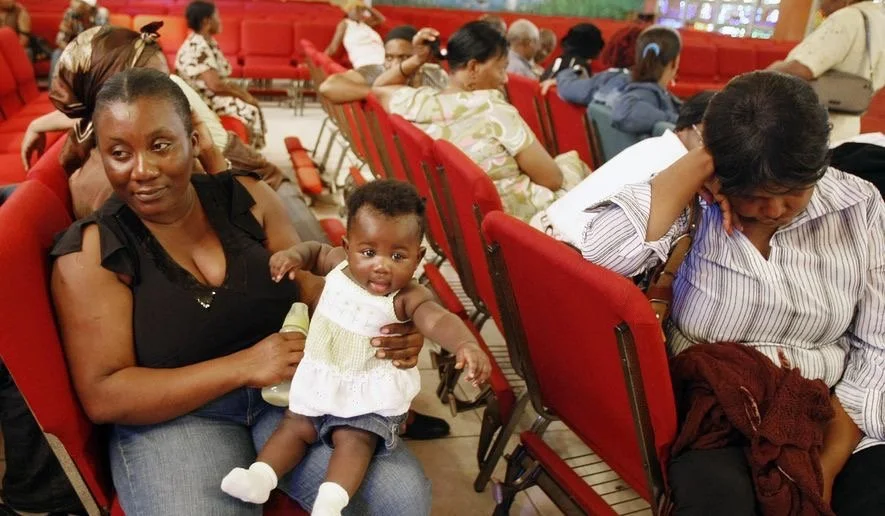
Haiti has asked the Trump administration to grant an 18-month deportation amnesty to its citizens who are already in the U.S., saying the island nation is still struggling to recover from the 2010 earthquake and can’t handle return of tens of thousands of people.Haitian Ambassador Paul G. Altidor, in a letter first reported by the Miami Herald, invited acting Homeland Security Secretary Elaine Duke to visit Haiti to see the continued struggles first-hand, saying she would conclude that another 18-month reprieve “is a necessity.”He said an ongoing cholera epidemic and new pressure from last year’s Hurricane Matthew have created new disruptions beyond the earthquake, that have made the country’s recovery tougher.Homeland Security is in the midst of making a decision, but has signaled it won’t simply renew protections, as previous administrations sometimes did.“This is the choice that’s being made is they aren’t going to continue to treat this program in ways that aren’t intended,” said department spokesman David Lapan.The Trump administration earlier this year granted a six-month extension but then-Secretary John F. Kelly — now the White House chief of staff — had signaled that Haitians should be prepared for an end to Temporary Protected Status (TPS), which they’ve enjoyed since the earthquake.Mr. Kelly said the law governing TPS says it is supposed to be a temporary status that’s in place only as long as the conditions from the original disaster remain.The current six-month protection runs out in late January, but a decision must come two months before that.Homeland Security also has to decide on TPS renewals for several Central American countries that have been under protected status since the turn of the century, meaning a pool of illegal immigrants has been shielded from deportation to those countries for more than 15 years.Some 46,000 Haitians are protected by TPS, while 86,000 people from Honduras and 263,000 people from El Salvador are protected.TPS beneficiaries are granted work permits, allowing them to hold jobs, get driver’s licenses and social security numbers and some taxpayer benefits.Mr. Kelly earlier this year said that abuse of TPS by past administrations had created a situation where some of those people who’ve been protected for nearly two decades have put down roots, and may need to be granted full legal status — a move that would have to come from Congress.By Stephen Dinan | October 19, 2017
Haitian Ambassador to Deliver Keynote Address at Caribbean Summit, November 3rd
 United States, H.E. Paul G. Atidor, will deliver the keynote address at the Caribbean Summit. Sponsored by the Division of Continuing Education and Professional Studies, the Summit will be held on campus on November 3. The day will be dedicated to bringing together U.S. and international colleagues to raise awareness about opportunities for business and development in the Caribbean region. Panel discussions will focus on topics including leadership, education innovation, the business of tourism, investment, the arts, and enterprise resiliency and business continuity.Appointed as Haiti's U.S. Ambassador in January 2012, Altidor is known for his innovative and strategic leadership. An economist and international development specialist, he received his undergraduate degree from Boston College, an advanced degree from the Massachusetts Institute of Technology (MIT) and pursued additional graduate studies in law and economics at the University of Paris X, in France. He has an extensive background in the private sector and has been involved in efforts to reset the narrative surrounding Haiti and encouraging people to explore and discover the island nation. Prior to becoming ambassador, Altidor served as vice president of programs and investments for the Clinton Bush Haiti Fund. Created in the wake of the devastating earthquake that hit the Caribbean island nation in 2010, the fund was established with the support of President Barack Obama and co-chaired by former presidents Bill Clinton and George W. Bush."Our diverse community of students and scholars hail from many parts of the Caribbean, making Seton Hall an ideal location for the summit," notes Karen A. Passaro, J.D., event co-chair and dean of the Division of Continuing Education and Professional Studies. "We have a tradition of supporting entrepreneurship, travel and service to the Caribbean and we look forward to working with others to strengthen their ties to this beautiful and resilient region."The Caribbean Summit, which is co-chaired by Reginald Boisrond Canal of Les Cayes Partners, will also examine how organizations can fulfill contractual obligations and maintain business operations in the aftermath of natural disasters.The day begins at 8:30 a.m. with a continental breakfast, plenary sessions and a Caribbean-inspired lunch featuring an address by Ambassador Altidore. Following panel presentations in the afternoon, participants will enjoy networking at the Summit’s closing reception which will end at 5:30 p.m. By Linsda Karten | October 18, 2017
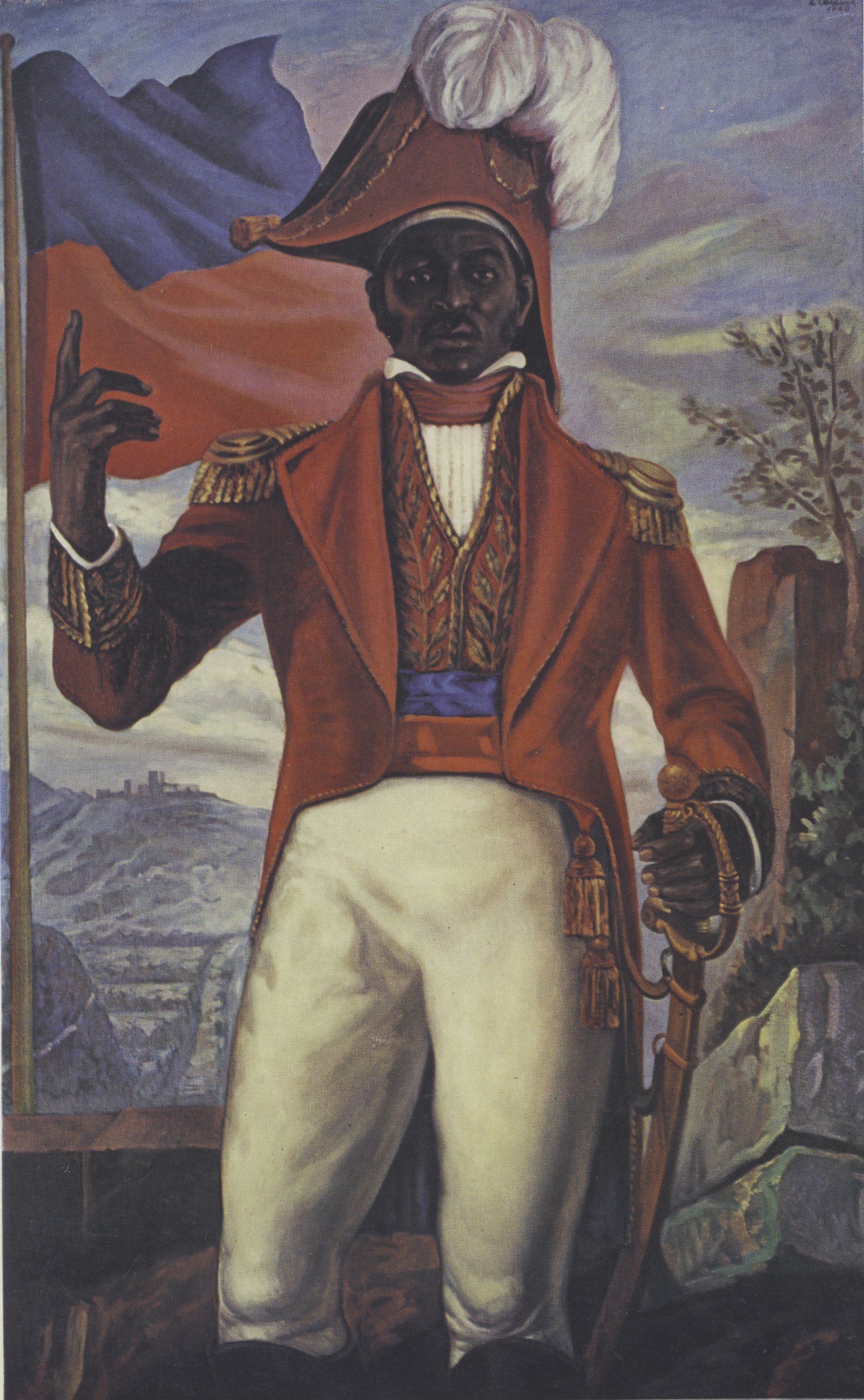
Haitian National Holiday: October 17th -Death of Jean-Jacques Dessaline
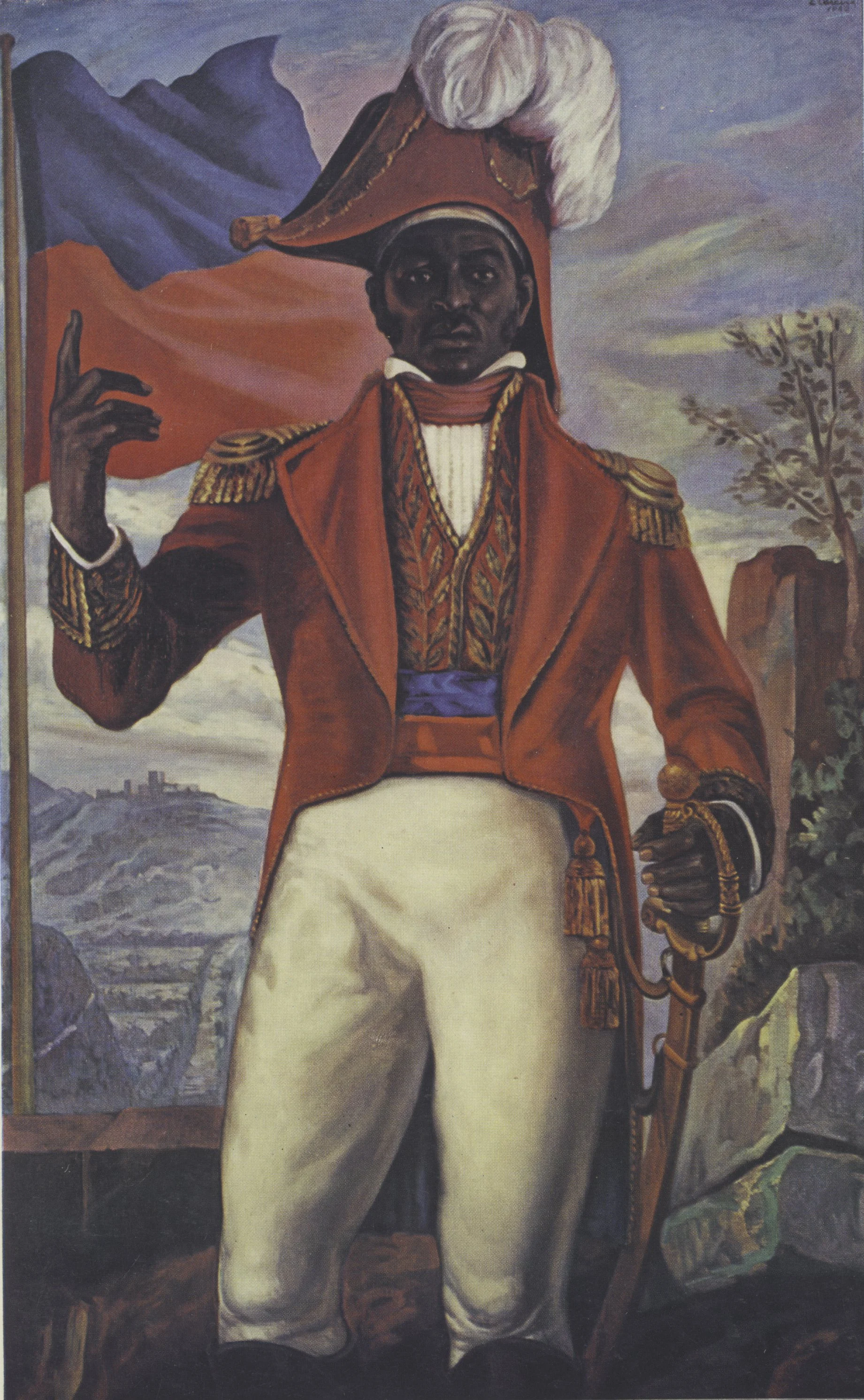
"We have dared to be free. Let us dare to be so by ourselves and for ourselves."— Jean-Jacques Dessalines
The death of Jean-Jacques Dessaline is a public holiday in Haiti. Haiti dignifies no other individual with an official national holiday. He is considered the “Père de la Patrie.”Born to Congolese parents, Dessalines was born on a plantation in an area called Cormiers, (today, Cormier), in the hills near the town of Grande Rivière du Nord 25 kms from Cap-Haitien. That plantation belonged to a French man named Duclos. The young man was ultimately given the name of Jacques Duclos. There isn’t much history about his parents, but there have been mentions of a beloved aunt, Victoria Montou, that he affectionately called “Toya.” At the age of 30 or so, he would be sold off on the market and be bought by a free black man named Dessalines, at which point he changed his name from Jacques Duclos to Jean Jacques Dessalines. He worked as a field hand for the black master until 1791, when he joined the slave rebellion that broke out in the colony amid the turmoil caused by the French Revolution.Upon joining the slave revolt that would ultimately lead to independence, Jean-Jacques followed the example of early band leaders, Boukman, Jean François and Biassou. He became a lieutenant in the Army of Jean François. He followed Jean François when he lent his services to the Royal majesty of Spain. There, he met Toussaint Bréda, who we would later come to know as Toussaint L' Ouverture who himself, was climbing the ranks and gaining notoriety for his successive brilliant victories against forces far superior to his. When the French Republic proclaimed freedom for all slaves, Dessalines followed Toussaint who rallied to the French flag in order to fight the armies of the Spanish and British crowns.Unable to read or write, Dessalines was nonetheless a quick study under L’Overture earning the nickname “the Tiger” for his fury in battle. In 1794 Dessalines’s military skill and leadership was vital to L’Overture’s success in capturing the Spanish-controlled eastern half of the island, and in return, L’Overture made him governor of the south.For a brief period of time after L’Overture’s capture in 1802 Dessalines appeared to be siding with the French, but the move was nothing more than a ruse designed to trick the French into trusting Dessalines so that he could regroup the insurgents and continue the fight for independence. It was successful. They expelled the French from Saint-Domingue, and on January 1, 1804, Dessalines, as governor-general, proclaimed the entire island of Hispaniola an independent country under the Arawak-derived name Haiti.Independence, however, did not bring peace, and from January 1804 until his death two years later, Dessalines “governed with terror.” Like L’Overture, Dessalines had himself appointed governor “for life.” The following September , emulating Napoleon, he adopted the title of emperor as Jacques I—and crowning his wife, Claire-Heureuse, empress. Fearing a French resurgence and the reinstatement of slavery that would accompany it, he ordered the massacre of approximately 5,000 of the island’s white men, women, and children declaring “I have saved my country. I have avenged America.” It was a move that two of Dessalines most influential generals, Alexandre Pétion and Henri Christophe, could not countenance and one that spoke to the growing political instability of the new government.On October 17, 1806, Dessalines met a violent death at the hands of his own lieutenants when he was ambushed; his body dragged through the streets before it was dismembered.Jean Jacques Dessalines was by all accounts a fearless soldier, a formidable general, great strategist, ruthless leader and unforgiving commander. However, most importantly, he was a man who fought for something he believed in. He fought for something bigger than just him. He fought for freedom.Sources: (1) "Jean-Jacques Dessalines: Demon, Demigod, and Everything in Between" by Lindsay J. Twa; (2) Blackpast.org "Dessalines, Jean-Jacques (1758-1806)" by Deborah McNally; (3) "Death of Dessalines Remembered in Haiti" by Aglobalworld.com; (4) "Jean Jacques Dessaline Emperor of Haiti by the Editors of the Encyclopedia Britannica
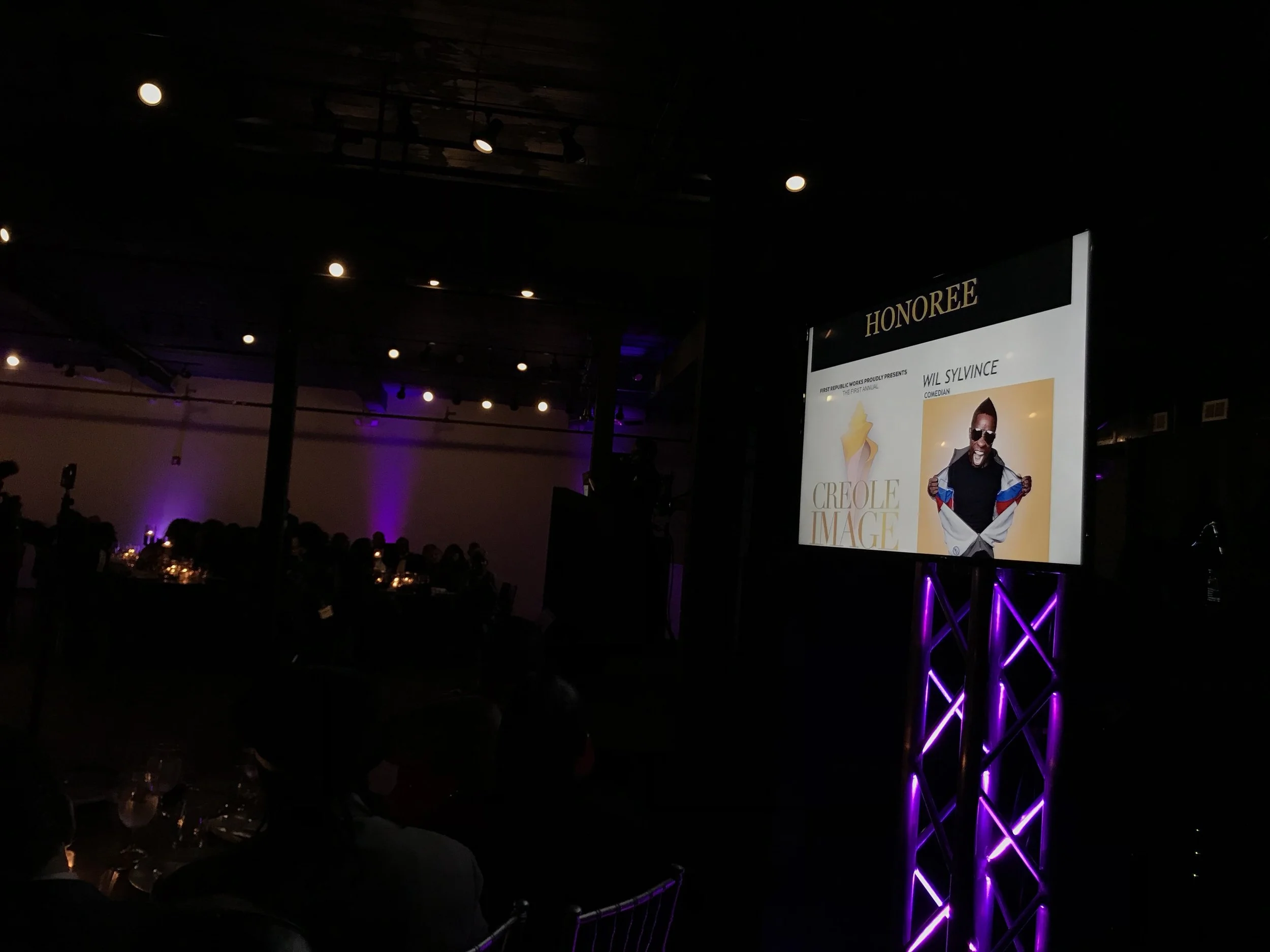
The First Annual Creole Image Honors
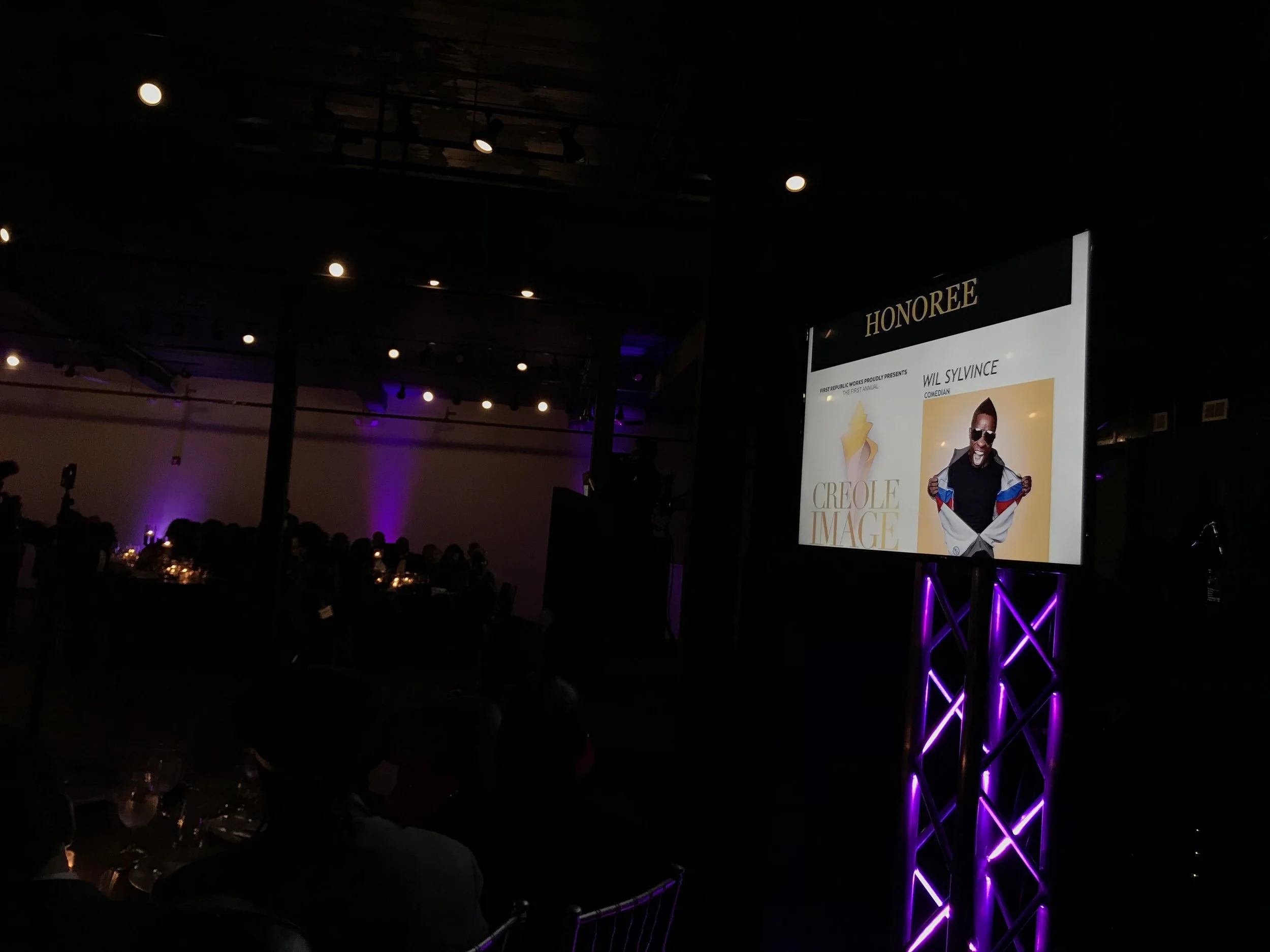
“Honneur… Respect...”
The Red Carpet was a buzz as Honorees and known personalities within the Haitian community came together to recognize and celebrate the noteworthy achievement of ten distinguished members of our community.
On Sunday October 8, 2017, Creole Image held its First Annual Honors ceremony. The event took place in Passaic, NJ and celebrated the achievements of Haitians/Haitian-Americans in Film, Art, Music, the Sciences and Public Service. The event was founded by, Nafeeza Holder and Fred Raphael, was presented by First Republic Works to honor pathfinding Haitians dedicated to uplifting the Haitian culture and shedding a positive light on the country and its people.
 Inspirational speaker and social service advocate, Stanley Neron hosted the ceremony with Haitian-American singer/songwriter Sybelle. Highlights from the evening included a moving and inspirational speech by Betty Jean. Ms. Jean, a breast cancer survivor, spoke of her journey and how it led to the work she currently focuses on to empower women and children. Honorees, Judge Sibyl M. Elias and Kangol Kid, referenced the trials of growing up Haitian in America during the 1980s, moving past the stereotypes and achieving their dreams. Each speech echoed the strength of the Haitian people and the sense of responsibility each felt to pay homage to the legacy of our forefathers.

 The Honorees:* Kervin Andre (@akomicsart) a gifted visual artist is recognized for his brand, AkomicsArt. He is known for showcasing Haiti’s rich history and culture through his work.* Doctor Ruth Celestin is a certified and nationally recognized plastic surgeon located in the Cobb County, GA area. She was born in New York and earned her medical degree at New Jersey Medical School.* Joseph M. Champagne is a Haitian attorney and former Mayor of Toms River, NJ. Mr. Champagne (@chamoagnehjoseph) focuses on immigration and family law.* Chef Stephan Durand (@haitianchef) is an award winning and highly acclaimed Chef and Culinary Ambassador. He is dedicated to bringing attention to the riches of Haiti’s gastronomy.* Honorable Judge Sibyl M. Elias is a Haitian Judge, presently serving as a judge on the East Orange Municipal Court. She became the first ever Haitian-American Jurist to sit on the Municipal Court in NJ.* Grammy nominated singer, songwriter and composer Melky Jean (@therealmelkyjean). Ms. Jean is the founder of Carma Foundation, an organization focused on helping women and children in Haiti.* Hip-Hop artist Kangol Kid (@yokangol). Kangol and his group U.T.F.O are best known for their Top 10 hit “Roxanne, Roxanne.”* Bergson Leneus (@haitianking80) is a Haitian-American property manager and community leader in the City of East Orange, NJ.* Carel Pedre (@carelperde) is a Haitian radio and tv personality. He is well known for his work as host of Radio One’s @chokarella.* Haitian comedian Wil Sylvince (@wilsylvince) is known around the world from his appearances on SHOWTIME, HBO’s DEF COMEDY JAM and COMEDY CENTRAL.Honorable Mentions:* Betty Jean is a NJ Licensed Counselor focused on helping women and children move from broken to healed.* The Federation Haitienne de Basketball (FHB)/Haitian Basketball Federation founded in 1951 is a non-governmental, non-profit organization with a goal to developing the game of Basketball in Haiti.
 Honorees enjoyed a big evening as they were entertained by singer (and host) Sybelle, singer Mickaelle Cartright and violinist Bri Blvck. Accompanied by IETBand, singer Anie Alerte had the guests on their feet as she opened the Creole Image after party.
 The event was planned and beautifully curated by Mimi Planned Events, Weddings by Natasha and Points of Creation Events. Public Relations was handled by SK Public Relations and the media sponsor for the First Annual Creole Image Honors was YAC Radio, Inc.It was an amazing evening filled with beautiful speeches and wonderful accolades. It’s genius that Creole Image was established to honor distinction in a sometimes unrecognized but overly deserving community. The talents of Haitians, in a host of industries, can now be applauded in an annual celebration. Without a doubt, we look forward to next year’s ceremony and a new class of Honorees.********Event Sponsors: Aella Gold Kremas, Dnalsi, Vodkila, McKayla Studios, Lori Diamond, Who's Styling Who, Music Speaks Power, and Gil Rios Productions.
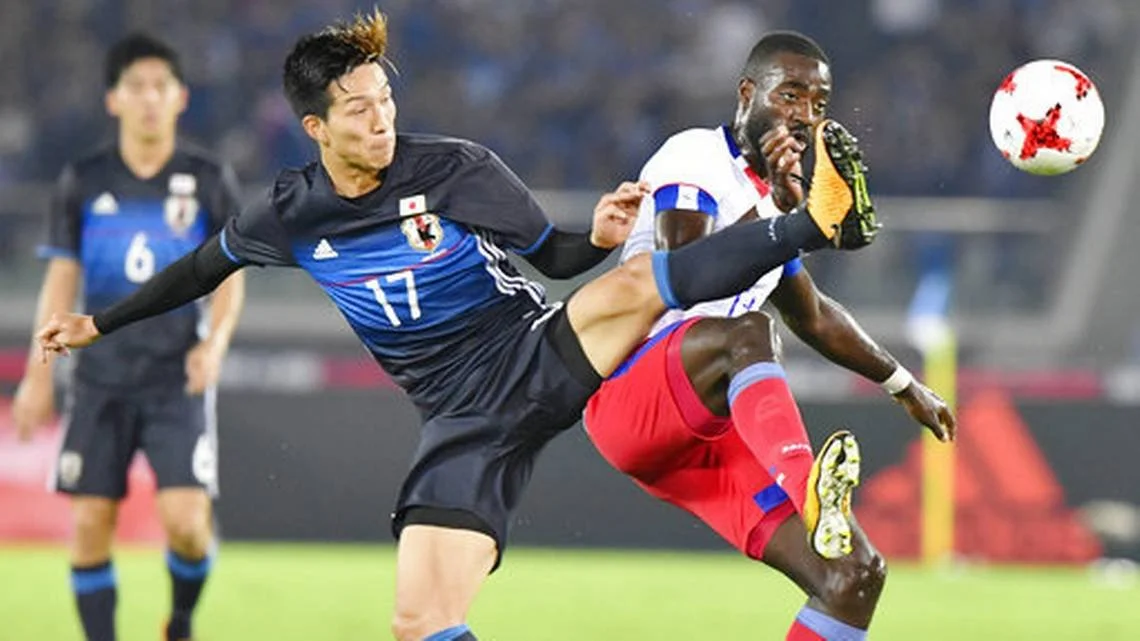
Kagawa scores late goal as Japan draws 3-3 with Haiti
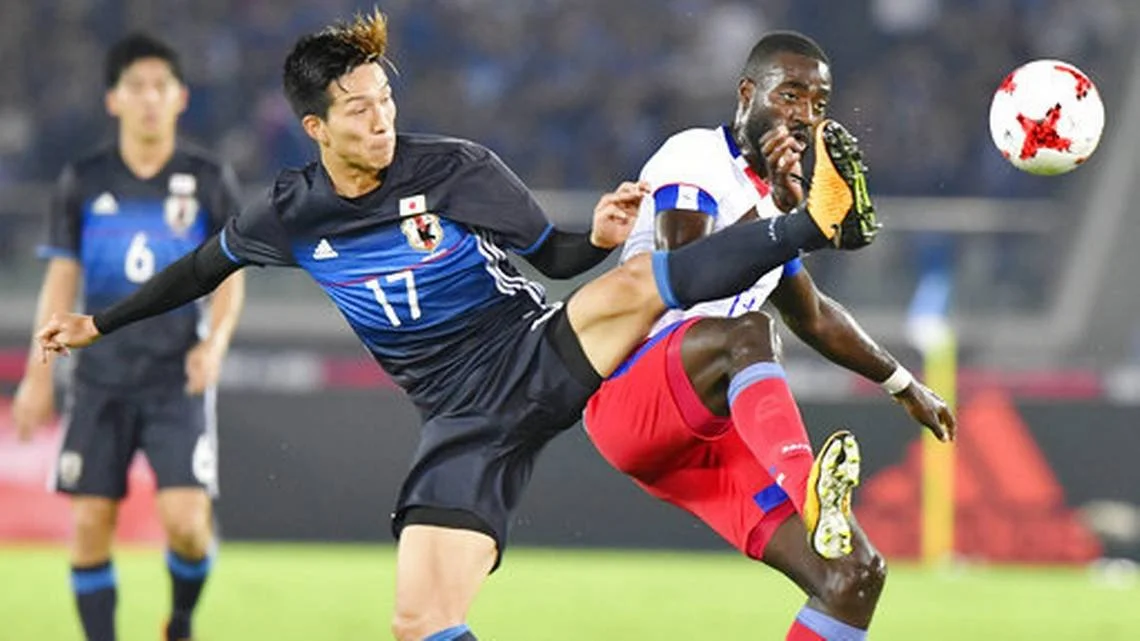
YOKOHAMA, JAPAN